Home Blog Page 4398

Gov’t to borrow P180B from local mart in Sept.

THE NATIONAL Government (NG) plans to borrow P180 billion from the domestic market in September, the Bureau of the Treasury (BTr) said on Wednesday.

The September borrowing plan is 20% lower than the P225-billion program for August. However, it is a tad higher than the actual P179.17 billion raised by the government this month.

According to the BTr, the government plans to borrow P60 billion from T-bills, and P120 billion via T-bonds in September.

Broken down, the government will offer P5 billion worth of 91-day, 182-day, and 364-day T-bills on Sept. 4, 11, 18 and 25.

For the long-term tenors, the BTr will offer P30 billion in three-year T-bonds on Sept. 5 and P30 billion in seven-year T-bonds on Sept. 12.

It will auction off P30 billion in 10-year T-bonds on Sept. 19, and P30 billion in three-year bonds on Sept. 26.

ING Bank N.V. Manila Senior Economist Nicholas Antonio T. Mapa said the September borrowing plan is still in line with the overall program.

“Rates will still likely take their cue from global bond movements and the outlook for domestic inflation,” he said in a Viber message.

Headline inflation slowed for a sixth straight month to 4.7% in July from 5.4% in June. For the seven-month period, inflation averaged 6.8%, still above the central bank’s 5.6% forecast.

The Philippine Statistics Authority will release the consumer price index data for August on Sept. 5.

“BTr appears to have a strong cash position and with inflation moderating we could see rates edge lower due to domestic factors. This, however, can always be superseded by global developments should US Treasury yields rise if US data prints on the upside,” Mr. Mapa said.

Yields in the secondary market and benchmark US Treasury will likely continue to ease in September amid expectations of a pause at the US Federal Reserve’s next meeting, Rizal Commercial Banking Corp. Chief Economist Michael L. Ricafort said in a Viber message.

Reuters reported Treasury yields slid to three-week lows on Tuesday but were stable in Asian hours. The two-year yield, which typically moves in step with interest rate expectations, was up 3.3 basis points at 4.923%, easing away from the three-week low of 4.871% it touched on Tuesday.

Markets are pricing in an 89% chance of the Fed standing pat at its meeting next month, the CME FedWatch tool showed, and are now pricing in a 50% chance of another pause at the November meeting compared with a 38% chance a day earlier.

The government’s gross domestic borrowing program this year is set at P1.654 trillion, composed of P54.1 billion in T-bills and P1.6 trillion in fixed-rate T-bonds.

The government borrows from local and external sources to help fund a budget deficit capped at 6.1% of the gross domestic product this year. — AMCS with Reuters

Maharlika fund allowed to invest in JVs, infrastructure projects

A Philippines peso note is seen in this picture illustration on June 2, 2017. — REUTERS

THE MAHARLIKA Investment Corp. (MIC), which will manage the country’s first sovereign wealth fund, can invest in joint ventures (JVs), infrastructure projects, and sustainable development programs, as well as extend loans.

Under the implementing rules and regulations of Republic Act No. 11954 or the Maharlika Investment Fund (MIF) law, the MIC can invest in joint ventures or co-investments, mergers and acquisitions; and mutual and exchange-traded funds invested in underlying assets.

The MIC can also invest in real estate and infrastructure projects. However, investments in infrastructure projects should be “directed towards the fulfillment of national priorities such as the national infrastructure program of the Department of Public Works and Highways and other infrastructure agencies, the inclusive innovation industry strategy of the Department of Trade and Industry, and the public investment programs of the National Economic and Development Authority.”

Investments in real estate should also be limited to “high-impact projects, those contained in the Strategic Investment Priority Plan, as well as other projects that are approved by the appropriate approving body to ensure that these are in line with the socioeconomic development program of the government.”

The MIC can also pour funds into health, education, research and innovation projects, as well as sustainable development programs.

It can extend “loans and guarantees to, or participation into joint ventures or consortiums with Filipino and foreign investors, whether in the majority or minority position in commercial, industrial, mining, agricultural, housing, energy, and other enterprises, which may be necessary or contributory to the economic development of the country, or important to the public interest.”

The board of directors must also make sure that allowable investments are in line with the “principle of sustainability.”

The MIC is also authorized to invest in cash, foreign currencies, metals, and other tradable commodities; fixed-income instruments issued by sovereigns, quasi-sovereigns and supranationals; domestic and foreign corporate bonds; listed or unlisted equities, whether common, preferred, or hybrids; and Islamic investments, such as Sukuk bonds.

BOARD OF DIRECTORS
Meanwhile, the list of nominees for the MIC’s president and chief executive officer (CEO), regular directors, and independent directors must be presented to the President by October.

“The solicitation of nominees and applications, for purposes of initial appointment, may be made immediately upon the publication of the IRR, the closing date of which shall not exceed 15 days from the effectivity of the IRR,” it said. The IRR will take effect on Sept. 12.

Under the rules, the MIC president and CEO must have an advanced degree (MBA, MA, MSc, PhD) in finance, economics, business administration, or any related field from a reputable university.

The MIC president and CEO must also show “exceptional experience and expertise in corporate management, financial planning strategy, strategic planning and vision, market and business development, budget development,” and have work experience in a finance or investment-related field for at least 10 years.

A minimum of 10 years in a senior leadership role in a “reputable financial institution or public or private sector organization” is also required.

The president and CEO will direct and supervise the operations and internal administration of the MIC. They will also be charged with the risk management, financial performance, human resources, as well as the accounting and legal affairs of the MIC.

Meanwhile, regular directors must be Filipino citizens, at least 35 years old and must be of “good moral standing and reputation, of recognized probity and independence and have substantial experience and expertise in corporate governance and administration, investment in financial assets, and/or management of investments in the global and local markets.”

The independent directors must have “probity, competence, expertise and experience in finance, economics, investments, business management, or law, and are highly capable to contribute to the attainment of the objectives and purposes of the MIF.”

Both regular and independent directors are required to have a master’s degree in finance, economics, business administration. They must also have at least 10 years of experience in finance, investments, economics, business, or any related field. — Luisa Maria Jacinta C. Jocson

SEC renews call for erring firms to seek amnesty

THE SECURITIES and Exchange Commission (SEC) reminded corporations and associations to avail of its amnesty program until Sept. 30 to avoid higher fees and penalties.   

“With fees and penalties increasing on October 1, the SEC strongly encourages companies to regain their good standing with the commission and take advantage of the lower fines offered by the program,” the corporate regulator said in a statement on Wednesday. 

Noncompliant corporations are only required to pay P5,000 for failure to submit their general information sheet (GIS), annual financial statement (AFS), or Memorandum Circular (MC) No. 28 report, regardless of the number of years of non-submission, under SEC MC No. 2 issued on March 15 that launched the amnesty program.

Suspended or revoked corporations only need to pay half of their total fines and penalties, plus the petition to lift the order of suspension/revocation fee of P3,060, subject to the submission of additional documents. 

The SEC previously extended the amnesty program to Sept. 30 from the initial deadline of June 30.   

“The SEC amnesty program is a chance for corporations and associations to get a fresh start in their compliance with reportorial requirements, so they continue to enjoy the benefits and privileges of being a registered corporation,” SEC Chairperson Emilio B. Aquino said. 

“Since the amnesty program’s launch in March, we have made it our mission to encourage as many companies as we can to avail, since we know this is a huge financial relief for our registered corporations,” he added.

According to the SEC, the amnesty program prods more companies to comply with the law, maintain the integrity of the capital market, as well as update the commission’s database for the benefit of the investing public.

“Registration with the SEC marks the first step toward legitimately setting up a corporation in the Philippines. This entails certain duties and responsibilities in order to maintain a good standing with the commission, including compliance with reportorial requirements provided under Republic Act No. 11232, or the Revised Corporation Code of the Philippines,” the SEC said. 

“The amnesty program is also an opportunity for companies to regain their good standing, return to their normal operations, and gain the trust of potential investors,” it added.

On June 30, the SEC fast-tracked the amnesty process as companies only need to answer a web-based form on the electronic filing and submission tool (eFAST) account.

Meanwhile, the SEC said the amnesty program also serves as a buffer as the commission finalizes the guidelines that will impose higher penalties for noncompliance with reportorial requirements.

The proposed fines and penalties are about 90% higher than the existing scale.

Based on proposed guidelines, the late filing of reportorial requirements by domestic stock and nonstock corporations with retained earnings of less than P100,000 will be fined a base amount of P5,000 for the first offense. The fine could increase up to P9,000 for the fifth offense. A P1,000 monthly fine will also be imposed for every month of the continuing violation.

The draft guidelines also provide that the non-filing of reportorial requirements by both stock and nonstock corporations with retained earnings of less than P100,000 will face fines worth P10,000 for the first offense up to P18,000 for the fifth offense, as well as an additional monthly fine of P1,000 per month of the continuing violation.

“Moreover, should a company fail to submit its reportorial requirements for three consecutive times or intermittently within five years, the SEC may declare said company under delinquent status,” the regulator said.

If a company has incurred a fourth offense, the commission may also revoke its registration “given that the company is sent a reasonable notice regarding its delinquent status prior to the revocation,” it added. — Revin Mikhael D. Ochave

Motorcycle sales seen to reach 1.6M this year

MDPPA

MOTORCYCLE sales are expected to hit 1.6 million this year for an estimated growth of 6.7% from the 1.5 million units sold last year, according to the Motorcycle Development Program Participants Association (MDPPA).

“MDPPA conducted a comprehensive review of its sales targets for the balance year. Unanimously, its members agreed to achieve a modest yet steady 5% growth rate for motorcycle sales from August to December,” the group said in a press release on Wednesday.

In the seven months ended July, motorcycle sales rose by 4.6% to 932,220 units from 890,720 units in the same period last year, data from MDPPA showed.

MDPPA President Norminio Mojica said the sales performance as of July could potentially be mirrored in the remaining months of the year.

“Drawing from historical trends, the months of September, October, and November have consistently exhibited heightened sales volumes, whereas the months of August and December have maintained an average profile in terms of monthly sales,” he said.

However, MDPPA said the projected growth for the remainder of the year could be significantly affected by foreign and local economic factors.

“Elements like rising prices and the lingering impacts of the pandemic, such as supply chain issues and a mix of rise on in-person and remote work setups, have contributed to a situation of slower growth,” the group said.

Data from the ASEAN Automotive Federation showed that first-semester local motorcycle and scooter sales rose by 4.6% to 798,366 units from 763,117 units last year.

Meanwhile, cumulative production in the Philippines during the period reached 694,946, up 57.4% from the 441,484 units produced in the same period in the previous year.

MDPPA is composed of manufacturers of the industry’s prominent brands, namely: Honda, Kawasaki, Suzuki, and Yamaha. — Justine Irish D. Tabile

Yields on term deposits decline as markets expect policy easing

Bangko Sentral ng Pilipinas main office in Manila. — BW FILE PHOTO

YIELDS on the Bangko Sentral ng Pilipinas’ (BSP) term deposits dropped on Wednesday amid lower US Treasury rates and expectations of monetary policy easing next year.

Demand for the BSP’s term deposit facility (TDF) amounted to P279.725 billion on Wednesday, lower than the P280-billion offer and the P318.596 billion in tenders seen a week earlier for the same amount on the auction block.

BSP Deputy Governor Francisco G. Dakila, Jr. said in a statement on Wednesday that the market preferred the shorter tenor in the central bank’s term deposit facility this week.

“Only the 7-day tenor was oversubscribed, with the respective bid-to-cover ratios for the 7-day and 14-day tenors at 1.0664x and 0.9092x,” Mr. Dakila said.

The seven-day term deposits fetched bids amounting to P170.616 billion, surpassing the P160 billion auctioned off by the BSP but below the P179.347 billion in tenders logged the previous week.

Accepted rates for the tenor ranged from 6.56% to 6.6%, a tad wider than the 6.578% to 6.6% band logged a week ago. This caused the average rate of the one-week deposits to slip by 0.34 basis point (bp) to 6.5902% from 6.5936% previously.

Meanwhile, demand for the two-week deposits amounted to P109.109 billion, below the P120-billion offer as well as the P139.249 billion in bids seen in the previous auction.

Banks asked for yields from 6.57% to 6.62%, slightly wider than the 6.5780% to 6.61% range seen last week. This caused the average rate of the paper to dip by 0.16 bp to 6.5984% from the 6.6% quoted on Aug. 23.

The BSP has not auctioned off 28-day term deposits for more than two years to give way to its weekly offerings of securities with the same tenor.

The term deposits and the 28-day bills are used by the central bank to mop up excess liquidity in the financial system and to better guide market rates.

“The results of today’s TDF auction reflected market participants’ lingering preference for the shorter tenor amid the need to attend to client requirements,” Mr. Dakila said.

“Looking ahead, the BSP’s monetary operations will continue to be guided by its assessment of prevailing liquidity conditions and market developments,” he added.

TDF yields were slightly lower on Wednesday as US Treasury yields slumped on Tuesday, Rizal Commercial Banking Corp. Chief Economist Michael L. Ricafort said in a Viber message.

The two-year US Treasury yield went down by 18 bps to 4.871% on Tuesday, before recovering to around 4.91% in Asian trading hours, Reuters reported.

The 10-year yield inched up to 4.1354% from Tuesday’s low of 4.106%.

TDF yields were lower as market players expect the Monetary Board to cut policy rates in the first quarter of 2024, Mr. Ricafort added.

BSP Governor Eli M. Remolona, Jr. earlier said the central bank remains hawkish, and rate cuts are far off as inflation is still elevated.

The Monetary Board kept benchmark interest rates steady for a third straight meeting this month, leaving its key policy rate unchanged at a near 16-year high of 6.25%.

The central bank raised borrowing costs by 425 bps from May 2022 to March 2023 to tame inflation.

The BSP will hold its next policy meeting on Sept. 21. — Keisha B. Ta-asan with Reuters

Stakeholders’ comment sought on proposed eSECURE platform  

THE Securities and Exchange Commission (SEC) is seeking comments from stakeholders on a proposed memorandum circular covering its electronic SEC universal registration environment (eSECURE) platform.

The eSECURE is a platform that allows users to manage their SEC account and online transactions in one place, the commission said in the proposed circular posted on Aug. 29.

“The eSECURE creates a digital passport of an individual which grants the user access to the different online services provided by the commission,” it said.

According to the proposed circular, individuals seeking to use eSECURE are required to create an account to improve the security of online transactions with the commission. 

The SEC added that a credentialing process or electronic know-your-customer (eKYC) is needed for sensitive and critical services where verification and establishment of the user’s identity is required.

“It enables risk-based credentialing procedure. At the basic level, it implements repeatable eKYC to determine authenticity of identity and establish reachability of persons transacting online with the Commission. At higher levels, other identity verification methods such as courier-based customer visit and remote retail on-customer-premise biometrics capture may be implemented,” the SEC said.

The SEC added that a P400 fee will be charged for initiating the credentialing process for the first time, while a P100 fee will be paid when the user initiates another credentialing process due to information changes, and a P250 fee will be paid for the renewal of the credentialing account.

Once an account is created, the user will have access to online services such as the SEC electronic simplified processing of an application for company registration, one-day submission and e-registration of companies, automated certification examination system, and electronic SEC education, analysis, and research computing hub.

Other services that could be accessed by the user include the SEC application program interface marketplace. SEC electronic registry application for market participants, SEC eFAST alternative submission environment, SEC amendment system, SEC appointment system, and SEC iMessage.

“The commission reserves the right to cancel any account, without prior notice, which has been found to have violated any of the terms of service or to have engaged in the conduct of inappropriate activities using the eSECURE account,” the SEC said.

It said a canceled account will no longer be allowed to log in and use the online services of the commission. An account can no longer be reactivated once it is canceled,” it added.

Comments on the proposed draft circular may be submitted to the SEC on or before Sept. 8. — Revin Mikhael D. Ochave

Discovery World adds residential subdivisions to product portfolio

LISTED hotel and resort operator Discovery World Corp. has amended its corporate purpose in a bid to expand its product portfolio.

In a stock exchange disclosure on Wednesday, Discovery World said that it included the development of “residential subdivisions” on the company’s primary purpose under its articles of incorporation to expand its portfolio and boost revenue streams.

Aside from the primary purpose, Discovery World said amendments were also made under its secondary purpose to expand the means by which the company could raise new funds to meet financial requirements.

The secondary purpose also explicitly provides the power of the corporation to apply and own trademarks, and authorize others to use the same.

Discovery World said in a separate disclosure that the Securities and Exchange Commission (SEC) also approved amendments to its articles of incorporation to include Terra Spa as a business name. The spa is located within Discovery Shores Boracay.

The regulator also approved the conversion of 265 million common shares from the company’s unissued capital stock into preferred shares.

Discovery World said the conversation is being undertaken “in consideration of a possible capital raising exercise that will be conducted by the company in the future.”

Meanwhile, Discovery World said in another disclosure that it amended its articles of incorporation to include its secondary purpose of being engaged in the business of dealing in foreign exchange transactions. 

“The corporation wishes to include in its services the exchange of currencies for its hotel guests,” Discovery World said. 

The company said the SEC approved the various amendments on Aug. 23.

Discovery World has several facilities across the country including Discovery Shores Boracay, Club Paradise Palawan, Discovery Suites, Discovery Primea, Manami, and Discovery Samal.

Shares of Discovery World at the local bourse were last traded on Aug. 24 when they finished at P1.29 apiece. — Revin Mikhael D. Ochave

Gov’t fully awards reissued T-bonds

BW FILE PHOTO

THE GOVERNMENT made a full award of the reissued 10-year Treasury bonds (T-bonds) it auctioned off on Wednesday at a lower average rate as the Bangko Sentral ng Pilipinas (BSP) is expected to keep borrowing costs steady for the rest of the year.

The Bureau of the Treasury (BTr) raised P30 billion as planned from the reissued 10-year bonds on Wednesday, with total bids for the offer reaching P54.542 billion.

The bonds, which have a remaining life of five years and four months, were awarded at an average rate of 6.22%, with accepted yields ranging from 6.15% to 6.25%.

The average rate of the reissued bonds was 54 basis points (bps) lower than the 6.76% quoted for the papers when they were last offered on July 12, 2022. It was likewise 65.5 bps below the 6.875% coupon for the series.

The average rate was also 3.7 bps lower than the 6.257% quoted for the five-year bond and 3.4 bps below the 6.254% seen for the same bond series at the secondary market before Wednesday’s auction, based on PHP Bloomberg Valuation Service (BVAL) Reference Rates data provided by the Treasury.

“The Auction Committee fully awarded the reissued 10-year Treasury Bonds at today’s auction. With a remaining term of five years and four months, the reissued bonds (FXTN 10-64) fetched an average rate of 6.22%, lower than the original coupon rate of 6.875% set on its original issuance in January 2019 and current secondary market benchmark rates,” the BTr said in a statement on Wednesday.

“The auction attracted P54.5 billion in total tenders, 1.8 times the P30 billion offer. With its decision, the committee raised the full program of P30 billion, bringing the total outstanding volume for the series to P325 billion,” it added.

The bonds were awarded at a lower average rate amid “expectations of steady BSP policy rates in the near-term,” a trader said in an e-mail.

BSP Governor Eli M. Remolona, Jr. last week said the central bank’s stance remains hawkish, with rate cuts unlikely for the rest of the year, as inflation is still elevated.

The Monetary Board kept benchmark interest rates steady for a third straight meeting this month, but said it is prepared to resume tightening if needed amid risks to inflation.

The BSP this month left its overnight reverse repurchase rate unchanged at a near 16-year high of 6.25%. Interest rates on the overnight deposit and lending facilities were maintained at 5.75% and 6.75%, respectively. 

The central bank raised borrowing costs by 425 bps from May 2022 to March 2023 to tame inflation.

The Monetary Board will hold its next policy meeting on Sept. 21.

T-bond rates also tracked the drop in benchmark US Treasury yields, Rizal Commercial Banking Corp. Chief Economist Michael L. Ricafort said in a Viber message.

US Treasury yields retreated after a sharp fall in US job openings increased the likelihood of a US Federal Reserve rate hike pause, Reuters reported.

Benchmark 10-year notes last rose 24/32 in price to yield 4.1178%, down from 4.212% late on Monday.

The Fed raised borrowing costs by 25 bps last month, bringing its target rate to a range between 5.25% and 5.5%.

It has hiked rates by a cumulative 525 bps since it began its tightening cycle in March last year.

The US central bank will hold its next policy review on Sept. 19-20.

Wednesday’s T-bond offering was the last for the month. The BTr raised P110.235 billion from the long tenors, short of the P150-billion program.

The government borrows from local and foreign sources to help fund its budget deficit, which is capped at 6.1% of gross domestic product this year. — A.M.C. Sy with Reuters

Cybersecurity should be part of schools’ curriculum — Kaspersky

FREEPIK

CYBERSECURITY must be included in the Philippines’ basic education curriculum as a first line of defense, an official of global cybersecurity firm Kaspersky said.

This can also help improve the government’s prioritization and budget for cybersecurity amid increasing threats, Adrian Hia, Asia Pacific managing director at Kaspersky, said in an interview with BusinessWorld on the sidelines of the company’s Asia Pacific Cybersecurity Weekend in Bali, Indonesia last week.

“The better way to get the attention of the Philippines and its government is to start with education at the basic level,” Mr. Hia said. “In high school or lower, just have one module on cybersecurity.”

“To do many big things like SIM registration… whether you like it or not, it will take time,” he added. “Everybody will try, but if you choose to click on a malicious link, what can we do?”

Mr. Hia said basic cybersecurity education can increase government awareness and public understanding about emerging threats.

Kaspersky said the Philippines was the second most attacked country by web threats last year, with 39,387,052 internet-borne cyber threats detected. The country placed fourth in 2021.

The Philippines also saw 2,409,085 brute force attacks (trial and error) among remote workers, 52,914 financial phishing cases among business, 24,737 crypto-phishing cases, 15,732 mobile malware cases, and 50 mobile banking Trojan cases last year, according to data from Kaspersky.

Mr. Hia noted that companies’ spending for cybersecurity has not gone up despite them ramping up their digitization efforts.

“What we analyze as the problem is that bad people are thinking, ‘Why do we need to rob a bank? Just do cybercrime. I get the same amount of money,’” he said. “Nobody is bringing up their cyber defenses, so that’s the easiest way.”

“This is unfortunately something we need to be wary about.”

Less than 25% of mobile devices in the Philippines are protected, Mr. Hia said, citing data from Kaspersky.

Hackers and fraudsters have shifted to attacking mobile phones from personal computers via scams on messaging apps due to the vulnerability of those devices, he said.

“This is where the hackers are really intelligent nowadays, and we can see that shift,” he said.

“Educate to not click on links unless it is from a trusted channel,” Mr. Hia said. “It’s really that resilience to navigate the digital world safely and responsibly.”

Alongside protection software, good cyber hygiene habits at a young age can also help curb threats, he added.

Kaspersky will hold its Kids’ Cyber Resilience project in the country in partnership with the Department of Education on Sept. 15, which will involve public school teachers in Valenzuela City.

“We will be helping educators learn about the basics of cyber hygiene, get familiar with Kaspersky’s free tools and resources for teaching online safety in the classroom, and how to support kids to become cyber resilient,” Mr. Hia said. — Miguel Hanz L. Antivola

Leaving on a jet plane

PHILSTAR FILE PHOTO

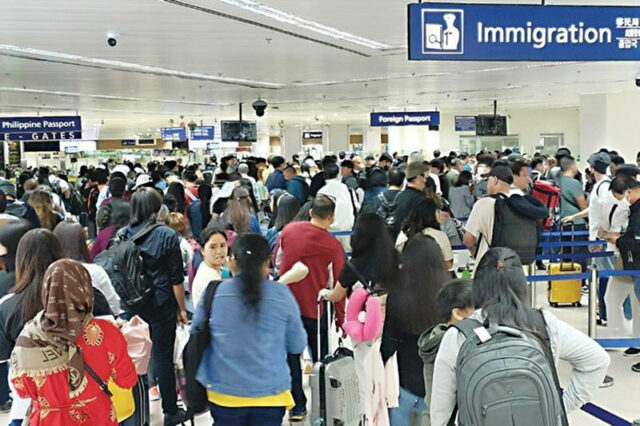
The Department of Justice released recently its updated list of requirements for people traveling abroad either for leisure or work. The “new” travel guidelines, which take effect Sept. 3, are obviously causing some ripples. The concern is that these requirements are unnecessary if not illegal “restrictions” on the right to travel.

Moreover, with travelers being made to disclose to immigration officers more information than they normally would, then the new guidelines also raise some concern regarding privacy. Among the requirements being questioned is the need to disclose proof of financial capacity either through an employment or bank deposit certificate, or other proof of income.

These are documents that an ordinary traveler, for tourism, would not normally carry on his person when leaving. In fact, going over the new list of travel requirements, they seem more like the type of information required for a visa application, and not from outbound passengers at immigration counters at the airport.

In my 45 years of travel, I do not recall my parents (when I was a minor) or myself (as an adult and a parent) ever having to prove financial capacity or proof or income at immigration counters during departure. Not even on arrival in destinations abroad, for that matter. It was required for all visa applications, but never at immigration counters either at departure or arrival.

I have traveled mainly for tourism or press work abroad, or to attend conventions and seminars. I have never departed as an immigrant or as an overseas Filipino worker. So, I may feel differently about being asked certain information by immigration officers. To date, I have never had any issue with Immigration at departure or arrival. So far.

Offhand, the new travel guidelines appear to impose unnecessary bureaucratic hurdles on leisure travelers and those going on work-related short trips. Some quarters are likewise concerned that the new requirements just create new “corruption” opportunities for immigration officers or give corrupt officers the reason to ask for bigger bribes from syndicates.

Cagayan de Oro City Representative Rufus Rodriguez, a former Immigration commissioner, said the “more stringent rules will unduly interfere with the Filipinos’ right to travel.” He told media that requiring proof of financial capacity, like a bank statement or proof of income, would also violate a departing passenger’s right to privacy.

The Mindanao lawmaker added that the new requirements would also allow immigration officers “to exercise ‘subjective judgment, whims and discretion’ on departing passengers,” claiming that this is where “extortion, harassment and corruption will arise.” For Senator Risa Hontiveros, “Filipinos traveling out of the country should not be treated as second-class citizens within our own airports.”

In April, CNN Philippines reported that the Bureau of Immigration recorded about 6,000 cases of suspected human trafficking, illegal recruitment, and misrepresentation in January and February. The bureau’s spokesman also claimed that incidents of human trafficking and illegal recruitment occurred in a daily basis.

But as potential cases got flagged at immigration counters at various airports, the Immigration official also said only 0.6% of total departing passengers in January-February were “offloaded” due to suspicion of human trafficking, illegal recruitment, and misrepresentation. Meantime, a few immigration officers are also under investigation for suspicion of corruption.

However, according to Justice Assistant Secretary Mico Clavano, from Jan. 1-May 15, of over 39,000 referrals for secondary inspection at immigration counters, over 25,000 passengers were allowed to leave but about 14,000 were deferred or held back. If these figures are accurate, then it means about 35% of departing passengers were not allowed to leave and not just 0.6%.

I am uncertain as to which figures truly represent the current situation. However, without doubt, many Filipinos are being lured to apply for jobs abroad but end up in illegal activities. Not too long ago, about 200 Filipinos were reportedly recruited to work in Thailand but were later found being part of cybercurrency syndicates in Myanmar.

I believe all efforts to combat human trafficking should be supported. But such efforts, including the new travel guidelines, should be calibrated to be more effective. And they should be communicated clearly to the public. Perhaps this is where the Immigration bureau is falling short. It needs to clearly communicate the “red flags” for travelers.

In fairness to Immigration, it makes some distinction between those frequently traveling vs first-time travelers. Obviously, track record is important. It also makes the distinction between those traveling for leisure and for overseas work. Moving forward, it should clarify these distinctions and guide travelers accordingly.

The basic requirements for leisure travelers remain the same: a passport valid at least six months from date of departure; an appropriate valid visa whenever required; a boarding pass; and a confirmed return or roundtrip ticket when necessary. In the past, the return ticket was not usually presented at immigration counters. A passport and boarding pass and departure card were enough (prior to pre-submission of electronic embarkation card).

For self-funded tourists, the new guidelines now require the presentation of the confirmed return or roundtrip ticket; proof of hotel booking or accommodation; financial capacity or source of income consistent with the declared purpose of travel; proof of employment and other equivalent document. And, of course, embarkation details submitted through the eTravel portal.

And for minors traveling with parents, the parents will also need to present their children’s original Philippine Statistics Authority (PSA)-issued birth certificates or reports of birth; and, if the minor is traveling without the mother, the original copy of PSA-issued marriage certificate of the parents. Other conditions require other additional requirements, including clearances from the Department of Social Welfare and Development.

Given the many categories of travel, travelers are well-advised to check the new guidelines and to secure the necessary requirements ahead of time. This entails effort and resources, obviously, and possibly time off work to secure necessary documents. And given that these may have to be presented at initial or secondary inspection at immigration, then expect delays at the airport.

In a recent trip out, I recall having filled out a departure card online through the eTravel portal. If I recall, since May, Immigration has done away with paper-based departure cards. Although one still needs to go through Immigration counters before departure. The thing is, the eTravel portal already made travel easier. The electronic counters on arrival are also a big help.

With recent developments in air travel, it seems the new Immigration guidelines are out of sync as they make travelers bring along more “documents” instead of less. Worse, the new guidelines require additional trips to other government agencies or banks to secure requirements. All the hassle results in expenses that unnecessarily raise the cost of travel, not to mention time lost.

It is bad enough that airports still suffer from congestion. Good thing the X-rays at entrances have already been removed. And check-in and baggage drop-off processes are being streamlined. But final security check remains a hurdle with ever-changing rules regarding X-rays, shoes and belts, and electronic devices. For the sake of departing passengers, immigration should not be another sore point of travel.


Marvin Tort is a former managing editor of BusinessWorld, and a former chairman of the Philippine Press Council

matort@yahoo.com

New law requires LGUs to do cultural mapping

OLD HOUSE located in Iloilo City —UPLOAD.WIKIMEDIA.ORG

ALL local government units (LGUs) are now required to survey and map out all the culturally important areas in their jurisdictions, according to the newly enacted Cultural Mapping Act.

Republic Act (RA) 11961, or the Cultural Mapping Act, which was enacted last week, mandates LGUs to conduct comprehensive cultural mapping of their areas of jurisdiction for both tangible and intangible, and natural and built heritage. It is an amendment of RA 10066, or the National Cultural Heritage Act of 2009, that places focus on the role of LGUs in promoting and preserving Filipino culture through cultural mapping and heritage education projects.

On Aug. 25, Malacañang released a copy of the new law, which aims to “strengthen the conservation and protection of Philippine cultural heritage through cultural mapping and an enhanced cultural heritage education program.”

“The institutionalization of cultural mapping was sought to make heritage an inclusive tool for local and national development,” said Senate President Pro-Tempore Lorna Regina “Loren” Legarda, who co-authored the measure, in a statement.

“[Cultural mapping] employs a grassroots approach that empowers local communities to identify and assign cultural value to properties that are important to them,” she said.

The Act was passed in the Senate and House of Representatives in May this year, and President Ferdinand R. Marcos, Jr. signed it into law in August.

ASSISTANCE AND COMPLIANCE
Under the Cultural Mapping Act, the National Commission for Culture and the Arts (NCCA) and other cultural agencies must provide technical and financial assistance to LGUs so that they can comply with the cultural mapping mandate.

Already in place are Local Cultural Inventories (LCI), one of the criteria for an LGU to qualify for a Seal of Local Good Governance. After completing this, they must also submit their cultural mapping reports.

According to NCCA Chairperson Victorino Manalo, 980 of the 1,715 LGUs around the country have complied with the submission of LCIs, but only 98 LGUs have submitted cultural mapping reports while 177 are currently in progress.

As of December 2022, the total number of properties registered with the Philippine Registry of Cultural Property (Precup), including those registered by the cultural agencies, was 10,385.

Many heritage advocates welcome the new law.

The act addresses one crucial part of the entire problem — the strategy on registry and proper mapping, Escuela Taller de Filipinas Foundation’s communications and special projects officer Philip Paraan told BusinessWorld. Escuela Taller trains young people in the specialized skills that are needed to restore and conserve heritage structures.

“There are a lot of issues in heritage conservation but at least it’s promising that the government has renewed attention to cultural heritage through this law,” he said via Facebook Messenger.

However, there has yet to be a general audit or impact assessment of the National Cultural Heritage Act of 2009, which could be more helpful than “approaching the issues in a piecemeal fashion,” said Mr. Paraan.

President Marcos Jr. signed RA 11961 into law on Aug. 24. — Brontë H. Lacsamana

ADVERTISEMENT
ADVERTISEMENT