Home Blog Page 435

Trump discussing how to acquire Greenland, US military always an option, White House says

GREENLAND’s flag flutters on a tourist boat as it sails past icebergs near Ilulissat, Greenland, Sept. 13, 2017. — REUTERS

WASHINGTON — The White House said on Tuesday that President Donald Trump is discussing options for acquiring Greenland, including potential use of the US military, in a revival of his ambition to control the strategic island despite European objections.

Mr. Trump sees acquiring Greenland as a US national security priority necessary to “deter our adversaries in the Arctic region,” the White House said in a statement.

“The president and his team are discussing a range of options to pursue this important foreign policy goal, and of course, utilizing the US military is always an option at the commander-in-chief’s disposal,” the White House said.

Greenland has repeatedly said it does not want to be part of the United States. Leaders from major European powers and Canada rallied behind the Arctic territory on Tuesday, saying it belongs to its people.

A US military seizure of Greenland from a longtime ally, Denmark, would send shock waves through the NATO alliance and deepen the divide between Mr. Trump and European leaders.

The strong opposition has not deterred Mr. Trump from reviewing how to make Greenland a US hub in an area where there is growing interest from Russia and China. Mr. Trump’s interest, initially voiced in 2019 during his first term in office, has been rekindled in recent days in the wake of the US arrest of Venezuelan President Nicolas Maduro.

Emboldened by Mr. Maduro’s capture last weekend, Mr. Trump has voiced his belief that “American dominance in the Western Hemisphere will never be questioned again,” and has put pressure on both Colombia and Cuba.

He has also started talking about Greenland again after putting it on the back burner for months.

A senior US official, speaking on condition of anonymity to discuss internal deliberations, said Mr. Trump and his advisers are discussing a variety of ways to acquire Greenland.

IS GREENLAND FOR SALE?
Those options include the outright US purchase of Greenland or forming a Compact of Free Association with the territory, the official said. A COFA agreement would stop short of Mr. Trump’s ambition to make the island of 57,000 people a part of the United States.

The official did not provide a potential purchase price.

“Diplomacy is always the president’s first option with anything, and dealmaking. He loves deals. So if a good deal can be struck to acquire Greenland, that would definitely be his first instinct,” the official said.

Secretary of State Marco Rubio told lawmakers that recent administration threats against Greenland did not signal an imminent invasion and that the goal is to buy the island from Denmark during a classified briefing late on Monday for congressional leaders, two sources familiar with the briefing said.

The Wall Street Journal first reported Mr. Rubio’s comment.

Members of Congress, including some of Mr. Trump’s fellow Republicans, pushed back against the administration’s comments on Greenland, noting that NATO member Denmark has been a loyal US ally.

“When Denmark and Greenland make it clear that Greenland is not for sale, the United States must honor its treaty obligations and respect the sovereignty and territorial integrity of the Kingdom of Denmark,” Democratic Senator Jeanne Shaheen of New Hampshire and Republican Senator Thom Tillis of North Carolina, the co-chairs of the Senate NATO Observer Group, said in a statement.

Administration officials say the island is crucial to the US due to its deposits of minerals important for high-tech and military applications. These resources remain untapped due to labor shortages, scarce infrastructure, and other challenges.

“It’s not going away,” the official said about the president’s drive to acquire Greenland during his remaining three years in office. — Reuters

China bans dual-use goods exports for Japan military over Taiwan remarks

People stand on the Tiananmen Square before the opening session of the National People's Congress (NPC) at the Great Hall of the People in Beijing, China, March 5, 2022.— REUTERS

BEIJING — China has banned exports of dual-use items to Japan that can be used for military purposes, according to a commerce ministry statement on Tuesday, Beijing’s latest move in reaction to an early November remark by Japanese Prime Minister Sanae Takaichi about Taiwan.

Dual-use items are goods, software or technologies that have both civilian and military applications, including certain rare earth elements that are essential for making drones and chips.

Exports of such items to military users or for any purposes that contribute to Japan’s military strength are banned, effective immediately, the statement said, adding that organizations or individuals from any country or region that violated the ban would be held legally liable.

Japan’s foreign ministry said it strongly protested the measures and demanded that China withdraw them. It called the move “absolutely unacceptable and deeply regrettable.” It said the measures targeted only Japan and that they “deviate significantly from international practice.”

‘PROVOCATIVE’ REMARKS
Ties between Beijing and Tokyo have deteriorated since Ms. Takaichi said a Chinese attack on the democratically governed island of Taiwan could be deemed an existential threat to Japan, in a remark that Beijing said was “provocative.” China regards Taiwan as part of its territory, a claim that Taipei rejects.

The Chinese foreign ministry later questioned Japan’s motives around Taiwan, saying its “provocations” could be a pretext for building up its military forces and overseas missions.

In late December, the Japanese cabinet approved a record spending package for the fiscal year starting in April, including a 3.8% increase in the annual military budget to 9 trillion yen ($58 billion).

In a commentary in December, China’s state-run Xinhua news agency said it had been “alarming” in recent years that Japan had “drastically” readjusted its security policy, increased its defense spending year after year, relaxed restrictions on arms exports, sought to develop offensive weapons and planned to abandon its three non-nuclear principles. China’s own annual defense budget has more than doubled over the last decade. Japan reaffirmed its non-nuclear pledge in mid-December.

Beijing’s statement on Tuesday did not specify which items fall under its new curbs. Around 1,100 items are on China’s export control list for dual-use goods and technologies, covering at least seven categories of medium and heavy rare earths such as samarium, gadolinium, terbium, dysprosium, and lutetium.

Despite Japan’s efforts to diversify, China still supplies around 60% of its imports of rare earths, macroeconomic research firm Capital Economics estimates.

“China has not provided a list of restricted items so at this stage it is impossible to say what impact the export curbs will have,” an official at the Japan External Trade Organization told Reuters, asking not to be identified because they are not authorized to talk to the media.

A Japanese government source who spoke on condition that they were not identified called the move “symbolic,” adding: “Until now, China has avoided doing things that would seriously hurt Japan’s business community. By taking this step and causing trouble for Japanese industry, they may be aiming to fuel domestic criticism of Takaichi.”

China throttled exports of rare earths to Japan during a previous diplomatic dispute more than a decade ago. So far, China Customs data has shown no sign of a decline in rare earth exports to Japan, though the data is released with some delay. In November, the latest month for which there was data, exports grew 35% to 305 metric tons, the highest tally last year.

FEARS OF RETALIATION
A Chinese state-affiliated social media blog wrote earlier on Tuesday that China was considering tightening approvals of rare earth export licenses to Japan due to Tokyo’s “recent egregious behavior”, citing sources with knowledge of the matter.

Some analysts and Japanese firms had feared that China would retaliate by restricting exports of rare earths, essential for Japan’s automotive sector, soon after the diplomatic dispute broke out in November.

One Japanese private sector source in Beijing told Reuters on condition of anonymity that it still took a “considerable amount of time” to obtain rare earth export license approvals as of late November, and that many other Japanese firms were in similar positions. But it was unclear whether that was a direct consequence of the diplomatic dispute, they cautioned.— Reuters

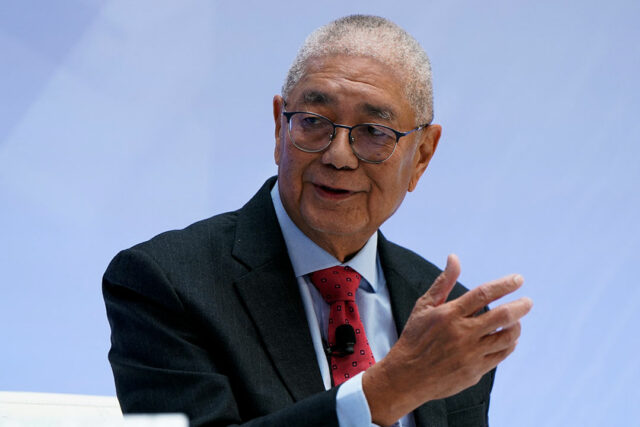
‘February cut on the table,’ says BSP governor Remolona

BANGKO SENTRAL NG PILIPINAS Governor Eli M. Remolona, Jr. attends a seminar during the 2025 annual IMF/World Bank Spring Meetings in Washington, DC, April 25, 2025. — REUTERS/ELIZABETH FRANTZ

FURTHER MONETARY POLICY easing might come as early as the Monetary Board’s first meeting for 2026 amid subdued inflation and dismal economic growth last year, the Bangko Sentral ng Pilipinas (BSP) said. 

Asked about the likelihood of a February cut, BSP Governor Eli M. Remolona, Jr. said: “(It’s) on the table. Unlikely pero puwede naman (but we could deliver it).”

Mr. Remolona said that the latest December inflation print of 1.8% is a “reasonably low rate,” even as it quickened from 1.5% in November. Year on year, it slowed from 2.9% in December 2024.

Philippine economic growth in 2025 also likely fell below the government’s target, he added.

“I can say that we’re very close to where we want to be in terms of policy,” he told journalists in Mandaluyong City. “There’s a chance that we may cut some more, and there’s also a chance that we may not move at all. But there’s not a lot of probability that we will raise in 2026.”

The Monetary Board ended last year with a fifth straight 25-basis-point (bp) cut at its Dec. 11 meeting, bringing the key policy rate to its lowest in over three years at 4.5%.

It has so far delivered 200 bps in total cuts since it began its easing cycle in August 2024.

The central bank chief said the country’s gross domestic product (GDP) may have expanded by 4.6% last year as the flood control corruption scandal continued to drag consumer and investor confidence.

This would be below the government’s 5.5%-6.5% target for the year and also lower than the Development Budget Coordination Committee’s (DBCC) latest projection of 4.8%-5%.

“There was a loss of confidence of investors. So, investments came down. Consumption also came down,” Mr. Remolona said.

“When you realize that your taxes are not really going into infrastructure spending, masakit ’yon eh (that’s painful)… It’s more painful when you know it’s going to the wrong guys. So, that has a big effect,” he added.

In the third quarter, GDP growth slumped to an over four-year low of 4% amid allegations that Public Works officials, lawmakers and private contractors received kickbacks from anomalous flood control projects.

Economic managers have since conceded that the economy likely failed to meet the government’s growth target for 2025.

Meanwhile, the BSP has repeatedly said following its December meeting that further easing is now limited and would depend on economic developments in the country.

Mr. Remolona said they may only deliver two 25-bp cuts if growth slows to below 5% this year due to weak demand.

“If we cut two more times, medyo ibig sabihin nu’n, things are worse than we thought (that might mean that things are worse than we thought). So, that would require a bad surprise in the data,” Mr. Remolona said.

“If growth is much slower than we anticipated. We’re saying that for 2026, growth will be 5.4%. If it goes below 5%, then there’s ground for one more cut beyond the 25 bps,” he added.

For 2026, the central bank sees GDP growth averaging 5.4%, noting that the economy will likely remain sluggish in the first half before picking up in the second half.

Mahaba pala ’tong impact eh ’yung loss of confidence (The impact of the loss of confidence may be prolonged)… it will continue through the first half of 2026,” Mr. Remolona said, noting that a 5.4% growth is “not bad” considering the flood control scandal.

The DBCC on Monday revised its growth target for this year to 5-6% from the 6-7% goal previously.

Economic growth may further improve to 6.2% in 2027, the BSP chief added, settling near the upper bound of the administration’s 5.5%-6.5% revised goal.

The Monetary Board is set to have its first policy meeting this year on Feb. 19. — Katherine K. Chan

Inflation eases to 1.7% in 2025, slowest in 9 years

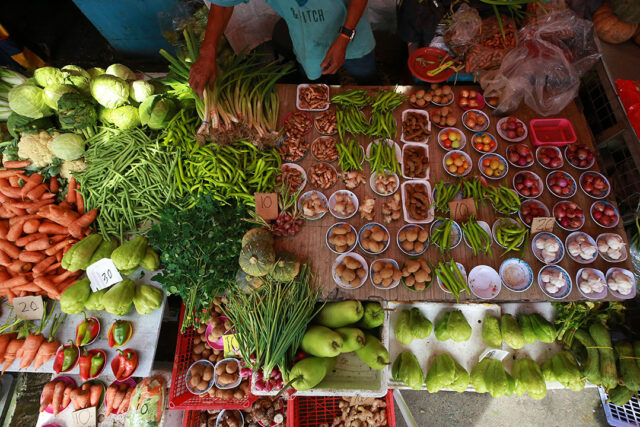
Various vegetables are for sale at a stall along Commonwealth Avenue in Quezon City, Jan. 6. — PHILIPPINE STAR/MIGUEL DE GUZMAN

By Katherine K. Chan, Reporter

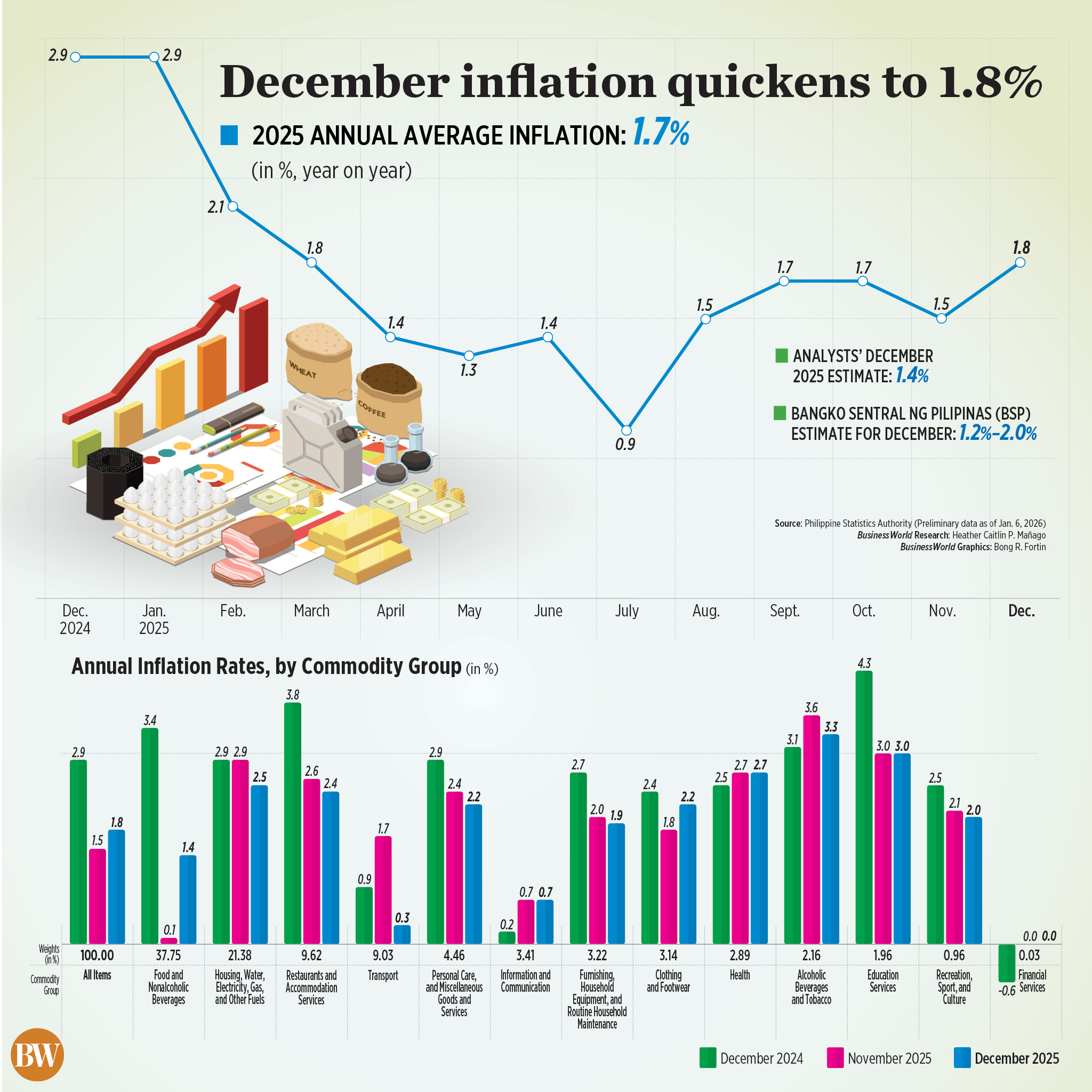
HIGHER FOOD PRICES during the holiday season lifted inflation to 1.8% in December, although the full-year average eased to 1.7% — the slowest in nearly a decade, the Philippine Statistics Authority (PSA) reported on Tuesday.

PSA data showed that last month’s consumer price index (CPI) quickened to 1.8% from 1.5% in November. Year on year, it slowed from 2.9% in December 2024.

December saw the fastest inflation since February or when inflation stood at 2.1%, but matched the 1.8% in March.

The latest CPI fell within the central bank’s 1.2-2% forecast for the month, but above the 1.4% median estimate in a BusinessWorld poll of 14 analysts conducted last week.

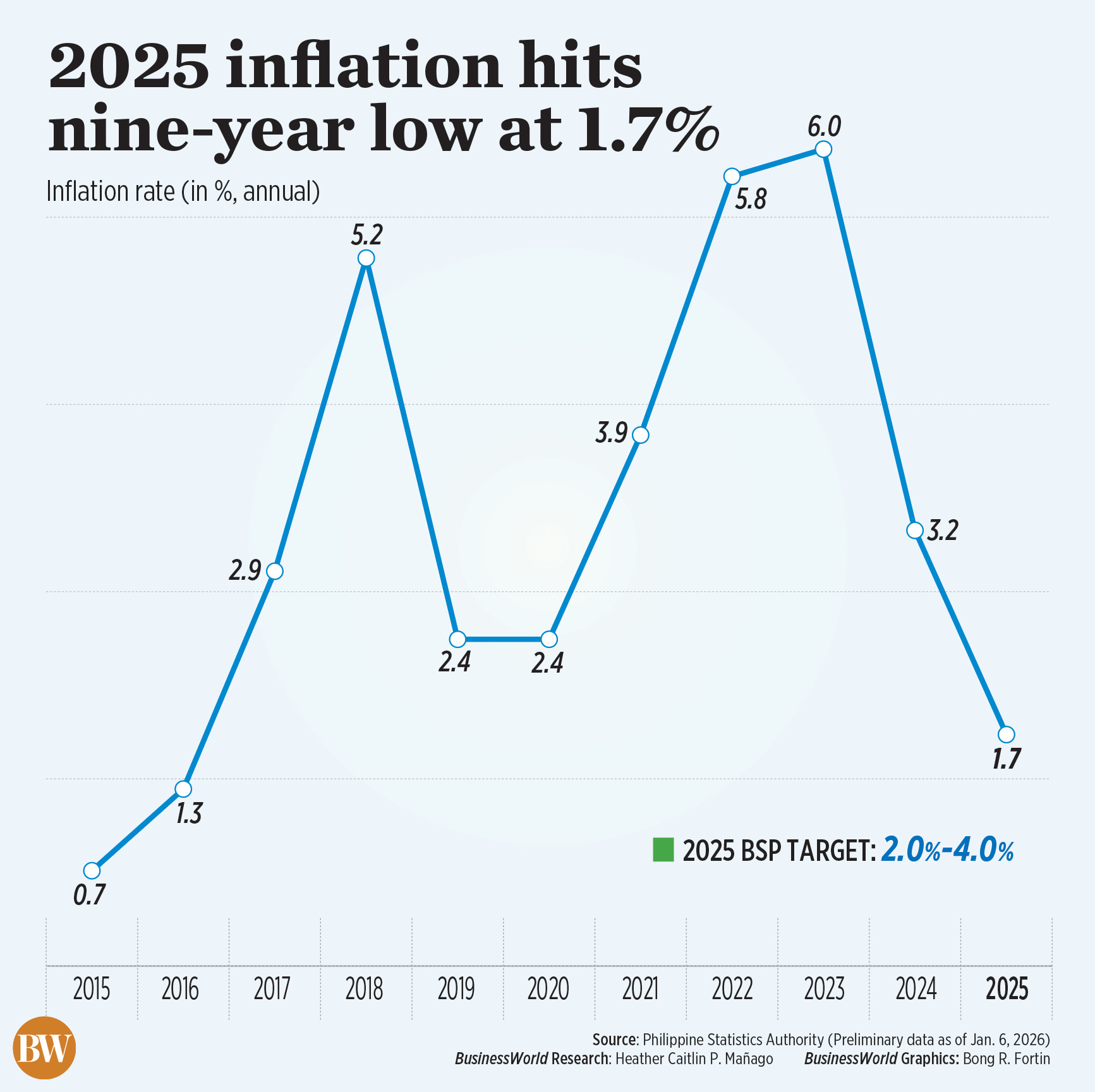
December marked the tenth consecutive month that inflation undershot the Bangko Sentral ng Pilipinas’ (BSP) 2-4% target.

The December print brought average inflation to 1.7% in 2025, easing from 3.2% in 2024. This was the slowest rate in nine years or since the 1.3% clip in 2016. It was also a tad above the central bank’s 1.6% estimate for the year.

“The major reason (for faster inflation) is really food, nonalcoholic beverages, particularly vegetables,” National Statistician Claire Dennis S. Mapa told a press briefing on Tuesday.

“(Prices of) vegetables and flour products rose. These are what we used for consumption in December, part of the holiday effect,” he added in mixed English and Filipino.

Inflation for the heavily weighted food and nonalcoholic beverages index accelerated to 1.4% from 0.1% in November amid faster price increases in cereals, cereal products, vegetables, tubers, fish and fruits.

According to Mr. Mapa, onion prices surged by 79% in December, followed by broad beans which rose by 41%, eggplants by 29.4%, okra by 28%, string beans by 24%, and tomatoes by 20.1%.

He also attributed the costlier vegetables last month to weather disruptions in November.

In November, Typhoon Kalmaegi (local name: Tino) battered parts of the country, leaving the local agricultural sector with about P2.5 billion in losses.

Rice deflation eased to -12.3% in December from -15.4% in the previous month. This was the slowest decline in rice prices in eight months or since -10.9% in April.

In mid-December, the average price of regular milled rice declined by 14.05% year on year to P42.10 per kilo from P48.98 per kilo previously, based on PSA data. Well-milled rice likewise fell by 9.9% year on year to P49.53 per kilo, while special rice fell by an annual 7.17% to P58.91 per kilo.

The National Government extended the suspension of regular and well-milled rice imports until end-2025.

CHEAPER ELECTRICITY, FUEL
Meanwhile, lower electricity and fuel prices during the month offered some relief, with inflation for housing, water, electricity, gas and other fuels slowing to 2.5% from 2.9% in November.

In December, the Manila Electric Co. (Meralco) lowered electricity rates by P0.3557 per kilowatt-hour (kWh) to P13.1145 per kWh from P13.4702 per kWh in November. This was equivalent to a P71 decrease in the monthly electricity bills of households consuming an average of 200 kWh.

Pump price adjustments in December recorded a net increase of P0.80 per liter for gasoline. However, prices of diesel saw a net decrease of P3.80 per liter, while kerosene posted a net decrease of P4.40 per liter.

PSA’s Mr. Mapa noted that the holiday-driven pressures may signal that the inflation spike in December was seasonal and temporary, adding that he hopes “prices will go back down in January.”

“Despite global headwinds and domestic challenges, the Philippine economy has remained resilient against inflationary pressures due to the government’s timely and targeted interventions,” Economy Secretary Arsenio M. Balisacan said in a statement.

Finance Secretary Frederick D. Go said the Department of Finance is focused on implementing “necessary measures to keep inflation manageable and ensure that Filipino families are protected from price shocks.”

Meanwhile, PSA data also showed that core inflation, which excludes volatile prices of food and fuel, steadied month on month at 2.4% in December, but eased from 2.8% in the same month in 2024.

In 2025, core inflation averaged 2.4%, easing from 3% in 2024.

Inflation in the National Capital Region (NCR) cooled to 2.3% in December from 2.8% in November and 3.1% in the same month a year ago. This brought full-year inflation in NCR to 2.4% in 2025 from 2.6% in 2024.

Outside NCR, inflation picked up to 1.7% from 1.2% in November but eased from 2.9% in December 2024, bringing the full-year average to 1.5%.

Central Visayas saw the highest inflation rate at 3.8%, while the Bangsamoro Autonomous Region in Muslim Mindanao recorded a -1% deflation.

On the other hand, inflation for the bottom 30% of income households stood at 1.1% in December, reversing the -0.2% in November but slowed from 2.5% in December 2024.

In 2025, inflation for the bottom 30% averaged 0.3%, easing from 4.9% in the previous year.

FURTHER EASING
Meanwhile, the central bank noted that the December clip supported its benign inflation outlook for 2025 and the next two years.

(The) 1.8% is a welcome number. It’s a reasonably low inflation rate,” BSP Governor Eli M. Remolona, Jr. told reporters during an event in Mandaluyong City on Tuesday.

Amid this, Mr. Remolona left the door open for another 25-basis-point (bp) reduction to the key policy rate in February, noting that economic data falling below their expectations may warrant further cuts.

“On balance, the Monetary Board views the monetary policy easing cycle as nearing its end,” the BSP said. “Any further easing is likely to be limited and guided by incoming data.”

The central bank has so far lowered borrowing costs by a total of 200 bps since August 2024, bringing the benchmark interest rate to an over three-year low of 4.5%.

For 2026, the BSP sees inflation accelerating to 3.2%, before cooling to 3% in 2027.

Chinabank Research projects faster inflation this year due to a low base effect from the 2025 as well as potential upticks in food and energy prices amid weather disruptions and geopolitical tensions.

“This 2026, we expect inflation to edge higher to around the midpoint of the target range, partly due to base effects from last year’s low readings,” it said in a commentary. “Still, barring new shocks, price pressures are projected to remain manageable moving forward.”

Chinabank Research said this gives the BSP room to trim its key rates this year to spur the economy.

Meanwhile, Rizal Commercial Banking Corp. Chief Economist Michael L. Ricafort said headline inflation will likely stay below target until February before rising to 2-3% by March.

“(This) could still justify future local policy rate cut/s that would match future Fed rate cuts in 2026, (which) could realistically happen in the latter part of 2026, as early as June 2026, based on the latest Fed Funds Futures,” he added.

Factory output grows at slowest pace in 7 months

Workers are seen inside a manufacturing facility in Sto. Tomas, Batangas in this file photo taken on March 1, 2023 — PHILIPPINE STAR/KJ ROSALES

MANUFACTURING OUTPUT growth fell to a seven‑month low in November, weighed down by weak domestic consumption and sluggish export demand.

Preliminary results of the Philippine Statistics Authority’s (PSA) latest Monthly Integrated Survey of Selected Industries showed factory output, as measured by the volume of production index, fell by 1.5% year on year in November, a reversal from the revised 1% growth in October.

Year on year, the decline slowed from the 4.5% drop in November 2024.

The November reading was the slowest output growth in seven months or since the 2.4% decline in April 2025.

On a monthly basis, November’s output contracted by 2.8%, reversing the 5% growth in October. Stripping out seasonality factors, it slipped by 3.5%.

Year to date, factory output fell by 0.1%, a reversal from the 0.7% growth in the same period in 2024.

PSA data showed the November manufacturing performance was mainly due to the slower month-on-month growth in food products (4.2% in November from 8.1% in October); and the decline in coke and refined petroleum products (-11.4% from -2.7%); and beverages (-2.8% from 4.9% growth).

“Manufacturing output contracted by 1.5% in November, reflecting a sharper deterioration in operating conditions as the Philippines Manufacturing Purchasing Managers’ Index (PMI) fell to 47.4 from 50.1, driven by weak domestic and export demand and typhoon‑related production disruptions,” Union Bank of the Philippines Chief Economist Ruben Carlo O. Asuncion said in an e-mail.

S&P Global PMI fell to over a four-year low of 47.4 in November, a reversal from the 50.1 in October.

“Beyond these, we continue to monitor declining export orders, softer purchasing activity, thinning inventories, and early signs of labor shedding — signals consistent with a sector adjusting to both global headwinds and domestic supply constraints,” added Mr. Asuncion.

Nicholas Antonio T. Mapa, chief economist at Metropolitan Bank & Trust Co., said the manufacturing performance reflected the slowdown in economic activity in the third quarter.

“In particular, softer household consumption may have weighed on volume of production,” he said in an e-mail.

In the third quarter, GDP grew by 4%, the slowest in over four years. This brought the nine-month average growth to 5%, below the government’s 5.5%-6.5% target.

Philippine Chamber of Commerce and Industry Chairman Sergio R. Ortiz-Luis, Jr. said that the decline in November came after most orders were frontloaded in the first nine months of 2025.

“Actually, both local and export production were fast-tracked in the first three quarters of the year… There was front-loading for year-end deliveries. So, production tapered down in the fourth quarter,” said Mr. Luis-Ortiz in mixed English and Tagalog in a phone call.

Capital utilization averaged 77.4% in November, slightly lower than October’s 77.6%. All sectors have reached an average capacity utilization rate of more than 60% during the month.

Going forward, Mr. Asuncion anticipates a “modest” improvement in December and “gradual” recovery through 2026. 

“Our view is that while November’s slump reflects temporary disruptions and cyclical demand softness, forward sentiment remains constructive. Manufacturers posted their strongest optimism since November 2024, and with domestic demand expected to firm up alongside an eventual BSP (Bangko Sentral ng Pilipinas) easing cycle… consistent with medium‑term projections that see manufacturing output trending higher toward 2026,” said Mr. Asuncion.

Mr. Mapa said a gradual recovering in manufacturing is likely as “inventories decline and demand returns over the next few months.”

“Manufacturing looks like to grow especially in export, but not as fast as we would like to, it will continue to grow but still we are left behind by our neighbors due to weak demand,” said Mr. Ortiz-Luis. — Lourdes O. Pilar

ADB expects PHL household spending to improve in 2026

People visit a mall in Cubao, Quezon City, Dec. 23, 2025. — PHILIPPINE STAR/MIGUEL DE GUZMAN

By Aubrey Rose A. Inosante, Reporter

THE ASIAN Development Bank (ADB) said household consumption in the Philippines is likely to rebound in 2026 on the back of easing inflation and interest rates, after a corruption scandal and adverse weather dampened spending in recent months.

However, analysts warned that depending on tax relief to spur consumption could undermine fiscal consolidation efforts.

ADB Country Director for the Philippines Andrew Jeffries said household final consumption expenditure, which accounts for over 70% of the economy, is expected to “strengthen in 2026 amid low inflation and accommodative monetary policy.”

“More broadly, policies need to focus on raising incomes and reducing vulnerability,” he said in an e-mailed statement to BusinessWorld.

Mr. Jeffries said these measures should include expanding higher‑quality employment, boosting productivity through skills upgrading, and targeted social protection for vulnerable households.

This comes as private consumption growth moderated in the third quarter of 2025, particularly discretionary spending on recreation, hotels and restaurants, partly due to weather‑related disruptions, he said.

Data from the Philippine Statistics Authority (PSA) showed household final consumption expenditure slowed to 4.1% in the third quarter from 5.2% a year ago.

This was the slowest since the 4.8% contraction in the first quarter of 2021. Excluding pandemic years, it was the slowest growth in private spending since the 2.6% increase in the third quarter of 2010.

The PSA will release the fourth-quarter and annual 2025 preliminary gross domestic product (GDP) data, including household consumption, on Jan. 29.

Despite the slower growth in the third quarter, the ADB said spending on essentials, particularly food, remained resilient, supported by low inflation.

Inflation picked up to 1.8% in December from 1.5% in November. This brought the average to 1.7% in 2025.

For 2026, the central bank sees inflation accelerating to 3.2%, but still within the 2-4% target band.

The Bangko Sentral ng Pilipinas (BSP) has so far delivered a total of 200 bps in cuts since August 2024, after it lowered its policy rate by 25 bps to an over three-year low of 4.5% at its Dec. 11 meeting, amid subdued inflation and sluggish growth.

The Monetary Board is scheduled to hold six regular policy meetings in 2026, with the first one set on Feb. 19.

TAX RELIEF?
To spur household demand and ease public concerns over flood control issues, a lawmaker had proposed giving tax relief to Filipinos, but analysts were divided, saying the measure could lift spending but risk undermining fiscal consolidation.

Senator Erwin T. Tulfo filed a bill in the Senate in October to provide a one-time, one-month income tax holiday for individual taxpayers receiving compensation income, effective on the first payroll month immediately following the bill’s approval.

Senate Bill No. 1446, or the One-Month Tax Holiday bill, remains pending at the committee level.

“A tax relief will only delay fiscal consolidation,” Foundation for Economic Freedom President Calixto V. Chikiamco told BusinessWorld on Tuesday.

The Marcos administration aims to bring the deficit down to P1.56 trillion, or 5.5% of GDP, in 2025, and eventually to P1.55 trillion, or 4.3% of GDP, in 2028.

Mr. Chikiamco noted that many factors influence consumer spending, such as unemployment, inflation, and wage growth.

“Depreciation of the peso will increase OFW (overseas Filipino worker) incomes and spur consumer spending without decreasing government revenues,” he added.

The peso has breached the P59-a-dollar mark several times since November and sank to a record low of P59.22 on Dec. 9.

Meanwhile, Jonathan L. Ravelas, a senior adviser at Reyes Tacandong & Co., argued that tax relief can boost private consumption, but the program has to be “smart and targeted.”

“Tax relief can help revive spending, especially after a year of high prices and tight budgets,” he said.

“Focus on essentials like VAT (value-added tax) breaks on food and utilities, and give relief to lower- and middle-income families who are more likely to spend,” Mr. Ravelas added.

However, he said tax relief must be “time-bound,” and paired with job creation and price stability, so people feel confident to open their wallets.

“The problem on spending is due to the uncertain environment due to ‘floodgate,’ the government should fix its trust issues so confidence will come back,” Mr. Ravelas said, referring to the flood control mess.

Meanwhile, the ADB’s Mr. Jeffries said improving VAT efficiency and sustaining gains in tax administration through digitalization are key to raising government revenue.

“The proposed tax on single-use plastic bags is a notable measure, serving both revenue and environmental objectives by helping address plastic and solid-waste challenges,” he said.

BIR Commissioner Charlito Martin R. Mendoza earlier said the proposed tax measure is projected to generate between P6 billion and P10 billion annually, “depending on the rate and coverage.”

“Beyond taxation, sustained improvements in expenditure efficiency and public financial management are crucial, particularly to strengthen investment planning, project execution, and governance,” Mr. Jeffries said.

Jollibee plans US listing for global business; stock surges

BW FILE PHOTO

JOLLIBEE FOODS CORP. on Tuesday said it plans to spin off its international business and list it on a US stock exchange by late 2027 as the Philippine fast-food group plots its global expansion.

Its stock jumped the most in more than five years after the announcement.

Jollibee, which increasingly is taking aim at global fast-food giants such as McDonald’s and Yum! Brands, Inc. from Los Angeles to Ho Chi Minh City, said it has hired international and local advisers to work on the spinoff and potential US listing.

Jollibee Foods Corp. International would include all of the company’s businesses outside its home market, the company said in a disclosure to the Philippine Stock Exchange, where its Philippine operations will remain listed.

Jollibee shares — after a one-hour trading halt — rose as much as 11.56%, the most since October 2020.

“Built on a capital-light model with significant whitespace for expansion, it is positioned to operate in markets that support companies pursuing international scale, innovation, and long-term global growth,” the company said.

“The transaction is intended to be executed in late 2027, subject to prevailing market conditions, completion of appropriate diligence and securing all required regulatory and legal approvals across relevant jurisdictions,” it added.

Establishing two listed businesses is meant to sharpen the strategic focus of each company and enhance the “clarity of each equity story,” Jollibee said.

The spinoff would let investors value the “stable, cash-generative Philippine business separately from the higher-growth but more volatile international operations,” COL Financial Group analyst Rachelle Biacora said in a note.

However, the company’s domestic unit might have a lower market value, which could affect its weighting in some stock indexes, she added.

Jollibee shareholders would receive a number of shares in the international business equal to their company holdings at the time of the listing, the company said.

Jollibee’s restructuring and spinoff of foreign operations is a novel way for a Philippine blue chip to list those units, allowing eligible shareholders “to capture the complete economics of the move,” Juan Paolo E. Colet, managing director at China Bank Capital Corp., said in a Viber message.

He added that spinning off and listing Jollibee Foods Corp. International would unlock full value in Jollibee’s international operations, with Jollibee Foods Corp. likely to see investor buzz over the international company’s valuation speculation.

“Jollibee Foods Corp. International will be seen as having a comparatively higher growth potential given the sheer size of the global consumer space, but that also comes with the associated higher risk of breaking into new markets,” Mr. Colet said.

“Meantime, Jollibee Foods Corp. will become a pure play on the Philippine food-service market where there is still room to refresh and grow a predominantly mature brand portfolio,” he added.

The food giant owns several brands, including its iconic Jollibee chain known for its sweet-style spaghetti and crispy fried chicken.

Jollibee is building its international profile, striking 27 cross-border deals worth about $1.1 billion since 2000, according to data compiled by Bloomberg. That includes US brands such as Smashburger and Coffee Bean and Tea Leaf, which Jollibee struggled to turn around, and recently, South Korea’s Compose Coffee.

The group had 10,304 stores as of September, 6,859 of which were located overseas across over 30 countries, including China, Canada and Vietnam. International business generated about 43% of Jollibee’s P224.2-billion ($3.8 billion) revenue from January to September. — Alexandria Grace C. Magno with Bloomberg News

Meralco 2025 energy sales decline by 0.65%

PHILIPPINE STAR/ MICHAEL VARCAS

MANILA ELECTRIC CO.’s (Meralco) energy sales volume declined last year due to soft demand in residential and commercial segments, a company executive said.

Indicative figures showed energy sales within Meralco’s franchise area fell 0.65% to 53,257 gigawatt-hours (GWh) in 2025 from 53,606 GWh in 2024, Meralco Senior Vice-President and Chief Revenue Officer Ferdinand O. Geluz said in a Viber message.

Residential and commercial sales dropped 2% and 0.5%, respectively, while the industrial segment grew by 1%.

Meralco has yet to consolidate figures from Clark Electric Distribution Corp. and other distribution utilities. Clark Electric, 65% owned by Meralco, serves the Clark Special Economic Zone.

This year, the power distributor is targeting 3% growth in energy sales, supported by higher customer connections and normalizing temperatures.

The distribution business contributed 55% of Meralco’s consolidated net income in the first nine months of 2025, which rose 14% to P40 billion. The company remains confident of meeting its full-year core profit guidance of P50 billion.

“Based on the growth of our power generation and steady performance of our core distribution in the past nine months, we stay positive we will achieve our full-year core profit guidance of P50 billion,” Meralco Chairman Manuel V. Pangilinan told a briefing in October.

Shares of Meralco gained 1.37% to close at P593 each on the local bourse on Tuesday.

Beacon Electric Asset Holdings, Inc., Meralco’s controlling stakeholder, is partly owned by PLDT Inc. Hastings Holdings, Inc., a unit of the PLDT Beneficial Trust Fund subsidiary MediaQuest Holdings, Inc., has an interest in BusinessWorld through the Philippine Star Group. — S.J. Talavera

ACEN powers Schneider Cavite plants with RE

ACENRENEWABLES.COM

AMERICAN POWER CONVERSION CORP. (APC), a flagship brand of French company Schneider Electric SE, has tapped the retail electricity supply unit of Ayala-led ACEN Corp. to power its manufacturing facilities in Cavite using renewable energy (RE).

In a statement on Tuesday, ACEN said APC and Schneider Electric entered into an RE supply agreement with ACEN RES under the government’s Green Energy Option Program, which allows electricity end-users with an average monthly demand of at least 100 kilowatts to choose renewable energy as their power source.

The agreement covers five facilities in Cavite, which are mainly engaged in semiconductor manufacturing. These sites began operating on renewable energy in December and include both office and production locations.

“This collaboration sets in motion our transition to 100% renewable energy at the Cavite Smart Factory — a bold stride in our journey toward net zero,” Antonio Cheng, Jr., plant director for the Cavite Cluster at Schneider Electric Philippines, Inc., said in the statement.

He added that the Cavite facility is set to become the first plant inside a government economic zone in Luzon, and the first Schneider Electric factory in East Asia, to run entirely on renewable energy.

ACEN President and Chief Executive Officer Eric T. Francia said the partnership shows how big industrial players could advance the country’s energy transition. ACEN RES accounts for 57% of the Green Energy Option Program market and obtains power from the company’s solar, wind and geothermal assets.

ACEN has about 7 gigawatts of attributable renewable energy capacity and has completed its shift away from conventional power generation.

The company earlier said it had transitioned its entire generation portfolio to renewable energy after divesting its conventional power assets. — Sheldeen Joy Talavera

RLX, SPX Philippines sign leasing deal

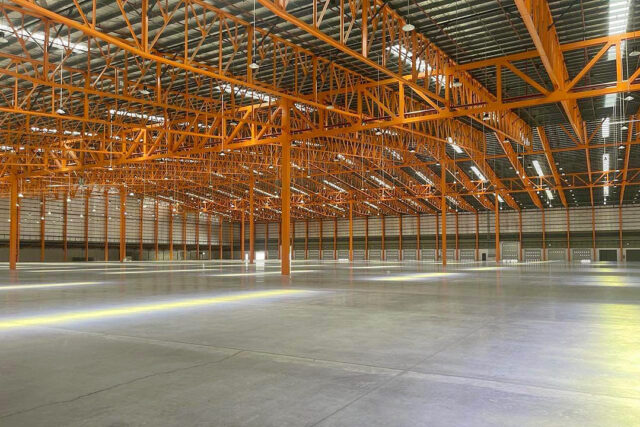
An interior shot of the Robinsons Logistix and Industrial Facilities’ warehouse. — COMPANY HANDOUT

ROBINSONS LOGISTIX & Industrials, Inc. (RLX) said it has signed its second warehouse leasing agreement with SPX Philippines, Inc., the logistics partner of e-commerce platform Shopee, Inc., as both companies seek to expand their distribution network across Luzon.

“RLX’s modern facilities in strategic locations like Calamba support our continued growth as we serve customers nationwide through our multi-partner logistics network,” SPX Philippines head Martin N. Yu said in a statement on Tuesday.

The deal expands the companies’ partnership, which began with the opening of SPX’s biggest sorting center within RLX’s property in Calamba, Laguna in 2024. The facility serves customers in the National Capital Region, South Luzon, the Visayas and Mindanao.

The renewed partnership aligns with both companies’ push to improve speed, efficiency and reliability in the domestic logistics sector.

“It also reinforces RLX’s position as a leading provider of future-ready, scalable logistics solutions built on innovation and operational excellence,” RLX said.

SPX offers services such as pick-up, drop-off, cash-on-delivery and register-as-a-service point, and operates across Southeast Asia, Taiwan and Brazil. SPX Express Philippines is a unit of Singapore-based Sea Group.

“Our collaboration with SPX Philippines highlights RLX’s commitment to delivering Grade A logistics facilities that help partners scale and grow,” RLX Senior Vice-President and Business Unit General Manager Cora Ang Ley said.

RLX, the industrial and logistics arm of Robinsons Land Corp. (RLC), operates 13 facilities across Calamba, Laguna; Sucat and Muntinlupa City; Pampanga; and Rizal. Its warehouses feature modern specifications and flexible layouts.

RLX posted a 2% increase in nine-month revenue to P661 million. Parent firm RLC reported a 19% rise in attributable net income to P3.3 billion for the period.

Shares of RLC rose 1.1% or 18 centavos to close at P16.58 on the Philippine Stock Exchange. — Beatriz Marie D. Cruz

Updates to REIT rules, rate cuts may attract listings, says ICCP

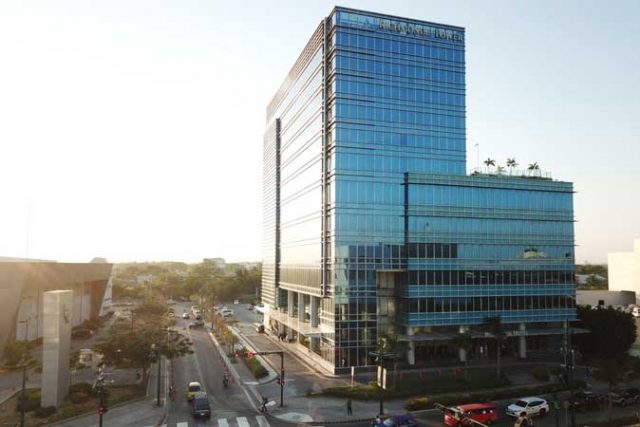
RICHMONDE Tower in Iloilo Business Park

THE Securities and Exchange Commission’s (SEC) proposed updates to real estate investment trust (REIT) rules, alongside possible interest rate cuts by the central bank, could encourage more REIT listings, the Investment & Capital Corporation of the Philippines (ICCP) said.

“If interest rates come down, that would be good for REITs because issuers would be more encouraged to come to market as they would not have to offer very high dividend yields,” ICCP President and Chief Operating Officer Jesus Mariano P. Ocampo said in a statement on Tuesday. “REITs are a dividend story at the end of the day.”

Under the updated REIT rules, the SEC has expanded the definition of income-generating assets to include sectors such as power, infrastructure and telecommunications.

The rules, which took effect this month, also extend sponsors’ reinvestment deadlines and strengthen disclosure and governance requirements.

Mr. Ocampo said the changes could attract billion-peso REIT offerings from tollway operators, water concessionaires, fiber optic network providers, cell tower operators and data-center developers.

He added that the timing of the regulatory changes aligns with a more accommodative monetary environment.

The Bangko Sentral ng Pilipinas (BSP) has cut interest rates by 200 basis points since August 2024.

BSP Governor Eli M. Remolona, Jr. has said another rate cut remains possible at the central bank’s February policy meeting, citing subdued inflation and weak economic growth last year.

The central bank ended 2025 with an additional 25-basis-point cut on Dec. 11, bringing the key policy rate to 4.5%, the lowest in more than three years.

Mr. Ocampo cited the surge in REIT activity from 2020 to 2021, noting that low interest rates during that period helped spur listings.

As rates decline, pressure on issuers to offer elevated dividend yields eases, making public listings a more viable and attractive capital-raising option, he said.

However, Mr. Ocampo said actual listings would still depend on issuer readiness, asset valuation and broader market conditions.

ICCP is a medium-sized group with businesses spanning investment banking, venture capital, industrial-estate development and township development.

The Philippines has eight listed REITs — AREIT, DDMP REIT, Inc., Filinvest REIT Corp., RL Commercial REIT, Inc., MREIT, Inc., VistaREIT, Inc., Citicore Energy REIT Corp. and Premier Island Power REIT Corp. — Beatriz Marie D. Cruz

Civic mindedness is a must to fight corruption

STOCK PHOTO | Image from Freepik

(Part 1)

Filipinos of all social levels are strongly demanding that corrupt officials from the Government — especially from the Senate, the House, the departments of Public Works and Highways (DPWH) and of Health (DoH), and the Bureau of Internal Revenue (BIR) — are actually sent to jail, together with private contractors and other business people involved in the flood control scandal that exploded before Christmas of 2025. They are disappointed that only “small fry” are actually being imprisoned.

Our efforts to minimize corruption in both the public and private sectors (after all, “it takes two to tango”) will not prosper unless we strengthen our weak institutions that directly address the problem of corruption. At this time, the highest priority should be assigned to the passage of four pending bills addressing the challenge of eliminating or at least reducing corruption. They are the Anti-Dynasty Bill, the Independent People’s Commission (IPC) Act, the Party-List System Reform Act, and the Citizens Access and Disclosure of Expenditures and National Accountability Act. President Ferdinand Marcos, Jr. has given his full support to the passage of these legislative measures.

The appropriate strong institutions are necessary for any socio-economic reform, as is very well documented with strong empirical evidence in the book Why Nations Fail by James Robinson and Daron Acemoglu, winners of the Nobel Prize in Economics. For example, the Philippine inflation rate is at a record low of below 3% today because of the expert management of the best Central Bank in the ASEAN. Institution building has also been evident in the former NEDA (the National Economic and Development Authority, now the Department of Planning, Economy, and Development), the departments of Trade and Industry, of Agriculture, Foresty and Fisheries, of Finance (with the exception of the still corrupt BIR), and the Department of Environment and Natural Resources. Much still has to be done to get rid of corruption and inefficiency in the DPWH, which is at the center of the ongoing corruption scandal, the Department of Education, and the DoH.

Strong institutions, however, can only do so much if they have no support from the majority of the population. Unfortunately, most Filipinos lack the virtue of civic mindedness, the concern for the common good of the entire society. The loyalty and the love for others stops with most of us at the level of the extended family system. We are still mostly a feudal society inherited from our pre-colonial era. Each of us still belongs to a “family dynasty” which is what the extended family system boils down to. It is telling that the ongoing attempts to pass a bill that will ban political dynasties are being stalled by the difficulty of determining the degree of consanguinity at which an individual should be banned from running for an elective position at the same time and same political constituency as a relative.

To understand better the type of concern for the common good or the love we call “patriotism,” let us review the classic definition of the different types of love (or seeking the good of another) as defined in the classic book of British writer C.S. Lewis entitled The Four Loves.

Borrowing from the Greek philosophers of ancient times, C.S. Lewis suggested that there are four loves: storge in Greek (affection in English); philia (friend); eros (romantic); and agape (charity or divine love).

The most common and natural form of love (which is always the attraction of the human will to an object perceived as good) is affection. It is the most natural and common love. There is no effort of the will involved here; it is instinctive, such as the love of parents for their children. It is warm, familiar, and humble. It often grows quietly from daily life and shared experiences. As a rule, Filipinos are known to be affectionate people even to strangers. That is why our call center agents in the BPO-IT industry are highly appreciated, because of the affectionate manner that they deal with their customers. The same can be said of Filipinos or Filipinas who work here or abroad in the hospitality industry or in the nursing and caregiving profession.

Then there is the love of friendship (philia in Greek or amistitia in Latin). This is the love that exists between two individuals, regardless of gender, who share common interests, values, or pursuits. It is based on mutual respect and companionship and is considered by C.S. Lewis as a most rewarding form of love.

Some of the most outstanding forms of friendship in the Philippines is the bond that ties individuals who shared the same educational experiences in grade school or high school and are in touch with one another for the rest of their lives — even if they reside in different countries. Especially among middle class women, it is common for them to celebrate the 50th anniversary of their graduation from high school or college.

Fortunately, this form of human is still deeply entrenched in Filipino society, in contrast with some other societies in the West where the bond of friendship among individuals has weakened to the extent that, especially among the youth, lonesomeness or loneliness has become a sort of a social disease. This trend has been abetted by the advent of Artificial Intelligence in which applications like ChatGPT have taken the place of real human friends. The breakdown of the family in some developed societies has also led to the declining role of friendship in human fulfillment since it is in the family that the bond of friendship is first developed.

As any human relationship, friendship has both its positive and negative features. Among the strengths of friendship are its being built on shared truth, values, and purpose. It is, in this most elementary form of human relations, where the individual is nurtured in virtue, honesty, and intellectual growth. Friendship is freely given, not compelled by nature. That is why, in some relationships, friends are treasured more than blood relatives.

There are, however, some perils in the love called friendship. It can become exclusivist or elitist, fostering group pride or moral blind spots. Friends in exclusive fraternities, especially among the economic elite, may foster group pride or moral blind spots. They may reinforce each other’s errors. There should be efforts to prevent bonds of friendship from being used for conspiratory loyalty, especially among soldiers.

C.S. Lewis notes that friendship groups can become dangerous when they see themselves as morally superior.

(To be continued.)


Bernardo M. Villegas has a Ph.D. in Economics from Harvard, is professor emeritus at the University of Asia and the Pacific, and a visiting professor at the IESE Business School in Barcelona, Spain. He was a member of the 1986 Constitutional Commission.

bernardo.villegas@uap.asia