Home Blog Page 4344

Rates of Treasury bills, bonds likely to decline

BW FILE PHOTO

RATES of Treasury bills (T-bills) and bonds on offer this week could track secondary market movements after faster-than-expected inflation last month.

The Bureau of the Treasury (BTr) will auction off P15 billion in T-bills on Monday or P5 billion each in 91-, 182- and 364-day papers.

On Tuesday, it will offer P30 billion in reissued seven-year Treasury bonds (T-bonds) with a remaining life of six years and 10 months.

“The upcoming Treasury bill auction yields could again decline week on week, after the comparable short-term PHP BVAL (Bloomberg Valuation Service) yields were lower by up to 0.05-0.07 basis point (bp) week on week,” Rizal Commercial Banking Corp. Chief Economist Michael L. Ricafort said in a Viber message.

“The upcoming seven-year Treasury bond auction yield could be similar to the comparable seven-year PHP BVAL yield at 6.42% as of Sept. 8,” Mr. Ricafort added.

At the secondary market on Friday, the 91-, 182-, and 364-day T-bills went down by 5.28 bps, 0.11 bp, and 7.02 bps week on week to end at 5.6553%, 5.9867%, and 6.193% respectively, based on PHP BVAL Reference Rates data published on the Philippine Dealing System’s website.

The seven-year bond likewise dropped by 12.89 bps week on week to end at 6.4154% on Friday.

“The seven-year bond auction should see a range of 6.35-6.45%, and is a good measure of risk appetite given the current backdrop of high inflation,” a trader said in an e-mail.

Headline inflation picked up to a two-month high of 5.3% in August from 4.7% in July, data released by the Philippine Statistics Authority last week showed.

Still, this was below the 6.3% print in August 2022, and was within the 4.8-5.6% forecast of the Bangko Sentral ng Pilipinas (BSP) for the month.

However, this was above the 4.9% median estimate in a BusinessWorld poll of 18 analysts.

August also marked the 17th consecutive month that the consumer price index (CPI) was above the BSP’s 2-4% target for the year.

For the first eight months, the CPI averaged 6.6%, above the central bank’s full-year forecast of 5.6%.

Last week, the BTr raised P15 billion as planned via the T-bills it auctioned off on Monday as total bids reached P47.56 billion, or more than thrice the amount on offer.

Broken down, the Treasury made a full P5-billion award of the 91-day T-bills as tenders for the tenor reached P13.242 billion. The average rate of the three-month paper went down by 2.1 bps for an average rate of 5.552%, with accepted rates ranging from 5.5% to 5.6%.

The government also raised P5 billion as planned from the 182-day securities as bids for the tenor reached P15.043 billion. The average rate for the six-month T-bill was at 5.966%, down by 2.7 bps, with accepted rates at 5.948% to 5.985%.

Lastly, the BTr borrowed the programmed P5 billion via the 364-day debt papers as demand for the tenor stood at P19.275 billion. The average rate of the one-year T-bill declined by 9.9 bps to 6.198%. Accepted yields were from 6.17% to 6.22%.

Meanwhile, the reissued seven-year bonds to be offered on Tuesday were first auctioned off on July 26, where the government raised P24.793 billion, short of the P30-billion program, at a coupon rate of 6.375% and an average rate of 6.328%.

The Treasury wants to raise P180 billion from the domestic market this month, or P60 billion via T-bills and P120 billion via T-bonds.

The government borrows from local and foreign sources to help fund its budget deficit, which is capped at 6.1% of gross domestic product this year. — A.M.C. Sy

Job quality deteriorates in July

The ranks of employed Filipinos who wanted additional work (i.e. wanted more hours of work, additional job, or a new job with longer working hours) climbed by over half a million to 7.10 million in July from 6.54 million tallied in July last year. This translated to an underemployment rate — the share of those Filipinos who wanted additional work to the total employed population — of 15.9% that month from 13.8% in July 2022. It was the highest share in 20 months. Twelve out of 17 regions saw their respective underemployment rates worsened annually in July. Eastern Visayas led the largest increase with 9.3 percentage points (ppts) to 25.3%. It was followed by Zamboanga Peninsula (up 9 ppt), Cagayan Valley (up 8.7 ppt), and Davao Region (up 6.1 ppt).

Job quality deteriorates in July

Globe says non-telco revenues to rise in three years

GLOBE Telecom, Inc. anticipates its non-telecommunications revenues to grow in the next three years mainly driven by its diversification strategies, its top official said.

“The non-telco earnings will grow. They could either be consolidated into our P and L (profit and loss statement) or they could be in a sharing equity earnings of a subsidiary if we become a significant minority investor,” Ernest L. Cu, president and chief executive officer of Globe, said in a media release on Sunday.

The listed telecommunications company said its non-telco revenues will fuel its overall revenues.

“The other way that it brings value to Globe is it adds to our overall market cap and market value as we create companies that may not be as profitable yet but do create significant value in terms of market valuation that will also show in the stock price of Globe,” Mr. Cu said.

The company said its shift from telco to techno — its strategy of venturing into fintech, health tech, edutech, climate tech, adtech, shared services, investments and entertainment — has allowed the company to boost its revenues.

For the first half, Globe said its non-telco revenues reached P2.8 billion, up by 47.4% from P1.9 billion in the same period last year, and accounted for about 3.5% of the company’s total gross service revenues.

The company reported a 17.7% increase in its attributable net income to P7.07 billion for the second quarter from P6.01 billion in the same period last year.

From April to June, the company’s gross revenues reached P44.49 billion, an increase of 1.7% from P43.76 billion in the corresponding period of 2022. — Ashley Erika O. Jose

Managing the current rice price crisis without reversing the Rice Tariffication Law

The global rice market is going through a price crisis, which, in my view, is still beginning relative to that in 2008. It is concerning because we have had the Rice Tariffication Law (RTL) since 2019, which allowed private sector instead of National Food Authority (NFA) to import rice for us. In a way we are assessing how well advised our legislators were in passing the RTL law.

Those who disagreed with RTL see in this crisis a confirmation of what they had been saying all along: that the RTL risks our food security situation. If the global rice market is in disarray like now, the private sector could not import. Since we are presently grossly behind rice self-sufficiency at world price levels, there is great risk that we may not have enough rice to eat.

This has prompted the government to impose a rice price cap. This measure does not truly solve the problem, and usually makes the shortage worse. We are just wasting public funds in subsidizing rice retailers to enforce it. We don’t have enough funds to cover the losses of rice retailers. We only end up destroying our local rice trading. Rice queues may not be far behind if we continue with this measure. Thus, in a few weeks, I bet the government would give up rice price control.

This proposed solution is worrisome. Opponents of RTL are calling now for a review of that law. They argue that if we rely on the global market for our food, and it is not able to supply us with rice at affordable levels for whatever reason, then this law is breeding food insecurity in our country. They call for a reversal of it and to go back to the days of the NFA, or at least some features of PD 4, the charter of the NFA.

HOW BAD IS THE GLOBAL RICE CRISIS NOW?
I examined the behavior of the Thai rice price, which is taken to be the global rice price. The data is obtained from the World Bank.
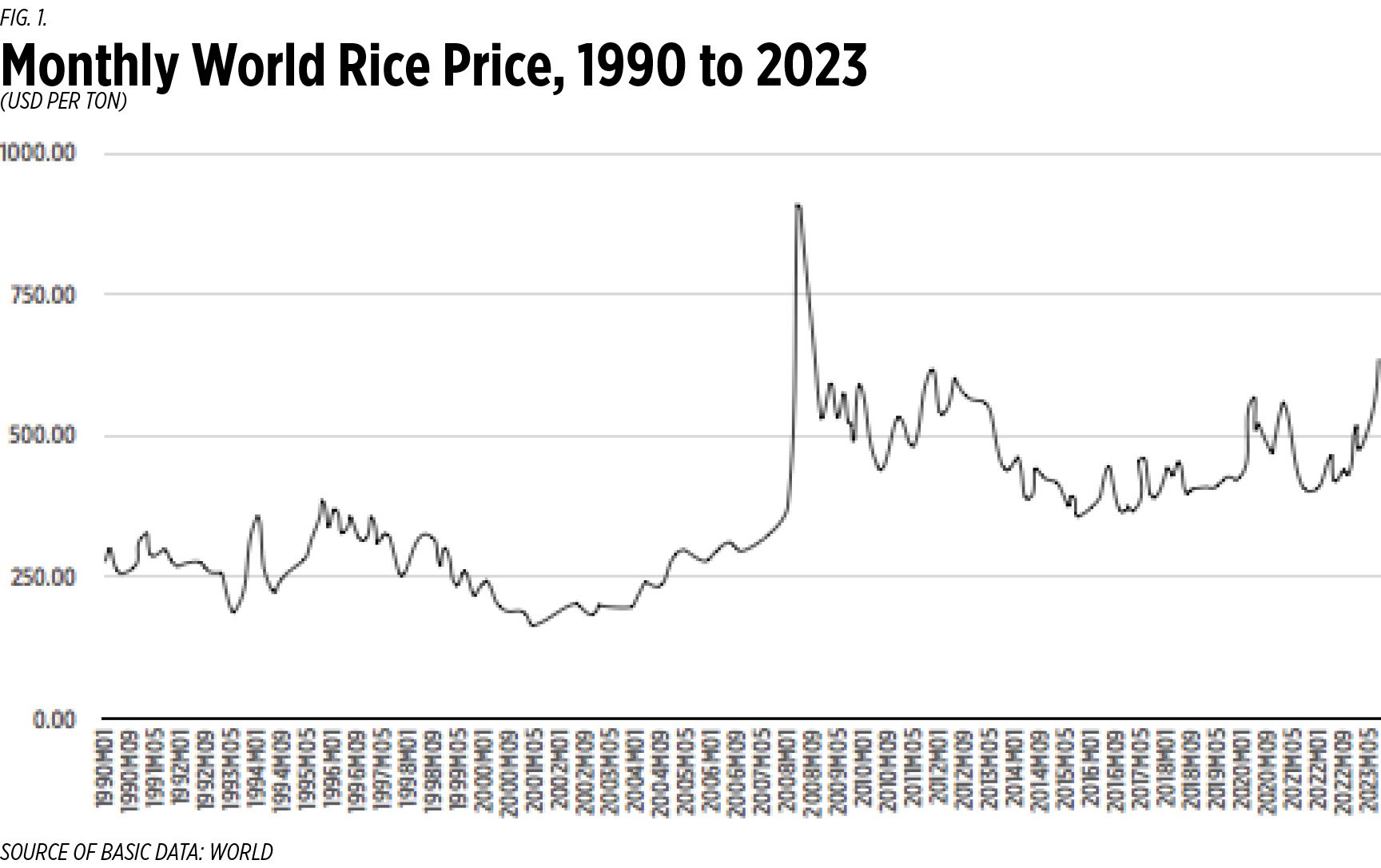
Figure 1 shows the plot of monthly rice prices since 1990. At the very end of this price plot, we see monthly rice prices surging. In August, it was $635 per ton. But there were similar episodes of rice price surges in the past.
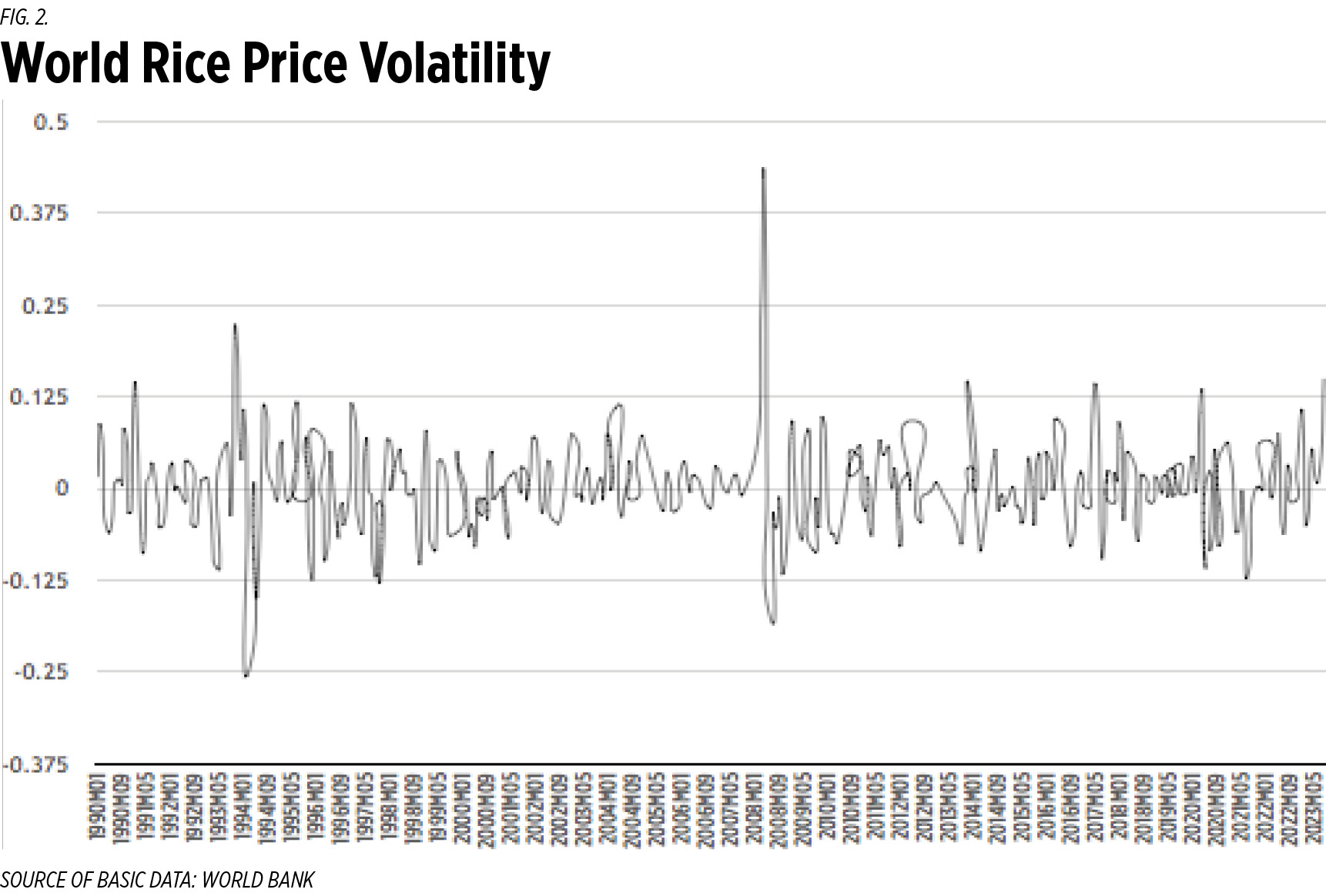
I used two indicators to check on how bad the current rice price surge is: extreme rice volatility and the level of rice prices. Price volatility is defined as the proportionate surge of monthly rice prices. Figure 2 shows the plot of global rice price volatility since 1990. The majority of fluctuations are 10% or below. Any volatility higher than 10% is extreme.

Table 1 shows the distribution of global monthly rice price fluctuations from 1990. Discounting rice price declines, nearly half of the price increases were at 10% or below. Extreme price volatility accounted for 2.7% of the data.
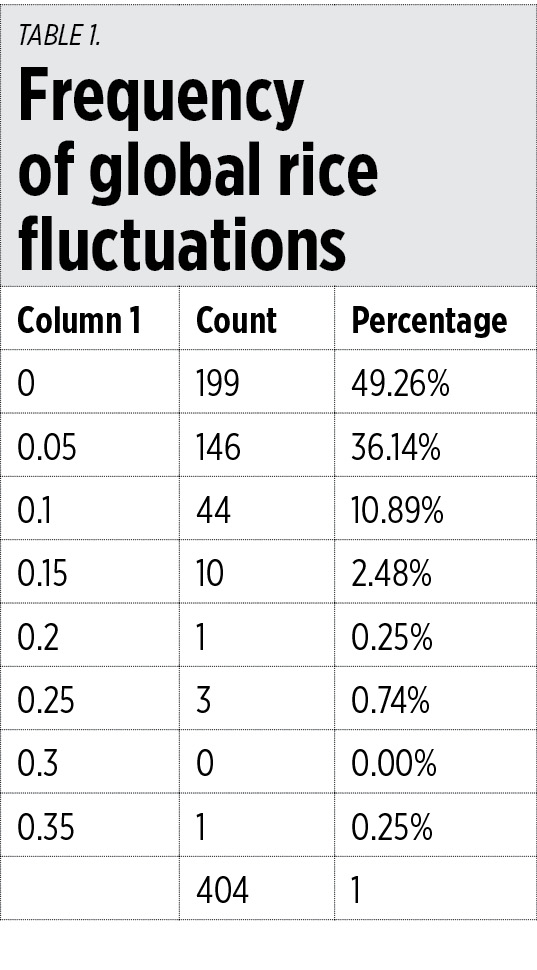
The current rice price fluctuation is just getting to be extreme. In August 2023, its volatility measured 14%.

I go back to the plot of the monthly prices and identify the episodes of rising world rice prices since 1991. An episode may be defined as the number of months when rice prices are increasing to their peak. Peak monthly prices are those followed by falling monthly prices.

Following these definitions, six price surge episodes may be identified from the chart of monthly world prices of rice (Figure 1). These were in February 1990, February 1991, July 1991, January 1994, October 1995, July 1995, May 2008, May 2012, and April 2020. The current monthly price for August 2023 is on a rising price surge, but we have yet to know if that would continue to increase.

The steepest price surge occurred in 2008. This was when Vietnam and India bent politically to their respective constituencies and banned rice exports. A third country contributed to that crisis by importing an unprecedentedly large amount of rice in just a period of four months. That was us during the administration of former President Gloria Macapagal Arroyo.

I checked if these episodes of rising prices were what we referred to in the past as rice price crisis. The episodes that elicited concern were in years where they occurred with extreme price volatility. I averaged the price volatility by year, and I came up with the following years — 1993, 1995, 2007, 2008, and 2020 — as displaying extreme price volatility of at least 10%. Combining these with the years where there were episodes of rising rice prices, I selected three years when the global rice market displayed rice price crises. They were 1995, 2008, and 2020. The years 1993, 2004, and 2007 exhibited extreme price fluctuations, but the rice prices did not surge to high levels.

The rice price crisis of 2008 was particularly concerning. It involved the highest price volatility and the steepest price surge. The other concerning years, 1995 and 2020, had relatively flatter price surges. Perhaps the volatility in 2020 may be explained by the global recovery from the global economic depression caused by COVID-19.

The average duration of the three rice price crises was just less than a year. The world was able to recover and rice prices were brought back to their stable and affordable levels.

When rice prices peaked in May 2008, the Japanese government offered to use their World Trade Organization rice buffer to alleviate the price surge. Just the mere announcement by the Japanese on selling rice to the Philippines brought global rice prices down sharply.

The current rice price surge in the global market may continue, but in my view, it is very unlikely that it could worsen into a 2008-like rice price crisis. It may be like the 1995 global rice price crisis. And locally we likewise had a crisis then. And that was because the NFA was late in importing rice. The late Agriculture Secretary Bobot Sebastian had to resign because of that problem.

WHAT MAY WE DO THEN?
In my view it is a big mistake to reverse the RTL because of this crisis. Like other commodities, rice prices fluctuate. Currently rice is displaying extreme price volatility and is showing rising prices. But if we look back, this may just be for a few months. The world has learned from 2008 that one important measure to strengthen the situation during a global rice price crisis is to coordinate with one another. The ADB promoted an ASEAN Rice Forum during 2008 where rice suppliers and buyers met regularly to assess the rice market situation.

Bringing the NFA back to what it was is over-insuring ourselves for food insecurity. Some improvements may be made to RTL, particularly on the use of the Rice Competitiveness Enhancement Program (RCEP), but it’s ending the NFA rice monopoly is its soundest feature for food security. The NFA invoiced taxpayers with P250 billion in corporate debt if I am not mistaken. This is just a high insurance premium for food security.

Some advisers to the government have not learned that price controls do not work. They are not enforceable, and they make the situation worse. Public funds are not enough to pay for the retailers’ losses, which prompts them to hide rice in the hope that price controls may be lifted in the next few weeks. That worsens the shortage.

The government can be more helpful if they convert the subsidy to a consumption subsidy targeted for the poor, and not disturb the market. The middle-income consumers would still bear the losses, but if this crisis only lasts less than a year based on what we observed in the past, that may be a better option than imposing price controls.

But there is always this question. The RTL enabled the private sector to import rice. But except for a few large traders, they may not import any if global rice prices continue to rise. These few large traders can manipulate the market, increasing rice prices further. Without the other smaller rice importers going into the global rice market, this risk is likely.

If this crisis develops into something like 2008, the government should be ready to import — but not through the NFA. That takes a long time because we must reverse the RTL for that solution. This would just be an ad hoc importation to serve as a counterweight to the few traders who may manipulate rice prices. The imported rice may be distributed through the Kadiwa program.

FOCUS ON INCREASING RICE PRODUCTIVITY
The RTL is not a perfect law. In my view, the RCEP part of it can be improved. The RCEP money could be used to promote rice productivity, but not in the way RTL has prescribed. For example, CP Foods has a good business model in modern swine farming involving clusters of backyard farmers in contract growing arrangements. Relatively large agribusiness companies can develop a similar arrangement in the rice industry. Capital investments of farmers can be lent to farm clusters supported by agreements between these farmers and these companies using RCEP.

Farmers could themselves likewise do farming all the way. We see successful cooperatives like the Soro Ibaba Development Cooperative in Batangas City. That is our largest agricultural cooperative, and they are managing their business relatively well.

I am not promoting the agencies of the Department of Agriculture distributing the RCEP money. That would not increase productivity and we would just be wasting money. Government agencies can support technology developments, provide public goods, and regulate to ensure fair trade between the cluster of small farmers and the large private agribusiness companies.


Ramon L. Clarete is a professor at the University of the Philippines School of Economics.

‘Climate change is here, and we need to transition to cleaner energy’

Mr. Rubio delivers a speech at the launch of AboitizPower’s Fleet Transformation Program. — PHOTO BY KAP MACEDA AGUILA

AboitizPower President and CEO Emmanuel ‘Manny’ V. Rubio looks forward to a greener power mix for the company

Interview by Kap Maceda Aguila

VELOCITY: As you mentioned, AboitizPower is looking at scaling up capacity, which leads to this question. One of the worries for Filipinos in our tangible quest, if you will, to go electric is, aside from the lack of charging infrastructure, is whether or not our power grid can actually accommodate the growth of electric vehicles. How do you see this playing out?

MANNY RUBIO: That’s right. I think we’re cognizant of the issues, moving forward, especially with regard to this massive integration of electric vehicles into the system. We see that as an opportunity, not as a disruptor. We’re seeing them as an opportunity for us growing beyond our core business of distribution and generation. We have to prepare for that, working together with NGCP (National Grid Corporation of the Philippines), the grid operator. We will be preparing ourselves as the distributor for say, Cebu, Davao, Cotabato, and some PEZA (Philippine Economic Zone Authority) zones. What we’d like to do is to have a platform where we can manage the charging and discharging, and (get) participation also from the owners. That’s why I mentioned that you can be more than a consumer of electricity power but become even a seller of electricity if you want to manage your charging. But we need to make sure that there are also regulations in place. And that’s what we’re working on with DoE (Department of Energy) to make sure that we have the right regulations to capture all the concerns and issues moving forward.

Not a few people say that it’s kind of hard to fathom the Philippines going full electric when we still have power supply problems. If we look at our ASEAN neighbors, they have perhaps a lot more things going for them. So what’s the timeline that you see here?

Well, we are not in the EV (electric vehicle) business. And in fact, I’m calling it a mobile energy storage foray because this is a whole value chain within the mobile energy storage system. Where do we participate? So with regard to increase in demand, because of the influx of EVs, we just have to rely on forecasts from the DoE, and it’s going to be incorporated in the demand forecast on a unit basis. They have to make sure that it’s on the road map of the demand so that we can also prepare for the supply. But it’s a whole value chain and not just generation. When there’s shortage of electricity, they’ll say we’re short of generation capacity, but transmission also needs to follow. In a lot of cases, there are constraints in transmission, that some generation capacities cannot be dispatched at full capacity because we cannot evacuate that capacity. So we really have to work hand in hand with transmission, with the DoE and ERC (Energy Regulatory Commission) for regulations, and the generators so that we can plan for the resources needed to make sure that we’re ready for the future.

You mentioned moving AboitizPower toward more sustainable energy. Of course, everyone knows that coal-fired power plants aren’t really ideal, right? How are you looking at evolving the power generation capability of the company while increasing capacity?

Well, first and foremost, I think the focus should be on making sure that there’s enough capacity in the grid to power the economy. And that energy should be reliable, should be stable and cost-effective. Having said that, two things are for sure: Climate change is here, and we need to transition to cleaner energy. Unfortunately, the transition to cleaner energy will take time. It will take time. That’s why we’re saying that by 2030 our portfolio should at least be 50% renewable energy and 50% thermal. Thermal will still be needed, I assume, for the next 20 years, until a cost-effective combination of a variable renewable energy and some form of energy storage becomes competitive. When we have that then it’s game over for thermal. But having said that, that’s why LNG (liquefied natural gas) was named as a transition fuel, well, because that’s still far down the horizon. But our focus would really be to shape the capacity growth into renewable energy, but also making sure that we have enough baseload capacity at a very competitive rate to make sure that we have energy for the country to power the economy.

When you say thermal it means traditional coal-fired plants?

Yes and LNG, we are going to LNG as our next baseload option.

So you are now using less coal?

We will be relying less on coal for baseload in the future. It may still be the same capacity, but the proportion would be lesser as we build more new baseload plants, other than coal. We have, if I’m not mistaken, around 2,800 megawatts of (coal-fired) capacity. That will still run, but as we grow, we will be building greener technologies.

So, is LNG some sort of short-term solution?

LNG is considered a transition fuel. LNG would be the next best available option. It gives off less carbon emissions than coal.

China’s demure ‘good for marriage’ trend sparks feminist furor

The pastel make-up and modest clothing that are the hallmark of ‘good for marriage’ style are based on Brilliant Girls, a 2021 drama that centers around a woman who wants to get married as quickly as possible. — FORUMS.SOOMPI.COM

HONG KONG — A fashion trend in China dubbed “good for marriage” has generated a social media storm, with scores of women saying the demure, feminine style plays to gender stereotypes and discourages financial independence.

The trend recently became popular after several social media influencers promoted ways they said would make women more attractive to potential husbands, as officials grapple with ways to boost the number of marriages, and births, which dropped to record lows last year, leading to the first decline in the population in six decades.

The number of newborns is closely tied to marriage rates due to official policies that make it difficult for single women to have children.

“I’m desperately working towards the ‘difficult to marry style.’ I love exercising, shopping and I’m a super feminist who loves to argue,” one user posted on China’s Weibo social media platform.

Another Weibo user posted: “I am so happy alone. Super happy! Be a hard-to-marry girl, sensible, self-interested, loves herself.”

The pastel make-up and modest clothing that are the hallmark of “good for marriage” style are based on Brilliant Girls, a 2021 drama that centers around a woman who wants to get married as quickly as possible.

In Chinese, the trend literally translates as “good family tradition.” Traditionally, women are seen as the primary carers for their children and households.

Many young Chinese women cite high childcare costs, a disrupted career, and not wanting to get married as the main reasons for not wanting children.

Angel, a user on China’s Little Red Book social media site said she was working hard to be “difficult to marry.”

“In the end the most important thing is to be rich and financially independent,” she said. — Reuters

Small banks continue lending to firms as reserve compliance

SMALL BANKS continued to lend to micro, small, and medium enterprises (MSMEs) and eligible large enterprises (LEs) as part of their alternative compliance with reserve requirements, the Bangko Sentral ng Pilipinas (BSP) said in a report.

“For the reserve week ending 27 July 2023, TBs (thrift banks) and RCBs (rural and cooperative banks) allocated an aggregate of P13.3 billion and P6.5 million loans to MSMEs and LEs, respectively, for compliance with the reserve requirements. These accounted for 1% and 0.0005% of total required reserves for the said reserve week,” the central bank said in a report on recent trends in the Philippine financial system.

During the coronavirus pandemic, the central bank allowed banks to count their loans to MSMEs and pandemic-hit LEs as part of their compliance with reserve requirements.

The relief measure expired on June 30. However, small lenders can still count their loans to MSMEs and LEs as alternative compliance with reserve requirements until they are fully paid, but not later than Dec. 31, 2025.

“The unwinding was set to coincide with the reduction in the reserve requirement ratios by 30 June 2023 to facilitate the transition, supporting the banks’ continued compliance with the reserve requirement and managing friction costs related to the policy adjustment,” the BSP said. 

In June, the BSP cut the reserve requirement ratios of big banks by 250 basis points (bps) to 9.5%, by 200 bps to 6% for digital banks, and by 100 bps for thrift banks, and rural and cooperative banks to 2% and 1%, respectively.

In 2022, banks lent P493.5 billion to MSMEs as alternative compliance with reserve requirements. This was 6.6% higher than the P463.1 billion a year prior.

By banking group, universal and commercial banks extended P390.9 billion in loans to MSMEs, while rural and cooperative banks lent P52.7 billion. — KBT

Farm industry says subsidy for rice retailers costing government P2 billion

PHILIPPINE STAR/ MICHAEL VARCAS

FARMERS said the P15,000 subsidy for rice dealers being squeezed by the price controls on the grain is expected to cost the government P2 billion.

Mapapagastos pa ang gobyerno ng P2 billion para ayudahan ang mga retailer (The government now has to spend P2 billion to aid the retailers),” Raul Q. Montemayor, national manager for the Federation of Free Farmers, said in a Viber message.

Farmers have expressed fears that traders will low-ball them on purchases of palay, or unmilled rice, to compensate for the margin squeeze resulting from the price controls.

Executive Order No. 39 imposed a temporary price ceiling of P41 per kilogram for regular-milled rice and P45 per kilogram for well-milled rice.

The Department of Agriculture (DA) has received complaints from farmers that traders might collude to pay a “uniform lower price” to make up for the price controls.

The effect has been to lower the price farmers receive for their harvest, leading to calls for a farmer subsidy as well to compensate them for lost revenue.

Samahang Industriya ng Agrikultura Executive Director Jayson H. Cainglet described the retailer subsidy as assistance in acquiring more expensive inventory.

’Yung ayuda ay para maitawid lang ’yung pagbili nila ng mas mahal na bigas mula sa mga wholesalers or millers (The subsidy is just to cover their purchase of more expensive rice from wholesalers or millers),” he added.

He estimated that the subsidy was sufficient to procure 7,000 kilograms (kg) of rice, equivalent to 280 sacks of rice at 25 kilos of rice.

He said the inventory of a typical retailer turns over every seven to 10 days.

He said that average rice stocks from retailers usually last for seven to 10 days.

The Department of Social Welfare and Development (DSWD) started handing out the P15,000 cash aid to rice retailers in Quezon City, San Juan, and Caloocan.

About 232 rice retailers received the subsidy, with 48 were from Quezon City, 136 from Caloocan City, and 48 from San Juan.

The Presidential Communications Office said in a statement on Sunday, that the Departments of Agriculture and Trade and Industry (DTI) have identified another 337 beneficiaries who are set to receive cash aid on Sept. 11.

Among these are 15 rice retailers in Pateros, 161 in Navotas, 129 in Parañaque, and 32 in Zamboanga del Sur.

“As the government’s cash assistance continues, the DSWD and the DTI will meet on Monday to discuss the list of beneficiaries for the rest of the National Capital Region (NCR) and those in the provinces, among other measures,” it said. — Adrian H. Halili

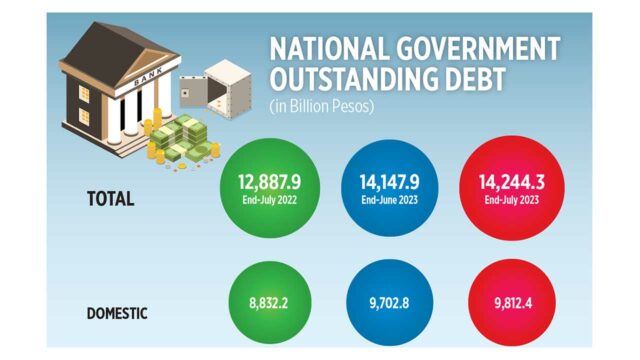
National Government outstanding debt

THE National Government’s (NG) outstanding debt hit a record P14.24 trillion as of end-July due to higher domestic borrowings, the Bureau of the Treasury (BTr) said on Friday. Read the full story.

National Government outstanding debt

Bigger gains seen for carriers as volumes rise

PHILSTAR

LOCAL airline companies are expected to post higher second-semester earnings, an analyst said, pointing to the expected recovery of domestic and international passenger and cargo volumes.

“The main catalyst would be the further recovery of domestic and international passenger and cargo volume as the economy reopened towards greater normalcy,” said Rizal Commercial Banking Corp. Chief Economist Michael L. Ricafort in a Viber message.

He said the airlines are on the right recovery path towards  “pre-pandemic levels or eventually higher.”

For the April-to-June period, PAL Holdings, Inc., the listed operator of flag carrier Philippine Airlines, posted an attributable net income of P6.23 billion, more than double the P2.47 billion in the same period last year, driven by higher revenues.

The company’s gross revenues for the second quarter expanded by 34.1% to P45.24 billion from P33.74 billion in the same period last year.

Cebu Air, Inc., the listed operator of budget carrier Cebu Pacific, reported a profit of P2.67 billion in the second quarter, turning around from the P1.89-billion net loss incurred in the same period last year, after a significant boost in passenger revenues.

From April to June, the company reported P22.67 billion in gross revenues, marking a 62.3% increase from last year’s P13.97 billion.

Passenger revenues, totaling P15.84 billion, constituted the majority of Cebu Air’s second-quarter top line, reflecting an 86.3% increase compared with last year’s P8.51 billion.

Meanwhile, the company recorded a 49.7% decline in cargo revenues, which amounted to P866.9 million, down from P1.72 billion in the same period last year.

Throughout the quarter, the company transported 5.46 million passengers, 29% higher compared with the previous year.

“Offsetting risk factors would include higher fuel prices with global crude oil prices near 10-month highs recently after oil production cuts by Saudi Arabia and Russia, among the world’s largest oil producers, since fuel accounts for a large share of the cost of airlines,” Mr. Ricafort said.

In a report last month, the Civil Aeronautics Board (CAB) said that it had raised the passenger and cargo fuel surcharge rate for this month, after keeping it at level 4 for three consecutive months or from June to August.

CAB announced that the applicable fuel surcharge for domestic and international flights was raised by two levels or to Level 6.

“Higher inflation that is added to operating cost and eats into profit margins, also added to cost of imported capital and inputs such as aircraft, parts, maintenance, fuel, among others,” he said.

In August, headline inflation rate quickened to 5.3% from 4.7% in July, but slower than the 6.3% clip a year ago. Last month’s rate is still within the Bangko Sentral ng Pilipinas’ 4.8-5.6% forecast range for the month. — Ashley Erika O. Jose

Revenge consumerism

FREESTOCKS-UNSPLASH

Corporate news: San Miguel Corp. (SMC) President Ramon Ang announced that SMC subsidiary Velocità Motors has been chosen by Italian sports car maker Ferrari to be its exclusive distributor in the Philippines (ABS-CBN News, Sept. 3, 2023).

Serving as a prequel to the Ferrari distributorship of Velocità was the setting up of the SMC Asia Car Distributors Corp. in July 2017 (65% owned by San Miguel Corp. and the rest owned by then Palawan Governor Jose “Pepito” Alvarez) for the importation and distribution of BMW vehicles in the Philippines (Rappler, July 18, 2017). This marked SMC’s entry into the motoring business.

Esquire magazine asked Mr. Ang in its April 19, 2021, issue, how luxury car sales were doing at the height of the pandemic. “According to Ang, despite the effects of the pandemic, sales of luxury and exotic cars globally have been brisk. With the super-rich having no place to go because of travel restrictions, buying luxury and exotic cars have become a form of ‘revenge’ shopping and retail therapy.”

Fast forward to the Ferrari launch, and Mr. Ang said the same thing about luxury car sales: “Not even a cooling economy will stop the very wealthy from buying luxury sports cars. Parang revenge travel, ’di ba? Now [its] revenge buying luxury car, ano?”

Two vehicles were presented at the media launch, one of which was the Purosangue 715 hp, Ferrari’s first-ever four-door four-seater to be powered by a V12 engine, with a 0-100 time of 3.3 seconds and a top speed of 309 kph. The selling price starts at P46 million, according to topgear.com.ph (posted Sept. 3, 2023). Aside from the Purosangue, Ferrari also showcased “the 296 GTS, the spider version of the hybrid V6-engined 296 GTB which website motowheeler.com says will cost P23 million.”

“You have to wait two to three years to buy (estimated delivery from ordering), maybe then you will have enough savings,” Mr. Ang teased. “I am confident [in] the luxury vehicle business in the Philippines amid inflation and other global issues affecting [the] supply chain,” Mr. Ang said on ANC.

At the same time that teasers were out for the expensive Ferraris, the Organization for Economic Co-operation and Development (OECD) came out with the discomforting news that it was trimming its gross domestic product (GDP) growth forecast for the Philippines for this year. “In its latest Economic Outlook for Southeast Asia, China, and India update, the OECD said it now expects Philippine GDP to expand by 5.6% this year, slightly lower than the 5.7% projection in March. This is below the government’s 6-7% GDP growth target for this year. The OECD kept its 2024 growth projection at 6.1%, which is still below the government’s 6.5-8% target” (BusinessWorld, Sept. 4, 2023).

The OECD said elevated inflation and higher borrowing costs dragged private consumption and investments in the second quarter. The slowdown was also amplified by the contraction in government spending, it added. The annual inflation rate in the Philippines unexpectedly rose to 5.3% in August, from July’s 16-month low of 4.7%. The latest result was also above market forecasts of 4.7%, with food prices rising the most in five months, 8.1% vs 6.3% in July, according to Trading Economics. The high inflation dampened demand, which lowered consumption and slowed GDP growth.

Finance Secretary Benjamin Diokno was very happy with the 7.6% GDP growth seen in December 2022, declaring that “For the Philippines, the worst is over and the best is yet to come.” But the uptick in GDP growth in 2022 “mainly reflected pent-up domestic demand,” according to the International Monetary Fund (IMF) team that held meetings in Manila on May 8-12 this year to discuss recent economic and financial developments and the outlook for the Philippine economy. But 2022 was an election year, and candidates for the executive and legislative branches of government at every level — national, provincial, and local (except for the barangay officials) plunked billions of pesos into the economy in the first half of the year. In Rappler’s “Tracker” of July 14, 2022, more than P1.77 billion was spent by the presidential, vice-presidential, and senatorial candidates alone (not including multiple candidates for 316 seats in the House of Representatives and some 15,273 local government positions).

Inflation is cumulative, and sticky, like the sticky prices that feed it. Inflation is the frightening realization that now there is money, but not enough goods or services available to buy. When the Bangko Sentral ng Pilipinas (BSP) raised the borrowing rates, it was supposed to discourage borrowing and thus lessen spending and hopefully encourage saving excess money through the deferment of spending. But this was not enough to discourage borrowing and spending and to foster savings and investment. “It appears that high inflation and policy rate hikes had a larger-than-expected impact on growth,” Citicorp said in an interview-poll taken of 21 economists by BusinessWorld (Aug. 13, 2023) on the prospects for GDP growth at end 2023.

“To achieve the government’s 6-7% growth target for 2023, the Philippine economy has to grow by at least 6.6% in the second half. An aggressive catch-up plan for infrastructure projects (roads, bridges, airports, seaports, power, water, irrigation, telecommunications facilities, digitalization, school buildings, housing and others), quicker response by GOCCs (government-owned and -controlled corporations), and strong and deliberate spending by resource-surplus local governments are essential parts of the solution to the relatively weak second-quarter growth performance of the Philippine economy,” Mr. Diokno said as he reacted to the BusinessWorld poll. The weaker-than-expected growth in the second quarter was partly attributed to a 7.1% contraction in government spending, which was a reversal of the 10.9% growth a year ago.

The Philippines remains, largely, a consumption driven economy, with most of its GDP being derived from services, trade, overseas remittances and business process outsourcing. Because of this, the retail sector could eventually account for as much as a fifth of GDP (oxfordbusinessgroup.com/2016). Private Consumption was 73.5% of Nominal GDP in June 2023, compared with 78.9% in the previous quarter, according to CEIC economists. In other words, the burden of growth depends largely on the consumption of the growing population with its increasing needs and wants. It desperately feels like a cat turning circles to catch its own tail.

But consumerism is good for business, as it stimulates production and delivery, and gives immediate recognition of income and reinvestment. Economist Adam Hayes of Investopedia calls it a predominantly Keynesian idea that consumer spending is the key driver of the economy and that encouraging consumers to spend is a major policy goal. He acknowledges the apprehension of sociologists that this can lead to a materialistic society that neglects other values. Traditional modes of production and ways of life can be replaced by a focus on consuming ever more costly goods in larger quantities.

And the political economist Thorstein Veblen spoke of “Conspicuous Consumption” in 1899, theorizing that some consumers purchase, own, and use products not for their direct-use value but as a way of signaling social and economic status. This is observably true across levels of society, in the taunting “keeping up with the Joneses” accusation leveled at those who live beyond their means.

Ramon Ang resonated with Veblen on conspicuous consumption, albeit from the business view: “Really wealthy people will always have money, and luxury cars are a form of conspicuous spending. Since travel and other luxuries are not an option these days, buying a supercar seems to be a popular choice these days,” he said in the Esquire interview.

Now even the 51% self-rated poor, and the 31% borderline poor in the Philippines are awakened to the P46-million Ferrari as a gauge of economic and social status.

I can dream, can’t I?


Amelia H. C. Ylagan is a doctor of Business Administration from the University of the Philippines.

ahcylagan@yahoo.com

‘LUBES’ flow within Shell Auto Workshops

From left are GCash Enterprise Sales Head Martin Kristopher Limgenco II, Shell Lubricants Philippines Digital Manager Ika Halili, Shell Lubricants Philippines National Sales Manager for Indirect Channel Paz Famador-Tiongco, Shell Lubricants Philippines Vice-President Jackie Famorca, Shell Lubricants Philippines Marketing and Business Development Manager Leo Mendoza, Francorp Philippines AVP-Consultancy Dana Cuneta, Shell Helix Brand Manager Chi Malabanan, and Shell Lubricants Philippines Business Development Manager Jensen Garcia. — PHOTO FROM SHELL LUBRICANTS

By Dylan Afuang

SHELL HELIX Auto Workshops — a hundreds-strong network of service centers around the country that are a franchise of Shell Lubricants — appear to balance the interests of both business and consumer. These are owners of out-of-warranty vehicles and the service centers themselves, respectively.

Shell Lubricants, part of Shell companies in the Philippines, provides its franchised outlets with Shell Helix’s line of engine oil and lubricants, along with various business tools. In turn, these outlets carry and deliver a wide range of services and products that promise to keep their customers’ cars in prime condition.

Underscoring the importance of the company’s partnership with the workshops, Shell Lubricants Vice-President Jackie Famorca, at a recent company event, stated, “Shell Helix is a credible partner that can help maximize your business potential by connecting you to people and providing you with an established network of experts who can help you succeed.”

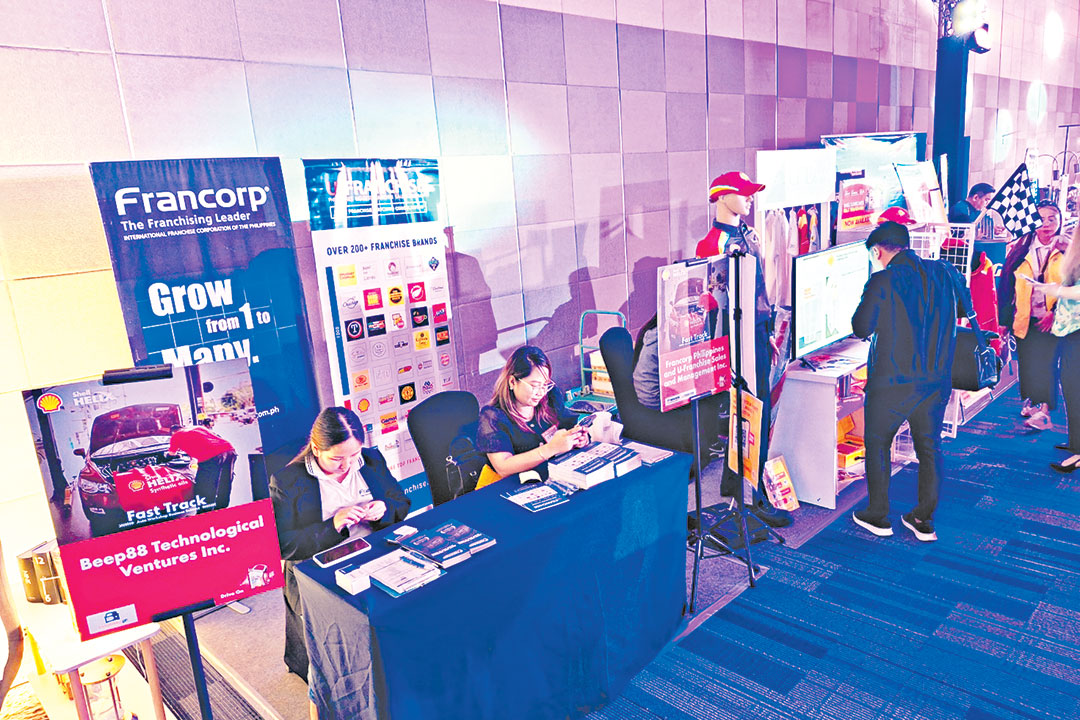
Staged by Shell Philippines, that event was the “Shell Helix Fast Track: Auto Workshop Business Summit” held last week, which gathered the representatives of its affiliate workshops and members of the media for the purpose of sharing “current trends, tools, and topics” within the partnership among the auto outlets and vehicle lubricant manufacturer.

Franchise Shell Helix vehicle service centers include Auto Casa, Car Crew, and Car Doctor that carry the Shell Helix Auto Workshops branding, and they can be located using the brand’s workshop online locator (shell.com.ph/motorists/helix-workshop-locator.html).

And what manner of business-boosting services and strategies have and will benefit Helix franchises, existing and prospective? As detailed by Shell Lubricants Business Development Manager Jensen Garcia at the summit, these fall under the “LUBES” categories.

Firstly, franchise workshops can “Learn.” That means “For Shell Helix (franchises), we have certain programs that put (importance) on (workshops’) learning,” Mr. Garcia explained.

Through the brand’s Master Mechanic Program and Workshop Academy, mechanics of affiliate service centers aim to deliver better service by keeping abreast with the latest automotive technologies, gaining a mechanic certification, and earning rewards as they complete courses in the program.

Franchise workshops can “Upgrade,” because “In every customer journey, it begins with awareness,” as the executive explained.

To establish the shops’ branding and make them easier for customers to identify, Shell Helix can provide to them exterior and interior signage, display racks for products, advertising graphics, and facade design — some and all bearing Shell’s logo and signature red-and-yellow color combination.

Affiliate workshops can achieve “Business development” through the company’s providing of various equipment, consultancy services, and advantage promos exclusive to the merchants.

Included in the catalog of equipment are vehicle servicing paraphernalia that range from compact items such as car creepers and engine scanners, to larger units such as wheel balancer and two-post and scissor-type car lifters.

Workshops have the opportunity to “Elevate” their products and services online. “We want you to future-proof your businesses… on-ground but most especially online,” Mr. Garcia pitched.

Franchise workshops being included in the Shell Helix Workshop Locator is chief among these online marketing initiatives, and this is supplemented by virtual exposition for workshop owners, vouchers for Shell products on marketplaces, and social media advertisements.

Last in “LUBES” is “Shell Lubricants,” also known as the “most preferred lubricant of vehicle owners globally,” as boasted by the Shell Helix executive.

Serving a variety of engines is Shell Helix’s line of engine oils that come in fully and semi-synthetic and premium mineral formulas. Complementing this range are Shell’s brake and clutch fluid, coolant, and oil filter.

And likely coming to Shell Helix Workshops soon are the Shell Helix SUV, touted as the first oil suited for the motors of such vehicles, and Shell Helix with Pure Plus technology, an oil that the manufacturer claims is made from 99.5% natural gas.

ADVERTISEMENT
ADVERTISEMENT