Home Blog Page 4342

[B-SIDE Podcast] Ghost Month and the stock market

Follow us on Spotify BusinessWorld B-Side

Ghost Month, a tradition deeply rooted in Chinese culture, has fascinated financial analysts for years.

In this B-Side episode, Carlos A. Temporal, a senior equity research analyst at Unicapital Securities, Inc., discusses the impact of Ghost Month on the stock market with BusinessWorld reporter Justine Irish DP. Tabile.

This year, Ghost Month, the seventh month in the Chinese lunar calendar, runs from Aug. 16 to Sept. 14.

Ghost Month, which usually falls in the month of August, stems from an ancient Chinese belief that claims the gates of hell open, letting ghosts return to the living world.

“Given that major businesses in the Philippines and most of the index constituents of the Philippine Stock Exchange are owned by Filipino-Chinese businessmen, and considering how superstitious Filipinos are, which is also attributable to the ingrained Chinese culture in the Philippines, Ghost Month has become a widespread phenomenon believed by many local market participants,” said Mr. Temporal.

In the case of the local bourse, he said, the period that Ghost Month covers is seasonally weaker, which is why investors are driven to position themselves ahead of it.

“By positioning, they are liquidating their positions and their stocks ahead of the potential decline in August, so that is how it affects the market,” he noted.

“Given that the belief during Ghost Month is that doing big-ticket things such as investments may cause some bad luck, which could upset spirits visiting our world, this has prompted investors and market participants to delay making investments in the market,” he added.

For this year, he said that although the weeks covered by Ghost Month showed a slowdown, it is not that much different from prior months.

“I won’t really say that what happened in the market is mostly attributable to that phenomenon, but I think it did play its part because we have that low liquidity. But again, the negative macro-conditions are what really drove the sell-off,” he also said.

Follow us on Spotify BusinessWorld B-Side

IMF urges pact to boost its resource quota, strengthen world economy

REUTERS

NEW DELHI – It is vital to increase quota resources for the International Monetary Fund (IMF) before year-end, its chief, Kristalina Georgieva, said on Sunday, while urging members of the G20 bloc to deliver on a promise of $100 billion a year in climate funds.

In a declaration at its summit in New Delhi this weekend, the grouping vowed to tackle debt vulnerabilities in low and middle-income countries “in an effective, comprehensive and systematic manner”, but offered no fresh plan of action.”G20 members must lead by example in delivering on the promises of $100 billion per year for climate finance, supported by strengthening the multilateral development banks,” Georgieva said in a statement at the end of the two-day summit.

“Countries also need to mobilize domestic resources to finance and manage the green transition through tax reforms, effective and efficient public spending, strong fiscal institutions, and deep local debt markets.”

She urged the grouping to strengthen the global financial safety net.

“To make the global economy stronger and more resilient in a more shock-prone world, it is vital to reach an agreement to increase the IMF’s quota resources before the end of the year,” she said.

Such a pact would secure resources needed for the Fund’s interest-free support to the poorest countries through the Poverty Reduction and Growth Trust, she added.

The G20 summit also pledged to strengthen and reform multilateral development banks, while accepting a proposal to regulate cryptocurrencies more tightly worldwide.

“More work lies ahead, including in the realm of digital money and crypto assets,” Georgieva said. — Reuters

DoF eyes temporary zero tariffs on rice

A store owner complies with the mandated price ceiling of rice at Blumentritt market in Manila. — PHILIPPINE STAR/EDD GUMBAN

By Luisa Maria Jacinta C. Jocson, Reporter

THE DEPARTMENT of Finance (DoF) is proposing to temporarily slash the tariff rates for rice imports to zero to curb the spike in retail prices of the national staple.

“We need to adopt a comprehensive approach to help ensure that rice supply remains sufficient at reduced prices,” Finance Secretary Benjamin E. Diokno said in a press chat on Friday.

He said the DoF proposed the “reduction of the 35% rice import tariff rates, both ASEAN (Association of Southeast Asian Nations) and MFN (Most Favored Nation) rates, temporarily to zero percent or maximum of 10% to arrest the surge in rice prices.”

This as inflation unexpectedly quickened to 5.3% in August from 4.7% in July, driven by the rise in pump prices and food costs, particularly rice.

The government began implementing a nationwide price ceiling on rice last week, as part of efforts to address increasing prices of the national staple amid reports of hoarding and price manipulation by cartels.

The ceiling is at P41 per kilo for regular milled rice and P45 per kilo for well-milled rice.

Mr. Diokno said price ceiling on rice would likely last only a month. He noted that price controls, if “closely implemented,” are effective in the near term.

“However, the government recognizes that it also has adverse effects if allowed to linger for a longer period. The President has directed the economic team to implement measures that will mitigate the negative impact of the price controls on rice retailers and farmers,” he said.

The Finance chief admitted he was “surprised” when Mr. Marcos first announced the price cap on rice on Sept. 1. At that time, Mr. Diokno was in Tokyo with National Economic and Development Authority Secretary Arsenio M. Balisacan, and Budget Secretary Amenah F. Pangandaman for the Philippines-Japan High-Level Joint Committee Meeting.

“We were in Japan when that was announced. I was beside Arsi (Mr. Balisacan). We were surprised, of course,” he said in mixed English and Filipino.

On the proposed cut in rice tariffs, Mr. Diokno said this can only be approved when Congress is in recess. Congress is set to adjourn on Sept. 30 and resume session on Nov. 6.

The tariff reduction will also only require an executive order (EO) for its implementation.

“There’s no need for Congress… The President may adjust the tariff when Congress is not in session,” he said. “There is just a hearing, then the Tariff Commission will recommend, it needs an EO. The Tariff Commission will draft an EO to the President.”

Mr. Diokno said the temporary tariff cut will only be applied to rice and not include the other MFN rates for pork, corn and coal.

“The relaxing of the tariff is forward-looking because the price of rice is going up globally… rice is really, I think, the biggest contributor to inflation,” he said.

Food inflation quickened to 8.2% in August from 6.3% in the previous month. This was partly driven by rice inflation, which surged to 8.7% in August from 4.2% in July.

Apart from the tariff cut, Mr. Diokno said the government is seeking “cooperation with tollway concessionaires and operators for the temporary exemption of trucks that cater to agricultural goods from the increase in toll fees.”

Mr. Diokno noted that this would mean trucks would still pay the regular toll, but not the recently adjusted increases.

“The private concessionaires agreed with the proposal, they’re just trying to define the guidelines on how to identify these delivery trucks,” Finance Undersecretary Zeno Ronald R. Abenoja said.

The Toll Regulatory Board (TRB) will be in charge of issuing the guidelines for the toll exemption, he added.

To curb rice price increases, Mr. Diokno said the government will encourage the timely importation of rice by the private sector and fully implement the Super Green Lane to expedite rice imports.

“There is also a need to curb noncompetitive behavior in the rice industry by aggressively pursuing cases of hoarding, smuggling, and economic sabotage; strictly monitoring the prices of imported rice in the logistics chain; and encouraging the public, including retailers, to report individuals violating price caps on rice,” Mr. Diokno said.

“At the same time, we have to pursue programs to protect vulnerable sectors by safeguarding our farmers from the effect of the price ceiling; provide targeted subsidies to small traders and retailers of rice; and provide support to low-income households to address the impact of the surge in rice prices,” he added.

The Department of Social Welfare and Development began distributing a P15,000 cash subsidy to small rice retailers on Saturday.

Mr. Diokno said that there is a need for “timely, granular and accurate information on the status of the rice industry.”

“In this regard, the government must also devote more resources to satellite-based technology and data analytics to complement the dashboard,” he added.

Inflation unlikely to overshoot target in Q1

Headline inflation accelerated to 5.3% in August from 4.7% in July amid a spike in food and fuel costs. — PHILIPPINE STAR/MIGUEL DE GUZMAN

INFLATION is on track to return to the central bank’s 2-4% target range in the fourth quarter, but unlikely to overshoot the target in the first quarter of 2024, Finance Secretary Benjamin E. Diokno said.

“By the first quarter of next year, instead of overshooting — because we expect overshooting before — we will be right smack in the middle of the 2-4% range,” he told reporters on Friday.

Inflation unexpectedly quickened for the first time in seven months in August, as food and transport costs jumped. Headline inflation accelerated to 5.3% in August from 4.7% in July, ending six months of decline.

For the first eight months of the year, inflation averaged 6.6%. This is still higher than the central bank’s revised 5.6% inflation forecast for this year.

Despite the faster August inflation, Mr. Diokno noted that the Bangko Sentral ng Pilipinas (BSP) still sees inflation falling within the 2-4% target range by the fourth quarter.

“While there was a spike in the inflation rate for (August), the continued decline in the year-to-date inflation rate suggests our (Development Budget Coordination Committee) full-year 2023 inflation rate assumption of 5-6% remains doable,” he said.

BSP Governor Eli M. Remolona, Jr. last week said the central bank will likely revise its full-year inflation forecast for 2023 at its Sept. 21 policy meeting.

Mr. Remolona has also said that inflation will likely return to the 2-4% target in the first quarter of 2024.

Meanwhile, former BSP Governor Felipe M. Medalla said inflation is now likely to remain above the target band for up to 22 straight months or until January 2024.

August marked the 17th consecutive month that inflation went above the BSP’s 2-4% target range.

“My original forecast was that inflation will be higher than target in 20 consecutive months (or November 2023) — the previous longest period wherein that was the case was 15 months. With the global rice price shocks, we could end up with 22 consecutive months of higher-than-target inflation,” he said in a text message.

Global rice prices soared after India banned the export on non-basmati white rice in July. India accounts for over 40% of global trade.

Even as inflation remains above the target range, Mr. Medalla said the BSP’s credibility will not be at risk.

“We have always said that the forecast of when inflation will be back within target was based on the assumption that there will be no new major shock. And clearly what happened to global rice prices was a surprise to anyone without a crystal ball,” he said. 

University of Asia and the Pacific (UA&P) Senior Economist Cid L. Terosa in an e-mail said that it will be difficult for inflation to ease to the 2-4% target in the fourth quarter due to supply-side constraints. 

Supply constraints contribute significantly to inflation, but “are not susceptible to change in monetary policy,” he noted.

“Moreover, the BSP does not have direct control over the actions of wholesalers and retailers, who are critical conduits of increases in prices,” he said.

Mr. Terosa also noted that the August headline inflation rate of 5.3% was expected due to high food and energy prices.

August inflation was mainly driven by the faster annual increase in the heavily weighted index for food and nonalcoholic beverages, which rose to 8.1% in August from 6.3% in the previous month.

Rice inflation surged to 8.7% in August from 4.2% in July due to tight supply, marking the fastest pace since the 9% print in November 2018.

Transport inflation quickened to 0.2% in August from -4.7% in July, ending three months of decline.

China Banking Corp. Chief Economist Domini S. Velasquez said the price cap on rice imposed by the government may cause inflation to ease in September, and return to within the 2-4% target in November.

The government on Sept. 5 began implementing a price ceiling on rice at P41 per kilogram for regular milled rice and P45 per kilogram for well-milled rice.

“The reaction of traders to the rice price ceiling merits close attention and monitoring,” Mr. Terosa said.

The Foundation for Economic Freedom earlier said the rice price cap may cause harm to retailers, farmers, and even consumers, as it will only “aggravate the current tight rice supply situation into a full-blown rice crisis.”

Meanwhile, Ms. Velasquez noted that upside risks to inflation have emerged in recent months.

“Vegetable prices are at risk due to consecutive typhoons, sometimes hitting northern Luzon. Oil prices will likely stay elevated especially with the recent production cuts of Saudi Arabia and Russia,” she said.

“Lastly, this month we expect the regional wage board decisions that could fan demand-side inflation.

Last week, the Regional Tripartite Wages and Productivity Board in Region IV-A (Calabarzon) issued a wage order which provides a 9-11% increase from the current daily minimum wage rates, ranging from P35 to P50 depending on the geographical area and labor sector. The higher daily minimum wage for the region, which is considered a manufacturing hub, will take effect on Sept. 24.

For his part, Mr. Terosa said supply shortages in agricultural products, higher fuel prices and the start of holiday-related spending may stoke inflation in the coming months.

“Nonetheless, I believe the BSP is still on top of things since it continues to mindfully address what it can control,” he said.

“Unfortunately, there are several external conditions that the BSP cannot influence or control such as weather disturbances, supply chain disruptions, policy actions of foreign governments, and geopolitical events, which have tightened supply of various commodities considerably,” he added. 

To tame inflation, the Monetary Board has raised borrowing costs by 425 basis points, bringing the benchmark interest rate to a near 16-year high of 6.25%.

Ms. Velasquez said the BSP may not respond with another rate hike in September. “For now, we expect BSP to stand pat at 6.25% but remain hawkish if inflationary expectations become de-anchored.”

Mr. Medalla also said that the BSP is unlikely to cut policy rates this year. 

“It is also worth noting that the current policy rate will be higher than the forecasted monthly headline inflation rates in the last four months of 2023 and average inflation in 2024,” he said. — Keisha B. Ta-asan with inputs from Luisa Maria Jacinta C. Jocson

Gov’t may launch dollar RTB offer this month

REUTERS

THE GOVERNMENT may push through with the launch of its US dollar retail Treasury bond (RTB) offer this month, National Treasurer Rosalia V. de Leon said.

“We’re monitoring the markets right now. We’re conducting financial literacy (seminars), including in Doha and Dubai. So, we’re looking at the interest of overseas Filipino workers (OFWs),” Ms. De Leon said in a press chat on Friday.

“So maybe at the end of the month, we’re looking. We will see, we’re not officially saying we are going to launch,” she added.

Earlier in July, Ms. De Leon said that they were planning to launch the retail dollar bond offering by September.

The government then said it was targeting an offer size of $2 billion.

The Philippines’ last retail dollar bond sale was in 2021, when it raised almost $1.6 billion.

In January, the government also raised $3 billion from its second global bond offering under the Marcos administration.

Ms. De Leon earlier said that the retail dollar bonds can be marketed through platforms such as the Bonds.PH app, the Land Bank of the Philippines mobile app and selling agents. The government is also working on coordinating with banks to waive the fees for opening dollar accounts.

This year, the government plans to borrow P2.207 trillion, of which 75% will be sourced locally. Broken down, P1.654 trillion will be sourced domestically and P553.5 billion will come from overseas.

As of end-July, the National Government’s (NG) outstanding debt stood at P14.24 trillion.

External debt rose by 9.3% to P4.43 trillion at the end of July, which consisted of P2.42 trillion in global bonds and P2.02 trillion in loans.

UNUSED LOAN PROCEEDS
Meanwhile, Finance Secretary Benjamin E. Diokno said that the Philippines is returning unused loan proceeds worth $320 million to the World Bank.

Last week, the World Bank held a high-level meeting with the heads of the departments of Finance and Health, as well as the National Economic and Development Authority.

“The $320 million was excess from the pandemic. The World Bank advised us to return that and come up with a new program,” Mr. Diokno said in mixed English and Filipino.

The loan proceeds were supposed to be used to purchase coronavirus disease 2019 (COVID-19) vaccines. However, Mr. Diokno said the funds were not utilized as the country is already recovering from the pandemic and there were enough donations of the COVID-19 vaccines.

Mr. Diokno said that the government is working on another health-related loan program focusing on “strengthening local health (and) preparing for the next pandemic.”

From 2020 until July 2023, the World Bank has provided over $7 billion for COVID-19 programs for the Philippines. — Luisa Maria Jacinta C. Jocson

Rice crisis in the Philippines sounds a global inflation alarm

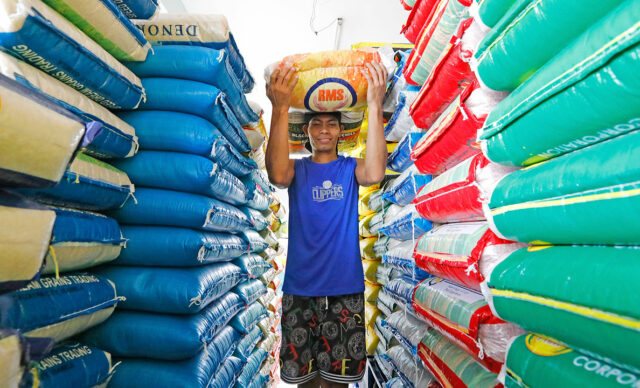
A STORE ATTENDANT carries a sack of rice at a storage facility in Marikina City. — PHILIPPINE STAR/WALTER BOLLOZOS

SURGING RICE PRICES in the Philippines could be a warning sign for other major importers of the food staple as the fallout from India’s export restrictions continues to reverberate across Asia and West Africa.

Rice inflation in the Southeast Asian nation increased at the fastest pace in almost five years in August, reviving memories of a 2018 shock that led to the end of a two-decade-old limit on imports. The Philippine central bank warned this week that it’s ready to resume monetary tightening if needed, while diplomacy and deals reign elsewhere as other countries rush to secure supply.

“We’re seeing a great deal of uncertainty,” said Shirley Mustafa, an economist at the United Nations’ Food and Agriculture Organization. “Price pressure is being exacerbated by the restrictions.”

India’s restrictions have upended the market and prompted worried nations to secure supply as they try and contain the rising cost of rice, which is a vital part of the diets of billions of people across Asia and Africa. Manila has placed a cap on prices, a measure that’s led to the downfall of a finance official.  

Finance Undersecretary Cielo Magno said she will resign after a Facebook post that appeared to question the recently implemented price cap. The limit was imposed earlier this month after an “alarming” increase in retail costs.

Supply security is at the top of the agenda for many consumers. Philippine President Ferdinand R. Marcos, Jr. and Vietnamese Prime Minister Pham Minh Chinh met on the sidelines of the ASEAN Summit in Jakarta and are planning a five-year deal. Senegal is making diplomatic overtures to India, taking similar steps to other nations including Guinea and Singapore to ensure supply.

Indonesia has agreed to sign a supply agreement with Cambodia for the first time in over a decade. The memorandum of understanding is for as much as 250,000 tons a year, more than double the volume of a similar deal in 2012. Jakarta has already pledged to provide 10 kilograms of the grain each month to millions of poor families during the fourth quarter of this year.

Other nations are taking steps to stem rising costs. Malaysia has implemented a purchase limit and started checks on wholesalers and commercial millers after allegations that local grain was being sold as imported rice at a higher price. Myanmar has also imposed a mandatory system to record volumes of stored rice to control domestic prices and deter speculation.

Some heat came out of the market this week with Asia’s rice benchmark dipping slightly, but prices are still near the highest level since 2008. — Bloomberg

Is my Prada bag real? New ways to spot fake designer purses

FOR almost a decade, I’ve been listening to digital prophets predict a future where banks save billions of dollars, customers can trace their mangoes back to the organic farm where they were grown, and financial intermediaries are a thing of the past, all thanks to the blockchain. I’ve been waiting for that future to arrive, but I’ve never come across it in my daily life.

Imagine my surprise, then, when I encountered the word “blockchain” inside a Miu Miu bag.

I’d recently purchased the bag, and a little white card was tucked away in a pocket. On the piece of 100% recycled fiber, it read: “This authentic Prada product’s certificate has been uploaded on Aura Blockchain Consortium’s platform to record and guarantee its integrity.”

Miu Miu’s parent company, Prada Group, is one of several major luxury houses investing in high-tech ways to track their most coveted and most expensive products. Over the past year, brands including Loro Piana, Louis Vuitton, and Maison Margiela have launched services built on the Aura consortium’s blockchain that allow customers to verify that their item isn’t a knockoff.

THE RISE IN COUNTERFEIT LUXURY BAGS
The hope is that tracking handbags, coats, watches, and diamond rings this way could be a game changer in the industry’s fight against the ballooning counterfeits market. As much as $464 billion worth of counterfeit and pirated products changes hands each year, accounting for 2.5% of world trade, according to a 2019 estimate by the Organization for Economic Cooperation and Development.

Blockchain technology is just one of the weapons deployed by the sector in years long battle against fakes. Recent efforts include Richemont’s new platform for sharing information about lost or stolen watches and jewelry and LVMH-owned Patou launching an AI-based verification system called Authentique Verify.

Giving customers a more reliable way to prove their products are real could help raise the appeal of originals, while making it harder to sell fakes on the secondhand market. And by making it easier for customers to pass on or resell their products, the technology could help prove the case that many of these highly priced items have some investment value.

“A digital certificate of authenticity is a huge, huge problem solver,” says Stefano Rosso, chairman of the French fashion house Maison Margiela and chief executive officer of BVX, which are both part of OTB Group. “In parallel, it helps us market the product and track its origins.”

OTB is a member of the Aura Blockchain Consortium, which runs blockchain technology specifically for luxury brands. The consortium was founded in 2021 by LVMH, Prada Group, and Richemont, and joined later by OTB and Mercedes-Benz. When customers look up one of the 600,000 OTB products registered, they don’t just do it on any random website; the brands control which goods are registered on the platform.

The concept of a blockchain — where transactions are recorded online, on a system run by many computer servers — first gained notoriety as the system underpinning such cryptocurrencies as Bitcoin. Information on blockchains is hard to tamper with, which many believe makes them an ideal tool for complex record-keeping, such as tracking a product’s origin or supply chain. It helps solve a big problem in the online world — lack of trust — that some believe is transferrable to products in the real world.

Other sectors have been toying with the technology for years, but have yet to implement any applications at scale. Wall Street, for instance, has been at the forefront of developing blockchain systems, but things have moved more slowly in a highly regulated environment with complex systems already in place. The consequences of an outage, say, in a system clearing equities trades would be quite different from a glitch in a system that tracks handbags. Some progress is still being made, but many projects announced years ago have yet to be implemented, while others have been scrapped.

Despite the billions of dollars invested, you’d be hard-pressed to find mainstream adoption of applications beyond cryptocurrencies. The deployment of blockchain across luxury goods will be a significant test of whether the technology has any utility at a scale beyond its original use case.

USING BLOCKCHAIN FOR AUTHENTICITY IN DESIGNER HANDBAGS
OTB’s service allows customers to tap their smartphone, for example, on a new pair of Maison Margiela Tabi shoes, which have NFC chips embedded in them. The chip instructs the phone to open a website with the product’s authenticity certificate, which is provided by the Aura Blockchain Consortium, and information about where the shoes were made (Italy).

Similarly, earlier this year, LVMH’s Loro Piana launched a service allowing customers to scan a QR code on labels of its high-end Gift of Kings garments to verify their authenticity — pretty important when buying one of its T-shirts, which can cost £1,665 ($2,100). Customers can also register themselves as the garment’s owner and find information about its origins, down to the batch of fine merino wool used to make a T-shirt. (It’s very soft and comes from select sheep farms in Australia and New Zealand.)

“We believe that blockchain is a strong enabler to augment everything related to traceability, origin, authenticity from the beginning of the story starting at the raw material level,” Franck Le Moal, LVMH Moët Hennessy Louis Vuitton’s group IT and technology director, said in an interview. “One day every product in the luxury industry will be able to benefit or be augmented by a digital product passport or certificate.”

Some experts think it won’t.

“I remain skeptical about the robustness or usefulness of blockchain solutions that attempt to bridge physical assets with the esoteric nature of blockchain networks,” says Colin Platt, who advises and consults companies on blockchain projects. “What happens if I pull that NFC chip out of the bags, make 10,000 copies and put them in 10,000 fake bags? Who owns the real bag?”

Applications built using the Aura Consortium’s technology use different layers of security including encrypted NFC chips, a spokesperson said.

Mr. Platt also wonders what would happen if people sell the bags without registering the change of ownership on the system. “If you sell the bag to your friend and don’t update the blockchain, who owns the bag?” he says. “You or your friend?”

Prada Group integrated blockchain tracking into its new Fine Jewelry Eternal Gold line as it began work on building its sustainable supply chain for recycled gold that took more than one year to set up. The line made its debut in October and uses 100% certified recycled gold and stones purchased from suppliers who meet high standards on human rights, labor safety, environmental impact and business ethics.

Customers can use their phones to tap a piece of jewelry’s card — including that accompanying a yellow gold chain necklace that costs £25,500 — to pull up a certificate of authenticity, its carbon footprint, and information on the material used. This helps tell the brand’s sustainability story, as customers can verify that the materials used effectively meet the criteria that is advertised, Timothy Iwata, Prada Group’s managing director of fine and high jewelry, said in an interview.

MAKING SURE GIFTS, PREOWNED LUXURY HANDBAGS ARE REAL
A digital certificate and tamperproof online records of who owns a product could make it easier for customers to pass items on to family and friends, executives say. Traditionally, certificates of authenticity have been plastic or paper cards with serial numbers, which can easily get lost or thrown out over the years. An inherited item might not come with that certificate, making it hard for the recipient to know whether the product is real. Instead, the ownership information is stored online.

The technology would also make it less risky for luxury houses to enter the secondhand market, says Daniela Ott, Aura Blockchain Consortium’s general secretary and a former chief operations officer at Kering’s luxury division. Companies could facilitate secondhand sales without worrying that they’re fencing fakes.

The technology can also help track the product’s sale and repair history, says Pierre-Nicolas Hurstel, CEO of Arianee, a startup that works with consumer brands to build blockchain applications. Sitting at a cafe in Paris earlier this year, Mr. Hurstel showed information about the authenticity and history of his Panerai watch, which he’d scanned with his phone. It included the date of sale, warranty expiry, and more.

Soon, Mr. Hurstel said, consumers could have a digital wallet on their phone containing certificates for all the valuable products they own. This could have an unexpected downside for luxury goods purveyors: A stronger secondhand market could make customers a bit too confident.

“This is not good for brands trying to avoid ubiquity and selling the promise of exclusivity,” says Luca Solca, a global luxury goods, senior research analyst at Alliance Bernstein.

THE IMPORTANCE OF AUTHENTICATION IN DESIGNER HANDBAGS
After I pulled the card out from my Miu Miu bag, I thought, “OK, so now what?” The card had no instructions for how to gain access to the digital certificate to verify its registration on a blockchain network. Was my bag actually on the blockchain?

After several rounds of questioning, Aura Consortium’s and Prada’s press teams said I couldn’t yet certify the bag myself, but Prada Group could access the information through an NFC chip inserted in the item.

“By having the Aura label on their products, Prada Group is telling their customers that it has been injected onto the blockchain,” Prada said in a statement. “They have the comfort of knowing that it is authentic and has its immutable own identity.”

In other words, “trust us.”

My comfort levels were minimal. Especially after the bag’s strap broke in April and I took it to Miu Miu’s store on London’s New Bond Street for repairs. No one scanned it in front of me to verify its authenticity.

Instead, a salesperson looked up my details on a tablet. The store’s system pulled up the products I owned from the group. The bag and parts were collected, and shipped abroad for repairs. A few weeks later, a representative messaged me on WhatsApp to tell me the bag had arrived. I collected it by giving them my name and the bag model. That was that. — Bloomberg


Rustan’s Beauty Hall gets prettied up

RUSTAN’s annual Beauty Addict event served as the formal launch of the newly renovated Beauty Hall in the department store chain’s Makati flagship. While the Beauty Hall has already been open for several months, the store gussied up its front with fairy lights to greet guests during the event on Sept. 7. Guests went to each of the beauty brands’ counters where stations were set up for guests to play games and win samples.

Renovations for the Makati flagship store had been announced before the COVID-19 lockdowns of 2020. Due to the delays caused by the pandemic, they only finished the makeover this year.

“There’s really a grand plan. It’s not just here [the beauty section],” Jackie Avecilla, Marketing and Communications Head for Rustan’s Beauty told BusinessWorld during the event. “The renovation just starts here, but the long-term plan is to renovate each of the floors, one by one.

“We didn’t want to close down the entire store, that’s why we’re going to do it in portions.”

Ms. Avecilla says that they started with the Beauty Hall because of the importance of the category within the Rustan’s chain. Unable to divulge exact figures, “I can say it’s the biggest [category] in the entire Rustan’s,” she said. “I know from the sales figures that it is the biggest, and I think that’s why also, when the renovation came to mind, the priority was really for beauty.”

She pointed out the changes in the section: it’s more brightly lit, is in a refined palette of neutrals, and has a more open layout. A fragrance library that holds most of the store’s fragrance lines stands in a corner once devoted to clothes.

She also pointed out new brands that are now available: Shiseido’s top luxury line, Clé de Peau Beauté, Swedish beauty brand LA bruket, and Greek cosmetics company Korres. She did remind us that “the staples are all here,” citing Chanel and Tom Ford as examples.

Brands that had independent stores that were right outside the store (L’Occitane, for one, and MAC) were brought inside. “The goal is to have all the brands inside the store,” said Ms. Avecilla.

From Sept. 8 to 17, participating Rustan’s beauty brands will have one-week promos available in all Rustan’s stores, Personal Shopper On Call, and Rustans.com. Furthermore, from Sept. 1 to Nov. 30, Rustan’s will be welcoming the holiday season with the Beauty Addict Holiday Gift With Purchase. For a minimum receipt purchase of P30,000, Beauty Addict members are entitled to a complimentary Make It Pop Floral Jewelry Box from Kate Spade New York.

Running simultaneously is the Beauty Addict Holiday Raffle. One lucky Beauty Addict winner can win the grand prize of a three-night luxurious stay for two at an exclusive hotel in Paris, France inclusive of Singapore Airlines KrisFlyer miles, redeemable for a Business Class Saver Award ticket to Paris, France. For every purchase of P2,500 worth of products and services from Rustan’s The Beauty Source, Beauty Addict and KrisFlyer members are entitled to one electronic raffle entry, while Metrobank cardholders who are also Beauty Addict and KrisFlyer members, are entitled to two electronic raffle entries when they shop until Nov. 30, 2023. — JLG

Maharlika expected to generate 100,000 jobs

THE Maharlika Investment Fund (MIF) is expected to generate 100,000 direct and indirect jobs as its initial capitalization becomes fully paid in over the first 10 years of operations, the Department of Finance (DoF) said.

The MIF is also expected to contribute 0.07 percentage point (ppt) to gross domestic product (GDP) each year over the same period, the DoF said, also citing data from the National Economic and Development Authority (NEDA).

“Due to spillover effects, the value added generated through investment activities in the first 10 years of the Fund is expected to still contribute 0.01 ppt annually to growth over the next 11-20 years,” it added.

The sovereign wealth fund will be managed by the Maharlika Investment Corp. (MIC), which will have authorized capital stock of P500 billion.

The MIC’s initial P125-billion funding will come from the National Government (P50 billion), the Land Bank of the Philippines (P50 billion) and Development Bank of the Philippines (P25 billion).

Under a scenario in which the MIF is not established and the government keeps the P125 billion, the retained initial capitalization is expected to contribute 0.06 ppt to growth.

“There are no spillover effects expected in this scenario,” the DoF added.

A further scenario has the MIF generating 0.2 ppt in GDP growth annually if “in addition to co-investments generated with other parties, the P500-billion authorized capital stock of the corporation can be fully paid in over the course of the first 10 years of operations.” 

“Job creation, both direct and indirect, is projected at 350,000,” it added.

Spillover effects from this scenario are also expected to contribute 0.05 ppt annually to growth over the next 11 to 20 years.

“NEDA also approximates when the impact of the investments in the following will be felt in the capital markets (in the) first few years (and) sectoral investments (in) five to seven years,” it added.

Meanwhile, Finance Secretary Benjamin E. Diokno clarified that the president and chief executive officer (CEO) of the Maharlika Investment Corp. (MIC) needs to be Filipino.

“I know the head of the MIC should be Pinoy. But independent directors (can be foreigners),” he said.

The implementing rules and regulations (IRR) of the Maharlika law do not explicitly state that the MIC president and CEO should be Filipino.

The MIC president and CEO is only required to hold an advanced degree (MBA, MA, MSc, PhD) in finance, economics, business administration, or any related field from a reputable university.

It also requires a minimum of 10 years in a senior leadership role in a “reputable financial institution or public or private sector organization.”

On the other hand, regular directors must be Filipino citizens and at least 35 years old.

Regular and independent directors are also both required to have a master’s degree in finance, economics, business administration and have at least 10 years’ experience in finance, investment, economics, business, or any related field.

The Bureau of the Treasury has started accepting nominations and applications for the president and CEO, independent directors, and regular directors.

The deadline for nominations and applications is on Sept. 27. — Luisa Maria Jacinta C. Jocson

Wild comedy Poor Things wins top prize at Venice Festival

Emma Stone and Ramy Youssef in a scene from Poor Things. — IMDB

VENICE — Poor Things, a gothic, sex-charged comedy directed by Greece’s Yorgos Lanthimos, won the prestigious Golden Lion award at the Venice Film Festival on Saturday.

Starring Emma Stone, Willem Dafoe, and Mark Ruffalo, the British-made film wowed festivalgoers with its zany story of a woman reanimated after suicide by a mad doctor who replaces her brain with that of her unborn baby.

Childlike but with an adult’s body, Ms. Stone’s character Bella Baxter grows increasingly independent and excited by her sexual experimentations as she undertakes a voyage of self-discovery through a surreal version of 19th century Europe.

“The central character is Bella Baxter, an incredible creature, and she would not exist without Emma Stone, another incredible creature,” said Mr. Lanthimos, whose previous films include The Favorite and The Lobster.

Venice marks the start of the awards season and regularly throws up big favorites for the Oscars, with eight of the past 11 best director awards going to films that debuted here.

The top acting awards at the festival went to two US stars — Cailee Spaeny, who played the former wife of Elvis Presley in the biopic Priscilla, and Peter Sarsgaard, who featured in the gritty family drama Memory.

The runner-up Silver Lion award went to Evil Does Not Exist, an enigmatic, rural drama directed by Japan’s Ryusuke Hamaguchi — the only Asian entry among the 23 films competing for the main prize.

STRIKE ACTION
Saturday’s ceremony wrapped up the 11-day movie marathon, which drew an array of top films to Venice, but far fewer stars than normal as a long-running Hollywood actors’ strike prevented many A-listers from coming to promote their work.

Actors and writers are demanding that streaming sites and film studios improve their contracts and impose curbs on the use of artificial intelligence.

Collecting his award, Mr. Sarsgaard said AI had to be curbed, warning that the issue had implications that went far beyond Hollywood.

“This holy experience of being a human will be handed over to the machines and the eight billionaires who own them. So if we lose that battle in the strike, our industry will be the first of many to fall,” he said.

Among other prizes handed out in Venice was a special Jury’s Award for Green Border, a harrowing film about migrants trapped on the Polish-Belarus border, directed by Poland’s Agnieszka Holland.

Best director went to Italy’s Matteo Garrone for Me Captain, another gripping migrant movie, which follows two teenagers from Senegal as they cross Africa hoping to reach Europe. The young star of the film, Seydou Sarr, won the award for best emerging actor or actress.

Best screenplay went to Guillermo Calderon and Pablo Larrain for the script of El Conde, a satirical film about Chilean dictator General Augusto Pinochet. — Reuters

How to be good to the planet while still being stylish

FASHION production creates up 10% of humanity’s carbon emissions, and yet 85% of all textiles simply end up in landfills. This according to the website of the Geneva Environment Network, a partnership of over 70 environmentally conscious organizations. It also cites plastics and chemical run-offs as industry byproducts filling up the world’s oceans. This information, plus an exhibit in SM Aura citing the ways fashion should be healing the world might make one think before shopping.

Fashion Forever provides an overview of the emerging fashion industry in Sweden and novel approaches in fashion design, production, and distribution. The exhibit, which opened on Sept. 8, is an initiative of the Embassy of Sweden in Manila, supported by the Swedish Institute, and held in partnership with SM Aura and Swedish clothing giant H&M.

Displays in the exhibits showed off clothes made of recycled materials, while homegrown brands Zarah Juan (a designer using natural materials) and Lily of the Valley (showing period underwear which is meant to reduce the presence of sanitary pads in landfills) also participated.

Notes across the exhibit showed various ways people can reduce the environmental impact of what they wear. Examples include clothes swapping, renting clothes, buying secondhand items, and simply buying better longer-lasting goods.

Dan Mejia, H&M’s Regional Head of Communications and PR for Southeast Asia, laid down the company’s initiatives for sustainability, noting that the company’s initiatives began back in 1997. “It was in 1997 when we created our Code of Conduct and launched a collection called Nature Calling — that’s when we pioneered the use of organic cotton. Today, 100% of the cotton we use in all our garments are either organic, recycled, or from Better Cotton (a non-profit that pushes for better cotton farming practices).”

“We acknowledge that we are part of the problem… not exactly the opening statement you would expect from us, but that is the truth,” said Mr. Mejia. “By we, I refer not only to H&M but to the entire fashion industry. We all have a stake here. Now, we may be one of the largest fashion retailers in the world, but we only represent 2% in the market. To move the industry to be truly fully sustainable, we need the other 98% to join in.”

Swedish Ambassador Annika Thunborg explained in a speech during the event that “The fashion industry is a big polluter and carbon emitter. Far too many textiles end up in trash bins and landfills, regularly thrown away with household waste. Each year, 4.3 million tons of textile waste is deposited or incinerated in the EU.”

After that depressing statement, she cited initiatives of the Swedish government to tackle the issue, which includes Textile & Fashion 2030, a government-supported initiative led by the University of Borås in collaboration with the Swedish School of Textiles, SmartTextiles, Science Park Borås, and the Research Institute of Sweden. This initiative aims to test and study different techniques of sustainable fashion settings of small-scale sustainability advancements and how these can be rolled out on the world stage. Another is the Swedish Textile Initiative for Climate Action (STICA), a network of businesses launched in 2018 that collaborate to reduce their climate footprint. H&M is a participant, as are Kappahl, Peak Performance, Acne, and Filippa K, in collaboration with Sustainable Fashion Academy.

“Upcycling, reusing, and eventually recycling, rather than using up even more virgin resources are some of the ways for the fashion industry to become good for the planet,” she said.

The Fashion Forever exhibit runs from Sept. 8 to 14 at SM Aura. The exhibit will also make an appearance at Cebu Design Week in November. — JLG

Steady earnings awaited for listed energy firms

BW FILE PHOTO

EARNINGS of listed energy companies are expected to be steady in the second half of the year if no unforeseen developments arise towards year-end, analysts said.

“In a general sense, the sector’s performance is likely to remain stable for the remainder of the year, assuming no stringent regulatory developments,” Luis A. Limlingan, head of sales at Regina Capital Development Corp., said in a Viber message.

“Apart from regulatory factors, fuel and coal prices, infrastructure investments, and weather-related power demand will influence the profitability of power firms,” he added.

For Toby Allan C. Arce, head of sales at Globalinks Securities and Stocks, Inc., the earnings outlook for energy companies is “complex and uncertain” as there are several factors that may affect the performance of the sector.

“Some analysts expect that power companies may see a moderate increase in their earnings in 2023, driven by the growth in electricity sales, the improvement in plant efficiency, and the reduction in operating costs,” he said in a Viber message.

“However, this outlook is subject to risks and challenges, such as regulatory uncertainties, environmental issues, technical problems, and market competition,” he added.

For the second quarter, listed energy companies posted mixed results.

Manila Electric Co. registered an attributable income of P9.78 billion, up 45% from P6.74 billion in the previous year, on the back of higher sales of electricity and other services.

Aboitiz Power Corp. reported a nearly 45% increase in attributable net income to P10.29 billion from P7.10 billion a year earlier after an increase in revenues from its operating segments.

For First Gen Corp., its renewable energy business drove its attributable net income, which rose by 29.6% to $77.21 million from $59.56 million previously.

The expansion of renewables also boosted the income of ACEN Corp. to P2.21 billion, higher by 24.2% from P1.78 billion a year ago.

“The government’s policies on renewable energy (RE) would be a positive factor for power companies that are involved in renewable energy, such as solar and wind power,” Mr. Arce said.

The government targets to increase the share of RE in the country’s energy mix to 35% by 2030 and 50% by 2040.

Last year, the Department of Energy raised the required share of RE for distribution utilities under its renewable portfolio standard or RPS program to 2.52% per annum starting this year from 1% per annum previously.

Meanwhile, Semirara Mining and Power Corp. reported a second-quarter attributable net income of P10.19 billion, down 5.5% on reduced domestic coal sales.

Mr. Limlingan said that the weak coal sales were due to normalized prices despite sustained high demand.

“The third quarter would be challenging but management continues to be bullish as the power segment picks up and the high demand for coal sustains,” he said.

The growth of energy companies for the remainder of the year will depend on power demand and the movement of fuel prices as the “Ber” months kick off.

September to December are associated with cooler temperatures in the Philippines and increased consumer spending due to holiday expenses, Mr. Limlingan said.

“Hence, this translates to lower residential power demand, but we are likely to see higher commercial power demand,” he said, citing visits to “leisurely places” such as malls.

Mr. Arce said possible oil increases will likewise increase the cost of coal and natural gas, resulting in higher fuel prices.

“If the price of oil increases, it would also increase the cost of coal and natural gas, which are the main fuels used to generate electricity in the Philippines,” Mr. Arce said.

In August, fuel retailers raised pump prices by P5.90 per liter for gasoline, P9.90 per liter for diesel, and P10 per liter for kerosene.

Oil prices inched up by 1% on Friday as the market worried about tight supply after Saudi Arabia and Russia announced their decision last week to extend voluntary oil cuts to the end of the year, Reuters reported. — Sheldeen Joy Talavera

ADVERTISEMENT
ADVERTISEMENT