Home Blog Page 4320

Asian Champions League spotlight falls on Saudi clubs

HONG KONG  — Five times UEFA Champions League winner Cristiano Ronaldo will begin his quest to add another continental title to his resume on Tuesday when Saudi Arabia’s Al-Nassr kick off their Asian Champions League campaign against 2020 runners-up Persepolis.

The Portuguese, who won his European titles with Manchester United and Real Madrid, and a host of other high-profile players lured to the Saudi Pro League will add significant stardust to Asia’s premier club competition when it begins this week.

Al-Nassr are one of 40 clubs from 20 leagues across the confederation drawn in 10 groups to face one another from Monday, with only the winners guaranteed to advance to the knockout rounds in the quest for the top prize of US$4 million.

That sum seems inconsequential compared to the amounts spent by Saudi clubs to acquire a band of experienced talent in an effort to bolster a league already among the continent’s best.

Al-Hilal, who signed Neymar from Paris Saint-Germain for 90 million euros in August, are the competition’s most successful club, winning the title on four occasions and losing in the final of the most recent edition to Japan’s Urawa Red Diamonds.

Coached by Portugal’s Jorge Jesus, the Riyadh-based squad includes 12 players who represented Saudi Arabia at the last World Cup and have been further bolstered by the signings of Aleksandar Mitrovic, Ruben Neves and Sergej Milinkovic-Savic.

Al-Hilal kick off their campaign on Monday against Uzbekistan’s Navbahor in Group D – which also features Mumbai City and Nassaji Mazandaran from Iran – and will be able to field up to six foreign recruits after regulations on overseas players were relaxed by the Asian Football Confederation.

Karim Benzema’s Al-Ittihad, the reigning Saudi Pro League champions, will be looking to win their first Asian title since 2005 and launch their campaign against Uzbekistan’s AGMK before facing Iran’s Sepahan and Air Force from Iraq in Group C.

Saudi teams are expected the dominate the west Asian half of the draw with Japanese clubs attempting to maintain their position of pre-eminence in the east.

Urawa travel to meet Chinese champions Wuhan Three Towns in their Group J opener on Wednesday having also been drawn with Pohang Steelers and Hanoi FC while J.League title holders Yokohama F Marinos start their campaign against Incheon United.

Kawasaki Frontale, meanwhile, face a tricky opener against Malaysia’s Johor Darul Ta’zim in Group I, which also features twice winners Ulsan Hyundai from South Korea and Thailand’s BG Pathum United.

The group stages of the competition, the last under the current format, run until Dec. 13 with the knockout rounds kicking off on Feb, 12, with the final to be played home-and-away on May 11 and 18. — Reuters

Championship

Late last month, Giannis Antetokounmpo made clear that he wasn’t about to commit to the Bucks for the long haul until he becomes certain that they can legitimately vie for titles. In an interview with The New York Times, he argued that signing a contract extension this year “doesn’t make sense … Next summer, it would make more sense for both parties.” And he’s right, “numbers-wise,” as he said. The clincher, however, is his disclosure that “even then, I don’t know. I would not be the best version of myself if I don’t know that everybody’s on the same page, everybody’s going for a championship, everybody’s going to sacrifice time away from their family like I do. And if I don’t feel that, I’m not signing.”

For someone like Antetokounmpo, who had hitherto displayed unshakable loyalty for the small-market Bucks in spite of his pull as a two-time Most Valuable Player awardee, the statements signified a significant departure from the norm. And he wasn’t just having a bad day when the NYT’s Tania Ganguli sat down with him. Last week, he reiterated his stance on “48 Minutes,” a podcast hosted by former assistant coach Ross Geiger. “I want to be a winner. Contracts, fame, status, comfort zone does not matter to me, What matters the end of the day is that thing right there,” he contended as he pointed to the Larry O’Brien Trophy behind him.

Antetokounmpo acknowledged the significance of the championship he led the Bucks to in 2021; they were down zero-two prior to claiming the last four matches and their first title in half a century. Nonetheless, he doubled down on his intent to wrap his arms around the hardware anew. “I don’t want to get stuck in this lifetime to keep on talking about the same story,” he said. “I want to create new memories. I want to win another championship.” Which, in a nutshell, places the onus on the green and cream to keep improving their roster for sustained viability. The task won’t be easy. Vital cogs Khris Middleton and Brook Lopez are locked in for the foreseeable future, but they’re getting ahead in age. Meanwhile, Jrue Holiday, one of the league’s best at the point, is in the midst of what he has stated would be his last contract.

For the Bucks, Antetokounmpo’s mere presence assures them of relevance. That said, it’s one thing to make the playoffs as a middling contender, and quite another to be justified in casting moist eyes on the crown. And, as currently constructed, their lineup is spotty at best. Heck, they do not even have an adequate backup at the one spot. Little wonder, then, that the Greek Freak has put them on notice. It’s not unlike the way other superstars in the National Basketball Association have tried to influence outcomes, but with a twist. In his case, he wants to stay, and is simply putting them on notice this early.

Perhaps “simply” isn’t the operative word, because Antetokounmpo isn’t just any other leading light. He’s a generational talent, which is why officials in other franchises already pursed their lips in anticipation of him changing addresses when he spoke out. What will actually happen, though, is anybody’s guess at this point.


Anthony L. Cuaycong has been writing Courtside since BusinessWorld introduced a Sports section in 1994. He is a consultant on strategic planning, operations and human resources management, corporate communications, and business development.

Philippines must build permanent structures in S. China Sea — analysts

REUTERS

By Kyle Aristophere T. Atienza, Reporter

THE PHILIPPINES should build permanent structures within its exclusive economic zone (EEZ) in the South China Sea with the help of allies to deter China from further advancing its claim of maritime areas and resorting to more swarming activities in the West Philippine Sea, analysts said on Sunday.

However the same analysts acknowledged that doing so could raise concerns over Manila’s commitment to a 2002 agreement that seeks to prevent new initiatives in the waterway that could disrupt the status quo.

Last week, the National Security Council of the Philippines reported that Chinese research vessels had been roaming the eastern side of the West Philippine Sea, just as the military flagged the resurgence of Beijing’s swarming tactics.

Enrico Cau, associate researcher at the Taiwan Center for International Strategic Studies, said China’s swarming activities, which were also spotted near the gas- and oil-rich Reed Bank (Recto Bank), may be aimed at testing the Philippines’ resolve and capability to enforce its maritime sovereign rights “in preparation for a Chinese takeover with the construction of new outposts in mind.”

“Another potential reason could be signaling displeasure with the Philippines’ recent decision to engage in closer cooperation with the United States and its partners, whose joint activities include joint patrol around the areas,” Mr. Cau said in a Facebook Messenger chat.

Should joint patrols with other nations and increased patrols by the Philippine Coast Guard and the Philippine Navy fail to temper China’s actions, “the key deterrent remains the construction of physical, habitable infrastructure in the features,” Mr. Cau said.

“The presence of such infrastructure would not stop the Chinese units from besieging the features, but would render useless their claims and stem their attempts to build new infrastructure,” he said, noting that Manila may rely on joint task forces for resupply missions to the proposed infrastructure “until the Philippines builds a strong-enough Navy to carry out the task itself.”

Last week, the Armed Forces of the Philippines – Western Command (WESCOM) reported spotting 23 Chinese fishing vessels in Iroquois Reef, near Reed Bank.

“Additional swarming was observed in Escoda (Sabina) Shoal, where five Chinese fishing vessels were present, and in Baragatan (Nares) Bank, with two Chinese fishing vessels recorded,” the WESCOM reported.

Raymond Powell, South China Sea lead at Stanford University’s Gordian Knot Center for National Security Innovation, said China’s swarming activities “create a security dilemma for Philippine security vessels, which have no simple means to disperse them.”

“China frequently uses vessel swarms to assert its sovereignty over particular West Philippine Sea (WPS) features, such as Sabina Shoal or Iroquois Reef,” he said in a Twitter message. “Often, Chinese militia ships will “raft” together, essentially creating a floating outpost deep in the Philippines’ exclusive economic zone.”

Blake Herzinger, a research fellow in the Foreign Policy and Defense Program at the United States Studies Center, said the Philippine government should replace BRP Sierra Madre – a dilapidated World War II-era warship deliberately grounded on Second Thomas Shoal (Ayungin Shoal) — with a permanent structure that will be manned by Filipino and American forces.

“The United States and the Philippines should act before being forced to react to deteriorating conditions aboard the ship,” he said in analysis published by Texas National Security Review, noting that failure to do so would create conditions “for loss of Philippine sovereignty, a reenactment of China’s seizure of the Philippines’ Scarborough Shoal in 2012.”

Recently, NSC Assistant Director-General Jonathan E. Malaya said legislators have proposed the inclusion of a P100-million fund in next year’s national budget for the proposed construction of a permanent structure in Ayungin Shoal.

Should the proposal generate controversy vis-a-vis the 2002 Declaration on the Conduct of Parties in the South China Sea, there should be discussions on how China’s selective incorporation of the deal has put smaller claimants like the Philippines at a disadvantage, said Don Mclain Gill, who teaches foreign relations at the De La Salle University in Manila.

It is Mr. Gill’s opinion that “whatever the Philippines does in its waters will always align with international law and the 2016 ruling.”

“At a time when the BRP Sierra Madre’s conditions continue to deteriorate, China will be closely monitoring this development to navigate how far it can go in terms of its adventurism in Philippine waters,” Mr. Gill said. “It is therefore inevitable and undeniable how maintaining a more formidable structure in the WPS is important for Manila.”

Chester B. Cabalza, founder of Manila-based International Development and Security Cooperation, said other South China Sea claimants like Vietnam and Malaysia have been able to develop their claimed features in the waterway “without the interference of China.”

He said the Philippines’ may harness its growing relationships with the US, Australia, and Japan in upgrading its facilities in the maritime areas within the country’s EEZ.

For Lucio B. Pitlo III, a research fellow at the Asia-Pacific Pathways to Progress Foundation, the Philippines should step up patrols and use available technologies like satellites to monitor situations as China reverts to its swarming activities.

“Relevant Philippine authorities should log the presence of such foreign fishing vessels, escort them out of the country’s EEZ and deter further intrusions,” Mr. Pitlo said via Messenger chat. “Incidents when such ships acted or behaved out of the ordinary should be noted.”

The documentation could be regularly published and serve as reference for filing necessary protests, he added. It could also be taken up with concerned neighbors in diplomatic discussions.

The latest Chinese swarming activity was reported days after the Chinese Coast Guard’s repeated attempts to block Philippine resupply missions to Second Thomas Shoal through dangerous maneuvers.

China has been pushing a narrative that the Philippine government had made a pledge in the past to remove BRP Sierra Madre from the shoal, which is about 200 kilometers from the Philippine island of Palawan and more than 1,000 kilometers from China’s nearest major landmass, the Hainan Island.

President Ferdinand R. Marcos, Jr. had said he’s “not aware of any such arrangement or agreement.” If such an agreement happened, “I rescind that agreement now.”

Experts have said Beijing’s narrative on BRP Sierra Madre is part of its attempts to advance its claims in the South China Sea through psychological warfare or disinformation.

Technology has helped  the government provide Filipinos with accurate information and combat false narratives, Philippine Coast Guard Jay Tristan Tarriela said in a tweet following his participation in Rappler, Inc’s technology-driven Social Good Summit.

“Despite having lesser technological capabilities compared to China, we have successfully countered their bullying behavior and even compelled them to modify their actions.”

“We firmly believe that the power of technology cannot be solely measured by its sophistication or complexity,” he said, “but rather by the positive impact it brings to the world.”


Better road design can help prevent road rage — experts

Motorists are stuck in traffic along Commonwealth Avenue in Quezon City, July 28, 2022. — PHILIPPINE STAR/MIGUEL DE GUZMAN

By Beatriz Marie D. Cruz, Reporter

TRANSPORT industry advocates urged the government to focus on improving the country’s road infrastructure, making it inclusive for all modes of transportation to reduce heavy traffic and incidents of road rage.

“Road rage is a complex phenomenon, and its root causes are debatable. We view it, however, in the simplest way possible, as the result of competition for time and space,” Primo V. Morillo, convenor of The Passenger Forum, said in a Viber chat.

“When we talk about time on the road, it usually means speed for motorists and when the need for speed overrides safety, road rage and accidents happen. When we talk about road space, it is about sharing the road and prioritizing those who have less horsepower like pedestrians and cyclists,” he said.

Last month, lawmakers filed House Bill No. 8991, the proposed Anti-Road Rage Act which seeks harsher penalties — such as imprisonment of up to 2 years and fines up to P100,000 — on motorists guilty of dangerous and impulsive behavior.

Road rage incidents resulting in injury would incur penalties of imprisonment of up to 4 years and a fine of up to P250,000. If the incident results in death, the guilty will be jailed for up to 12 years and fine of up to P500,000.

But Mr. Morillo said there are already existing laws that punish criminal acts on the road. “We have laws against unjust vexation, against light and grave threats, against slight and grave physical injuries, among others.”

“We don’t think a new law is necessary to lessen the incidents of road rage,” he noted.

AltMobility director Ira Cruz said that improving and ensuring a more inclusive kind of road infrastructure is the better long-term solution to traffic and road rage incidents.

“Infrastructure dictates behavior and so people behave the way they do on the road primarily because of the way that roads are designed,” Mr. Cruz said via telephone.

He noted that the government’s policies on road usage and transportation remain “car-centric,” or tend to favor four-wheeled vehicles.

The Metro Manila Development Authority (MMDA), the government agency in charge of managing traffic and road transportation in the country, said last month that it is looking to convert bike lanes into shared lanes, as these lanes are “underutilized.”

Active transport groups opposed the plan and supported the need for exclusive lanes for bikes and motorcycles.

A Social Weather Stations (SWS) survey showed that one bike exists in every three households in the country and noted an increase to 7.3 million cyclists on the road in April 2022 compared with only 6.2 million in 2021.

However, Mr. Cruz said that at the stakeholders’ meeting he attended, there was resistance from the MMDA to exclusively dedicate a lane for bicycles. “They (MMDA) continued to fear that it will disappoint… or it will cause complaints coming from [four-wheeled vehicle] motorists,” he said.

Mr. Morillo emphasized: “When we talk about road space, it is about sharing the road and prioritizing those who have less horsepower like pedestrians and cyclists.”

Meanwhile, Joey A. Concepcion III, Private Sector Advisory Council (PSAC) lead for jobs, had said that traffic — given the growing number of vehicles on the road — is synonymous with economic activity.

But Mr. Morillo said: “Heavy traffic as a barometer of a productive economy is flawed.” He cited a 2018 study from the Japanese International Cooperation Agency (JICA) stating that the country suffers a P3.5-billion economic loss daily from heavy traffic.

“It’s very important for any city that there be multiple modes of transportation. That people are able to select their mode of transportation,” Mr. Cruz said.

Mr. Morillo also called for better implementation of traffic rules by training enforcers not to tolerate forms of bribery like kotong (extortion) or lagay (grease money) so that motorists will not escape penalty.

“Solving road rage requires that our citizens believe in the rule of law, trust that the law applies to all, and have faith that no one is above the law,” he said.

Chiz to BoC: Sue rice smugglers

PHILIPPINE STAR/GEREMY PINTOLO

By John Victor D. Ordoñez and Luisa Maria Jacinta C. Jocson, Reporters

A PHILIPPINE senator has called on the Bureau of Customs (BoC) to file criminal complaints against rice smugglers, who he says are responsible for spiking grain prices.

“Why haven’t I heard anyone sued for economic sabotage or something? Who owns these warehouses? Who are the people involved?” Senator Francis “Chiz” G. Escudero said in a statement on Sunday.

He said the BoC should also disclose to the public known traders and operators whose warehouses were raided by state agencies and yielded hoarded grains.

“This is what they have to know the answer to: Who oversees the disposition and how will it be disposed of (criminal cases)?” Mr. Escudero said in Filipino, referring to the BoC.

Last Sept. 14, the BoC found reportedly smuggled rice worth an estimated P40 million during a raid of two warehouses in Las Piñas City in Metro Manila and Bacoor City in Cavite.

“The warehouses were verified storing/warehousing rice products from Vietnam, Thailand, and China,” the BoC said in a statement.

The BoC said the warehouse owner claimed that they were not importers but rice traders.

“During the investigation, it was discovered that the trader was selling a 25-kilo sack of Vietnamese rice for P1,320 in the market, equivalent to P52.8 per kilogram,” it added.

The BoC noted that the price significantly exceeds the Department of Agriculture’s (DA) prescribed range of P41-45 per kilogram for well-milled and regular-milled rice.

The warehouse owners have been given 15 days to submit necessary documents to support that their imported grains went through the proper legal processes.

Senator Cynthia A. Villar has sponsored a bill that seeks stiffer penalties against agricultural smugglers. Last Sept. 11, her proposed measure reached the Senate plenary for deliberations.

Citing government data, Ms. Villar, who heads the Senate Committee on Agriculture, said the government has been losing at least P200 billion in revenues due to smuggling.

DBM: Comply with SC ruling on Makati-Taguig budgeting

BW FILE PHOTO

THE DEPARTMENT of Budget and Management (DBM) is reminding various agencies to comply with the Supreme Court (SC) decision on the Makati-Taguig jurisdiction case with regard to budget planning and allocation.

In a circular letter dated Sept. 15, the DBM said that all government entities concerned should take all “appropriate action on budgeting matters and concerns relative to the Fiscal Year (FY) 2023 General Appropriations Act and the FY 2024 National Expenditure Program (NEP)” to comply with the SC decision.

The SC previously ruled in favor of Taguig City on the jurisdiction of Fort Bonifacio and the Enlisted Men’s Barrios (EMBO) barangays: CEMBO, COMEMBO, PEMBO, East REMBO, West REMBO, South CEMBO, Pitogo, Post Proper Northside, Post Proper Southside, and Rizal. — Luisa Maria Jacinta C. Jocson

Bar results to be released earlier

PHILIPPINE STAR/MIGUEL DE GUZMAN

THE SUPREME Court will release the results of this year’s bar examinations by early December before Christmas day, the bar chairperson said on Sunday.

At a press briefing, Associate Justice Ramon Paul L. Hernando said the earlier release date would allow passers to find employment quicker.

“For the longest time, Bar examinees have had to endure several months of perceived agony of waiting before the results of the professional licensure exams for future lawyers are released,” he said.

This year’s test for aspiring lawyers runs on Sept. 17, 20 and 24, earlier than the usual November schedule. Mr. Hernando said a total of 10,791 examinees will take the bar exams at 14 local testing centers nationwide.

The magistrate added that setting the oath-taking of the Bar passers earlier would allow the country to have more full-fledged lawyers this year.

Earlier, the High Court announced that it would condense topics such as commercial law and taxation law since they are similar fields of practice.

“We need to modernize the manner in which we admit those who wish to join our profession if we are to keep up with the best practices that other legal jurisdictions observe and implement in their respective areas,” Mr. Hernando had said. — John Victor D. Ordoñez

Lamitan gets drug rehab facility

COTABATO CITY — Efforts to rehabilitate drug dependents in Basilan province will now be easier with the construction of a reformation facility in Lamitan City, officials said over the weekend.

Christian O. Frivaldo, director of the Philippine Drug Enforcement Agency-Bangsamoro Autonomous Region in Muslim Mindanao (PDEA-BARMM), confirmed on Saturday the opening of the Balay Silangan Reformatory Center in Barangay Maganda in Lamitan City, which was built by the local government.

Mr. Frivaldo thanked Lamitan City Mayor Roderick H. Furigay and Basilan Gov. Jim H. Salliman for putting up the facility, which is critical in rehabilitation efforts for victims of drug abuse.

Echoing the same sentiments, Brig. Gen. Allan C. Nobleza, director of the Police Regional Office-Bangsamoro Autonomous Region, said: “We need the facility to hasten the reintroduction to the local communities of people once hooked to illegal drugs. We are thankful to the Lamitan City local government unit and the provincial government of Basilan for embarking on this project.” — John Felix M. Unson

P24-M airport development in Central Mindanao set to start

MLANG.GOV.PH

THE GOVERNMENT of Cotabato is set to start the implementation of the Central Mindanao Airport (CMA) development project worth P24,189,614.84 next week.

During the recent multi-agency pre-construction conference, Project Construction Engineer Heinrich A. Balacuting said the project includes: the rehabilitation of the passenger terminal building; construction of powerhouses; construction of vehicular parking areas; provision of concrete curbs, sidewalks, wheel stop, and pavement markings at VPA; construction of the 10,000 gallons water tank; construction of drainage systems and vertical path angle (VPA); and construction of transformer yard.

Governor Emmylou “Lala” J. Taliño-Mendoza said all efforts are being exerted to make the airport operational at the soonest time.

The CMA is included in the Mindanao Development Authority’s (MinDA) priority infrastructure projects portfolio and is seen to “catalyze inclusive and balanced rural development in Mindanao” and complement General Santos and Awang Airports in boosting economic activity. — Maya M. Padillo

Upheavals in Xi’s world spread concern about China’s diplomacy

REUTERS

BEIJING — The disappearance of China’s defense minister, the latest in a string of upheavals in the country’s top ranks, is stoking uncertainty about President Xi Jinping’s rule as an internal security clampdown trumps international engagement.

The growing unpredictability could affect the confidence other countries have in the leadership of the world’s second-biggest economy, diplomats and analysts say.

Defense Minister Li Shangfu, who has missed meetings including with at least one foreign counterpart since he was last seen in late August, is under investigation in a corruption probe into military procurement, Reuters reported on Friday.

Newly installed Foreign Minister Qin Gang vanished with scant explanation in July, the same month as an abrupt shake-up of the military’s elite Rocket Force, which oversees China’s nuclear arsenal.

As Mr. Xi, China’s commander-in-chief has focused inward, he caused concern among foreign diplomats this month by missing a Group of 20 summit in India, the first time he has skipped the global leaders’ gathering in his decade in power.

Faced with the growing uncertainties, some diplomats and analysts are calling for a hard look at the true nature of Mr. Xi’s regime.

“Clear-eyed assessments are needed — this isn’t just a question of whether China is a partner or a competitor, it is a source of economic, political and military risk,” said Drew Thompson, a former Pentagon official who is now a scholar at the National University of Singapore.

Due to a lack of transparency surrounding the changes, various explanations were plausible “and this feeds the crisis of confidence that is brewing around China,” Thompson said.

China’s Foreign Ministry did not immediately respond to a request for comment on Saturday.

PROXIMITY ISN’T PATRONAGE
Regarding Defense Minister Li’s disappearance and investigation, a ministry spokeswoman told reporters on Friday she was not aware of the situation. The State Council and Defense Ministry did not respond to requests for comment.

Since his appointment in March, Mr. Li has been the public face of China’s expanding military diplomacy, expressing concern over US military operations during a high-profile security conference in June and visiting Russia and Belarus in August.

He had been expected to host an international security meeting in Beijing in October and represent the People’s Liberation Army (PLA) at a meeting in November of regional defense chiefs in Jakarta.

With corruption long permeating China’s military and state institutions, some analysts and diplomats believe Mr. Xi’s anti-graft crackdowns mark political purges across the Communist Party.

“Regardless of the reason… the sense that this could keep happening could have an impact on foreign actors’ confidence in engaging with their Chinese counterparts,” said Helena Legarda, lead analyst with the Mercator Institute for China Studies in Berlin.

The Mr. Li upheaval is unusual for its speed and its reach into Xi’s hand-picked elites.

“This is all so sudden and opaque. One thing we can now see is that proximity does not equate to patronage in Xi’s world,” said Singapore-based security analyst Alexander Neill, an adjunct fellow with Hawaii’s Pacific Forum think-tank.

CONTINUITY RISK
Although not in a direct command position, Mr. Li serves on Mr. Xi’s seven-person Central Military Commission and is one of China’s five state councilors, a cabinet position that outranks regular ministers. Some scholars believe he is close to General Zhang Youxia, who sits above him on the commission and is Xi’s closest ally in the PLA.

Mr. Li, sanctioned by Washington in 2018 for an arms deal with Russia, shunned a meeting with US Defense Secretary Lloyd Austin at Singapore’s Shangri-la Dialogue security conference in June, where a handshake marked their closest interaction.

Mr. Austin and other US officials are keen to resume high-level talks between the two militaries regional tensions roil. But Beijing counters that it wants Washington to be less assertive in the Asia-Pacific.

Regional envoys say deeper Chinese military diplomacy is vital, particularly with the U.S. but also with other powers, as China increasingly deploys forces around Taiwan — the democratically governed island it claims — and across disputed parts of the East and South China Seas.

If Mr. Li’s fate “reflects Xi’s increasingly inward focus, it is not good for those of us who want greater openness and lines of communications with China’s military,” said one Asian diplomat.

As the PLA has an unprecedented level of military engagements with Southeast Asian forces this year, the recent swift changes back in Beijing “spur speculation and some concern about the continuity of policy,” said political scientist Ja Ian Chong at the National University of Singapore.

“A shake-up of the military at this time is likely to draw attention, given the heightened activity of the PLA near Taiwan and the East China Sea, as well as stepped-up paramilitary activity in the South China Sea, since such actions create potential risk of accidents, escalation and crises,” Ja Ian Chong said. — Reuters

Flood-hit Libyan city facing a long recovery

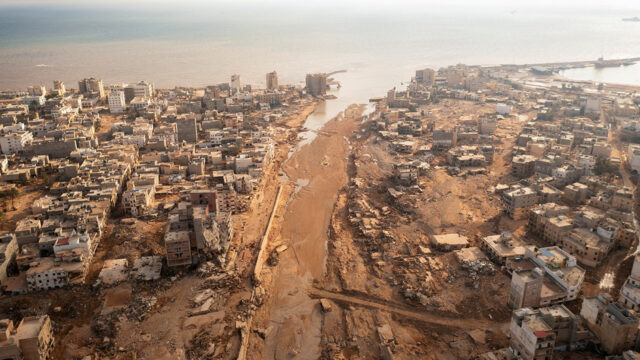
AN AERIAL VIEW shows the destruction, in the aftermath of the floods in Derna, Libya, Sept. 16, 2023. — REUTERS

DERNA, Libya — Residents of Derna in eastern Libya were counting their losses from a flood that devastated swathes of the coastal city as the search for the missing continued on Saturday for a sixth day and more bodies were pulled from the sea.

Central Street, once a focus of economic activity in Derna lined with shops, was largely deserted, the silence broken only by the sound of the wind whistling past mangled buildings as a few people sat disconsolate in the road, sipping coffee and surveying the damage.

“The first thing I’m afraid of is that this will take a long time,” said 44-year-old teacher Tarek Faheem al-Hasadi, whose wife and five young grandchildren were killed in the flood. He and his son survived by climbing onto the roof.

“This needs persistence and I’m afraid that the support that is coming is temporary,” he said between tears, standing guard in front his ruined home, but adding that he was determined not to leave the area.

A three-storey building standing opposite had been swept 60 meters (200 feet) down the road by the floodwaters, Mr. Hasadi said.

At Derna’s seafront, where a wrecked car could be seen perched on top of concrete storm breakers and driftwood was strewn across muddy pools, diggers worked to clear the path for rescue teams and a helicopter scanned the sea for bodies.

Entire districts of Derna, with an estimated population of at least 120,000, were swept away or buried in brown mud after two dams south of the city broke on Sunday night unleashing torrents of floodwater down a usually dry riverbed.

The International Organization for Migration mission in Libya has said that more than 5,000 people were presumed dead, with 3,922 deaths registered in hospitals. About 38,640 were displaced in the flood-stricken region.

The true death toll could be far higher, officials say.

“The situation is very, very tragic,” said Qais, a rescue worker from Tunisia at the seafront who only gave his first name. “We have never seen such damage caused by water.”

More than 450 bodies had been recovered in the past three days from the seashore, including 10 from under the rubble, said Kamal Al-Siwi, the official in charge of missing people.

“The work is ongoing and is very, very, very complicated,” he told Reuters. “This operation in my opinion, needs months and years.”

MASS GRAVES
The World Health Organization said on Saturday it had flown in enough emergency aid to reach nearly 250,000 people affected by Storm Daniel across eastern Libya, including essential medicines, surgery supplies and body bags for the deceased.

Saudi Arabia announced the departure of its first aid flight to Libya and Russia said the third of its aid flights had arrived carrying a mobile hospital.

An Italian naval ship docked in Derna with supplies including tents, blankets, water pumps and tractors, Italy’s Embassy in Libya said, posting photos of smaller vessels bringing equipment ashore.

More than 1,000 people have been buried in mass graves, according to the United Nations, drawing warnings from aid groups about the risk of contaminating water or causing mental distress to families of the deceased.

The head of Libya’s National Center for Disease Control, Hayder Al-Sayah, said there was little risk from corpses unless they were carrying diseases, but that recorded cases of diarrhoea had risen to 150 from 55 on Friday due to people drinking polluted water.  

Derna has been hit hard by the turmoil and conflict in Libya since the NATO-backed overthrow of Muammar Gaddafi during a popular uprising in 2011.

It was controlled for several years by jihadist militants before forces loyal to eastern-based commander Khalifa Haftar’s Libyan National Army (LNA) besieged and took control of the city in 2019.

Infrastructure across Libya has been degraded amid the political paralysis of the past decade, and experts had warned that Derna faced potential disaster if maintenance work was not carried out on the dams outside the city.

Libya’s continuing political divisions, with rival administrations and parliaments in the east and west, could hamper the aid effort. — Reuters

Lagarde seized ECB colleagues’ handsets to prevent leaks — sources

REUTERS

FRANKFURT/SANTIAGO DE COMPOSTELA — European Central Bank (ECB) President Christine Lagarde seized the mobile phones of her fellow policymakers at this week’s meeting and rebuked them for leaking crucial information ahead of a policy decision, two sources told Reuters.

The unprecedented move is the boldest step that Ms. Lagarde has taken to stop information leaking out from the Governing Council, an issue that has plagued her presidency as well that of her predecessor, Mario Draghi.

The 26 members of the Governing Council were told to hand over their mobile phones on Wednesday, the first day of the meeting, as policymakers were about to pick Claudia Buch as the ECB’s top banking supervisor, the sources familiar with the matter said.

The handsets were returned after Ms. Buch’s nomination as chair of the Single Supervisory Board, which oversees more than a hundred of the euro zone’s biggest lenders, had been announced, the sources added.

The decision was taken because the choice in 2018 of the current chair, Andrea Enria, appeared in the media before the official release, the sources said.

An ECB spokesperson declined to comment.

Ms. Lagarde’s move came a day after Reuters exclusively revealed the ECB would raise a key inflation forecast this week, which paved the way for an interest rate hike on Thursday.

Most economists and traders had expected the ECB to keep rates on hold, but many changed their view after the Reuters report was published late on Tuesday. Ms. Lagarde stigmatized the leak at the start of the two-day meeting, a criticism that was echoed by several colleagues.

DIVIDED
Ms. Lagarde inherited a divided Governing Council from Mr. Draghi, who had alienated so called hawks in the euro zone’s north with his ultra-easy monetary policy and abrasive management style.

She has steadily tried to create a more harmonious atmosphere and several sources agree she has largely succeeded.

Ironically, her efforts were helped by painfully high inflation over the past two years, which reduced the room for dissent and effectively forced the ECB to embark on a streak of interest rate hikes.

But as borrowing costs were pushed higher, more policymakers expressed reservations about further hikes, the sources said.

Ms. Lagarde said on Thursday the latest increase was backed by “a solid majority of the governors,” compared to all of them for the previous rise in July and a “very, very broad consensus” a month earlier.

Ms. Lagarde has spared no effort in trying to woo her colleagues.

Weeks into her term in 2019, they gathered at a German mountain castle where she pledged to spend more time listening, and not to front-run decisions before policymakers had weighed in, as Mr. Draghi was often accused of doing.

In return, she asked for governors to stop trashing policy decisions once taken, keep internal disputes out of the media and put their phones away while colleagues were speaking.

She also set informal guidelines last year instructing colleagues to present the majority view to the public after the ECB’s policy decisions, which are published on Thursdays, and hold back “personal” views until the following Monday. — Reuters

ADVERTISEMENT
ADVERTISEMENT