Home Blog Page 4317

Globe Business BPO HR Solutions paves the way for an empowered Philippine IT-BPM industry

Aware of the growing projection of talent requirement in the IT-BPM industry, Globe Business seeks to equip organizations with its comprehensive suite of solutions to streamline hiring, onboarding, and retention processes.

Globe Business, the leading enabler of digital transformation in the Philippines, reaffirms its commitment as the trusted business partner of the Philippine Information Technology and Business Process Management (IT-BPM) Industry with its BPO HR Solutions, designed to empower organizations in pursuit of hiring, retaining, and developing company talents.

The expansion of the IT-BPM industry has given rise to a talent and skills gap. As demands grow more complex, the need for specialized skills becomes increasingly apparent.

Globe Business understands that the heart of any successful business process outsourcing (BPO) operation lies in its people or human resources (HR). Its solutions are designed to provide assistance in human resources, facilitating a seamless journey through the entire HR process for BPOs.

Hiring and Onboarding: The Start of the Employee Journey

Traditional methods of talent acquisition often limit companies to local talent pools. With Globe Business BPO HR Solutions, however, the technology transcends these boundaries, allowing enterprises to tap into a larger talent pool through data-driven platforms and targeted digital marketing.

Globe Business employs hyper-targeted recruitment campaigns, leveraging data insights to connect with potential candidates on the channels they engage with the most.

Through Globe’s Inquiro, a data-driven solution to discover audience profiles beyond the existing network; AdSpark, a full-service digital agency that capitalizes on Globe’s customer intelligence, unique inventory, and telco assets; and M360, a web-based multi-channel message blaster, BPO companies can now take charge of their recruitment endeavors to ensure rapid and efficient hiring process.

Furthermore, enterprises can ensure faster and more efficient screening and scheduling of interviews with IVES, a cloud-based Interactive-Voice-Response (IVR) web application for automated calls; Yondu, offering a chatbot to answer application queries; and M360 for an easy-to-use SMS blast to applicants for any announcements.

According to McKinsey & Co., the onboarding process plays a significant role in shaping the employee experience, contributing to their long-term success within the company. The transition from candidate to employee, therefore, should be as seamless as possible.

In response, for the hiring and onboarding process for BPO enterprises, Globe Business offers end-to-end visibility that tracks the application funnel and optimizes HR processes.

As part of its suite of solutions, Globe Business helps companies create a distinct advantage in their hiring endeavors through Yondu and DigiOffice, offering a powerful Recruitment Management System; Load Up and GPlan Enterprise, providing efficient communication tools and load disbursement; and 917 Lifestyle, providing tailor-fit and exclusive onboarding packages for new hires.

More than a service provider, Globe Business endeavors to be a collaborative partner of BPOs in creating and maintaining seamless employment experiences for talents.

Redefining Retention: Unique Benefits for Employee Loyalty

Globe Business’ BPO HR Solutions also extends throughout an employee’s stay in the company. They include a transformative set of BPO Engagement and Retention Solutions curated to understand employee needs and foster an environment of growth and fulfillment.

With offerings including exclusive vouchers from AdRewards; talent upskilling from Globe University (GU) and DigiOffice; and fun engagement activities from Office GFest, IT-BPM companies can cultivate a workplace that delights and retains employees, encourages continuous learning, and fosters a vibrant and engaged community.

BPO HR Solutions offers comprehensive human resource tools and strategies tailored to address the industry’s most pressing challenges, ensuring sustainable growth amidst shifting industry landscapes.

The digital landscape is currently reshaping the landscape of various industries, including IT-BPM. Integrating Globe Business BPO HR Solutions into BPO processes ensures convenience, competitiveness, and long-term success.

Globe Business: Your Trusted Partner

As the industry sets its sights on achieving $58.9 billion in revenue and an additional 1.1 million workforce by the end of 2028, Globe Business BPO HR Solutions provides an answer to bridge the industry gap by combining digital transformation that creates a tangible impact.

Globe Business takes pride in being more than just a service provider. With its HR solutions for BPOs, Globe Business seeks to be a leading partner of BPO companies and the country’s IT-BPM landscape in their progress, innovation, and sustainable growth.

Learn more about Globe Business BPO HR Solutions at glbe.co/bposervices.


Spotlight is BusinessWorld’s sponsored section that allows advertisers to amplify their brand and connect with BusinessWorld’s audience by enabling them to publish their stories directly on the BusinessWorld website. For more information, send an email to online@bworldonline.com.

Join us on Viber at https://bit.ly/3hv6bLA to get more updates and subscribe to BusinessWorld’s titles and get exclusive content through www.bworld-x.com.
BSP proposes criteria to assess sustainable activities for banking

BW FILE PHOTO

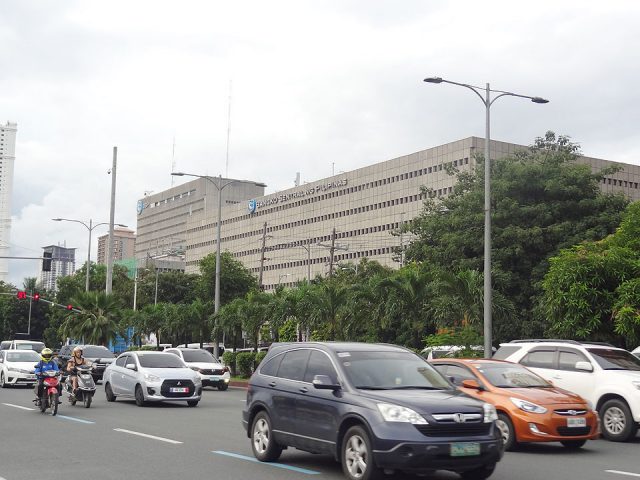
THE Bangko Sentral ng Pilipinas (BSP) is proposing three essential criteria that financial institutions and regulators can use to evaluate the environmental sustainability of their economic activity.

In a draft circular posted on its website, the central bank released a consultation paper that assesses the design of the Philippines Sustainable Finance Taxonomy Guidelines (SFTG) and outlines the proposed scope, objectives, and operations for the financial sector. 

Stakeholders have until Oct. 6 to give feedback on the proposed guidelines.   

The BSP proposed that for each economic activity to be taxonomy aligned, it should fulfill three “essential” criteria: do no significant harm (DNSH), remedial measures to transition (RMT), and minimum social safeguards (MSS). 

The criteria aim “to ensure that the activity does not contribute to an objective at the cost of doing damage to another objective or society,” the central bank said, adding that “they are particularly important in considering a just transition approach.”

A sustainable finance taxonomy serves as a guide for companies, investors, financial institutions, regulators, and consumers to help them make an informed decision on whether to finance, purchase, or monitor an asset, product, project, activity, company or portfolio that is aligned with the sustainability agenda.

According to the BSP, an activity should not do any significant harm to any other environmental objectives.

“For example, a wind farm that is built in a coastal area that is vulnerable to significant storm surges may significantly harm the climate change adaptation objective if it is not reasonably designed to withstand expected climate change impacts,” it said.

But if an activity does cause harm to another objective, it may still be aligned with the taxonomy given that it has taken RMT, which will require the removal of the significant harm within a specified time frame. 

“If significant harm is occurring or will occur, and RMT is not planned to be completed within the specified timeframe, the Activity is automatically classified as Red,” the BSP said.

“If an assessment shows that an activity is causing or may cause significant harm, the classification can be downgraded to a lower color-coded classification (e.g., Amber), pending effective remediation,” it said.

The central bank noted that the Association of Southeast Asian Nations (ASEAN) Taxonomy version 2.0 imposes a five-year time frame where any RMT should be fulfilled. 

The Philippine SFTG, at its current level, is mainly based on the ASEAN Taxonomy’s Foundation Framework as it is the main guide that aims to foster sustainable finance among the bloc’s member countries.

Meanwhile, the MSS is a set of standards that ensures entities comply with regulatory requirements and international social frameworks in conducting an economic activity that is suitable for sustainable financing.

“This assessment is typically done at the company level as opposed to the activity level. Applying this principle ensures that the activity achieving an environmental objective is not done while harming a social aspect,” the BSP said. 

The central bank proposes to adopt the three social safeguards of the ASEAN taxonomy to the Philippines. This includes the promotion and protection of human rights, prevention of forced labor, protection of children’s rights, and impact on people living close to investments.

Meanwhile, the BSP said the SFTG will be developed in phases, adopting as a first phase a “principles-based” approach to determining whether an activity aligns with the SFTG. It also draws on a range of national and regional taxonomy projects.

“The first phase will take a principles-based approach using qualitative assessments of activities or projects with emphasis on climate change mitigation and climate change adaptation objectives,” it said.

“The readiness of the financial sector and the limited availability of data favor this approach. Subsequent phases will extend the environmental objectives to the Protection of Biodiversity and Transition to a Circular Economy,” it said.

A “traffic light” classification system will also be used. Activities will be assessed with a series of guiding questions and decisions to ultimately determine if it is green, amber or red under the principles-based approach.

Environmental objectives usually include climate change mitigation and adaptation, protection of biodiversity and ecosystem loss, water and wastewater management, pollution prevention and control, and transition to a circular economy.

Social objectives have also been included in selected taxonomies, such as gender equality, health and education. The Philippine SFTG may consider these social objectives in future versions, the BSP said. 

Aside from the ASEAN taxonomy, other taxonomies such as Bank Negara Malaysia’s Climate Change and Principle-based Taxonomy, the Indonesian Green Taxonomy, the Green Finance Industry Taskforce Singapore’s Taxonomy, and the European Union Taxonomy have been considered in the Philippines.

In the draft rules, the BSP said the country should prioritize six sectors in lowering greenhouse gas (GHG) emissions to mitigate the impact of climate change.

These sectors include energy, transport, waste, the industrial sector, agriculture, as well as coastal and marine resources.

“The selection of these sectors shows the Philippines’ commitment to reducing GHG emissions in all sectors of the economy, as well as its focus on adaptation and resilience-building measures to address the impacts of climate change,” the BSP said. 

In December last year, the BSP launched its 11-point sustainable central banking agenda as it seeks to mitigate climate risks by advocating green policies and practices.   

The BSP released its first sustainability report in July, which outlines the progress made in advancing the sustainability agenda in the Philippine financial system last year. — Keisha B. Ta-asan

Financing growth: PEB in Qatar and UAE, mining tax, and liberalized wage setting

(Part 3 of a series)

Last week, the Philippine economic team embarked on more economic diplomacy with two non-deal roadshows in the Middle East. The economic team is composed of Finance Secretary Benjamin Diokno, Budget Secretary Amenah Pangandaman, Economics Secretary Arsenio Balisacan, and Bangko Sentral Governor Eli Remolona. The latter was represented on this trip by Deputy Governor Francis Dakila. National Treasurer Rosalia de Leon also joined the team.

ECONOMIC DIALOGUE, PEB IN QATAR, UAE
The two major events were the “Philippine Dialogue: Economic Outlook and Opportunities” in Doha, Qatar on Sept. 10, and the “Philippine Economic Briefing” (PEB) in Dubai, United Arab Emirates (UAE) on Sept. 11-12.

Qatar and UAE are among the richest countries in the world on a per capita income basis. Their wealth largely comes from production and export of oil and gas, plus tourism and finance. So, it is a bright idea that the economic team went there to attract investors.

Qatar is the third-largest destination for overseas Filipino workers (OFWs), with more than 200,000 Filipinos working and residing there. In 2022, bilateral trade with Qatar amounted to $599.2 million, more than double 2021’s $224.5 million.

The UAE is our 6th largest source of OFW remittances, our 17th major trading partner, our 21st largest export market, and our 16th largest import supplier.

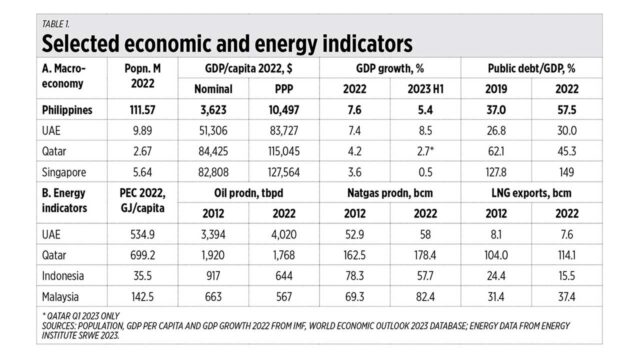
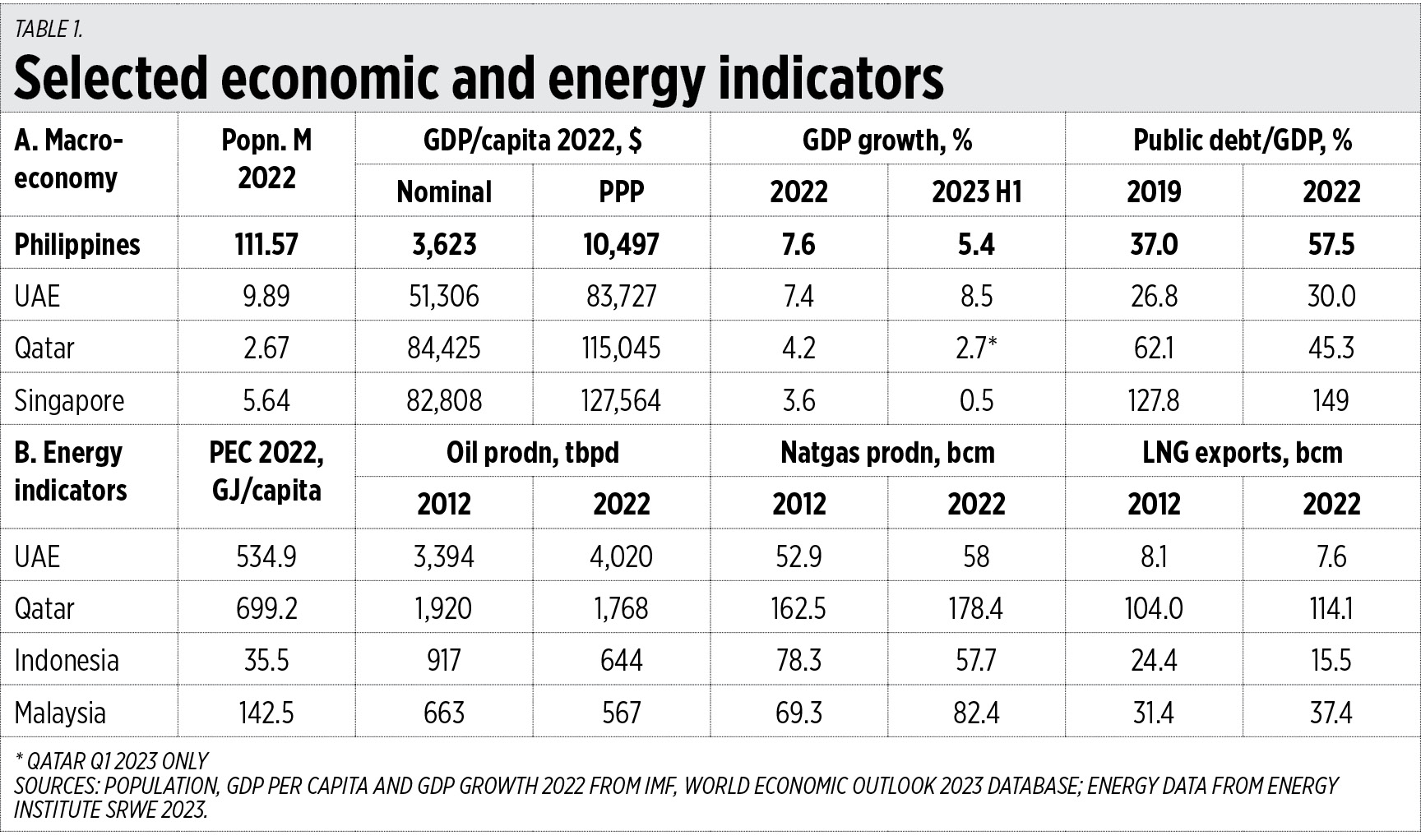
I put together a table showing some basic economic indicators of the Philippines, Qatar, and the UAE, and also Singapore where the economic team already held two PEBs. I also included basic energy indicators, plus data on Indonesia and Malaysia, the two big oil and gas producers in the ASEAN. The energy indicators are: primary energy consumption (PEC) in gigajoules per capita (GJ/capita), oil production in thousand barrels per day (tbpd), natural gas production and liquefied natural gas (LNG) exports in billion cubic meters (bcm).

The Qatar and the UAE’s very high GDP per capita, in both nominal and purchasing power parity (PPP) values, are consistent with their huge PEC. The Philippines’ low GDP per capita is also consistent with its low PEC of only 18.2 GJ/capita vs Qatar’s 699 and UAE’s 535 GJ/capita (see Table 1).

The Philippines should aspire to be a major oil and gas producer someday. We should have more natgas fields like Malampaya, and drill for more oil offshore. Malaysia and Indonesia can share some expertise while Qatar and the UAE can put in the funding and investments to supplement local investments.

In Qatar, the economic team headed by Secretary Diokno met with the Qatar finance minister and the top executives of Qatar Cool; their sovereign wealth fund, the Qatar Investment Authority (QIA); the Qatar Insurance Co. (QIC); and the Qatar National Bank (QNB), among others.

In the UAE, the two-day roadshow included the economic team’s visits to Nasdaq Dubai, and the UAE Minister of Foreign Trade and Minister of Finance. They also met with executives of Arqaam Capital, Millennium Capital, Waha Capital, the Investment Corp. of Dubai (ICD), the Dubai Islamic Bank (DIB), the Abu Dhabi Islamic Bank (ADIB), Emirates NBD Asset Management (ENBD AM), and the Kuwait Finance House (KFH), among others.

In her speeches in Doha and Dubai, Budget Secretary Pangandaman discussed the country’s digital transformation agenda to improve public service delivery and reduce the cost of doing business in the country. As the Philippines’ only Muslim Cabinet Secretary visiting two rich Muslim countries, she highlighted that the Philippines has allocated P74.35 billion for the Bangsamoro Autonomous Region of Muslim Mindanao (BARMM) alone, to help uplift the lives of people there.

MINING PHILIPPINES 2023
The biggest annual conference of the country’s mining industry will be held this week, Sept. 19-20, at the Edsa Shangri-La Hotel. I will be one of the speakers in the last important panel of Day 2, about mining fiscal regime.

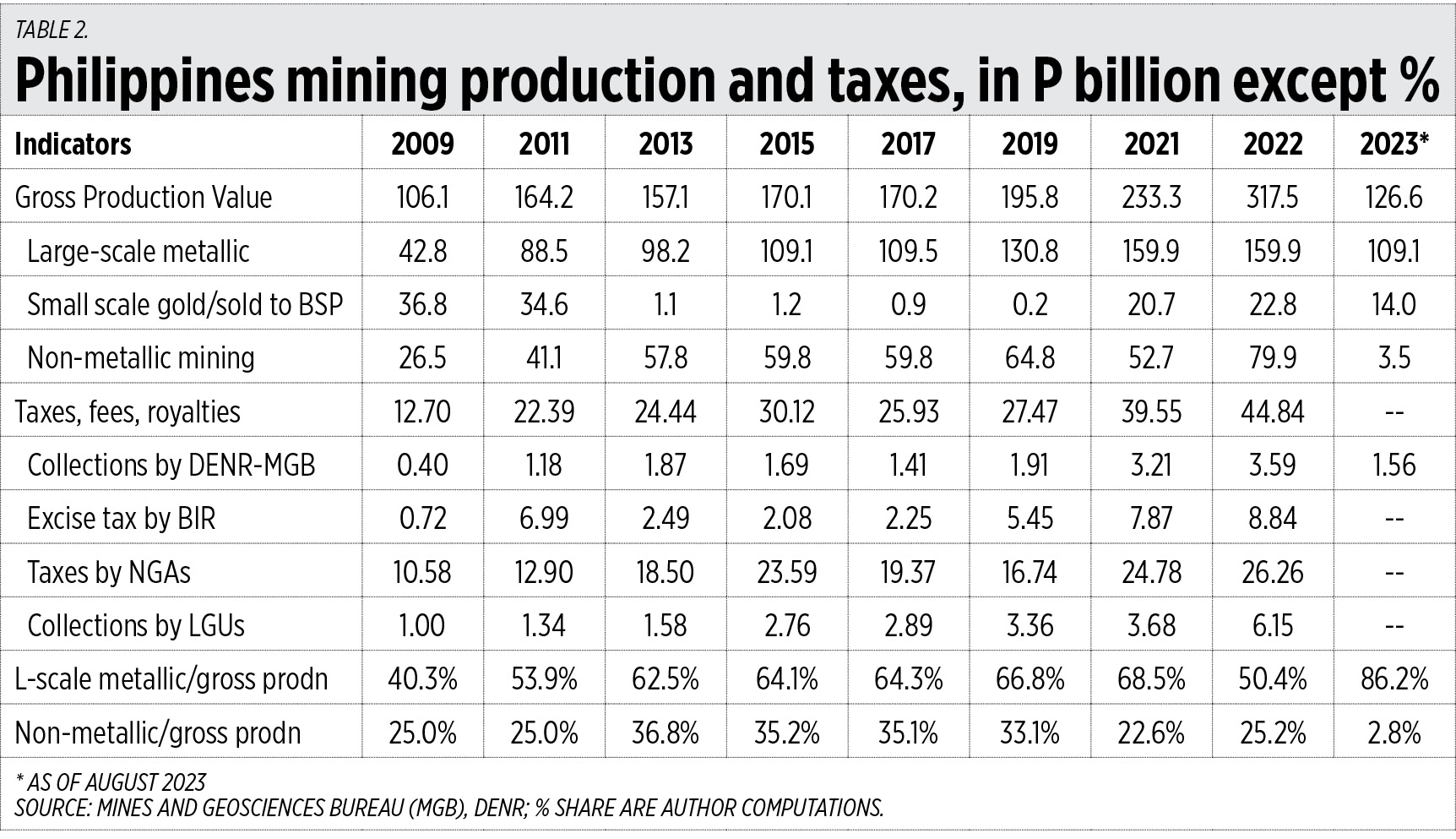
I checked how much output the industry has contributed to the country and the taxes it has paid, and the numbers are significant. In 2022, large-scale metallic mining, small-scale gold mining, and non-metallic mining like coal, had a combined output of P318 billion, and paid P44.8 billion in taxes, fees, and royalties. This is a big jump from 2021’s already high level of P233 billion in output and P40 billion in taxes (see Table 2).

If one looks at the mandatory spending for communities like the Social Development and Management Program (SDMP) or social tax, on top of the national and local government taxes and royalties, the industry pays a lot. I will discuss this and other fiscal topics on Day 2 of the conference.

WAGES ARE TIED TO PRODUCTIVITY, NOT POLITICS
Last Friday, Sept. 15, I attended a discussion on the “Proposed legislated wage increase, other economic issues, reactions by business groups” at the Pandesal Forum in Kamuning, Quezon City. The speakers were George Barcelon, President of the Philippine Chamber of Commerce and Industry (PCCI), Sergio Ortiz Luis, Jr., President of Philippine Exporters Confederation, Inc. (PhilExport), and Dr. Cecilio Pedro, President of the Federation of Filipino Chinese Chambers of Commerce and Industry, Inc. (FFCCCII). The moderator was Wilson Lee Flores.

Mr. Barcelon read the PCCI’s letter that it had sent to the Senate about another round of legislated mandatory wage hikes nationwide and noted that “rising inflation also negatively impacted businesses. Of these, 98% are micro, small and medium enterprises (MSMEs)…. these employers may have to further increase the prices of their products, reduce the number of their workers, or simply close down. Large firms which are capable of paying the wage increase only make up less than 2% of all Philippine companies.”

Good statement, sirs. As a market advocate, I believe in THREE important principles. One: Employment is a private contract between employers and employees, not between government and employees, and government should not impose their decisions and demands on employers. Two: Wages are tied to productivity, not the number of children the workers have, nor the increase in cost of living, and political pressures. And, three, wage differentiation and liberalization create more jobs and expands labor choices.


Bienvenido S. Oplas, Jr. is the president of Bienvenido S. Oplas, Jr. Research Consultancy Services, and Minimal Government Thinkers.

minimalgovernment@gmail.com

Sagrada Familia Church set to open in Araneta City

SAGRADA FAMILIA CHURCH is located on Level 5 of New Gateway Mall 2 in Araneta City, Quezon City. — COMPANY HANDOUT

A CHURCH will soon open at the New Gateway Mall 2 in Araneta City, Quezon City.

Cardinal Luis Antonio G. Tagle on Saturday presided over a special Eucharistic celebration at the Sagrada Familia Church, located on the mall’s fifth level.

The service was attended by members of the Araneta family, Araneta Group executives, tenants of Araneta City malls, and other guests.   

He also led the blessing of the altar, a ceremony that marked the readiness of the church to welcome the public.

“Sagrada Familia Church at the New Gateway Mall 2 will be opened to the public very soon,” said ACI, Inc., the owner, developer and manager of the Araneta City.

The fully air-conditioned, mitre-shaped church has an all-white interior and can accommodate up to 1,000 mass-goers.

The church has a high ceiling design and features a prominent hanging cross created by sculptor Wilfredo Layug. — CRAG

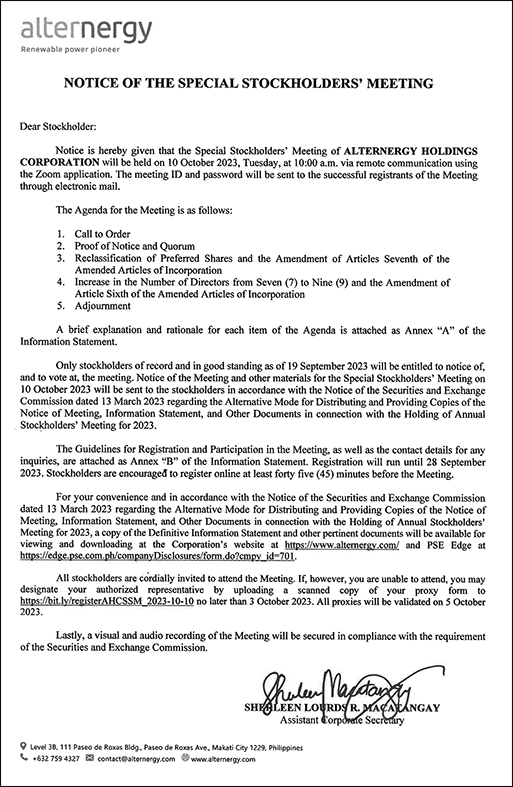
Alternergy Holdings Corp. to hold special stockholders’ meeting via Zoom


Spotlight is BusinessWorld’s sponsored section that allows advertisers to amplify their brand and connect with BusinessWorld’s audience by enabling them to publish their stories directly on the BusinessWorld website. For more information, send an email to online@bworldonline.com.

Join us on Viber at https://bit.ly/3hv6bLA to get more updates and subscribe to BusinessWorld’s titles and get exclusive content through www.bworld-x.com.
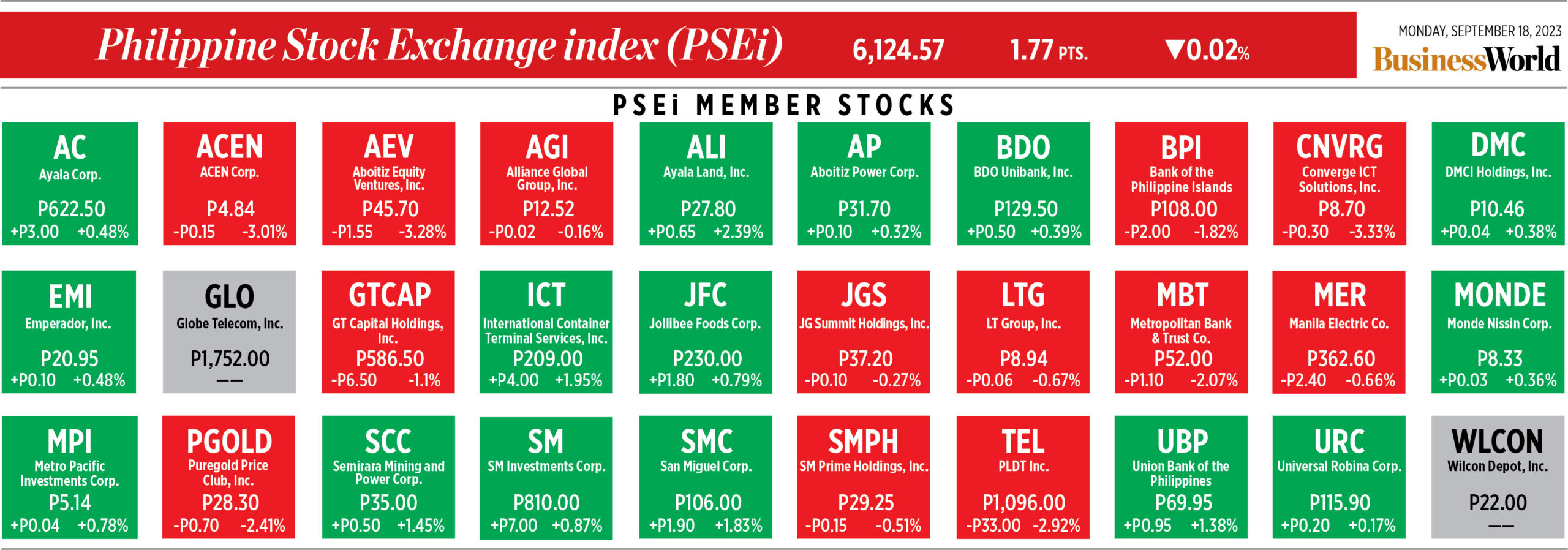
How PSEi member stocks performed — September 18, 2023

Here’s a quick glance at how PSEi stocks fared on Monday, September 18, 2023.


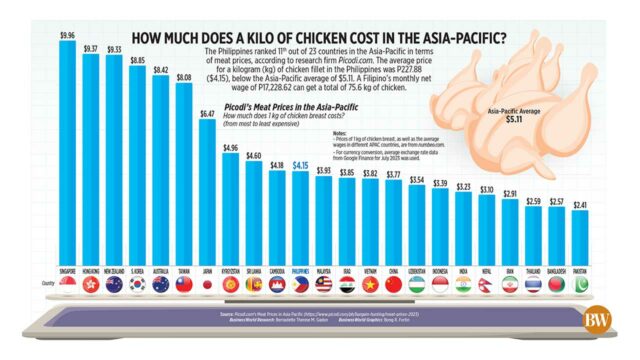
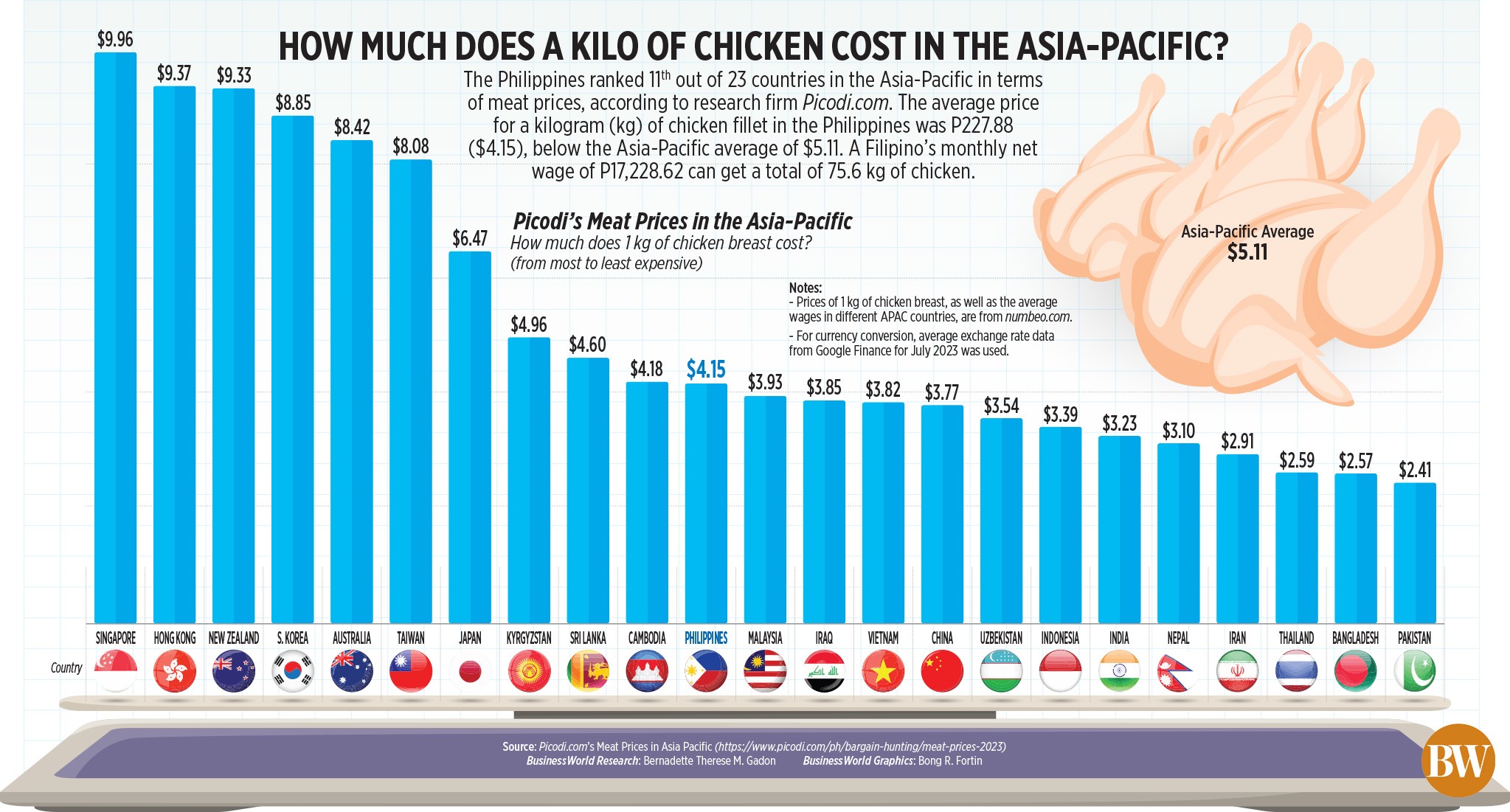
How much does a kilo of chicken cost in the Asia-Pacific?

The Philippines ranked 11th out of 23 countries in the Asia-Pacific in terms of meat prices, according to research firm Picodi.com. The average price for a kilogram (kg) of chicken fillet in the Philippines was P227.88 ($4.15), below the Asia-Pacific average of $5.11. A Filipino’s monthly net wage of P17,228.62 can get a total of 75.6 kg of chicken.

 
How much does a kilo of chicken cost in the Asia-Pacific?

Peso down vs dollar on bets for US Fed holding key rate

BW FILE PHOTO

THE PESO depreciated against the dollar on Monday on expectations that the US Federal Reserve will hold its key rate at its meeting this week.

The local currency closed at P56.866 versus the dollar on Monday, weakening by 5.1 centavos from Friday’s P56.815 finish, data from the Bankers Association of the Philippines’ website showed.

The local unit opened Monday’s session at P56.80 per dollar. Its intraday best was at P56.74, while its weakest showing was at P56.875 against the greenback.

Dollars traded fell to $821.1 million on Monday from the $1.06 billion on Friday.

The peso weakened due to expectations that the Fed will keep its benchmark rate steady in its meeting this week, Rizal Commercial Banking Corp. Chief Economist Michael L. Ricafort said in a Viber message.

“The peso weakened further amid expectations of hawkish policy cues from the US Federal Reserve in their meeting this week,” a trader likewise said in an e-mail.

A Reuters poll of 97 economists conducted on Sept. 7-12 showed 95%, or 94 economists, predicted the US central bank would hold the federal funds rate at the current 5.25%-5.5% during its Sept. 19-20 meeting.

The Fed raised interest rates by 25 basis points (bps) last month, bringing its benchmark overnight rate to a range between 5.25% and 5.5%.

It has hiked rates by a cumulative 525 bps since it began its tightening cycle in March last year.

The peso was also dragged down by higher global crude oil prices on Monday, Mr. Ricafort added.

Reuters reported Brent crude futures rose 71 cents or 0.8% to $94.64 a barrel by 0622 GMT while US West Texas Intermediate crude futures were at $91.55 a barrel, up 78 cents or 0.9%.

Both benchmarks have climbed for three consecutive weeks to touch their highest levels since November and are on track for their biggest quarterly increase since Russia’s invasion of Ukraine in the first quarter of 2022.

For Tuesday, the trader said the peso could recover due to a potentially stronger euro zone inflation report.

The trader sees the peso moving between P56.70 and P56.90 per dollar on Tuesday, while Mr. Ricafort expects it to range from P56.75 to P56.95. — Aaron Michael C. Sy

Shares dip as investors await key policy meetings

LOCAL STOCKS closed lower on Monday as investors await fresh leads ahead of the policy meetings of the US Federal Reserve and the Bangko Sentral ng Pilipinas (BSP) later in the week.

The Philippine Stock Exchange index (PSEi) went down by 1.77 points or 0.02% to end at 6,124.57 on Monday, while the broader all shares index dropped by 10.94 points or 0.33% to close at 3,309.24.

“The local bourse saw a slight decline,” Philstocks Financial, Inc. Research Analyst Claire T. Alviar said in a Viber message, citing “a lack of a strong catalyst” while investors wait for the BSP and Fed meetings.

“Philippines shares traded quietly to start the week, as investors await the main event this week, which is the [Monetary Board’s] policy-setting meeting on Sept. 21,” Regina Capital Development Corp. Head of Sales Luis A. Limlingan said in a Viber message.

BSP Governor Eli M. Remolona, Jr. said on Thursday that a policy rate hike might be unlikely if there were no further supply shocks after the acceleration in August inflation.

Previously, the BSP extended its policy hold for three straight meetings, keeping the key policy rate at 6.25%.

A BusinessWorld poll last week showed 14 of 17 analysts expecting the Monetary Board to keep benchmark rates steady during its sixth policy meeting for the year on Thursday.

Meanwhile, Mercantile Securities Corp. Head Trader Jeff Radley C. See said in a Viber message that “investors continue to stay on the sidelines and increase their cash position until the announcement of the Federal Reserve.”

The Federal Open Market Committee will hold its policy review on Sept. 19-20, a week after the release of the US consumer price index (CPI) report.

The Federal Reserve raised borrowing costs by 25 basis points (bps) in July, bringing the US central bank’s target to the range of 5.25% to 5.5%, Reuters reported.

It has hiked rates by a total of 525 bps since it began its tightening cycle in March last year.

Back home, sectoral indices were split on Monday. Mining and oil went down by 89.53 points or 0.85% to 10,396.08; financials dropped by 13.12 points or 0.73% to 1,773.81; and services lost 4.22 points or 0.28% to 1,490.34.

Meanwhile, property gained 10.18 points or 0.4% to 2,512.77; holding firms rose by 6.01 points or 0.1% to 5,865.33; and industrials increased by 2.51 points or 0.02% to 8,792.39.

Value turnover declined to P3.64 billion on Monday with 549.70 million shares changing hands from the P9.07 billion with 1.55 billion issues seen on Friday.

Decliners outnumbered advances, 121 versus 58, while 52 names closed unchanged.

Net foreign selling dropped to P419.26 million on Monday from P2.48 billion on Friday. — Sheldeen Joy Talavera with Reuters

Travel industry confident in rebound despite inflation

REUTERS

By Justine Irish D. Tabile, Reporter

TRAVEL industry officials remain confident in a tourism rebound despite rising prices, with bookings and applications already exceeding pre-pandemic levels.

“From what I can see in our travel agency, we are experiencing an increase in demand for… individual bookings and group bookings; I’m sure that airlines and hotels are also experiencing that,” Travel Sale Expo Chairperson Michelle Taylan said at the Travel Sale Expo 2023 news conference on Monday.

She said that the increase in bookings reflects how the “thirst to travel” is still supporting demand despite the rising prices.

“We are experiencing problems, but the people still want to travel,” she said.

“Even a business class (seat) is not that easy for us to book because it’s always full. And this is very interesting and we really don’t know the reason… we just came from the pandemic,” she added.

Jagmohan Tamber, director of online visa application center BLS International, said visa applications have also surpassed pre-pandemic levels.

“In BLS before the pandemic, we accepted applications for Spain visa appointments of around 100 a day … After the pandemic, we are now accepting 135 to 150 every day, but it is still increasing,” Mr. Tamber said.

He added that this is also the same for its agency in Poland, which recorded a more than double the normal level of visa applications.

“Just seeing the difference … I think travel is very good now,” he said.

Marissa Dimaano, assistant vice-president for passenger sales at Philippine Airlines (PAL), said airlines achieved record results in the first half.

“Thanks to our loyal patrons, PAL was actually able to achieve record results for the first half of 2023. And this is really telling how the travel industry has really bounced back from the pandemic,” Ms. Dimaano said.

She said that in the first half, the flag carrier saw an 89% increase in passenger volumes last year and booked record revenue.

“That enabled us to actually invest in new aircraft, new technology and customer experiences for our travelers,” she said.

“With these very positive numbers, we hope that we will be able to sustain it with this hunger for travel for many of our Filipino travelers, as well as our international foreign travelers coming into the Philippines as well,” she added.

United Airlines Philippine country manager for sales Pam C. Navarro said that the airline has been exceeding expectations.

“I’m also happy to share that on the global level, regional level and at the local level we’re doing much better than expected,” she said.

She added that the airline’s fleet buildup during the pandemic reflected its confidence it is in the recovery of the sector.

“We placed orders for 700 aircraft, a combination of wide and narrow bodies, in anticipation of the return of travel,” she said.

The airline has announced plans to operate a Manila-San Francisco service.

“(We are confident) not just in the Philippine market but also on the traffic coming from the US, because ultimately you would want to look at the market from both sides of the world. And the demand is really there, it’s really booming,” she added.

On the sidelines of the briefing, Ms. Navarro said that the direct flight to San Francisco from Manila is only one of the flights that the airline will be launching but noted that it is the most popular route for the US market.

Kesler U. Go, marketing and Philippine representative of Guam Visitors Bureau, said that Guam has yet to return to pre-pandemic levels.

“But if you look at it in a bigger picture, Guam has seen a 200% recovery from 2022 and that includes tourists coming in from Japan and Korea,” he said.

Energy dep’t preparing airlines for sustainable fuel phase-in by 2027

REUTERS

THE Department of Energy (DoE) said it has taken the first steps towards getting airlines ready for the global adoption of sustainable aviation fuel (SAF) starting in 2027.

“The use of SAF is intended to reduce the carbon footprint associated with aviation operations. This alternative fuel source, derived from renewable feedstock, holds the potential to lower greenhouse gas (GHG) emissions while ensuring the highest safety and performance standard,” Energy Undersecretary Alessandro O. Sales said in a statement.

“The DoE is working to establish the necessary framework and regulations to support the adoption of SAF,” he added.

SAF adoption is an initiative of the International Civil Aviation Organization (ICAO), which has put forward the Carbon Offsetting and Reduction Scheme for International Aviation (CORSIA).

The CORSIA timetable requires member states to start complying with the carbon offset requirements by 2024-2026, followed by the mandatory phasing in of SAF in 2027-2035.

According to the DoE, SAF is an “environmentally sustainable and chemically identical alternative to fossil fuel-based aviation fuel.”

The Philippines joined CORSIA in December 2018 through the Civil Aviation Authority of the Philippines (CAAP).

The DoE conducted consultations in February along with the CAAP, Philippine National Oil Co. and the European Aviation Safety Agency (EASA) and discussed the potential advantages of SAF in preparation for full compliance by 2027.

The agency said that EASA is expected to complete a proposal for the Philippines’ SAF readiness evaluation by December. — Sheldeen Joy Talavera

Maharlika court challenge claims bill was rushed through Congress

WIKIMEDIA/PATRICKROQUE01

THE Supreme Court has been asked to rule on how the Maharlika Investment Fund was legislated, with petitioners claiming that the Maharlika bill was improperly certified as urgent and passed without the benefit of the required viability review for new government corporations.

The Bayan Muna party-list and Senator Aquilino Martin D. Pimentel III filed the 55-page petition on Sept. 18, alleging that the way Congressional approval was obtained “short-circuited” the process outlined in the Constitution.

“All told, the President committed grave abuse of discretion amounting to lack or excess of jurisdiction when he exercised his Presidential power of certification twice — in the House of Representatives in December 2022, and in the Senate in May 2023,” according to a copy of the petition.

The petitioners also argued that an urgent certification was not necessary after Senate President Juan Miguel F. Zubiri stated that the effects of the sovereign wealth fund would only be felt in about five years’ time.

In May, opposition legislators from the Makabayan bloc asked the High Court to reconsider its denial of their petition seeking to void the urgent certification of the proposed Maharlika Investment Fund, as well as of the subsequent approval of the bill in the House of Representatives.

The plaintiffs noted that the investment fund did not undergo a test of economic viability for proposed government corporations to ensure that government does not “haphazardly relinquish its governmental functions without basis.”

The Constitution requires a viability test before a government-owned or -controlled corporation can be set up.

“Although it is true that the Business Proposal of the Maharlika Investment Corp. reflected promising estimated returns for the next 10 years, the computation on which the estimated returns were based was not even provided in order for Congress, and also the public, to study and review such basis,” they said.

President Ferdinand R. Marcos, Jr. signed the measure into law on July 18. He had certified the bill creating the Maharlika Investment Fund as urgent on May 22.

The Senate approved the bill creating the sovereign wealth fund on May 31, while the House of Representatives had approved the measure in December, two weeks after the bill was filed.

Mr. Marcos said in his certification letter that the immediate passage of the bill creating the Maharlika fund is needed “in order to establish a sustainable national investment fund as a strategic mechanism for strengthening the investment activities of top performing government financial institutions (GFIs), and thus pump-prime economic growth and social development.”

The Maharlika Investment Corp., which will manage the fund, has an initial allotment of P125 billion in capital from the National Government, the Land Bank of the Philippines and the Development Bank of the Philippines. 

Earlier this month, the Department of Finance said the sovereign wealth fund is expected to generate 100,000 direct and indirect jobs as its initial capitalization becomes fully paid in over the first 10 years of operations.

“While petitioners do not contest the power of the State to create such agencies, instrumentalities, or corporate bodies when needed, such power is not without limitations,” Bayan Muna and Mr. Pimentel said.

“The test of economic viability is among the limitations imposed by the Constitution to ensure the government does not relinquish  governmental functions… especially if it depletes public funds wantonly nor arbitrarily intrude on the private sphere.” — John Victor D. Ordoñez