Home Blog Page 429

Digital banks face profitability concerns with new players to intensify competition

FREEPIK

By Katherine K. Chan, Reporter

THE EXPANSION of the Philippine digital banking sector is expected to lead to increased innovation and improved financial services that would benefit consumers, the Bangko Sentral ng Pilipinas (BSP) said.

However, profitability could remain elusive for most existing players as industry competition heats up, analysts said.

“Beyond short-term profitability effects, the entry of new players is expected to deliver significant long-term benefits to the digital banking landscape. Increased competition can drive improvements in pricing, product innovation, and service quality,” the central bank told BusinessWorld in an e-mail.

New players can also bring fresh ideas about product development and emerging technologies that incumbent digital banks can draw insights from, it said.

“Most importantly, customers stand to benefit from wider choices, more convenient digital solutions, and more inclusive financial services.”

But the battle for market share could mean higher costs for digital banks that could keep the sector in the red, analysts said.

“The entry of four new digital banks will likely keep the industry in investment mode through 2026, with profitability remaining elusive as players scale up and absorb high operating costs,” Union Bank of the Philippines Chief Economist Ruben Carlo O. Asuncion said in an e-mail.

“Over time, however, this expansion could accelerate innovation and broaden revenue streams — particularly in lending and wealth management — laying the groundwork for stronger financial performance beyond 2026.”

Mr. Asuncion said increased competition from new players and existing digital banks’ pursuit of growth will bring benefits and risks to both the industry and customers.

“The main risk is prolonged margin pressure if competition stays focused on pricing rather than differentiated services,” he said. “Expect sharper competition in deposits and credit products as new entrants pursue aggressive pricing and partnerships to gain traction.”

Robert Dan J. Roces, group economist at SM Investments Corp., also said the industry may continue to post losses as digital banks continue to refine their business models.

“The entry of four new digital banks in 2026 will likely extend near-term losses for the sector, as new players add start-up costs and competition intensifies, but this should be seen as investment rather than structural weakness — expanding scale, deposits, and use cases is essential before profitability can meaningfully improve,” he said in a Viber message.

The digital banking sector has been in the red since March 2023, which was when the BSP began publishing data on the industry.

As of September 2025, the sector booked a combined net loss of P3.971 billion, narrowing from the P5.785-billion loss a year prior.

In December 2020, the BSP released guidelines on the establishment of digital banks and granted six licenses in 2021 to GoTyme Bank, Maya Bank, Inc., Overseas Filipino Bank, Inc. (OFBank), Tonik Digital Bank, Inc., UnionDigital Bank, Inc., and UNObank, Inc.

Of these six, only Maya Bank and OFBank were in the black in 2024. Maya Bank booked a P72.78-million net profit, a turnaround from the P826.83-million net loss it logged the previous year, while OFBank’s net income was at P86.28 million, 71.4% higher than the P50.34 million recorded in 2023.

“Despite sustained losses since 2022, digital banks have continued to post strong growth in assets and transaction volumes, supported by the broader shift toward digitalization… Thus, the early red ink should be interpreted primarily as a reflection of the industry’s growth and transformation cycle rather than a sign of structural weakness,” the central bank said.

“The impact of new digital banks on the industry’s financial performance will be largely shaped by the maturity, expertise, and business proposition of the new players.”

It said the new entrants will likely need to make heavy investments as they set up shop, including costs related to technology buildout, talent acquisition, intensive marketing and ecosystem integration efforts, and customer onboarding.

In January 2025, the BSP lifted a three-year freeze on digital bank licensing to welcome four entrants to the sector, which could be both new players and existing banks seeking to convert to digital operations.

To spur industry growth, the regulator set a higher bar for the new applicants, such as having a unique value proposition, capacity to develop new or innovative business models and reach untapped and underserved market segments, as well as readiness to deploy digital solutions and sustainably grow business in the Philippines.

The application window was closed anew effective on Dec. 1, with the Monetary Board approving a new indefinite licensing moratorium in September.   

The BSP said they received three digital bank applications within the deadline, which they are still evaluating. The results of the candidates’ assessment will be elevated to the Monetary Board.

Meanwhile, UnionDigital Bank President and Chief Executive Officer Danilo “Bong” J. Mojica II also said the sector is unlikely to achieve industry-wide profitability this year as players’ aggressive lending push could lead to more bad loans.

“So, my feeling is, and I know this for a fact, that other digital banks are going to get into… more lending. So, what will happen to NPLs (nonperforming loans)?” he said on the sidelines of an event in December. “The more people get into lending, people will have to watch out.”

UnionDigital Bank posted a net loss of P3.13 billion in 2024 versus the P155.31-million profit it booked in 2023. Mr. Mojica said they hope to breakeven this year as they have managed asset quality risks by becoming more “disciplined” in lending.

Mr. Mojica took the helm of the digital bank in August, which marked its shift to a “low and grow” strategy that prioritizes shorter-tenor payroll loans and gradually scaling high-performing accounts.

UNO Digital Bank President and Chief Executive Officer Manish Bhai said in October that they target to hit operating breakeven by the first half of 2026 and full breakeven within next year. Its net loss widened to P1.04 billion in 2024 from P653.5 million in 2023

Tonik Digital Bank also said in its 2024 annual report that it wants to achieve “sustainable profitability” by 2026. Its net loss widened to P1.126 billion in 2024 from P744.92 million in the previous year.

For its part, GoTyme Bank is eyeing profitability by 2027. It booked a net loss of P3.44 billion in 2024, wider than the P2.47 billion posted a year earlier.

GoTyme Bank President and Chief Executive Officer Nathaniel D. Clarke has said that their phygital or physical and digital model gives them an advantage, with its affiliation with the Gokongwei group boosting its reach.

GROWTH OPPORTUNITIES
Mr. Asuncion said the six operating digital banks must ensure that they can remain competitive as they secure their foothold in the market.

“Incumbents will need to pivot toward ecosystem integration, embedded finance, and data-driven personalization to defend market share,” he said.

“By 2026, success will hinge on balancing growth with sound risk management and delivering superior customer experience, not just low-cost offerings.”

Mr. Roces added that digital banks must continue to improve their products and services to stay relevant.

“Competition will sharpen around ecosystems and distribution rather than just rates, pushing banks to innovate in payments, lending, and merchant services while improving customer experience and financial inclusion,” he said.   

The potential new digital banking players could also bring more solid business models that would bode well for the sector’s growth as a whole, the BSP said.

“With the criteria for new digital banks, we expect that they will commence operations with established capabilities — such as expertise in digital financial services, advanced technology platforms, or existing customer ecosystems. These will enable them to scale more quickly and create a broader revenue base,” it said.

“In terms of pricing, these players are expected to implement a market-based, equitable framework with sufficient flexibility to encourage customer acquisition, transaction volume growth, and ecosystem expansion.”

The digital banking industry’s growth will support the central bank’s goal to bring more Filipinos into the formal financial system and have more transactions done online, Mr. Roces said.

“More players mean faster onboarding, wider merchant acceptance, and deeper penetration into cash-heavy segments, helping convert everyday transactions to digital. With digital payments already nearing the BSP’s 2028 target, new entrants can help close the remaining gap and make digital usage more pervasive, durable, and economically viable over the medium term.”

The BSP wants digital payments to have a 60%-70% share in the total volume of retail payments by 2028, in line with the Philippine Development Plan.

New digital banks can become “structural accelerators that can exponentially grow digital transactions,” the central bank said.

“Their expected contribution lies in expanding user bases, transaction pathways, and payments innovation which are critical to pushing the share of retail digital payments toward the 2028 goal,” it added.

Latest BSP data showed digital payments accounted for 57.4% of total monthly retail payments in 2024, up from 52.8% in 2023. 

The central bank also targets to onboard at least 70% of adult Filipinos into the formal financial system. The share of Filipinos with bank accounts reached 65% of the adult population in 2022, BSP data showed.

Meanwhile, the World Bank’s Global Findex Database 2025 report showed that 50.2% of approximately 82 million Filipinos aged 15 years old and above had financial accounts in 2024, lower than the 51.4% recorded in 2021 but higher than 26.6% in 2011.

The data showed that 33.5% of Filipino adults had accounts with banks or similar formal financial institutions, while 28.8% had mobile money accounts. Some 32.7% said they had digitally enabled accounts, or those used with a card or phone.

Mr. Asuncion added that in their quest for growth, digital banks must also target to reach more underbanked and unbanked Filipinos.

“The opportunity lies in expanding beyond urban centers into underserved areas, where digital penetration remains low. The challenge will be ensuring interoperability and trust, which will require sustained collaboration among banks, fintechs, and regulators.”


Demon Slayer movie director aimed to deliver nonstop demon battles

A SCENE from Demon Slayer: Kimetsu no Yaiba – The Movie: Infinity Castle

LOS ANGELES — For the Japanese action-packed anime film Demon Slayer: Kimetsu no Yaiba – The Movie: Infinity Castle, chief director Hikaru Kondo set out to deliver something he’d never seen on screen before: relentless, back-to-back battles inside a demon-filled castle.

“I was trying to find examples or other films that were similar, that had a similar kind of composition or format, I guess you could say to ours, and I couldn’t,” Mr. Kondo told Reuters.

“So, this could be perhaps one of the first films that exists that has this type of structure and narrative. It’s back-to-back-to-back combat,” he added.

The already surging global popularity of the manga and animé series Demon Slayer laid the groundwork for Infinity Castle to become the highest-grossing international film ever in the US and land at the top of the Japanese box office.

The film, which arrived in Japanese theaters last July, earned a Golden Globe nomination for best animated film.

The movie is based on the Infinity Castle arc of the 2016-2020 Demon Slayer manga by Koyoharu Gotouge and is a direct sequel to the fourth season of the anime television series, which is produced by animation studio Ufotable for original streaming on the platform Crunchyroll.

The series follows teenage Tanjiro Kamado, who becomes a demon slayer after his family is murdered and his younger sister, Nezuko, is turned into a demon.

Infinity Castle places Tanjiro and his fellow Demon Slayer Corps members in a series of battles against the first and oldest demon Muzan Kibutsuji and the host of demons he summons in the “Infinity Castle.”

Mr. Kondo recalled being “cooped up” in his house for three weeks trying to figure out how to weave together the overall flow of the film’s action and drama to “astonish” audiences.

However, by the time he finished it, the film was too long.

“When you lose the groove, the audience becomes detached from your journey, then immediately I think they’ll just be disengaged and shut down,” he said about the importance of trimming the film to its runtime of two hours and 35 minutes. — Reuters

PHINMA’s Philcement welcomes Sumitomo as minority shareholder

PHINMA.COM.PH

PHINMA CORP. subsidiary Philcement Corp. said on Monday that Sumitomo Osaka Cement Co. Ltd. has officially acquired a 15% ownership stake in the local cement producer, completing the share subscription agreement signed in September 2025.

“The transaction is aligned with Philcement’s strategy to expand its manufacturing operations and provide Filipino consumers with reliable, high-quality cement products under its legacy brand, Union Cement,” the company said in a disclosure on Monday.

Sumitomo Osaka Cement, which has over 100 years of experience in the global cement industry, now holds a 15% stake in Philcement, which remains 51%-owned by PHINMA.

Philcement manufactures, imports, processes, distributes, and sells cement products and operates facilities in Bataan, Pampanga, Zamboanga del Norte, and Davao.

PHINMA also has operations in education, real estate, steel products, and business process outsourcing.

At the local bourse on Monday, PHINMA shares fell 0.25% to P16.18 apiece. — A.G.C. Magno

10 major players in the Philippine electricity sector — 2

FREEPIK

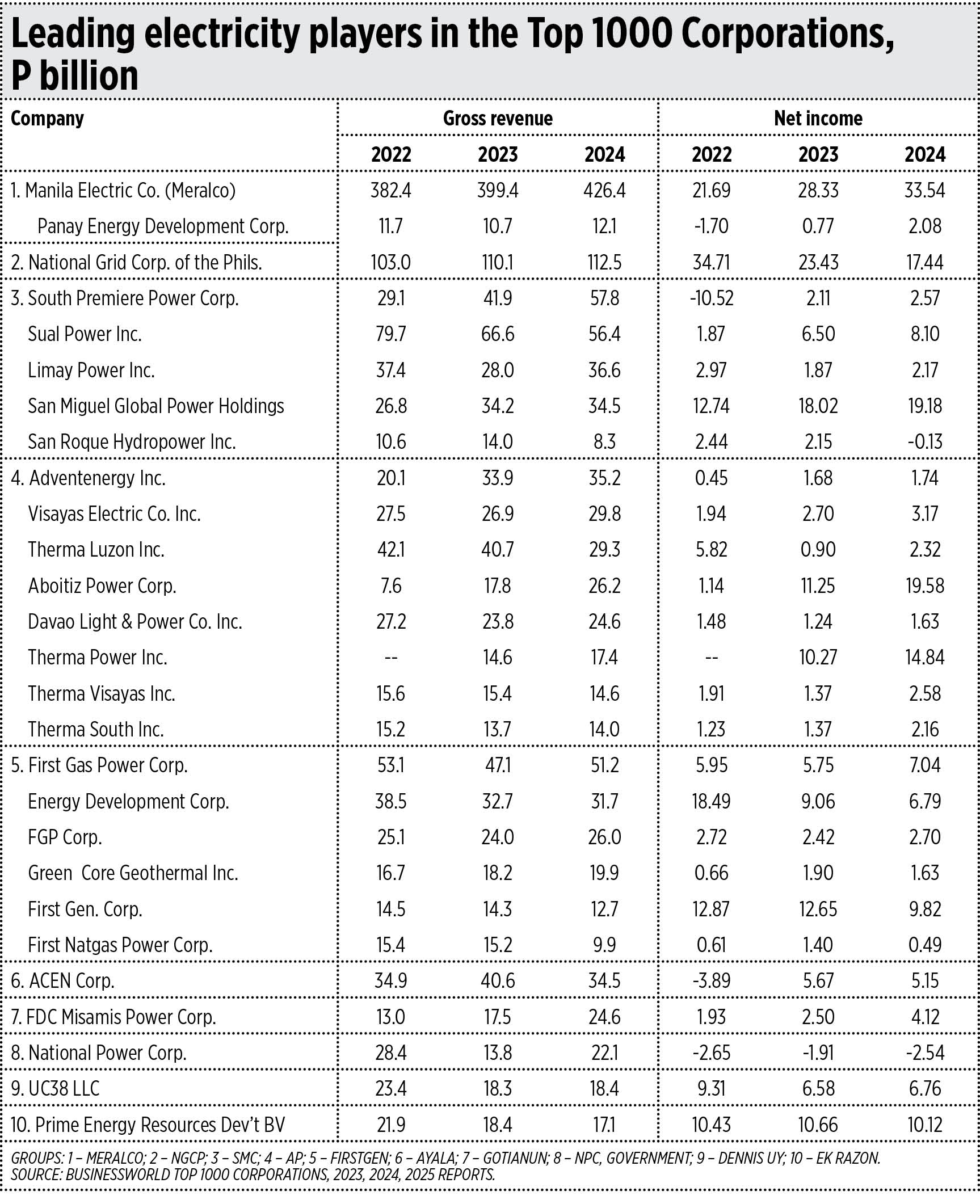
This is a follow up piece to my earlier column, “10 major players in the Philippine electricity sector” (Jan. 8). I used data from the BusinessWorld Top 1000 Corporations in the Philippines 2024 report in the earlier story. Here, I have incorporated data from the 2025 report.

The top 10 major players in terms of their gross revenues (GR) in 2024 were the following.

1. Manila Electric Co. (Meralco), which remained the top electricity company in the country with P426 billion in GR. I think this includes the revenues of Meralco Power Gen (MGEN), MPower, and other Meralco subsidiaries. MGEN could be the fourth largest generation company (genco) in the country, at least it was in 2024.

2. National Grid Corp. of the Philippines (NGCP) had a limited GR of P103 billion in 2022 to P113 billion in 2024, mainly because it has a maximum annual revenue (MAR) set by the Energy Regulatory Commission.

3. San Miguel Corp. (SMC) remained the largest conglomerate in power generation. South Premier Power Corp. (SPPC) or the Ilijan gas plant was the biggest genco in terms of GR in 2024. In 2025, Excellent Energy Resources, Inc. (EERI), along with SPPC, were co-owned by SMC with MGEN and Aboitiz Power (AP).

4. AP is the second largest power company having many gencos (Therma Luzon, Visayas, South/Mindanao), distribution companies (VECO, Davao Light), and the retail electricity supplier Adventenergy.

5. FirstGen was the third largest genco, at least until 2024. Its Energy Development Corp. (EDC) had a modest GR but huge net income, P34.3 billion total from 2022-2024, and this should be partly gravy from the feed-in tariff (FIT) subsidy of their huge wind plant. In 2025, FirstGen sold their gas plants to Prime Energy of Enrique Razon.

6. ACEN by Ayala could be the fifth largest genco after MGEN. ACEN had a big net income in 2023-2024, which could be partly gravy from their FIT subsidy for their wind and solar plants.

7. FDC Misamis by Filinvest Dev’t Corp. (FDC) of the Gotianun family has a rising GR and net income.

8. The National Power Corp. (Napocor) owns the big gensets in off-grid provinces and islands. It endures losses yearly. Napocor President Jericho Nograles has a big challenge on how to cut the loses, but big reforms could be outside Napocor’s power and mandate.

9. UC38 LLC, owned by Udenna/Dennis Uy, had a big net income from co-owning the Malampaya gas consortium.

10. Prime Energy by Enrique Razon, as another co-owner in the Malampaya consortium, had a total net income of P31 billion from 2022-2024, which is huge. Mr. Razon also owns several big distribution utilities in Iloilo, Bacolod, and other big cities.

The Visayas grid has the thinnest reserve margins compared to the Luzon and Mindanao grids, and thus experiences frequent yellow alerts. AP and MGEN both have coal plants in Cebu, which is the largest energy user in the Visayas grid. Without these big coal plants, Cebu would have daily “Earth Hours,” so the two companies are Cebu’s energy heroes. But their coal plants must expand and not be dismantled as climate activists are lobbying for.

Meanwhile, on the huge P24-billion fine imposed by the Department of Energy (DoE) on Solar Philippines for undelivered contracts — the SP New Energy Corp. (SPNEC) clarified that is not liable to pay the penalties. Of the 12,000 megawatts (MW) in terminated contracts by the DoE, only the 280-MW Sta. Rosa project is under SPNEC. The former management of the Sta. Rosa project was awarded 280 MW, then it filed a notice of force majeure with the DoE in 2025 citing reasons beyond its control for preventing it from completing the project.

Congressman Leandro Leviste should spend more time finding additional billions of pesos to settle his penalties with the DoE, and less on the flood control scandal as many agencies (the Ombudsman, the Independent Commission for Infrastructure, the Commission on Audit, the Senate, etc.) are already investigating the latter.


Bienvenido S. Oplas, Jr. is the president of Bienvenido S. Oplas, Jr. Research Consultancy Services, and Minimal Government Thinkers. He is an international fellow of the Tholos Foundation.

minimalgovernment@gmail.com

Listed property firms seen posting modest revenue growth this year

DC STUDIO/FREEPIK

By Beatriz Marie D. Cruz, Reporter

LISTED PROPERTY companies in the Philippines are expected to post modest revenue growth this year amid tepid economic expansion and elevated inventory in the office and residential segments, analysts said.

“Revenue trajectory [is] on the way to recovery, but the journey can be challenged by moderating gross domestic product growth this year and the oversupply overhang in some segments like office and high-rise residential,” First Metro Investment Corp. Head of Research Cristina S. Ulang said in a Viber message.

The government has lowered its economic growth target for this year to 5%-6% from the previous 6%-7% range set for 2026 to 2028.

This came after a corruption scandal involving flood control projects dampened government spending and consumer confidence in the latter half of 2025.

Ms. Ulang also cited the oversupply of office and vertical residential units in some areas, which could weigh on listed developers’ revenue growth.

The Metro Manila office market has about 2.7 million square meters of vacant supply, while 80,300 condominium units remain unsold in the region, according to Leechiu Property Consultants’ fourth-quarter property market report.

Unicapital Securities, Inc. Research Head Wendy B. Estacio-Cruz said modest revenue growth is expected this year as the sector has yet to fully recover from tempered demand following a prolonged period of high interest rates.

In December, the Bangko Sentral ng Pilipinas (BSP) cut policy rates by 25 basis points (bps) to a more than three-year low of 4.5%. This marked the BSP’s fifth consecutive 25-bp reduction, bringing total rate cuts to 200 bps since August 2024.

BSP Governor Eli M. Remolona, Jr. recently signaled that the Monetary Board is nearing the end of its easing cycle.

However, Ms. Estacio-Cruz said interest rates remain relatively elevated and may continue to weigh on housing affordability, particularly in the mid- to mass-market segments.

Rising land, construction, and financing costs may also delay project launches, she added.

“Leasing assets in prime locations should remain resilient, while upper-mid to high-end residential projects are likely to drive sales, given their relative resistance to interest rate pressures,” Ms. Estacio-Cruz said.

As a result, developers are expected to rebalance their revenue mix this year, analysts said.

The country’s industrial and logistics sector also presents revenue opportunities for listed firms, particularly amid the growth of e-commerce, data centers, and cold storage facilities, First Grade Finance, Inc. Managing Director Astro C. del Castillo said.

Developers with hospitality and retail assets may also post steady profits, he said, supported by an influx of local and international events scheduled this year.

Sy-led SM Prime Holdings, Inc. reported a 10% increase in net income to P37.2 billion for the first nine months of 2025.

Ayala Land, Inc.’s nine-month profit rose slightly to P21.4 billion from P21.2 billion a year earlier.

Robinsons Land Corp. posted a 2% increase in attributable net income to P10.17 billion for the period.

Megaworld Corp. recorded a 16% rise in attributable net income to P15.93 billion.

Federal Land, Inc. posted a 6% increase in nine-month reservation sales, while Filinvest Land, Inc. reported a 5% rise in consolidated net income to P3.64 billion.

Century Properties Group, Inc. saw its nine-month net income climb 17% to P2.1 billion, while DoubleDragon Corp.’s consolidated net income edged up to P2.55 billion.

Cebu Landmasters, Inc. posted a 6% increase in consolidated net income to P3.1 billion, while Vista Land & Lifescapes, Inc. recorded a 4% rise to P9.46 billion for the first nine months of 2025.

Rockwell Land Corp. posted a 13.1% increase in consolidated net income to P3.5 billion as of end-September, while Sta. Lucia Land, Inc.’s net income fell 38% to P2.05 billion during the period.

“In our view, topline performance will be supported by improving leasing conditions, a gradual recovery in residential sales, and the increasing contribution of recurring income streams,” Ms. Estacio-Cruz said.

ATRAM, UnionBank trust units complete merger

THE MERGER between the trust units of the ATR Asset Management Group (ATRAM Group) and Union Bank of the Philippines, (UnionBank) has been completed following approval by the Bangko Sentral ng Pilipinas (BSP) and registration with the Securities and Exchange Commission.

ATRAM Trust Corp. (ATC) and UnionBank Investment Management and Trust Corp. (UBIMTC) have merged effective Jan. 9, with the former as the surviving entity and assuming all fiduciary and investment management responsibilities of the latter, ATRAM Group said in a statement on Monday.

“This merger brings together two institutions with complementary strengths and a shared commitment to fiduciary excellence. With the transaction now completed, ATC is well-positioned to deliver a broader range of investment, wealth and trust solutions while maintaining the highest standards of governance, risk management, and client service,” ATRAM Trust President Deanno J. Basas said.

The transaction is the first merger between trust corporations in the country, which marks the continuing development of the sector.

“The milestone reflects a strategic move toward scale, specialization, and strengthened governance, undertaken under close regulatory supervision and with a strong emphasis on client protection and continuity,” ATRAM Group said.

BSP data as of end-September 2025 showed that ATC held trust assets worth P369.95 billion, while UBIMTC had P106.84 billion. This brings their combined assets to about P477 billion.

The merged entity will benefit from ATC’s investment management expertise and diversified product capabilities and UBIMTC’s digital infrastructure and extensive client reach through its listed parent UnionBank, ATRAM Group said.

“This strengthened company enhances service delivery, expands fiduciary and investment solutions, and supports continued innovation across trust and asset management services,” it said.

“With the merger complete, ATC is reinforcing its leadership position in the Philippine market and setting a precedent for future consolidation within the trust sector.” — BVR

Netflix to stream Sony films globally after debut in cinemas

NETFLIX, INC. obtained global streaming rights to Sony Group Corp.’s films after they complete their run in theaters and pay-per-view, adding releases from one of Hollywood’s biggest studios.

A multiyear agreement announced last Thursday expands a partnership the companies struck in 2021. That accord gave Netflix US rights to show Sony films after their theatrical release and after they’re available for online purchase or rental, as well as rights in Germany and parts of Asia.

Sony pictures will gradually start appearing on Netflix globally later this year as individual territory rights become available, the companies said in a statement, with the rollout complete by early 2029. As part of the deal, Netflix will also be able to license select films and TV series from Sony’s library, which includes hit franchises such as Spider-Man and Jumanji.

The deal is worth roughly $7 billion and runs through 2032, according to people familiar with the matter, who asked not to be named as the terms aren’t public. It beefs up Netflix’s lineup of theatrical pictures — a slate that could grow even more if the streaming company acquires the studio operations of Warner Bros. Discovery, Inc. It’s vying with Paramount Skydance Corp. with dueling bids for Warner Bros.

In 2024, Netflix expanded a deal with Comcast Corp.’s NBCUniversal, adding rights to stream live-action films to an agreement for animated pictures from the studio’s DreamWorks Animation and Illumination divisions.

Starting in 2027, the live-action films from Universal Pictures and Focus Features, which include franchises such as Fast & Furious and Jurassic Park, will appear on Netflix “no later than eight months following theatrical release,” the companies said at the time.

Netflix reports fourth-quarter financial results on Jan. 20. The company finished 2024 with 301.6 million subscribers. The previous deal with Sony included a commitment to make original films for the streaming service.

If Netflix is successful in its Warner Bros. acquisition, it would hold post-theatrical rights to films from Sony, Universal, Warner Bros., and the independent studio A24, which currently has a deal with Warner Bros.’ HBO Max streaming service. — Bloomberg

Japan, PHL celebrate ties with jazz

ASOSASYON ng Musikong Pilipino or AMP Big Band

THE year 2026 marks the 70th anniversary of the establishment of diplomatic relations between Japan and the Philippines, and to mark the occasion, The Japan Foundation, Manila will present Harmony of Friendship: A Jazz Prelude to 70 Years of Japan-Philippine Ties, featuring jazz performers from both countries.

The concert tour serves as the official inauguration of a year-long celebration of enduring diplomatic partnership.

The headline act is the Tokyo-Manila Jazz & Arts Festival Group, an ensemble led by Filipino jazz vocalist, Charito, a prominent figure in the Japanese jazz scene. They will be joined by the Philippines’ AMP Big Band, an organization of professional session musicians.

The opening reception and jazz concert will be held on Jan. 20 at the Proscenium Theater in the Rockwell area of Makati.

Following the opening festivities, the concert tour then moves to the Carlos P. Romulo Auditorium at the RCBC Plaza in Makati on Jan. 22, 7 p.m., before concluding with a final performance at the Social Hall of the Cebu Provincial Capitol (done in partnership with the Consulate-General of Japan in Cebu City) on Jan. 23.

The opening at the Proscenium and Cebu Capitol Social Hall are by invitation-only, while the RCBC Plaza performance is free and open to the public.

There will also be a cultural and educational exchange as The Japan Foundation, Manila and the Tokyo-Manila Jazz & Arts Festival Group visit De La Salle University-Dasmariñas for “CIFRA International: A Workshop with Tokyo-Manila Jazz & Arts Festival Group” on Jan. 21, 1 p.m. It will be held in partnership with the Lasallian Pop Band, a student group dedicated to exploring diverse musical genres. Participation in the workshop requires an RSVP through the Lasallian Pop Band.

AirAsia PHL expects operational boost after AirAsia brand consolidation

REUTERS

By Ashley Erika O. Jose, Reporter

LOW-COST carrier AirAsia Philippines expects improved operations and route expansion following the completion of AirAsia X Berhad’s acquisition of AirAsia Berhad and AirAsia Aviation Group Ltd. from Capital A.

“This integration is expected to improve connectivity, more efficient operations, and the possibility to introduce new routes or better schedules depending on demand, and hopefully, additional aircraft as the Group is currently ordering more units to scale our reach,” AirAsia Philippines President and Chief Executive Officer Suresh Bangah said in a Viber message to BusinessWorld on Monday.

The transaction brings all AirAsia-branded airlines under a single platform, the AirAsia Group, while Capital A will focus on non-aviation businesses.

“This milestone marks a defining moment for the Group. With the consolidation now complete, we have established a stronger, more streamlined aviation platform that is well-positioned for sustainable growth, operational excellence and long-term value creation for all stakeholders. The Board is confident that this integration will unlock significant synergies and reinforce AirAsia Group’s leadership in the region,” AirAsia X Chairman Dato’ Fam Lee Ee said in a media release.

AirAsia X said the acquisition was completed through the allotment and issuance of 2.31 billion new ordinary shares to Capital A and its entitled shareholders, which also included the assumption of RM3.8 billion previously owed by Capital A to AirAsia Berhad.

Concurrently, AirAsia X issued 606.06 million new ordinary shares to independent third-party investors via a private placement.

The consolidation is expected to improve fleet utilization, integrate network planning, and enhance financial performance.

“The Group is also finalizing additional aircraft orders to scale our reach, connecting the world to Asean and Asean to the world. This expansion is the engine behind our low-cost network model ambition, supported by a relentless focus on maintaining a highly competitive cost base,” the group said.

Mr. Bangah said AirAsia Philippines will benefit from the stronger group platform, enabling better network alignment, fleet optimization, and long-term growth in the Philippine market.

To recall, AirAsia announced in 2025 a fleet expansion plan of 150 additional aircraft, with up to 20 expected to be delivered to its Philippine unit over the next five years.

Is populism the solution to our politics?

STOCK PHOTO | Image from Freepik

By Nicomedes B. Alviar

“WE NEED GOOD LEADERS!”

Amidst the scandalous, systemic corruption in the government’s flood control projects involving mind-boggling trillions of pesos, and the resulting crisis in our bastardized institutions beginning with the Department of Public Works and Highways, and both Houses of Congress, we hear a louder and louder clamor for good leaders to replace the bad leaders who steal public money at the expense of lost property, crops, and lives because the budgeted, large-scale infrastructure deliverables turned out to be substandard, unfinished, or ghost projects.

We pin our hopes on a savior to bring us out of this mess, like another Cory Aquino, the democracy icon hailed worldwide who led a seemingly impossible task of overthrowing an entrenched authoritarian regime.

Our leader-centered politics have always been largely personality driven. Look at our elections, and how they have become popularity contests as actors, singers, comedians, boxers, and the like transform into political leaders overnight, or traditional politicians campaigning by singing, dancing, cracking jokes, shaking hands in wakes, and doing just about anything to win votes. Digital technology exacerbates this kind of populism, as Facebook, TikTok, X, etc. enable politicians to build their image to please the masa as well as to spread misinformation against their opponents.

Political parties, ideologies, and governance platforms don’t matter because politicians can switch allegiance anytime, anyway. Personal favors are also indispensable. Political candidates distribute cash or various forms of ayuda and they promise jobs, scholarships, basketball courts, etc. in exchange for votes. We call this patronage politics, which has been around since the elections of the last century. And because it’s been that long, populism and patronage have become deeply cultural to us, embedded in our mindset and social practices.

Historically, populist presidents have dominated our politics leaving us with a lasting impact that charted our nation’s trajectory. We have happy memories of Ramon Magsaysay and Cory Aquino; unpleasant stories about Manuel Quezon, Ferdinand Marcos, Sr., and Rodrigo Duterte.

Generally, populists — oftentimes skirting institutions and formal processes — directly appeal to the people, projecting themselves as one with the common man. Adeptly using masa language — some are gifted with charisma — populists capitalize on wide socio-economic inequalities and frustration over inept leadership, promising swift and radical action if elected in office. For these demagogues, society is a simplified fight between the corrupt elites versus the oppressed majority.

But then, populism is not particular to the Philippines. Worldwide, we see a surge of populist leaders even among highly democratic societies with strong institutions. Populist Giorgia Meloni, for example, has been Italy’s undisputed Prime Minister for almost four years now.

Rightist Victor Orban has been Hungary’s Prime Minister since 2010. Then, there are popular nationalists like Geert Wilders of Netherlands and Marine Le Pen of France.

Volodomyr Zelensky, Ukraine’s hero-President, is a former comedian.

In South America, populist presidents have always been a standard feature of politics; Brazilian Lula Da Silva and Argentinian Javier Milei are among those presently in office.

Then, there’s President Donald Trump of the world’s top democracy who has a very personal approach in running his government, and likes making policy pronouncements via X and Trutch Social.

But is populism all that bad as to be detestable at all costs?

Professor Bojan Bugaric of the University of Sheffield talks about two types of populism: authoritarian and democratic. He argues that “despite the current hegemony of authoritarian populism, a democratic and anti-establishment populism is possible which combines elements of liberal and democratic convictions.” And such populism, he adds, speaks for the common people “with distinctive features (such as) prioritization of popular sovereignty, direct democracy, and a strong emphasis on anti-elitism.”

Harvard University’s Professor Dani Rodrik asserts “that when the interests of autonomous regulatory agencies, independent central banks, and global trade rules diverge significantly from those of the public, particularly in ways that exacerbate inequality or economic insecurity for a large segment of the population, a democratic response (which could be labeled as ‘populism’) is a legitimate political expression.”

Even Pope Francis in his encyclical, Fratelli Tutti, cites the need for good populists: “popular leaders, capable of interpreting the feelings and cultural dynamics of a people, and significant trends in society, … (and) by their efforts to unite and lead can become the basis of an enduring vision of transformation and growth” for the common good.

Definitely, a populism that promotes a more responsive, equitable, and inclusive democracy is a good thing for the Philippines. So, perhaps, instead of aiming for the moon of doing away with populism, we can instead aspire for good populism. This means getting different sectors (universities, the Church, civil society, professional organizations, etc.) involved in training competent, patriotic, and ethical leaders, and devoting more energy to voters’ education so that good leaders are elected in office. The task is big, but doable.

If one Vico Sotto can do much good for Pasig, imagine many Vico Sottos at the national level and in localities all over the country. If there is one ray of hope happening amidst the current crisis we are facing, it is the emergence of popular leaders courageously fighting corruption; Heidi Mendoza, Benjie Magalong, Vince Dizon, Cielo Magno, and Chel Diokno, to name a few.

Yes, we need good populists, and they have to be leaders who will build institutions so that when their popularity is gone, the seeds they’ve planted will continue growing.


Nicomedes B. Alviar is the dean of the School of Politics and Governance at the University of Asia and the Pacific.

Metro Manila office rents seen to rise in some districts, analysts say

PNA PHOTO BY ROBERT OSWALD P. ALFILER

METRO MANILA’s key business districts are expected to face upward pressure on office rents this year, driven by strong demand from multinational firms and business process outsourcing tenants, analysts said.

“Rental performance will continue to be highly district-specific,” Mikko Barranda, director for commercial leasing at Leechiu Property Consultants, said in an e-mailed reply to questions.

Submarkets such as Bonifacio Global City (BGC) are likely to see upward pressure on rents as demand outpaces available supply, he said.

BGC posted the lowest vacancy rate among Metro Manila office submarkets at 9% as of end-2025, according to Leechiu Property Consultants’ Fourth-Quarter Property Market Report.

In contrast, districts with double-digit vacancy rates include Makati City (15%), Ortigas and Mandaluyong City (18%), Quezon City (19%), Taguig City (21%), Alabang (23%), and the Bay Area (28%).

“This trend will be reinforced by limited new completions and strong flight-to-quality preferences among multinational occupiers,” Mr. Barranda said.

He added that major central business districts (CBDs) such as Makati and BGC are expected to continue benefiting from strong tenant preference, constrained new supply, and sustained interest from multinational companies.

Submarkets with higher vacancy levels, however, may see “relatively flat rental growth in the near term,” he said.

Office rents in Metro Manila will remain a “case-to-case” scenario, said Kevin Jara, head and director of office services — tenant representation at Colliers Philippines.

“In established business districts with limited available space, such as Makati CBD, BGC and Ortigas CBD, we expect modest year-on-year rental growth in the range of 1% to 5%, supported by low vacancy levels,” he said in an e-mail.

“So far, we are not seeing any major space surrenders similar to the levels during the POGO (Philippine Offshore Gaming Operators) exodus, that could materially increase vacancy and put downward pressure on rents,” Mr. Jara noted.

However, Colliers is monitoring potential risks to office demand, including corporate layoffs overseas and the progress of proposed outsourcing-related bills in the United States, he said.

These include the Keep Call Centers in America Act and the Halting International Relocation of Employment (HIRE) Act, which aim to protect US-based call center jobs amid rising offshoring and the use of artificial intelligence-powered bots.

The Keep Call Centers in America Act seeks to limit federal benefits granted to companies that outsource call center jobs overseas.

Meanwhile, US Senate Bill 2976, or the HIRE Act, proposes a 25% excise tax on American firms’ payments to foreign service providers for work consumed in the United States.

Jamie S. Dela Cruz, research manager at Savills Philippines, said office rents in Metro Manila’s CBDs are likely to remain tenant-favorable overall.

She noted that elevated vacancy levels in some districts continue to give locators greater flexibility in lease negotiations, she told BusinessWorld in an e-mail.

“Despite this, office demand continues to be supported by the information technology-business process management sector, as the industry works to remain competitive by enhancing skills and attracting more global shared services,” Ms. Dela Cruz said.

She added that higher-quality, green-certified office buildings continue to command higher asking rents.

“Less competitive office stock that remains vacant could put pressure to the overall market and potentially further soften rental rates,” she said.

Data from Leechiu Property Consultants showed that as of end-2025, BGC remained the most expensive office submarket at P1,167 per square meter (sq.m.), followed by Makati City at P891 per sq.m.

Other office rental rates were recorded in the Bay Area and Pasay City at P798 per sq.m., Alabang and Muntinlupa City at P787 per sq.m., Ortigas and Mandaluyong City at P738 per sq.m., and Taguig City at P724 per sq.m. — Beatriz Marie D. Cruz

Peso drops on US tariff threats

BW FILE PHOTO

THE PESO slid against the dollar on Monday as fresh tariff threats from the United States dented risk sentiment.

The local unit closed at P59.44 versus the greenback, weakening by nine centavos from its P59.35 finish on Friday, data from the Bankers Association of the Philippines data showed.

The peso opened Monday’s trading session slightly stronger at P59.34 versus the dollar. Its intraday best was at P59.29, while its weakest showing was at P59.45.

Dollars traded rose to $1.119 billion from $852.7 million on Friday.

“The dollar-peso closed a bit lower amid broad dollar weakness caused by fresh tariffs imposed by Trump on European countries. But we saw some dip buyers after the dollar-peso touched the intraday low,” a trader said by phone.

The dollar fell on Monday as investors unnerved by US President Donald J. Trump’s latest tariff threats against Europe over Greenland piled into the safe-haven yen and Swiss franc in a broad risk-averse move across markets, Reuters reported.

Mr. Trump over the weekend said he would impose an additional 10% import tariff from Feb. 1 on goods from Denmark, Norway, Sweden, France, Germany, the Netherlands, Finland and Britain, until the United States is allowed to buy Greenland.

European Union (EU) ambassadors agreed on Sunday to step up their efforts to dissuade Mr. Trump from imposing tariffs, while also preparing retaliatory measures should the duties go ahead, EU diplomats said.

Domestic political concerns also affected sentiment as some lawmakers filed an impeachment complaint against President Ferdinand R. Marcos, Jr., Rizal Commercial Banking Corp. Chief Economist Michael L. Ricafort said in a Viber message.

For Tuesday, the trader said the peso could move between P59.20 and P59.60, while Mr. Ricafort said it could range from P59.30 to P59.50. — A.M.C. Sy with Reuters