Home Blog Page 4285

Boats grounded, cattle grazing in dry reservoirs as drought grips Istanbul

REUTERS

ISTANBUL — Cattle now graze and sunflowers grow in the dried lakebed of the Terkos Dam outside Istanbul, where a drought this year has reduced water levels in the reservoirs of Turkey’s largest city to their lowest in nearly a decade.

In the 11 months to September, Turkey’s northwest received 23% less precipitation than average, according to the Turkish State Meteorological Service.

In August alone, it was 74% lower than average, and down 90% from last year.

At Terkos Dam — among the fullest of Istanbul’s 10 reservoirs — water levels are around 9%. Overall levels are under 25%, the lowest since 2014, risking water rationing and jeopardizing some farming for its 16 million people.

Fishing boats are grounded along the dam’s old water line. Nearby, villagers have planted sunflower fields to cultivate land left where the lake once was.

Mehmet Emin Gergili, a 45-year-old shepherd, said the water had receded significantly since he first came to the Terkos Dam to graze cattle three months ago.

“There was no grass, it was all water. But now the cattle can go all the way to the other end. The water recedes every day,” he said, standing in the lakebed and pointing off toward the new water line in the distance.

Villagers in nearby Ormanli, which depends on Terkos Dam water, could not sow most of their rice fields this year due to a lack of rain.

Villagers at the local teahouse complained of subpar yields in 2023 that had slashed their income.

Farmer Cavit Gurbuz, 68, said residents had planted rice paddies here since 1958. They tried sowing different crops this year but the soil was not suitable.

“If you could see the field, it is cracked so wide your foot could go into it. It hasn’t rained for a year. There has not been drenching rain for a year,” he said.

Mr. Gurbuz, standing next to a dry former rice paddy that had not been left fallow, said 25,000 acres of soil would normally turn into a lake when floods arrived every year.

“We did not plant everywhere (this year) — only along the river where we could water them if needed. But we couldn’t even water those because there is no water and the river is not flowing,” he said. “We are very pessimistic (about coming years). Drought is raging everywhere.”

Tugba Olmez Hanci, head of the Strategy Development Department at Istanbul Water and Sewerage Administration (ISKI), said there was no need to be alarmed about a water shortage yet, as there were sources outside the city that could supply.

“The changes in climate we are experiencing, the drought or very heavy precipitation we see in different years, is a problem arising all over the world,” said Ms. Hanci, also an environmental engineering professor at Istanbul Technical University.

She said authorities did not expect rain in September but that some models forecast precipitation in October.

ISKI has cut supply for watering gardens and landscaping since late August, but Olmez said there were no plans yet for further rationing.

Adding to Istanbul’s concerns is a sharp rise in summer water consumption, which averaged 3.25 million cubic meters per day this year compared to 3 million in 2022.

On some days in July, it surged to 3.5 million cubic meters, Ms. Hanci said. She attributed the rise to Istanbul’s swelling population and said the actual number of people living in the city is far more than the official 16 million, given the presence of unregistered migrants.

“As the population rises, water consumption will rise. But together with this, we can also see certain increasing trends in water consumption that come with extreme heat.” — Reuters

Big banks’ asset and loan growth eases in Q2

THE PHILIPPINES’ largest banks saw asset and loan growth ease in the second quarter, reflecting the impact of high interest rates and a slowing economy. Read the full story.

Big banks’ asset and loan growth eases in Q2

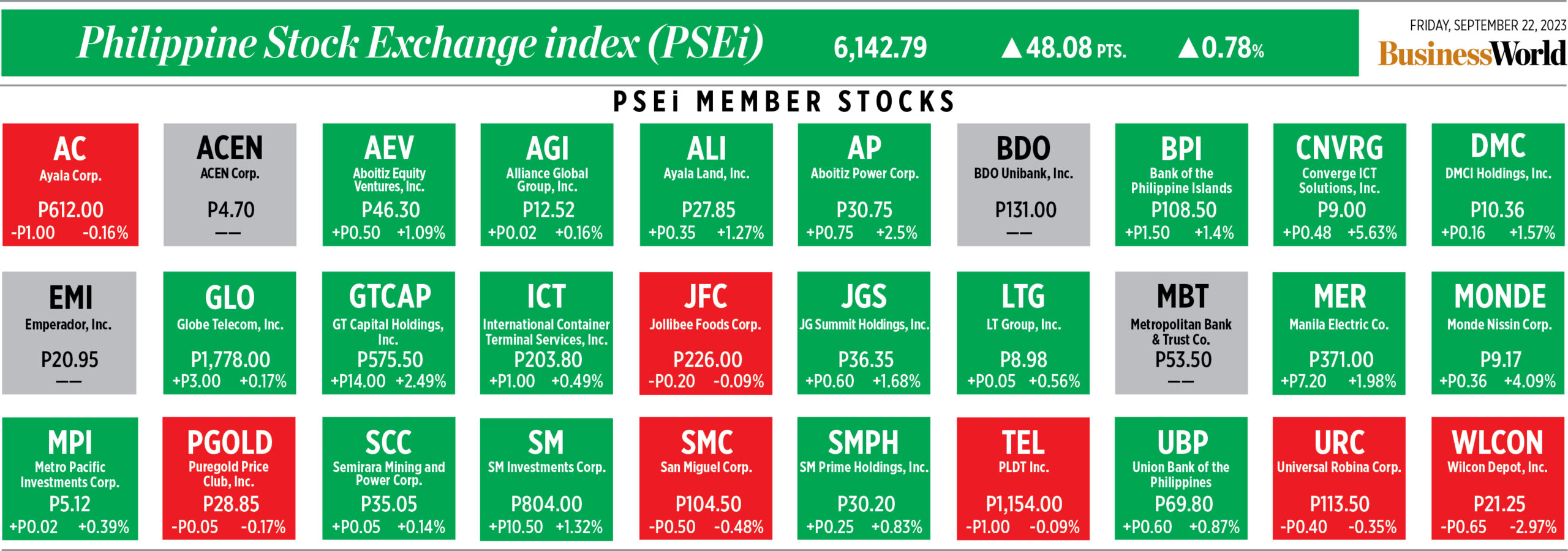
How PSEi member stocks performed — September 22, 2023

Here’s a quick glance at how PSEi stocks fared on Friday, September 22, 2023.


T-bill, bond rates expected to move sideways

BW FILE PHOTO

RATES of Treasury bills (T-bills) and bonds on offer this week could trade sideways after the Bangko Sentral ng Pilipinas (BSP) signaled the possibility of resuming its tightening cycle.

The Bureau of the Treasury (BTr) on Monday will auction off P15 billion in T-bills or P5 billion each in 91-, 182- and 364-day papers.

On Tuesday, it will offer P30 billion in reissued three-year Treasury bonds (T-bonds) with a remaining life of two years and 11 months.

Rizal Commercial Banking Corp. Chief Economist Michael L. Ricafort said in a Viber message that T-bill and bond yields may decline amid signals from the Bangko Sentral ng Pilipinas (BSP) on a possible policy rate hike in November.

At the secondary market on Friday, the 91-, 182-, and 364-day T-bills went down by 1.23 bps, 1.97 bps, and 6.76 bps week on week to end at 5.6102%, 5.9444%, and 6.0960%, respectively, based on PHP BVAL Reference Rates data published on the Philippine Dealing System’s website.

The three-year bonds likewise inched down by 1.59 bps to 6.2072% on Friday.

“Trading will likely move sideways until the end of the month. More pain will likely come during the October auctions,” a trader said in an email.

The trader also noted that the reissued three-year bonds might be rejected this week as market players could demand higher rates.

In an interview with Bloomberg TV, BSP Governor Eli M. Remolona said that the central bank may resume monetary tightening at its next meeting on Nov. 16 and hinted at the possibility of future rate hikes.

“It immediately triggered players to unwind positions as it was already an indication that they can hike more after November — beyond what was initially signaled yesterday in the MB (Monetary Board),” the trader said.

The Monetary Board on Thursday maintained its policy rate at 6.25% for a fourth straight meeting, as expected by 14 economists in a BusinessWorld poll last week.

Interest rates on the overnight deposit and lending facilities were also left unchanged at 5.75% and 6.75%, respectively.

From May 2022 to March 2023, the BSP has raised borrowing costs by 425 bps.

Last week, the BTr raised P15 billion as planned via the T-bills as total bids reached P55.665 billion, or more than thrice the amount on offer.

Broken down, the Treasury made a full P5-billion award of the 91-day T-bills as tenders for the tenor reached P16.37 billion. The average rate of the three-month paper went down by 2.3 bps to 5.552%, with accepted rates ranging from 5.53% to 5.568%.

The government also raised P5 billion as planned from the 182-day securities as bids for the tenor reached P17.792 billion. The average rate for the six-month T-bill was at 5.939%, down by 2.1 bps from the previous week, with accepted rates at 5.9% to 5.953%.

Lastly, the BTr borrowed the programmed P5 billion via the 364-day debt papers as demand for the tenor stood at P21.503 billion. The average rate of the one-year T-bill inched down by 11.7 bps to 6.073%. Accepted yields were from 6.04% to 6.08%.

Meanwhile, the reissued three-year bonds to be offered on Tuesday were last auctioned off on Sept. 5, where the government raised just P21.187 billion of the P30 billion program for a coupon rate of 6.25% and an average rate of 6.222%.

The Treasury wants to raise P180 billion from the domestic market this month, or P60 billion via T-bills and P120 billion via T-bonds.

The government borrows from local and foreign sources to help fund its budget deficit, which is capped at 6.1% of gross domestic product this year. — Luisa Maria Jacinta C. Jocson

Peso rebound seen after BSP policy stance

BW FILE PHOTO

THE PESO may rebound against the US dollar this week on hawkish remarks from the Bangko Sentral ng Pilipinas (BSP) chief following the policy hold on Thursday. 

The local unit closed at P56.795 per dollar on Friday, strengthening by six centavos from its P56.855 finish on Thursday, based on Bankers Association of the Philippines data.

The peso also appreciated by two centavos from its P56.815-a-dollar finish a week earlier. Year to date, the peso has weakened by 1.8% or P1.04 from its P55.755 close on Dec. 29, 2022.

The local currency opened Friday’s session at P56.85 against the dollar. Its weakest showing was at P56.90, while its intraday best was at P56.765 versus the greenback.

Dollars exchanged increased to $994.31 million on Friday from $815.28 million on Thursday.

The Rizal Commercial Banking Corp. Chief Economist Michael L. Ricafort said in a Viber message that the peso strengthened versus the dollar on Friday after hawkish signals from the BSP governor.

In an interview with Bloomberg TV on Friday morning, BSP Governor Eli M. Remolona said a possible rate hike at the next policy review on Nov. 16 may not be the last amid risks to inflation.

“We’re not convinced it would be the last one. It won’t be the last hike in the cycle,” he said. “We’re still in a hawkish stance.”

The Monetary Board maintained key interest rates for a fourth straight meeting on Sept. 21 but signaled it might resume tightening this year if inflation pressures persist.

The BSP kept its key benchmark rate at 6.25%, the highest in nearly 16 years. Interest rates on the overnight deposit and lending facilities were also left unchanged at 5.75% and 6.75%, respectively.

The Monetary Board hiked interest rates by 425 basis points (bps) from May 2022 to March 2023.

“If the inflation numbers had been just a bit worse, we might have gone for a hike this time. Nonetheless, the vote was unanimous, but the numbers were pretty close between hiking and not hiking,” Mr. Remolona said.

August inflation unexpectedly rose to 5.3% from 4.7% in July, bringing the year-to-date average to 6.6%, still above the central bank’s 2-4% target and the revised 5.8% forecast for the year.

Last week, the BSP also raised its average inflation forecast for 2023 to 5.8% (from 5.6%) and to 3.5% (from 3.3%) for 2024. It kept its 2025 forecast at 3.4%.

For this week, Security Bank Corp. Chief Economist Robert Dan J. Roces in an interview said the peso will “consolidate” as the market will continue to react to the hawkish remarks of the BSP governor.

According to Mr. Remolona, the impact of the BSP’s aggressive monetary tightening may continue up to the first half of next year.

“We’ll still see the rates, the previous hikes weighing on economic activity in the Philippines. The lags are long,” he said. “Another hike would mean falling below potential. But that’s a price we may have to pay if inflation is too high.”

Meanwhile, the BSP chief is not concerned about the depreciation of the peso, which almost touched the P57-to-a-dollar level on Thursday.

“Currency weakness has been a factor but not that much of a factor. The weakness seems not to come from the difference in policy rates between us and the US. It comes more from uncertainty about the economic outlook,” Mr. Remolona said.

He said that the movements in the foreign exchange market were not that sharp.

“Usually, small movements don’t affect expectations of inflation in the Philippines. Once they become very sharp then it begins to affect expectations and that is what we worry about. But so far it has not been the case,” he said.

The US Federal Reserve signaled it would keep rates higher for longer, even as it opted to keep the target Fed fund rate unchanged at 5.25-5.5% at its meeting last week. 

In a note, MUFG Senior Currency Analyst Michael Wan said they have raised their peso forecasts against the dollar for this year and 2024. 

The peso is now seen to end the year at P57.30 (from P56.70 previously) versus the greenback, before weakening further to P57.50 (from P55.20) in the next 12 months, along with some underperformance of other Asian currencies. 

“Our forecast change reflects a stronger pickup in oil prices than we assumed, while the US Dollar and US rates have also been higher than our forecasts,” Mr. Wan said.  

He also said the BSP may only start cutting policy rates in the second half of 2024 amid risks to inflation and to the peso.

For this week, Mr. Ricafort gave a forecast range of P56.55 to P56.95 versus the greenback, while Mr. Roces expects the local unit to move within P56.58 to P56.90 per dollar. — Keisha B. Ta-asan

Philippine stocks may decline due to profit taking

BW FILE PHOTO

By Sheldeen Joy Talavera, Reporter

PHILIPPINE SHARES are expected to fall this week due to increased profit taking after the back-to-back oversold rallies on Friday.

Stocks may also trade sideways “with a sense of caution,” AB Capital Securities, Inc. Vice-President Jovis L. Vistan said in a Viber message at the weekend.

“From a technical perspective, the Philippine Stock Exchange Index (PSEi) recently breached crucial support levels but subsequently recovered on unstable footing,” he said.

Confidence appears to be wavering due to hawkish warnings from both the US Federal Open Market Committee and the BSP regarding interest rates for the next nine months, he added.

“The consensus view is that inflation will be a lingering issue that will hound the market,” the stock analyst said. He put the support level at 5,800 and resistance 6,200 points.

The PSEi gained 0.78% or 48.08 points to end at 6,142.79 on Friday. The broader all-share index increased by 0.69% or 22.88 points to 3,316.95. The index gained 0.27% or 16.45 points from a week earlier.

Both the Bangko Sentral ng Pilipinas (BSP) and the US Federal Reserve kept benchmark interest rates steady last week but maintained a hawkish stance.

The Monetary Board maintained its overnight reverse repurchase rate at 6.25%, as expected by 14 economists in a BusinessWorld poll last week. Interest rates on the overnight deposit and lending facilities were also unchanged at 5.75% and 6.75%, respectively. 

It was the fourth straight pause from the Philippine central bank.

“We may see increased profit-taking activities next week following the back-to-back oversold rallies at the tail end of this week,” China Bank Securities Corp. Research Associate Lance U. Soledad said in an e-mail on Friday.

“As the Fed and the BSP affirmed their hawkish stance at their policy meetings, we suggest that investors look for swing trade opportunities (i.e., buy low and sell high), prioritizing stocks which have already started to bounce from their lows and are currently establishing new bases,” he added.

BSP Governor Eli M. Remolona, Jr. on Friday said the Monetary Board was not done hiking key rates and was likely to raise these at its next meeting in November if inflation remains elevated.

“The local stock market may enter a phase of sideways movement, with a projected range of 6,100 to 6,300 for the coming weeks,” Seedbox Securities, Inc. equity trader Jayniel Carl S. Manuel said in a Facebook Messenger chat.

“Despite the BSP and Fed’s decisions to hold rates steady, Fed Chairman Jerome H. Powell’s comments hinted at a more cautious approach,” he said. “Additionally, the Federal Open Market Committee has reduced its projections for potential rate cuts in the next year from 100 basis points to 50 basis points.”

Mr. Soledad put the stock market’s support level at 6,000 and resistance at 6,150 points.

Miners see fiscal bill boosting investment, gov’t revenue

THE Chamber of Mines of the Philippines (CoMP) said that the proposed fiscal regime for mining, which seeks to impose margin-based royalties and a windfall profits tax, will help encourage more investment in the industry while raising the government’s collections.

“The addition of two new income-based taxes makes the increase more palatable as higher taxes are paid at higher operating margins when metal prices are high, and conversely lower taxes are paid when metal prices are low or when operations are not profitable,” CoMP Vice-Chairman Gerard H. Brimo said in an e-mail.

“It will help sustain mining operations and encourage quality investment in the mining sector,” he added.

Legislators last week approved House Bill (HB) No. 8937, which seeks to create a new fiscal regime for the mining sector. It is set for third and final reading approval in the chamber before Congress goes on recess beginning Sept. 30.

“HB 8937 will enable the government to have an increasing share in the profits during the price upswings and provide the industry some breathing room during downturns,” according to Mr. Brimo.

Under the bill, large-scale metallic mining operations within mineral reservations are charged a 4% royalty on gross output of minerals or mineral products extracted.

A margin-based royalty will be imposed on income of metallic mining operations outside mineral reservations.

Miners with margins of between 1% and 10% are subject to a 1% rate. This royalty can rise as high as 5% for those with margins above 70%.

Under the bill, small-scale mining operations will be charged a royalty equivalent to 1/10 of 1% of gross output of minerals or mineral products extracted or produced.

Mr. Brimo said that an income-based royalty for metallic mining operations outside mineral reservations is used in other mineral-rich countries like Chile, Peru, and Canada. It was also recommended by the 2022 Deloitte Financial Services study on the Philippines’ mining tax structure, which was commissioned by government agencies.

The measure would also impose a margin-based windfall profits tax on mining operations. Miners with margins of more than 35% up to 40% will be charged a rate of 1%, while those with margins of more than 80% pay 10%.

Global Ferronickel Holdings, Inc. President Dante R. Bravo, however, said that increasing taxes adds to miners’ costs.

He noted that the effective tax rate based on the bill is at 60%.

“We are hopeful that even with the new fiscal regime for mining, foreign investment will still pour in. Otherwise, we should also be ready to bring down the taxes to competitive levels by reducing, if not eliminating altogether, the rates based on gross revenue and shift to net income-based rates of taxation,” Mr. Bravo added.

According to the proposed law, the Mines and Geosciences Bureau will also require metallic mining companies to submit an assay report for each shipment before they leave port.

The bill also proposes “ring-fencing to prevent consolidation of income and expenses of all mining projects by the same taxpayer to ensure that losses from other mining projects are not deducted from more profitable projects.”

All small-scale miners will be required to register with the Mines and Geosciences Bureau, as well as local government units. The bill encourages them to organize into cooperatives to qualify for the awarding  of People’s Small-Scale Mining Contracts.

However, a study conducted by the Legal Rights and Natural Resources Center (LRC) said that the bill “failed to consider the potential adverse effects or negative externalities (or spillovers) of mining operations.”

“Under this scenario, the involuntary costs are deemed imposed on others, especially the impacted communities and the government, rather than those directly responsible for the effects,” according to the study by Leon Dulce and E. M. Taqueban of LRC, the Philippine Mining Situation. “In other words, for the mining fiscal regime to be truly equitable, these costs must be fully accounted for,” it said.

“Mineral production and money flow are not guarantees of social and economic progress. The proceeds from extraction should be invested in social and economic activities that will benefit the present and future generations,” the study concluded. — Beatriz Marie D. Cruz

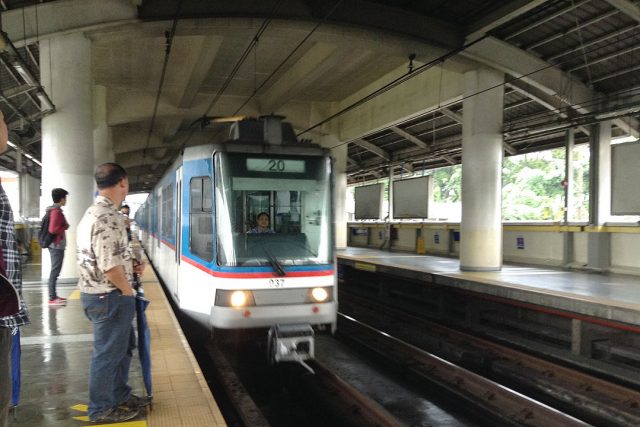
Second MRT-3 proposal triggers review of rules for unsolicited bids

THE Department of Transportation (DoTr) said it is reviewing the rules governing the handling of multiple unsolicited proposals after receiving a second bid for the operations and maintenance of Metro Rail Transit (MRT) Line 3.

Transportation Undersecretary Timothy John R. Batan said the department is consulting the Public-Private Partnership (PPP) Center on how to proceed.

San Miguel Corp. was declared original proponent for the rail line’s operations and maintenance (O&M) contract last year, followed by another bid this month submitted by Metro Pacific Investments Corp. (MPIC). The unsolicited MPIC O&M bid was submitted to the DoTr for the operations and maintenance of MRT-3.

“There are rules on how to handle multiple unsolicited proposal submissions. We are confirming with the PPP Center,” Mr. Batan told reporters on the sidelines of NAIA-PPP pre-bid conference last week.

“We received (the MPIC bid) and we are processing it according to the IRR. We just note that there was a previous submission from the previous administration and that is what we are coordinating with the PPP center on how to properly address this,” Mr. Batan said, adding that the department still needs to confirm whether the previous unsolicited proposal from the previous administration is valid.

Mr. Batan added that the DoTr is working with the Asian Development Bankand International Finance Corp. of the World Bank on the terms of reference (ToR) for the solicited proposal to privatize the Light Rail Transit line 2 and MRT-3.

Meanwhile, Transportation Secretary Jaime J. Bautista said that the privatization of the Ninoy Aquino International Airport (NAIA) has so far attracted six bidders.

The DoTR has identified these companies as GMR Airports International; San Miguel Holdings Corp.; Manila International Airport Consortium;  Spark 888 Management; Asian Airport Consortium; and Turkey’s Cengiz Insaat Sanayi ve Ticaret A.S.

Mr. Bautista said that according to the draft concession agreement, the winning bidder is required to pay an upfront payment of about P30 billion and an annual P2 billion, plus a share of revenue.

“Based on the study that we did; it will be good for them — the investors will be able to earn a reasonable rate of return on their investments. If the government will be able to share in the revenue and while we think about it, there will be an improvement in the service which I think will be the most important considering we have an airport which is very congested,” he said.

According to the NAIA-PPP concession agreement, the contract term for the project is 15 years, extendable by another 10 years.

This project will be a rehabilitate-operate-expand-transfer arrangement, as provided for under the Build-Operate-and-Transfer Law.

“Discussions on an extension will be conducted on year eight. The extension is based on performance by the winning bidder, based on certain KPIs (key performance indicators),” Mr. Batan said.

Mr. Batan noted the concessionaire must fulfill the KPI conditions set out in the agreement; failure to achieve performance benchmarks will result in rejection of the 10-year extension bid.

The DoTr has set the deadline for bids on Dec. 27. It has said that it expects to announce the winning bidder by the first quarter of 2024.

In August, the government invited bidders for the P170.6-billion public-private partnership to modernize and operate the main gateway airport. The modernization hopes to increase the current annual passenger capacity of the airport to 62 million from 35 million.

Separately on Sunday, NAIA was ranked the 15th most-connected airport, according to the 2023 Megahubs Index compiled by OAG, a global travel data provider.

“We are pleased that MNL is able to ride the momentum brought about by the strong and consistent travel rebound from the COVID-19 pandemic, as well as the LCC (low-cost carrier) penetration in our region. We are likewise grateful for the confidence the international carriers have extended to us,” Manila International Airport Authority Officer-in-Charge Bryan Co, said in a statement Sunday. 

Manila’s climb to 15th follows a rating of 29th in 2019. The OAG report said Philippine Airlines had a 32% share of flights.

“NAIA being the country’s main gateway makes it incumbent upon us, as the airport authority, to expand the destinations Filipinos, as well as our guests, can fly to and from Manila,” he said. — Ashley Erika O. Jose

Chinese companies expected to invest in electronics, renewables

THE Board of Investments (BoI) said it received commitments from two Chinese companies for investments in renewable energy and consumer electronics.

The commitments were made on the sidelines of the China-ASEAN Expo, Ceferino S. Rodolfo, BoI managing head and Trade undersecretary, told reporters in an online briefing.

He said that one of the two potential investors is a state-owned company which claims to be the biggest renewable energy company in China and has $15 billion in investible funds for Southeast Asian projects.

“They can allot $1 billion to $5 billion for the Philippines and all of it they would like to put into renewable energy projects. The (funds) can come in as equity or for financing. And of course, they will be the technology partner,” Mr. Rodolfo said.

“They have been asking us for introductions to Philippines companies who have been active also in renewable energy projects,” he said.

The state-owned firm is involved in solar, wind, and hydropower energy projects.

Meanwhile, Mr. Rodolfo said that the second investor already has operations in Batangas and is involved in specialized segments of the consumer electronics market.

“They are just renting a facility from another company, but right now they have secured five hectares in Batangas, where they will put up a world-class plant,” he said.

He said that the second company plans to replicate its China facility in the Philippines and build a research and development hub for software here.

The DTI also met with another company which has expressed preliminary interest in entering the Philippine market.

“At this point, (it just wants) to penetrate the Philippine market for electronic products. It does not have any plans yet in investing in an assembly line which is what we would like,” Mr. Rodolfo said.

The BoI did not identify any of the potential investors.

The BoI said it approved projects worth P725.93 billion as of Sept. 12, close to exceeding the full-year total of P729 billion in 2022.

For this year, the investment promotion agency is hoping to approve P1.5 trillion worth of investments. — Justine Irish DP Tabile

Nokia touts private wireless tech as productivity booster for miners

By Adrian H. Halili, Reporter

NOKIA Corp. said mining projects, typically located in remote areas, stand to raise their efficiency with the connectivity provided by its private wireless networks.

“The mining industry is a sector that clearly needs mission-critical connections,” Nokia Philippines Head Carlos Alberto Reyes said in an interview.

He said communication networks with “low latency” — referring to the delay experienced in data transfer — ensures “continuous communication for the equipment in the mine.”

He said that the company is currently in talks with potential mining partners to roll out Nokia’s private wireless network.

“We are interacting with several partners and industries that are interested in going in that direction… there are several areas that are doing mining and we are working in that direction,” Mr. Reyes said.

Mr. Reyes said that in mining, “technology is becoming a key differentiator. To be more safe, efficient, and sustainable; technology is helping (the industry) improve.”

“This is possible by digitalizing all the processes in mining, (which can create) an environment that helps the companies operate in a safer way,” he added.

“The solution that Nokia has designed for sectors like mining are specialized (technologies) dedicated for its operations,” Mr. Reyes said.

He added that Nokia’s private wireless network, is a “mini network” that links “all the elements; from the core, the processing, the data center, as well as the radio that connects to the mine.”

He assured that such networks are highly secure, with the system capable of handling “sensitive data reliably.”

“The mining industry is a sector that clearly needs mission-critical connections,” Mr. Reyes added.

New site-blocking rules rolled out to counter piracy

THE Intellectual Property Office of the Philippines (IPOPHL) said it launched new rules governing site blocking that will disrupt access to sites offering pirated items.

In a statement, IPOPHL said Memorandum Circular 23-025, or the Rules on Voluntary Administrative Site Blocking, will improve the Philippines’ current ranking as third-worst in East and Southeast Asia in terms of levels of piracy.

Signed on Sept. 20, the rules on site blocking will take effect after two months from publication in a newspaper of general circulation.

“The Philippines now has an essential tool to protect the creativity that drives our economy and defines our cultural landscape,” IPOPHL Director General Rowel S. Barba said in a statement.

Mr. Barba said that the rules are aimed to replicate the success of Indonesia, where more than 50% of consumers stopped accessing pirate services as a result of blocking measures launched in 2019.

“We encourage rights holders to optimize this tool and protect the value of your creative assets,” Mr. Barba said.

Under the rules, a rights holder or a duly authorized representative may file a written request with the IP Rights Enforcement Office (IEO) which will then be given 10 working days to submit an evaluation report.

The report will carry a recommendation on the issuance of a site blocking order, to be elevated to the supervising director or deputy director general for approval within five working days.

The due process requirement will be met via the submission of the blocking request to the site administrator, or will be published on the IPOPHL website if no contact details are found.

If no protest is received from the website administrator within seven days from receipt, a site-blocking request to internet service providers (ISPs) will be issued, which in turn must be carried out in 48 hours.

On Wednesday, IPOPHL signed partnership agreements with the National Telecommunications Commission (NTC) and ISPs to effectively implement the new rules.

Under the agreement with the NTC, IPOPHL’s oversight will be expanded to over 300 ISPs which are not part of IPOPHL’s current agreements with ISPs.

“The NTC holds a pivotal role in the regulation and supervision of the telecommunication sector, establishing it as an indispensable ally in this initiative” IEO Supervising Director and Bureau of Legal Affairs Assistant Director Christine V. Pangilinan-Canlapan said.

NTC Commissioner Ella Blanca Lopez said that the partnership will enhance cooperation within the interagency National Committee on Intellectual Property Rights.

“This cooperation ensures a synchronized and streamlined approach in enforcing IP rights in the country. It is imperative that we work hand in hand to protect our creative economy,” Ms. Lopez said. — Justine Irish D. Tabile

Closing gaps in infrastructure prescribed to address lagging tourism recovery

IMAGE BY GIULIANO GABELLA VIA UNSPLASH

By Justine Irish D. Tabile, Reporter

THE Philippines must focus on infrastructure to maximize its tourism potential and restore foreign tourism to pre-pandemic levels, analysts said.

“More infrastructure spending and development is needed to further boost the capacity of the country’s various airports and gateways to accommodate more foreign tourists and help bring back the country’s foreign tourism numbers and revenue (in line with) other ASEAN (Association of Southeast Asian Nations) countries,” Rizal Commercial Banking Corp. Chief Economist Michael L. Ricafort said in a Viber message.

The United Nations World Tourism Organization (UNWTO) recently reported that international tourism in the first half, as measured by arrivals, was 84% of pre-pandemic levels. However, in Asia and the Pacific, the recovery was only 61%.

“International tourism is experiencing a rapid recovery in Asia and the Pacific where arrivals climbed to 61% of pre-pandemic levels this period after the reopening of many destinations and source markets earlier this year,” UNWTO said.

In the Philippines, the Department of Tourism reported 3.88 million visitor arrivals as of Sept. 19, accounting for 80.8% of the 4.8 million target for the year. In 2019, visitor arrivals totaled 8.25 million.

“Philippine tourism is as resilient as other destinations but unique in such a way that ours is driven mostly by domestic tourism, comprising approximately 80% of receipts,” according to John Paolo R. Rivera, OIC executive director of the Asian Institute of Management’s Dr. Andrew L. Tan Center for Tourism.

“The Philippines is working its way to become a hub. This is not done overnight. Until adequate infrastructure both soft and hard are in place, only then we will be able to fully harness tourism potentials of the Philippines not confined to the mainstream local destinations,” he said in a Viber message.

According to the UNWTO, “the reopening of China and other Asian markets and destinations is expected to continue boosting travel both within the region and to other parts of the world.”

On Aug. 10, China announced the resumption of outbound group tour services to a third batch of 78 countries. It has so far expanded to 138 in August from 60 in April.

“However, the recovery of international travel to and from China has been hampered by still limited flight connectivity and visa backlogs,” UNWTO said.

Mr. Rivera said that tourism from China is a “double-edged sword,” as it may also be a threat to sustainability.

“It is good for arrival figures and receipts but may be a threat to sustainability given the volume of tourists coming from China. It’s a matter of balancing sustainability pillars as far as demand from China is concerned,” he said.

China Banking Corp. Chief Economist Domini S. Velasquez said the Philippine services sector is expected to continue benefiting from a jumpstart in tourism after the pandemic.

“However, tourist arrivals are still below pre-pandemic levels, compounded by the slow arrival of visitors from China,” Ms. Velasquez said.

“If you recall, before the pandemic, Chinese tourists were second to Koreans. As China reduces restrictions to travel, we expect the Philippines to also benefit, especially the tourism industry,” she added.

ADVERTISEMENT
ADVERTISEMENT