Home Blog Page 4251

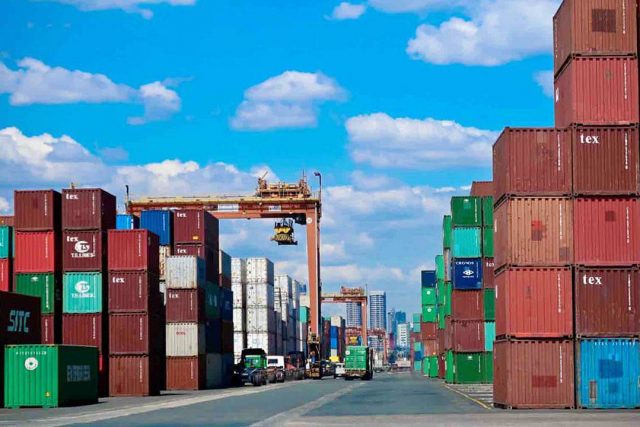
Trade deficit revised to $27.98 billion in first half

BW FILE PHOTO

THE DEFICIT in the balance of trade in the first half widened compared to the preliminary estimate, with the final import bill higher than initially reported, the Philippine Statistics Authority (PSA) said.

The revised trade deficit was $27.979 billion, up from the $27.955 billion initially posted in August. The deficit is narrower than the $28.403-billion deficit from a year earlier. 

The value of merchandise exports in the first half was revised to $34.944 billion from $34.941 billion previously reported. The revised tally represents a 9.3% decline from the $38.536 billion posted in the first half of 2022.

Imports were also revised higher to $62.924 billion from $62.896 billion previously reported in August. The revised total represents an 8% decline compared with the year-earlier $68.377 billion.

The Development Budget Coordination Committee’s export and import growth assumptions are set at 1% and 2%, respectively, for this year.

Accordingly, total trade was revised to $97.868 billion against the earlier estimate of $97.837 billion.

“Imports and exports both eased to three-month lows recently amid higher inflation that weighed on spending worldwide, higher interest rates that increased financing costs that slowed down investments and global trade,” Rizal Commercial Banking Corp. Chief Economist Michael L. Ricafort said in an e-mail.

The PSA reported, citing preliminary data, that the consumer price index accelerated to 5.3% in August from 4.7% in July. It slowed from the 6.3% posted a year earlier.

“Membership in the Regional Comprehensive Economic Partnership (RCEP), which is the world’s biggest free trade agreement, would help attract more foreign direct investment to locate in the Philippines as a production or marketing base, as well as an access point to bigger export markets,” Mr. Ricafort said.

“The RCEP will also expand the sources of cheaper imports for foreign investors that manage their respective global supply chains with reduced import tariffs in the coming years,” added Mr. Ricafort. — Lourdes O. Pilar

DTI seeks more funding for creatives to maintain PHL lead within ASEAN

PHOTO COURTESY OF THE METROPOLITAN THEATER

THE Department of Trade and Industry (DTI) said more funding for the creative sector is needed to maintain the Philippines’ regional lead in exporting creative services.

“We hope to get a bigger share of the budget because considering all these huge programs that we’re planning to implement,” Trade Undersecretary Rafaelita M. Aldaba told reporters on Thursday.

“We are already number one in ASEAN in terms of creative services exports, but we really need to be able to sustain this position. And we can only do that if we can if we continue to provide all the necessary support to allow our creatives to compete abroad,” she added.

According to Ms. Aldaba, the department received over P400 million from the 2023 budget for the industry, and is requesting up to P600 million for 2024.

The budget will be going to programs that will promote creative industries at the city and municipality level, capacity-building, market intelligence reports, and a creative venture fund.

“The focus is really on promoting and growing more creative cities… There are a lot of opportunities for the creative sector. But at the same time, we need government support,” she said.

The government’s support could take the form of new technology that can level up the Philippines’ creative output.

The DTI also wants to build a creative learning academy to help with capacity building and upskilling and reskilling of the work force.

Asked when DTI plans to launch the venture fund, Ms. Aldaba said the department hopes to launch it next year.

“Of course, we first need to have the budget. So, we’re hoping next year, we’ll be able to formally launch the program,” she said.

“What we envision is for the government to be able to provide equity, soft loans, and at the same time, grants through vouchers to address the needs of the individual companies, startups, and especially the micro, small and medium enterprises,” she added.

Ms. Aldaba said that DTI allotted P100 million for the creative venture fund. — Justine Irish D. Tabile

Palace decision not to cut rice tariffs seen averting market disruption during harvest

PHILIPPINE STAR/ANDY ZAPATA JR.

By Luisa Maria Jacinta C. Jocson, Reporter

THE President’s rejection of the proposal to reduce tariffs on rice imports will help stabilize prices, as supply receives a boost from domestic farmers, who get to bring in their harvest without disruption from cheap imports, analysts said.

Raul Q. Montemayor, chairman of the Federation of Free Farmers, said the organization supports the Palace’s decision not to lower tariffs.

“Harvests are already starting, there will be no supply problem until the end of the year, and because of increased supply, prices will naturally go down and stabilize,” he said in a Viber message.

“But at some point next year, we will still have to import because our total annual output is enough for only about 80% of our annual (demand),” he added.

President Ferdinand R. Marcos, Jr. last week rejected a proposal from the economic team to cut the tariff on imported rice to as low as 0% from 35%.

Samahang Industriya ng Agrikultura (SINAG) last week expressed its support for the Palace’s decision, calling it a “significant milestone for the agriculture sector.”

SINAG Executive Director Jayson H. Cainglet said that issues driving up rice prices include distribution gaps and hoarding and profiteering.

“Even if the executive order on tariff reduction was signed, it would not have solved these problems,” he said in a Viber message.

“We have no rice shortage, we are safe beyond the first quarter of next year. (There is) no basis for tariff reduction,” he added.

Philippine Chamber of Commerce and Industry President George T. Barcelon said that the rejection likely means that Mr. Marcos prefers sticking to the temporary price cap.

“This would allow the economics of supply and demand to play out… What’s important is for the government to be vigilant regarding hoarders and price manipulators. Policies to maintain price stability in the food commodities are fundamental to containing inflation to help low-income earners,” he said in a Viber message.

By executive order, rice retail prices were capped at P45 a kilo for well-milled rice and P41 for regular-milled rice, starting Sept. 5.

To address spiraling prices, Mr. Montemayor said that the government should still manage imports to prevent depressing the price of palay (unmilled rice) and disincentivizing farmers.

“Otherwise, we will end up becoming even more reliant on imports at a time when international prices are rising, and countries are restricting their exports.”

“We can resolve hoarding, profiteering and smuggling — if we can finally convict those involved. We have zero convictions despite all the raids, padlocking, seizures. That’s why these people remain emboldened,” he said.

“The problem is the distribution gaps; especially the market abuse of a few importer-traders and those involved in profiteering. The government must finally sustain support and subsidies to increase our rice yield,” he added.

If cost of production can be reduced to P10-12 per kilogram and farmgate prices are at P18-20 per kilogram, then well-milled rice prices could fall to as little as P36-38 per kilogram, Mr. Cainglet said.

On the other hand, Foundation for Economic Freedom President Calixto V. Chikiamco said that complying with the rice caps would have helped if the tariff cut was approved.

“The recent rejection is disappointing… In fact, the rice price cap would be rendered unnecessary as traders would be able to offer regular rice at P41 per kilo and well-milled rice at P45 per kilo without the 35% tariff,” he said.

Mr. Chikiamco said higher prices may likely lead to an imbalance of supply and demand. He also noted that the only way to stabilize prices is to “flood the market with rice.

“However, the National Food Authority can no longer import rice.  It has also not built enough reserves,” he said.

“Without sufficient reserves, especially during the lean season from late December to March, any disruption from adverse weather conditions can cause a further imbalance in supply and demand and cause prices to skyrocket.  By that time, the government may be helpless to do anything about it,” he added.

The US Department of Agriculture (USDA) last month downgraded its forecast for Philippine rice production due to crop damage caused by typhoons.

Milled rice production is estimated to slip to 12.55 million metric tons (MT) for the market year 2023-2024, lower than its previous forecast of 12.6 million MT.

Rice imports are also expected to decrease to 3.5 million MT, down from the USDA’s earlier estimate of 3.8 million MT.

Innovation ranking to improve with more science and tech investment, DTI says

PHILSTAR FILE PHOTO/PIXABAY

THE Department of Trade and Industry (DTI) said more investment is needed in science and technology to improve its Global Innovation Index ranking.

“To continually improve our position, we need to address weaknesses by investing in science, technology, engineering, arts and math education and vocational training programs that focus on skill-building for the future,” Trade Undersecretary Rafaelita M. Aldaba told BusinessWorld in a Viber message.

She added that innovation could also be unlocked through diversification into higher-value industries and services and simplifying regulations to make businesses focus more on innovating rather than dealing with bureaucratic hurdles.

The Philippines rose three spots to 56th out of 132 economies in the Global Innovation Index 2023 compiled by the World Intellectual Property Organization.

Ms. Aldaba said improving the Philippine ranking would be an excellent indicator of progress.

“But it should also serve as a catalyst for continuous improvement and strategic planning to ensure that the positive trend continues,” she added.

She said that what contributed to the improvement are the firms “offering sophistication and high-tech imports along with improvements in market sophistication covering credit, investment, trade, diversification and markets.”

The Philippines ranked 69th in innovation inputs against 76th a year earlier. It placed 52nd in innovation outputs, one spot lower.

Its best category was business sophistication, knowledge and technology outputs, and market sophistication, but was worst-placed in human capital and research, infrastructure, and institutions. — Justine Irish D. Tabile

NCR retail price growth steady in August  

RETAIL PRICE growth in Metro Manila was flat in August, ending five consecutive months of increases, the Philippine Statistics Authority said.

Price growth in the National Capital Region (NCR), as measured by the general retail price index (GRPI), remained at 3.9% year on year in August.

The August reading remains the highest since the 4.4% posted in June 2023.

In the eight months to August, NCR retail price growth averaged 5.1%, up from 3.7% a year earlier.

The increase in the GRPI was driven by the faster growth posted in the miscellaneous manufactured articles of 1.8%, against 1.7% in the previous month.

Indices for chemicals, including animal and vegetable oils and fats, and machinery and transport equipment remained unchanged from the previous month’s growth rates of 3.1% and 1.4%, respectively.

Slower price growth was seen in the indices of food (6.9% in August from 8.2% in July); beverages and tobacco (4.9% from 6.1%); crude materials, inedible except fuels (3.8% from 4%) and manufactured goods classified chiefly by materials (2.3% from 2.5%). — Lourdes O. Pilar

Stagnation still possible if youthful economies fail to invest — DBS  

Young students form a line as they wait for their respective room assignments for their afternoon class at Malanday Elementary School, June 8, 2022. — PHILIPPINE STAR/ WALTER BOLLOZOS

AN ECONOMY with a younger population like the Philippines can fail to grow robustly if it fails to invest in key areas like health, skills, and infrastructure, according to DBS Bank Ltd.

In a report issued by DBS economists Taimur Baig and Radhika Rao on Sept. 25, the bank noted misperceptions among economies in Asia which have contrasting demographic dynamics.

“Demographics is not destiny. Ageing societies can continue to prosper; youthful societies can stagnate,” it said.

The bank noted that China, Hong Kong, Taiwan, Thailand, South Korea, and Singapore have ageing demographics while Bangladesh, India, Indonesia, Malaysia, and the Philippines skew younger.

According to the bank, the younger working population in economies like the Philippines have at least two decades more to expand, though this will not immediately translate to economic growth.

“Without job creation, job seekers, young or old, become chronically unemployed, sapping economic vitality,” it said. “Without adequate infrastructure and logistics, even a cheap labor force can be insufficient in driving competitiveness.”

Meanwhile, an ageing economy can continue prospering by enhancing productivity, it added.

In several Philippine economic briefings abroad, Finance Secretary Benjamin E. Diokno has said that the Philippines is in a “demographic sweet spot,” with a young cohort entering or currently in the work force.

During the economic briefing in Dubai last month, Mr. Diokno said the Philippine labor force has a median age of 25 years.

“The current demographic sweet spot will fuel the country’s economic growth,” he earlier said.

The Philippine Statistics Authority (PSA) estimates the youth labor force in July at 5.97 million, out of a youth population of 20.16 million. The PSA defines the youth age bracket as 15-24 years.

This translated to a youth labor force participation rate of 29.6%, lower than 37.1% posted a year earlier.

Youth that are new entrants into the labor force more than doubled to 1.13 million in July from 496,000 a month prior.

However, the youth employment rate fell to 86% in July from 90.1% in June and the year-earlier 88.1%.

The proportion of youth not in education, employment or training increased to 14.7% from 12.9% in July 2022. — Keisha B. Ta-asan

Reimagining the digital supply chain

In recent years, there has been a substantial change in the global landscape of supply chains. Companies are dealing with a wide range of challenges that are changing the way they see supply chain strategy, from geopolitical conflicts to digital disruptions and pressures from climate change and the sustainability agenda. A new paradigm reimagining supply chains is emerging in reaction to these disruptions, forcing businesses to reconsider their existing strategies and adopt a comprehensive approach to capitalize upon new opportunities while ensuring resilience.

Because of this, traditional and analog supply chain strategies may no longer be capable of effectively responding to supply chain shocks. Instead, an agile, digital supply chain consisting of intelligent monitoring, real-time data visibility and management, and crisis and exception management frameworks, among other things, can be a massive game-changer. However, there are no shortcuts to the digital transformation of the supply chain, as merely adding technology to existing supply chain management systems and processes for the sake of supply chain digitalization will not deliver the real value that businesses desire.

This is the second article in a supply chain series that previously looked at integrated supply chain planning.

SUPPLY CHAIN CHALLENGES
According to an EY report, exponential data growth is another fundamental problem that continues to overwhelm most businesses at an accelerated pace. Companies that can effectively navigate the increasing complexity of new digital business models will be able to maintain a competitive advantage, but companies that are unable to do so will inhibit their ability to derive meaningful insights, leading to a barrier to achieving automation and efficiency.

The disruption brought about by digital technology has significantly reshaped supply chains, accelerating supply chain digitalization. According to the Evolution to Revolution: MHI Annual Industry Report, 78% of supply chain executives in the study acknowledge the revolutionary value of digital technologies. The whole supply chain will benefit from the new opportunities for efficiency improvements as well as improved decision-making brought forth by this shift toward digitalization.

Digital supply chain reimagination has also become defined by the mounting demand to improve resiliency, combat climate change, and promote sustainability. Consumers are more aware of how products affect the environment, with 75% of US consumers voicing worries in this area, according to an article titled “Majority of US Consumers Say They Will Pay More for Sustainable Products” by Sustainable Brands, a community of brand innovators shaping the future of commerce. In order to meet these changing customer expectations, businesses are adopting supply chain redesign driven by sustainability.

THE FOUR PILLARS OF SUPPLY CHAIN REIMAGINATION
In order to navigate these complexities and seize opportunities, companies have to embrace a comprehensive approach to supply chain reimagination, utilizing a framework that revolves around the following four key pillars.

Supply chain sustainability and resiliency. This pillar emphasizes tech-led process excellence to build resilient supply chains through enhanced visibility and improved agility. To guarantee continuous operations and satisfy customer demands, integrated business planning, manufacturing reliability, and secure alternative bill of materials (BoMs) and sources of supply all play critical roles.

End-to-end (E2E) cost optimization. For a company to stay competitive, better cost management along the entire supply chain is essential. Among the key levers necessary to achieve long-term cost reductions and operational efficiency are strategic sourcing, the elimination of manufacturing waste, and maximizing logistics expenditures. Adopting a centralized operating model for supply chain through Global Business Services (GBS) or Shared Services Center (SSC) solutions can also create significant cost savings.

Supply chain process digitalization. The digitalization of supply chains opens up new opportunities for agility and efficiency. Real-time decision-making and enhanced collaboration are made possible by autonomous planning, digital factories, and procurement analytics. E2E visibility and quality management through the use of the Control Tower system also allow seamless integration between functions, enhancing the effectiveness and response of the supply chain as a whole. Leveraging a Digital Twin (a virtual model of the physical supply chain that includes a digital counterpart of every piece of the process) enables companies to run a parallel version of the supply network and simulate scenarios for better insights before making transformative changes.

Strategic interventions. This final pillar includes supply chain redesign driven by sustainability, carbon footprint optimization, and segmentation and portfolio optimization. Companies can future-proof their operations and align their supply chains with shifting market dynamics by carefully reevaluating their operations and implementing asset-light solutions.

Companies may significantly affect their profit and loss statements by concentrating on these four supply chain reimagination areas.

UNLOCKING BENEFITS FOR BUSINESSES
According to an assessment of prior supply chain engagements conducted by EY, adopting a supply chain reimagination framework has had a substantial positive impact on customers in four areas.

First, implementing strong resilience measures can result in gains in total revenue of 3% to 5%, a forecasting accuracy of 5%, supplier lead times of 50% to 60%, and overall equipment efficiency (OEE) of 15% to 30%.

Second, through route optimization and freight rate benchmarking, focusing on cost optimization can result in reductions of 4% to 6% in direct material costs, 5% to 10% in manufacturing expenses, and 6% to 10% in transportation costs.

Third, embracing digital transformation in the supply chain can lower production costs by 5% to 10%, inventory carrying costs by 10% to 15%, and warehouse and distribution center operating expenses by 6% to 10%.

Last, through network redesign, strategic interventions can reduce transportation costs by 10% to 25% and increase on-time-in-full (OTIF) performance so that it reaches 95% or higher.

REIMAGINING THE FUTURE OF SUPPLY CHAIN MANAGEMENT
The supply chain landscape is rapidly changing as a result of a convergence of major disruptions and the demand for sustainability and resilience. However, businesses that use the framework for supply chain reimagination can elevate themselves to a leading position during this change. Enhancing digitalization, building robust supply chains, controlling costs, and aligning operations with shifting market dynamics are all possible for firms that take a comprehensive approach and make full use of technology, process excellence, and strategic interventions.

Reimagining the digital supply chain is no longer a choice — it is imperative for businesses seeking long-term success as the business climate continues to evolve. Organizations may maximize the potential of their supply chains and succeed in a complex and dynamic world by reevaluating their strategies and embracing these four pillars, charting a path to increased resilience, sustainability, and autonomous supply networks.

The next article in this series will discuss why green supply chains are the key to long-term value.

This article is for general information only and is not a substitute for professional advice where the facts and circumstances warrant. The views and opinions expressed above are those of the authors and do not necessarily represent the views of SGV & Co.


Jan Ray G. Manlapaz is a consulting partner and Mary Andrea T. Bacani is a Supply Chain and Operations (SCO) senior manager of SGV & Co.

Experience Super-Sized Fun at SM’s 65th Anniversary this October

SM Mall of Asia

It’s October and it only means one thing at SM — Super Month!
Suit up for some super-sized deals, treats, and fun as SM celebrates its 65th anniversary. Check out the month-long festivities filled with spectacular activities, immersive attractions, and unforgettable experiences that will leave you thrilled and excited.

SM lights up the sky with Super Blue Illumination
Signaling the start of SM’s 65th celebration, key malls and iconic landmarks will bathe in a brilliant shade of blue starting Oct. 1. A sight to behold and an event to watch out for, the Super Blue Illumination is a captivating display of dazzling lights that signify SM’s enduring legacy and commitment to bringing fun, awesome, and memorable malling experiences for over six decades.

It’s a shopper’s paradise with Super Buy 1 Get 1 Deals
October isn’t complete without a month-long parade of super-sized deals and promos at SM Deals! Expect Buy 1 Get 1 Deals from your favorite dining, shopping and entertainment brands, extravagant discounts, exclusive bundles, and exciting freebies you can swipe to redeem in-store when you download and register on the SM Malls online app. And with a diverse range of brands and product offerings at SM, surely there’s something for everyone in everyone’s shopping paradise.

Indulge yourself with Super Treats
Fun and frenzied October awaits as SM unleashes its Super Treats! On Oct. 15, indulge the movie buff in you as SM Cinema offers a Php 65 movie ticket deal and a Php 65 caramel popcorn combo. It’s truly a match made in cinema heaven!

From October 1 to 30, knock down pins all you want as SM Game Park and SM Bowling offer Php 65 off on unlimited bowling for one hour. For the skating aficionados, SM Skating will also be slashing off Php 65 on the all-day pass.

And for the thrill seekers, you are in for a super treat! Have a whole day of wonder and excitement with a Php 65 entrance fee at Skyranch Tagaytay for all Mondays of October until 12 noon.

Create core memories at the Super Play Spots
Gather your squad and have fun at the Super Play Spots. With well-lit, Instagrammable areas, you’ll have the perfect backdrop for your Super Month memories. These Super Play Spots promise hours of entertainment whether you’re a social media maven or simply looking for a fun day out. Check out the Super Play Spots at SM Mall of Asia, SM Megamall, SM City North Edsa, SM Aura, SM Southmall, SM City Dasmariñas, SM Seaside City Cebu, SM Cagayan Downtown Premier, SM Lanang, SM City Clark, SM City Marikina, and SM City Iloilo.

Experience the magic of SM City Marikina’s Super Play Spot’s Kaleidoscope Tunnel – a dazzling experience for family and friends of all ages!

Drive away in style at the Super Raffle Giveaway with VISA
From Oct. 1 to Nov. 30, eleven lucky shoppers can get a chance to drive away in style at SM’s Super Raffle Giveaway with VISA. All you need to do is to shop for a minimum single receipt purchase of Php 2,000 via tap to pay using your VISA card at participating SM Retail Stores in 75 SM Malls nationwide. Get a chance to win one of the six brand-new Hyundai Stargazers and one of the five brand-new Hyundai Cretas. These brand-new Hyundai cars will really make your daily commute a super experience so shop till you drop and maybe drive away with a new set of wheels!

SM’s Super Month promises to be a 65th-anniversary celebration like no other. Don’t miss out on the super-sized deals, indulgent treats, and the chance to win big. Mark your calendars and get ready for a super malling experience at your favorite SM mall.

To stay updated for everything SUPER this October, visit www.smsupermalls.com or follow @SMSupermalls on social media.


Spotlight is BusinessWorld’s sponsored section that allows advertisers to amplify their brand and connect with BusinessWorld’s audience by enabling them to publish their stories directly on the BusinessWorld website. For more information, send an email to online@bworldonline.com.

Join us on Viber at https://bit.ly/3hv6bLA to get more updates and subscribe to BusinessWorld’s titles and get exclusive content through www.bworld-x.com.

Philippines told to work with sectors to fight China fake news, ambitions

A CHINESE Coast Guard ship ‘shadowing’ a Philippine vessel on its way to deliver supplies on Dec. 17, 2022 to troops stationed at the BRP Sierra Madre, which is grounded in Ayungin Shoal in the West Philippine Sea. — WESTERN COMMAND AFP

By Kyle Aristophere T. Atienza, Reporter

THE PHILIPPINES should work with local sectors and other nations in countering China’s disinformation campaign and put in check its military and economic ambitions in the South China Sea, geopolitical analysts said.

The Philippines has been subjected to China’s disinformation tactics through “diplomatic slurs, media projection and people-to-people networks at the national and local levels,” Joshua Bernard B. Espeña, a resident fellow at the International Development & Security Cooperation in Manila, said in an e-mail at the weekend.

He added that the Philippines started to become highly vulnerable to China’s disinformation campaign under the government of ex-President Rodrigo R. Duterte, who led a foreign policy pivot to Beijing when he took office in 2016 in exchange for investment pledges, few of which materialized. 

“Duterte’s rebuke of his predecessor’s foreign policy, Washington’s incapable and destabilizing regional presence, and China’s ‘peaceful rise’ to unite people for development and prosperity had blurred the need to take action to defend claims in the West Philippine Sea,” he added, referring to areas of the sea within the country’s exclusive economic zone.

In a Sept. 28 report, the US State Department said the Chinese government has allocated huge resources for its disinformation and censorship tactics to support its maritime ambitions.

China has spent billions of dollars annually on “foreign information manipulation efforts” and uses “false or biased information to promote positive views” of itself and the Chinese Communist Party (CCP), it added.

China suppresses critical information that contradicts its views on issues involving the South China Sea, Taiwan, human rights practices and its domestic economy, according to the US report.

The Chinese Embassy in Manila did not immediately reply to to a Viber message seeking comment.

Tensions between the Philippines and China have escalated, with Beijing conducting activities that deny Philippine vessels of their access to parts of South China Sea that fall within Manila’s 200-nautical mile exclusive economic zone. 

A United Nations-backed arbitral tribunal in The Hague in 2016 voided China’s claim to more than 80% of the South China Sea based on a 1940s map.

China on numerous occasions blocked Philippine vessels from delivering food and other supplies to a World War II-era ship that Manila deliberately grounded at Second Thomas Shoal in the 1990s to assert its claim.

China in August said the Philippines had pledged to remove the grounded ship from the shoal, which is about 200 kilometers from the Philippine island of Palawan and more than 1,000 kilometers from China’s nearest major landmass, Hainan Island.

Mr. Marcos has said he’s “not aware of any such arrangement or agreement.” If there exists such an agreement, “I rescind that agreement now.”

Mr. Espeña said the Chinese Foreign Ministry, state media and pro-Beijing academics and think tanks had accused the Philippines of violating the status quo when it removed a floating barrier installed by China at Scarborough Shoal last month.

“This narrative is in conjunction with Beijing’s 2019 National Defense White Paper that the Asia-Pacific region is generally stable,” he said. “But this is too deceptive,” he added, noting that China had reneged on a deal with the Philippines in 2012 to pull its vessels out of Scarborough Shoal after a standoff there. 

‘GEOPOLITICAL ENDS’
In the report, the US State Department said China seeks to cultivate and uphold a “global incentive structure” that encourages foreign governments, elites, journalists and civil society to accept its side of the story and avoid criticizing its conduct.

“The PRC’s approach to information manipulation includes leveraging propaganda and censorship, promoting digital authoritarianism, exploiting international organizations and bilateral partnerships, pairing cooptation and pressure, and exercising control of Chinese-language media,” it said.

“Collectively, these five elements could enable Beijing to reshape the global information environment along multiple axes”

Don Mclain Gill, who teaches international studies at De La Salle University in Manila, said disinformation from authoritarian countries like China could easily exploit the intellectual fabric of democratic societies like the Philippines due to their free press.

“It is equally difficult to target authoritarian countries with such means due to their controlled media,” he said via Messenger chat.

China’s ability to project influence in critical geographic areas “rests on altering the status quo in its favor without the overt use of military force,” Mr. Gill said. “Bejing is a calculative power. China has often invested in nonmilitary means for geopolitical ends.”

Mr. Espeña said some Philippine politicians, businesses and think tanks and social media influencers have allowed themselves to be used by China in its propaganda “due to lack of nuancing on national security and financial pull factors.” 

Thanks to China’s “increased aggressiveness,” more and more Filipinos including the elites are now “much somber on the need for a sophisticated response and unified narrative for counter-information warfare.”

Amid China’s disinformation efforts in response to growing discontent among Filipinos, Philippine sectors need a “more coordinated approach,” Mr. Espeña said.

“The government should take the lead in agenda-setting while academia, think tanks, business communities, media and nongovernment organizations should provide a niche input for this effort,” he said.

Mr. Gill urged the government to promote “professional journalism” and “encourage transparent, consistent, and efficient reporting on critical issues” involving the South China Sea. 

The government should also encourage technology companies to invest in technology “that can track fake news and help users identify it via algorithms and even crowdsourcing,” he added.


Economists: Easier tax procedures likely to boost state revenues

PHILIPPINE STAR/EDD GUMBAN

By John Victor D. Ordoñez, Reporter

A PRIORITY BILL that seeks to make paying taxes easier will probably lead to increased revenue collection, according to economists.

“The proposed Ease of Paying Taxes Act would boost sales and other business transactions, thereby increasing tax revenue collections through this positive paradigm shift,” Michael L. Ricafort, chief economist at Rizal Commercial Banking Corp., said in a Viber message at the weekend.

The Senate and House of Representatives last week ratified the measure, which now awaits President Ferdinand R. Marcos, Jr.’s signature.

Senator Sherwin T. Gatchalian, who filed the Senate bill, said the reconciled version of the measure includes taxpayer classification, a file-and-pay anywhere mechanism, exemptions for micro taxpayers from withholding taxes, reduced penalties for micro and small taxpayers and exemptions for overseas Filipino workers from filing income tax returns.

Bienvenido S. Oplas, Jr., founder of think tank Minimal Government Thinkers, said simpler tax requirements would lead to more micro and small companies complying with their tax obligations.

“If tax compliance rules are simpler and penalties are less harsh, more informal sector entrepreneurs will surface as formal businesses and would register as taxpaying entities,” he said in a Viber message. Many of these small companies refused to expand to avoid tax payments, he pointed out.

Mr. Gatchalian earlier said the measure aims to modernize tax administration by removing outdated procedures and make tax payment more efficient.

Leonardo A. Lanzona, who teaches economics at the Ateneo de Manila University, said lawmakers should craft more tax measures. Easier taxes will not do much to cut the government’s debt and budget deficit, he added.

“We should introduce new tax measures especially targeting the wealthy,” he said in a Facebook Messenger chat.

The National Government›s budget deficit widened to P133 billion in August as revenues declined, according to data from the Finance department.

Tax revenues fell by 5.82% from a year earlier to P291.7 billion as collections by the Bureau of Internal Revenue (BIR) slipped by 6.73% to P213.5 billion.

The tax bureau expects to increase collections by 13% this year to P2.64 trillion. The BIR collects about 70% of government revenues.

In August, BIR filed 127 complaints of tax evasion worth P6.1 billion against companies that failed to report company revenues.

The government loses about P500 billion annually to tax evasion, BIR Commissioner Romeo D. Lumagui, Jr. said in February.

“We urge our taxpayers to participate in all of the BIR processes and avoid hiding since we will give you an opportunity to explain what you need to pay,” he said in August.

Koinu to become typhoon as it passes through Luzon

SEVERE tropical storm Koinu, locally named Jenny, is expected to intensify into a typhoon as it passes through northern Philippines, the state weather bureau said on Sunday.

In an 11 a.m. bulletin, the Philippine Atmospheric, Geophysical and Astronomical Services Administration (PAGASA) said the storm was seen 790 kilometers east of Tuguegarao City, Cagayan province.

It was moving northwestward at 15 kilometers per hour (kph) with maximum sustained winds of 95 kph near the center and gustiness of up to 115 kph.

“Jenny is forecast to steadily intensify throughout the forecast period and may reach typhoon category (on Monday),” PAGASA said. “This tropical cyclone could attain its peak intensity of 150 kph by Tuesday.”

The weather bureau said it could not rule out a landfall because the storm is expected to pass over Batanes and the southern portion of Taiwan on Wednesday.

It added that the storm would continue to enhance the Southwest Monsoon and bring occasional rains over the western portions of Central and Southern Luzon, the Visayas and Mindanao in the next three days.

Heavy rains are expected in Cagayan, Isabela, Quezon including Polillo Islands, Camarines Norte, Camarines Sur, Catanduanes, Albay, Sorsogon, Northern Samar and Eastern Samar.

PAGASA had not hoisted any typhoon wind signals.

“The current forecast scenario shows that tropical cyclone wind signals may be hoisted over extreme Northern Luzon… in anticipation of the onset of severe tropical cyclone winds,” it said.

Koinu is also expected to cause moderate to rough seas over the coastal waters of extreme northern Luzon and the northern part of Cagayan province.

“Mariners of motor bancas and similarly sized vessels are advised to take precautionary measures while venturing out to sea and, if possible, avoid navigating in these conditions, especially if inexperienced or operating ill-equipped vessels,” PAGASA said.

A gale warning might be issued in the coming days. — Adrian H. Halili

Officials pledge protection of Liguasan Delta

THE LIGUASAN DELTA is the 220,000-hectare wetlands that serve as the catch basin of a dozen rivers traversing the mountainous areas of provinces in Region 12 and the Bangsamoro Autonomous region in Muslim Mindanao. The ecosystem is threatened by poachers and encroachments. — JOHN FELIX M. UNSON

By John Felix M. Unson, Contributor

COTABATO CITY — Efforts to protect the 220,000-hectare Liguasan Delta from environmental hazards got a boost over the weekend as the chairperson of the Regional Development Council 12 (RDC-12), along with other agencies, pledged to protect the iconic catch basin of a dozen rivers that is home to an ethnic Maguindanaon community.

Cotabato Gov. Emmylou Taliño Mendoza, who chairs the RDC-12, said Sunday that she will task experts in their provincial government and request the Department of Environment and Natural Resources (DENR) in Region 12 to provide inputs as basis for comprehensive approaches in protecting the delta for possible adoption by the council.

“There is no problem with us helping save the ecosystem of this very symbolic and important wetlands. A big portion of it, the northern part, is inside the territory of Cotabato province, near towns that are under my administration,” Ms. Mendoza said.

The Liguasan Delta, surrounded by the provinces of Maguindanao del Norte and Maguindanao del Sur, both in the Bangsamoro region, and Sultan Kudarat and Cotabato under Region 12, had been proven by experts in the DENR central office and foreign geologists to have vast deposits of fossil fuels that can be used to generate electricity and for other industrial purposes.

Officials of the DENR-12 said on Saturday that they are ready to cooperate with the Ministry of Environment and Natural Resources of the Bangsamoro Autonomous Region in Muslim Mindanao (BARMM) in enforcing measures meant to protect the Liguasan Delta.

HEAVILY SILTED
“A big challenge lies ahead of us in furthering that objective. The Liguasan Marsh had become so heavily silted and that is the reason why farming villages around it easily gets flooded because it immediately overflows if there are heavy downpours in upland areas in provinces in Mindanao,” BARMM Natural Resources Minister Akmad Brahim said.

While dredging the Liguasan Delta would be very costly as it is the catch basin for a dozen rivers that spring from watersheds in Bukidnon, Cotabato, South Cotabato and Sultan Kudarat provinces, lawyer-entrepreneur Ronald Hallid Dimacisil Torres, who chairs the Bangsamoro Business Council, said doing so would be a profitable venture.

“Just imagine scooping out from the marsh, possibly millions or even billions of tons of the much sought after organic pit soil, which is a very good organic fertilizer. There are markets for that abroad and even here in the Philippines,” Mr. Dimacisil said.

Overfishing and use of car batteries to electrocute fish in the Liguasan Delta for more catch are also two serious concerns that the DENR-12, the MENRE-BARMM and the Cotabato provincial government have promised to help address.

The Moro Islamic Liberation Front (MILF) that has enclaves in the Liguasan Delta had punished in the past four years more than 200 people caught using electrical devices in catching fishes in swamps and rivers that connect to it.

STOPPING ENCROACHMENTS
A member of the 80-seat Bangsamoro parliament, Susana S. Anayatin, authored last week a resolution, for adoption by the regional law-making bloc, urging the Army’s 6th Infantry Division based in Datu Odin Sinsuat in Maguindanao del Norte to organize a special marshland protection unit that can help stop the wanton encroachment of abusive fishermen and wildlife poachers into the Liguasan Delta.

“I am optimistic that my colleagues will give their nod to my effort,” Ms. Anayatin, a former senior staff member of the trade and industry department of the now defunct Autonomous Region in Muslim Mindanao, said.

About three-fourths of the 220,000-hectare Liguasan Delta is inside the core territories of BARMM’s adjoining Maguindanao del Sur and Maguindanao del Norte provinces.

Harris M. Sinolinding, vice president for academic affairs of the state-run Cotabato Foundation College of Science and Technology in Arakan town in Cotabato, who in the summer of 2000 had documented the endemic fish and bird species in the Liguasan Delta, has recommended the crafting of regulations that can prevent extinction of both due to environmental degradation and poaching.

“One problem that we also need to focus attention on is the thickening surface vegetation in this wetland, the rapid growth of water hyacinths. Why? The commercial fertilizers that corn farmers in upland areas use mixes with the waters that flow downstream to the marsh, fertilizing water hyacinths that slow down the flow of water from the delta to the seas in the coasts of Cotabato City,” Mr. Sinolinding said.