Home Blog Page 422

Masters on display at Galleria Duemila
BRONTË H. LACSAMANA

FOR THE PAST 50 years, Galleria Duemila has been shaping the contemporary art scene by nurturing deep friendships with Filipino artists through exhibits and gatherings.

Silvana Ancellotti-Diaz founded the gallery on Dec. 5, 1975, out of sheer curiosity to meet artists and an eventual drive to celebrate contemporary art in the Philippines. Through the intervening years, Galleria Duemila has worked with hundreds of artists, mounted around 600 exhibitions (holding monthly shows throughout its 50 years), and housed thousands of artworks.

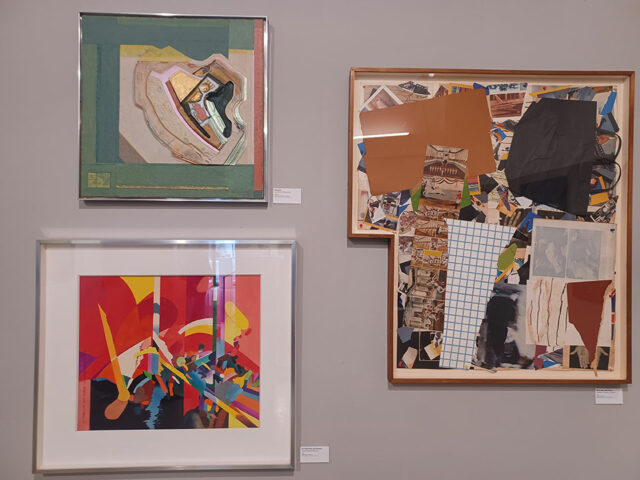
As part of its 50th anniversary celebration, the gallery has mounted an exhibit called AVANTI, SEMPRE AVANTI / FORWARD, ALWAYS FORWARD which is ongoing until March 14. It is a masters collection, featuring 37 artists that represent symbiotic relationships that blossomed into life-long friendships with Ms. Ancellotti-Diaz.

“There is a responsibility to treasure what we have. For me, it is really important that you put together everything like this. If you don’t give importance to it, it disappears,” she said at the exhibit preview on Jan. 10.

The exhibit showcases a range of paintings, mixed media, works on paper, and sculptures that have never or rarely been seen by recent generations of artists, collectors, arts appreciators, art students, and educators.

The featured artists include Leopoldo Aguinaldo II, Ray Albano, Augusto Albor, Nunelucio Alvarado, Agnes Arellano, Santiago Bose, Benedicto “Bencab” Cabrera, Eduardo Castrillo, Roberto Chabet, Charlie Co, Ramon Manuel De Leon, Duddley Diaz, Lamberto Hechanova, Jose Joya, Lao Lianben, Raul Lebajo, Cesar Legaspi, Arturo Luz, Jerry Elizalde Navarro, Justin Nuyda, Hernando R. Ocampo, Manuel Ocampo, Romulo Olazo, Onib Olmedo, Imelda Pilapil, Mauro “Malang” Santos, Solomon Saprid, Nestor Vinluan, and Betsy Westendorp.

STORIES
Ms. Ancellotti-Diaz toured the media around during the preview, her razor-sharp memory allowing her to explain the context behind each work’s importance. She could point out how a seascape by the late National Artist Cesar Legaspi reflects his own unique approach to cubism; detail how rare paintings by another National Artist, Federico Aguilar Alcuaz, and Juvenal Sanso were inspired by their time abroad; and discuss how works by many women artists represent tumultuous points in their lives, such as Julie Lluch’s Cactus sculptures and Phyllis Zaballero’s painting Sea Horizon I.

She fondly selected each of the pieces alongside the exhibit’s curator Angel Velasco-Shaw, who recalled how the process was “extremely difficult given the thousands of artworks we could choose from.”

Some works are there because of how integral they were to the start of Ms. Ancellotti-Diaz’s journey in the arts. Her sister-in-law Isabel Diaz’s work Anxiety of Motherhood represents the very first exhibit she organized in the country, with the Miladay Art Center. A sculpture by Lebanese artist May Baddour comes from the very first exhibit that Galleria Duemila mounted in 1976.

“My father-in-law, who’s a businessman, who gave me the P20,000 to put up a gallery, told me that this is the worst investment he’d ever done in his life!” she recalled.

Today, Galleria Duemila is the oldest running commercial art gallery in the Philippines.

Another piece in the exhibit that she’s proud of is Pacita Abad’s Rolling Stones, an important work that was part of the artist’s last exhibition with the Cultural Center of the Philippines, before she succumbed to cancer in 2004.

Ms. Ancellotti-Diaz also pointed out Luis “Junyee” Yee, Jr.’s Cosmic Snake, as proof of how he was capable of making “unbelievable installations” that she hopes will one day land him recognition as a National Artist.

A HISTORY
The artworks on view span from 1957 to 2018, culled from Galleria Duemila’s vast collection and archival treasure trove. They are a small sampling of works from the Philippine modern art scene. One corner in the gallery has documentation of old exhibitions and events, which is an integral part of their thrust to “protect the transmission of knowledge.”

Walkthroughs and panel discussions featuring writers and artists will be scheduled from January to March. They will be open to the public, with details to be announced online.

“Silvana is an important figure who was able to bring Philippine art out into the world. She is proof of the importance of patronage, of how we need to grow art from the ground up, by giving it the support that it needs,” said curator Ms. Velasco-Shaw.

As for how Galleria Duemila has become an important institution in an evolving contemporary art scene, Ms. Ancellotti-Diaz explained that she never expected such success.

In the 1970s, her only goal was to widen her network, which she did by attending exhibitions, joining conferences and workshops, and becoming acquainted with members of the Saturday Group of artists.

“As a foreigner, an outsider, my priority was to get to know the artists, their works, their vision, what brought them to paint. I learned the ropes,” she said.

Ms. Velasco-Shaw added that “the language of art is in the heart,” seen in how the lines between insider and outsider can blur as people pursue avenues of exchange and patronage.

A BOOK
In the pipeline is a book chronicling Galleria Duemila’s journey and Ms. Ancellotti-Diaz’s contributions to the art scene. It will include insights from different art writers, like Cid Reyes, Patrick Flores, and Eileen Legaspi Ramirez.

“The idea of the book is to create something for the past, present, and future. Silvana is a very strong advocate for the relationship between art, culture, and education, to create a greater appreciation of the arts for everyone,” she said.

In the meantime, the exhibit AVANTI, SEMPRE AVANTI / FORWARD, ALWAYS FORWARD is on view at Galleria Duemila, located at 210 Loring St., Pasay City. — Brontë H. Lacsamana


Airline fuel surcharge stays steady for February

STOCK PHOTO | Image by L.Filipe C.Sousa from Unsplash

THE Civil Aeronautics Board (CAB) said the passenger fuel surcharge will remain at Level 4 for February, keeping charges steady for the seventh consecutive month.

At Level 4, the surcharge will range from P117 to P342 for domestic flights and from P385.70 to P2,867.82 for international flights originating from the Philippines.

The surcharge has been at this level since August last year, CAB data showed.

For Feb. 1-28, airlines collecting the fuel surcharge in foreign currency may use the applicable rate of P58.94 per dollar, the CAB said.

Fuel surcharges are adjusted based on movements in jet fuel prices using the Mean of Platts Singapore (MOPS) benchmark.

According to the International Air Transport Association (IATA), jet fuel prices rose 3.5% to $89.63 per barrel for the week ending Jan. 16, while on a year-on-year basis, prices declined by 0.4%.

IATA said airlines in Asia are likely to sustain growth this year, supported by strong demand in both passenger and cargo segments and by declining jet fuel costs, which account for the majority of airline operating expenses.

Fuel costs are projected to fall to $252 billion in 2026, largely due to expected declines in crude oil prices. — Ashley Erika O. Jose

Valentino, Italian haute couture ‘emperor’ who painted fashion red, 93

A STILL from the 2008 documentary Valentino: The Last Emperor.

ROME — A mix of carmine and scarlet, with a hint of orange — a new hue, inspired by an elderly woman at Barcelona’s opera house, whose elegance struck a young Valentino Garavani.

The color, introduced to the fashion world several years later, in 1959, with a strapless cocktail dress of draped tulle, has carried his name — “Valentino red” — ever since, doubling as the eponymous Italian fashion group’s signature.

“I think a woman dressed in red is always wonderful, she is the perfect image of a heroine,” Mr. Valentino wrote in the book Rosso (Red), released in 2022. He would include at least one red dress in every one of his collections.

Mr. Valentino, the Italian fashion designer who built one of the country’s most celebrated luxury houses and was known in the industry as “the emperor,” died on Monday at his home in Rome, his foundation said. He was 93.

The cause of death was not immediately known.

‘I LOVE BEAUTY’
Mr. Valentino ranked alongside Giorgio Armani and Karl Lagerfeld as the last of a leading generation of designers, from an era before fashion became a highly commercial industry run as much by financiers and marketing executives as by couturiers.

Scaling the heights of high fashion, he was the first Italian to feature on the exclusive Paris haute couture catwalks.

Passionate about film, he dreamed as a young man of dressing the “beautiful ladies of the silver screen,” as he called them, among them 1950s Hollywood stars Lana Turner and Judy Garland.

Mr. Valentino would eventually design Elizabeth Taylor’s wedding gown, and was the first choice for numerous Oscar winners, including Sharon Stone and Penelope Cruz.

“You had a kind soul, rich in humanity. You were a friend, and your art and passion will forever remain a source of inspiration,” said Sophia Loren upon news of his passing. “It was a privilege to know you, and I will always carry you with me. My family and I extend our hearts to your Giancarlo and all your family.”

His romantic designs, simple at first glance, were full of intricate detail. “I love beauty,” Mr. Valentino said. “It is not my fault. And I know what women want: they want to be beautiful.”

“We share with heartfelt sympathy the grief of his loved ones, and we remain committed to preserving and elevating the valued creative, cultural, and human heritage he entrusted to us, upon which Maison Valentino is founded,” said Maison Valentino in a statement. “His life was a beacon in the ceaseless pursuit of beauty, and guided by that same beauty, we will continue to honor his memory with our deepest devotion.”

The designer, who also dressed Jackie Kennedy, created a business empire under his own name before selling it off ahead of his retirement, in 2008.

‘YOU NEED A LOT OF PATIENCE’
Mr. Valentino was an only child, born into a well-to-do family in Voghera, south of Milan, where his father ran an electrical supplies company.

Having started drawing and appreciating high-end clothes from a young age, he studied couture in Milan and Paris, where he then worked as an apprentice for designer Jean Dessès. He returned home in 1960, opening his own fashion house in the heart of Rome.

That year, Elizabeth Taylor chose a white Valentino gown for the premiere of blockbuster Spartacus.

Also in 1960, he met Giancarlo Giammetti in a Roman café. Mr. Giammetti would go on to be his partner in business and in life.

“To share life with a person for your whole existence — every moment, joy, pain, enthusiasm, disappointment — is something that cannot be defined,” Mr. Valentino said of him.

“We want to remember Valentino Garavani not only for his ‘Rosso,’ but for the courage of a life lived in the light of day with his lifelong partner, Giancarlo Giammetti,” said the Italian Gay LGBT+ Party in a statement. “His coming out, expressed with the naturalness of greats, broke down barriers in an era when silence was the norm.”

Mr. Giammetti took on the managerial part of the business, leaving creative matters to the designer.

“To be with Valentino as a friend, as a lover and as an employee is a bit the same: you need a lot of patience,” Mr. Giammetti said in Valentino: The Last Emperor, a documentary that followed the designer in the last two years of his career.

Mr. Valentino’s georgette fabrics, chiffon ruffles and ornate embellishments, including the exclusive budellini technique — where long strips of sheep’s wool are hand rolled into tubes, wrapped in silk and stitched together — won him a multitude of awards, including France’s highest civilian distinction in 2006.

“Fame and fortune didn’t change him,” Mr. Giammetti said at the time. “He is still the little guy I met 45 years ago.”

Superstitious and introverted, Mr. Valentino loved chocolate, skiing, and his pugs. He told Corriere in 2017 that he was afraid of death.

‘THE PERFECT MOMENT TO SAY ADIEU
In 2007 he wowed Rome with lavish celebrations to celebrate his decades in fashion — a three-day event that included dinners, parties, and exhibitions with thousands of guests flying in from around the world.

Months later he announced that he would stop designing for his company, which he no longer controlled after selling the firm almost a decade earlier for some $300 million.

“I have decided that this is the perfect moment to say adieu to the world of fashion,” he said. “As the English say, I would like to leave the party when it is still full.”

His last catwalk show was held in January 2008 in Paris, a city he called his second home and which he said had taught him to love fashion and life.

The business that bears his name was bought by Qatari fund Mayhoola for €700 million in 2012. French luxury group Kering bought a 30% stake in 2023, with a commitment to fully acquire the business from 2026, but then deferred the move to 2028 at the earliest.

Mr. Valentino and Mr. Giammetti remained active in supporting the arts. Their foundation opened the PM23 gallery in the center of Rome in 2025, next to the Valentino headquarters.

Fittingly, the opening exhibition — Horizons/Red — focused on the color most closely associated with Valentino.

“Red isn’t just a color,” Mr. Giammetti said at the time. “It’s a symbolic and aesthetic force of extraordinary power.” — Reuters

Tiered public float rules among key SEC reforms due by mid-February

BW FILE PHOTO

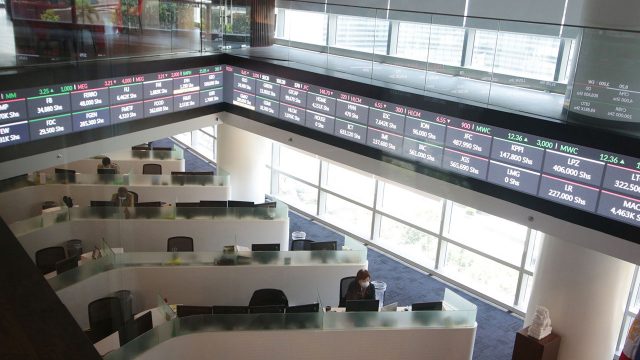
THE Securities and Exchange Commission (SEC) plans to issue at least eight memorandum circulars this month, with the long-awaited tiered minimum public float rules for stock exchange listings targeted by mid-February.

“At the very least, [we will be releasing] two more. So maybe, eight or nine [memorandum circulars] for January,” SEC Chairperson Francisco Ed. Lim told reporters on the sidelines of the Management Association of the Philippines (MAP) Inaugural Meeting 2026 on Monday.

Since the start of the year, the SEC has already released three circulars through its eAmend portal. These cover amendments to real estate investment trust (REIT) rules, the extension of discounted filing fees for micro, small, and medium enterprises (MSMEs), and measures to simplify corporate amendment processes.

Meanwhile, the proposed tiered minimum public float framework is designed to tailor stock exchange listing requirements to company size while maintaining market liquidity, investor protection, and capital formation.

Under the draft rules, companies planning to list on an exchange would be assigned to one of five tiers based on their expected market capitalization at listing.

Companies in Tier I, with a market value of up to P500 million, would be required to maintain an initial public float of 33%. Tier II companies, valued between P500 million and P1 billion, would need at least 25% public float, but not less than P165 million in shares.

Tier III companies with market values from P1 billion to P50 billion would maintain a minimum of 20% public float worth at least P250 million. For Tier IV companies, with market values between P50 billion and P150 billion, the requirement would be 15% public float valued at no less than P10 billion, while Tier V companies valued above P150 billion would be required to maintain at least 12% public float, worth a minimum of P22.5 billion.

After listing, companies would be required to maintain minimum public ownership aligned with their initial public offering tier: 20% for Tiers I to III, 15% for Tier IV, and 12% for Tier V.

“The tiered approach addresses the limitations of the current 20% minimum public ownership rule, which does not account for differences in company size,” Mr. Lim said.

The January circulars are also part of the SEC’s broader initiative to improve efficiency and predictability in corporate filings. Measures include digital processing of amendments, classification of filings into simple or regular categories, and standardized forms to reduce processing time.

Simple amendments are expected to be completed within seven working days, while more complex filings may take up to 21 days.

In his recent speech at the “Big Bold Reforms: the Philippines 2026” event, Mr. Lim said that the SEC is working to strengthen rules, processes, and fairness to ensure faster, more certain operations while maintaining market integrity.

“External and internal issues will arise in any economy. But what sustains confidence is how firmly institutions respond — by enforcing standards and making accountability real,” he said. — Alexandria Grace C. Magno

Reissued 20-year bonds fetch higher rates on tepid demand

BW FILE PHOTO

THE GOVERNMENT made a full award of the Treasury bonds (T-bonds) it offered on Tuesday at higher rates amid weak market appetite for longer tenors.

The Bureau of the Treasury (BTr) borrowed P30 billion as planned via the reissued 20-year bonds, with total bids reaching P41.506 billion.

This brought the outstanding volume for the bond series to P157.3 billion, the Treasury said in a statement.

The reissued bonds, which have a remaining life of seven years and two months, were awarded at an average rate of 5.934%. Accepted yields ranged from 5.88% to 5.98%.

The average rate of the reissued 20-year papers was 174.7 basis points (bps) higher than the 4.187% fetched for the series’ last award on June 29, 2021 and was likewise 230.9 bps above the 3.625% coupon for the issue.

This was also 2.6 bps above the 5.908% quoted for the seven-year debt — the benchmark tenor closest to the remaining life of the issue — but 1.5 bps lower than the 5.949% fetched for the same bond series at the secondary market before Tuesday’s auction, based on the PHP Bloomberg Valuation Service Reference Rates data provided by the BTr.

“The auction was uninspiring, with awards clearing toward the upper end of the expected yield range,” a trader said in a text message.

“The immediate market reaction was a sell-off in the secondary market, as some participants had positioned for partial bid rejections at higher yield levels given strong demand seen for other tenors as well as the announcement of dollar bond issuance.”

The BTr has seen robust demand for its recent offerings of government securities, especially those with shorter maturities.

Last week, it made a full P30-billion award of its offering of reissued seven-year bonds with a remaining life of five years and four days and even opened its tap facility, raising another P10 billion. It has also upsized its recent Treasury bill (T-bill) awards to take advantage of the strong appetite shown by the market.

Meanwhile, the Philippines on Tuesday launched a triple-tranche offering of US dollar-denominated bonds, marking its first offshore issuance for the year.

The government is looking at a benchmark size issue for each of the 5.5-, 10-, and 25-year notes it was offering, National Treasurer Sharon P. Almanza said in a Viber message. Benchmark-sized issues are typically worth at least $500 million.

Initial pricing guidance was at 70 bps above the comparable benchmark US Treasury yield for the 5.5-year tranche, T+100 bps for the 10-year tenor, and at the 5.9% area for the 25-year debt.

The notes were expected to be priced during the New York trading session overnight.

The reissued 20-year bonds fetched higher yields as players are hesitant to lock in their cash in long-term instruments amid lingering market risks, Rizal Commercial Banking Corp. Chief Economist Michael L. Ricafort added in a Viber message.

These risks include a weakening peso that could stoke domestic inflation in the coming months, uncertainty over the US Federal Reserve’s policy path amid an upcoming leadership change, and geopolitical concerns overseas, he said.

The BTr wants to raise P180 billion from the domestic market this month, or P110 billion via T-bills and P70 billion through T-bonds.

The government borrows from local and foreign sources to help fund its budget deficit, which is capped at P1.647 trillion or 5.3% of gross domestic product this year. — Aaron Michael C. Sy

Arts & Culture (01/21/26)


Sheila Osmeña-Go exhibits with Galerie Joaquin

THE exhibition A Symphony of Corals by Sheila Osmeña-Go marks her first with Galerie Joaquin. It is a visual meditation on harmony, resilience, and interconnected life, drawing inspiration from coral ecosystems. The exhibit is ongoing until Jan. 23 at Galerie Joaquin’s space in the Atrium of Opus Mall.


DF Art Agency mounts 15th anniversary exhibit

DF ART Agency marks its 15th anniversary with Grateful Horizons, a group exhibition taking place at Leon Gallery International, Corinthian Plaza along Paseo de Roxas in Legazpi Village, Makati City. The show brings together works by 33 artists across generations, reflecting on the relationships and shared histories that have shaped the agency’s practice. Artists include Briccio Santos, Demi Padua, Miller Laberinto, and Tita Halaman. It runs until Feb. 2.


Gus Albor exhibits at Alliance Française

THE exhibit Aurae II by Gus Albor will open at the Alliance Française de Manille Gallery on Jan. 22. With a vernissage scheduled at 6:30 p.m., it will showcase Mr. Albor’s body of work that explores minimal abstraction as a distillation of form, color, and conviction. The opening is in partnership with fine dining restaurant Bocca. The exhibition runs until Feb. 21.


Raymond Lauchengco holds live book reading

THE activity series of Navitas Haus titled “Of Stories and Art” continues with singer Raymond Lauchengco, who will have a book reading at the venue. It will feature his book, Dance with the Wind, which he will read live and discuss with participants afterwards. Copies will be available for sale at the event. Open to the public from ages seven and up, there will be craft activities available for kids and coffee and food for teens and adults. Admission to the book reading is free. It takes place on Jan. 31, 1 p.m., at Navitas Haus, 6218 Manalac St., Poblacion, Makati.


Orchestra of the Filipino Youth opens concert season

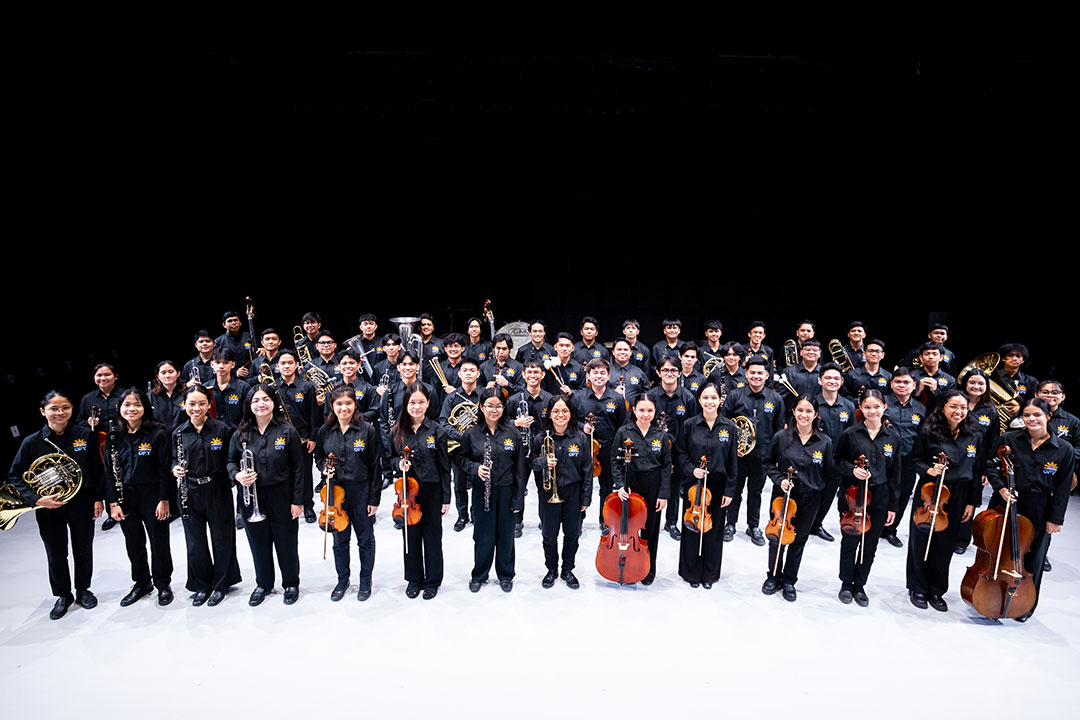
THE Orchestra of the Filipino Youth (OFY) is opening its 2026 concert season with ELEVATE: Triumphs of Tchaikovsky on Feb. 1 at the Proscenium Theater, Rockwell, Makati. The young classical musicians will perform under the baton of Gerard Salonga. It will feature Tchaikovsky’s Violin Concerto, performed by rising OFY violinist Gavril Tiburcio. Tickets are available by messaging Ang Misyon on social media.


CCP Pasinaya returns with new component, venues

NOW on its 20th year, the CCP Pasinaya: The Open House Festival is ushering in this year’s National Arts Month with new components and venue partners. Slated for Feb. 7 and 8, it expands to an additional regional venue in Roxas City, Capiz, and adds Rizal Park in Luneta, Manila as a new venue partner, as well as Calle Wright as a new part of the Paseo Museo tour. The components for the two-day festival are: Palihan, a workshop-all-you-can experience offering hands-on art exploration and learning; Palabas, featuring performances by 169 participating performing arts groups; the Paseo Museo hop-on, hop-off curatorial tours across 17 museums and galleries in Metro Manila; a business-to-business platform for embassies and arts programmers titled Palitan; the Pamilihan marketplace with food stalls, artisanal treats, and handcrafted goods; and a new component called Paligsahan, which spans competitions like cosplay, TikTok, photography, mobile games, and short filmmaking. The CCP Pasinaya embraces a “workshop-all-you-can, watch-all-you-can, and pay-what-you-can” approach. Registration is available online through the official CCP Facebook page.

CREC targets 3-GW renewable portfolio by yearend

Citicore Solar Negros Occidental — CREIT.COM.PH

SAAVEDRA-LED Citicore Renewable Energy Corp. (CREC) is diversifying its renewable energy (RE) portfolio with the development of onshore wind farms totaling nearly 200 megawatts (MW).

CREC President and Chief Executive Officer Oliver Y. Tan told reporters last week that the company aims to complete a 45-MW wind power project in Camarines Sur by next year. Its 152-MW wind farm in Iloilo is expected to be finished within the next three years.

The wind projects are being developed in partnership with Singapore-based Levanta Renewables, a collaboration established in 2024.

Together, CREC and Levanta are developing four onshore wind projects across Luzon and Visayas with a combined capacity of 375 MW. These projects secured offtake agreements through the Department of Energy’s green energy auction program in 2023.

CREC has doubled its capital expenditure budget for 2026 to around $2 billion to support the rollout of 1.2 gigawatts (GW) of solar power projects.

The company, directly and through its subsidiaries and joint ventures, manages a diversified portfolio spanning renewable energy generation, power project development, and retail electricity supply. It currently operates solar facilities in the Philippines with a combined gross installed capacity exceeding 500 MW.

CREC aims to scale its portfolio to around 5 GW by 2028 and is targeting a 3-GW capacity by the end of this year.

At the local bourse on Tuesday, CREC shares closed unchanged at P4.45 apiece. — Sheldeen Joy Talavera

Civic mindedness is a must to fight corruption: Lessons from Japan

STOCK PHOTO | Image by Daniel A from Unsplash

(Part 3)

However his Presidency will be remembered, President Ferdinand Marcos, Jr. will stand out as the Philippine Head of State who arouse the whole nation — civil society, the Catholic Bishops, the academe, and a whole range of cause-oriented political groups — to fight with all their might against corruption in all of its forms, whether public or private.

His statement “Mahiya naman kayo!”* — whatever his motivation was — will be the rallying cry of all those who will fight to rid the country of the heinous crimes of thievery, dishonesty, and deception. The multi-trillion peso robbery we have recently witnessed due to the corrupt practices directly associated with the infrastructure projects of the Department of Public Works and Highways (DPWH) literally cries out to heaven for vengeance because those humongous sums have been directly stolen from the poorest of the poor. They could have been spent improving the nutritional, educational, health, and housing conditions of the poorest of the poor.

We want to be optimistic and expect a reduction of corrupt practices in the near future as we witness some of the guilty ones go to jail; the passing of laws that will make it more difficult for the incorrigible thieves to continue plundering the public coffers; the further strengthening of institutions like the Supreme Court, the Office of the Ombudsman, and the Commission on Audit, among others. Since we were not born yesterday, however, we know that some form of corruption will continue to hound Philippine society as it has in practically all upper middle-income and high-income economies surrounding us in the Indo-Pacific region, except perhaps Japan and Singapore. We may learn some lessons from these two countries that are on top of the Good Governance global ranking year after year, together with countries like Finland, Denmark, Switzerland, Sweden, and the Netherlands.

It may strike us that none of the top countries when it comes to good governance are predominantly Catholic, like the Philippines is. Although we fully appreciate all the moral guidance we get from our spiritual leaders, starting with the Supreme Pontiff and the Bishops, and their prayerful pleas, many times their exhortations seem to fall on deaf ears. The answer can be found in the theological principle that grace does not destroy nature.

A society must first work unstintingly on forming the necessary human virtues that are the foundation of a just society among its citizens. This task is independent of the religious belief predominant in a given country. We must remember that “nature” refers to what human beings are by creation. God imbued in every human being with reason and free will, a moral conscience, and the natural ability (even before grace) to cultivate the natural virtues of justice, prudence, temperance, and courage, among others. By nature, human beings are created good and are ordered toward truth and goodness. They are  capable of knowing God in a limited way through reason (natural theology).

After the fall of our first parents, however, human nature has been wounded by sin, the only evil in the world. Because of this original sin, human beings are inclined to error and selfishness, and pride. Man has the three-fold concupiscence: of the eyes (greed); of the flesh (lust); and the pride of life. He was rendered unable by his own nature to reach his supernatural end which is the Beatific Vision. This is where Grace comes in. It is a free and undeserved gift of God, a supernatural participation in God’s own life and given through Christ, especially in the Sacrament. Grace enables human beings to be healed from sin, to act beyond their natural powers and attain supernatural ends, especially eternal bliss in heaven.

Human nature alone can aim at earthly happiness, moral goodness, and a natural knowledge of God. That is why in some non-Christian societies like Japan, there can be traditional practices embedded in child rearing through which the human virtues of concern for the common good, orderly behavior, the spirit of cooperation, and hard work can be cultivated on the basis of human nature alone. Grace is not needed in the cultivation of these human virtues. What Grace does is to raise humanity to divine sonship, friendship with God, and eternal life beyond natural capacity. This elevation is not owed to nature; it is purely a gift. Christ died to save mankind from sin out of pure generosity.

That is why it would be enlightening for us to examine what countries with low levels of corruption like Japan and Singapore practice that, based on human nature alone, nurture the virtue of civic mindedness among their citizens. We Catholics, should remember that if we don’t make the effort to train our children to be naturally concerned about the welfare of others, about the good of the community, about the good of the entire country, no amount of praying and going to the Sacraments will rid our country of corruption. Grace perfects nature. It does not replace it. Human institutions and human virtues matter. Grace does not replace politics, economics, or culture. It purifies, elevates, and directs them toward the common good, which is a social or juridical order which enables every member of society to attain his or her integral human development. Let us now study how the Japanese are able to cultivate among their young the virtues needed to keep corruption at as low a level as possible in their society.

Consulting with Chat GPT, we learn that the Japanese people cultivate social virtues — such as respect, discipline, cooperation, responsibility, and community orientation — through a systematic mix of family upbringing, school practices, cultural norms, and community institutions. These habits are nurtured early in childhood and continue to be developed throughout life. It must always be kept in mind that a virtue is a habit to do good that is developed by constant repetition, by conscious acts of the human will until it becomes spontaneous.

The process necessarily begins with the family, the foundation of society that should be protected from the evils of rampant divorce, live-in arrangements, single motherhood, same-sex unions, birth control, and abortion. Japanese families instill amoiyari (thoughtfulness for others) from early childhood. Children are taught to be considerate, avoid inconveniencing others, and maintain harmony. Parents emphasize politeness (traditional greetings, gratitude, honorific speech especially in addressing the aged). Children learn routines such as helping with household tasks, sharing, and apologizing sincerely.

At the pre-school and kindergarten stage during which early socialization is the focus, there is more time and effort devoted to character building than academic rigor. Some of the key practices consist of group play and cooperation rather than competitive sports; and an emphasis on self-reliance: as soon as they are physically able, children put away their things, dress themselves, and serve meals. There is a very early introduction to cleanliness and orderliness. Teachers exert all effort possible to be models of calm, patience, and respect instead of having recourse to strict punishment at the first provocation. This character forming stage helps form the habit of acting as part of a group while taking responsibility for oneself.

At the elementary school level, there is even greater emphasis on civic or social virtues. For example, the pupils clean their own classrooms, hallways, toilets, school grounds or premises (this is called o-soji). The children are made very conscious of their responsibility to the group, the importance of being humble, respect for shared spaces, and the spirit of cooperation. There is constant reinforcement of the idea that everyone contributes to the welfare of the community, regardless of social status. Daily class duties revolve around students rotating roles such as leading greetings, managing lunch distribution, organizing materials, watering plants, and monitoring hall behavior.

All these actions (not mere exhortations) create a sense of ownership, discipline, and civic duty. Supplementing these actions is moral education (dotoku kagami). In these classes, the teachers expound on the human virtues of honesty, empathy, perseverance, and respect for others. Subjects include contributions to society, environmental responsibility, and conflict resolution. Lessons often use stories, case studies, and role-playing rather than lectures.

(To be continued.)

*Mahiya naman kayo can be translated as “Have some shame.”


Bernardo M. Villegas has a Ph.D. in Economics from Harvard, is professor emeritus at the University of Asia and the Pacific, and a visiting professor at the IESE Business School in Barcelona, Spain. He was a member of the 1986 Constitutional Commission.

bernardo.villegas@uap.asia

LANDBANK plans to open 15 new branches, branch-lite units this year

LAND BANK OF THE PHILIPPINES

LAND BANK of the Philippines (LANDBANK) is planning to open 15 branches and branch-lite units nationwide this year as it looks to make financial services available to more Filipinos.

“By expanding our touchpoints, LANDBANK continues to ensure that financial services remain accessible, inclusive, and responsive to the evolving needs of our clients — especially in the countryside. These new facilities reflect our sustained commitment to empower local economies and support national development,” LANDBANK President and Chief Executive Officer Lynette V. Ortiz said in a statement on Tuesday.

The bank ended 2025 with 615 branches and branch-lite units, as well as 3,268 automated teller machines (ATMs), 3,882 ATMs in partner 7-Eleven convenient stores, and 236 cash deposit machines.

It also has 1,001 LANDBANKasama Partners, which include client cooperatives, associations, rural banks, local government units, and small enterprises  tapped by the state-run lender to provide basic banking services like cash withdrawals, deposit, fund transfers, bills payment, and balance inquiry.

In December, LANDBANK opened a new corporate center in Isabela and five branches and branch-lites to expand its footprint across Luzon, Visayas, and Mindanao.

The bank’s corporate centers serve as a one-stop shop for clients.

Meanwhile, its new branches and branch-lite units are equipped to deliver a “phygital” or physical and digital user experience in line with LANDBANK’s digitalization intiaitvies.

“Through its expanding network, LANDBANK continues to support government programs, including social protection disbursements, salary loans for employees, and credit assistance for priority sectors, contributing to inclusive growth and countryside development,” the state-run bank said.

LANDBANK’s net income climbed by 41.79% year on year to P35.64 billion in the first nine months of 2025. — A.M.C. Sy

Armani debuts first menswear line without founder as Milan Fashion Week ends

Giorgio Armani Fall/Winter 2026-2027 Men’s Fashion Show — YOUTUBE.COM/@ARMANI

MILAN — Giorgio Armani’s menswear show — the first staged without any input from the brand’s founder, who died in September — closed Milan Fashion Week on Monday, presenting a winter collection built around silky, iridescent fabrics.

Cangiante,” the Italian word for iridescent, was chosen as the title of the collection to describe something that remains entirely itself yet shifts depending on one’s perspective, according to the show notes. (See the show here: https://tinyurl.com/9fxfn5ha)

“The metaphor lends itself naturally to Giorgio Armani’s style today,” they said.

“Leo Dell’Orco’s vision emerges naturally after 40 years working alongside Giorgio Armani, and from a desire to make a personal mark on what stands as his debut,” the notes added.

Mr. Dell’Orco, longtime collaborator and partner of the late designer, continues to oversee the menswear division after the death of Mr. Armani. He is also the fashion house’s main shareholder by voting rights and chairman of the foundation in charge of the sale of a stake in the company.

The new collection combined velvet, crepe, and chenille with brushed cashmeres, felted wools, and matte leathers, creating rich, tactile contrasts.

“It was a beautiful show marked by continuity, with great attention to detail and a magnificent selection of fabrics,” said Federico Giglio, chief executive of Italy-based high-end fashion retailer Giglio.com.

Mr. Dell’Orco stepped out at the end of the fashion show to greet the audience, accompanied by his nephew Gianluca Dell’Orco, who has worked for many years in the menswear design studio. — Reuters

IdeaSpace Ventures sees brighter outlook for Philippine startups in 2026

AUSTIN DISTEL-UNSPLASH

By Beatriz Marie D. Cruz, Reporter

IDEASPACE Ventures, the startup accelerator arm of the MVP Group, said 2026 is shaping up to be a strong year for Philippine startups, as local founders show greater maturity even as competition from foreign firms intensifies.

“The future of the Philippine startup scene has never looked brighter, and 2026 is shaping up to be a coming-of-age year,” IdeaSpace Executive Director Alwyn Joy E. Rosel said in an e-mailed reply to questions.

She said local startups have moved beyond copying business models from Silicon Valley and other overseas hubs, with more founders building companies that address domestic needs and contribute to national development.

“Filipino founders have really matured,” Ms. Rosel said. “They are not just pitching dreams; they are coming to us with real businesses that already have paying customers or pilot tests with companies.”

She added that startup activity is gaining traction outside Metro Manila, with growth seen in cities such as Iloilo, Davao and Cagayan de Oro, reflecting broader access to talent and markets.

Demand this year is expected to favor startups offering business-to-business and digital services, as companies seek to automate inventory management, payments and logistics, Ms. Rosel said.

Financial technology is also seen as a growth area, including digital wallets, microinsurance, remittances and person-to-government payments.

Climate technology and renewable energy startups might also see rising demand as extreme weather events heighten the need for resilience and sustainable solutions, she added.

Despite the positive outlook, Ms. Rosel said Philippine startups continue to face challenges, particularly in funding and talent, as global companies compete for skilled workers and capital.

To attract investors, she said founders need to show a clear path to profitability, while talent retention increasingly depends on company culture and purpose, not just pay.

“It is not just about salary anymore, but about building a great company culture and offering people a chance to solve real, meaningful Filipino problems that global firms often do not touch,” she said.

IdeaSpace runs a Startup Accelerator Program that provides mentorship, training and access to industry networks.

Six startups graduated from its 13th cohort, including KaHero Apps, Inc., Soolok Properties Inc., Xure, DashoContent, Cloverly.tech and Polka Motors.

For its next cohort, IdeaSpace would remain sector-agnostic and would not set a fixed number of participants, Ms. Rosel said.

“While we typically see an average of about six startups per cohort, the final number depends on the quality of the applications and how well we feel we can support them,” she said.

IdeaSpace is also working with a local university to help turn student projects and academic research into viable ventures. It is strengthening partnerships in the Philippines and overseas to support startup growth in the provinces.

“We want to make sure that a founder in the Visayas or Mindanao has the same access to resources as someone in Makati,” Ms. Rosel said.

Established in 2012, IdeaSpace is backed by First Pacific Co. Ltd., Metro Pacific Investments Corp. (MPIC), PLDT Inc., Smart Communications, Inc., Manila Electric Co. and Maynilad Water Services, Inc.

MPIC is one of the three key Philippine units of First Pacific, the others being Philex Mining Corp. and PLDT.

Hastings Holdings, Inc., a unit of the PLDT Beneficial Trust Fund subsidiary MediaQuest, has a majority stake in BusinessWorld through the Philippine Star Group, which it controls.

Emirates to add four weekly Manila-Dubai flights from April

EMIRATES.COM

DUBAI-BASED carrier Emirates will expand its Manila-Dubai services with four additional weekly flights starting April 2.

The new flights, scheduled on Mondays, Wednesdays, Thursdays, and Saturdays, will raise Emirates’ Manila-Dubai weekly services to 32 from the current 28, it said in a statement on Tuesday.

These will be operated using the Boeing 777-300ER, which can carry up to 20 tonnes of cargo, eight first-class private suites, 42 lie-flat business-class seats, and 304 economy seats.

“With the expansion, Emirates now offers more options and improved connectivity to travelers, including a large number of Filipinos across our global network,” the airline said.

The additional flights will also shorten connections to and from Canada, the United States, Milan, London, Budapest, and Athens via Dubai.

Emirates said the extra frequencies will increase cargo capacity, supporting imports and exports, particularly in light of the recently signed comprehensive economic partnership agreement (CEPA) between the United Arab Emirates and the Philippines.

Currently, Emirates offers up to 22,700 weekly seats between Manila and Dubai with 28 weekly flights. The airline also maintains a partnership with Philippine Airlines (PAL), extending its domestic connectivity to Manila, Cebu, and Clark.

Last year, Emirates said it was exploring further expansion of its partnership with PAL to serve more passengers and enhance cargo operations. — Ashley Erika O. Jose