Home Blog Page 414

NPL ratio rises to 9-month high in Aug.

BW FILE PHOTO

By Katherine K. Chan

PHILIPPINE BANKS’ gross nonperforming loan (NPL) ratio rose to a nine-month high in August, preliminary data from the Bangko Sentral ng Pilipinas (BSP) showed.

The local banking sector’s gross NPL ratio worsened to 3.5% in August from 3.4% in the previous month. However, it eased from the 3.59% recorded a year earlier.

August’s bad loan ratio was the highest in nine months or since 3.54% in November 2024.

Loans are considered nonperforming once they are unpaid for at least 90 days after the due date. These are deemed as risk assets since borrowers are unlikely to pay.

Preliminary BSP data showed that soured loans edged up by 2.7% to P550.095 billion in August from P535.448 billion in July.

Year on year, nonperforming loans went up by 7.3% from P512.704 billion.

The total loan portfolio of Philippine banks stood at P15.709 trillion in August, down by 0.4% from P15.771 trillion in July. However, it climbed by 9.9% from P14.299 trillion a year ago.

“The slight uptick in banks’ NPL ratio to 3.5% in August reflects softer economic momentum and early stress in consumer and MSME (micro, small, and medium enterprises) segments amid cost pressures,” Union Bank of the Philippines (UnionBank) Chief Economist Ruben Carlo O. Asuncion said in a Viber message.

Meanwhile, Michael L. Ricafort, chief economist at Rizal Commercial Banking Corp., said bad weather affected many businesses, affecting borrowers’ ability to repay debts.   

“This is largely due to weather-related disruptions since July 2025, in view of the series of storms (and) flooding that reduced business days, sales and incomes of businesses and people, thereby reducing the ability to pay by some borrowers,” he said in a Viber message.

From late July to early August, tropical storms Crising, Dante and Emong, and the southwest monsoon brought heavy rains and flooding across the country.

Mr. Ricafort said the higher bad loan ratio in August partly reflected the impact of US President Donald J. Trump’s recent policies on the economy.

“This is on top of the slower global and local (economy) due to Trump’s higher tariffs, protectionist measures, and the resulting trade wars that reduced exports and global trade, investments, employment and other economic activities,” he added.

The US imposed a 19% tariff on Philippine goods starting Aug. 7.

Based on central bank data, past due loans inched up by 0.8% to P693.085 billion in August from P687.588 billion in July and by 9.8% from P631.421 billion in August last year.

This brought the past due loan ratio to 4.41%, higher than the 4.36% in July but slightly lower than the 4.42% last year.

Restructured loans, on the other hand, dipped by 0.2% to P328.917 billion in August from P329.643 billion a month ago, but increased by 12.2% from P293.162 billion in August 2024.

This accounted for 2.09% of the industry’s total loan portfolio, unchanged from July but higher than the 2.05% seen a year prior.

Meanwhile, banks’ loan loss reserves amounted to P519.293 billion, up by 1.4% from P512.061 billion in July and by 7.6% from P482.489 billion a year earlier.

With this, the August loan loss reserve ratio was higher month on month at 3.31% from 3.25% in July but down from 3.37% the previous year.

Lenders’ NPL coverage ratio, which gauges the allowance for potential losses due to bad loans, slipped to 94.4% in August from 95.63% in July. However, it was above the 94.11% logged in August 2024.

“While some upward drift is possible as loan portfolios mature, we expect asset quality to remain broadly manageable, supported by strong capital buffers and recent monetary easing,” UnionBank’s Mr. Asuncion said.

Jonathan L. Ravelas, a senior adviser at Reyes Tacandong & Co., said the bad loan ratio reflects sluggish economic growth, elevated borrowing costs, and lingering repayment challenges among consumers and small businesses.

“Unless these floodgate issues are resolved soon, growth challenges remain (and) NPLs may remain elevated,” he said in a Viber message, referring to the corruption scandal involving government flood control projects.

On Thursday, the central bank delivered a surprise 25-basis-point (bp) cut, bringing the benchmark policy rate to a three-year low of 4.75%.

BSP Governor Eli M. Remolona, Jr. said the fourth straight cut this year came as recent corruption issues affected business sentiment and weakened the growth outlook.

The Monetary Board has so far slashed borrowing costs by a cumulative 175 bps since it began its easing cycle in August 2024.

Mr. Remolona also left the door open for another cut at their last policy-setting meeting this year on Dec. 11 and possibly more next year.

BSP likely to continue easing until early 2026 – analysts

The Monetary Board last week unexpectedly trimmed the key policy rate — PHILIPPINE STAR/EDD GUMBAN

THE BANGKO SENTRAL ng Pilipinas (BSP) is expected to deliver two more 25-basis-point (bp) cuts until early next year following the central bank chief’s dovish comments, analysts said.

This came after the Monetary Board last week unexpectedly trimmed the key policy rate by 25 bps to a three-year low of 4.75%, a move that BSP Governor Eli M. Remolona, Jr. attributed to weakening business sentiment amid the widening flood control corruption mess.   

“We never bought into Mr. Remolona’s talk of a ‘sweet spot’ in August and, with corporate sentiment going from underwhelming to outright miserable, we reckon more monetary easing is in the pipeline until early next year,” Pantheon Macroeconomics Chief Emerging Asia Economist Miguel Chanco and Asia Economist Meekita Gupta said in a report.

“We still see a 25-bp cut in December and we’ve added an additional reduction in (the first quarter next year), taking the TRR (target reverse repurchase) rate to a terminal of 4.25%,” they added.

If realized, the policy rate of 4.25% would be the lowest in over three years or since August 2022 and would match the rate in September 2022.

Mr. Remolona had also signaled at least two more cuts at its December meeting and by next year, noting the BSP now sees the neutral nominal policy rate to be closer to 4% than their earlier projection of 5%. 

“BSP’s tone was decisively more dovish by suggesting that it sees scope for a more accommodative stance and that the output gap may be larger,” Nomura Global Markets Research analysts Euben Paracuelles and Yiru Chen said in a note.

Nomura likewise expects the BSP to bring borrowing costs to a terminal rate of 4.25% by the first quarter next year, but noted that they see “risks of more cuts next year if adverse scenarios play out.”

Meanwhile, Bank of the Philippine Islands (BPI) and MUFG Global Markets Research see the central bank’s policy easing potentially stretching until the first half of 2026.

“Further easing could be supported by several factors, including expectations that the (United States) Federal Reserve will also deliver additional rate cuts amid a more dovish composition of the FOMC (Federal Open Market Committee) once Chair (Jerome) Powell steps down in May 2026,” BPI Lead Economist Emilio S. Neri, Jr. said in a note.

Slower Philippine economic growth amid growing concerns over public infrastructure spending and disinflationary risks from China’s potential dumping could likewise give the BSP more room to cut, he added.

Last week, the Trade department warned China, which is facing high US tariff rates, might start diverting its goods to the Philippines. This move could lead to foregone revenues and slower inflation.

Mr. Neri expects the BSP to end its current easing cycle once the policy rate hits 4% next year.
“However, such aggressive easing could prove to be an overshoot, raising the risk of a sharp policy reversal later on once inflation accelerates,” he said.

“The possible continuation of BSP rate cuts could drive a rally in government bonds, led by the short end of the yield curve,” he added.

Meanwhile, MUFG Senior Currency Analyst Michael Wan said the central bank might also bring its reserve requirement ratio (RRR) to 4% from 5% by 2026. 

The BSP last reduced the RRR in February by 200 bps to 5%. RRR refers to the portion of a bank’s deposits held as reserves and cannot be lent out and is used to manage the banking system’s liquidity.

MUFG also noted that the Philippine central bank governor’s sentiments in the latest meeting reflect “somewhat less support” for the peso.

Mr. Remolona on Thursday said they will only defend the peso if it depreciates sharply to a point that it could become inflationary.

“For the PHP, these changes in forecasts imply somewhat less support for PHP from (a foreign exchange) perspective, but what will also matter for FX (foreign exchange) is the extent of growth slowdown, and also the resultant impact on key flow dynamics such as the current account deficit, FDI (foreign direct investment) inflows, and to a smaller extent portfolio flows,” MUFG’s Mr. Wan said. — Katherine K. Chan

Analysts call for more transparency in bicameral committee meetings for budget bill

PHILIPPINE STAR/MICHAEL VARCAS

By Kenneth Christiane L. Basilio, Reporter

THE HOUSE of Representatives’ approval of the P6.793-trillion national budget for 2026 signals “business as usual,” as lawmakers sidestepped deeper reforms despite pledges of transparency amid a widening scandal over flood control spending, analysts said over the weekend.

Congress should make the 2026 spending plan’s bicameral conference committee process more transparent to help rebuild public trust and ensure that spending priorities align with genuine development needs rather than political interests, they added.

“After the flood control scandal, Congress needed to be bold,” AJ A. Montesa, an advisor at budget watchdog People’s Budget Coalition, said in a Viber message. “This was their chance to restore public trust in the budget process and prove that corruption and pork barrel politics were truly being eliminated.”

“Unfortunately, it ended up being almost business as usual.”

Congressmen last week approved on second reading the massive spending bill amid a multibillion-peso flood control scandal that has gripped the flood-prone country, reallocating funds originally earmarked for flood infrastructure to education, health and agriculture in a bid to boost human capital development.

The move came alongside efforts to open the budget process to greater scrutiny, though critics warned it fell short of meaningful reform.

The budget bill’s final approval is set for Oct. 13 (Monday).

While the reforms have fallen short for now, University of Makati political science professor Ederson DT. Tapia said the changes mark a step toward greater transparency in a budget process long criticized for opacity and political maneuvering.

“Given the public’s temperature, they have to start with something,” he said in a Facebook Messenger chat. “But it can be more than what we’ve seen so far.”

The House Appropriations Committee introduced a series of reforms in this year’s budget cycle, including inviting civil society groups to participate in budget briefings and offer input.

It also scrapped the long-standing “small committee” of select lawmakers that previously amended the spending bill through a sub-panel on budget adjustments.

“Civil society organizations were invited to observe the early committee hearings, but after that, it was as if they were forgotten,” said Mr. Montesa, whose group was accredited to participate in the House budget process.

Budget watchdogs were not briefed on subsequent steps in the process, including sub-committee amendments, he said.

“The resolutions or reports from those meetings weren’t even shared with civil groups,” he said. “We had to rely on a few House members who were open to engaging with civil society.”

Nueva Ecija Rep. Mikaela Angela B. Suansing, who heads the House appropriations panel, did not immediately reply to a Viber message seeking comment.

“If Congress truly wants to restore public trust, it must take citizen participation seriously. Transparency alone is not enough,” Mr. Montesa said.

He urged lawmakers to open the bicameral conference committee meetings on the spending bill to the public, saying the traditionally closed-door process has kept people in the dark about last-minute changes to the national budget.

“There is no reason to hide the bicameral meetings of the budget process from the people,” he said.

The Senate passed a resolution in August to open joint congressional budget talks to the public, but the House has yet to adopt a counterpart measure.

House Deputy Speaker and Antipolo Rep. Ronaldo V. Puno said the chamber has committed to opening bicameral budget talks to the public, but noted that formal approval may no longer be necessary as the move could be implemented by “operation of existing procedures.”

“The House leadership is already committed to opening the bicameral meetings,” he told BusinessWorld in an interview in Filipino. “So, I’m not sure that resolution is even necessary, since that’s already the declared intent of the leadership.”

He said the House Appropriations Committee can declare the joint congressional talks open to the public without needing plenary approval. “It doesn’t need to go to the full House.”

“But if there’s any doubt about whether the bicameral meetings will be open to the media and the public, that can be resolved once we return,” he added, noting that congressmen are currently focused on passing the budget on final reading before addressing the issue.

Mr. Puno said if the bicameral meeting is open, then there would be no more “project smuggling.”

“Transparency becomes the best antidote to illegal activity,” he said.

In addition to opening joint congressional budget talks, lawmakers should consider establishing an open budget transparency server that enables the public to track individual proposals in real time — making it easier to scrutinize who proposes what and when, Mr. Montesa said.

Right-of-way issues still hamper ODA-assisted projects in Philippines

Construction of the Metro Manila Subway Project-Tandang Sora station continues along Mindanao Avenue in Quezon City, Jan. 12. — PHILIPPINE STAR/MIGUEL DE GUZMAN

By Aubrey Rose A. Inosante, Reporter

RIGHT-OF-WAY (RoW) bottlenecks are stalling the rollout of official development assistance (ODA)-funded infrastructure projects, Asian Development Bank (ADB) Philippine Country Director Andrew Jeffries said.

“The problems that are ongoing — right of way, land acquisition and the like, are problems faced globally, that’s not a unique problem in the Philippines,” Mr. Jeffries told BusinessWorld on the sidelines of an event on Oct. 6.

He cited densely populated areas such as the Clark region through Metro Manila to Laguna, where the ADB-funded Malolos-Clark Railway, part of the North-South Commuter Railway (NSCR), is located.

“The government in particular is very adamant that progress be made quickly, and they’re anxious to show tangible results during this administration. We’re working hard with them to make sure that happens,” Mr. Jeffries said.

The acquisition of RoW from landowners for National Government infrastructure projects is mostly hampered by disputes over property valuation.

Department of Transporation (DoTr) Acting Secretary Giovanni Z. Lopez said the newly signed Accelerated and Reformed Right-of-Way Act (ARROW) as a key tool in resolving land acquisition issues. 

The agency also expanded its workforce, tightened coordination with the local government units for RoW acquisition.

“On the issue of right of way, I think we have to disabuse our mind that to consider right of way as parallel activity, it must be considered as the first priority when it comes to project implementation,” he said in a separate Philippine Development Forum panel on Oct. 6.

Republic Act No. 12289 or the ARROW law, which was recently signed by President Ferdinand R. Marcos, Jr., sought to streamline the land acquisition process to ensure the faster construction of key infrastructure.

This measure amended the existing law on government access or expropriation of land for infrastructure projects by clarifying provisions on subterranean or underground rights-of-way.

It covers roads, bridges, power and water pipelines, telecommunications facilities, airports, seaports, and irrigation projects, among others.

Mr. Lopez said it already resolved 75% of right-of-way issues for the Metro Manila Subway and expected to complete 95% by end-2025. The bulk of the project is funded by the ADB.

Nigel Paul C. Villarete, a senior adviser on public-private partnerships at the technical advisory group Libra Konsult, Inc., said the law will allow the government to streamline RoW acquisition process and speed up project implementation.

“The Accelerated and Reformed Right-of-Way Act surely helped in facilitating for faster and easier project implementation, but it retains restraints called for by the upholding of private rights,” he told BusinessWorld in a Viber message over the weekend.

Mr. Villarete said many land owners will resist but national interests should be upheld over private ones.

“Until we can amend our existing RoW law, our ODA will always be hampered by that,” Mr. Villarete said.

In the 2024 ODA Portfolio Review Report, the Department of Economy, Planning, and Development (DEPDev) also flagged the right of way acquisition issues along with procurement delays project design misalignment as among the ongoing challenges faced by implementing agencies.

The ADB was the second-biggest development partner of the Philippines, with $11.05 billion worth of 59 loans and grants, behind Japan at $13.32 billion.

ADB PROJECTS
In the same interview, Mr. Jeffries said the ADB is working on extending more support in Mindanao as it is funding connectivity infrastructure projects such as North-South Commuter Railway, Bataan-Cavite Interlink Bridge, and Laguna Bay transport.

“Going forward, we have further financing for some of these same large projects, but we are working on more support in Mindanao. We have projects in the design stage for more connectivity in Mindanao,” he said.

The ADB is also looking at getting the board’s approval for support for the insurance sector and improving the business environment with technology.

“We have a support program for the insurance industry, which is much lower penetration in the Philippines compared to a lot of ASEAN (Association of Southeast Asian Nations) neighbors, and there’s a lot of elements to that,” the ADB official said.

“Insurance companies, you know, people pay them premiums to insure health or other life or other kinds of risks. Insurance companies need to invest that money, and in a lot of countries it’s a source of funding for infrastructure,” he added.

ADB approval for the P400-million Insurance Reform Program Subprogram 1 project is still pending. The Insurance Commission is the implementing agency.

Manila FAME taps into nature-inspired design

THE MANILA FAME trade show will be back this year for its 73rd edition, featuring all things home, fashion, and lifestyle inspired by the roots of Filipino design — nature itself.

Organized by the Department of Trade and Industry (DTI) through the Center for International Trade Expositions and Mission (CITEM), the three-day fair will be held from Oct. 16 to 18 at the World Trade Center in Pasay City.

“As part of the government’s plans to support the creative industries, Manila FAME is one way we are empowering our MSMEs (micro, small, and medium enterprises),” DTI Secretary Cristina Aldeguer-Roque said at the press preview on Oct. 8 in Intramuros, Manila.

“We will be equipping our artisans and creative entrepreneurs with essential mentorship, design innovation, and access to international markets,” she added.

CITEM Executive Director Leah Pulido Ocampo said that, with the theme “Objects of Nature,” this year’s Manila FAME will “celebrate everything that makes Filipino artistry sought after all over the world.”

“The word ‘nature’ refers to our physical world, and it can also mean the qualities that are basic or inherent to a person or an object,” she explained.

THE DIFFERENT PAVILIONS
Manila FAME this year takes its inspiration from the Philippines’ diverse flora and fauna, landscapes, and bodies of water.

“In the process, we unveil the unique selling propositions of our products that have made the Philippines a must-visit sourcing destination for design,” Ms. Pulido Ocampo said.

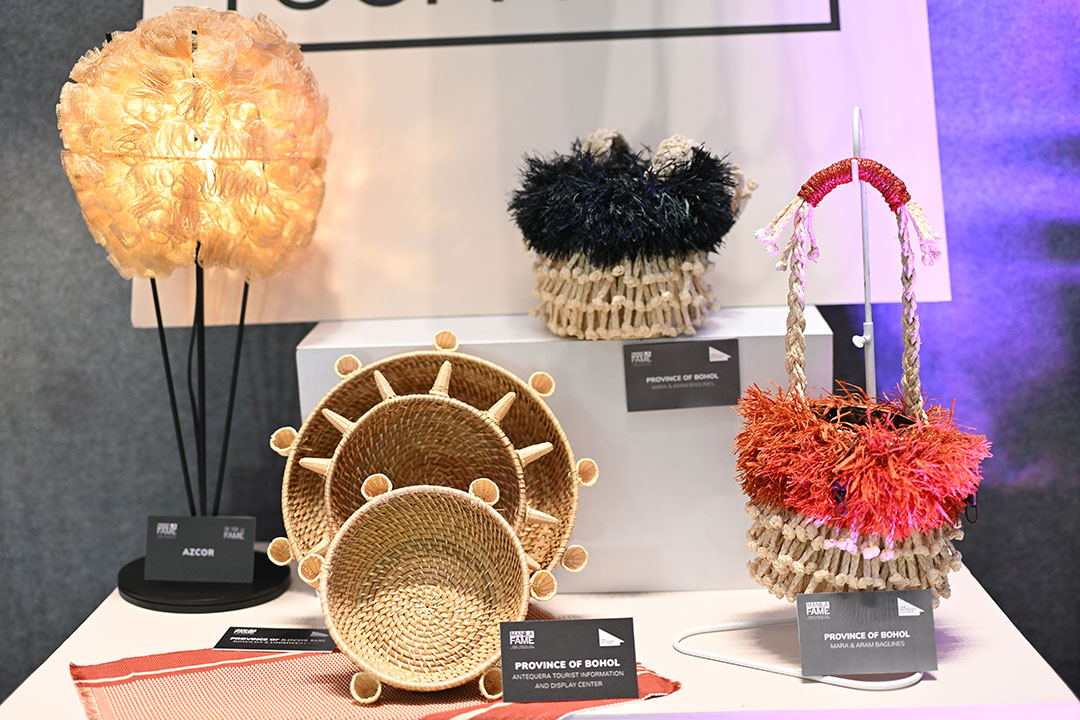
The Artisans Village, Manila FAME’s regional spotlight, will feature signature materials from various provinces: natural fibers from Bohol; inabel from Ilocos Sur; woodwork and fossilized flowers from Quirino; and wood, stone, clay, and rattan from Tarlac.

Products showcased at the preview included stools and vases made of natural stones from Oricon Corp., fossilized flowers from Maddela Flowers and Crafts, placemats and table runners with nature-inspired patterns from Tubigon Loomweavers, and bamboo placemats from ADDS Bambutek Handi Crafts.

The program that day was led by global trend ambassador Patti Carpenter and product development specialist Rachelle Dagñalan, who had made factory visits to help with conceptualization and development of various products.

The Design Commune, which culminates the product development program for Manila FAME, will be presented in two pavilions for this edition.

Veteran designers Tony Gonzales and Milo Naval spearheaded “Elements of Nature” and “Home at FAME,” respectively, showcasing prototypes developed with 20 local exhibitors from the lamps and lighting, furniture, home decor, and holiday and seasonal decor categories.

Mr. Gonzales told BusinessWorld that they specifically took inspiration from earth, wind, and water. “Since most of our materials are natural, we are not highly industrialized. It’s a good mix, to be inspired by colors, lights, and sounds we see in our environment,” he said.

At the preview, aside from their own designs, the two displayed a small array of products that emerged from the commune: poppy-inspired table and floor lamps from Camila Faye; anahaw leaf rugs from Weavemanila; an accent table with metal leaves as legs, and chairs with wave details from Jed Yabut; a fruit tray featuring ocean waves from Natures Legacy; lamps inspired by a giant bird’s nest from Dela Cruz House of Piña, and a metal twig tabletop with perched birds and candle votives from Artifeks.

GROWING THE INDUSTRY
“Philippine Components” will highlight local manufacturers’ expertise in crafting bespoke elements for architectural and interior applications. Also curated by Mr. Gonzales, these include furniture company Yrezabal & Co.’s claddings made of laminated rattan.

The section held its maiden showcase last year, and is now focusing on showcasing fundamentals such as coverings, parts, and fittings. There will be 15 companies presenting their prototypes here this year.

“This is just a small number. The dream is to invite more designers. If we have more designers, especially younger ones, we can help the industry grow,” said Mr. Gonzales.

Visitors will also get to learn from design and business experts and thought leaders at FAME Talks. These forums will tackle timely topics, like “Innovative, Versatile, and Sustainable Approaches to Designing Products for the Home, Fashion, and Lifestyle Sector” and “Global Design Trends for Fashion Accessories.”

CREATELab, an on-site design clinic, will have professionals offering branding and marketing guidance to participating exhibitors. It is a joint project by CREATEPhilippines, a content and community platform for the Philippine creative industries, and the Communication Design Association of the Philippines.

Ms. Pulido Ocampo said that the trade show is taking into account “the current international trends, all of which point to nature as a dominating key element for 2025 and 2026,” be it through the use of recycled and upcycled materials or bolder, more playful aesthetics.

“All these handcrafted items made from natural and indigenous materials are inspired by our rich cultural diversity and heritage,” she said. “They easily show the best of Philippine design.” — Brontë H. Lacsamana

DoE seeks to allow generators to build transmission infra

STOCK PHOTO | Image by Heri Susilo from Unsplash

THE Department of Energy (DoE) is proposing a policy that would allow power generation companies to finance and build transmission infrastructure to help ensure the timely completion and delivery of power projects.

While generation companies may construct their own dedicated point-to-point (P2P) connection facilities, it may also be necessary to allow them to build “associated transmission projects” to directly inject capacity into the grid, the DoE said in a draft department circular.

Under existing rules, generation companies are limited to building P2P connection lines that link their plants directly to the substations. They are not allowed to develop or finance transmission facilities that serve the broader grid — a restriction the DoE now seeks to relax through the proposed circular.

The proposed associated transmission projects include new or expanded transmission lines, substations, or other facilities beyond a generation company’s dedicated P2P connection, according to the draft circular.

“Even with a generation company constructing its own dedicated P2P connection facility, the surrounding transmission grid may still have inadequate capacity or technical constraints [that prevent] the effective and full dispatch of the new generation, rendering the connection futile and thereby delaying the commercial operation and delivery of the committed power project,” the DoE noted.

The department said these “systemic constraints” need to be addressed to effectively integrate new generation projects, especially those critical for the energy transition and energy security.

It also pointed out that delays in carrying out the Transmission Development Plan and the “inadequacy” of the transmission system are the major reasons many committed power projects, particularly renewable energy projects, do not come online as scheduled.

“Delays in the installation and completion of facilities for the transmission system hinder the alignment of generation and grid development programs, constrain the entry of new capacities, and undermine investor confidence, thereby affecting the reliability, adequacy, affordability, and security of the country’s energy supply,” the DoE said.

Under the proposed policy, generation companies would be allowed to finance, construct, and install lines, substations, equipment, and other facilities as part of the associated transmission project.

Power generators would be entitled to recover the actual costs incurred in implementing the project.

The companies would have to enter into an agreement with the transmission network provider to oversee the construction, financing, and turnover of the associated transmission project.

The draft department circular is open for comments and suggestions until Oct. 15. — Sheldeen Joy Talavera

Co-ops say BIR red tape hindering their ability to tap RA 9520 tax breaks

THE Philippine Chamber of Cooperatives, Inc. (Co-op Chamber) said Bureau of Internal Revenue (BIR) rules are hindering them from accessing tax exemptions.

In particular, the group is asking the government to remove the requirement that individual co-op member present a tax identification number (TIN) to secure a certificate of tax exemption.

“Since 2010, we have been complying with it. But a lot of cooperatives nationwide cannot comply. That is why if you look at our data, only a few have complied,” Noel D. Raboy, chairperson of the Co-op Chamber, told reporters.

“And there are cooperatives now that have (been penalized by) the BIR. Some of them are negotiating compliance. And this is our problem because there are a lot of reports that they just want to settle (the penalties),” he added.

He said that the tax exemption is a benefit granted to cooperatives under the Republic Act (RA) No. 9520.

“Under the law, wala kaming babayaran (we pay no tax) on the interest of our deposits, our share capital, and also our final tax,” he said.

Kaya lang may mga requirements na binigay ng BIR ay (The requirements set by the BIR are) outside the requirements of the law. They said that to get our tax exemption, we need to submit yearly the TIN of the members,” he added.

He said smaller cooperatives can comply with this, but those with about 100,000 members find it hard to comply.

“We want to get rid of it so we can grow and we can really avail ourselves of the exemptions,” he added.

He said that the penalties vary by cooperative, with one cooperative assessed around P300 million in penalties.

According to the group, the TIN requirement issue is being addressed in Senate Bill No. 1431, the proposed amendment to the Cooperative Code.

“The Co-op Chamber, as a member of the technical working group in both the House of Representatives and the Senate, is just awaiting the schedule of the Committee Meeting in the House of Representatives to finalize its version of the proposed revisions,” it added. — Justine Irish D. Tabile

Into Ativ

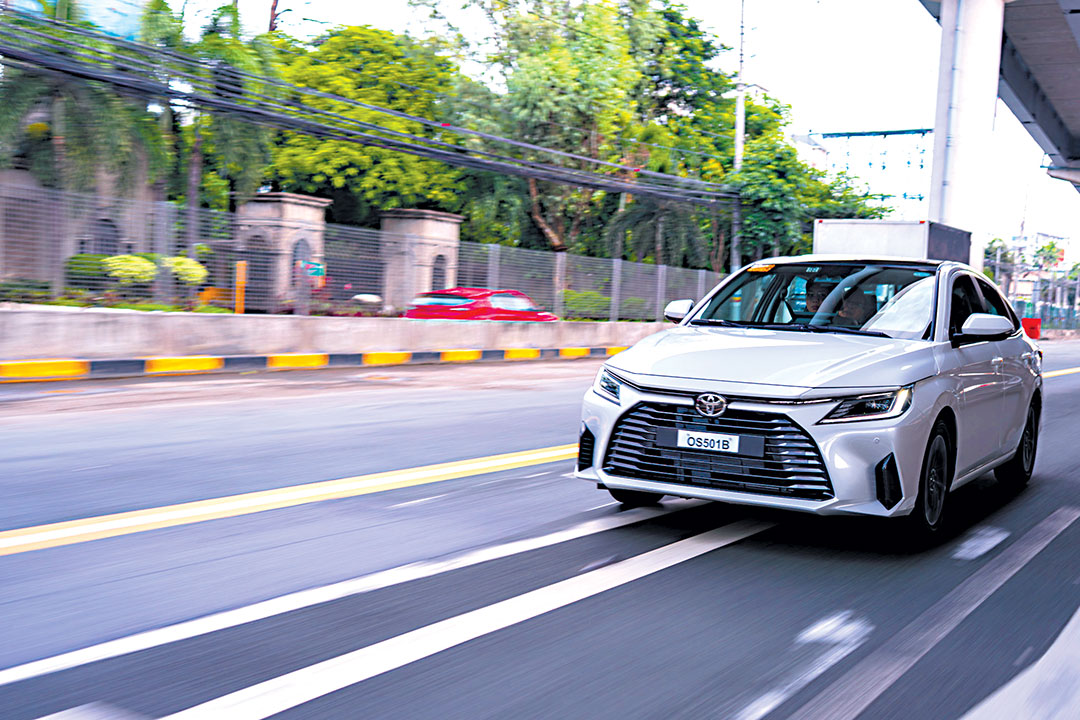
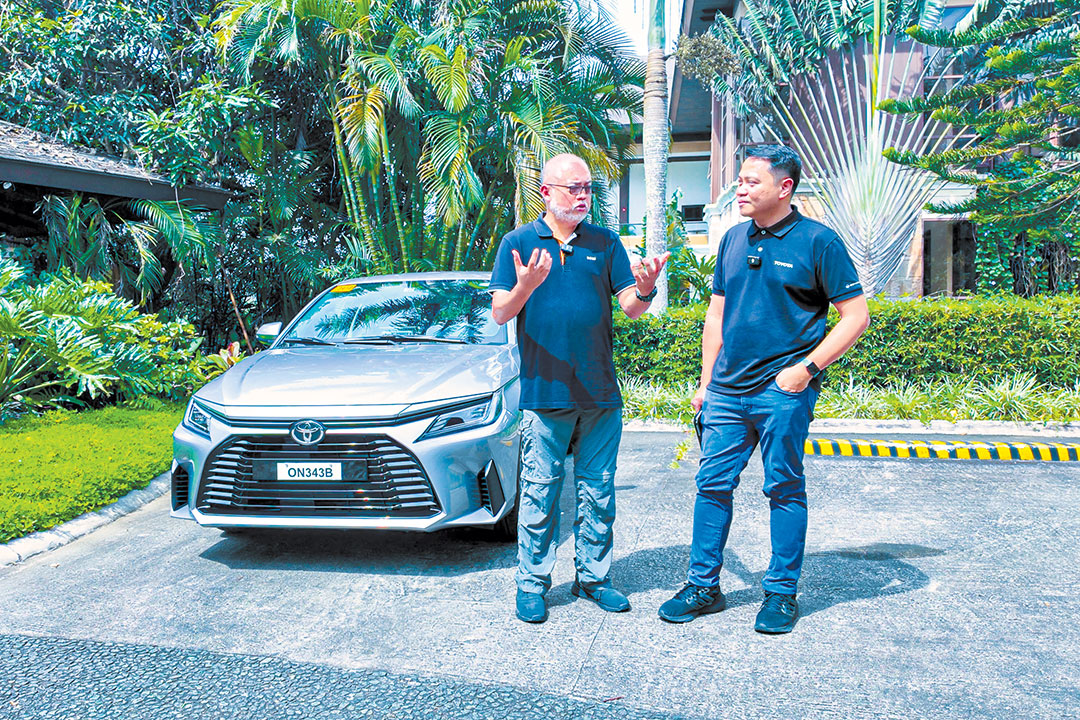
The Toyota Ativ HEV CVT is priced at P1.198 million. — PHOTO BY KAP MACEDA AGUILA

Toyota lowers the price of admission to hybrid

THE TALE OF TOYOTA’s take on — and push to — carbon neutrality is well-documented. Toyota Motor Corp. (TMC) Chairman Akio Toyoda had long elucidated that there is no single, correct way (meaning one powertrain) to achieve this. The realistic formula is predicated on espousing a “multi-pathway” toward a zero carbon society. The “enemy,” as it were, postulated by a chorus of Toyota Motor Philippines (TMP) executives, is not one powertrain type but carbon. Thus, any step to mitigate the production of this emission is a step in the right direction.

Today, TMP formally unveils the Toyota Ativ (pronounced “ey-tiv”) which enters the subcompact sedan category. The company positions it as a complement to its ubiquitous, popular model, the Vios — a proven nameplate regardless of its role: workhorse, fleet mover, TNVS (Transportation Network Vehicle Service), or family car.

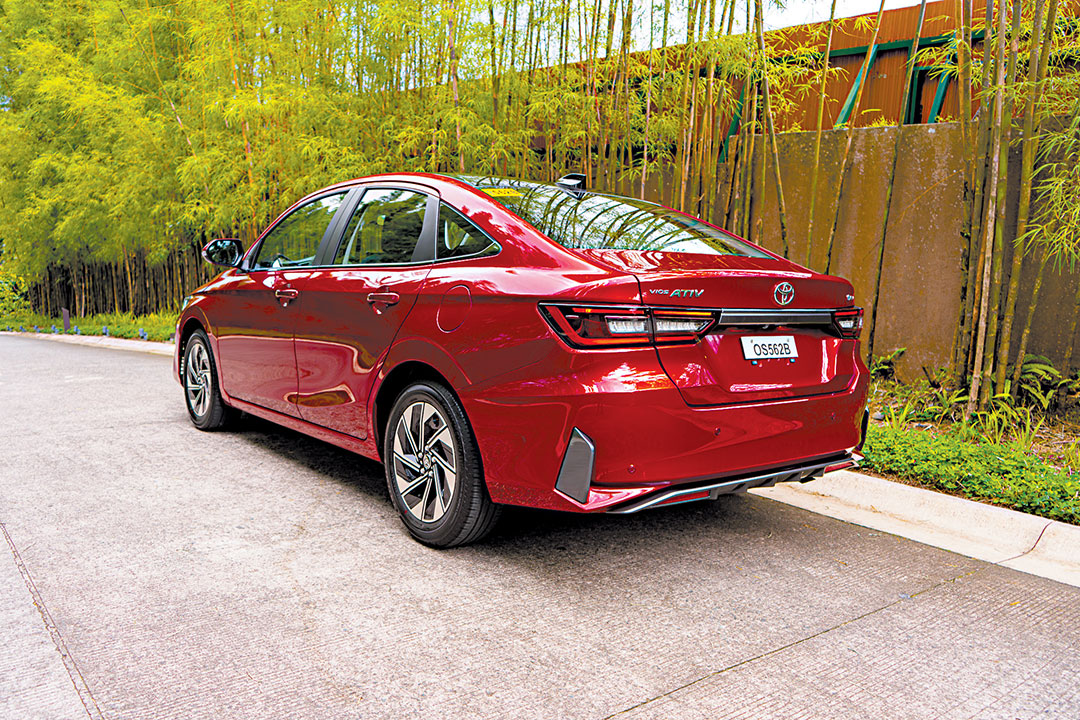
The Ativ, manufactured in Thailand, is still prefixed by the “Vios” moniker but is distinguished by its more upmarket qualities. To be clear, this is not the replacement to the Vios but a veritable expansion of choices in the segment.

Chief among the plethora of differences is the availability, for the first time in this model, of a hybrid powertrain — present in the range-topping Ativ 1.5 HEV (hybrid electric vehicle) CVT variant.

“The all-new Toyota Ativ is another statement of Toyota’s continued mission to bring electrified mobility within reach of more Filipinos,” declared TMP First Vice-President for Vehicle Sales Operations Elijah Sue Marcial in a release. “We know choosing your first car, and an electrified model at that, can be a bold decision, so the Ativ makes it simple and easy by delivering modern HEV features, while providing peace of mind with reliability, safety, ease of ownership, and joy of use,” she added.

Meanwhile, in an exclusive “Velocity” interview, TMP Vice-President for Marketing Services Elvin G. Luciano described the Ativ as “the next important model in (the company’s) lineup.” He averred, “There’s anticipation for the car, with most of you having seen this car being launched in other markets already. We see this as a model further strengthening our electrified lineup. Maybe the best description that we can have for this model right now is that it’s currently the most affordable electrified car in TMP’s lineup.”

CASTING A WIDER HEV NET
Previously, that honor belonged to the Corolla Cross 1.8 G HEV CVT, which retails for P1.514 million. The Ativ now further lowers TMP’s electrified price bar, with the Ativ 1.5 HEV CVT coming in at P1.198 million. This makes the Ativ even more important for TMP in the grand scheme of electrified mobility. Stressed Mr. Luciano, “Toyota has been pushing for electrification in the country for quite a while now, and we recognize that because of the increasing awareness and education of our market regarding electrified cars and what they can do — both for the users and the environment — there are customers who are looking for (them).”

The traditional idea of a first car is now starting to be recast. People are no longer averse to the idea of an electrified vehicle — even for first-time auto buyers, according to the executive. The Ativ deploys a net that’s wider than ever — lowering the price of admission into the HEV format.

To reiterate, the Ativ and Vios will coexist in the TMP lineup. The Vios, of course, was and remains to be a key model in the portfolio as it famously became the company’s entry in the CARS (Comprehensive Automotive Resurgence Strategy) program launched in 2015 under the administration of the late President Benigno S. C. Aquino III. Toyota enrolled the Vios, while the only other entrant, Mitsubishi Motors Philippines Corp., put forth the Mirage. The two models are locally manufactured (with a production target of 200,000 units each) in exchange for tax perks and fiscal support. TMP has already reached milestone, and is now awaiting the implementation of the current administration’s equivalent program, RACE (Revitalizing the Automotive Industry for Competitiveness Enhancement).

In a relatively recent BusinessWorld article by Justine Irish D. Tabile, Department of Trade and Industry (DTI) Secretary Ma. Cristina A. Roque was quoted as saying, “We want more companies to avail… It is open to everyone. And the bottom line is, if they can (manufacture) 100,000 units in three years, then they will be able to avail of the incentives.” The government wants to “fast-track the release and the implementation of the joint administrative order that will govern the strategy,” Ms. Tabile wrote. But other agencies are involved as well so there’s quite a bit of coordination and clearance to be made. In the case of Toyota, it has expressed interest in enrolling the all-new Tamaraw — which it makes in its Santa Rosa, Laguna facility — into the program.

TMP is clearing the demarcation lines between the Vios and Ativ as it quietly pulled out the 1.5 G CVT and 1.5 GT M/T variants. The remaining four grades of the Vios are priced from P738,000 in the 1.3 J M/T up to P908,000 for the 1.3 XLE CVT, removing overlapping price points. The Ativ 1.3 M/T, for reference, is priced at P916,000.

ATIV-ITIES
The Ativ 1.5 HEV CVT is powered by a 2NR-VEX inline four-cylinder HEV mill with lithium-ion-battery-powered electric motor. Total system output is 111hp and 121Nm. Pure internal combustion engine options are available, too — powered by either a 1.5-liter mill (106ps, 138Nm) or a 1.3-liter engine (98ps, 122Nm).

The Ativ measures 4,425mm in length, 1,740mm in width, and 1,480mm in height. Compared to the Vios, it is 5-mm longer, 10-mm wider, and 5-mm taller.

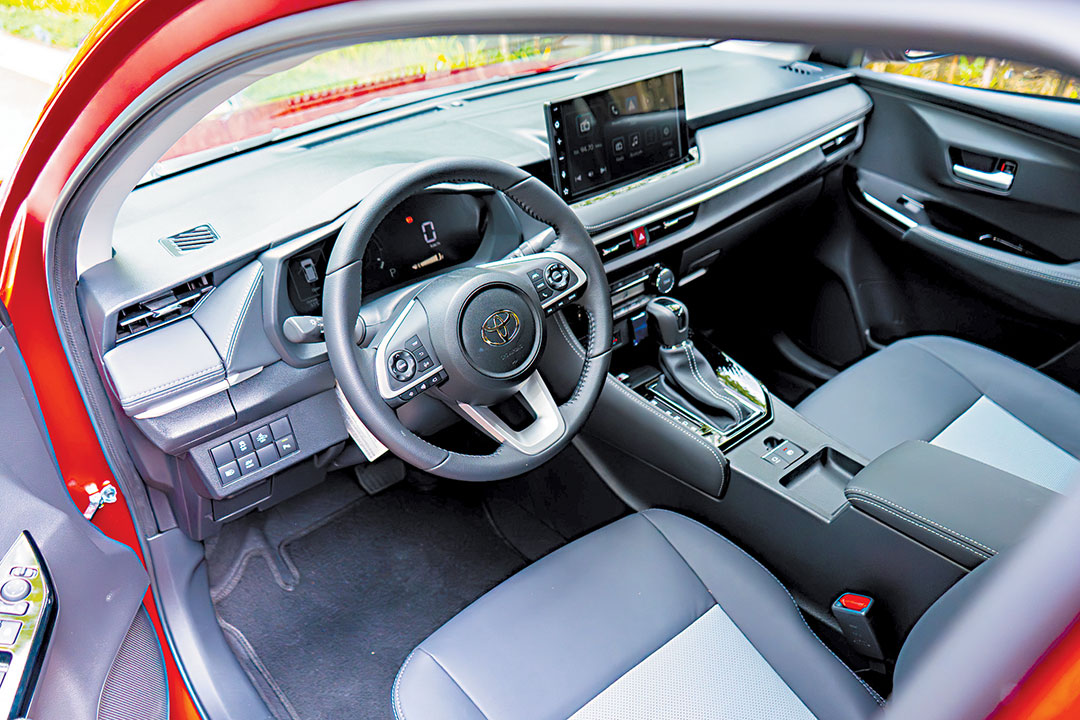
True to its more upmarket intentions, the fastback-shaped Ativ receives a host of commensurate touches outside and inside. It boasts LED headlamps and rear sequential turn signals (in the HEV variant). In the cabin, the HEV grade wraps its seats in leather; fabric seats go to the G CVT, E CVT, and E M/T variants. Its infotainment system is predicated on a seven-inch digital display for the non-HEV grades, while the HEV variant receives a 10.1-inch Display Audio system with wireless Apple CarPlay and Android Auto. I did find myself looking for a center armrest in the back seat though, and the rather elevated seating in front compared to the typical sedan might take a little getting used to (the driver’s seat may be adjusted for height, of course).

ADAS
ADAS (Advanced Driver Assistance System) features tucked in the Toyota Safety Sense (TSS) suite are in the Ativ hybrid — upping protection and convenience through a pre-collision system, automatic high beam, lane tracing assist, lane departure alert, adaptive cruise control, and others. Across the line, Ativ models get multiple air bags, ABS with brake assist, vehicle stability control, blind spot monitor, and Isofix child restraint systems. The HEV also receives electronic parking brake with brake hold, a wireless charger, and a panoramic view monitor (also available on the G CVT grade). Push start and smart entry is available for all variants.

QDR
“Your first car needs to be simple and worry-free,” Mr. Luciano averred. “So you don’t have to be concerned about the reliability, the quality of the car… (The Ativ) is a combination of what Toyota has to offer in one practical and reachable package (featuring) our signature QDR — quality, durability, and reliability… Of course, what we want to highlight is that when you go for the Ativ as your first electrified car, your first entry into that space, you are assured that you are being assisted.”

Mr. Luciano maintained that Toyota has the widest network of dealerships and service centers across the country. “You can rest assured that you can get genuine customer support and quality after-sales service.”

Once again, the Ativ is TMP’s newest poster child for electrified mobility. “We at Toyota have always believed that we can feel or we can experience the good impact of electrification through massive adoption. In order to do that, we need to offer the widest range of electrified options.”

Concluded the executive: “Through affordable options like the Ativ, it’s now much easier for more Filipinos, for more of us, to be part of this movement to collectively reduce our carbon emissions and make a positive impact on the planet.”

The other Ativ variants are priced as follows: Ativ 1.5 G CVT (P1.069 million) and Ativ 1.3 E CVT (P980,000). There is a price premium on special colors.

Wearable, handwoven pieces of art

THE Grand Dame of Philippine fashion Patis Tesoro (center). — BRONTË H. LACSAMANA

Patis Tesoro unveils new Filipiniana collection

PATIS TESORO, known as the Grand Dame of Philippine fashion, is orchestrating a vision of what Filipiniana is today in a benefit fashion show presented by the Zonta Club Alabang.

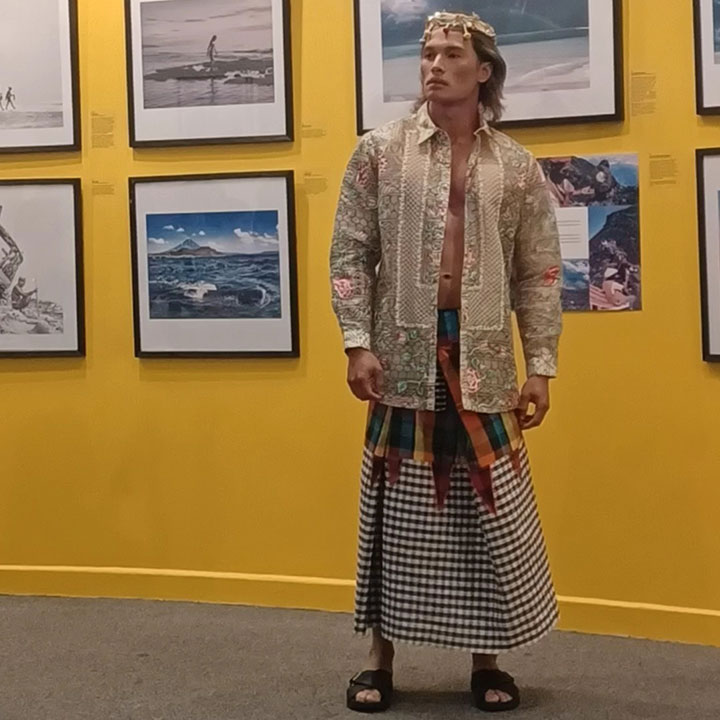
At a preview on Oct. 8 at the Yuchengco Museum in Makati, she offered a glimpse of what is in store, showing eight of the 100 pieces, showcasing piña fabric, natural dyes, and elegant tropical designs, which make up the collection called “Filipiniana is Forever.”

There are colorful dasters or house dresses, a preferred everyday garment of the fashion icon, but elevated via handwoven details, patchwork, and hand embroidery. Meanwhile, the Maria Clara-esque gowns, a more formal version of the baro’t saya, will clearly be the highlights of the collection.

The kimona jackets with intricate patterns and vibrant colors catch the eye. For men, hand-painted barongs add a splash of personality to what is usually plain beige formal wear.

Whether the prints on the fabrics are floral or geometrical, the embroidered details on each piece give them texture — even the headwear range from thick and dazzling to light and diaphanous.

For Ms. Tesoro, the phrase “Filipiniana is forever” is one she will stand by with a passion, it also being the title of a coffee table book and documentary about her which were released earlier this year.

“It is part of our culture to wear embellished clothes. Western clothes are, give or take, plain, because that is their culture. Our culture is full of burloloy (ornaments), even our houses. We cannot get away from that. We also have to continue it because it basically gives a lot of work to our people,” she said at the preview.

This collection is the first that she is presenting in a fashion show in over two years.

It’s become difficult to build a full collection, with many pieces getting sold out as soon as she finishes making them.

“It’s my first fashion show in years, so it’s a lot of stress. I thought I would not anymore have this stress at my age — I’m in my 70s now — but Zonta persuaded me to do this,” Ms. Tesoro said.

Most importantly, the show is set to raise funds for the projects of the Zonta Club of Alabang. These include prenatal screening for hepatitis B, an equine therapy program for young, underprivileged cancer patients, ballet outreach for indigenous children, and educational programs for the early detection of breast cancer.

Aside from proceeds from the ticket sales to the benefit fashion show going to these initiatives, Ms. Tesoro herself also represents the club’s advocacy of women empowerment, according to its president, Kathleen Liechtenstein.

“Women empowerment informs all our projects. Patis is the very embodiment of this,” she said at the preview. “In all her endeavors, she has contributed to empowering women from artisanal communities. Her team, for example, is made up of 90% women.”

For Ms. Tesoro, “Filipiniana is Forever” is a summation of her life’s work. “I wanted to emphasize the beauty of handmade things. About 95% of the collection is handmade. Fabrics are handwoven, hand painted, hand embroidered, hand beaded,” she said.

She was also inspired by the idea of a woman’s nape subtly peeking from behind the traditional baro or lightweight embroidered blouse.

“When you are Filipino, you are attractive when you wear the baro’t saya. Characteristically, it is folded at the back to show the nape. It’s very sensual. It is also an evolving, wearable piece of art,” she explained.

Her process consists of “piling on layers of details like notes of a crescendo,” which comes together as she sees the materials.

“All Filipinos aspire to dress in a sheer handwoven piña or what resembles it. Our climate and environment necessitate this mode of dress. I wanted to show daily wear to formal wear, focusing on the craftsmanship and artistry of our people,” Ms. Tesoro said.

However, she jokingly warned the Zonta guests and the media that “no one should be buried in piña.”

“It’s just too expensive. You can show your body in piña, but then before you get buried, maghubad ka muna (take off your clothes first),” she said. “That’s my suggestion.”

“Filipiniana is Forever” will be presented on Nov. 4 at the Grand Ballroom of the Hyatt BGC in Taguig. Tickets are available via https://qlickpass.com/ and the e-mail zontaclubofalabang1@gmail.com. — Brontë H. Lacsamana

No weekend plans? Here are spots worth visiting in Manila accessible via LRT-1

Rizal Park

There’s simply no place like Manila, or so how the popular OPM song goes. The nation’s capital, home to more than 15 million people, possesses a unique charm and energy that is incomparable to any other city. It is also a place rich with both historical and new destinations that will enrich your mind and fill your heart (and tummy).

It doesn’t matter if you’re from the north or south, you can visit Manila’s most iconic spots with ease and comfort using the LRT-1! With 25 stations, it connects major cities including Quezon City, Caloocan, Manila, Pasay, and Parañaque. Embark on a quick weekend adventure and discover the best that Metro Manila can offer, one LRT-1 station at a time.

Take a stroll at the Pasig River Esplanade

See the Pasig River in a new light and enjoy scenic views of Manila’s historic infrastructures, including the Jones Bridge, when you visit the Pasig River Esplanade. Just a 10-minute walk from the LRT-1 Carriedo station, this urban development project features walkways, bike paths, and open spaces ideal for recreation and Instagram-worthy moments. Its location also provides easy access to other iconic landmarks in the area, such as Binondo and Escolta.

The Pasig River Esplanade offers an amazing sunset view over the city skyline, and at night, it is adorned with vibrant and colorful lights. There are also food stalls available with sitting areas where you can score quick bites, rest, and just enjoy the ambiance.

Pasig River Esplanade — Photo by Jayfrey Generoso

Connect with nature at Arroceros Forest Park

Dubbed as the “last lung” of Manila, the Arroceros Forest Park is a welcome reprieve amidst the city’s concrete jungle, and it’s only a few steps from the LRT-1 Central Terminal station. The park houses over 3,000 native trees of varying species, making it an ideal home or stopover for both local and migratory birds. The tree canopies help lower the ground temperature in the area, which enables visitors to walk comfortably in the park.

After checking out the meditation area, koi pond, and riverside walkway, head to the nearby Pekaps sa Gedli coffee shop for some drinks and snacks.

Arroceros Forest Park — Photo by Byahe ni Kuya Gil

Experience a piece of history at Rizal Park

A 5-minute walk from the LRT-1 United Nations station will bring you to the historic Rizal Park, a must-visit whenever you find yourself in Manila. Here, you’ll often see families and groups having a picnic, watching the Musical Dancing Fountain show, or taking photos in front of the Jose Rizal National Monument. The park has recently undergone upgrades, making it an even better place to visit. If you wish to learn more about this landmark and its namesake, you can join free walking tours offered by the National Parks Development Committee.

Within the grounds of Rizal Park, you can also visit the National Museum Complex that houses the National Museum of Fine Arts, the National Museum of Anthropology, and the National Museum of Natural History.

Visit the newly renovated Manila Zoo

Manila Zoo — Photo by Byahe ni Kuya Gil

The Manila Zoological and Botanical Garden, popularly known as Manila Zoo, has undergone major rehabilitation in recent years, resulting in more modernized facilities and larger enclosures for animals. A 10-minute walk from the LRT-1 Quirino station, the zoo showcases both native wildlife, such as the Philippine Deer and the Philippine Palm Civet, and exotic species like the Siberian Tiger and African Lions.

Visitors are encouraged to purchase tickets online for convenience. You can view the entrance fees here. While it’s not allowed to bring food and bottled drinks inside the zoo, there are plenty of food stalls within the premises where you can fuel up and take a breather. Another tip: don’t forget to bring an umbrella when you visit!

Baclaran Church — Photo by Lorenzo Atienza Photography

Aside from these Manila spots, you can also reach other popular and fun destinations in nearby cities using the LRT-1. The iconic Baclaran Church (and market), for example, is just a footbridge climb away from the LRT-1 Redemptorist-Aseana station. The trending Parqal Mall and its 24-hour arcade are also just a 9-minute walk away from the station.

Parqal Mall Arcade — Photo by Elahdventure

Explore new, exciting places and discover what adventures await with LRT-1 as your KasamBiyahe!


Spotlight is BusinessWorld’s sponsored section that allows advertisers to amplify their brand and connect with BusinessWorld’s audience by publishing their stories on the BusinessWorld Web site. For more information, send an email to online@bworldonline.com.

Join us on Viber at https://bit.ly/3hv6bLA to get more updates and subscribe to BusinessWorld’s titles and get exclusive content through www.bworld-x.com.

PSE says no P5-T MCAP loss since Dec. 2024

PHILIPPINE STAR/KJ ROSALES

THE Philippine Stock Exchange (PSE) has denied social media claims that it has lost as much as P5 trillion in market capitalization (MCAP) since December 2024.

In a statement on Sunday, the PSE said a social media post on Oct. 10 “advanced the preposterous claim that the PSE has lost up to P5 trillion in market capitalization since December 2024.” The post was “reposted the following day in an online tabloid,” it added.

“The Phisix market cap actually dropped by P5 trillion from Dec. 2024 to Oct. and by P3.6 trillion from Feb. to Oct. These numbers are in fact much larger than what was formerly cited. Although, if one looks at the index performance in the last 3 weeks the P1.7-trillion loss may not be that farfetched,” the social media post said.

The PSE said that it tracks two types of MCAP — domestic and total. Domestic MCAP covers Philippine companies whose primary listing is on the PSE, while total MCAP includes both domestic MCAP and the market value of foreign companies dually listed in the Philippines and abroad, such as Manulife Financial Corp. (MFC), Sun Life Financial, Inc. (SLF), and Del Monte Pacific Ltd. (DELM).

“Since only less than 1% of the outstanding shares of MFC and SLF and less than 5% of DELM are lodged for trading in PSE, PSE uses domestic MCAP data as the MCAP reference number since it more accurately captures the performance of the Philippine stock market,” the Exchange said.

PSE data showed that domestic MCAP stood at P14.29 trillion as of Oct. 10, down by P273.26 billion or 1.88% from P14.57 trillion as of Dec. 27, 2024. Total MCAP, which includes the foreign listings, fell by P886.84 billion or 4.43% during the same period.

“Deliberately comparing apples to oranges by comparing domestic MCAP to total MCAP is dishonest, if not malicious, and is clearly meant to provoke investors to lose confidence in the Philippine capital market and destabilize the economy,” the PSE said.

“We trust that the data provided in this statement will put an end to fake news about trillions lost in PSE’s MCAP this year,” it added. — Alexandria Grace C. Magno

PHL ‘can withstand’ US tariff but must preserve multilateral options, ICC says

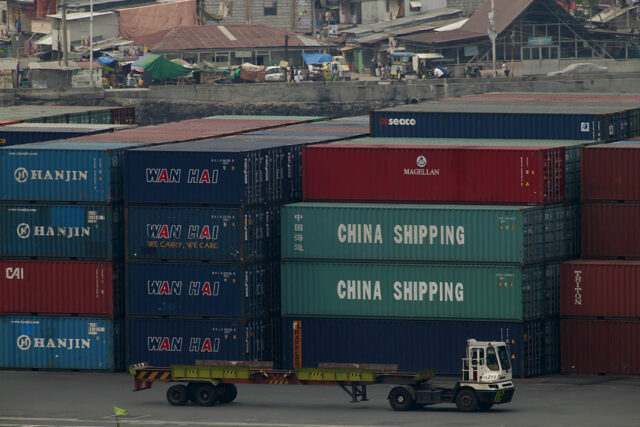
Container vans are seen inside the Manila South Harbor, Metro Manila. — REUTERS

By Justine Irish D. Tabile, Reporter

THE PHILIPPINES is not unduly disadvantaged by US tariffs because it is essentially in the same position as its rivals, the International Chamber of Commerce (ICC) said, adding however that it must support multilateral approaches to trade to manage its risks.

“I think you can absorb the tariff, because on a relative basis, in the key industries, your competitors have not done any better. So, you’re actually in a position to withstand that,” ICC Secretary General John W.H. Denton AO told BusinessWorld.

“I think the Philippines would be at risk if the system that it is reliant upon, the trading system, collapses. That is why it is important to work with us, with the rest of the Association of Southeast Asian Nations (ASEAN), to maintain it,” he said.

“And also, at the same time, getting access to development support because there’s less going around than there was, so we need to work out a new strategy here and that is really around increasing economic activity and attracting foreign investment,” he added.

He said ASEAN forms the foundation of the largest free trade group, the Regional Comprehensive Economic Partnership (RCEP).

“But the RCEP group has not been able to deliver a lot of the economic activity that is necessary and opportune for small businesses,” he said.

“We are looking at how we can help, and one of the inhibitors there is actually the way rules of origin are drafted,” he added.

He said ASEAN must establish clear principles, which makes the Philipines’ chairmanship of the ASEAN Summit next year an important role.

“ASEAN is an incredibly important group because it’s a very large grouping when you look at the population, but it has quite a significant convening power because people want to do business with ASEAN,” he said.

“And so establishing the clear principles for what a revitalized trading system looks like is something that the Filipino chairmanship of ASEAN could actually work with us to deliver as well,” he added.

In terms of business sentiment, he said that lack of certainty is making investors pause before plunging into new ventures.

“But the economy here is going relatively well compared to other economies in ASEAN … It’s still the fastest-growing economy in Southeast Asia, so there are a lot of opportunities there,” he said.

He said the demography in the Philippines is what has helped it so far but noted the need to reduce red tape.

“You actually do have to make it easier to invest, do business, and do more economic activity, and reduce some of the red tape, which has actually stopped or hindered business activity here,” he added.