Notice: Function _load_textdomain_just_in_time was called incorrectly. Translation loading for the Newsmag domain was triggered too early. This is usually an indicator for some code in the plugin or theme running too early. Translations should be loaded at the init action or later. Please see Debugging in WordPress for more information. (This message was added in version 6.7.0.) in /data/bwonline/walaakomaisip/wp-includes/functions.php on line 6131
BusinessWorld Online | BusinessWorld: The leading and most trusted source of business news and analysis in the Philippines | Page 4113                                   
Home Blog Page 4113

Philippines still needs to address deficiencies in ‘dirty money’ controls

THE LOGO of the Financial Action Task Force (FATF) is seen at the OECD headquarters in Paris, France, Oct. 18, 2019. — REUTERS

THE BANGKO Sentral ng Pilipinas (BSP) will continue to address deficiencies in its efforts against money laundering and terrorism financing as the Philippines remained on the Financial Action Task Force’s (FATF) “gray list,” an official said.   

“We continue to do our usual on-site examination and off-site surveillance to ensure banks’ compliance with the AML (anti-money laundering) law and BSP rules and regulations,” BSP Deputy Governor Chuchi G. Fonacier said in a Viber message.   

In a report released on Saturday, the FATF said the Philippines is still in its gray list of jurisdictions under increased monitoring for “dirty money” risks after failing to address strategic deficiencies against money laundering, terrorist financing and proliferation financing.

The Philippines has been on the gray list since June 2021.

Government officials earlier expressed hope the Philippines can exit the gray list by January 2024. Inclusion in the FATF’s gray list can affect a country’s reputation and investment ratings, as well as limit trade opportunities.

After a three-day plenary session in Singapore, the dirty money watchdog said the Philippines still needs to address five out of the 18 deficiencies in anti-money laundering/combating the financing of terrorism (AML/CFT) controls. 

However, this was an improvement from the eight deficiencies identified by the FATF in June.   

According to the FATF, the Philippines should continue to demonstrate effective risk-based supervision of designated nonfinancial business and professions (DNFBPs) and ensure that supervisors are using the proper AML/CFT controls to mitigate risks associated with casino junkets. 

The Philippines should also enhance and streamline law enforcement agencies’ access to beneficial ownership information and ensure accurate and up-to-date information.   

The country should also increase investigation and prosecution of cases related to money laundering and proliferation financing.

“The FATF urges the Philippines to swiftly implement its action plan to address the above-mentioned strategic deficiencies as soon as possible as all deadlines expired in January 2023,” the global dirty money watchdog said.   

Rizal Commercial Banking Corp. (RCBC) Chief Economist Michael L. Ricafort said there are already some mitigating measures to improve the Philippines’ efforts against money laundering in recent years.

“There may be more documentary requirements for fund inflows into the country such as investment and other remittances, thereby could lead to higher transaction costs and additional time for transaction processing,” he said, adding these could cause some delays in transactions.

Mr. Ricafort said the Philippines could save more time and save on costs if it adopts corrective measures and action plans to exit the FATF’s gray list.

“One reform measure being considered is the lifting of the secrecy on bank deposits, to better align the country’s banking regulations/rules with the rest of Asia and the rest of the world; as well as help in facilitating the country’s integration of its capital markets with the rest of the region,” he said.

The proposed amendments seek to allow the BSP to examine deposits in relation to possible fraud, serious irregularity, or unlawful activity being committed by bank officials.

President Ferdinand R. Marcos, Jr. also gave government agencies until Nov. 30 to address deficiencies in their anti-money laundering strategies in hopes that the Philippines could get out of the gray list by January next year.   

Aside from the Philippines, there are still 22 other countries in the gray list. Albania, Cayman Islands, Jordan, and Panama are no longer subjected to increased monitoring by the FATF. — Keisha B. Ta-asan

Industry group sees fighting chance to hit exports target

REUTERS

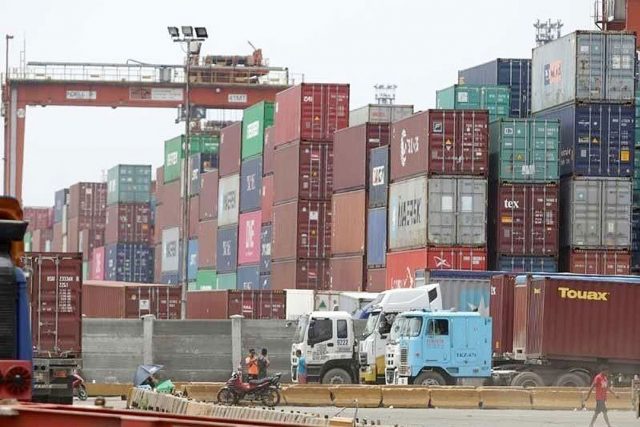
PHILIPPINE EXPORTS are showing signs of a recovery, despite elevated inflation and rising pump prices, an official of the Philippine Exporters Confederation, Inc. (Philexport) said.

“It is recovering, it is going up. Slowly but surely, it is increasing, but not as fast as we would like it to be,” Sergio R. Ortiz-Luis, Jr., president and chief executive officer of Philexport, told reporters last Thursday.

He expressed hope that Philippine exports would achieve the target under the Philippine Export Development Plan (PEDP) 2023-2028. Under the PEDP, the country’s total merchandise and services exports are projected to reach $126.8 billion in 2023.

“I think we should be achieving near to it. I think we have a fighting chance to meet the targets. Although [still] lower than last year, it is increasing now,” Mr. Ortiz-Luis said.

He said the industry now expects to hit its target of $150 billion in export value in three years.

“(Target was moved) because of the challenges that are happening. We did not anticipate the prices of fuel (going up) and although the inflation is going down, it was not as low as what was projected before, which is around 4%,” he said.

Headline inflation quickened to 6.1% in September from 5.3% in August, marking the 18th straight month that inflation exceeded the central bank’s 2-4% target. Year to date, inflation averaged 6.6%. 

The Bangko Sentral ng Pilipinas (BSP) sees average inflation at 5.8% for 2023.

Mr. Ortiz-Luis noted exporters are again facing challenges from rising fuel costs. “We cannot control some of the challenges, for example the fuel cost, we were so happy when it went down, but now, it is going up again.”

Last week, oil companies raised pump prices by P0.95 per liter of gasoline, by P1.30 per liter of diesel, and by P1.25 per liter of kerosene. This brought year-to-date price adjustments as of Oct. 24 to P12.25 per liter for gasoline, P11.70 per liter for diesel, and P7.74 per liter for kerosene.

The Development Budget Coordination Committee is projecting a 1% growth for exports and 2% for imports this year.

In the eight months to August, exports fell by 6.6% to $47.81 billion, while imports dropped by 9.6% to $84.12 billion.

For the first eight months, the trade deficit narrowed to $36.31 billion from the $41.86-billion gap during the same period a year ago. — J.I.D.Tabile

Marcos orders buy-local for infra construction materials

PHILIPPINE STAR/ MICHAEL VARCAS

THE PRESIDENT has ordered the Department of Trade and Industry (DTI) to draft a list of construction materials required by the infrastructure program ahead of the imposition of a buy-local policy on such building materials, the Palace said.

President Ferdinand R. Marcos, Jr. was acting on the recommendation of advisors to make domestic building materials preferred for use in the infrastructure program, according to a statement issued by Malacañang.

Following a meeting with the Private Sector Advisory Council’s (PSAC) infrastructure cluster, Mr. Marcos ordered the DTI to compile the list of building materials, in collaboration with the PSAC.

Mr. Marcos also ordered the Department of Budget and Management, through the Government Procurement Policy Board, to operationalize the “policy of giving preference to local materials” through procurement guidelines.

“The chief executive stressed the need to specify which materials will be procured by the government to avoid any conflict in the future,” the Palace said.

The PSAC advised Mr. Marcos that Philippine manufacturers make cement, steel and other building materials that conform with national standards, and are “designed to withstand the country’s climate and other natural disasters.”

“Our advocacy is really to promote our buy local, Filipino-made products for Filipinos,” PSAC head and Aboitiz Group CEO Sabin M. Aboitiz was quoted as saying. “It’s just fair for our government to take the lead in also patronizing our own locally made product.”

Trade Secretary Alfredo E. Pascual was at the meeting, along with PSAC members Joanne De Asis, founder of Globe Capital Partners LLC; Manuel V. Pangilinan, CEO of PLDT Inc.; Eric Ramon O. Recto, chairman of Philippine Bank of Communications, Inc.; Enrique K. Razon, president of International Container Terminal Services, Inc.; Ramoncito S. Fernandez, CEO of Maynilad Water Services, Inc.; and  Reinier H. Dizon, president of the Cement Manufacturers Association of the Philippines. — Kyle Aristophere T. Atienza

BoC counting on yearend surge to beat revenue target

PHILSTAR FILE PHOTO

THE Bureau of Customs (BoC) said it expects to exceed its revenue target this year with collections expected to improve in the runup to the holidays. 

On the sidelines of a forum last week, Customs Assistant Commissioner Vincent Philip C. Maronilla told reporters that the BoC is on track to hit its internal projections, which will carry it past its target.

“In fact, our goal is not just to hit that (target). We have an internal goal of trying to hit more than the target. We’re trying to maximize as much as possible the surplus that we want to collect, knowing fully well we’re in the position to contribute more,” he said.

The BoC is tasked to collect P874.166 billion this year.

The Bureau of the Treasury (BTr) reported that Customs collections totaled P660.4 billion in the first nine months, exceeding the goal for the period by 2.52%.

Mr. Maronilla said that the last quarter’s collections are usually strong due to the holidays.

“The ‘-ber’ months (are when) we usually hit our largest surpluses. Historically, November has been very good to us. We’ve hit very large surpluses in November. We’re looking into October and November to help catch up with our internal goal of reaching a certain surplus,” he added.

Mr. Maronilla also noted that the surplus may be “significant” judging from current trends. “Right now, we’re at about a little over P10 billion in surplus from the target set to us for this year,” he added.

Though the BIR has been on track to hit its targets, BTr data indicate that monthly collections have been tracking lower year on year since June.

Mr. Maronilla noted a slowdown in the volume of imports during the period.

“Oil, not just in terms of volume, but sometimes in terms of value, fluctuated as well. Overall, the data would show there might be lower actual collections compared to last year, but then revenue-efficiency wise, we’re still up there,” he said.

Finance Secretary Benjamin E. Diokno has said that declines in the BoC’s monthly results were due partly to the reduction in collection days due to inclement weather.

The BIR loses as much as P3 billion to P4 billion when it misses a day of collection, Mr. Maronilla said.

“When you give us our targets, we compute it per day. If you provide us with three days (of collection) where there’s a holiday or suspension of classes, we might (operate with a skeleton workforce) but the other participants in the release of goods might not be there,” he said.

“We can’t force importers to tell their companies to operate on that particular day. Even if we’re open and some of our stakeholders are not, that really affects our collections,” he added.

Mr. Maronilla said that the agency remains “on track” with its October collection target.

“We have a few more days to go. We’re preparing for some holidays. On Tuesday (Oct. 31) we might get a boost because some might be trying to complete their transactions before the long holidays,” he said.

“As you all know, long holidays translate to no transactions and the longer the holiday is, the cost of their goods being stored in the ports doesn’t lower at all. I hope we get that boost on that day and recover whatever it is we’re going to miss on the previous day,” he added.

Oct. 30 (Monday) was declared a holiday for the Barangay and Sangguniang Kabataan Elections. — Luisa Maria Jacinta C. Jocson

Total electrification by 2028 to require funding of P71.97B — Energy dep’t

THE Department of Energy (DoE) said its various programs aimed at achieving total electrification by 2028 would require funding of P71.97 billion.

In its 2023-2032 National Total Electrification Roadmap (NTER), the DoE said programs such as the stand-alone home system (SAHS) would need P35.818 billion.

SAHS taps renewable energy (RE) coupled with batteries in hard-to-reach areas considered unviable for distribution line connection or microgrid systems.

Distribution line extension will require P35.23 billion, microgrid systems P347.82 million, and household electrification via regular connection P243.98 million.

Of the funding, 96.15% will be allocated to the National Electrification Administration (NEA) to support its Sitio Electrification Program, Barangay Line Enhancement Program, and Photovoltaic Mainstreaming projects.

“Electrification primarily entails providing electricity access to remote and rural areas, often located far from existing urban infrastructure. Notably, a large portion of households without electricity can be found in these remote rural areas, contributing to the country’s poverty challenges,” the DoE said.

It said funding sources include its Total Electrification Program as authorized by Energy Regulations (ER) No. 1-94, as well as NEA programs and the Missionary Electrification Plan of the National Power Corp. (NPC).

ER 1-94 authorizes payments to communities hosting energy sources and energy generating facilities.

As of June, the DoE said household electrification was 91.1% with 25.3 million households served, against the estimated potential households of 27.727 million implied in the 2020 Census of Population and Housing. For the rest of 2023, the estimated unserved households total 2.454 million.

By 2028, households are expected to number 29.475 million.

The DoE said that it has identified 285 unserved areas and 122 underserved areas in off-grid locations will be prioritized for tender to private sector investments through a competitive selection process (CSP).

According to Republic Act No. 11646 or the Microgrid Systems Act, the DoE is required to conduct a CSP for micro grid system providers (MGSP) to serve off-grid areas. The initial auction is expected to be conducted within the fourth quarter while the awarding is targeted by the first quarter of 2024.

The bidding will cover 98 unserved and underserved areas clustered into 49 lots. Some 15,645 households are expected to benefit from the initial auction.

“If there are no participants or no awarded MGSP in the CSP for a particular DoE-declared unserved or underserved area, the NPC shall continue to perform its missionary electrification mandate in the underserved area, considering its AHP (Accelerated Hybridization Project),” the DoE said.

AHP, which utilizes RE sources and technology, allows the private sector to enter off-grid areas and put up RE generation plants or facilities to supplement, augment, or replace the existing capacities of the Small Power Utilities Group’s diesel power plants. — Sheldeen Joy Talavera

Budget to be submitted to Palace by mid-Dec.

BUDGET SECRETARY AMENAH F. PANGANDAMAN — DBM

THE 2024 budget will likely be transmitted to the Office of the President by mid-December, Budget Secretary Amenah F. Pangandaman said.

On the sidelines of an event on Friday, Ms. Pangandaman told reporters that the budget bill will likely be submitted to the Office of the President between Dec. 15 and 20.

“The Senate has finished its committee hearings… hopefully they will transmit it after the (November) holidays. Then, when they resume session, we will have the Development Budget Coordination Committee (DBCC) plenary on Nov. 8,” she said.

The House of Representatives approved the 2024 budget bill on Sept. 27. It is currently being evaluated by the Senate.

Ms. Pangandaman also said she is hoping for an early signing, but deferred to Congress in carrying out its functions.

The P5.786-trillion national budget for next year is 9.5% higher than this year’s budget.

Ms. Pangandaman said that the DBCC will be meeting on Nov. 3 for its last review this year of the government’s medium-term macroeconomic assumptions.

She said increased consumption and spending due to the holiday season are expected to help drive growth.

“(On) our part, at least for the government sector, our figures have been improving since September. I hope that will contribute to our growth and the last quarter of the year; that’s when the agencies spend and our consumption increases because of the holidays,” she said.

Gross domestic product (GDP) grew by a weaker-than-expected 4.3% in the second quarter amid a 7.1% contraction in government spending.

The government is targeting 6-7% growth this year. The economy would need to expand by 6.6% in the second half in order to meet the lower end of the government target.

Third-quarter GDP data will be released on Nov. 9. — Luisa Maria Jacinta C. Jocson

Double Trouble

Two ‘brats’ of counterculture fashion have a pop-up

A POP-UP STORE shared by designers Rik Rasos (of Proudrace) and Randolph Santos (of Randolf) was announced via a poster on Instagram earlier this month. With Leah Navarro’s “Ligaw-Tingin” playing in the background, the poster showed the two designers like wrestlers, with horses and flames framing the both of them. That’s not so easy to ignore, is it?

We caught up with both designers on the first night of their pop-up in Cubao Expo’s Pablo Gallery on Oct. 14. The pop-up will run until Nov. 11.

RANDOLF
The designer has come a long way from his cheeky tote bags and T-shirts in 2013. He got a big push when he was named the winner of the 2017 Bench Design Awards.

Then, last year, he was picked up as one of the new labels of Rustan’s, showing off his playful take on the barong. His barongs are embroidered with childish line drawings, tattoo outlines — anything but the traditional rococo-style embroidery — making the stiff formal Filipino garment more mentally accessible to a younger, more daring audience.

Yet that was not his original intention. Mr. Santos told BusinessWorld that he just really liked see-through fabrics. After making a shirt out of jusi, someone remarked, “You make barongs pala.”

“I guess,” he said.

The barongs first came out in 2019, and his name has since become synonymous with counterculture formal Filipiniana. His clients include LGBTQ+ TV host Vice Ganda, their colleague Anne Curtis-Smith, beauty queen’s daughter Isabelle Daza, and actress Bea Alonzo. Another reason why he started making these barongs was his own conflicted relationship with tattoos: he wants one, but is afraid to commit to one. What was meant to go on his skin is simply embroidered onto translucent fabric, thus for him becoming a second skin.

Poking fun at fashion is rooted in his favorite art movement, Dadaism. The art movement came about after the First World War, with artists responding to the absurdity of death and destruction with their own take of the absurd and the loss of reason. In his case, he learned about it during his studies in Fine Arts at UP Diliman, before shifting to Clothing Technology. “It kind of made fun or destroyed traditional art,” he said about Dada. “Feel ko I found myself there.

“That’s me as a person. I like having fun. I wanted to reflect that in clothing. Part of the reason why I started Randolf was really to poke fun at pop culture,” he said.

Part of his display at Pablo includes crisp white shirts covered in childish scrawls, and bodysuits with puppies. The name of the brand itself is a game: named after his father, he changed the “ph” of his own name to “f” for his brand, to make it truly his.

Still, it’s funny to think that a guy poking fun at well-established tropes in fashion now has a home in what can be considered a decidedly “establishment” store, Rustan’s. “They never really told me to tone it down,” he said, adding that predicted slow movers at his display actually sell faster. “I’m happy that now, it’s accepted. When I was starting, it was really difficult for me to get clients. Now, I feel the appreciation of other people.”

PROUDRACE
What started out as a joke between drunks is now a brand selling in Tokyo and Canada, and even dressing Korean boyband BTS.

Talking about how the brand’s name came about, Proudrace co-founder and Creative Director Rik Rasos (his fellow co-founder is industrial designer Patrick Bondoc) said that during a night of drinking in the early 2000s, his friend tried to take a picture of him, but he covered his face. His friend said, “Why are you covering your face? We’re a proud race.”

“I ran with it,” he said, and made that the name of his new brand.

When they were starting in the early 2000s, it was all about graphic T-shirts, his cheeky slogans emblazoned across the torsos of the young and wild. In 2012, the brand received a makeover, and now, they’re better known for manipulating what were supposed to be ordinary clothes into something more avant garde. At his display, we saw a trucker jacket with an extra flap in front, forming a sort of wing, and a polo shirt with a print that could only be loved by a lolo, with one shoulder stretched to inhuman proportions. Ads for the Mahal Kita Inn are printed on T-shirts, and another shirt is ripped then flipped to create the illusion of being worn inside out.

These designs are rooted in the more subtle nuances of Filipino pop culture and streetwear. “You see everyone in the streets. That for me is Filipino streetwear. Very casual. What you would wear at home, what you would wear sa pagbili sa tindahan (to go out to buy something at the store). What we did was just twist that… and try to make it more fashionable,” said Mr. Rasos.

His efforts have landed them in Vogue Talents (by Vogue Italia) as well as a listing in Highsnobiety. “From what I see, global audiences resonate if you’re very authentic to your culture and who you are. You’re not masking anything.”

RESURGENCE OF FILIPINIANA
We see now a resurgence of cool in wearing the Filipino identity on one’s sleeve. Filipino formalwear has never been more visible, and wearing local brands has never been a better choice. The two designers talk about how this came about, and, surprisingly, it happened because of what should have been disastrous events.

Mr. Rasos, for example, thinks that the pandemic changed how Filipinos dress. Not only have they begun to appreciate local craftsmanship more, but, “It became more experimental. Because of the pandemic, nobody’s afraid to dress up anymore. They just want to do what they want, what makes them happy.”

For Mr. Santos, it’s the arrival of all the global fast fashion brands in the 2010s, which once threatened to kill off smaller local brands. The sheer saturation in the market of their clothes brought out the opposite effect. “Maraming ayaw nilang may kapareho (nobody wanted to dress the same as everybody else). Naghahanap na sila ng bago (they are looking for something new), something different.”

“That’s where we come in.” — Joseph L. Garcia

Michael Cinco pays homage to Spain

THIS YEAR’S Legacy gala ball is the next place to see renowned Filipino fashion designer Michael Cinco’s latest works, this time inspired by the vibrant culture of Spain.

Titled “The Impalpable Dream of España,” his newest collection of elegant creations will take center stage at the charity ball on Nov. 27 at the Marriott Grand Ballroom.

At a media preview on Oct. 25, he said that it wouldn’t be his first time to design pieces with Spanish cultural influences.

“I did it back in 2010 and 2013, and now I decided to do it again. I have always been in awe of Spanish culture, ever since I first went to Spain in 1998,” he told BusinessWorld.

His designs, exquisite as always, this time fuse artistic, historical, and architectural influences, from the Roman Catholicism of La Sagrada de Familia to the iconic masterpieces of Pablo Picasso and Salvador Dalí.

Most evident in his latest collection are the silhouettes and overall visual flair lifted from Spanish matadors and flamenco dancers.

“All 50 of the haute couture looks draw inspiration from my travels,” Mr. Cinco said.

With long capes, intricate embroidery, and sparkling stones, the fiery red-and-black blazers and dresses instantly catch the eye and hold the gaze.`The Dubai-based Filipino designer has dressed A-list Hollywood celebrities including Beyoncé, Jennifer Lopez, Britney Spears, Lady Gaga, Mariah Carey, Mila Kunis, Rihanna, and Naomi Campbell.

However, his priorities now are to give back to his home country. Proceeds from the Legacy gala ball will benefit the Philippine Missionari Della Fondazione di Carita, Inc. and the Gusi Peace Prize Foundation.

The show will also mark the launch of his new perfume series and jewelry line, offering a complete lifestyle brand experience — all for a good cause.

For table reservations and more information, e-mail thephlegacygala@gmail.com. — Brontë H. Lacsamana

A brief history of goth fashion – from all-black to pastels

FREEPIK

GOTH is the subculture that never died — or more precisely, perhaps, remains undead. The persistence of the subculture’s style is due to the remarkable richness of the cultural tradition on which it draws, and its malleability — its striking ability to absorb new influences into a recognizably coherent aesthetic.

Goth’s visual style has left as vivid a legacy as its music, one that continues to inspire designers, creatives and today’s teenagers far beyond its initial invention.

Early goth fashion shared many of the same reference points as punk. Many of its early icons, such as The Damned’s singer Dave Vanian and Siouxsie Sioux of Siouxsie and the Banshees, straddled both scenes.

In late 1970s and early 1980s Britain, subcultural style was very much a DIY affair. In the economic recession of the late 1970s, an improvised approach to style became a necessity for many young people. As the economy boomed later in the 1980s, this remained a form of resistance to a mainstream culture that fetishized wealth. In the ongoing spirit of punk, those pursuing “alternative” style would raid jumble sales and charity shops, recycle army surplus, customize high street fashion, and make their own clothes and accessories.

This creative approach to style has been the key to the subculture’s longevity. Goth has always been about mixing things up and adapting what you find to fit your own aesthetic.

The goth aesthetic distinguished itself from punk through its preoccupation with imagery of death and decadence. As such, it seemed to articulate the underlying mood of Margaret Thatcher’s Britain — a culture in which pervasive images of wealth and success were underpinned by policies facilitating the disintegration of the social fabric. The earliest goth ensembles, like those associated with London’s Batcave club, were characterized by ripped fishnet stockings, repurposed bondage gear, deathly makeup and improvised chain jewelry. Towering, backcombed, dyed black hairstyles were a crucial element of the look.

As the 1980s wore on, however, goth style diversified, absorbing looks from other subcultures such as metal, rockabilly and even hippy psychedelia in the model of Kate Bush or Stevie Nicks.

DIVERSIFICATION OF GOTH STYLE
Although the goth music scene began to lose impetus in the early 1990s, versions of goth style began to appear on the catwalks.

This was most prominent in the work of British designer Alexander McQueen. His uncompromising collections experimented with the macabre in ways that thrilled the alternative scene and high fashion insiders alike.

Meanwhile, goth style became more available to mainstream consumers through high street versions of designer trends. In the US, the Hot Topic chain, founded in 1989, sold alternative style to teenagers through regional mall outlets.

For some, this commercialization diluted goth’s countercultural charge. In contrast to the do-it-yourself (DIY) culture of the 1970s and ’80s, a desirable Goth look became increasingly expensive to acquire.

Nevertheless, the subculture proved resilient, expanding to incorporate new influences. By the later 1990s, hybridization with dance music culture produced cybergoth. Ensembles combining colossal platform boots, neon hair extensions and tech accessories like masks and goggles evoked a dystopian, posthuman future. 

The international spread of the subculture generated new styles, too. Japanese Gothic Lolita style aimed to refashion its wearer in the image of a Victorian doll.

Exported internationally in the early 2000s via manga and animé, Gothic Lolita became a major influence on western goth style. It indirectly inspired “cute” gothic looks like “pastel goth” — goth style in the sweet, childish colors the subculture once rejected.

At the same time, many goths cultivated a passion for authentic recreations of historic costume, harking back to period styles inspired by the literary and cinematic tradition of the gothic. At the twice-annual Whitby Goth Weekend, founded in 1994, many participants pay tribute to Dracula author Bram Stoker by parading the sea front of the town where the author found his inspiration for the novel in meticulously crafted Victorian ensembles.

For members of the subculture, one particular style might define their personal image, or they might choose to wear different looks for different occasions.

The “corp goth” even adapts their look for the corporate environment, wearing office-friendly versions of the style. But crucially, by 2023, there are many ways of being a goth.

THE SECRETS OF GOTH’S ENDURANCE
Goth style has its controversies. Subcultures are, understandably, resistant to the appropriation of their style by outsiders. There is endless debate about whether offshoots and associated aesthetics such as emo or steampunk can be counted as goth or not.

While the finer points of these debates can be difficult to resolve, this very diversity is the key to goth’s longevity. Goth is not one look, one style — it is a rich, complex aesthetic drawing on many influences across literature, art and culture. This makes it remarkably resilient to cultural change, as it is able to shift to meet new demands.

Goth is not static, but a living tradition. Research shows that many goths remain active in the subculture long past youth. Moreover, new generations of goths continue to seize the subculture and make it their own.

One of the most dynamic developments of recent years is the mobilization of goths of color, sometimes known as Afrogoths, who resist the presumed association between goth and pale skin and draw music and fashion inspiration from black culture.

It is important that we recognize these new ways of being a goth, even if some of them find connection through visual rather than musical culture. In them, lies the subculture’s lively (undead) future. — The Conversation via Reuters Connect


Catherine Spooner is a Professor of Literature and Culture, Lancaster University.

SC tells Pasay court: Resolve common train station dispute

DEPARTMENT OF TRANSPORTATION

THE SUPREME COURT (SC) has ordered a Pasay City court to resolve a dispute involving the construction of a common train station that would connect separate rail systems in front of the Trinoma mall, which was originally supposed to be in front of the SM North EDSA mall.

Its order to the Pasay City Regional Trial Court Branch 111 involved SM Prime Holdings, Inc. (SMPHI) and entities handling the rail systems — Metro Rail Transit Corp. (MRT) and the Light Rail Transit Authority (LRTA).

In a resolution dated March 15 and made public on Oct. 26, the tribunal lifted an injunction on the station’s construction but said that doing so was moot since SMPHI had reported that the station’s construction had started.

“This is a judicial admission that is binding upon SMPHl, without need for further proof. At any rate, the aforesaid admission of SMPHI itself renders the present petition for injunction moot,” the tribunal said.

“Here, further proceedings would be of no practical value because there is no longer any substantial relief to which SMPHI would be entitled and or would otherwise be negated by the denial of the petition.”

In a 2017 agreement, SMPHI, the LRTA, and the Department of Transportation (DoTR) agreed to compromise on a common station plan acceptable to all parties, after the High Court told them to do so.

The tribunal said the parties have yet to finalize or implement the plan for the common station.

The entities had agreed to “facilitate the immediate development, construction, and operation of a Unified Station/Grand Central Station.”

“While judicial policy strongly encourages compromise, the court cannot allow the supposed negotiations to indefinitely stay hanging in the air and continue to clog the docket of the court, without any clear showing that it would ever come to fruition,” the High Court said.

In 2009, SMPHI and the LRTA signed a deal that involved SMPHI agreeing to help finance a common station that would be built in front of SM North EDSA by earmarking P200 million for its construction. Funding was delivered to the LRTA that same year.

Under the agreement, SMPHI was granted naming rights over the common station.

Two years later, the LRTA and the DoTR, formerly known as the Department of Transportation and Communications (DoTC), signed a separate agreement assigning the latter as the lead implementing agency for the project.

SMPH argued that the LRTA and the DoTC suddenly stopped the station’s construction and complained that it had not been informed of plans to change the construction site to Trinoma, which the DoTC confirmed in a 2014 bulletin.

SMPHI had asked a Pasay City regional trial court to implement a temporary restraining order (TRO) against the station’s construction in the new site in front of Trinoma, which the court denied.

That same year, the firm asked the Supreme Court to grant its plea for a TRO, saying that not even the government can violate a valid contract and that the P200 million it had delivered to the LRTA should have been used for a common station in its original location.

The SC granted the petition for an injunction, halting the transfer of the common station.

The DoTC argued that the transfer of the common station’s location was “made for the best interest of the public,” claiming that the transfer would save the government P1.22 billion since the Trinoma location was more convenient.

“Considering the parties’ protracted negotiations, and the absence of even a faint showing that the parties are attempting to comply with the supposed conditions precedent… the court could only conclude… they are no longer minded coming to any compromise agreement which would write finish to their 9-year-old case,” the High Court said. — John Victor D. Ordoñez

Zara-owner Inditex to buy recycled polyester from US start-up

AN AMBERCYCLE x Zara Athleticz Zippered Training Shirt. The shirt is made of lightweight, technical stretch fabric.

MADRID/LONDON — Zara-owner Inditex, the world’s biggest clothing retailer, has agreed to buy recycled polyester from a US start-up as it aims for 25% of its fibers to come from “next-generation” materials by 2030.

As fast-fashion retailers face pressure to reduce waste and use recycled fabrics, Inditex is spending more than €70 million ($74 million) to secure supply from Los Angeles-based Ambercycle of its recycled polyester made from textile waste.

Polyester, a product of the petroleum industry, is widely used in sportswear as it is quick-drying and durable.

Under the offtake deal, Inditex will buy 70% of Ambercycle’s production of recycled polyester, which is sold under the brand cycora, over three years, Inditex Chief Executive Officer (CEO) Oscar Garcia Maceiras said at a business event in Zaragoza, Spain.

Mr. Garcia Maceiras said Inditex is also working with other companies and start-ups in its innovation hub, a unit looking for ways to curb the environmental impact of its products.

“The sustainable transformation of Inditex … is not possible without the collaboration of the different stakeholders,” the CEO said in a speech at the event.

The Inditex investment will help Ambercycle fund its first commercial-scale textile recycling factory. Production of cycora at the plant is expected to begin around 2025, and the material will be used in Inditex products over the following three years.

CAPSULE COLLECTION
Zara Athleticz, a sub-brand of sportswear for men, launched a capsule collection last week of “technical pieces” containing up to 50% cycora. Inditex said the collection would be available from Zara.com.

Some apparel brands seeking to reduce their reliance on virgin polyester have switched to recycled polyester derived from plastic bottles, but that practice has come under criticism as it has created more demand for used plastic bottles, pushing up prices.

Textile-to-textile polyester recycling is in its infancy, though, and will take time to reach the scale required by global fashion brands.

“We want to drive innovation to scale-up new solutions, processes and materials to achieve textile-to-textile recycling,” Inditex’s chief sustainability officer Javier Losada said in a statement.

The Ambercycle deal marks the latest in a series of investments made by Inditex into textile recycling start-ups.

Last year it signed a €100 million ($104 million) three-year deal to buy 30% of the recycled fiber produced by Finland’s Infinited Fiber Co., and also invested in Circ, another US firm focused on textile-to-textile recycling.

In Spain, Inditex has joined forces with rivals including H&M and Mango in an association to manage clothing waste, as the industry prepares for European Union legislation requiring member states to separately collect textile waste from January 2025. — Reuters

Real Steel taps TotalEnergies ENEOS for solar rooftop 

REAL STEEL Corp. (RSC) is partnering with a Singapore-based renewable energy company to build a 16.8-megawatt-peak rooftop solar photovoltaic (PV) system in its manufacturing facility in San Simon, Pampanga.

“By implementing the largest rooftop solar PV system in the Philippines, we are accelerating the production of lower carbon, high-quality steel products for the Philippine market,” William T. Chen, chief finance officer of RSC, said in a media release over the weekend.

The company said it had inked the deal with TotalEnergies ENEOS for the project, which is aimed at significantly reducing operational expenses and the carbon footprint of its high-speed rolling mill.

TotalEnergies ENEOS is a joint venture between French energy and petroleum company Total Energies and Japanese oil company ENEOS.

With over 22,000 solar modules to be installed, the PV system will generate 26,000 megawatt-hours of renewable electricity annually, which will lead to “substantial cost savings” for the facility, RSC said.

The project would also reduce the company’s carbon emissions by approximately 12,800 tons of carbon dioxide per year equivalent to planting 200,000 trees.

Under the agreement, TotalEn-ergies ENEOS will install and maintain the PV system, while RSC will be the operator and owner of the asset from the commissioning.

“The business model proposed by TotalEnergies ENEOS ensures a neutral cash flow for RSC for the first 10 years of engagement,” RSC said, adding that it “will fully benefit from the asset for its entire lifespan of around 30 years.”

The signing of the agreement was witnessed by executives of RSC and TotalEnergies ENEOS, as well as by Marissa P. Cerezo, the director of the Department of Energy’s Renewable Energy Management Bureau, and Rémy Tirouttouvarayane, deputy head of mission of the Embassy of France in Manila.

“As a leading solar service provider for commercial and industrial businesses, TotalEnergies ENEOS is committed to aiding companies like RSC in reducing their energy costs and carbon footprint through our expertise in tailored renewable solutions,” said Elodie Renaud, managing director of TotalEnergies ENEOS Renewables Distributed Generation Asia.

RSC, a manufacturer of steel deformed bars, has melting and rolling mill facilities in San Simon that are equipped to produce high-quality steel products. — Sheldeen Joy Talavera

ADVERTISEMENT
ADVERTISEMENT