Home Blog Page 4111

SolX Technologies wins big in IGNITE 2023 Wildfire X Startup World Cup PH leg

By Mhicole A. Moral

End-to-end digital energy solutions platform SolX Technologies, Inc. bagged the top award in the Wildfire X Startup World Cup Philippine Regional Competition during the IGNITE 2023 on Oct. 13 at Fairmont Makati.

SolX Technologies topped nine other early-stage startup finalists. They will represent the Philippines at the 2023 Startup World Cup Grand Finale in Silicon Valley, with a chance to win the $1-million grand prize.

In an exclusive interview, SolX Technologies Co-Founder and CEO Sergius Santos stated the importance of providing digital energy solutions to help make cost-effective decisions with energy consumption.

“SolX provides three core technologies. Our proprietary hardware allows real-time data acquisition from any smart meter brands and sensors. It fully encrypts the data, which is used to verify electricity bills and utilize it to get the best energy contract. Second, the energy contract optimization system matches customers with the fittest energy portfolio, including suppliers, grid-connected, and self-generating assets. We also utilize the data from the first system to recommend key operational changes to further save on energy costs. Third, our anomaly detection system allows end-users to set certain thresholds on important energy parameters to monitor and verify,” said Mr. Santos.

SolX has already saved their clients close to P400 million in energy costs through their system as of date.

“Our technology is 100% Filipino-made, and our team is all from the Philippines. This showcases what our engineers, data scientists, and software developers can make when given the right opportunity,” Mr. Santos added.

The Wildfire X Startup World Cup PH by IGNITE 2023 is part of the Startup World Cup, an annual conference and competition that brings together promising startups, venture capitalists, entrepreneurs, and world-class tech CEOs worldwide. The event will happen in San Francisco, California on Dec. 1.

“To be able to be given an opportunity to pitch in front of Pegasus Tech Ventures, one of the largest funds in the valley, is already a huge upside regardless of the outcome,” Mr. Santos shared. “Hopefully, the Philippines can win the cup globally one day, whether it’s us or another venture. This will strongly impact the narrative towards looking at the Philippine startups and allowing better flow deals to our country.”

Yield Guild Games to hold week-long Web3 Games Summit this November

YGG Pilipinas Country Head Mench Dizon

By Angela Kiara S. Brillantes, Special Features and Content Writer

As the gaming industry continues to grow and evolve, a new generation of Web3 gaming is in the spotlight — a centralized platform for gaming and social interaction. The hype for Web3 gaming is a significant step toward the gaming industry in a more advanced and more efficient manner.

Since 2018, Yield Guild Games (YGG), the first and largest gaming guild, has become a platform where gamers “enrich themselves as they find their community, discover games, and develop vital skills for Web3.” Moreover, it has been at the forefront of supporting the use and adoption of Web3 gaming in the Philippines.

To further strengthen the Web3 gaming community, YGG is holding one of the most anticipated gaming summits this year, the YGG Web3 Games Summit 2023, at the Bonifacio Global City (BGC), Taguig, from Nov. 18 to 25.

According to Mench Dizon, country head of YGG Pilipinas, the YGG Web3 Games Summit is set to be the world’s premier Web3 gaming event that will offer an exclusive look at the future of Web3 gaming.

“The Filipino Web3 gaming community will be among the first to learn about where the industry is headed as blockchain technologies continue to evolve, and how mutual support will be beneficial in the long run as communities become even more interconnected,” Ms. Dizon said in a press conference held at BGC last Oct. 17.

“The Philippines has consistently been among the top countries with the highest interest in Web3. Most of this interest is driven by the roster of engaging Web3 games that are currently in the market. The fact that global leaders from the Web3 gaming industry are coming all the way to the Philippines for the Web3 Games Summit shows that the world recognizes us as one of the leading countries in Web3 adoption and home to a thriving market for new and upcoming Web3 games,” she added.

More than 1,500 global Web3 leaders are expected to attend the summit, which will start with a two-day game jam at STI’s BGC Campus on Nov. 18-19, which will welcome over 300 developers and students and 5,000 active gamers.

This will be followed by a two-day conference at Shangri-La, The Fort on Nov. 21-22, which will bring 90 global and local speakers talking on topics such as Web3 gaming development, eSports, content creation, and player adoption.

Some of the speakers include Yat Siu, co-founder and executive chairman of Animoca Brands; Jeffrey “Jihoz” Zirlin, co-founder of Axie Infinity and Sky Mavis; Rohit Gupta, co-founder of NYXL; Kyu Lee, president of Com2Us; and Gabby Dizon, co-founder of YGG.

Lastly, the summit will hold a three-day expo and tournament at Samsung Hall on Nov. 23-25, which will feature more than 40 Web3 games, such as Ragnarok Landverse, Pixelmon, PROJECT XENO, Parallel, Mighty Action Heroes, Anito Legends, Metacene, Star Atlas, and Axe Infinity: Origins. On the last day of the three-day expo and tournament, content makers and eSports athletes will be featured in a Web3 gaming tournament.

“Despite the challenging times, we continue to give back and remain steadfast in our mission to provide Filipinos with sustainable opportunities to participate in this exciting Web3 space and we want to make sure that the Filipinos are at the forefront of this. This is one of the core drivers and a source of passion for us is seeing how Filipinos can be at the forefront of this pioneering technology,” Ms. Dizon said in her opening remarks at the press conference.

Tickets are available at ygg.events, with packages offering access to different experiences during the event.

Pinas Forward’s inaugural e-Bayanihan Ideathon yields tech-for-good civic projects from Filipino youth

Pinas Forward President Pao Pangan (leftmost), together with YGoal Mentors Chester Fabian and JR Demecais (first and second from right), poses with e-Bayanihan Ideathon 2023 participants from the Philippine Science High School - Central Luzon Campus. Team Kalibur, represented by (from second from left) Adviser Sharmaine Lizada and delegates Andie Moreno, Kim Mendoza, and Enzo Banzon, is only one of the several groups that successfully completed the two-month learning-intensive program.

Social movement Pinas Forward recently concluded its first e-Bayanihan Ideathon, which was participated by 72 young individuals from Luzon, Visayas, and Mindanao who were empowered to transform their concerns into innovative solutions.

Over two months, these budding visionaries immersed themselves in an intensive program, arming themselves with essential tools and knowledge necessary to transform their tech-for-good ideas into reality, all through the strategic application of the Design Thinking framework.

Facilitated with consulting and training social enterprise YGoal, Inc. as learning partner and sponsored by the Taiwan Foundation for Democracy, the Ideathon produced a diverse range of innovative projects, from developing a mobile app that alleviates commuting challenges to creating an online platform that provides tutorial support to students. These projects are dedicated to addressing pressing social challenges in the Philippines, contributing significantly to the nation’s societal well-being.

Through a series of workshops and mentoring sessions, delegates gained valuable insights into effecting meaningful change in their communities. These sessions, facilitated by experts and like-minded individuals, equipped them with essential tools for empathizing with end-users, operationalizing projects, and addressing community challenges.

Moreover, participants engaged in in-person workshops focused on project management and prototyping, enhancing their learning journey. Consequently, the program guided delegates in collaboratively designing and developing 15 civic projects that tackle diverse social issues.

At the heart of the program was the core mission of developing tech-for-good civic projects, aligning with Pinas Forward’s primary objective of advancing digital democracy and digital development. The participants not only refined their initial ideas but also presented well-developed solutions to various social challenges such as unemployment, livelihood accessibility, education, online safety, and disinformation. These projects are poised to instigate meaningful and sustainable change in their respective communities.

Among the standout projects was “TraPick,” a mobile application developed by Team Maji from the University of Science and Technology of Southern Philippines in Cagayan de Oro. TraPick aims to enhance commuting in Cagayan de Oro by providing real-time bus occupancy and seat availability information, streamlining travel, and minimizing stress for commuters.

Another noteworthy initiative is #BAYANKABUHAYAN, a project developed by Team SIKAP from Parañaque National High School-Main. This initiative takes the form of a livelihood website, aiming to provide vocational ideas and opportunities to both students and unemployed individuals in Parañaque City. To empower citizens, the project offers valuable vocational resources, enhancing their prospects for sustainable livelihood.

In a similar vein, Team SHORE-SKwela from Xavier University-Ateneo de Cagayan has implemented innovative techniques in their supplementary education programs for incoming first-year students and aspiring scholars in Cagayan de Oro (CDO) City. By integrating these innovations, they effectively enhance the knowledge base of their young kababayans, preparing them thoroughly for scholarship-qualifying exams such as the CDO City Scholarship Program and Department of Science and Technology scholarships.

One of the participants, Lord Cedrick Haroll T. Abaya of San Luis National High School in Pampanga, shared his gratitude for being part of Ideathon.

“I was able to connect with other people, and at the same time, I was able to showcase my passion for connecting with people and creating positive impact and change in society. I would like to thank Pinas Forward and Taiwan Foundation for Democracy for this wonderful opportunity to promote and showcase our visions for the betterment of the nation,” he said.

Meanwhile, one of the advisers of the participating teams, Kim Patrick B. Caparal from Ilaya Barangka Integrated School, said, “The impact of this event is huge. It’s not just about them. It’s not just about themselves anymore. It’s about their community. Now they have a sense of responsibility that they feel they have a duty. So, I’m happy that their sense of ownership of their projects has come alive.

edamama founders chosen among Endeavor’s high-impact entrepreneurs

From left: Nish D’Souza and Bela Gupta D’Souza

edamama founders Bela Gupta D’Souza and Nish D’Souza were selected as part of the latest global cohort of Endeavor, the premier international community for high-impact entrepreneurs. The selection was made during Endeavor’s 40th Virtual International Selection Panel (vISP) last Sept. 18–20.

15 entrepreneurs from seven innovative, high-growth ventures around the world were selected at the organization’s most recent vISP following a rigorous, multi-step evaluation process, which has a historical acceptance rate of less than 5% based on candidates screened.

Ms. D’Souza and Mr. D’Souza, founders of edamama, a leading online-to-offline parenting platform in the Philippines, stands out among Endeavor’s latest selections.

When edamama was launched in 2020, its founders set out on a mission to build a personalized, community-driven platform where families could find a trusted assortment of authentic, affordable and quality products for their children, family and home.

Three years since its launch, edamama has delivered over 3.5 million essential products to Filipino households across the country via its proprietary e-commerce app — which was one of the top 10 most downloaded shopping apps in the country last year. Due to its rapid expansion, the company has grown to become the largest online-to-offline parenting platform in the Philippines. In addition to its app, edamama hosts the largest annual family shopping and learning expo, and has also begun rolling out brick-and-mortar stores across multiple malls in Metro Manila.

To date, edamama has raised over $35 million in venture funding from leading strategic and financial investors, including Gentree Fund, anchored by the Sy family; Gokongwei Group’s Robinsons Retail; Ayala Corp.’s ACTIVE Fund and Kickstart Ventures; Foxmont Capital Partners; as well as regional heavyweights such as Alpha JWC Ventures, GS Group, and Innoven Capital, anchored by Temasek.

edamama aims to become Southeast Asia’s leading parenting brand. Made by parents for parents, edamama is dedicated to giving families access to a range of well-chosen, genuine, and competitively priced parenting products, paired with expertly written content and a well-engaged community of parents to support their journey.

With the goal of building healthy entrepreneurial ecosystems in developing and underrepresented countries, Endeavor serves as a beacon for startup founders who “dream big, scale fast, and give back.” Endeavor now supports over 2,500 entrepreneurs who are leading over 1,500 businesses in over 40 global markets.

BSP likely to pause at next meeting

Rising pump prices may further stoke inflation. — PHILIPPINE STAR/WALTER BOLLOZOS

By Keisha B. Ta-asan, Reporter

THE PHILIPPINE central bank is more likely to keep its key policy rate unchanged than hike by 25 basis points (bps) at its Nov. 16 meeting, its governor said.

Bangko Sentral ng Pilipinas (BSP) Governor Eli M. Remolona, Jr. said on Friday that while a rate hike is always possible, upcoming economic data would still dictate its next policy move.   

“I’m not really sure if a 25-bp hike would be justified. There’s a good chance we won’t hike. There’s a good chance we will pause. There’s a chance we might hike but 50 bps is a bit of a stretch,” he told reporters.    

The Monetary Board resumed tightening monetary policy as it delivered a 25-bp rate hike in an off-cycle move last Thursday. This brought the key interest rate to a fresh 16-year high of 6.5%.

Rates on the overnight deposit and lending facilities were also raised by 25 bps to 6% and 7%, respectively. The BSP’s first policy move in seven months brought the cumulative rate increases since May 2022 to 450 bps.

Mr. Remolona said a “really bad” development on inflation may prompt the Monetary Board to hike rates by 50 bps at its Nov. 16 meeting, but he does not expect that to happen.   

“We’re actually expecting inflation to go down (in October) but not as much as we used to expect. The whole path is elevated, the trajectory looks the same (from before) but it’s now a higher path,” he said in mixed English and Filipino.   

Headline inflation quickened to 6.1% in September from 5.3% in August, marking the 18th straight month that inflation exceeded the central bank’s 2-4% target. Year to date, inflation averaged 6.6%. 

The BSP sees average inflation at 5.8% for 2023, before easing to 3.5% in 2024 and 3.4% in 2025. However, officials said the BSP will be revising its inflation forecasts on Nov. 16.   

Mr. Remolona also noted that inflation may ease to within the 2-4% target “very briefly” in the first quarter of 2024, due to base effects. Inflation peaked at 8.7% in January this year.

However, from March to July, he noted inflation is likely to be above the 2-4% target band.   

Aris Dacanay, economist for Association of Southeast Asian Nations (ASEAN) at HSBC Global Research, said the BSP will likely keep borrowing costs steady at the Monetary Board’s two remaining policy-setting meetings on Nov. 16 and Dec. 14.

“After all, core inflation is still treading downwards, which means the BSP’s tight monetary stance is already in the works,” he said in a note.   

In September, core inflation eased to 5.9% from 6.1% in August. However, it was still faster than 5% a year earlier. Year to date, core inflation averaged 7.2%.   

“Since the off-cycle hike is preemptive in nature, we don’t think the BSP will hike interest rates at its November rate-setting meeting, even if the Fed hikes in November (not HSBC’s base case scenario),” Mr. Dacanay said.   

“Nonetheless, the BSP maintained a very hawkish tone and will likely continue doing so — mentioning its openness to resume tightening if inflation continues to be sticky. And the risk of inflation is very much to the upside,” he said.   

Mr. Dacanay added that if Executive Order No. 10, which temporarily lowers the tariff rates for key commodity items, will not be extended beyond Dec. 31 this year, it could add 1.4 percentage points to overall inflation.   

“That said, our baseline forecast is for headline inflation to breach the BSP’s 2-4% target band in the second quarter of 2024. We don’t think core inflation will follow, but if it does — and the risk is there — then there is a risk that the BSP continues its tightening cycle even further,” he said. 

Citi economist for the Philippines Nalin Chutchotitham also sees the Monetary Board keeping policy rates unchanged for the rest of the year and will likely be maintained at the current level through the first half of next year.   

“But we see risks of further rate hikes should October CPI (consumer price index) and third-quarter GDP (gross domestic product) suggest there is a need for the BSP to further tighten monetary policy in order to put the brakes on domestic demand and thus demand-pull price pressures,” she said.   

The local statistics agency will release October inflation data on Nov. 7 (Tuesday), while third-quarter GDP data will be released on Nov. 9 (Thursday).   

“We believe the BSP’s decision to hike by 25 bps (on Thursday), and not 50 bps, suggests that the BSP still has some reservations and is keeping options open, especially if third-quarter GDP disappoints again,” Ms. Chutchotitham added.   

Meanwhile, ANZ Research Chief Economist Sanjay Mathur and economist Debalika Sarkar in a note said the BSP may deliver another 25-bp rate increase to 6.75% before the year ends.

ANZ ruled out any chance of policy easing from the BSP in 2024, as inflation is seen to remain elevated through the first half of next year.   

Following the BSP’s off-cycle move, BMI Country Risk & Industry Research raised its year-end inflation forecast to 4.7% in 2023 from 4% previously. It now sees next year’s inflation to average 4%, from 3.6%, previously.

“With headline inflation expected to stay higher for longer and the BSP’s still hawkish slant, we now expect policy rates to be hiked once more by 25 bps in November,” BMI said in a note.   

However, further monetary tightening “will do little” to help mitigate inflation as the increase in consumer prices were largely supply-side driven.   

“We think that inflation will stay elevated until policies aimed at quelling supply-side constraints are implemented. This feeds into our forecast for inflation to average 4% in 2024,” it said.


Debt service bill swells in August

BW FILE PHOTO

By Luisa Maria Jacinta C. Jocson, Reporter

THE NATIONAL GOVERNMENT’S (NG) debt service bill nearly tripled in August due to a spike in amortization payments, according to the Bureau of the Treasury (BTr).

Data from the BTr showed that debt payments surged by 176.77% to P189.027 billion in August from P68.297 billion in the same month a year ago.

Month on month, debt service payments shot up by 193.7% from P64.358 billion in July.

In August, principal payments accounted for more than three-fourths or 77.4% of the total debt service bill.

Amortization payments soared by 290% to P146.359 billion during the month from P37.524 billion in the same month a year ago.

The BTr settled P141.618 billion with domestic lenders and P4.741 billion with foreign creditors.

Meanwhile, interest payments jumped by 38.65% to P42.668 billion in August from P30.773 billion in the same month a year earlier.

Interest paid on domestic debt increased by 44.86% to P29.536 billion. Domestic debt consisted of P17.85 billion in fixed-rate Treasury bonds, P8.883 billion in retail Treasury bonds, and P2.763 billion in Treasury bills.

Interest on foreign debt rose by 26.48% to P13.132 billion.

In the first eight months, debt service payments climbed by 70% to P1.16 trillion from P682.85 billion in the same period a year ago.

The bulk (66.53%) of the debt service bill in the January-to-August period consisted of principal payments.

As of end-August, amortization payments more than doubled to P772.636 billion from P342.771 billion a year ago.

Payments for domestic debt jumped by 151.5% to P703.118 billion, while amortization for foreign debt rose by 10.07% to P69.518 billion.

Meanwhile, total interest payments went up by 14.29% to P388.676 billion.

Interest paid on domestic debt inched up by 1.13% to P261.422 billion, while interest on foreign debt increased by 56% to P127.254 billion.

Rizal Commercial Banking Corp. Chief Economist Michael L. Ricafort said the increase in the debt service bill was due to higher interest rates and the weaker peso.

For the coming months, Mr. Ricafort said that the same factors would continue to affect the government’s debt repayments.

Last week, the Bangko Sentral ng Pilipinas (BSP) raised the benchmark rate by 25 basis points (bps) in an off-cycle rate hike.

This brought the key policy rate to 6.5%, the highest in 16 years. Since May 2022, the BSP has raised borrowing costs by a cumulative 450 bps.

“However, relatively lower government bond maturities in the fourth quarter to February 2024 could somewhat reduce the NG debt bill during this period,” he added.

For 2023, the government’s total debt service program this year is set at P1.55 trillion, composed of P610.665 billion in interest payments and P941.353 billion in amortization payments.

As of end-August, the NG’s outstanding debt stood at a record P14.35 trillion.

The government borrows from external and local sources to fund a budget deficit capped at 6.1% of gross domestic product (GDP) this year.

Philippines still needs to address deficiencies in ‘dirty money’ controls

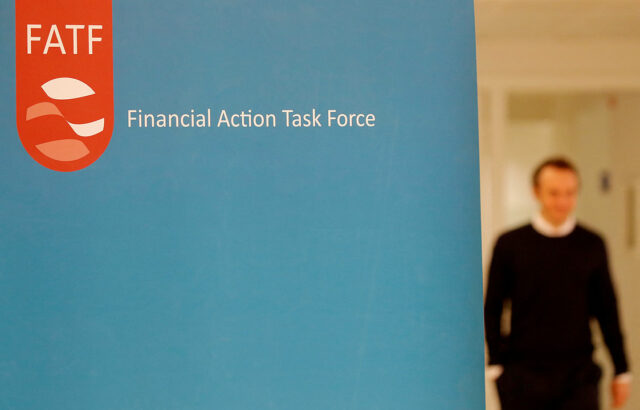
THE LOGO of the Financial Action Task Force (FATF) is seen at the OECD headquarters in Paris, France, Oct. 18, 2019. — REUTERS

THE BANGKO Sentral ng Pilipinas (BSP) will continue to address deficiencies in its efforts against money laundering and terrorism financing as the Philippines remained on the Financial Action Task Force’s (FATF) “gray list,” an official said.   

“We continue to do our usual on-site examination and off-site surveillance to ensure banks’ compliance with the AML (anti-money laundering) law and BSP rules and regulations,” BSP Deputy Governor Chuchi G. Fonacier said in a Viber message.   

In a report released on Saturday, the FATF said the Philippines is still in its gray list of jurisdictions under increased monitoring for “dirty money” risks after failing to address strategic deficiencies against money laundering, terrorist financing and proliferation financing.

The Philippines has been on the gray list since June 2021.

Government officials earlier expressed hope the Philippines can exit the gray list by January 2024. Inclusion in the FATF’s gray list can affect a country’s reputation and investment ratings, as well as limit trade opportunities.

After a three-day plenary session in Singapore, the dirty money watchdog said the Philippines still needs to address five out of the 18 deficiencies in anti-money laundering/combating the financing of terrorism (AML/CFT) controls. 

However, this was an improvement from the eight deficiencies identified by the FATF in June.   

According to the FATF, the Philippines should continue to demonstrate effective risk-based supervision of designated nonfinancial business and professions (DNFBPs) and ensure that supervisors are using the proper AML/CFT controls to mitigate risks associated with casino junkets. 

The Philippines should also enhance and streamline law enforcement agencies’ access to beneficial ownership information and ensure accurate and up-to-date information.   

The country should also increase investigation and prosecution of cases related to money laundering and proliferation financing.

“The FATF urges the Philippines to swiftly implement its action plan to address the above-mentioned strategic deficiencies as soon as possible as all deadlines expired in January 2023,” the global dirty money watchdog said.   

Rizal Commercial Banking Corp. (RCBC) Chief Economist Michael L. Ricafort said there are already some mitigating measures to improve the Philippines’ efforts against money laundering in recent years.

“There may be more documentary requirements for fund inflows into the country such as investment and other remittances, thereby could lead to higher transaction costs and additional time for transaction processing,” he said, adding these could cause some delays in transactions.

Mr. Ricafort said the Philippines could save more time and save on costs if it adopts corrective measures and action plans to exit the FATF’s gray list.

“One reform measure being considered is the lifting of the secrecy on bank deposits, to better align the country’s banking regulations/rules with the rest of Asia and the rest of the world; as well as help in facilitating the country’s integration of its capital markets with the rest of the region,” he said.

The proposed amendments seek to allow the BSP to examine deposits in relation to possible fraud, serious irregularity, or unlawful activity being committed by bank officials.

President Ferdinand R. Marcos, Jr. also gave government agencies until Nov. 30 to address deficiencies in their anti-money laundering strategies in hopes that the Philippines could get out of the gray list by January next year.   

Aside from the Philippines, there are still 22 other countries in the gray list. Albania, Cayman Islands, Jordan, and Panama are no longer subjected to increased monitoring by the FATF. — Keisha B. Ta-asan

Industry group sees fighting chance to hit exports target

REUTERS

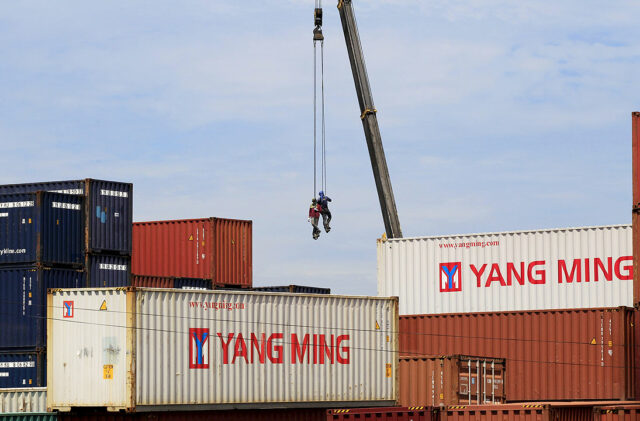
PHILIPPINE EXPORTS are showing signs of a recovery, despite elevated inflation and rising pump prices, an official of the Philippine Exporters Confederation, Inc. (Philexport) said.

“It is recovering, it is going up. Slowly but surely, it is increasing, but not as fast as we would like it to be,” Sergio R. Ortiz-Luis, Jr., president and chief executive officer of Philexport, told reporters last Thursday.

He expressed hope that Philippine exports would achieve the target under the Philippine Export Development Plan (PEDP) 2023-2028. Under the PEDP, the country’s total merchandise and services exports are projected to reach $126.8 billion in 2023.

“I think we should be achieving near to it. I think we have a fighting chance to meet the targets. Although [still] lower than last year, it is increasing now,” Mr. Ortiz-Luis said.

He said the industry now expects to hit its target of $150 billion in export value in three years.

“(Target was moved) because of the challenges that are happening. We did not anticipate the prices of fuel (going up) and although the inflation is going down, it was not as low as what was projected before, which is around 4%,” he said.

Headline inflation quickened to 6.1% in September from 5.3% in August, marking the 18th straight month that inflation exceeded the central bank’s 2-4% target. Year to date, inflation averaged 6.6%. 

The Bangko Sentral ng Pilipinas (BSP) sees average inflation at 5.8% for 2023.

Mr. Ortiz-Luis noted exporters are again facing challenges from rising fuel costs. “We cannot control some of the challenges, for example the fuel cost, we were so happy when it went down, but now, it is going up again.”

Last week, oil companies raised pump prices by P0.95 per liter of gasoline, by P1.30 per liter of diesel, and by P1.25 per liter of kerosene. This brought year-to-date price adjustments as of Oct. 24 to P12.25 per liter for gasoline, P11.70 per liter for diesel, and P7.74 per liter for kerosene.

The Development Budget Coordination Committee is projecting a 1% growth for exports and 2% for imports this year.

In the eight months to August, exports fell by 6.6% to $47.81 billion, while imports dropped by 9.6% to $84.12 billion.

For the first eight months, the trade deficit narrowed to $36.31 billion from the $41.86-billion gap during the same period a year ago. — J.I.D.Tabile

Marcos orders buy-local for infra construction materials

PHILIPPINE STAR/ MICHAEL VARCAS

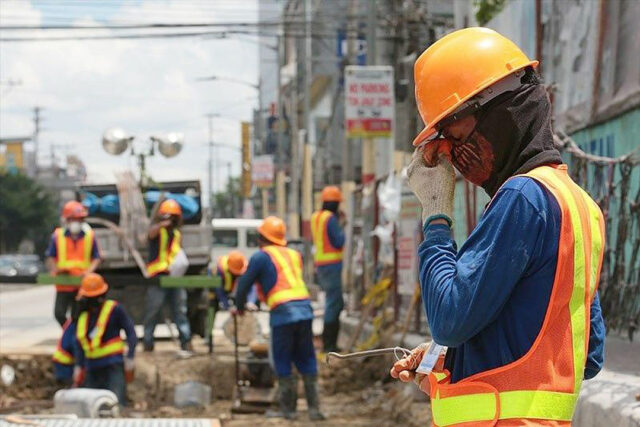
THE PRESIDENT has ordered the Department of Trade and Industry (DTI) to draft a list of construction materials required by the infrastructure program ahead of the imposition of a buy-local policy on such building materials, the Palace said.

President Ferdinand R. Marcos, Jr. was acting on the recommendation of advisors to make domestic building materials preferred for use in the infrastructure program, according to a statement issued by Malacañang.

Following a meeting with the Private Sector Advisory Council’s (PSAC) infrastructure cluster, Mr. Marcos ordered the DTI to compile the list of building materials, in collaboration with the PSAC.

Mr. Marcos also ordered the Department of Budget and Management, through the Government Procurement Policy Board, to operationalize the “policy of giving preference to local materials” through procurement guidelines.

“The chief executive stressed the need to specify which materials will be procured by the government to avoid any conflict in the future,” the Palace said.

The PSAC advised Mr. Marcos that Philippine manufacturers make cement, steel and other building materials that conform with national standards, and are “designed to withstand the country’s climate and other natural disasters.”

“Our advocacy is really to promote our buy local, Filipino-made products for Filipinos,” PSAC head and Aboitiz Group CEO Sabin M. Aboitiz was quoted as saying. “It’s just fair for our government to take the lead in also patronizing our own locally made product.”

Trade Secretary Alfredo E. Pascual was at the meeting, along with PSAC members Joanne De Asis, founder of Globe Capital Partners LLC; Manuel V. Pangilinan, CEO of PLDT Inc.; Eric Ramon O. Recto, chairman of Philippine Bank of Communications, Inc.; Enrique K. Razon, president of International Container Terminal Services, Inc.; Ramoncito S. Fernandez, CEO of Maynilad Water Services, Inc.; and  Reinier H. Dizon, president of the Cement Manufacturers Association of the Philippines. — Kyle Aristophere T. Atienza

BoC counting on yearend surge to beat revenue target

PHILSTAR FILE PHOTO

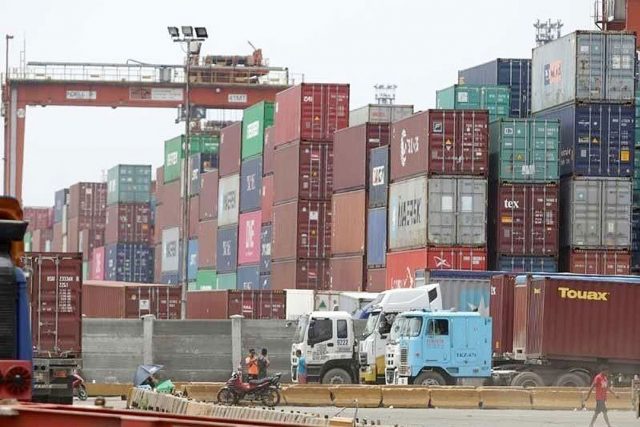
THE Bureau of Customs (BoC) said it expects to exceed its revenue target this year with collections expected to improve in the runup to the holidays. 

On the sidelines of a forum last week, Customs Assistant Commissioner Vincent Philip C. Maronilla told reporters that the BoC is on track to hit its internal projections, which will carry it past its target.

“In fact, our goal is not just to hit that (target). We have an internal goal of trying to hit more than the target. We’re trying to maximize as much as possible the surplus that we want to collect, knowing fully well we’re in the position to contribute more,” he said.

The BoC is tasked to collect P874.166 billion this year.

The Bureau of the Treasury (BTr) reported that Customs collections totaled P660.4 billion in the first nine months, exceeding the goal for the period by 2.52%.

Mr. Maronilla said that the last quarter’s collections are usually strong due to the holidays.

“The ‘-ber’ months (are when) we usually hit our largest surpluses. Historically, November has been very good to us. We’ve hit very large surpluses in November. We’re looking into October and November to help catch up with our internal goal of reaching a certain surplus,” he added.

Mr. Maronilla also noted that the surplus may be “significant” judging from current trends. “Right now, we’re at about a little over P10 billion in surplus from the target set to us for this year,” he added.

Though the BIR has been on track to hit its targets, BTr data indicate that monthly collections have been tracking lower year on year since June.

Mr. Maronilla noted a slowdown in the volume of imports during the period.

“Oil, not just in terms of volume, but sometimes in terms of value, fluctuated as well. Overall, the data would show there might be lower actual collections compared to last year, but then revenue-efficiency wise, we’re still up there,” he said.

Finance Secretary Benjamin E. Diokno has said that declines in the BoC’s monthly results were due partly to the reduction in collection days due to inclement weather.

The BIR loses as much as P3 billion to P4 billion when it misses a day of collection, Mr. Maronilla said.

“When you give us our targets, we compute it per day. If you provide us with three days (of collection) where there’s a holiday or suspension of classes, we might (operate with a skeleton workforce) but the other participants in the release of goods might not be there,” he said.

“We can’t force importers to tell their companies to operate on that particular day. Even if we’re open and some of our stakeholders are not, that really affects our collections,” he added.

Mr. Maronilla said that the agency remains “on track” with its October collection target.

“We have a few more days to go. We’re preparing for some holidays. On Tuesday (Oct. 31) we might get a boost because some might be trying to complete their transactions before the long holidays,” he said.

“As you all know, long holidays translate to no transactions and the longer the holiday is, the cost of their goods being stored in the ports doesn’t lower at all. I hope we get that boost on that day and recover whatever it is we’re going to miss on the previous day,” he added.

Oct. 30 (Monday) was declared a holiday for the Barangay and Sangguniang Kabataan Elections. — Luisa Maria Jacinta C. Jocson

Total electrification by 2028 to require funding of P71.97B — Energy dep’t

THE Department of Energy (DoE) said its various programs aimed at achieving total electrification by 2028 would require funding of P71.97 billion.

In its 2023-2032 National Total Electrification Roadmap (NTER), the DoE said programs such as the stand-alone home system (SAHS) would need P35.818 billion.

SAHS taps renewable energy (RE) coupled with batteries in hard-to-reach areas considered unviable for distribution line connection or microgrid systems.

Distribution line extension will require P35.23 billion, microgrid systems P347.82 million, and household electrification via regular connection P243.98 million.

Of the funding, 96.15% will be allocated to the National Electrification Administration (NEA) to support its Sitio Electrification Program, Barangay Line Enhancement Program, and Photovoltaic Mainstreaming projects.

“Electrification primarily entails providing electricity access to remote and rural areas, often located far from existing urban infrastructure. Notably, a large portion of households without electricity can be found in these remote rural areas, contributing to the country’s poverty challenges,” the DoE said.

It said funding sources include its Total Electrification Program as authorized by Energy Regulations (ER) No. 1-94, as well as NEA programs and the Missionary Electrification Plan of the National Power Corp. (NPC).

ER 1-94 authorizes payments to communities hosting energy sources and energy generating facilities.

As of June, the DoE said household electrification was 91.1% with 25.3 million households served, against the estimated potential households of 27.727 million implied in the 2020 Census of Population and Housing. For the rest of 2023, the estimated unserved households total 2.454 million.

By 2028, households are expected to number 29.475 million.

The DoE said that it has identified 285 unserved areas and 122 underserved areas in off-grid locations will be prioritized for tender to private sector investments through a competitive selection process (CSP).

According to Republic Act No. 11646 or the Microgrid Systems Act, the DoE is required to conduct a CSP for micro grid system providers (MGSP) to serve off-grid areas. The initial auction is expected to be conducted within the fourth quarter while the awarding is targeted by the first quarter of 2024.

The bidding will cover 98 unserved and underserved areas clustered into 49 lots. Some 15,645 households are expected to benefit from the initial auction.

“If there are no participants or no awarded MGSP in the CSP for a particular DoE-declared unserved or underserved area, the NPC shall continue to perform its missionary electrification mandate in the underserved area, considering its AHP (Accelerated Hybridization Project),” the DoE said.

AHP, which utilizes RE sources and technology, allows the private sector to enter off-grid areas and put up RE generation plants or facilities to supplement, augment, or replace the existing capacities of the Small Power Utilities Group’s diesel power plants. — Sheldeen Joy Talavera

Budget to be submitted to Palace by mid-Dec.

BUDGET SECRETARY AMENAH F. PANGANDAMAN — DBM

THE 2024 budget will likely be transmitted to the Office of the President by mid-December, Budget Secretary Amenah F. Pangandaman said.

On the sidelines of an event on Friday, Ms. Pangandaman told reporters that the budget bill will likely be submitted to the Office of the President between Dec. 15 and 20.

“The Senate has finished its committee hearings… hopefully they will transmit it after the (November) holidays. Then, when they resume session, we will have the Development Budget Coordination Committee (DBCC) plenary on Nov. 8,” she said.

The House of Representatives approved the 2024 budget bill on Sept. 27. It is currently being evaluated by the Senate.

Ms. Pangandaman also said she is hoping for an early signing, but deferred to Congress in carrying out its functions.

The P5.786-trillion national budget for next year is 9.5% higher than this year’s budget.

Ms. Pangandaman said that the DBCC will be meeting on Nov. 3 for its last review this year of the government’s medium-term macroeconomic assumptions.

She said increased consumption and spending due to the holiday season are expected to help drive growth.

“(On) our part, at least for the government sector, our figures have been improving since September. I hope that will contribute to our growth and the last quarter of the year; that’s when the agencies spend and our consumption increases because of the holidays,” she said.

Gross domestic product (GDP) grew by a weaker-than-expected 4.3% in the second quarter amid a 7.1% contraction in government spending.

The government is targeting 6-7% growth this year. The economy would need to expand by 6.6% in the second half in order to meet the lower end of the government target.

Third-quarter GDP data will be released on Nov. 9. — Luisa Maria Jacinta C. Jocson