Home Blog Page 4104

Britain brings together political and tech firm leaders to discuss AI

STOCK PHOTO | Image by Rawpixel.Com from Freepik

LONDON — Britain will convene governments, academia and companies working at the cutting edge of artificial intelligence (AI) on Wednesday at the inaugural AI Safety Summit to debate how, and even if, the risks of the technology can be contained.

The meeting is the brainchild of Prime Minister Rishi Sunak, who wants to carve out a role for Britain as an intermediary between the economic blocs of the United States, China, and the European Union.

The 100-strong guest list includes world leaders, tech executives like Elon Musk and ChatGPT boss Sam Altman, and academics for the event at Bletchley Park, home of Britain’s World War Two code-breakers, on Wednesday and Thursday.

Skeptics have questioned how much influence Britain can wield when the United States, the Group of Seven industrialized nations and the European Union are pushing other initiatives, some of which are advanced.

But the summit, which focuses on highly capable general-purpose models called “frontier AI,” has managed to attract US Vice-President Kamala Harris, European Commission President Ursula von der Leyen, China’s vice-tech minister, and United Nations’ Secretary-General António Guterres.

Britain’s technology minister Michelle Donelan said “the right people with the right expertise” would be around the table to discuss how to mitigate the risks of AI.

China will be a key participant, given the country’s role in developing AI technology, although questions have been raised by some lawmakers in Britain about its presence.

The US ambassador to Britain, Jane Hartley, said the AI conversation should be global, but added that the invitation to China had come from London.

“This is the UK invitation, this is not the US,” she told Reuters. “When the UK government was talking to us, we said it’s your summit. So if you want to invite them, invite them.”

Canada’s minister of innovation, science and industry Francois-Philippe Champagne said AI would not be constrained by national borders, and therefore interoperability between different regulations being put in place was important.

“The risk is that we do too little, rather than too much, given the evolution and speed with which things are going,” he told Reuters.

On the agenda are topics like how AI systems might be used by terrorists to build bioweapons and the technology’s potential to outsmart humans and wreak havoc on the world. — Reuters

S&P upgrades Meralco outlook to positive, affirms ‘BBB-’ rating

PHILSTAR FILE PHOTO

S&P GLOBAL Ratings has affirmed its “BBB-” long-term issuer credit rating on Manila Electric Co. (Meralco) with a positive outlook.

“We revised the rating outlook on Meralco to positive from stable,” the credit rating agency said in an e-mailed media release on Wednesday.

A BBB- rating is considered lowest investment grade by market participants, according to S&P.

S&P’s positive outlook on Meralco represents its expectations that the distribution utility’s improving operating performance and clarity on tariffs “could lead to stronger financial metrics over the next 12-24 months.”

“We forecast the company to maintain a healthy ratio of funds from operations (FFO) to debt of 33%-40% over the next two years, above our 30% upside trigger. We expect Meralco to generate steady cash flow from its distribution business, as well as a material earnings recovery in its unregulated power generation business,” the rating firm said.

It expects that the revised contracts of Meralco’s subsidiary, Global Business Power Corp., with its offtakers — which now incorporate fuel pass-through — will mitigate its exposure to volatile prices.

Strong dividends brought about by the utility’s associate/joint-venture companies in the power generation business are also seen to support stronger cash flow over the next two years.

“We see rating upside if the regulatory tariff reset allows Meralco to continue passing through all costs and in a more timely manner,” S&P said.

The Energy Regulatory Commission has said that it has completed the fourth regulatory process (RP) for the National Grid Corp. of the Philippines and plans to initiate the RP for private distribution utilities.

The rating firm also noted that the distribution utility is seen to ramp up its capital expenditure (capex) and investments in power generation assets over the next two to three years due to its “increased appetite” to hold controlling stakes in such assets.

This is compared to its previous preference for holding large equity stakes in joint ventures.

“We expect the company to incur sizable distribution-related growth capex of PHP17 billion-PHP20 billion annually to support network strengthening and asset renewal,” it said.

S&P said it could lower Meralco rating “if the company’s ratio of FFO to debt declines sustainability below 23% or its financial policy becomes more aggressive.”

Meralco’s controlling stakeholder, Beacon Electric Asset Holdings, Inc., is partly owned by PLDT Inc.

Hastings Holdings, Inc., a unit of PLDT Beneficial Trust Fund subsidiary MediaQuest Holdings, Inc., has an interest in BusinessWorld through the Philippine Star Group, which it controls. — Sheldeen Joy Talavera

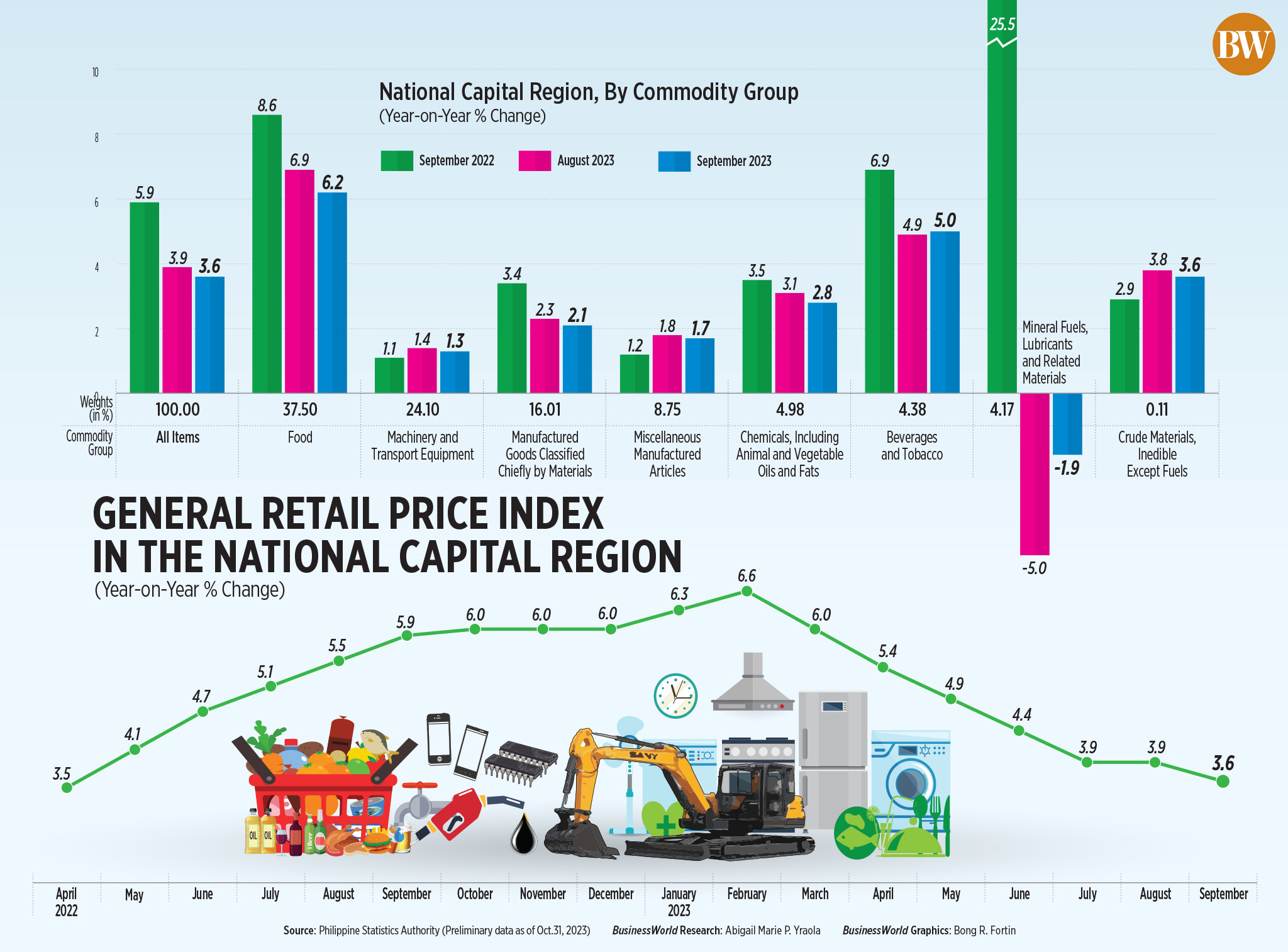
General Retail Price Index in the National Capital Region

RETAIL PRICE GROWTH of general goods in Metro Manila eased to a 17-month low in September, amid the slower annual rise in food costs, the Philippine Statistics Authority (PSA) reported on Wednesday. Read the full story.


General Retail Price Index in the National Capital Region

Drop that hotdog if you value your health

YUHENG CHEN-UNSPLASH

THE HEALTH case against regularly eating red meat keeps getting stronger. At what point is the data convincing enough for Americans to change their diets? One recent study found that eating red meat increases the risk of type 2 diabetes; another paper finds a diet low in meat, sugar, and salt but rich in vegetables and legumes is associated with a lower risk of Alzheimer’s.

And both studies — which followed thousands of people for decades — show that replacing even a few servings of meat can have an impact.

There are also implications here for the legions of people expected to try the new class of obesity drugs called GLP-1s. While studies have shown the drugs can induce enough weight loss to improve cardiovascular and kidney health, a lower body mass index (BMI) doesn’t solve all ills. “Losing weight will not entirely prevent you from developing other chronic diseases. You still have to rely on a healthy diet,” says Xiao Gu, a postdoctoral fellow at the Harvard T.H. Chan School of Public Health.

Mr. Gu is one of the authors of the new study linking red meat to diabetes. His team found that people who routinely consume more than a serving per day of red meat have a 50% higher risk of developing type 2 diabetes than those who partake at lower levels.

More than a serving per day might sound like a lot. But as my Bloomberg Opinion colleague Mark Gongloff recently pointed out, Americans are among the world’s most voracious meat eaters, with each person consuming an average of 280 pounds per year, which amounts to about three servings a day.

That meat-heavy diet comes at a clear cost to our climate, as livestock farming is responsible for some 18% of global greenhouse gas emissions. And it is clearly bad for our hearts; the greater a person’s red meat consumption, the greater their risk of cardiovascular disease.

But the link to type 2 diabetes has been a subject of ongoing debate. Some research suggests various components of meat can impair insulin function, whether the culprit is saturated fat, the meat’s iron content, or something in how the meat is prepared — grilling, curing, and overcooking have all been associated with poorer health outcomes. However, causation has been hard to prove: One recent meta-analysis found the link between saturated fat in red meat and diabetes tenuous at best.

Diet’s impact on health is also notoriously hard to study. What we eat changes over time and is just one factor affecting our risk of developing a disease — our genes, environment and lifestyle matter, too, as do socioeconomic factors.

The Harvard team took special care to account for those confounders. They used data from the Nurses’ Health Studies, which have followed more than 200,000 health care professionals for more than 40 years. That meant enough cases of diabetes had accumulated — more than 20,000 — to find the association between meat consumption and diabetes. And because volunteers were interviewed every two to four years, researchers had good information about how participants’ diets changed over time; by contrast, many other studies have only looked at diet at the time a study began.

One of the biggest confounders they had to untangle was body mass index (BMI). If people who eat a lot of red meat eventually gain weight, it could be their weight — not the meat — that leads to insulin resistance. But the researchers found that BMI only accounts for about half of the increase in risk. That means that red meat increases diabetes risk even for people who aren’t overweight. And processed meat — like sausage and salami — increased diabetes risk the most.

If that isn’t enough to convince you to cut back on meat, consider another new study. This one, which mined data from the NYU Women’s Health Study, found that people who ate more red meats, sugar, and full-fat dairy had a higher risk of Alzheimer’s disease.

Between 1985 and 1991, researchers enlisted some 14,000 middle-aged women and followed up with them for decades. Using data from about 5,000 women in the cohort, they found that people adhering to the “DASH” diet (shorthand for Dietary Approaches to Stop Hypertension) had a 17% lower risk of developing two or more cognitive issues later in life. In other words, a heart-healthy diet favoring plant-based foods fared better than those who consumed more red meat, sodium, and sweets.

The NYU team’s findings suggest the dietary choices made in midlife have a far-reaching impact on women’s health, whether it protected (or harmed) their heart or their brain, says Yu Chen, a chronic disease epidemiologist at NYU Langone who led the study.

Both studies do have some limitations. The Harvard study’s dataset is predominantly White women; the NYU study was more diverse but measured cognitive challenges across a short time frame — more follow up would better capture changes in brain health.   

But the take-away from both studies is clear. Your health will be better if you swap some lentils for that steak. — Bloomberg

Spot bitcoin ETFs aim to whip up US demand

ALEKSI RAISA-UNSPLASH

BITCOIN, the original crypto rebel, is racing into the heart of the financial establishment with an exchange-traded fund (ETF) that tracks its price. But will it strike gold?

The world’s biggest cryptocurrency has leapt 28% in October, with investors betting US regulators will give the green light for a spot bitcoin ETF and thereby unleash a new wave of demand.

How much cash could such a fund reel in, though?

Well, it’s hard to say, judging by the wide assortment of estimates from market players, ranging from $3 billion on its first day to $55 billion over five years.

“The analogy that I’m looking at is to gold,” said Dave Mazza, chief strategy officer at ETF provider Roundhill Investments, adding that the gold market had been transformed by the approval of spot ETFs.

He said he expected the first spot bitcoin ETFs on the scene to see a “wave of buying,” echoing the launch of the first-ever gold ETF in 2006 in the US or the bitcoin futures ETF in 2021.

Mainstream investment giants such as BlackRock and Fidelity, as well as crypto-focused firms like Grayscale, have filed applications for spot bitcoin ETFs.

Ranged against the ETF optimists are those traditional investors long wary of crypto who say they won’t be won over by new investment vehicles.

“Not a penny of my clients’ money will find its way into these misbegotten so-called investments,” said George Gagliardi, an investment advisor with Coromandel Wealth Management in Lexington, Massachusetts, who believes cryptocurrencies “have no underlying intrinsic value.”

The prospect of an ETF that offers investors direct exposure to bitcoin has nonetheless buoyed the price of the cryptocurrency, which hit $35,198 last week, its highest level since May 2022.

The metrics investors and analysts use to come up with estimates for demand for an ETF, from the size of the gold ETF market to demand for existing products, vary almost as much as their conclusions. Bitcoin markets are also opaque, with price moves driven mostly by investor sentiment.

US crypto firm NYDIG estimates demand for a spot bitcoin ETF at around $30 billion. Their calculation compares the sizes of the gold and bitcoin ETFs — $210 billion versus $28.8 billion, respectively — and adjusts them for their relative volatility.

“It’s rare to see a brand-new asset class arrive on the ETF market,” said Todd Sohn, ETF strategist at Strategas Securities. “That makes it tough to figure out exactly how much demand is going to materialize.”

Steven McClurg, investment chief at Valkyrie Funds, which has applied for a spot bitcoin ETF, believes one starting point in gauging demand is the size of the Grayscale Bitcoin Trust (GBTC), an open-ended private trust that owns bitcoin directly.

“If you look at the current market capitalization of GBTC — $3.2 billion — that’s probably day-one demand” for a spot bitcoin product, he said.

HALF OF FUNDS ‘GONE IN TWO YEARS’
Some advocates say that financial advisers, pension funds and other money managers — a pool of capital estimated to total around $46.5 trillion by Boston Consulting Group — could be a significant source of demand for a spot bitcoin ETF.

“If BlackRock reaches the market then some percentage of the wire houses and financial advisers will add their fund to platforms,” said Matthew Sigel, head of digital assets research at VanEck, which has a spot bitcoin ETF awaiting SEC approval.

Matthew Hougan, CEO of crypto firm Bitwise Investments, said in an industry panel earlier this month that he expects spot bitcoin ETFs to pull in $55 billion in their first five years. His forecast is based on how demand evolved in smaller markets where spot bitcoin ETFs already exist, such as Canada.

However large demand turns out to be, it is unlikely to sustain offerings from all the asset managers vying for a slice of the action, said Steve Sosnick, chief strategist at Interactive Brokers.

“Are all of them going to be a success? Of course not,” he added. “The ones with the best marketing will succeed, but half will be gone within two years.” — Reuters

How was the service?

FREEPIK

CUSTOMER FEEDBACK is part of the marketing process. Most companies want to know how the customer finds the product or service, and how he can be served better, preferably at no additional cost.

Restaurants routinely solicit customer comments. The waitress looks sheepish when handing out the small card with the questions. She knows she is intruding on someone trying to get further into a conversation with a lunch mate on the possibilities of dessert somewhere else. But she has a job to do.

A short pencil with no eraser is provided for the feedback exercise, ensuring that no one is going to pocket a thin unbranded piece of wood, even as a souvenir. The form includes far-fetched questions like where one has heard of the restaurant — was it online? Maybe, the answer is not among the choices — I just walked in from the rain. Such honest answers are seldom among the multiple choices for checking.

Most questions involve product quality (Did your salad come with the dressing?) or speed of delivery (Did your order arrive before your vacation leave expired?). Another category may involve the menu (Did we offer enough healthy choices for you?).

What happens to these customer feedback forms?

Not everybody is willing to spend five minutes to complete a survey form. The customer came to eat. He orders what he wants from the menu (Sir, we don’t have tripe today). He expects to be served, left alone to eat in peace, chat with his companions, pay his bill, and get on with the rest of his day — what time’s the next meeting?

So, who fills up these forms? They fall into three categories: a) those with time on their hands waiting for a meeting at 3 p.m.; b) those who are unusually peeved by the service and the type who writes letters to the editor on the long lines at the airport; and c) those with a perverse sense of humor. So, here you have what statisticians call a biased sample. Those who have blogs and consider themselves “influencers” will reserve their comments for their posts, usually nasty. And they don’t even have any followers.

Do the store managers look at these comments? One can only surmise the tug of war between propriety (Top management must see this?) and job security (This will affect my rating). Guess which side of the rope wins this tug of war. So, what percentage of the forms actually reach market research as part of customer feedback? Are they sent in their original form? Are there ghost survey respondents? The introduction of digital feedback using the mobile phone and a QR code may have improved the feedback system and avoided the removal of the negatives. But the process just becomes more tedious for the respondent.

Hostile reactions, such as food poisoning in a restaurant or an unauthorized debiting of an online bank account from an ATM withdrawal that did not give out the requested cash, are handled differently. Customer complaints or negative feedback are dodged by on-premises staff — “Sir, here’s the number to call for your complaint.” It’s called a “hot line.”

Companies are shifting to chat bots or AI programs to handle queries and complaints. This makes the exchange less emotional. Presumably, the remedies are handed down the line for the concerned departments to fix. Robots have no feelings and do not stress out like real people (Please don’t shout at me). But how do customers feel when they talk to some disembodied voice (Can you say that again?)?

The important insights from customer feedback are those not found in the form, simply because those who have not eaten in the restaurant (or bothered filling up) are unaccounted for. The nonrespondents, who are part of the target market, are missing in any survey.

Customer feedback as a basis for retaining customers, or even adding new ones, has limitations. Maybe the old-fashioned way of physical observation by the owner or manager of customer reactions to slow delivery of food from the kitchen or the walking out of already seated patrons can be more informative. The routine dropping-by of the store manager surely helps — How was the service? And hope they come back for more.


Tony Samson is chairman and CEO of TOUCH xda

ar.samson@yahoo.com

Experts: Digitalization shift should start with local governments

TRUSTPAIR.COM

THE DIGITALIZATION of industries and public services should start from local government units (LGUs), experts at a forum held by the US Agency for International Development (USAID) last week said.

LGUs, even the small ones, have been receptive to the shift to digitalization, Dragonpay founder and CEO Robertson Chiang said in an interview at the sidelines of the forum.

“It could be done. It’s really just the political will of the mayor if they want to do it or not,” he added.

Government services, including the payment of taxes and documents, should be done digitally to help cater to overseas transactions from Filipinos working abroad, Mr. Chiang said.

“We would want LGUs to have a system that can be accessed by their citizen through the Internet. They should be able to view anything from their property taxes to business permits online,” he added.

Meanwhile, Vice Catudio, chief of party of USAID SPEED or Strengthening Private Enterprises for the Digital Economy Activity, said the shift to digitalization starts with educating LGUs on technology.

“By educating our LGUs and teaching them about technology and what technology can do, I think a lot of our LGUs will shift to digitalization,” he said in his speech.

Aside from using digital payments in government transactions, for their part, digitalizing Halal goods and services is necessary to the development of the Bangsamoro region, Dato’ Abdul Malik Melvin Castelino bin Anthony, ambassador of Malaysia to the Philippines, said in his speech at the event.

“The Philippines has a strong ecosystem that can support it (Halal economy),” he said. “The collaboration between private and public sectors is crucial because the government may no longer rely on their own funding or their own manpower to achieve the objective and target in terms of development.” 

“I encourage LGUs to look at this concept in a more structured manner… Halal economy is not only meant for Muslims. It is meant for every aspect of the population… Halal constitutes a clear example or clear channel for us to develop the economy there (Bangsamoro region),” Mr. Castelino added. — J.R. Paguian

First Gen renews power contract with Silliman University

FIRST GEN Corp. has renewed its retail electricity contract with Silliman University (SU), agreeing to supply up to 2.5 megawatts (MW) of renewable energy, the company announced on Wednesday.

In an e-mailed statement, First Gen said that its renewable energy arm Energy Development Corp. will supply the university’s power needs, providing 2.1 megawatts (MW) in the first year, 2.3 MW in the second year, and 2.5 MW in the final year.”

First Gen and SU had their first contract covering the periods 2021-2022 and 2022-2023.

“More than the savings generated by our switch to renewable energy, what is more compelling is our contribution to a ‘decarbonized and regenerative future,’” said Jane Annette L. Belarmino, SU’s vice-president for development, enterprise, and external affairs.

“To concretize this, with just a year’s use of renewable energy from 2020-2021, we were able to prevent an equivalent of 974.5 tons of carbon dioxide from going into the atmosphere,” she added.

First Gen is targeting to grow its renewable energy portfolio to up to 13 gigawatts (GW) by 2030 from the current capacity of more than 3.4 GW.

“We hope that besides supplying you with renewable energy, we can explore projects with your students that we can partner with, as well as provide energy solutions that can help with SU’s energy efficiency,” said Arlene Soriano, First Gen’s power marketing and sales head. — Sheldeen Joy Talavera

October PSEi drops on rate woes, Middle East war

BW FILE PHOTO

PHILIPPINE SHARES dropped month on month in October as concerns over monetary tightening, the conflict in the Middle East and a surge in US Treasury yields affected market sentiment.

The Philippine Stock Exchange index (PSEi) closed at 5,973.78 on Oct. 31, the last trading day of October, down by 347.46 points or 5.5% from its Sept. 29 finish of 6,321.24.

For the year so far, the benchmark index has declined by 9.02% from its Dec. 29, 2022 close of 6,566.39.

“It was an October to forget in the PSE as the benchmark index posted its lowest close so far this year. Risk sentiment was drained by a mix of economics and geopolitics, especially surging US Treasury yields, the Israel-Hamas war, and a more hawkish BSP (Bangko Sentral ng Pilipinas),” China Bank Capital Corp. Managing Director Juan Paolo E. Colet said in a Viber message.

The PSEi closed at 5,961.99 on Oct. 27, its worst finish so far this year, after the BSP fired off an off-cycle 25-basis-point rate hike due to growing inflationary pressures. The increase came ahead of the Monetary Board’s scheduled meeting on Nov. 16.

Meanwhile, armored Israeli forces attacked the Gaza Strip’s main city from two directions on Monday and targeted the main road linking it to the south of Gaza, witnesses said, drawing more international appeals for Palestinian civilians to be protected, Reuters reported.

Israel said its forces freed a soldier from Hamas captivity, one of 239 hostages Israel says were captured on Oct. 7 by Hamas gunmen from Gaza who rampaged through southern Israeli communities, killing over 1,400 people.

US Treasury rates have climbed due to the war as investors flocked to safe havens.

China Bank Securities Corp. Research Director Rastine Mackie D. Mercado attributed the PSEi’s decline to the “uptick in inflation and inflation expectations as upside risks continued to materialize.”

“We also generally saw lackluster volumes accompanying the sell-off, which gives us the impression that the market decline was likely exacerbated by the lack of buying appetite amid elevated selling pressure,” Mr. Mercado said in an e-mail.

For this month, investors are expected to remain on the sidelines amid the ongoing conflict in the Middle East, but a rebound is likely as shares have reached oversold levels, Globalinks Securities and Stocks, Inc. Senior Trader Mark V. Santarina said in a Viber message.

“Local investors are also hopeful for a year-end Santa Claus rally,” Mr. Santarina said.

“However,… it also remains possible that the market will test the 5,830 level prior to a bounce, especially given the lack of positive catalysts and tepid buying appetite.” China Bank Securities’ Mr. Mercado said.

The market’s direction will “largely depend on the monetary policy stance of the Federal Reserve and BSP, the impact of the Middle East conflict on oil prices, and the quality of third quarter corporate earnings reports,” China Bank Capital’s Mr. Colet added. — S.J. Talavera with Reuters

143 Filipinos want to return home from Israel

A view shows houses and buildings destroyed by Israeli strikes in Gaza City, Oct. 10, 2023. — REUTERS

AT LEAST 143 Filipinos in Israel want to come home amid the worsening war the Hamas militant group, the Department of Foreign Affairs (DFA) said on Wednesday.

About 120 Filipinos have been repatriated.

“The numbers vary by day, and this is according to the numbers of our Migrant Workers office there,” Foreign Affairs Undersecretary Jose Eduardo A. de Vega told CNN Philippines. “There will be another batch coming this week, and they will be repatriated continuously.”

Mr. De Vega said two Filipinos were still missing in Israel, which is still under Alert Level 2.

The Philippine envoy said they likely had been kidnapped by the Palestinian Islamists.

Israel launched extensive airstrikes in Gaza after Hamas militants backed by a barrage of rockets stormed from the blockaded Gaza Strip into nearby Israeli towns, killing 1,400 people, mostly civilians, in a surprise attack on Oct. 7.

Israel has also enforced a blockade and deployed tens of thousands of its troops for a ground assault on the Palestinian enclave.

Mr. De Vega said 126 of the 136 Filipinos in Gaza, which is under Alert Level 4 for forced repatriation, have been marked safe. DFA lost communication with them last week, and 10 Filipinos in Gaza were still unreachable, he added.

“On Sunday morning (Oct. 29), little by little, we’ve been able to contact them again but only limited,” he said.

There are 57 Filipinos at the Rafah Border Crossing looking to cross into Egypt, he said, citing a decrease from the 78 reported a week earlier. He said some Filipinos stopped waiting by the border and have gone to southern parts of Gaza.

“The word is the Egyptians are getting ready to accept wounded or injured Palestinians, and we trust that foreign nationals are to follow,” Mr. De Vega said. “Hopefully we will start getting our countrymen to cross by the weekend, but it’s up to Egypt.”

The Rafah border crossing between Gaza and Egypt has opened for the first time since the Israel-Hamas war erupted, Al Jazeera reported. As many as 500 foreign nationals and a number of injured Palestinians needing medical treatment in Egypt would be allowed to leave the enclave, it said.

Two Filipino doctors working with Doctors Without Borders were among the foreigners who had been allowed to leave Gaza and cross to Egypt, Mr. De Vega said in a WhatsApp message.

More than 7,000 people have died in Gaza and the death toll continues to rise amid Israeli airstrikes, according to Palestinian authorities.

A ground invasion of Gaza has become more imminent after the Israeli military issued an “urgent plea” at the weekend for Palestinians to head south immediately as it vowed to neutralize Hamas militants.

The Philippines was one of 45 countries that abstained from a United Nations (UN) resolution passed last week calling fora sustained and immediate “humanitarian truce” in Gaza. The United States and Israel voted no to the resolution, which was drafted by a group of 22 Arab countries.

Mr. De Vega said the Philippines wanted the UN resolution to paint a more accurate picture of the Oct. 7 attack and armed conflict.

“We wanted something which would be more balanced and reflective of the actual situation in the area,” he said.

“Nevertheless, we did read an after-vote statement wherein we said we support the elements of the resolution like humanitarian assistance and following international humanitarian law.”

The UN resolution is nonbinding, but serves as a barometer of global opinion as fighting between Israel and Hamas nears the end of its third week.

The UN General Assembly voted after the UN Security Council failed to act over two weeks, with the US and Russia using their veto powers to block proposals supported by the other.

The adopted resolution calls for an “immediate, durable and sustained humanitarian truce leading to a cessation of hostilities” and “firmly rejects any attempts at the forced transfer of the Palestinian civilian population.” — John Victor D. Ordoñez

48% of Pinoy families feel poor, according to SWS

PHILIPPINE STAR/ MICHAEL VARCAS

By Kyle Aristophere T. Atienza, Reporter

ALMOST HALF of Filipino families said they were living in poverty, with 1.8 million families considering themselves “newly poor,” according to a Social Weather Stations (SWS) poll.

The number of self-rated poor families rose by 700,000 to 13.2 million in September, or 48% of the total,  SWS said in a statement on Wednesday. In June, 45% of Filipino families considered themselves poor.

The significant increase in the self-rated poor figure by SWS was likely driven by soaring prices that have reduced people’s purchasing power, Michael L. Ricafort, chief economist at Rizal Commercial Banking Corp., said in a Facebook Messenger chat.

“The continued adverse effects of the pandemic since the first quarter of 2020 also somewhat reduced people’s earnings,” he said, adding that the pandemic has also led to business closures, which reduced livelihood opportunities.

He also attributed the increase in self-rated poverty to economic decline in other countries including the United States, “amid aggressive interest rate hikes since 2022 in an effort to better manage inflation risks.”

Self-rated poverty increased in all areas especially in the southern Philippine region of Mindanao, where it rose to 71% from 54%, SWS said. It also rose in Metro Manila to 38% from 35%. The rate fell in Luzon areas outside Metro Manila to 35% from 39%.

The government seeks to reduce the poverty rate to 16.4% this year, to 13.2% by 2025 and to 9% by 2028 under the Philippine Development Plan, from 18.1% in 2021.

The Philippine central bank last week hiked the key interest rate by 25 basis points (bps) to a fresh 16-year high of 6.5% in an off-cycle move. This has brought the rate increases to 450 bps since May 2022.

The central bank expects average inflation to settle at 5.8% this year before easing to 3.5% in 2024 and 3.4% in 2025.

“The declining economic growth is one of the causes as opportunities for generating incomes are lower today than before,” Leonardo A. Lanzona, who teaches economics at the Ateneo de Manila University, said in a Facebook Messenger chat.

“However, a crucial factor is inflation because even if one is able to maintain one’s income over time, their real value has declined,” he added.

Philippine inflation rose to 6.1% in September from 5.3% in August amid a double-digit increase in rice prices.

The Philippine economy expanded by 4.3% in the second quarter, the slowest in two years. The country’s economic output averaged 5.3% in the first half, which was below the government’s 6-7% target for the year.

Mr. Lanzona said the monthly poverty threshold used to measure poverty rates in 2021 was roughly P12,000 for a family of five, which was “obviously not enough in meeting basic needs this year.”   

“In effect, many of the economic achievements intended for raising social welfare cited in the state of the nation address this year are now proven to be false,” he said. “In effect, the government is not doing enough to reduce poverty, thus moving the country away from development.”

President Ferdinand R. Marcos, Jr. took charge of the Agriculture department in July last year, promising to boost the country’s food security amid rising prices spurred by Russia’s invasion of Ukraine.

More than a year later, the country continues to struggle with rising prices, with rice inflation hitting a 14-year high last month. Mr. Marcos enforced a rice price ceiling on Sept. 5, limiting the commodity’s price to P41 a kilo for regular milled rice and P45 for well-milled rice.

The ceiling was lifted on Oct. 4, and critics have said it did not help bring down prices.

The President’s trust rating fell by three points to 73% in the third quarter from a quarter earlier, the Octa Research Group said on Monday. His approval rating also declined by 6 points to 65%.

SWS interviewed 1,200 Filipino adults for the poll, which had an error margin of ±2.8 points.

Philippines urged to fast-track grave threat case vs Duterte

RODRIGO DUTERTE — PRESIDENTIAL PHOTO/ ROBINSON NIÑAL

THE INTER-PARLIAMENTARY Union (IPU) has called on the Philippine government to speed up a congressman’s grave threat complaint against ex-President Rodrigo R. Duterte.

“The governing council of the Inter-Parliamentary Union demands that, in light of the serious concerns arising from this situation, the treatment of Ms. Castro’s complaint will proceed speedily,” it said in a decision adopted on Oct. 27.

Mr. Duterte had “directly threatened” Party-list Rep. France L. Castro’s life on air, which may discourage lawmakers from “speaking out on important matters and put their lives at significant risk,” the IPU said.

Harry L. Roque, Mr. Duterte’s spokesman, did not immediately reply to a Viber message seeking comment.

Ms.  Castro on Oct. 24 filed a criminal complaint against Mr. Duterte for allegedly threatening to kill her in a TV interview.

He said had told his daughter, Vice-President Sara Duterte-Carpio, to say that she would use her intelligence funds to kill Maoists in Congress including Ms. Castro.

“Your first target in your intelligence fund is France, the communists, whom you want to kill,” he said in Filipino.

Ms. Castro accused Mr. Duterte of violating Article 282 of the Revised Penal Code, which punishes offenders with up to six months of jail time and a P100,000 fine. The complaint was also in relation to section 6 of the Cyber-crime Prevention Act, which could get the penalty a degree higher — a jail term of up to six years with a P100,000 fine.

Ms. Castro, a member of the House minority, had criticized Ms. Duterte-Carpio’s proposed P650-million confidential funds for next year.

The vice-president had sought P500 million in confidential funds for her office and another P150 million for the Education department, which she also heads.

Ms. Castro also questioned Ms. Duterte-Carpio’s confidential funds worth P125 million that she allegedly spent in less than a month last year.

Philippine congressmen on Oct. 10 stripped several agencies including the Office of the Vice President and Education department of their confidential funds, transferring P1.23 billion worth of these budgets to security agencies amid worsening tensions with China.

The IPU also questioned the validity of a 2018 child abuse case filed against Ms. Castro and former congressman Satur Ocampo in connection with the evacuation of 14 students of Salugpungan Learning Center, a Lumad school shuttered by the Education department that year.

“It fails to understand at the present time how she could stand accused of the crime of child abuse,” the IPU said. The trial dates before the Tagum City Prosecutor’s Office in Davao del Norte are scheduled for Nov. 15 and 22.

Ms. Castro last month said the city prosecutor dismissed the kidnapping and human trafficking charges in connection with the children in 2019. — Beatriz Marie D. Cruz

ADVERTISEMENT
ADVERTISEMENT