Home Blog Page 4033

The Crown aims to depict Princess Diana’s final days with dignity

ELIZABETH DEBICKI, portraying Princess Diana, in a scene from The Crown. — IMDB

LOS ANGELES — For Elizabeth Debicki, portraying Princess Diana on The Crown for two seasons created a sense of responsibility to be as authentic as possible for the many people who revere the British royal family.

“There is a profound sense of tragedy that lives in your body when you play that part of the story,” Ms. Debicki told Reuters in an interview. “But having watched it, which I recently did, and while the credits are rolling, I thought this was a really serious thing that we put on the screen.”

The two-part sixth, and final, season of The Crown explores Princess Diana’s final days before she perishes in a car accident in 1997. It premieres on Netflix on Nov. 16.

As a historical drama, the Emmy-winning drama series created by Peter Morgan seeks to tell the story of Queen Elizabeth’s reign against the backdrop of various royal dramas.

Ms. Debicki believes it’s a common experience for The Crown actors to struggle to “let go” and stop “observing” themselves while filming the show.

The pressure of capturing the British royals is intense, especially when depicting the loss of a princess to whom many people still feel connected, she said.

“Yeah, we left all the pieces of ourselves up there on the screen, because it deserves nothing less than that,” Ms. Debicki said.

Similarly, Khalid Abdalla — who portrays Dodi Fayed, Egyptian billionaire Mohamed al-Fayed’s son, who was in a romantic relationship with Princess Diana — viewed his work with Ms. Debicki as a huge responsibility.

“The process of doing it together has been everything that you would wish for in collaboration,” he said, referring to working with Ms. Debicki.

He went into the final season also thinking about how the loss of Princess Diana is still a “cultural trauma” for “millions of people around the world.”

Mr. Abdalla said the sacredness of what The Crown cast was recreating was something to which he wanted to give dignity. — Reuters

Vista Land’s net income increases 70% as real estate segment boosts revenues

VILLAR-LED property developer Vista Land & Lifescapes, Inc. (VLL) posted a 70% increase in its nine-month net income on the back of higher revenues led by its real state segment.

In a stock exchange disclosure on Thursday, VLL said its net income for the January-September period climbed to P8.2 billion from P4.82 billion.

The company’s consolidated revenue improved 18% to P27.4 billion. Its real estate revenue rose 17% to P12.2 billion. It said rental income hit P11.8 billion, without giving a comparative figure.

Earnings before interest, taxes, depreciation, and amortization improved 21% to P15.2 billion while core net income, excluding the gain from insurance proceeds, increased 30% to P6.8 billion. 

As of end-September, VLL launched 27 projects valued at about P40 billion.

VLL Chairman Manuel B. Villar, Jr. said the company is anticipating a boost in its commercial centers as well as residential sales amid the approaching holiday season. 

“With the holiday season approaching, we eagerly anticipate welcoming an increased number of customers to our commercial centers as well as our overseas Filipinos coming home during the holidays which bodes well for our residential sales,” Mr. Villar said.

Mr. Villar added that VLL has launched more projects this year, which increased reservation sales by 10% to P53.1 billion for the nine-month period.

“We are delighted with our results, as we remain optimistic with the industry for the rest of the year with the strong gross domestic product (GDP) growth of 5.9% coupled with sustained growth in overseas Filipino remittance and revenge spending from consumers, all of which contributed to the positive performance of the group,” Mr. Villar said.

Meanwhile, VLL President and Chief Executive Officer Manuel Paolo A. Villar said the company’s leasing portfolio has already exceeded the pre-pandemic level in terms of foot traffic.

VLL’s portfolio spans over 1.6 million square meters of gross floor area across 45 malls, 56 commercial centers, and seven office buildings.

Mr. Villar added that VLL’s land bank currently spans more than 3,085 hectares across the country.

“The demand for our residential developments, spanning both horizontal and vertical segments, remains robust and sustained, with the strong interest from overseas Filipino buyers, constituting approximately 60% of our total sales,” Mr. Villar said. “Our strategic approach to maximizing prime land is actively underway, with the continuous launch of Vista Estates nationwide.”

“We are consistently enhancing our residential business by offering more vertical and upscale projects, while our leasing sector is maintaining its growth trajectory for the period,” he added. 

VLL is engaged in the residential and commercial property development businesses through six distinct business units consisting of Camella Homes, Communities Philippines, Crown Asia, Brittany, Vista Residences, and Vistamalls.

On Thursday, shares of VLL at the local bourse closed unchanged at P1.62 apiece. — Revin Mikhael D. Ochave

Statement of Saul Hofileña, Jr.

THIS statement concerns the recent news reports about me in relation to the Resolution of the Third Division of the Supreme Court in G.R. No. 215121 dated June 23, 2021.

Almost 18 years ago or on Jan. 5, 2006, the Doctor conducted an arthroscopy operation on my left knee which led to an infection. The infection was exactly in the same site where the arthroscope which was used in the operation was inserted. Twenty-eight days later or on Feb. 2, 2006, the infection was surgically removed by another doctor. Surgical removal was necessary because the infection was already widespread. I then had another operation on June 7, 2006, because of a locked wrist which I suffered because I was using a cane when I am not on my wheelchair. More than one year later, on June 20, 2007, I had yet another operation to remove the scar which formed inside my left knee which resulted from the removal of the infection. This last operation was not included in my complaint because it was performed more than a year after its filing.

I was bound to a wheelchair for almost two years and had to use a cane when I had to walk out of necessity. I also underwent physical rehabilitation for three years. The second, third and fourth operations were performed in St. Luke’s Medical Center, Quezon City, unlike the very first operation which was performed in another hospital. More than a dozen doctors who graduated from the University of the Philippines helped me in my predicament. What they did was nothing short of a miracle because I thought that I will never walk again, and I was only 46 years old at that time and now I am 64 years old. For more than two years, pain was my constant companion. My reward for bearing pain was pain.

I will always be grateful to St. Luke’s Medical Center, to my wife who is also a physician, and the doctors and other medical personnel who helped me during those trying times.

G Summit 2023 empowers businesses in achieving sustainability, resiliency

Globe Business, the arm of Globe Telecom that supports businesses of all sizes, recently held its G Summit 2023 with the theme “Phase: Forward” at the Manila Marriott Grand Ballroom.

G Summit 2023 brought together industry leaders, entrepreneurs, and experts to share best practices and insights on digital transformation, providing re-evaluation of business practices, agile business models, customer-focused decision-making, and long-term business resilience.

Vice President and Head of Globe Business KD Dizon

Recognizing the current state of the Philippine economy and its impact on the average Filipino, KD Dizon, Vice President and Head of Globe Business, rallied the summit attendees to a mission, “This puts the onus on us, business, and policymakers to work together to overcome present-day challenges and capitalize on the opportunities that our country and economy are facing,” adding emphasis on the need to re-evaluate their practices urgently to assure business sustainability and resilience.

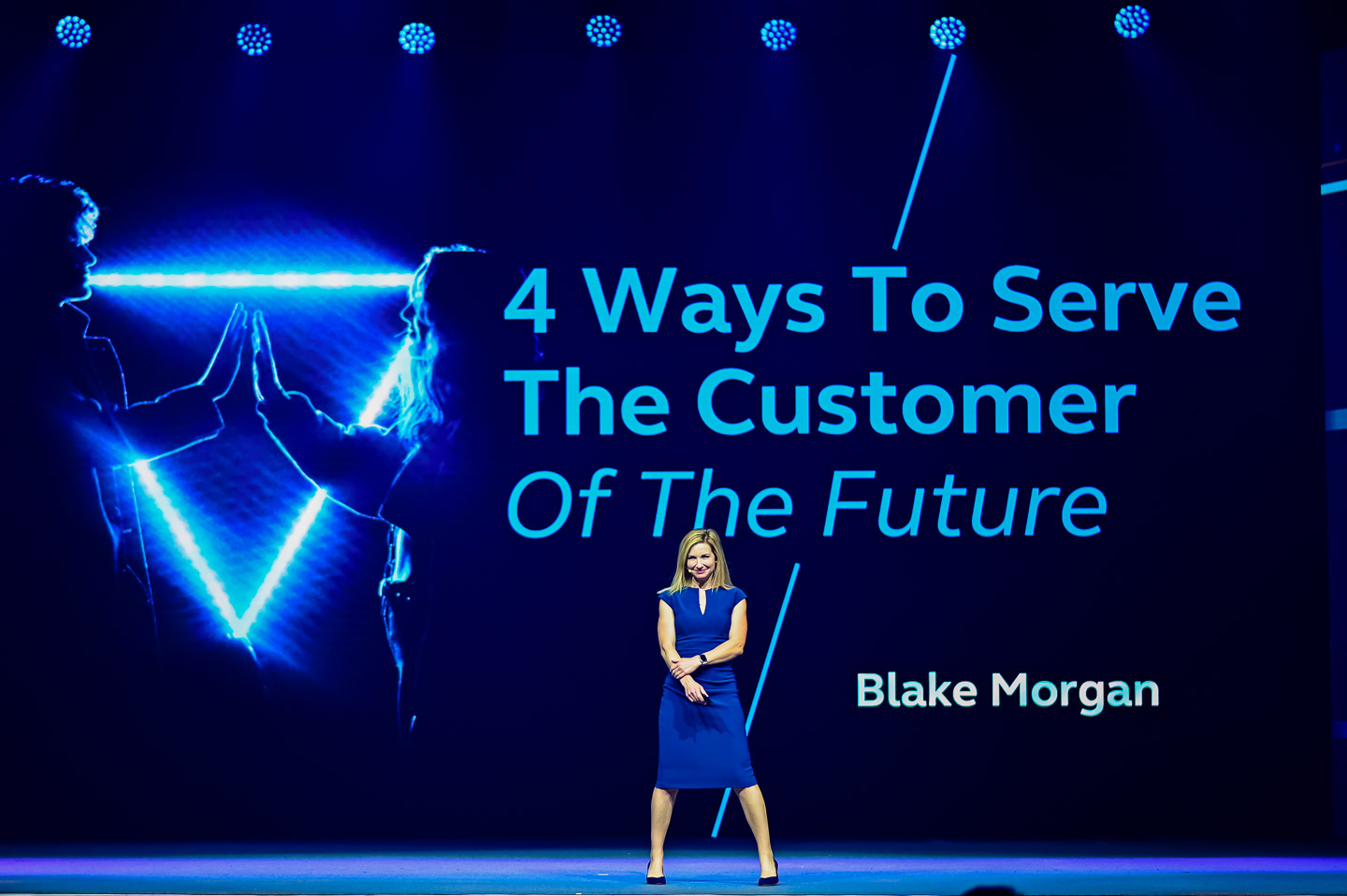
Blake Morgan

Speakers during the G Summit included Blake Morgan, Customer Experience Futurist; Josiah Go, Chairman and Chief Innovation strategist of Mansmith & Fielders, Inc.; Ms. Dizon of Globe Business; and Pia Gonzalez-Colby, Chief Marketing Officer of Globe Telecom.

The event kicked off with a CEO Breakfast, where executives had the opportunity to network and discuss key issues in the business and economic landscape.

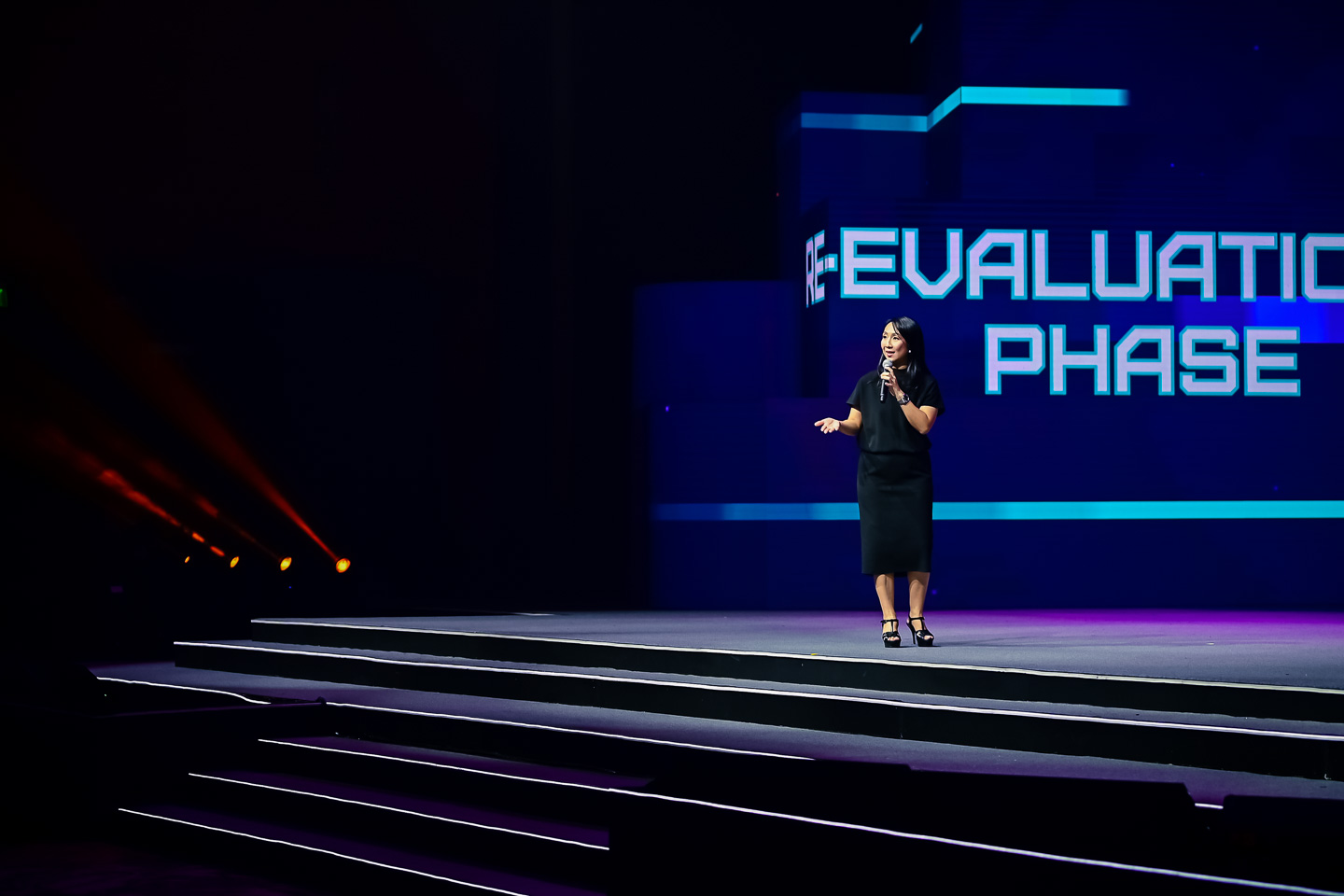
Ms. Dizon started the plenary sessions with a discussion on the “Re-evaluation Phase: Revisiting Business Practices.” She emphasized the importance of urgently and strategically reviewing business practices to achieve long-term success.

Chairman and Chief Innovation strategist of Mansmith & Fielders, Inc. Josiah Go

Mr. Go championed the “Revamp Phase: Agile Business Models Powered by Tech Innovations,” leveraging the power of technology to mitigate risks and enable business agility.

Ms. Morgan discussed the need to refine business strategies and decision-making processes through leadership practices that put the customers at the heart of the business in the “Refinement Phase: Grounding Decision-Making to be Customer-Focused.”

Chief Marketing Officer of Globe Telecom Pia Gonzalez-Colby

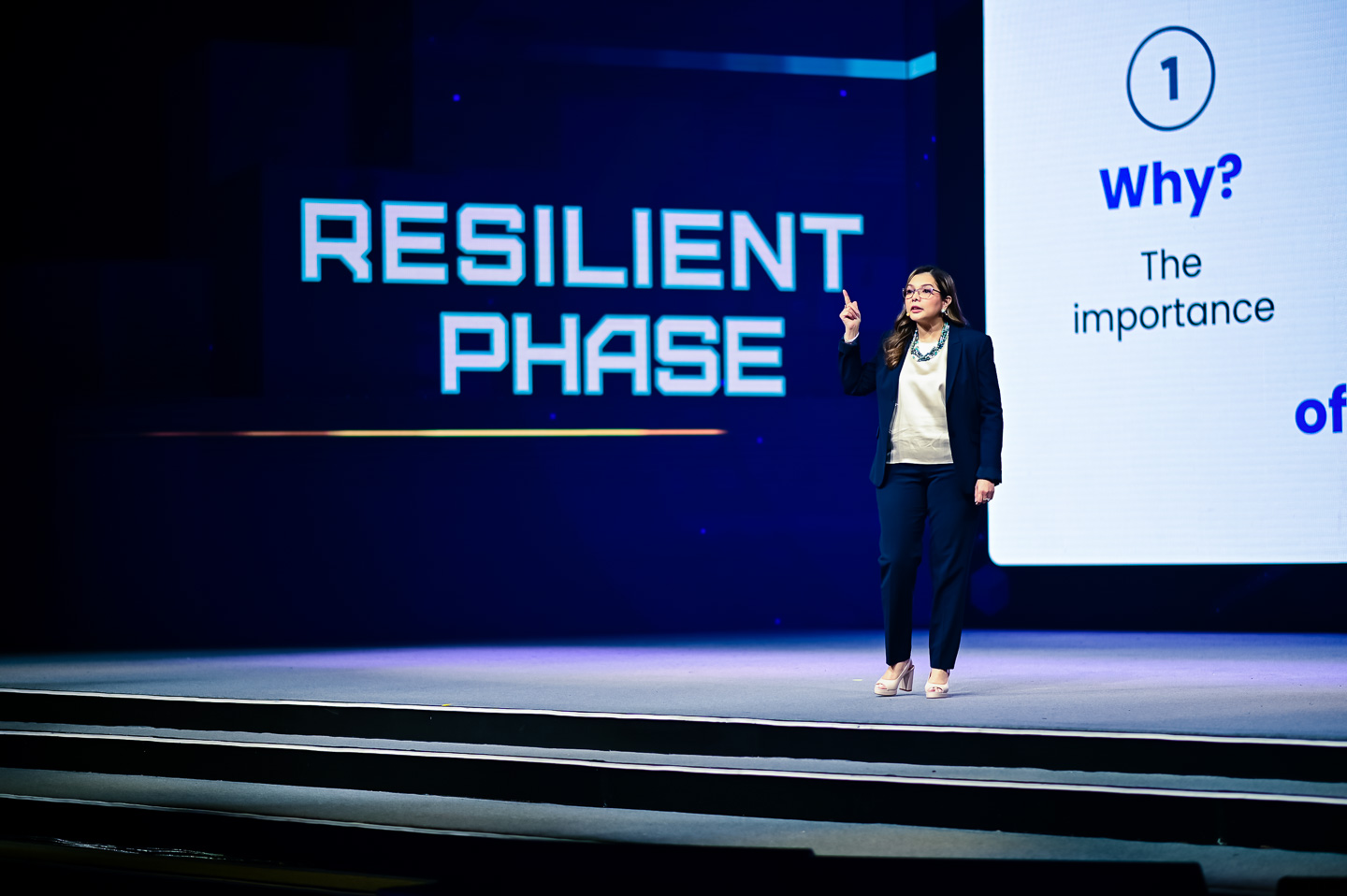
In the final Resilient Phase of the G Summit. Ms. Gonzalez-Colby shared her insights on the importance of brand resilience and how it can lead companies to a long-term state of commercial success and strong brand identity.

Participants had the chance to have individual consultations with industry experts for personalized guidance and advice on specific business challenges and opportunities.

The summit also featured breakout sessions with industry experts, where participants could delve deeper into specific topics and engage in more in-depth discussions.

Globe has come a long way from being a traditional telco provider to becoming a technology company, or TechCo, as it offers an ecosystem of partners and solutions. Through its annual G Summit, Globe continues to establish itself as the leading partner for digital transformation.

“It’s all about driving that innovation by investing in new technologies, expanding into new markets, and improving operational efficiency. But at the same time, it’s working with the government to help the workforce add more value to organizations while innovation opens opportunities for new jobs. Globe Business stands firm and committed to our goal of uplifting the lives of Filipinos by providing solutions that enable our customers and by responding to the growing needs of our business clients,” Ms. Dizon shared. “When we empower  businesses, we are able to create a significant impact on society.”

To learn more about their transformative solutions, visit their website at https://www.globe.com.ph/business.


Spotlight is BusinessWorld’s sponsored section that allows advertisers to amplify their brand and connect with BusinessWorld’s audience by enabling them to publish their stories directly on the BusinessWorld website. For more information, send an email to online@bworldonline.com.

Join us on Viber at https://bit.ly/3hv6bLA to get more updates and subscribe to BusinessWorld’s titles and get exclusive content through www.bworld-x.com.

Comparative analysis of worker performance

What’s the best way to compare the performance of people doing the same job? I know it’s easy to simply rank employees by the ratings they received in their evaluations. However, my inner voice is telling me there’s more to this. Can you help me? — Long Shot.

You’re right! There’s more to doing a comparative approach in analyzing and ranking employee performance. You must do a ranking to gain insights on which worker to promote when the time comes.

Basically, there are five approaches. One is the ranking system you were referring to, where you list the individual workers’ appraisal ratings from highest to lowest.

Next is forced distribution. This is also known as grading on a curve. The normal curve in statistics places the majority (around 70%) of employees in the middle, or the average group. Generally, this is the group that meets the company’s expectations.

The rest are distributed into either side of curve. The extreme left consists of the 5% that “need much improvement” and the 10% that “need slight improvement.” The extreme right represents the 5% who are deemed “outstanding” and the 10% that “exceed expectations.”

The third approach is called the paired comparison. This requires every line leader, supervisor and manager to compare every employee with every other employee in the work group. An employee is given a score of one point every time another worker considers him as the top performer in the group.

Once all the pairs have been compared, the concerned manager computes the number of times each employee receives a favorable score and totals them all. This becomes the employee’s performance score. After that, they are ranked accordingly. Paired comparison eliminates the managers’ subjectivity and their tendency to play it safe by giving an average rating.

BALANCED SCORECARD
The fourth approach is called the 360-degree feedback system, where an employee receives confidential evaluations of their work performance anonymously from the people who work around them. They include the boss, colleagues and direct reports. For efficiency, this is better done through an online form and measured on a scale similar to the forced distribution system.

This allows the person being rated to accomplish a self-rating questionnaire similar to what the boss, colleagues and direct reports are using.

The last performance approach is the so-called balanced scorecard, a performance management system that focuses on translating the company’s objectives into a set of performance metrics that include financial analysis (profitability and return on investment), customer interaction, internal business analysis and the learning perspective.

I would normally recommend the balanced scorecard as it connects an individual performance to corporate results. In other words, you cannot have people being given an excellent performance rating when the company is losing money. It may sound unfair, but that’s the way it goes. All employee accomplishments must be translated to financial performance.

Somehow, the unfairness can be tempered by evaluating, first and foremost the performance of division and department heads. Mr. Erick Reyes, a human resource (HR) management professional with more than 40 years of experience, says that “individual performance emanates from the corporate results.”

For example, if a Department ABC has exceeded the expectations of top management, a certain percentage is given as a merit increase to those people with an above average rating. On the other hand, if Department XYZ received a poor rating, then it’s almost impossible for anyone in that department to be given even a small monetary or non-monetary recognition.

Of course, that’s assuming that all goals are specifically defined by individual and department Key Performance Areas or Key Performance Indices.

FINANCIAL REWARD
As I’ve said earlier, this becomes necessary if we’re talking of financial reward like merit increases, profit-sharing bonuses or performance bonuses, except the mandated 13th month pay which must be given to all workers regardless of their employment status. Also, there’s a caveat to this — not all jobs can be measured easily.

For a department like HR, measurable objectives can be set for how it manages the recruitment cycle, prevents conflict with the labor union, reduces employee grievances, maintains a suggestion system, administers town hall meetings, conducts the annual morale survey, keeps turnover rates down, etc.

It’s also a good idea for HR to take the lead in implementing a continuous improvement program such as Lean HR, which applies kaizen and lean thinking to the HR function.

In conclusion, nothing is more convincing than creating an approach that suits the company’s culture. Just the same, don’t be afraid to change the system. Even major organizations don’t copy everything from model companies. They adjust things to achieve an ideal process.


Bring Rey Elbo’s leadership program called “Superior Subordinate Supervision” to your management. Chat with him on Facebook, LinkedIn, X (Twitter) or e-mail elbonomics@gmail.com or via https://reyelbo.com


St. Luke’s Medical Center pioneers research for health equity in PHL with launch of HERE Foundation

SLMC HERE Foundation logo unveiling with SLMC HERE Foundation’s President and CEO Dr. Arturo S. De La Peña and St. Luke’s Medical Center’s President and CEO Dr. Dennis P. Serrano

St. Luke’s Medical Center (SLMC), a trailblazer in delivering quality healthcare in the Philippines, marked a pivotal moment on Thursday, Nov. 16, by launching the SLMC Health Equity and Research (HERE) Foundation. The ceremonial launch took place at Shangri La The Fort, Bonifacio Global City, and was attended by business leaders and top researchers from both public and private sectors.

Dr. Arturo De La Peña, president and CEO of St. Luke’s HERE Foundation, said, “While St. Luke’s Medical Center delivers the highest standard of healthcare to individuals, it is imperative that we acknowledge and address the reality of healthcare inequality. Recognizing this disparity is the first step towards fostering a more inclusive and equitable healthcare system, ensuring that quality medical care reaches all segments of our community, irrespective of socio-economic backgrounds.”

SLMC HERE Foundation Vice-President Dr. Antonio Dans concurred highlighting the failure of many policies to bridge the healthcare gap between the affluent and the impoverished.

“For example, PhilHealth benefits are supposed to improve access to healthcare for those with less. However, the National Demographic and Health Survey shows that the poorest Filipinos use PhilHealth three times less frequently than the richest,” Dr. Dans added.

Beyond research, the HERE Foundation will also champion capacity building in health equity research and advocate for relevant policies in collaboration with other institutions.

Dr. Dennis Serrano, president and CEO of St. Luke’s Medical Center, underscored the commitment to equal care, stating, “All this must begin with ourselves. At St. Luke’s, there is no distinction in the level of care provided to social service cases and self-paying patients. They receive equal attention and are not segregated into separate rooms.”

The SLMC HERE Foundation is a non-stock, not-for-profit research foundation with a mission to finance research to enhance healthcare accessibility, particularly for the underprivileged. Research grants under the HERE Foundation will be administered by an independent Governing Council, featuring inaugural members selected for their profound expertise in various health research fields relevant to health equity. Notable members include pediatric infectious disease and pharmacologic researcher Dr. Benjamin G. Co, biostatistician and clinical epidemiologist Dr. Cynthia P. Cordero, clinical epidemiologist and infectious disease specialist Dr. Mary Ann D. Lansang, medical anthropologist and former University of the Philippines Diliman Chancellor Dr. Michael L. Tan, health economist and senior research fellow at the Philippine Institute for Development Studies Dr. Valerie G. Ulep, and health technology assessment pioneer and Former Department of Health Undersecretary for Research Development Dr. Madeleine D.R. Valera.

Research grant funding is open to eligible researchers nationwide, and inquiries can be submitted through their dedicated email address at herefoundation@stlukes.com.ph.


Spotlight is BusinessWorld’s sponsored section that allows advertisers to amplify their brand and connect with BusinessWorld’s audience by enabling them to publish their stories directly on the BusinessWorld website. For more information, send an email to online@bworldonline.com.

Join us on Viber at https://bit.ly/3hv6bLA to get more updates and subscribe to BusinessWorld’s titles and get exclusive content through www.bworld-x.com.

UnionBank eyeing to use AI solutions to help make online transactions safer

BW FILE PHOTO

SINGAPORE — Union Bank of the Philippines, Inc. (UnionBank) is working on artificial intelligence (AI) solutions to curb fraudulent activity and make online transactions more efficient, including a speaker verification mechanism that may be released by next year.

The bank said it is working on technology for enhanced user authentication through voice.

“We are planning to roll this out, but we are still prepping for that. We hope (by) next year,” Adrienne Heinrich, who heads UnionBank’s AI and Innovation Center of Excellence, said in a media roundtable here on Wednesday.

“It’s definitely faster, more efficient, and also [allows for] better interaction with customers. We’ll understand them better, we’ll have a more holistic view of them — we can be much more personalized [and] bring more value to customers,” she added.

Ms. Heinrich said testing for this technology has been done and it is now in the planning stage for deployment.

She, however, cited potential challenges when using the technology, including capturing a user’s voice when they have a clogged nose, the use of different dialects, and noisy environments, among others.

This technology will be applied to customer service calls, but it could potentially be used for the bank’s other systems.

“This is for calling customer service. If this all works out really well, then we can also see… In developing AI, [it’s] important to do it step by step so the customer is not so impacted so much,” Ms. Heinrich said.

“I can tell you the mindset is there; we want to build scalable technology. There are many channels we can bring it in,” she added.

UnionBank is also exploring AI technology for active listening in customer experience, identifying mules and fraud, and digitalizing cash delivery, among others.

Separately, UBX Chief Executive Officer and President John Januszczak also highlighted the importance of AI in helping expand access to finance.

“We believe that AI is the next lever in reaching the rest of the population… we’ve been leveraging AI, but at UBX we’ve stepped on the gas exactly for this reason: AI is going to unlock financial inclusion for the rest of the population in this country,” Mr. Januszczak said in a media roundtable here on Thursday.

UBX Head of Platform Business Charles Chan said UnionBank’s fintech arm is consolidating its products.

“You’ll start seeing products are more integrated with each other,  you can lend, you can sell, you can make payments,” he said.

He also noted UBX’s use of targeted and specific AI.

“The user from a lower tier is different from a user from an enterprise tier, so we’re trying to make experiences better.”

Meanwhile, Mr. Januszczak said UBX is approaching P100 billion in gross transaction volume on its platform for the year so far.

“For credit alone, we’ve processed close to P30 billion in credit applications and transactions,” he added.

UBX’s goal in five years is to “multiply gross transaction volume as a measure of real customers using the platform by ten times,” he said.

Mr. Januszczak said they have been growing at a “tremendous trajectory.”

“We’ve grown five times year over year in revenue over the last few years. There is an opportunity to unlock more growth.  Our market penetration is quite small, so we’re just starting. I believe UBX is a highly investable business,” he added. — Luisa Maria Jacinta C. Jocson

Ridley Scott’s Napoleon film premieres in Paris

JOAQUIN PHOENIX in a scene from Napoleon. — IMDB

PARIS — The cast of Ridley Scott’s biopic Napoleon flocked to Paris for the film’s global premiere on Tuesday night, taking to the red carpet just days after strikes ended in Hollywood.

Joaquin Phoenix plays the role of Napoleon, a historical figure both revered and criticized in France, who is portrayed in the film as a ruthless military tactician with a softer, vulnerable side, uncovered by his wife the empress Josephine de Beauharnais, played by Vanessa Kirby.

Sony Pictures Motion Picture Group Chairman and Chief Executive Officer Tom Rothman said he was relieved the movie’s release came after the Screen Actors Guild deal to end the months-long strike.

“I feel very fortunate the strike ended in time,” Mr. Rothman told Reuters.

Ms. Kirby, who was cast as Josephine after Jodie Comer bowed out due to scheduling issues, said her performance took cues from various descriptions of the aristocrat, eventually divorced by Napoleon for failing to produce an heir for the empire.

Ms. Kirby said she learned about the challenge of being “the feminine in that extremely masculine world,” and appreciated Beauharnais for “remaining dignified,” even through her public divorce.

Filmed during the pandemic, Scott and Dariusz Wolski, his frequent collaborator for cinematography, orchestrated elaborate battle scenes that recounted Napoleon’s conquests in Austerlitz and Moscow, and his famous defeat in Waterloo.

Napoleon might have been a tyrant and a “man of power,” but he was “still a man, crazy in love with a woman,” said French actor Tahar Rahim, who plays the role of Revolutionary-era politician Paul Barras. — Reuters

SPNEC suffers bigger net loss

SP New Energy Corp. (SPNEC) reported an attributable net loss of P49.73 million for the third quarter, wider than the P15.51 million recorded in the same quarter last year.

In a disclosure to the stock exchange on Wednesday, the listed energy firm said its gross revenues stood at P269.62 million, without disclosing a comparative figure.

The company’s gross expenses were at P123.15 million while gross profit was at P146.47 million.

For the nine months through September, SPNEC’s attributable net loss also widened to P106.98 million compared with P49.68 million in the previous year.

As of November, Solar Philippines Power Project Holdings, Inc. (SPPPHI) held 74.38% ownership of SPNEC’s outstanding common shares.

In March, Metro Pacific Investments Corp. entered into a share purchase agreement with SPPPHI to “acquire the latter’s rights, title and interests in and to SPNEC” with 1.6 billion common shares.

Meanwhile, MGen Renewable Energy, Inc., the renewable energy unit of the Manila Electric Co. (Meralco), said last month that it had signed an investment agreement with SPNEC and SPPHI to develop solar and battery energy storage systems.

Under the agreement, SPNEC will serve as the primary vehicle to develop 3,500 megawatts (MW) of solar panels and 4,000 MW of battery energy storage systems in Luzon.

Meralco Chairman and Chief Executive Officer Manuel V. Pangilinan earlier said that he was hoping to complete the deal by the end of this year.

The project is estimated to have a required investment of P200 billion throughout its implementation, Mr. Pangilinan said. — Sheldeen Joy Talavera

Philippines slips in global sustainability ranking

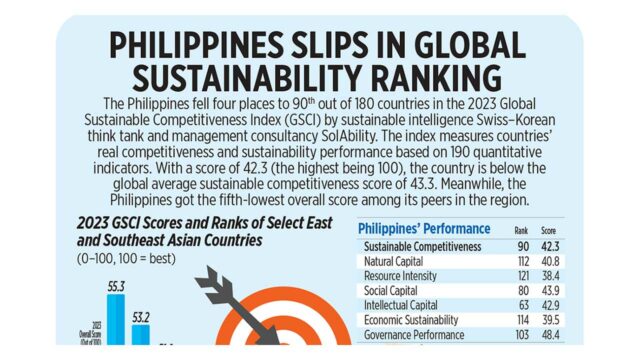
The Philippines fell four places to 90th out of 180 countries in the 2023 Global Sustainable Competitiveness Index (GSCI) by sustainable intelligence Swiss–Korean think tank and management consultancy SolAbility. The index measures countries’ real competitiveness and sustainability performance based on 190 quantitative indicators. With a score of 42.3 (the highest being 100), the country is below the global average sustainable competitiveness score of 43.3. Meanwhile, the Philippines got the fifth-lowest overall score among its peers in the region.

Philippines slips in global sustainability ranking

How PSEi member stocks performed — November 16, 2023

Here’s a quick glance at how PSEi stocks fared on Thursday, November 16, 2023.


Peso climbs after BSP decision

BW FILE PHOTO

THE PESO appreciated against the dollar on Thursday after the Bangko Sentral ng Pilipinas (BSP) kept benchmark borrowing costs unchanged but signaled it would need to keep rates higher for longer to keep inflation expectations anchored.

The local unit closed at a fresh three-month high of P55.79 per dollar on Thursday, strengthening by 3.5 centavos from its P55.825 finish on Wednesday, based on Bankers Association of the Philippines data.

This was its best close in more than three months or since its P55.74-per-dollar finish on Aug. 4.

The peso opened Thursday’s session weaker at P55.90 against the dollar. Its intraday best was at P55.75, while its weakest showing was at P55.935 versus the greenback.

Dollars exchanged went down to $1.28 billion on Thursday from $1.48 billion on Wednesday.

The peso rose against the dollar on Thursday after the BSP kept its policy rate unchanged at a 16-year high of 6.5%, Rizal Commercial Banking Corp. Chief Economist Michael L. Ricafort said in a Viber message.

The BSP on Thursday kept its target repurchase rate at 6.5% amid easing inflation, as expected by 15 of 18 analysts in a BusinessWorld poll last week. Interest rates on the central bank’s overnight deposit and lending facilities were also maintained at 6% and 7%, respectively.

The pause came after the BSP raised its rates by 25 basis points (bps) in an off-cycle move on Oct. 26.

It has raised interest rates by 450 bps since May 2022 to temper inflation.

Headline inflation fell to a three-month low of 4.9% in October from 6.1% in September.

However, this marked the 19th straight month that inflation breached the central bank’s 2-4% target. For the 10-month period, inflation averaged 6.4%.

The peso was supported by signals from the BSP that rates will need to stay higher for longer due to lingering upside risks to inflation, Mr. Ricafort added.

BSP Deputy Governor Francisco G. Dakila, Jr. on Thursday said the central bank is prepared to resume its tightening cycle to make sure inflation goes back within the 2-4% annual target.

“The peso appreciated following the softer US producer inflation and retail sales reports for October 2023,” a trader added in a text message.

US retail sales fell for the first time in seven months in October as motor vehicle purchases and spending on hobbies dropped, pointing to slowing demand at the start of the fourth quarter that further strengthened expectations the Federal Reserve is done hiking interest rates, Reuters reported.

That was supported by other data on Wednesday showing the biggest decline in producer prices in three-and-a-half years in October on the back of cheaper gasoline. The reports followed on the heels of news on Tuesday that consumer prices were unchanged last month for the first time in more than a year.

Retail sales slipped 0.1% last month, the Commerce department’s Census Bureau said. Data for September was revised higher to show sales increasing 0.9% instead of the previously reported 0.7% rise. Economists polled by Reuters had forecast retail sales would fall 0.3%.

A separate report from the Labor department’s Bureau of Labor Statistics on Wednesday showed the producer price index (PPI) for final demand declined 0.5% in October, the largest decrease since April 2020. The PPI rose 0.4% in September.

Economists had forecast the PPI would edge up 0.1%. In the 12 months through October, the PPI increased 1.3% after rising 2.2% in September.

For Friday, the trader said peso could strengthen further before the release of US jobs data.

The trader sees the peso moving between P55.65 and P55.90 per dollar on Friday, while Mr. Ricafort expects it to range from P55.70 to P55.90. — AMCS with Reuters

ADVERTISEMENT
ADVERTISEMENT