Home Blog Page 3998

UN vote challenges OECD global tax leadership
REUTERS

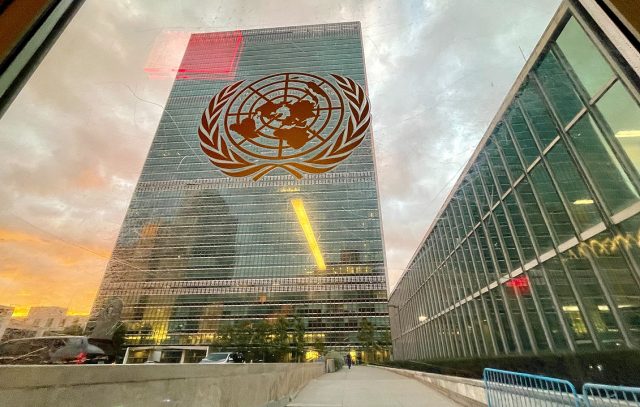
PARIS – The Organisation for Economic Cooperation and Development’s leadership on global tax coordination has come under threat after a majority of UN members backed an African-led initiative to bring international tax cooperation to the United Nations.

Many developing countries have lamented for years that they are unable to influence discussions on global tax cooperation at the OECD, where the rules for cross-border taxation are generally thrashed out.

Frustrated their voices had not been heard, on Wednesday 125 mostly developing countries backed a draft U.N. resolution proposed by Nigeria calling for a “framework convention on international tax cooperation”.

Some 48 mostly developed countries, including Britain, Germany, Japan and the United States were against while nine countries abstained, including OECD members Iceland, Mexico, Norway and Turkey.

Welcoming the vote as a “beacon of hope”, the African Union said in a statement that it would “facilitate the access of much needed financial resources”.

OECD head Mathias Cormann said that the 38-member group was “proud of its record of achieving consensus-based solutions” on international tax cooperation.

The Paris-based policy forum has for decades coordinated among its 38 mostly developed country members and other countries on international tax issues ranging from guidelines for intra-group transfer pricing to how tax authorities can share bank account information.

It also steered a 2021 deal among nearly 140 countries to rewrite the rules of cross-border taxation for the first time in a generation to bring them up to date for the age of digital commerce where big multinationals like Apple and Meta can book profits in low-tax countries.

The two-track deal aims to create a 15% global minimum corporate tax rate and calls for a new treaty that would shift some taxing rights on the most profitable multinationals to the countries where the companies clients are located.

While the minimum corporate tax rate is due to begin entering force next year, the new treaty on taxing rights faces a far more rocky road, not least in the United States where a two-thirds majority is needed to ratify treaties by the deeply divided Senate.

KPMG global tax policy leader Grant Wardell-Johnson said that though the two-track overhaul was backed by the G20 group of economic powers and had aimed for a global consensus, the UN vote was likely to lead to increased cooperation between it and the OECD in the future.

“It is hoped that the UN will focus on areas where there are current needs for low-income economies. This includes illicit financial flows and bringing the formal economy into the formal economy,” Wardell-Johnson told Reuters. — Reuters


Philippines considers return to ‘fold’ of International Criminal Court

BW FILE PHOTO

MANILA – The Philippines is considering resuming membership of the International Criminal Court (ICC) nearly five years after it withdrew over objections to a bid by the court to investigate a bloody anti-narcotics campaign, the president said on Friday.

“There is also a question, should we return under the fold of the ICC, so that’s again under study. So we’ll just keep looking at it and see what our options are,” President Ferdinand R. Marcos, Jr. told reporters.

The Philippines withdrew from the international tribunal in 2019 after then President Rodrigo R. Duterte questioned its authority to investigate the a campaign against illegal drugs in which thousands of people were killed.

Mr. Marcos said questions over jurisdiction and sovereignty were still “problems” for the Philippines.

“Now if we can solve these problems, then that would be something else, but those questions are fundamental,” Mr. Marcos said.

The ICC this year rejected a Philippine appeal to stop investigating Mr. Duterte’s drug war.

Mr. Marcos said in March he would cut off contact with the court after the decision.

In July, appeals judges at the ICC cleared the way for an investigation into the killings, a ruling that families of victims and right groups hailed as another step towards justice. — Reuters

CCI France Philippines holds its Annual Gala ‘Rendez-Vous’: A celebration of the Philippines and France’s vivid cultures

The French Chamber of Commerce and Industry in the Philippines held its Annual Gala 2023 “Rendez-Vous,” at the Sofitel Philippine Plaza Manila last Nov. 8, 2023, to celebrate 76 years of the harmonious relationship between France and the Philippines.

Over 460 key members of the French and Filipino communities were in attendance, brought together to build connections, recognize a year’s worth of achievements, and celebrate the fruitful alliance between the two countries. Also present were dignitaries from various countries, local government officials, and celebrities including Nadine Lustre, Issa Litton, and Solenn Heusaff.

The Gala was also graced with the presence of the French Ambassador to the Philippines, H.E. Marie Fontanel, who gave a speech on her “Make It Iconic” campaign. Guests also heard from First Lady of the Philippines Marie Louise “Liza” Araneta Marcos, the President of the French Chamber of Commerce and Industry Jacques Christophe Branellec, Pasay City Mayor Imelda Calixto-Rubiano; and Miss World Philippines 2023 Gwendolyne Fourniol.

The main event of the evening was the awards ceremony of Le Trophée Bleu: Sustainability Business Awards, recognizing and celebrating the efforts of companies in establishing initiatives and programs in pursuit of the 17 Sustainable Development Goals. Held in partnership with HAVAS Ortega, the Business Awards awarded the following companies for their initiatives in the four categories: for People, Sanofi; for Planet, Essilor; for Partnership, CMA-CGM Philippines; and for Sustainable Excellence for SMEs, MAD Courses.

A theatrical production also took place after the awards ceremony, showcasing both French and Filipino cultural dances and performances for the guests to enjoy as dinner was served. Dinner was an exquisite exhibition of Filipino-French cuisine prepared by Chef Bettina Arguelles, the 2019 World Gourmet Awards Chef of the Year and Executive Chef at Sofitel Philippine Plaza Manila. The six-course meal featured an Artisanal Mini Bread Selection; Bacalao Rillette and Foie Gras au Torchon & Piña for the Entrance Course; Duck Adobo Façon “Vol-au-Vent” and Fillet de Boeuf “Bulalo” for the Main Course; a selection of Cheeses including Brie, Ossau Iraty, Comte, Fourme d’Ambert, St. Maure de Touraine; and Pink Guava Charlotte and Petit Fours for Dessert.

The meal was paired with a fantastic selection of wine and spirits such as Champagne Martel, Victoire Prestige Brut; Gerard Bertrand, Heritage “An 542” 2018, Languedoc; Agimat Ube Cream Liqueur; and Plantation Rum XO 20th Anniversary.

The Jewelmer Band, joined by Mr. Branellec, serenaded the gala after the program proper and invited guests to the dance floor after dinner. The evening wrapped up with a celebration with DJ Abdel Aziz.

It was truly a magical evening building connections, creating memories, celebrating the accomplishments of the year, and looking forward to more achievements to come!

Special thanks to our Gala sponsors and partners: Sofitel Philippine Plaza Manila, Jewelmer, BDO, Clinique de Paris, ENGIE Services Philippines, Vienovo, San Miguel Corp., Artelia in the Philippines, 10Inch, ReelReve, Globaltronics, R Concepts & Events, Auro Chocolate, L’Oreal Philippines, The French Baker, Alternatives Food Corp., Winedrop, Malongo Atelier Barista Philippines, Citadelle Gin de France, Plantation Rum and Destileria Barako.


Spotlight is BusinessWorld’s sponsored section that allows advertisers to amplify their brand and connect with BusinessWorld’s audience by enabling them to publish their stories directly on the BusinessWorld website. For more information, send an email to online@bworldonline.com.

Join us on Viber at https://bit.ly/3hv6bLA to get more updates and subscribe to BusinessWorld’s titles and get exclusive content through www.bworld-x.com.

Romania is not ready to uphold same-sex couples’ rights – PM

CHANDLERVID85-FREEPIK

 – Romanian society is not ready to uphold the rights of samesex couples in line with a European Court of Human Rights (ECHR) ruling, leftist Prime Minister Marcel Ciolacu said late on Thursday.

The ECHR ruled in May Romania had failed to enforce the rights of samesex couples by refusing to recognise their relationships, in a ruling which could eventually force policymakers to expand protections for the LGBT community.

Asked whether Romania will enforce the ruling, Mr. Ciolacu told radio station Europa FM that “the Romanian society is not ready for a decision at the moment. It is not one of my priorities and … I don’t think Romania is ready.”

“I am not a closed-minded person, I … have friends in relationships with a man, I don’t have a problem with that, I am talking now from the point of view of a prime minister.”

Romania holds local, European, general and presidential elections in 2024. Mr. Ciolacu added it wouldn’t be the first or the last time that Romania fails to enforce ECHR rulings.

Socially conservative Romania decriminalized homosexuality in 2001, decades later than other parts of the European Union, but still bars marriage and civil partnerships for samesex couples.

Three legislative proposals to change civil unions to include samesex couples filed between 2016 and 2019 have not yet made it through parliamentary approval committees, while four similar draft laws had been rejected by 2020.

A referendum to change Romania‘s constitution to prevent samesex couples from securing the right to marry failed to draw enough voters in 2018.

A survey commissioned by LGBT rights group ACCEPT in 2021 showed while 71% of Romanians said legal recognition of civil marriage for samesex couples would not have any impact on their lives, only 43% were in favor of it. – Reuters

Brazil highlights poverty, climate change as G20 priorities

STOCK PHOTO | Image by vleyva from Pixabay

 – Brazil will focus on reducing hunger and poverty, slowing climate change and global governance reform when it heads the G20 group of the world’s largest economies starting next month, President Luiz Inacio Lula da Silva said on Thursday.

Brazil takes over the G20 presidency from India on Dec.1 and will hold the 2024 summit in Rio de Janeiro in November next year.

“I hope we can address the issues that we need to stop running away from and try to resolve,” Mr. Lula at a meeting with cabinet ministers to lay out Brazil‘s priorities for the G20.

Mr. Lula has frequently criticized what he says are global governance failures by bodies like the United Nations, the World Bank and the International Monetary Fund (IMF), and has insisted on the need to expand the permanent U.N. Security Council.

“It is not possible for the Bretton Woods institutions, World Bank, IMF, and many other financial institutions to continue functioning as if nothing were happening in the world, as if everything had been resolved,” he said.

He complained the institutions often lend money to countries to pay off their debt, without any meaningful change.

G20 foreign ministers will meet in Rio de Janeiro on Feb. 21-22 and finance ministers will gather in Sao Paulo over Feb. 28-29.

Indian Prime Minister Narendra Modi hosted a virtual summit of G20 nations on Wednesday to review progress on policy goals set at the annual G20 summit in New Delhi in September. – Reuters

The key players in New Zealand’s new government

STOCK PHOTO | Image by Kerin Gedge from Unsplash

 – New Zealand’s National Party, ACT New Zealand and New Zealand First Friday signed a coalition agreement and will be sworn in as the 54th government on Monday.

Here are some facts on the major players in the new government.


CHRISTOPHER LUXON, PRIME MINISTER AND NATIONAL PARTY LEADER

A former Air New Zealand chief executive, who also held senior roles at global consumer goods firm Unilever, Luxon has only been in politics for three years and became leader of the center-right National Party at the end of 2021.

A 53-year-old father of two, Mr. Luxon has said he will bring the same skills he bought to business to improving New Zealand, reducing government debt and bringing down inflation.

In a country where almost half the people say they have no religion, Mr. Luxon has faced scrutiny for saying he was Christian and has defended stances such as personally opposing abortion.


WINSTON PETERS, LEADER OF NEW ZEALAND FIRST, DEPUTY PRIME MINISTER UNTIL MAY 31, 2025, FOREIGN MINISTER

A colorful, populist figure, the 78-year-old Mr. Peters will take the mantle of foreign minister for the third time having held the role in both the 2005 and 2017 governments.

Mr. Peters is credited during this tenure for helping in the thawing of relationships between US and New Zealand, which had been strained by New Zealand’s nuclear free policy and then a decision not to support the US invasion of Iraq.

During his most recent stint, Mr. Peters launched a “Pacific Reset” to woo neighboring pacific countries and significantly boosted the country’s foreign aid budget.


DAVID SEYMOUR, ACT NEW ZEALAND LEADER, DEPUTY PRIME MINISTER FROM MAY 31, 2025, MINISTER OF REGULATION

In parliament since 2014, Mr. Seymour was behind the law change in New Zealand to legalize euthanasia, voted in favor of legalizing abortion in 2020 and attended a pro-Hong Kong democracy protest in Auckland in 2019.

His newly created ministerial role will look after the Minister of Regulation, which is being set up to assess the quality of new and existing regulation.


NICOLA WILLIS, FINANCE MINISTER, DEPUTY LEADER OF THE NATIONAL PARTY

Ms. Willis has been National’s finance spokesperson since 2022 and its deputy leader since 2021.

Ms. Willis has had a number of testy exchanges with the current Reserve Bank of New Zealand governor Adrian Orr at select committee meetings. She said in 2022 publicly she was appalled when Orr was reappointed as governor without a review but has since said the National Party will work with any governor.

Prior to entering parliament in 2017, the mother of four worked in a number of senior roles including at dairy giant Fonterra Co-Operative Group.

Reuters

Mediators Qatar and Egypt say Gaza truce to start on Friday

REUTERS/MOHAMMED SALEM

 – truce between Israel and Hamas in Gaza will start on Friday at 7 a.m. (0500 GMT), with a the first batch of hostages to be released at 4 p.m., a spokesperson for Qatar‘s foreign ministry said on Thursday.

The truce would include a comprehensive ceasefire in both the north and south of the Gaza Strip, Majed Al-Ansari told reporters in Doha, adding that Palestinians would also be released from Israeli jails as part of the deal.

The first group of hostages to be released would be 13 women and children, Mr. Ansari said.

“If there were a group of hostages from the same family they will be released together in this first batch,” he added, saying that a total of 50 hostages will be released over four days.

Egypt, which helped mediate between Hamas and Israel, confirmed the start time of the truce and that 13 hostages would be released in the afternoon, adding in statements from its state information service that it was receiving lists of captives due to be freed on both sides.

Egypt said 200 trucks of aid, 130,000 litres of diesel and four trucks of gas would enter Gaza daily. That would be a step up from current deliveries through the Rafah crossing, but still far less than what U.N. and other aid agencies say is needed.

Israel has said the truce could last beyond the initial four days, as long as the militants free at least 10 hostages per day.

The first pause in the seven-week-old war is meant to be accompanied by the release of 50 women and children hostages captured by militants who raided Israel on Oct. 7, in exchange for 150 Palestinian detainees from Israeli jails.

Mr. Ansari did not give details on how many Palestinian women and children will be released from Israeli jails on Friday or when this would take place. He said Doha expected they will be released by Israel as part of this reciprocal deal.

An operations room in Doha will monitor the truce and the release of hostages and has direct and real-time lines of communication with Israel, the Hamas political office in Doha and the International Committee of the Red Cross (ICRC), he added.

“The important thing is that we maintain a very clear line of communication with everybody through the operations room and make sure that the environment which the hostage transfer will happen will be a safe one,” Mr. Ansari said.

Qatar hopes to negotiate a subsequent agreement to release additional hostages from Gaza by the fourth day of the truce.

“We all hope that this truce will lead to a chance to start a wider work to achieve a permanent truce,” he said. – Reuters

China says no unusual pathogens found after WHO queries respiratory outbreaks

STOCK PHOTO | Image by Mohamed Hassan from Pixabay

Chinese health authorities have not detected any unusual or novel pathogens and provided the requested data on an increase in respiratory illnesses and reported clusters of pneumonia in children, the World Health Organization (WHO) said on Thursday.

The WHO had asked China for more information on Wednesday after groups including the Program for Monitoring Emerging Diseases (ProMED) reported clusters of undiagnosed pneumonia in children in north China.

As per the rule, China responded to the WHO within 24 hours. The WHO had sought epidemiologic and clinical information as well as laboratory results through the International Health Regulations mechanism.

The data suggests the increase is linked to the lifting of COVID-19 restrictions along with the circulation of known pathogens like mycoplasma pneumoniae, a common bacterial infection that typically affects younger children and which has circulated since May.

Influenza, respiratory syncytial virus (RSV) and adenovirus have been in circulation since October.

The agency does not advise against travel and trade as they have been monitoring the situation with authorities.

No unusual pathogens have been detected in the capital of Beijing and the northeastern province of Liaoning.

Chinese authorities from the National Health Commission held a press conference on Nov. 13 to report an increase in incidence of respiratory disease.

Both China and the WHO have faced questions about the transparency of reporting on the earliest COVID-19 cases that emerged in the central Chinese city of Wuhan in late 2019.

The U.N. health agency had also asked China for further information about trends in the circulation of known pathogens and the burden on healthcare systems. The WHO said it was in contact with clinicians and scientists through its existing technical partnerships and networks in China.

WHO China said it was “routine” to request information on increases in respiratory illnesses and reported clusters of pneumonia in children from member states, such as China.

The global agency decided to issue a statement on China to share available information, as it received a number of queries about it from media, WHO China said in an emailed statement.

The ProMED alert was based on a report by FTV News in Taiwan that came out on Tuesday.

Undiagnosed pneumonia was not mentioned at last week’s press conference, according to a transcript, but one speaker said everyone felt like there had been an increase in respiratory illnesses this year compared with three years ago.

The speaker said that global monitoring for mycoplasma pneumoniae had been at a low over the past three years and outbreaks were cyclical, occurring every three to seven years.


‘SEASONAL SURGE’

The rise in respiratory illnesses comes as China braces for its first full winter season since it had lifted strict COVID-19 restrictions in December. Many other countries saw similar increases in respiratory diseases after easing pandemic measures.

“It is just a relatively large seasonal surge, perhaps partly due to chance and partly because there’s a bit of ‘immunity debt’ from the lesser winter surges in the last three years,” said Ben Cowling, an epidemiologist at Hong Kong University.

China‘s National Health Commission did not immediately respond to a request for comment.

On Thursday, it published an interview with the state media agency Xinhua in which it advised parents what to do and mentioned that big hospitals were receiving a large number of patients and waiting times were long. It did not comment on the WHO notice.

Since mid-October, the WHO said northern China had reported an increase in influenza-like illness compared with the same period in the previous three years.

It said China had systems in place to capture information on trends in illness incidence and to report that data to platforms such as the Global Influenza Surveillance and Response System.

In recent days, media in cities such as Xian in the northwest have posted videos of hospitals crowded with parents and children awaiting checks.

Some social media users have posted photos of children doing homework while receiving intravenous drips in hospital.

The WHO said that while it was seeking additional information, it recommended that people in China follow measures to reduce the risk of respiratory illness.

Measures included vaccination, keeping distance from sick people, staying at home when ill, getting tested and medical care as needed, wearing masks as appropriate, ensuring good ventilation, and regular hand-washing, it said. – Reuters


Philippine central bank says to stay hawkish for a while

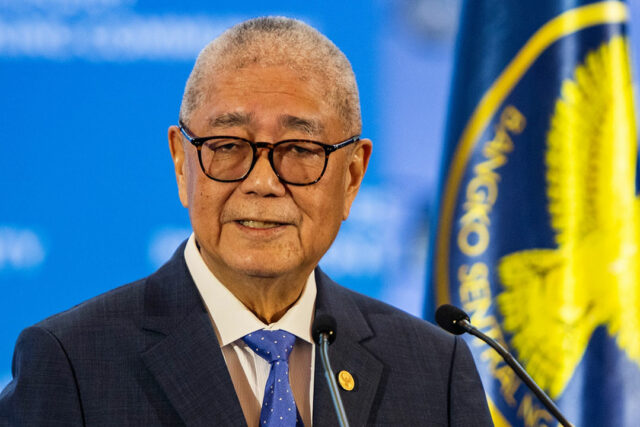
Bangko Sentral ng Pilipinas (BSP) Governor Eli M. Remolona, Jr. — BLOOMBERG

Philippine central bank Governor Eli Remolona said monetary policy will remain “hawkish for a while” and authorities could resume tightening if inflation comes in higher than expected.

“If the inflation rate doesn’t go down as projected, we have no choice,” Mr. Remolona said on the sidelines of FX Forum Manila on Thursday. “But what we are watching more than the inflation rate itself is the expectations; if they get de-anchored we’ll have to do something,” he said.

Mr. Remolona said the central bank expects inflation to continue slowing in November and to be “within striking distance from the target range.” Although still above the Bangko Sentral ng Pilipinas’ 2%-4% goal, inflation came in sharply slower than anticipated in October at 4.9%, providing policymakers room to pause.

The BSP left its target reverse repurchase rate at a 16-year high of 6.50% on Nov. 16 as inflationary pressures eased and the peso strengthened, after an off-cycle rate hike three weeks earlier.

The central bank’s policy will remain “hawkish for a while,” which Mr. Remolona said “means we’re not about to ease. We might even hike but we’ll see.”

The peso’s recent appreciation against the dollar is “not a major factor” in the central bank’s policy decisions, he said, adding the currency’s move is “not big enough to worry about.”

“A big move in the peso would be an issue but so far it’s strengthened a bit. We intervene if there’s some stress that need to be contained; we don’t see that,” the central bank chief said.

The BSP head reiterated that a rate cut is not on the table for this year and policy decisions will remain data-dependent. The Monetary Board is set to hold its last rate-setting meeting for the year on Dec. 14.

Philippine economic output grew faster than expected in the third quarter, even as consumer spending softened and investment declined after the BSP’s most aggressive monetary tightening in two decades.

Officials are optimistic that the Philippines will achieve the lower end of its 6%-7% GDP growth target for this year, remaining one of Asia’s fastest growing economies.

FX Forum Manila is organized by Bloomberg LP, the parent company of Bloomberg News. — Bloomberg

PEZA investment approvals surge

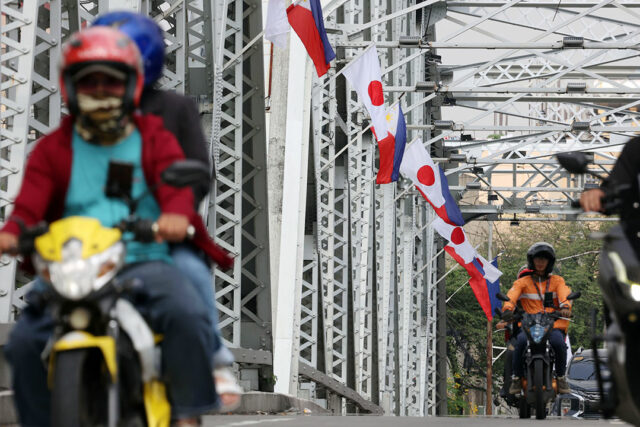
Japanese companies remain to be the top source of investments, according to the Philippine Economic Zone Authority. Photo shows Japanese and Philippine flags along the Ayala Bridge, Nov. 2, 2023. — PHILIPPINE STAR/EDD GUMBAN

THE PHILIPPINE Economic Zone Authority (PEZA) approved investments worth P140.89 billion so far this year, more than double from a year ago, its top official said.

“We are now at P140 billion as of our latest board meeting on Nov. 16, so that is about 92% of our target,” PEZA Director-General Tereso O. Panga told reporters on the sidelines of the PEZA Investors Night on Wednesday.

The investment promotion agency (IPA) is targeting to approve P154.77 billion worth of project registrations this year.

Mr. Panga said the PEZA-approved investments as of Nov. 16 are 147% higher than the P57.05-billion investments approved during the same period last year.

“With two more board meetings to go, we will surpass our targets for the year with flying colors,” he said during his presentation at the event.

The PEZA chief said economic zones will continue to perform well as the Philippine economy posts one of the fastest growth rates in Southeast Asia for this year and next year.

Citing data from the ASEAN+3 Macroeconomic Research Office (AMRO), Mr. Panga said that the Philippine gross domestic product (GDP) is expected to grow by 5.9% and 6.5% this year and in 2024, respectively.

AMRO’s growth forecast for the Philippines is above the regional 2023 and 2024 consensus of 4.3% and 4.5% GDP growth, respectively. The region is composed of the 10-member Association of Southeast Asian Nations (ASEAN) plus China, Japan and South Korea.

Meanwhile, Mr. Panga said PEZA expects around P50 billion worth of investments to come in, which includes a billion-dollar investment from a US company Texas Instruments, Inc.

“We are expecting some more investments that have a combined worth of over P50 billion. If we are lucky enough, these might bring us back to the P200-billion to P250-billion level or the 2012 and 2015 peak years of PEZA investment approvals,” he said in mixed English and Filipino.

The PEZA Board is scheduled to hold a meeting on Nov. 30, while the last meeting will be in December.   

In his presentation, the PEZA director-general said that Japanese companies remain to be the top source for investments, followed by Filipino, American, Dutch and British companies. 

“This year, we are seeing an increase in investments from other markets like China, Taiwan, Australia and the European Union,” Mr. Panga said.

Around a third of the approved investments are in electronics and semiconductors, followed by information technology (IT) services (12.45%) and metals or fabricated metal products investments (8.66%).

“In the coming Industry 4.0, we see huge potential in advanced and smart manufacturing, electric and hybrid vehicles, artificial intelligence and robotics, frontier technologies, and other unique industries,” Mr. Panga said.

The PEZA Board pre-qualified a total of 25 big-ticket locator projects from July 2022 to November 2023 which are estimated to generate P217.21 billion in investments, $1.5 billion in exports and 16,414 direct jobs.

Mr. Panga said that a total of 11 economic zones (ecozones) with investments totaling P3.5 billion have already been approved under the current administration. These ecozones are located in Batangas, Bacolod, Bataan, Naga City, Dumaguete City, Davao, Cebu, Pampanga and Sarangani.

There are three ecozones with a total investment of P654.43 million awaiting the release of the presidential proclamation. These are MetroCas Industrial Estates-Special Economic Zone, Suyo Economic Zone, and Kamanga Agro-Industrial Economic Zone.

“We have increased our presence outside of Luzon and the metropolis to bring ecozone development in rural and new growth areas. Rural communities continue to be transformed into bustling urban centers,” Mr. Panga said.

To date, the IPA has 422 operating ecozones. — Justine Irish D. Tabile

Auto sales up 18.6% in October but slip month on month

PHILIPPINE STAR/WALTER BOLLOZOS

NEW VEHICLE SALES jumped by an annual 18.6% in October but dipped by 1.3% from the previous month, an industry report showed.

A joint report by the Chamber of Automotive Manufacturers of the Philippines, Inc. (CAMPI) and the Truck Manufacturers Association (TMA) showed new vehicle sales increased to 38,128 units in October from 32,146 units in the same month a year ago.

However, car sales declined by 1.3% from 38,628 units sold in September amid elevated inflation.

In a statement, CAMPI President Rommel R. Gutierrez attributed the sustained annual sales growth in October to “aggressive marketing activities and supply improvement across all brands.”

“Consumer appetite is high, and sales are driven by continued pent-up demand, which is also supported by easier access to credit,” he added.

Despite high interest rates, central bank data showed consumer loans jumped by 23.5% to P1.19 trillion in September. In particular, motor vehicle loans rose by 13.4%.

CAMPI-TMA data showed sales of commercial vehicles rose by 17.6% to 28,041 units in October from 23,852 units in the same month last year. Commercial vehicles accounted for 74% of the sales during the month.

Month on month, commercial vehicle sales fell by 3.5% from 29,070 units in September.

Light commercial vehicle sales went up by an annual 19.3% to 21,702 units but declined by 6% month on month.

Sales of Asian utility vehicles (AUV) increased by an annual 14.3% to 5,358 units in October. Month on month, AUV sales rose by 8.1%.

Sales of medium trucks slumped by 29.4% year on year to 279 units in October, and by 14.2% month on month.

Meanwhile, passenger car sales increased by 21.6% to 10,087 units in October from 8,294 units a year ago. Month on month, sales of passenger cars went up by 5.53% from 9,558 units in September.

For the first 10 months, CAMPI-TMA members sold 352,971 units, up by 25.9% from 280,300 units a year ago.

Mr. Gutierrez said that the industry is on track to hit its total sales target for the year.

“We already achieved 83% of our 2023 forecast in October; with sustained demand, we are confident that we can achieve 423,000 units sales by yearend,” he said.

CAMPI revised its 2023 sales target in September from the previous target sales of 395,000 units. If realized, the new target would be 20% higher than the 352,596 actual sales last year.

For the January-to-October period, commercial vehicle sales increased by 24% to 262,875 units, while passenger car sales rose by 31.8% to 90,096 units.

Toyota Motor Philippines Corp. remained the market leader with a 45.96% share as 10-month sales went up by 15.5% to 162,229 units.

Mitsubishi Motors Philippines Corp. came in second spot as sales soared by 60.3% to 65,192 units.

In third spot was Ford Motor Co. Phils., Inc. with a 39.5% increase in sales to 26,003 units.

Rounding out the top five were Nissan Philippines, Inc., which saw a 25.4% increase in sales to 22,268 units, and Suzuki Phils., Inc. which reported a 6.8% drop in sales to 15,062 units. — Justine Irish D. Tabile

BSP urged to remain  hawkish in next 2 years

Achieving the government’s 6-7% economic growth target this year could be a “tall order,” as consumer spending slows. — PHILIPPINE STAR/MIGUEL DE GUZMAN

By Luisa Maria Jacinta C. Jocson, Reporter

THE BANGKO SENTRAL ng Pilipinas (BSP) should retain its tightening bias as forecasts show inflation will remain elevated until 2025, GlobalSource Partners said. 

“All in all, we believe the BSP should remain hawkish in both its policy moves and policy pronouncements. The forecasts indicate above-target inflation for this year, and we agree as to its likelihood, and the next,” GlobalSource Country Analyst Diwa C. Guinigundo said in a report dated Nov. 22.

The BSP’s baseline inflation forecast this year is at 6%, still well above its 2-4% target band. It sees inflation easing to 3.7% for 2024 and 3.2% for 2025.

The Monetary Board kept its key policy rate unchanged at a 16-year high of 6.5% at its Nov. 16 meeting, after hiking by 25 basis points (bps) in an off-cycle move last month. 

Since May 2022, the BSP has raised rates by a cumulative 450 bps to tame inflation. The Monetary Board is set to have its final policy-setting meeting this year on Dec. 14.

“For 2025, we argue for sustained tightening for at least two reasons. One, inflation forecasts are quite close to the upper end of the inflation target and two, credit and economic growth remain intact. There is enough space for monetary cautiousness. The biggest risk is the inability of those nonmonetary interventions to make a difference,” Mr. Guinigundo added.

Mr. Guinigundo, a former BSP deputy governor, said that risk-adjusted inflation forecasts are more “realistic.”

The central bank’s risk-adjusted inflation forecast is higher at 6.1% for 2023, 4.4% for 2024, and 3.4% for 2025.

“These (risk-adjusted) forecasts incorporate potential game changers including higher power and petroleum prices, and higher minimum wages in areas outside Metro Manila, including the impact of prolonged El Niño conditions. Transport fare adjustments and nonmonetary interventions were also considered,” he said.

In a follow-up Viber message, Mr. Guinigundo said that the BSP could potentially “start pausing and ultimately reducing the policy rate” if its risk-weighted forecasts show inflation in 2025 would fall within the 2-4% target.

“Monetary policy works with a long and variable lag — so they need to act fast as soon as they see a clear trend of inflation moderating to within target. Otherwise, they should remain cautious or at least pause. Again, their move will be driven by data and forecasts,” he added.

‘TALL ORDER’
Meanwhile, GlobalSource said that achieving the government’s 6-7% economic growth target this year will be a “tall order.”

“Based on the third-quarter outcome, it is difficult to share the optimistic view of the country’s economic managers that the current (growth) target of 6-7% is still achievable,” Mr. Guinigundo said.

The Philippines’ gross domestic product (GDP) expanded by 5.9% in the third quarter, faster than 4.3% in the second quarter but slower than 7.7% a year earlier.

For the first nine months, economic growth averaged 5.5%. The economy would need to grow by 7.2% in the last quarter to hit the lower end of the government’s target.

Mr. Guinigundo said that the economy’s demand-side drivers have been weak, particularly in private consumption, which accounts for about three-fourths of GDP.

“There has been a perceptible slowdown in household final consumption since the first quarter of 2022, an obvious result of base effects and revenge spending after the pandemic lockout. Since then, private consumption growth has consistently decelerated,” he said, adding that high prices of food and other goods have also curbed consumer spending.

Despite the rebound in government spending, Mr. Guinigundo said that there is “very little left” to fuel growth in the last quarter.

The government’s 6.5-8% growth target for next year will also be hard to reach, GlobalSource said.

“The downsides are just too great, coming from the depressed global economic scenario, unavoidable slowdown from the peak of the credit cycle, COVID scarring in education and the labor market, AI’s negative impact on overseas Filipino workers’ business process outsourcing potential, and the challenge of converting those official government-sponsored investment roadshows into actual foreign direct investments,” Mr. Guinigundo said.

ADVERTISEMENT
ADVERTISEMENT