Home Blog Page 395

PHL banks face moderate risk from corporate segment amid global uncertainty
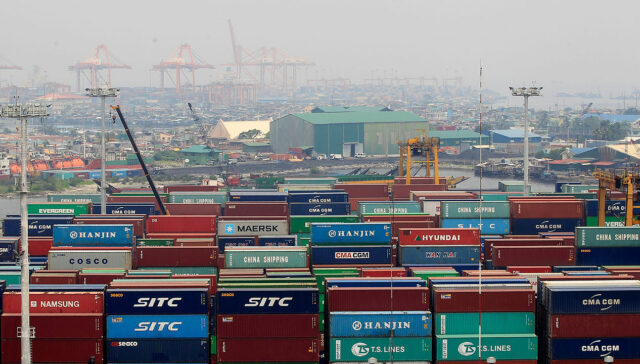
GLOBAL macroeconomic uncertainty due to trade concerns could affect corporate borrowers’ debt servicing capacity, Moody’s Ratings said. — REUTERS

PHILIPPINE BANKS face moderate risk from their exposure to corporates as the uncertain global macroeconomic environment could affect businesses’ capacity to repay their debt, Moody’s Ratings said.

“Banks in Indonesia and the Philippines face a moderate level of risk, despite having lower levels of corporate leverage relative to regional peers,” Moody’s Ratings said in a report dated Oct. 6.

“For the Philippines, corporate asset risks stem from high counterparty concentration which could result in material credit impact on banks in the event of corporate default,” it added.

The debt watcher said Philippine banks’ operating environment is stable. However, in terms of risk factors, it flagged moderate risks from the pace of corporate debt growth, the proportion of nonperforming and underperforming corporate loans, and capitalization and loan loss buffers.

Meanwhile, it sees low risks from corporate leverage levels, the proportion of debt to corporates with weak debt servicing capacity, and foreign currency debt risks.

Moody’s Ratings said the ongoing global trade uncertainty could affect economic credit conditions in Southeast Asia, which would affect companies’ debt servicing ability.

However, the potential impact could be less in countries like the Philippines as its economy is more domestically driven with low reliance on trade, compared to those with significant trade exposure to the United States and China, like Vietnam and Thailand.

This comes even as banks in the Philippines have the greatest exposure to corporate loans in the region, making up 73% of total system loans at end-2024, Moody’s Ratings said.

“This increases the banks’ vulnerability to corporate asset risks amid a deterioration in the financial health and debt repayment abilities of corporates, where the credit impact could be material given the much larger ticket sizes of these exposures relative to non-corporate borrower segments.”

It, however, noted that this share is beginning to decline as Philippines banks are now focusing on growing their retail lending portfolios to boost their margins as interest rates go down.

Meanwhile, the growth in new corporate nonperforming loans (NPLs) is also expected to be contained amid supportive operating conditions and easing interest rates, Moody’s Ratings added.

“Corporate NPLs have moderated over the past few years, and in 2024, delinquencies in the corporate segment were below the systemwide average in most banking systems. This was partly because of a post-pandemic recovery in economic activity, as well as an uptick in retail delinquencies, particularly in the Philippines, Vietnam, Thailand and India,” it said.

“For most economies in the region, we expect corporate NPLs to remain below the systemwide average as the majority of corporates have adequate financial buffers to cope with rapidly changing economic and trade conditions, compared to SME (small and medium enterprises) and retail borrowers… Most banks in the region maintain adequate loss-absorption buffers to withstand some asset quality deterioration.”

It added that Philippine banks have a lower proportion of outstanding debt associated with corporates that have weak debt servicing capacity compared to regional peers, even as they have sizable exposure to the construction and real estate sectors, which are cyclical and account for a higher proportion of debt at risk.

In the region, Moody’s Ratings said banks in Vietnam face high corporate asset risks due to the rapid growth of corporate debt, their high exposure to borrowers from both trade-oriented and cyclical sectors, and their weak loan loss coverage and capital buffers. — K.K. Chan

British author Jilly Cooper, famous for novels of sex and snobbery, 88

A NEW generation discovered Jilly Cooper’s books after Rivals was made into a series by Disney+ in 2024.

LONDON — Jilly Cooper, the British author of novels such as Rivals and Riders whose 1980s bestsellers were a blend of sex, satire, and class-based snobbery, has died aged 88, her agent said in a statement on Monday.

Ms. Cooper, a longstanding friend of Britain’s Queen Camilla, sold 11 million copies of her books in Britain alone.

From the mid-1980s, her raunchy novels depicting the romantic adventures of an upper-class set of characters in the fictional county of Rutshire, modelled on Gloucestershire where she and Camilla both lived, gained huge commercial success.

QUEEN PLAYS TRIBUTE TO ‘LEGEND’
Camilla called Ms. Cooper, a life-long dog-lover who was a guest at her 2005 marriage to King Charles, a “wonderfully witty and compassionate friend,” in a statement issued by Buckingham Palace.

“Very few writers get to be a legend in their own lifetime but Jilly was one, creating a whole new genre of literature,” Camilla said. “May her hereafter be filled with impossibly handsome men and devoted dogs.”

Last year, Rivals found a new generation of fans when it was made into a series for Disney+. Sales of books published decades before shot up once again, as the themes of adultery and class rivalry thrilled younger audiences.

“You wouldn’t expect books categorized as ‘bonkbusters’ to have so emphatically stood the test of time but Jilly wrote with acuity and insight about all things,” Ms. Cooper’s agent, Felicity Blunt at Curtis Brown, said in the statement.

Ms. Cooper was born in Essex in 1937. In the 1960s, she was a newspaper columnist for the Sunday Times, commenting on marriage, sex, and household chores, before she started writing novels in the 1970s.

It was not until Riders in 1985 that she had her breakthrough. At the center of the story was Rupert Campbell-Black, a handsome, ruthless showjumper and womanizer, who lives in his family’s manor house in Rutshire.

“There’s far less bonking now. People are so serious. I think we need more joy,” Ms. Cooper said last year.

LIFE IN THE COTSWOLDS
Ms. Cooper had moved to Gloucestershire, in the wealthy Cotswolds area of western England, with her husband, Leo Cooper, a publisher of military history books in the early 1980s, and it was there she met Camilla.

Life amongst the aristocratic country estates and the honey-colored villages of the area inspired her novels, Ms. Cooper said.

At that time Camilla was married to her first husband, Andrew Parker Bowles. Speaking on a podcast last year, Ms. Cooper compared him to her most famous character, the dashing rogue Rupert Campbell-Black.

“He’s been a great friend for a long time… so he’s very like Rupert. He’s beautiful and blond and stunning,” she said of the queen’s first husband.

Ms. Cooper wrote more than 40 books, many of them produced in a summerhouse at the bottom of her garden while she listened to classical music.

Prime Minister Keir Starmer’s spokesman on Monday called Ms. Cooper “a literary force,” whose wit, warmth and wisdom brought joy to millions.

She died after a fall on Sunday, her agent’s statement said. She and her husband had married in 1961 and had two adopted children. He died in 2013.

Filming for the sequel to Rivals began earlier this year. — Reuters

The case for nuclear power as a strategic baseload imperative

BW FILE PHOTO

The Philippines, despite its own challenges, is on track to achieve upper middle-income status by the end of this year or in 2026 — a milestone defined by the World Bank based on gross national income per capita. Beyond economic symbolism, this signals real improvements in the quality of life for many Filipinos. But to sustain this momentum, one crucial factor stands out: a stable, reliable, and affordable energy supply.

Energy underpins industrial competitiveness, digital transformation, inclusive development, and our attractiveness to large-scale, job-generating investments. Simply put, economic progress cannot be sustained without a robust baseload power generation system.

At the same time, power generation must align with the government’s emission goals and the move towards reducing our dependence on coal-fired power plants that emit greenhouse gases into the atmosphere.

The Philippine Energy Plan (PEP) 2023-2050 recognizes the urgency of transforming the sector in the decades ahead. It envisions an energy future that is affordable, reliable, resilient, and sustainable, with nuclear power integrated as a strategic component of the clean energy transition.

Under the PEP, the government has set ambitious targets: 35% of the energy mix from renewables by 2030, rising to 50% by 2040, and surpassing half of the total mix by 2050. But bridging the gap between ambition and reality remains a challenge. Many renewable sources — while promising — are still in the early stages of development and come with high costs. This creates an urgent need for a stable, low-carbon power source to complement the transition. Nuclear energy, with its ability to deliver clean and consistent baseload power, is uniquely suited to fill that role.

Public support for nuclear energy is also clear. A May 2024 Social Weather Stations survey commissioned by the Department of Energy found that 70% of Filipinos favor nuclear energy as part of the country’s power mix. Beyond power generation, nuclear energy can reduce oil imports, create high-quality jobs, and support climate action.

The government has responded with serious intent. Last month, President Ferdinand Marcos, Jr. signed Republic Act 12305, or the Philippine National Nuclear Energy Safety Act, laying down the regulatory framework for nuclear integration. This is a landmark development.

Building on this, Energy Secretary Sharon Garin issued her first policy directive following her confirmation — Department Circular 2025-10-0019 — during the 2nd International Nuclear Supply Chain Forum held on Oct. 2-3. The Circular creates the enabling framework for the country’s first commercial nuclear power project (NPP), the Pioneer NPP, which will be prioritized as a baseload plant regardless of the technology chosen. Ms. Garin has also committed the Department’s support for offtake agreements to help bring the project to viability.

But the government cannot embark on this nuclear journey alone.

Nuclear development demands a whole-of-society effort. Industry, foreign partners, the academe, and civil society must work together to build a secure, future-ready nuclear supply chain for the benefit of generations to come.

The private sector has already stepped up. In April 2025, Meralco launched its Nuclear Energy Strategic Transition (NEST) program — its flagship initiative to explore nuclear power as a long-term, low-carbon solution. NEST follows a multi-track approach: evaluating large-scale greenfield projects with international partners, assessing the potential of Small Modular Reactors (SMRs), and studying the possible rehabilitation of the Bataan Nuclear Power Plant.

Meralco is reinforcing its commitment through partnerships with leading South Korean institutions. Via the Meralco Power Academy, it recently signed an MoU with KEPCO International Nuclear Graduate School (KINGS) to launch the FISSION Program (Filipino Scholars and Interns on Nuclear Engineering), sending scholars abroad starting March 2026. Strategic agreements are also underway to explore SMR deployment in the Philippines.

On the diplomatic front, the Philippines has formalized partnerships with the US and Canada through the 123 Agreement and Administrative Agreement, respectively. The Department of Energy is also pursuing similar arrangements with South Korea and Japan — two countries with proven nuclear programs and technology.

These partnerships not only accelerate technical capacity but also underscore a broader strategic imperative: energy security in a time of geopolitical uncertainty. In a region facing volatile fuel markets and heightened competition for resources, nuclear energy provides a hedge — giving the Philippines greater control over its energy future while reducing vulnerability to external shocks.

Next year will be a test of readiness. After years of planning and partnership-building, the real work of developing nuclear infrastructure that delivers — on budget, on time, and on target, must now begin.

This phase requires decisive, coordinated implementation anchored in consistency of purpose and disciplined action. Nuclear energy must move from the margins of policy to the center of execution, supported by capable institutions and long-term planning.

The challenge is not only technical. It is institutional and political. Advancing this agenda will require coordination across agencies, consistency across administrations, and a recognition that energy security is a strategic imperative. If we get this right, we won’t just meet immediate demand — we will reshape our energy landscape to support a new era of inclusive prosperity


Victor Andres “Dindo” C. Manhit is the president of the Stratbase ADR Institute.

MacroAsia breaks ground on P2-B Iloilo water project

MacroAsia’s waterworks system in Solano, Nueva Vizcaya. — MACROASIACORP.COM

MACROASIA CORP. has broken ground on the P2-billion New Earth Iloilo Water Supply Project, which aims to address the rising water demand in Iloilo.

The project is being implemented by New Earth Water System, Inc. (NEWS), a wholly owned subsidiary of Boracay Tubi System, Inc. (BTSI), which is majority owned by MacroAsia.

“This facility will not only close the immediate supply gap, but will also provide Iloilo with resilient and sustainable water infrastructure for the future,” NEWS and BTSI Chairman Eduardo Luis T. Luy said in a statement on Tuesday.

The project’s first phase involves the construction and development of a water treatment facility with an initial capacity of 37.5 million liters per day (MLD), expandable up to 50 MLD.

NEWS will also build transmission lines and a distribution network of pipelines to deliver treated water to off-take points of the supply system.

The project is expected to be completed within two years. Once finished, NEWS will hold the necessary water rights and permits in Iloilo, including a certificate of public convenience that will allow it to supply, treat, and distribute water to Iloilo City and nearby municipalities such as Sta. Barbara, Pavia, Oton, Leganes, Cabatuan, Maasin, and San Miguel.

“Once operational, the facility is expected to help address the current water supply shortfall in Iloilo, which has affected households and businesses in underserved areas,” it said.

MacroAsia said the project’s tariff structure will remain competitive, balancing affordability and sustainability for consumers.

“The New Earth Iloilo Water Supply Project is expected to enhance public health and sanitation, support economic development, and strengthen the province’s resilience against water scarcity,” the company said.

MacroAsia’s core businesses include aircraft maintenance, repair, and overhaul (MRO); airline and institutional catering; ground handling; property development and leasing; and water utility services.

At the stock exchange on Tuesday, shares in MacroAsia rose by four centavos or 0.95% to close at P4.25 each. — Ashley Erika O. Jose

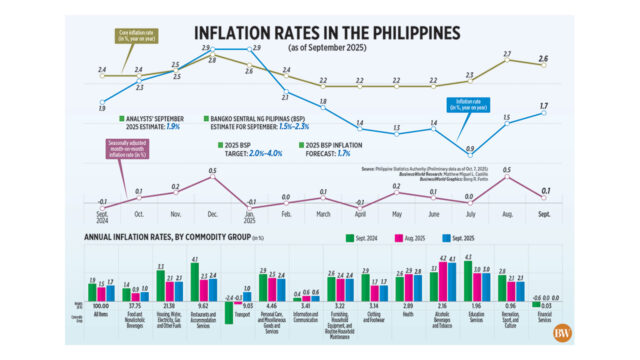
Inflation Rates in the Philippines

HEADLINE INFLATION accelerated to a six-month high in September, mainly due to costlier fuel and vegetables, but remained below the central bank’s 2-4% target, the Philippine Statistics Authority (PSA) said on Tuesday. Read the full story.

Inflation Rates in the Philippines

HitPay teams up with Ingenico to roll out payment system for SMEs

HitPay

HITPAY Payment Solutions, Inc. has partnered with financial technology company Ingenico to launch an all-in-one system that will allow small and medium enterprises (SMEs) to accept major types of payments like cards and e-wallets for transactions.

The payments system, available via an integrated smart terminal, lets merchants process transactions made via major credit and debit cards, e-wallet QRs, and even cross-border payments.

The smart terminal also allows SMEs to manage end-to-end operations from a single platform, including unifying online and offline payment methods, issuing invoices, and automating recurring billings.

HitPay said this would help improve small businesses’ cash flow and operations. The partnership also leverages Ingenico’s global payments network and HitPay’s network made up of 25 regional payment partners to allow SMEs to serve both domestic customers and tourists.

“As the Philippines accelerates its ‘cash-lite’ goal, SMEs need to provide choice, speed, and security at checkout without being overwhelmed by complex software, multiple reconciliation steps, and high integration costs,” HitPay Co-Founder and Chief Executive Officer Aditya Haripurkar said in a statement.

“Our collaboration with Ingenico goes beyond terminals and transactions; it is about democratizing access to enterprise-grade tools, giving SMEs the confidence to play their full part in the Philippines’ digital future,” Mr. Haripurkar said.

Hitpay has already rolled out the terminal to businesses in industries like retail, food & beverage, and travel. “The partnership aims to equip 10,000 SMEs in the Philippines in the next two years.”

“Ingenico’s mission has always been to simplify payments for businesses of every size. By working with HitPay and leveraging a comprehensive network of payment and banking partners, we’re giving Filipino SMEs access to secure and innovative tools that allow them to grow and stay relevant in a fast-changing market,” Ingenico Southeast Asia Channel Markets Head Xavier Michel said.

HitPay has an operator of payment system license from the Bangko Sentral ng Pilipinas. — Aaron Michael C. Sy

Olympian Ilona Maher gets her own Barbie doll

TEAM BARBIE Members (L-R): Ellie Kildunne, Ilona Maher, Nassira Konde and Portia Woodman-Wickliffe. — CORPORATE.MATTEL.COM

NEW YORK — American Olympian Ilona Maher is taking the leap from the rugby pitch to the toy-store shelves, as the bronze medalist was honored with her own signature Barbie doll on Monday.

Ms. Maher conquered the social media game in her last two Olympic appearances, bringing her sport to new heights in a country where rugby rarely breaks through to the mainstream. She picked up her bronze with the US team in Paris.

“It’s going to feel really real when I get to give it to a young girl,” said Ms. Maher, one of the most recognisable figures in her sport. “For them to get to enjoy the Barbie, see themselves in the Barbie, that’s when I think I’ll have a tear in my eye.”

The Maher Barbie doll, made by Mattel, will be available at retailers next year.

Featuring her signature red lipstick and braided ponytail, Ms. Maher insisted that the doll have her broad shoulders and muscular frame, advancing her mission of body positivity.

“We wanted to see that in the Barbie and they did such a good job with it. I mean, she’s been hitting the gym,” she told Reuters.

“I just wanted to make sure I felt seen in the Barbie and that I feel proud to give this to somebody else so that they feel like they see themselves in it as well.”

The 29-year-old praised the manufacturer’s attention to detail, with the doll appearing game-ready with knee-pads and precise replicas of her Adidas cleats.

Three other rugby players — England’s Ellie Kildunne, New Zealand’s Portia Woodman-Wickliffe, and France’s Nassira Konde — will also be immortalized in doll-form in celebration of International Day of the Girl, though Ms. Maher’s is the only doll that will be at retailers in fall 2026.

“Barbies are the ultimate image of beauty and femininity. And so that’s what we grew up seeing every day,” said Ms. Maher.

“What I want is that when girls play with this and they see my Barbie and the broad shoulders and the big arms, that can kind of shape their views of beauty as well.” — Reuters

The AI suicide problem knows no borders

FREEPIK

By Catherine Thorbecke

How are Chinese artificial intelligence (AI) developers protecting their most vulnerable users? A string of dystopian headlines in the US about suicide and youth mental health has put mounting pressure on Silicon Valley, but we’re not seeing a similar wave of cases in China. Initial testing suggests that they may be doing something right, although it’s just as likely such cases would never see the light of day in China’s tightly controlled media environment.

A wrenching wrongful death lawsuit against OpenAI filed by the parents of Adam Raine alleges that the 16-year-old died by suicide after the chatbot isolated him and helped plan his death. OpenAI told the New York Times it was “deeply saddened” by the tragedy, and promised a slew of updates, including parental controls.

I tried engaging with DeepSeek using some of the same so-called “jailbreak” methods that the American teen had reportedly employed to circumvent guardrails. Despite my prying, the popular Chinese platform didn’t waver, even if similarly I cloaked my queries under the guise of fiction writing. It constantly urged me to call a hotline. When I said I didn’t want to speak to anyone, it validated my feelings but still emphasized that it was an AI and cannot feel real emotions. It is “incredibly important that you connect with a person who can sit with you in this feeling with a human heart,” the chatbot said. “The healing power of human connection is irreplaceable.”

It encouraged me to bring up these dark thoughts with a family member, an old friend, a coworker, a doctor, or a therapist, and even practice with a hotline. “The most courageous thing you could do right now is not to become better at hiding, but to consider letting one person see a tiny, real part of you,” it stated.

My experiment is purely anecdotal. Raine engaged with ChatGPT for months, possibly eroding the tool’s built-in guardrails over time. Still, other researchers have seen similar results. The China Media Project prompted three of China’s most popular chatbots — DeepSeek, ByteDance Ltd.’s Doubao, and Baidu, Inc.’s Ernie 4.5 — with conversations in both English and Chinese. It found all were markedly more cautious in Chinese, repeatedly emphasizing the importance of reaching out to a real person. If there’s a lesson, it’s that these tools have been trained not to pretend to be human when they’re not.

There are widespread reports that Chinese youth, grappling with rat-race “involution” pressures and an uncertain economy, have been increasingly turning to AI tools for therapy and companionship. The technology’s diffusion is a top government priority, meaning agonizing headlines of things going wrong are less likely to surface. DeepSeek’s own research has suggested that open-source models, which proliferate throughout China’s AI ecosystem, “face more severe jailbreak security challenges than closed-source models.” Put together, it’s likely that China’s safety guardrails are being pressure-tested domestically, and stories like Raine’s simply aren’t making it into the public sphere.

But the government doesn’t seem to be ignoring the issue either. Last month, the Cyberspace Administration of China released an updated framework on AI safety. The document, published in conjunction with a team of researchers from academia and the private sector, was notable in that it included an English translation, signaling it was meant for an international audience. The agency identified a fresh series of ethical risks, including that AI products based on “anthropomorphic interaction” can foster emotional dependence and influence users’ behavior. This suggests that officials are tracking the same global headlines, or seeing similar problems festering at home.

Protecting vulnerable users from psychological dangers isn’t just a moral responsibility for the AI industry. It’s a business and political one. In Washington, parents who say their children were driven to self-harm from interactions with chatbots have given powerful testimonies. US regulators have long faced criticism for ignoring youth risks during the social media era, although they’re unlikely to stay quiet this time as lawsuits and public outrage mount. And American AI companies can’t criticize the dangers of Chinese tools if they’re neglecting potential psychological harms at home.

Beijing, meanwhile, hopes to be a world leader in AI safety and governance, and export its low-cost models around the world. But these risks can’t be swept under the rug as the tools go global. China must offer transparency if it is truly leading the way in responsible development.

Framing the problem through the lens of a US-China race misses the point. If anything, it allows companies to use geopolitical rivalry as an excuse to dodge scrutiny and speed ahead with AI development. Such a backdrop puts more young people at risk of becoming collateral damage.

An outsize amount of public attention has been paid to frontier AI threats, such as the potential for these computer systems to go rogue. Bodies like the United Nations have spent years urging multilateral cooperation on mitigating catastrophic risks.

Protecting vulnerable people now, however, shouldn’t be divisive. More research on mitigating these risks and preventing jailbreaks must be open and shared. Our failure to find the middle ground is already costing lives.

BLOOMBERG OPINION

PHL students develop concrete panel to cut home energy use

A FUSION of microcapsules, cement and reclaimed waste engineered to cool. — JAMES DYSON AWARD

By Edg Adrian A. Eva, Reporter

A GROUP of students from Mindanao State University has developed a concrete panel designed to reduce indoor heat and cut household energy use, offering a potential low-cost solution to rising electricity demand driven by hotter temperatures.

Called ChillWise, the concrete panel minimizes heat transfer in homes and could lessen dependence on air-conditioning, co-developer John Joseph P. Banticil told BusinessWorld in an interview in Filipino. “It’s an innovative solution that addresses higher electricity consumption in every household, especially now that temperatures are rising.”

ChillWise was named one of two national runners-up in the Philippine leg of the 2025 James Dyson Award, an annual global competition for student inventors.

The team will advance to the international round, where winners will be announced on Nov. 5 and can receive as much as P2.16 million in prize money.

The ChillWise panel is a lightweight foamed concrete that contains air bubbles that act as natural insulation by slowing heat transfer. It also integrates a microencapsulated phase change material — a substance that absorbs and releases heat to stabilize indoor temperatures.

“Microencapsulated phase change material consists of tiny capsules that act like ice,” Mr. Banticil said. “When exposed to heat, they absorb it and melt, trapping the heat inside the wall.”

To enhance sustainability, the team incorporated rice hull ash and fly ash as fillers, which reduce costs, strengthen the panels and lower carbon emissions. In laboratory tests, ChillWise recorded up to 95% energy savings compared with conventional concrete, the developers said.

The project aligns with regional energy concerns. The International Energy Agency estimates that electricity demand for space cooling across Southeast Asia including the Philippines could surge to 300 terawatt-hours (TWh) by 2040, from about 80 TWh in 2020.

The agency has urged countries to adopt measures that improve building insulation and reduce cooling loads.

Co-developer Jayvimar B. Sumagang said the group plans to conduct market testing by using ChillWise panels in actual homes and buildings to assess user experience and durability.

“We would like to understand the needs, preferences and constraints of our target users,” he said. “Essentially, we are trying to achieve product-market fit.”

The patent process for ChillWise is under way, and the developers said they are exploring partnerships with government agencies and construction companies to bring the product to market.

Vivant to study other water sources amid Cebu supply gap

VIVANT.COM.PH

VIVANT WATER, a subsidiary of energy and water conglomerate Vivant Corp., plans to explore other potential sources of potable water aside from desalination to support Metro Cebu’s growing water supply needs.

“Actually, that is one of our goals for next year, where we want to identify other sources also of water that is not desalination for Metro Cebu,” Vivant Water President and Chief Operating Officer Jess Anthony N. Garcia told BusinessWorld last week.

Mr. Garcia said the company will conduct further feasibility studies and engage engineering consultants to determine whether other sources, such as rivers, can be developed.

He earlier said Metro Cebu faces a supply gap, with demand reaching about 500 to 600 million liters per day (MLD) while supply ranges from 100 to 250 MLD.

To help address the shortage, Vivant Water is developing a P2-billion desalination plant in Cordova, Cebu, designed to produce up to 20 MLD of potable water in its first phase — enough to meet the average daily consumption of around 20,000 households.

A desalination plant removes salt and other impurities from seawater to produce freshwater suitable for drinking and household use.

Mr. Garcia said the facility is expected to begin commercial operations by the fourth quarter this year, with potential expansion to up to 50 MLD.

Isla Mactan-Cordova Corp., a wholly owned subsidiary of Vivant Hydrocore Holdings, Inc. operating under the Vivant Water brand, oversees the project. Vivant Hydrocore is wholly owned by Vivant Infracore Holdings, Inc., the holding company for Vivant’s water-related investments.

In June, Vivant announced plans to invest about P10 billion over the next five years to expand its water infrastructure portfolio.

Vivant has investments in electric power generation and distribution, as well as the retail electricity market. It has also diversified into the water sector, with projects in bulk water supply, wastewater treatment, and water distribution. — Sheldeen Joy Talavera

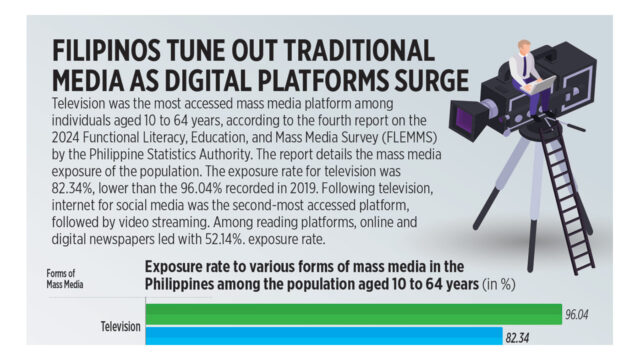
Filipinos Tune Out Traditional Media as Digital Platforms Surge

Television was the most accessed mass media platform among individuals aged 10 to 64 years, according to the fourth report on the 2024 Functional Literacy, Education, and Mass Media Survey (FLEMMS) by the Philippine Statistics Authority. The report details the mass media exposure of the population. The exposure rate for television was 82.34%, lower than the 96.04% recorded in 2019. Following television, internet for social media was the second-most accessed platform, followed by video streaming. Among reading platforms, online and digital newspapers led with 52.14%. exposure rate.

Filipinos Tune Out Traditional Media as Digital Platforms Surge

Private credit pivots from ‘risky’ West to emerging markets

Traders are seen in front of a screen with trading figures in red at Thailand Stock Exchange building in Bangkok, Thailand, March 13, 2020. — REUTERS

LONDON/NEW YORK — An intricate series of pipes off Angola’s Atlantic coast snakes toward a new fuel refinery that signals the country’s push for energy independence — and its use of private creditors, instead of banks, to fund a big-ticket project.

“We’re not the lender of last resort,” said Felipe Berliner, co-founder of emerging markets (EM) asset manager Gemcorp, which provided the bulk of funding for the refinery, using private capital. “Sometimes we are the only lender.”

Private credit for emerging markets — driven by investors’ hunt for yields and saturation in developed Western markets — could grow exponentially, veteran investors told Reuters, providing tens of billions in funding as bilateral lending and foreign aid shrink.

“This is a paradigm shift,” said Pramol Dhawan, head of emerging markets portfolio management at PIMCO. “The need to globally reallocate is not a hedge — it’s a secular thesis.”

PIMCO has committed around $30 billion across 140 emerging market deals in five years, and expects to boost annual lending by 30% this year to $10 billion. Other investors are targeting similar increases.

RAPID GROWTH, BUT YIELDS SQUEEZED
Private credit skyrocketed over the past 20 years, with global assets under management rising to over $1.2 trillion from $200 million in the early 2000s, according to the Bank for International Settlements.

The funding filled a gap for companies, mainly in the US, as banks limited lending due to regulations and capital requirements.

Today, emerging markets get less than 10% of that cash.

But the US and Europe are saturated; competition has driven down margins, and bets are riskier. Experts from JPMorgan CEO Jamie Dimon to the International Monetary Fund warn private credit looks shaky; the collapse of US firms Tricolor and First Brands underscored the risks.

Emerging markets, investors say, have bankable projects so keen for cash that you can pick and choose.

“Emerging market companies have been forced to be more fundamentally conservative,” said Matt Christ, portfolio manager at London-based global investment manager Ninety One. Developed markets are “priced for perfection,” while emerging markets offer more upside.

He said EM yields are 150-300 basis points higher than their developed market peers — and risk is often lower than ratings suggest.

Mr. Christ, whose private credit portfolio is around $8 billion globally, sees scope to expand to $15 billion. EM firms, he said, are used to volatility and political instability — unlike most Western firms.

“Developed market companies are going into an era they’ve never experienced before, but emerging market companies have been doing this for a long time,” he said.

Gustavo Ferraro, head of capital solutions at emerging markets-focused fund manager Gramercy, also said EM risk profiles and returns have surpassed those in developed markets.

“The US market isn’t the benchmark anymore,” he said. “Our (investors) want yield and uncorrelated exposure.”

Gramercy has doubled its private credit investment in five years to $4.8 billion, focusing on Latin America, Turkey and parts of Africa.

Ninety One said that in Turkey, where authorities are limiting bank lending to cool inflation, private credit is filling a gap.

FROM SOVEREIGNS TO SAUDI COMPANIES
Most EM private credit is asset-backed — giving investors anything from company shares to control over the project itself.

The structure favors infrastructure, but funding has gone to sovereign budgets and Turkish cities’ transport networks.

Angola’s new refinery, mostly funded by Gemcorp with state oil company Sonangol also providing funds, will ultimately run at 60,000 barrels per day and make sub-Saharan Africa’s No. 2 oil producer less reliant on costly fuel imports. The plant’s first phase, which cost $475 million, is due to start operation by the end of the year.

Gemcorp has also funded a wind farm in Lake Turkana in Kenya, a water sanitation project in Angola and power transmission between Angola and Namibia.

A Gemcorp survey showed 67% of EM private credit went to large or medium corporates, and 22% to sovereign or quasi-sovereign projects.

Gemcorp is launching a $1-billion fund targeting mid-market Saudi companies.

“They are underfunded, they don’t have access to the flexible capital they need to maintain growth from the government’s fiscal push,” Mr. Berliner said.

The firm also funds Central American commodity exports to the US, West African fuel prepayment deals and gold producers.

Mr. Berliner and others say private credit is flexible, fast and offers customized repayment terms — from upfront fees to extended maturities or EBITDA warrants (earnings before interest, taxes, depreciation, and amortization) — making it ideal for upstarts and lower-rated sovereigns.

“We’re not replacing banks anymore. We’re building something that didn’t exist,” Mr. Ferraro said. “This is bespoke financing for bespoke problems. That’s what EM has in abundance.”

Privately, some bond investors worry private credit — nimbler and less onerous than bonded debt — could eat into their business. Others fear bigger problems if borrowers hit trouble.

“If something goes wrong, like a big restructure, how does private credit deal with that? We don’t really know,” said Daniel Cash, associate professor of law at the UK’s Aston University, adding that the “much more opaque” lending could also create issues. — Reuters