Home Blog Page 3897

Building blocks for a new tomorrow

The new two-floor school building of Laguna Resettlement Community School (LRCS) features four fully equipped rooms with PWD-friendly facilities.

SM Foundation and SM Prime build new school building in Laguna

Overcrowded classrooms, insufficient learning time, inadequately designed learning spaces, and teacher dissatisfaction pose challenges to the Philippine education system.

With inadequate time for instruction, students are unable to grasp concepts thoroughly, leading to a compromised educational experience. Non-conducive learning environments contribute to an atmosphere that hampers intellectual growth. These challenges not only impact students’ academic performance but also the job satisfaction of teachers, who navigate these obstacles daily.

SM Prime and SM Foundation turn over the new school building in LRCS, helping the students receive adequate learning time necessary for a more comprehensive education.

Believing in the power of education, the SM group, through the collaboration of SM Prime and SM Foundation, continuously builds school buildings to help address the challenges faced by the education system in the Philippines. A testament to this is the school building they recently built at the Laguna Resettlement Community School (LRCS).

BEYOND THE STRUCTURE

LRCS has a sheer number of over 2,600 students packed into 52 classrooms, which Principal Rosalie Mabale says affects the performance of the learners and the job satisfaction of teachers.

The SM group strategically placed handwashing facility in LRCS to provide access to clean water while instilling healthy habits to raise a healthy community.

The school day for some pupils in grades 1 and 2 extends until 6 p.m., an unusually late hour for elementary school. This extended schedule leads to long working hours for teachers, leaving them with limited time to provide additional support to students who need it most.

“The intervention classes are very important as we intervene with the problems that may come along the way of learning. Ginagawa natin ito para hindi pa man dumarating ang problema, nabibigyan na natin ng solusyon,” Principal Rosalie shared, adding that lack of facilities hamper them from providing the quality of education they hope to give.

“Let’s say you have learners who are non-readers or non- numerates at natutukan sila dahil mayroon kang maayos na silid- aralan. Through this, masasabi mong you were able to make a difference in the lives of the learners kapag natuto silang magbasa at magsulat. Mabo-boost natin ang kanilang academic performance at maiiwasan natin ang bullying, na siyang makakatulong sa kanilang mental health,” she added.

The new school building fosters an environment conducive to effective learning.

By providing spacious and well-equipped facilities, students now have room for growth, fostering an environment conducive to effective learning. The expansion of school infrastructures has allowed LRCS to end class shifts in second grade, ensuring that students receive the adequate learning time necessary for a more comprehensive education.

Napakalaking factor na makakauwi na ang mga bata ng mas maaga at makakapahinga ang mga teachers sa tamang oras. Malaking factor ito sa mental health, quality of education, academic performance, and overall wellness of the children and teachers,” she smiled.

For LRCS, their new school building goes beyond the physical structure — it’s a symbol of something that is built to last.

“This building is not just about the school structure or the conducive learning environment. Ang pinakamalaking epekto nito ay nasa pagkatao ng mga bata. Through this building, they will be reminded that they are the next generation and the future leaders of the country, and they, too, can help the community they belong to,” she shared.

Joining the turnover ceremony are representatives from Laguna LGU; DepEd and SM group, including SM Center San Pedro Asst. Mall Manager Christian Liston; SM Foundation Executive Director for Education Programs Carmen Linda Atayde; San Pedro, Laguna Mayor Art Mercado and Vice-Mayor Ina Olivarez; and Laguna Resettlement Community School Principal Rosalie Mabale.

“Through their programs, they are making a difference in the lives of every Filipino learner, especially here in LRCS. Having this building helps nurture better individuals as they see that they belong to a community that genuinely cares for them. Initiatives like this help them learn about civic responsibility. When learners achieve their goals in the future, they will remember the value of giving back to the community,” she added.


Spotlight is BusinessWorld’s sponsored section that allows advertisers to amplify their brand and connect with BusinessWorld’s audience by enabling them to publish their stories directly on the BusinessWorld website. For more information, send an email to online@bworldonline.com.

Join us on Viber at https://bit.ly/3hv6bLA to get more updates and subscribe to BusinessWorld’s titles and get exclusive content through www.bworld-x.com.

New bank rules are bad for the West, worse for the rest

REDD F-UNSPLASH

WALL STREET’s most powerful bankers told the Senate Banking Committee last week that proposed new rules known as the “Basel III endgame” would hurt average Americans. JPMorgan Chase & Co. CEO Jamie Dimon warned that by demanding banks expand their capital cushions, the regulations would raise the costs of “your local affordable housing, or the Montana pension plan.”

While that may very well be true, at least those Montana pensioners have people in the Senate supposedly looking out for their interests. The bigger problem with the way countries are implementing Basel III regulations is that nobody’s looking out for the interests of borrowers outside their own borders. That hurts everyone — borrowers, lenders, and even the planet.

Back before the financial crisis, developed-world banks played a central role in financing the growth of emerging economies. In 2006, for example, Indian companies and households borrowed almost as much from foreign banks as they did from domestic institutions.

Crucially, foreign banks often contributed more than domestic institutions to financing long-term, growth-enhancing infrastructure projects. Sometimes as much as a third of external borrowing in India supported the infrastructure sector.

In recent years, as various Basel III rules have been introduced around the world, that lending has begun to dry up. When banks were told that they needed to fund long-term, illiquid lending with more secure, higher-cost assets, they cut down sharply on the longer-duration loans essential for infrastructure projects. Few stayed interested in loan tenors of 15 years, and even tenors of five to seven years received far fewer takers.

The rich world may not have noticed because, of course, public spending on domestic infrastructure in Europe and the US has vastly increased in recent years. But emerging markets certainly have. Cross-border syndicated loans to developing countries — often used as a way to get foreign bankers into projects in emerging economies — fell as a proportion of the total from almost 90% in the 2000s to just over half by 2014.

New ways of weighting the risk attached to various assets — such as those the Basel III endgame proposes to implement for US banks — threaten to penalize the poorest countries the most. One study by the G20’s Global Infrastructure Hub found that if banks used actual historical data instead of the new mechanisms, it might make a 37% difference in how they evaluated their possible losses from loans to infrastructure in developing countries, but only 11% in loans to high-income ones.

Shouldn’t we in the emerging world be tapping the bond market instead of banks to fund infrastructure? Such advice is perfectly reasonable — and, given realities on the ground, absolutely useless. The regulatory and financial capacity that would be required is beyond most developing countries. Meanwhile, everyone has banks and banking regulators.

In any case, fast-growing emerging markets have governments that need to borrow more and thereby take up all the oxygen that would otherwise have kept a non-government bond market alive. That’s why bank loans have remained the primary financing instrument for infrastructure in emerging economies, even if fewer foreign banks are in the mix.

Why should it matter if the developing world has to rely on its own scarce resources to build the trillions of dollars of infrastructure it needs? Is there any reason the Senate Banking Committee, say, should care?

Well, yes. In the 2000s, banks could lend to infrastructure abroad at margins of 50 basis points; that rose by 2016 to 250 to 300 basis points. When you add this much friction, bankers stop looking for the best projects, only the safest ones — and lazy banking means that savers earn less.

US senators — and regulators in Brussels, as well — should ask themselves how many remunerative projects their financial sectors will lose out on in the post-Basel III era, and what that means for the savings of their aging citizens. Are regulators punishing banks for the financial crisis, or are they punishing pensioners?

If both borrowers in the developing world and savers in the West are hurt by the mindless application of Basel III principles, so is the fight against climate change. Green infrastructure — such as solar energy — has particularly high initial costs. Without more long-term lending across borders, countries in the Global South are not going to be able to afford the infrastructure they need to mitigate carbon emissions and adapt to climate change.

Policymakers should consider how endless restrictions aimed at preventing a future financial crisis are worsening a climate crisis that threatens devastating impacts now. Their zeal for a safer banking sector may be fueling risks that are far harder to contain.

BLOOMBERG OPINION

Managing without regular employees

We’re a three-year-old family business. Outside of family members, our 65 workers are all temps, casual employees, part-timers and project workers. We rely much on manpower agencies and third-party service providers to handle our operations. Is it possible for us to continue with this arrangement without necessarily hiring full-time, regular workers? What are the adverse implications, if we keep operating with non-regular workers? — Cheap Skate.

Sooner or later, you’ll be in legal trouble with labor authorities, who may receive complaints from “employees” working under your roof. This is possible when your management team ignores the so-called “four-fold test” of establishing the existence of an employer-employee relationship.

The four criteria of the test are as follows: One, selection and engagement of employees. Two, payment of their wages and benefits. Three, the power of dismissal. And four, the power to control the employee’s conduct.

Even if you have a decent number of regular workers but they’re outnumbered by atypical workers like those provided by manpower agencies and cooperatives, it could raise possible issues in the near future. That’s why you should exercise extreme caution in maintaining a workforce composed of non-regular employees.

If I were to have my way, I’d aim for a ratio of 80-20 (regular workforce vs. temps), which will likely be sufficient to persuade labor authorities, tripartite bodies or industry labor-management councils that you’re not abusing the temp system.

WASTAGE INDEX
Any organization fully relying on temps does not understand employee motivation. Who would want to continue working for a manpower agency or a cooperative for only the most basic wages and benefits and limited career opportunities?

You must consider the experience accumulated by temps that is wasted if and when they decide to move to some other employer who can give them much better compensation and career opportunities. This will be made clear when you compute the company’s wastage index, a measure of how well you maintain temps and other contractual workers.

Let’s say you have 500 temps at the start of the year. By Dec. 31, 60 temps have resigned voluntarily and have been honorably discharged, for various reasons. This translates to a 12% turnover rate, sometimes called the wastage index — representing the loss of experienced and talented people.

Why do we consider it wastage? Take the issue of training.  How can your work teams function effectively if the temps continually come and go? Imagine the hassle. This may not be a big issue in the case of simple manual operations in organizations like fast food restaurants and department stores.

But then, how about other businesses like high-technology manufacturing or service jobs requiring special skills for customer relations?

Imagine the investment in training that you had to make. This problem is magnified with the continued inflow of new temps requiring fresh training, even if you classify this as an employment cost and not an investment. Double check whether the cost does not in any way wipe out the advantages of hiring temps.

Another reason to be dubious about an all-temp company is that customer service is no simple task that can be left to workers whose continued presence is dependent on your contract with the service provider. Another issue is their motivation to perform their duties when their minds are focused on finding better employment.

Therefore, your best approach is to periodically assess your options when relying on temps.

LABOR SUPPLY
Unemployment in this country is high even in normal economic situations. That means an abundance of people looking for jobs. Many are eager to be employed full time but only a handful are chosen because the majority lack the skills required for the tasks at hand.

Looking for the best person for the job is a difficult challenge for many organizations. This can be easily demonstrated by thousands of job ads posted on social and print media every day.

Even if you’re focused on maintaining only temps for your organization, there will come a time that you’ll need the right number of people who would want to be hired directly  rather than by manpower agencies, cooperatives or other third-party service providers. If that happens, what would you do?


Bring Rey Elbo’s leadership program on “Superior Subordinate Supervision” to your management team. Or chat your workplace issues via Facebook, LinkedIn, X (Twitter) or e-mail elbonomics@gmail.com or via https://reyelbo.com

How PSEi member stocks performed — December 14, 2023

Here’s a quick glance at how PSEi stocks fared on Thursday, December 14, 2023.


Philippines ranks near bottom of Corporate Governance Index

THE Philippines has kept the 11th spot but at a lower overall score in a ranking of 12 Asia-Pacific countries on their performance in corporate governance (CG) and environmental, social, and corporate governance (ESG). Read the full story.


Philippines ranks near bottom of Corporate Governance Index

PHL stocks rebound as Fed hints at policy easing

REUTERS

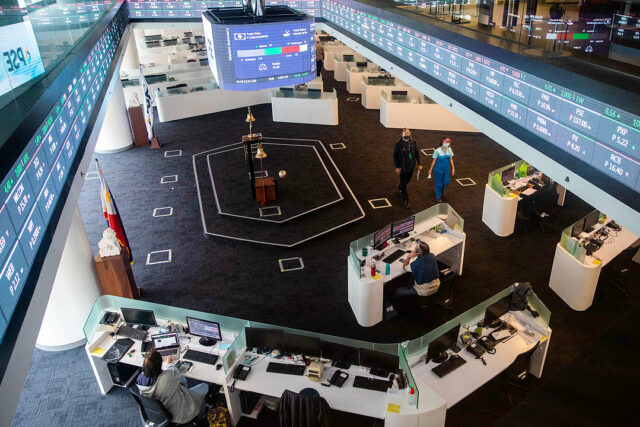
PHILIPPINE SHARES rebounded on Thursday on improved investor sentiment as the US Federal Reserve kept rates steady at its final meeting this year, with its chief saying they are done hiking borrowing costs.

The Philippine Stock Exchange index rose by 154.74 points or 2.47% to end at 6,410.48 on Thursday, while the broader all shares index climbed by 55.82 points or 1.67% to close at 3,394.96. 

“This Thursday, the local market rose by 154.74 points to 6,410.48 as investors cheered the Federal Reserve’s dovish outlook after it held policy rates unchanged in its recent meeting. The Federal Reserve stated that they anticipate three possible rate cuts for 2024, to be done in 25-basis-point (bp) increments,” Philstocks Financial, Inc. Research and Engagement Officer Mikhail Philippe Q. Plopenio said in a Viber message.

“This gave hope that the Fed may ease their policy soon after more than a year-long combat against inflation. As a result, the bourse was in the green territory for the whole session and even breached the 6,400 resistance level,” he added. 

The Federal Reserve left interest rates unchanged on Wednesday and US central bank chief Jerome H. Powell said the historic tightening of monetary policy is likely over as inflation falls faster than expected and with a discussion of cuts in borrowing costs coming “into view,” Reuters reported.

“People are not writing down rate hikes” in their latest economic projections, Mr. Powell said in a press conference following the end of the central bank’s final policy meeting of the year.

“That’s us thinking we’ve done enough,” he said, adding that rate increases were “not the base case anymore.”

“Locally, investors bought into the assumption that the Bangko Sentral ng Pilipinas (BSP) would follow in a similar fashion, maintaining its own policy rate, but reducing this next year,” Regina Capital Development Corp. Head of Sales Luis A. Limlingan said in a Viber message.

The BSP on Thursday kept its policy rate steady at a 16-year high of 6.5% for a second straight meeting, as expected by 15 of 17 analysts in a BusinessWorld poll conducted last week, but said there is a need to remain hawkish amid lingering upside risks to inflation.

Most sectoral indices ended higher on Thursday. Holding firms increased by 228.11 points or 3.82% to 6,185.79; property rose by 96.92 points or 3.51% to 2,851.14; financials went up by 27.77 points or 1.64% to 1,719.58; industrials gained 144.33 points or 1.64% to end at 8,926.87; and mining and oil climbed by 61.44 points or 0.64% to 9,573.89. 

Meanwhile, services slipped by 6.28 points or 0.4% to 1,546.28.

Value turnover went up to P6.78 billion on Thursday with 385.71 million issues changing hands from the P3.55 billion with 245.11 million shares seen the previous day.

Advancers overwhelmed decliners, 120 against 59, while 44 names ended unchanged.

Net foreign selling climbed to P367.52 million on Thursday from P280.55 million on Wednesday. — with Reuters

Peso recovers as Fed, BSP keep key rates unchanged

THE PESO recovered against the dollar on Thursday as both the US Federal Reserve and the Bangko Sentral ng Pilipinas (BSP) kept rates unchanged at their policy meetings.

The local unit closed at P55.795 per dollar on Thursday, strengthening by 26 centavos from P56.055 on Wednesday, based on Bankers Association of the Philippines data.

The peso opened Thursday’s session at P55.75 against the dollar. Its intraday best was at P55.62, while its worst showing was at P55.80 versus the greenback.

Dollars exchanged went down to $1.48 billion on Thursday from $1.6 billion on Wednesday.

“Today, the pair tapered off as volatility overnight saw the dollar weaken after the US Fed held rates steady while signaling that their next move will be rate cuts,” Security Bank Corp. Chief Economist Robert Dan J. Roces likewise said in a Viber message on Thursday.

The US central bank kept the fed funds rate steady at the 5.25%-5.5% range for a third straight time during its Dec. 12-13 meeting, with Fed Chair Jerome H. Powell saying they are likely done hiking borrowing costs.

The Fed raised rates by a total of 525 basis points (bps) from March 2022 to July 2023.

The peso was supported by the BSP’s hawkish rhetoric after its meeting on Thursday, Rizal Commercial Banking Corp. Chief Economist Michael L. Ricafort said in a Viber message.

The BSP on Thursday kept its policy rate steady at a 16-year high of 6.5% for a second straight meeting, as expected by 15 of 17 analysts in a BusinessWorld poll last week, but said they remain cautious amid lingering upside risks to inflation.

The Monetary Board has raised benchmark interest rates by 450 bps since it began its tightening cycle in May 2022.

For Friday, Mr. Roces said the peso could continue to get a lift from the BSP’s hawkish stance. He expects the peso to move between P55.50 and P55.80, while Mr. Ricafort sees it ranging from P55.70 to P55.90. — A.M.C. Sy

Maharlika’s Consing outlines fund’s proposed structure

Rafael D. Consing, Jr. — COURTESY OF THE PRESIDENTIAL COMMUNICATIONS OFFICE

By Luisa Maria Jacinta C. Jocson, Reporter

THE Maharlika Investment Corp. (MIC) is hoping to organize itself along the lines of a unit investment trust fund to steer the sovereign wealth fund towards a “sectoral and tactical” approach in investing.

“I’m going to be proposing a structure where it’s going to be a unitized fund. What I’ve presented at least to the advisory board is a sectoral approach and a tactical approach,” MIC President and Chief Executive Officer Rafael Jose D. Consing, Jr. said in an appearance on ANC late Wednesday.

“In the tactical approach,… you can create an MIF for infrastructure, an MIF for energy. So (co-investors) that have very specific objectives can then invest in those,” he added.

Mr. Consing has said that he targets a doubling in the MIC’s seed capital to P250 billion over the next two years.

Under the law creating the Maharlika Investment Fund (MIF), the P125-billion initial funding will be provided by the Land Bank of the Philippines and Development Bank of the Philippines, which will supply P50 billion and P25 billion, respectively. The National Government is also being counted on for P50 billion.

The MIC has an authorized capital stock of P500 billion.

Mr. Consing said he plans to tap domestic and overseas funding to raise the MIC’s capital.

“You’ve got both institutional and retail investors, so they’re coming in at the same price. This is not going to be like an initial public offering (IPO), because they’re not actually buying shares, they’re buying participation in unit trust funds,” he said.

He cited the need to address energy issues to attract more investors.

“Of the pain points investors have identified… Number one is the cost of energy; and number two is the need for their products to be acceptable in more developed economies (through the greater use of) mostly renewable power,” he said.

“One of the things we want to do is distributive generation, meaning create renewable capacity or renewable energy for ecozones directly,” he added.

Mr. Consing has also floated proposals for agro-forestry industrial urbanism projects.

“What it is is creating clusters making use of idle government land, turning them into clusters to (create) a ‘mega ecozone,’” he said.

“Within that, develop agricultural facilities where you basically put together the farmers and those that process their products to reduce their logistics cost and similarly reduce the need for middlemen. The benefits of that are improved climate, cleaner air and the generation of carbon credits we can sell; from there we can generate additional capital to reinvest,” he added.

Mr. Consing also said townships within the mega ecozones will allow people to live where they work.

The MIC is focusing its investments on tourism infrastructure, agro-urbanism, energy security, and digital infrastructure.

It is expected to be operational before year’s end.

Solar seen filling shortfall in hydro output during El Niño

TRINA SOLAR FB PAGE

By Sheldeen Joy Talavera, Reporter

THE Department of Energy (DoE) said power supply shortfalls resulting from El Niño’s impact on hydropower are expected to be filled by new solar power plants.

Our challenge here in El Niño is the need to run all our sources of power that are available to us during this period,” Energy Secretary Raphael P.M. Lotilla said in a briefing on Thursday.

“We are not depending on hydropower plants precisely because there has been an advisory from PAGASA to prepare for the El Niño. That is why we are not using the Angat power plant for now,” he said.

PAGASA (Philippine Atmospheric, Geophysical and Astronomical Services Administration), the government weather service, forecasts a moderate El Niño, possibly intensifying in the coming months. 

The Angat hydroelectric power plant in Bulacan was shut down on Nov. 6 and is due to return to service on Jan. 6. It is undergoing major repairs and rehabilitation of its penstock.

Irma C. Exconde, director of the Electric Power Industry Management Bureau, said the bureau is assuming hydroelectric power plants will be derated 70% during the dry spell, equivalent to 300 megawatts (MW) of dependable capacity.

“We have been monitoring hydropower plants because of the preparations for El Niño and we have assumed a 70% deration, particularly the large ones in Luzon and Mindanao,” she said.

Ms. Exconde said the bureau does not expect red or yellow alerts “because of the power plants coming in 2024.”

Yellow alerts are issued when reserves fall below a designated safety margin. Red alerts are raised when the supply-demand balance deteriorates further, signaling the possibility of rotational brownouts.

“The assumption (is that) forced outages (will be within acceptable limits) with no red and yellow alerts for next year. This also assumes an El Niño lasting until the second quarter of 2024,” she said.

Solar power plants entering operations next year will be “favorable under an El Niño scenario,” according to Ms. Exconde.

This includes solar power projects in Pangasinan, Subic, Batangas, and Pampanga which have a combined capacity of 702 MW.

The DoE has reported that wind, natural gas, and solar dominate the pipeline of indicative projects, or those currently in the pre-development stage, as of August. These indicative projects have capacities of 34,080.50 MW, 7,987.60 MW, and 7,811.86 MW, respectively.

Despite the low risk of power interruptions, Mr. Lotilla said coal-fired power plants sometimes do not work well in hot temperatures.

“That’s why we cannot assume that there will be no interruptions. But we should try to minimize the interruptions by making sure that there are alternative plants that can come in,” he said.

Spot power prices fall in early Dec.

THE average electricity spot market price dropped in early December, the Independent Electricity Market Operator of the Philippines (IEMOP) said, adding that the downtrend is expected to continue next month.

“Our average price for December is P3.90. Last month, it was P4.12 per kilowatt hour. In October, it was around P6.60, so the trend is downward,” IEMOP head of trading operations Isidro E. Cacho, Jr. said in a briefing on Thursday.

The December price will be more or less the price until January, he added.

As of Dec. 10, the average supply system-wide fell 0.73% to 18,712 MW while demand increased 0.65% to 13,032 MW.

The IEMOP said average price at the Wholesale Electricity Spot Market (WESM) on Luzon fell to P3.89 per kilowatt hour (kWh) in the first two weeks of October, from P4 per kWh in November.

Supply was 12,912 MW, down 2.03%, while demand climbed by 0.74% to 9,286 MW.

In the Visayas, the average electricity spot market price dropped to P4.62 per kWh during the period, from P5.14 per kWh in November.

IEMOP reported that supply was at 2,413 MW, up 3.61%. Demand was 1,865 MW, up 0.76%.

The WESM price in Mindanao declined to P3.17 per kWh, from P3.67 per kWh a month prior.

Supply increased 1.32 % to 3,386 MW while demand rose 0.16% to 1,881 MW.

The spot market serves as the venue where energy companies can buy power when their long-term contracted power supply is insufficient for their customers’ needs. 

Currently, the IEMOP is gearing up to launch commercial operations of the reserve market on Dec. 26.

The reserve market will facilitate the trading of ancillary services — the power reserves that the grid operator must maintain to ensure the reliability of the transmission system. — Sheldeen Joy Talavera

British chamber backs law vs agri smuggling, 5-year EO 10 effectivity

THE British Chamber of Commerce of the Philippines (BCCP) said it supports the passage of the proposed Anti-Agricultural Smuggling Act and the extension of Executive Order (EO) No. 10’s validity until 2028.

At a briefing on Thursday, BCCP Executive Director Chris Nelson presented the foreign chamber’s wish list for the Philippines next year.

EO 10, which reduced the Most Favored Nation tariff rates on pork, corn, rice, and coal as an anti-inflation measure, was due to expire at the end of the year. The Palace on Thursday announced the extension of the EO’s validity for a further year beyond Dec. 31.

“Obviously, we would have preferred it to be extended for the period of his (President Ferdinand R. Marcos, Jr.) presidency because it is an EO. But realistically, we understand that it’s going to be extended for (just) one year,” Mr. Nelson said.

“What we have tried to emphasize is that we as a chamber and the companies we bring in, try to make this a long-term relationship … so I think we would like it for a longer period. But… we understand that it may only be for another year,” he said.

The President had signed the EO on Dec. 10.

Under the EO, tariff rates for imports of pork were kept at 15% for shipments within the minimum access volume (MAV) quota and 25% for those exceeding the quota.

Meanwhile, the corresponding rates for corn remained at 5% for shipments within the MAV quota and 15% for those exceeding the quota. The rice tariff was set at a uniform 35% for all grain regardless of source. The previous 35% rate had applied originally to Southeast Asian rice. The EO retained the zero rate on imports of coal.

Mr. Nelson said that the importance of agriculture has been a key focus worldwide.

“One of the major impacts of the Russia-Ukraine conflict is on grain. Ukraine is one of the largest producers of grain in Europe. (The war) obviously had an impact and caused distortions in supply,” he said.

“I raise this point as if you look at agriculture, costs have a key impact on the consumer sector… I think what we can do is to supply pork, which will help in terms of the supply side, and then the security and inflation are going to be very important factors,” he added.

He said that it is the reason behind BCCP support for the proposed Anti-Agricultural Smuggling Act.

“Significant progress has been made. The House has passed its version, and the Senate has just passed (its measure) on third reading. As you will know, under your system, those two bills must be reconciled in bicameral session,” Mr. Nelson said.

He said that the chamber has consistently supported the passage of the measure to help with inflation, food security, food supply, the resiliency of Philippine agriculture, and the promotion of fair trade practices. — Justine Irish D. Tabile

Lumify signs on to upskill, certify IT-BPM employees

STOCK PHOTO | Image by Hack Capital from Unsplash

THE IT and Business Process Association of the Philippines (IBPAP) has entered into a tie-up with Lumify Work Ph to upskill and certify the industry’s workers, Lumify said.

In a statement on Thursday, Lumify — a joint venture between the Aboitiz group and Australia’s Edventure Co. — said it will provide training services with internationally recognized learning tools to professionals in the information and technology and business process management (IT-BPM) industry.

Lumify Country General Manager Gilbert Cadiang said he hopes the partnership will elevate the value of the IT-BPM Industry.

“Employees today and in the future need to be upskilled and re-skilled to remain relevant and adapt to the speed of technological change,” said Mr. Cadiang.

“I am looking forward to working as IBPAP’s Talent Development Partner and to establish our role as the premiere training provider in the IT-BPM industry,” he added.

IBPAP President and Chief Executive Officer Jack Madrid said he hopes that the partnership will help the industry pivot to high-value services, raise its global competitiveness, and create a sustainable learning ecosystem.

“In the era of evolving talent needs in an artificial intelligence (AI)-driven landscape, it is imperative to enhance and empower the workforce for the skills of the future,” said Mr. Madrid.

“This partnership with Lumify echoes our commitment to enable and equip the labor force with higher-value tasks as we drive the industry ahead in the era of innovation and AI,” he added.

IBPAP members will enjoy discounts on Lumify’s digital learning assets, customized webinars and digital workshops, access to Lumify facilities and instructors, and joint training needs analysis with clients.

Lumify’s training courses include IT service management, cloud computing, data analytics and AI, professional development, cyber security, project and program management, business analysis, business applications, agile and scrum tools, end-user applications, application and web development, and IT infrastructure and networks.

Lumify will also bring in expertise from partner vendors like Microsoft, AWS, Cisco, ISC2, and ISACA.

Aboitiz group, Lumify’s joint venture partner, said that the partnership helps the group provide professionals with agile and accessible high-quality IT training. 

“The world is changing quickly, and education needs to adapt. We need a modern way of training the workforce. These skills have never been more relevant and this style of teaching has never been more appropriate,” Aboitiz Impact Ventures President Jokin Aboitiz said. — Justine Irish D. Tabile