Home Blog Page 3881

China stays open to dialogue, but pins ‘provocation’ on Philippines

PHOTO FROM PHILIPPINE COAST GUARD

By John Victor D. Ordoñez, Reporter

CHINA moderated its tone towards the Philippines on Tuesday, expressing openness to dialogue over the two nations’ territorial disputes in the South China Sea after Philippine President Ferdinand R. Marcos, Jr. said he would explore alternatives to resolving maritime issues.

“We stand ready to properly handle disputes through dialogue and consultation with the Philippines and will not close our door of dialogue and contact with the Philippines,” Chinese Foreign Ministry spokesperson Wang Wenbin told a news briefing.

However, Beijing continued to stick with its narrative that traced the cause of tensions to Manila’s supposed provocative stance.

“The recent events between China and the Philippines in the South China Sea are caused by deliberate infringement of China’s sovereignty and the provocations of the Philippines,” Mr. Wang said.

Speaking in Japan last Saturday, Mr. Marcos said his government plans to explore a “paradigm shift” in the way it deals with China amid its repeated incursions and swarming of South China Sea features closest to the Philippines.

He underscored how Beijing has ignored traditional diplomatic means initiated by the Philippines, including 132 diplomatic protests over the aggressive actions of Chinese vessels within the country’s exclusive economic zone since he became president in mid-2022.

As a result, the Philippines is looking to work with its global partners to come up with a joint position on safeguarding the South China Sea, he said.

But Mr. Wang stressed that maritime disputes between the Philippines and China do not represent the entirety of diplomatic relations between the states.

“We hope that the Philippines will make the right choice, seriously honor its commitment of properly handling disputes through dialogue and consultation and work with China to pursue the healthy and steady growth of bilateral ties and jointly safeguard peace and stability in the region,” he said.

The Philippine defense chief, however, rebuked China on Wednesday for accusing his country of provoking tension and stirring trouble in the South China Sea, saying only Beijing believed what it was saying.

“Truth and in fact, no country in the world, none, supports unequivocally their claim to the whole of South China Sea,” Defense Secretary Gilberto C. Teodoro, Jr. said as both nations have exchanged accusations over recent collisions in the waterway.

China has been blocking Philippine resupply missions to BRP Sierra Madre, the vintage warship grounded on Second Thomas Shoal, which is only 200 kilometers (km) west of Palawan Island and more than 1,000 km from China’s nearest major landmass, Hainan Island.

Tensions between the Philippines and China have worsened after the Chinese Coast Guard fired water cannons to block Manila’s attempt to deliver food and other supplies to troops stationed at BRP Sierra Madre.

In 2016, a United Nations-backed arbitration court based in The Hague said China’s claim to nearly the entire South China Sea has no legal basis, but Beijing has largely ignored the ruling.

China insists on its claims of almost the entire South China Sea, a conduit for more than $3 trillion of commercial shipping annually, including parts claimed by the Philippines, Vietnam, Indonesia, Malaysia and Brunei. — with a report from Reuters

One China Policy hampers Manila-Taiwan trade, says health sector executive

BW FILE PHOTO

By Beatriz Marie D. Cruz, Reporter

TAIPEI — The Philippine government’s adherence to the One China Policy could be restricting potential trade and investment opportunities with Taiwan, according to a hospital industry executive who attended the recent Healthcare+ Expo, here.

“There are some problems between the trade between Taiwan and the Philippines probably because of the One China Policy,” Jose Rene D. de Grano, president of the Private Hospitals Association of the Philippines, Inc., told BusinessWorld on the sidelines of the expo last November.

He noted how particular imports from Taiwan may not be accepted by the Department of Health (DoH) because of the One China Policy, which states that Taiwan is part of China.

In April, Chinese Ambassador Huang Xilian asked the Philippines to oppose Taiwan’s independence if the country “cares genuinely” about the welfare of more than 150,000 overseas Filipino workers (OFW) there.

Anthony B. Rivera, director for commercial affairs at the Philippine Trade and Investments Center in Taipei (PTIC-Taipei), said the One China Policy is not discussed in investment and trade talks between Philippine and Taiwanese businesses.

“[The] One China Policy… is beyond what we do because what we do is really offer opportunities for both trade and investment. We focus on the business,” Mr. Rivera said also on the sidelines of the expo.

President Ferdinand R. Marcos, Jr. in February gave the United States access to four more military bases on top of five existing sites under the 2014 Enhanced Defense Cooperation Agreement (EDCA) with Washington. But he ruled out the use of Philippine military bases to launch offensives.

Ongoing tensions between Manila and Beijing were underscored by a recent incident where Filipino officials accused the Chinese Coast Guard of using a water cannon and ramming Philippine civilian boats on a resupply mission to troops stationed at the Second Thomas Shoal.

Mr. De Grano pointed out that products, especially healthcare technology, are cheaper if bought directly from Taiwan than in China or the United States, noting how the latter also procures manufacturing parts from Taiwan.

However, he cautioned Philippine hospitals to prioritize equipment with longer warranties over lower costs.

Jose P. Santiago, Jr., the incoming president of the Philippine Hospitals Association (PHA), stressed the need for the government to improve infrastructure and mobility across the country to facilitate the distribution of healthcare technologies to various regions, including isolated areas.

“We’re separated by islands, so the infrastructure is really very important,” he stated in a separate interview with BusinessWorld.

Mr. Santiago also noted potential cost savings through increased manufacturing collaboration with Taiwan, particularly in the healthcare technology sector. “It will probably be cheaper to manufacture that machine or that technology in the country (Philippines)… [and] you can get tax incentives,” he said.

During the PHA’s 74th National Convention, Health Secretary Teodoro J. Herbosa outlined a plan to establish at least one hospital per province.

Mr. Santiago envisioned a substantial increase in the demand for technology and equipment under such a plan, saying: “Could you imagine how the big demand for technology and equipment [would be]? So if there’s a [Taiwanese] manufacturing plant, it could be more affordable [for us].”

SC petition filed vs jeepney modernization plan

TRANSPORT group Pinagkaisang Samahan ng mga Tsuper at Operator Nationwide (PISTON) — PHILIPPINE STAR/JESSE BUSTOS

By Jomel R. Paguian

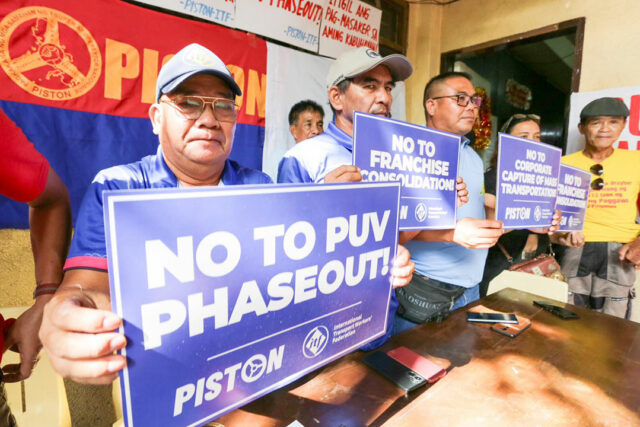
A GROUP of jeepney drivers and operators filed a petition before the Supreme Court (SC) on Wednesday, seeking to declare null and void the department order and circulars implementing the Public Utility Vehicle Modernization Program (PUVMP).

The Pinagkaisang Samahan ng mga Tsuper at Operators Nationwide (PISTON) filed a 57-page petition for a temporary restraining order against the Department of Transportation (DoTr) Omnibus Franchising Guidelines, which serves as the framework of PUVMP.

The petition also sought a preliminary injunction on the Land Transportation Franchising and Regulatory Board (LTFRB) issuances mandating franchise consolidation and its year-end deadline.

PISTON, in their petition, argued that the mandatory consolidation requirement infringes on the constitutional right to freedom of association, rendering it unconstitutional. “The constitutionally guaranteed freedom of association includes the freedom not to associate.”

The PUVMP mandates drivers and operators to merge their separate franchises into a cooperative or corporation by Dec. 31 to obtain franchises for modern public utility vehicle (PUV) units. The group argued that this would initiate the phaseout of jeepneys, benefiting only financially capable large corporations able to meet consolidation requirements.

“Revoking franchises due to non-participation in cooperatives is a violation of the rights of drivers and operators,” PISTON national president Mody T. Floranda said in a statement. “They will be deprived of their livelihood simply because they didn’t join cooperatives.”

The transport group said that an estimated 140,000 drivers and 60,000 operators could be displaced and lose their jobs if the year-end deadline for franchise consolidation pushes through. The group added that around 28.5 million commuters nationwide will be affected, potentially leading to a “transport disaster” in January 2024.

“We urge the Supreme Court to act swiftly to save not only the livelihoods of drivers and operators, but also the well-being of commuters,” added Mr. Floranda.

In their petition, the transport group argued that the PUVMP is an improper exercise of police power. They asserted that the authority to impose a ban on traditional jeepney units falls within the domain of legislative bodies, emphasizing that the DoTr and the LTFRB are executive offices. The petition stated that the modernization plan has been implemented through department orders and circulars alone without any law in effect.

The petition also argued that the LTFRB has no authority to regulate transport cooperatives, stating that it is within the jurisdiction of the Office of Transportation Cooperatives (OTC).

The transport group asserted in their petition that jeepney drivers and operators are under pressure to surrender their jeepney units, which violates their constitutional right to livelihood.

“The subject circulars require forming and joining of cooperatives before small jeepney drivers or operators could avail of the equity subsidy. Ultimately, they mandate the surrender of jeepneys and thus violative on the right to gainful employment.”

Echoing a High Court ruling, the petition stated: “The power to regulate does not include the power to prohibit. The power to regulate does not include the power to confiscate.”

Apart from PISTON, representatives from Bayan Muna, No To PUV Phaseout Coalition, public transport advocacy group PARA, and commuters group Komyut, joined the petition.

German law to benefit OFWs

THE EMBASSY of Germany in Manila said on Wednesday that Filipinos looking to work in Germany will find it easier to migrate after its new Skilled Migration Act took effect last November.

“Germany is welcoming skilled workers with open arms and full support,” German Embassy’s Economic Counsellor David Klebs said in a statement on the newly enacted law that lowers salary thresholds and expanded eligibility for foreign applicants like overseas Filipino workers (OFWs).

“This law creates even better incentives for Filipino skilled workers to consider working in Germany,” he added as he explained how the measure streamlines the employment process for migrant workers and allows information technology specialists to secure European Union Blue Cards on professional experience alone.

The embassy said it has been working closely with the Technical Education and Skills Development Authority, the Commission on Higher Education, and the Department of Migrant Workers. 

“The Skilled Migration Act signifies a progressive step in the bilateral relationship (with the Philippines), promoting collaboration, fair immigration and mutual benefit for both countries,” embassy said.

Meanwhile, President Ferdinand Marcos, Jr. vowed that his administration would continue to craft programs and services catered to migrant workers.

“There are many projects lined up, and even our current programs will be improved,” he said in his speech in Filipino during the OFWs Family Day in Pasay City.

Mr. Marcos noted that the DMW is planning on launching the One Repatriation Command Center’s 24/7 hotline which will assist OFWs who need repatriation or reintegration services. — John Victor D. Ordoñez

Davao Light ready for El Niño

JEROME CMG-UNSPLASH

DAVAO CITY — An official of the Davao Light and Power Co. said on Wednesday that they have contingency plans put in place, like balancing the use of renewable and non-renewable energy, as dry spells associated with El Niño loom until next year.

“We are hoping that we will never reach the time when we will have to do rotational brownouts,” said Fermin Edillon, head of the Davao Light Reputation Enhancement Department, at a yearend media briefing.

Mr. Edillon said they cannot totally rely on renewable energy alone because if there is an El Niño, their suppliers who are using hydropower will also be affected. The Department of Science and Technology forecasts potential dry spells and drought in April or May next year due to El Niño.

Meanwhile, Davao Light has lowered its power rate from P9.12 to P8.74 per kilowatt-hour in December, down from November.

Mr. Edillon attributed the decrease to reductions in power supply pricing from the Philippine Wholesale Energy Spot Market and the global market.

For households with an average monthly electricity consumption of 200 kWh, a reduction of P76.34 will be experienced. The lowered rate applies to bills received from Dec. 12, 2023 to Jan. 10, 2024.

Despite the decrease, customers are urged to monitor energy usage, emphasizing the fluctuating nature of rates. — Maya M. Padillo

House to probe DepEd dues

PHILIPPINE STAR/MICHAEL VARCAS

THE HOUSE of Representatives will probe the Department of Education (DepEd) after it failed to remit a total of P5.55 billion in premium contributions and loan amortizations deducted from salaries of teachers and non-teaching personnel, Roman T. Romulo, who heads the House basic education and culture panel, told BusinessWorld in a Viber Message.

Mr. Romulo said the House committee will invite to a hearing the involved agencies including DepEd, Philippine Health Insurance Corp. (PhilHealth), and Home Development Mutual Fund (HDMF, commonly known as the Pag-IBIG Fund) to clarify the issues on unremitted amounts.

“We will target the 2nd work week of January 2024 to give time to send invitations to the concerned agencies,” he said when asked when hearings will start. 

Mr. Romulo said the committee will take action or propose solutions based on the explanations and clarifications to be obtained from its probe.

In its 2022 annual report, the Commission on Audit (CoA) flagged the education department for failing to remit taxes, insurance contributions, and loan payments totaling P5.55 billion, P4.47 billion of which were Government Service Insurance System (GSIS) contributions. Teachers and other DepEd staff might face penalties, reduced benefits, and unwarranted interests, said CoA.

In a statement last week, DepEd said it is “aggressively looking into various ways to address the subject of unremitted premium and contributions,” citing that the issue has been recurring due to “system incompatibility and timing differences”

The department said CoA is “well-aware of the steps being taken to resolve this matter, which is why in the same Consolidated Annual Audit Report, CoA rendered an Unqualified/Unmodified Opinion in favor of DepEd — a first in the Department’s history.”

In a video message sent on Viber, Teachers’ Dignity Coalition national chairperson Benjo Basas said his group is looking forward to the investigations of the House committee, emphasizing that teachers might not get the benefits that were deducted from their salaries.

“We are looking forward to the plan of the House to investigate and hold accountable those who should be accountable,” he said in Filipino. “This problem greatly affects our status as government employees because we are unable to obtain the benefits that should be rightfully allocated to us.”

Mr. Basas said the non-remittance issue worries teachers whose salaries are being deducted religiously and timely for premium contributions and amortization loans. “Unfortunately, those payments to agencies are not being remitted.” — Jomel R. Paguian

Farmers get P209-M support

PHILIPPINE STAR/MICHAEL VARCAS

THE PHILIPPINE Center for Postharvest Development and Mechanization (PhilMech) said it has distributed about P209 million worth of agricultural machineries to farmers’ cooperatives and associations (FCAs) in the provinces of Camarines Sur, Zamboanga del Sur, and Davao del Sur.

For Camarines Sur, the PhilMech distributed about P19 million worth of combine harvesters to farmers in an event marking the agency’s final turnover for the area in 2023.

Another 52 units of farm equipment worth a total of P47 million were handed out to Davao del Sur FCAs. There were 19 floating tillers, 10 hand tractors, seven combine harvesters, six four-wheel-drive tractors, four mobile rice mills, and two units each of walk-behind and riding-type transplanters, and rice threshers.

Meanwhile, PhilMech also distributed over 100 various agricultural equipment that cover the stages of production and postharvest, benefitting more than 70 FCAs and local government units. The estimated worth of the equipment is P149.5 million. — Adrian H. Halili

La Trinidad pushes receipt rules

LA TRINIDAD, Benguet — Seeking to protect farmers, local legislators of this capital town are set on mandating the issuance of receipts in all transactions between vegetable traders and farmers.

Already passed on third and final reading before the Sangguniang Bayan (Municipal Council), the proposed ordinance would require all buyers and purchasers to issue delivery receipts and other documentary proof of their transaction with farmers.

Councilor Bartolome Baldas, Jr., the main proponent of the measure, wanted to address many incidents in which buyers and purchasers disappear without completely paying the farmers.

Under the measure, receipts will bear the names of the buyer and purchasers, their contact numbers and addresses, the produce they got and their corresponding prices to facilitate claims of payments, debts or even loans.

The La Trinidad Vegetable Trading Post and other markets support the move for the protection of farmers from scammers. — Artemio A. Dumlao

Security tightened vs terrorists

UNSPLASH

COTABATO CITY — As Christmas Day draws nearer, authorities are tightly securing Christian worship sites near Pagalungan, Maguindanao where the Dawlah Islamiya attacked and plundered a barangay more than a week ago apparently to avenge their losing 12 members in clashes with the Moro Islamic Liberation Front (MILF).

Mayors in Cotabato and Gov. Emmylou T. Mendoza, units of the Police Regional Office 12, and the Army’s 602nd Infantry Brigade are coordinating their security deployments at Christian worship sites to ensure a peaceful holiday season.

To prevent potential incidents, security forces are also monitoring the surroundings of mosques, recognizing the terrorists’ tendency to create scenarios to sow discord between Muslims and Christians. Several towns in Cotabato are in close proximity to Pagalungan, where encounters between Dawlah Islamiya and pursuing MILF members displaced around 2,000 Moro families.

Dawlah Islamiya, known for venting anger on innocent people following clashes, faces coordinated efforts from the police, Army, MILF, and leaders of the Moro National Liberation Front (MNLF). Major Gen. Alex S. Rillera, commander of the 6th Infantry Division, highlighted the importance of local government support in Cotabato province, emphasizing collaboration with the MNLF and MILF to guard against potential Dawlah Islamiya incursions during the Yuletide Holidays. — John Felix M. Unson

RTC orders transfer of convict-witnesses in De Lima case

PHILIPPINE STAR/ GEREMY PINTOLO

THE MUNTINLUPA Regional Trial Court (RTC) ordered the transfer of custody of the seven convicts who recanted their testimonies against former Senator Leila M. de Lima in her drug trafficking cases, citing safety and security concerns.

In a four-page order dated Dec. 13, shared to the media on Wednesday by Ms. De Lima’s team, Muntinlupa Presiding Judge Gener M. Gito ordered the transfer of the seven convicts from the Sablayan Prison and Penal Farm in Occidental Mindoro to the National Bilibid Prisons.

“[T]he prosecution posited that this is congruent with the appeal of accused Leila M. de Lima to transfer some PDL (persons deprived of liberty) witnesses for their safety and security,” the order read.

The seven inmates were German L. Agojo, Tomas D. Doniña, Jaime V. Patcho, Wu Tuan Yuan (alias “Peter Co”), Engelberto Durano, Jerry R. Pepino, and Hans Anton Tan. Apart from them, four convicts who are in “similarly and in a comparable position” were also transferred from Sablayan Prison to NBP, naming Herbert R. Colangco, Noel G. Martinez, Nonilo A. Arile, and Joel D. Capones.

In a manifestation, Ms. De Lima asked the court to order their transfer to the city jail in Muntinlupa last month.

In a three-page handwritten letter to Mr. Gito dated Nov. 17, the seven convicts urged the court to void their statements because they were coerced.

“We no longer desire to live our lives with the knowledge that we allowed ourselves to become pawns of instruments of injustice,” according to a copy of the letter provided by Ms. De Lima’s camp. “It will be our way of expressing our sincerest apologies to Senator de Lima and her family.” — Jomel R. Paguian

Trump cannot run for president, state court rules

REUTERS

WASHINGTON — Former President Donald Trump is disqualified from serving as US president and cannot appear on the primary ballot in Colorado because of his role in the Jan. 6, 2021, attack on the US Capitol by his supporters, the state’s top court ruled Tuesday.

The historic 4-3 ruling by the Colorado Supreme Court, likely to be taken up by the US Supreme Court, makes Mr. Trump the first presidential candidate deemed ineligible for the White House under a rarely used constitutional provision that bars officials who have engaged in “insurrection or rebellion” from holding office.

The ruling applies only to Colorado’s March 5 Republican primary but it could affect Mr. Trump’s status in the state for the Nov. 5 general election. Nonpartisan US election forecasters view Colorado as safely Democratic, meaning that President Joseph R. Biden, Jr. will likely carry the state regardless of Mr. Trump’s fate there.

Mr. Trump vowed to appeal the ruling to the US Supreme Court, and the Colorado court said it would delay the effect of its decision until at least Jan. 4, 2024, to allow for an appeal.

The ruling sets the stage for the Supreme Court, whose 6-3 conservative majority includes three Trump appointees, to consider whether Mr. Trump is eligible to serve another term as president.

The lawsuit is viewed as a test case for a wider effort to disqualify Mr. Trump from state ballots under section 3 of the 14th Amendment, which was enacted after the US Civil War to keep supporters of the confederacy from serving in the government.

The Colorado court concluded that the US Constitution bars Mr. Trump, the frontrunner for the Republican nomination in 2024, from appearing on the ballot because of his role instigating violence at the Capitol as lawmakers met to certify the results of the 2020 election. The court’s majority acknowledged the decision was “uncharted territory.”

“We do not reach these conclusions lightly,” the majority justices wrote. “We are mindful of the magnitude and weight of the questions now before us. We are likewise mindful of our solemn duty to apply the law, without fear or favor, and without being swayed by public reaction to the decisions that the law mandates we reach.”

Mr. Trump’s campaign called the court decision “undemocratic.”

“The Colorado Supreme Court issued a completely flawed decision tonight and we will swiftly file an appeal to the United States Supreme Court,” a spokesperson from the Trump campaign said.

The decision reverses a ruling by a lower court judge who found Mr. Trump engaged in insurrection by inciting his supporters to violence, but concluded that, as president, Mr. Trump was not an “officer of the United States” who could be disqualified under the amendment.

The Biden campaign declined to comment.

COLORADO VOTERS
The case was brought by a group of Colorado voters, aided by the advocacy group Citizens for Responsibility and Ethics in Washington, who argued that Mr. Trump should be disqualified for inciting his supporters to attack the Capitol in a failed attempt to obstruct the transfer of presidential power to Mr. Biden after the 2020 election.

CREW President Noah Bookbinder said in a statement that the court’s decision is “not only historic and justified, but is necessary to protect the future of democracy in our country.”

Courts have rejected several lawsuits seeking to keep Mr. Trump off the primary ballot in other states. Minnesota’s top court rebuffed an effort to disqualify Mr. Trump from the Republican primary in that state, but did not rule on his overall eligibility to serve as president.

Some advocates had hoped the Colorado case would boost the overall disqualification effort and potentially put the issue before the US Supreme Court.

Mr. Trump’s campaign has condemned 14th Amendment challenges as an attempt to deny millions of voters their preferred choice for president.

Mr. Trump’s lawyers argued that his speech to supporters on the day of the riot was protected by his right to free speech, adding that the constitutional amendment does not apply to US presidents and that Congress would need to vote to disqualify a candidate.

Three Colorado Supreme Court justices dissented from Tuesday’s ruling.

One of the dissenting justices, Carlos Samour, said in a lengthy opinion that a lawsuit is not a fair mechanism for determining Mr. Trump’s eligibility for the ballot because it deprives him of his right to due process, noting that a jury has not convicted him of insurrection.

“Even if we are convinced that a candidate committed horrible acts in the past — dare I say, engaged in insurrection — there must be procedural due process before we can declare that individual disqualified from holding public office,” Mr. Samour said. — Reuters

WHO says the JN.1 coronavirus strain is ‘a variant of interest’

GERD ALTMANN-PIXABAY

THE World Health Organization (WHO) on Tuesday classified the JN.1 coronavirus strain as a “variant of interest” and said current evidence shows risk to public health was low from the strain.

At least two experts told Reuters that while the strain can evade the immune system and transmit more easily than other currently circulating variants, it has not shown any signs of more severe disease.

While there might be more cases with the variant, JN.1 doesn’t pose a greater risk, said Andrew Pekosz, a virologist at the Johns Hopkins Bloomberg School of Public Health.

JN.1 was previously classified a variant of interest as part of its parent lineage BA.2.86, but WHO has now classified it as a separate variant of interest.

WHO said current vaccines will continue to protect against severe disease and death from JN.1 and other circulating variants of the COVID-19 virus.

The US Centers for Disease Control and Prevention (CDC) said earlier this month the subvariant JN.1 makes up about an estimated 15% to 29% of cases in the United States as of Dec. 8, according to the agency’s latest projections.

The CDC had said currently there was no evidence that JN.1 presents an increased risk to public health relative to other currently circulating variants and an updated shot could keep Americans protected against the variant.

JN.1 was first detected in the United States in September, according to the CDC.

Last week, China detected seven infections of the COVID subvariant. — Reuters

ADVERTISEMENT
ADVERTISEMENT