Home Blog Page 3868

Age matters 

KRAKENIMAGES —UNSPLASH

“AGE cannot wither nor custom stale her infinite variety.” But that’s Shakespeare’s Cleopatra. Many others fall into a different category as far as aging goes. Age withers the ordinary person. In Cleopatra’s case the asp shortened her life anyway. She died at 39 years old.

Even when employers do not specify age limits for top jobs, including those to head big organizations, they have in mind a person south of 50 years old. The adjectives of “dynamic,” “energetic,” and “innovative” when putting together a profile of a recruitment target naturally attach to a youthful individual, not someone who gets a senior citizen discount at the restaurant.

Business safeguards the lowering of the age median in its organization by setting a mandatory retirement age, and even hurrying up the exits with early retirement. This ensures that after the retiree blows out six candles (each representing a decade) on his cake, he is on the way out. (You will be covered by our healthcare program for five more years.)

A “youth culture” is obligatory in entertainment and sports where someone in his mid-30s is nearing his expiration date. Sure, movies still feature cameo appearances by aging stars who may still rock but need to sit down after three minutes. They are especially in demand in sequels of a franchise series, playing their old roles decades back.

The culture of youth has extended to the political arena. Spokespersons don’t even have laugh lines, and candidates for local government positions look like the third generation of a dynasty, which they happen to be.

The fascination with young people taking the reins of government and business lies in the oft-quoted phrase that you can’t teach old dogs new tricks. Just mention the word “digital” and the topic quickly changes to vinyl records — they have a warmer sound.

This bias against age (sometimes called “ageism”) is pernicious as it seems enough to dismiss somebody who comes out for a TV interview simply by describing him as old without needing to refute the points he is making. (Of course, that was during your time, Sir.)

Still, it must be said that our culture respects age. How many times are we extended unsolicited help to climb stairs or negotiate a slippery floor? (Please take my hand.) What about the ever-ready offer to take a photo — Sir, you want me to take your photo with your very fetching caregiver?

But is an old person automatically ignored?

Certain positions are unaffected by age. A partial list of these will suffice. Trillionaires can have hair growing out of their ears and still be accorded a measure of respect punctuated by genuflections. There are Warren Buffet for one and his deputy successor, Charles Munger, even a bit older, both in their 90s (age, not the decade) but still taken seriously. The latter, who died recently at 99 years old, famously counseled against cryptocurrency — “it’s rat poison squared.”

Oldsters exempt from the age prejudice tend to hire or associate with others not in their age bracket, (Many of their classmates have died anyway.) When the management team looks like a class reunion for the golden jubilarians, it can send the wrong signal to the investors. Old leaders surround themselves with much younger associates, so that they can be construed to possess the faint intention of having a succession plan, even if they do not — success needs no succession.

Age has become a political issue in the presidential race in the most powerful country in the world. The top two contenders are only three years apart and crossing their 80s, not exactly holding hands. There are even now calls for setting an age limit for elected positions. The physical demands of a job, in the corporate or political setting, require some level of stamina, and the ability to stay awake at meetings.

Ageism fuels the demand for cosmetic alterations like removal of eye bags. (Ma’am, you need to check those in at the counter.) The effort to look younger, or at least not too old, is a constant struggle. Still, an increasing number of seniors just stop dyeing their hair and declare — okay, so I’m old… sue me.

Does age consign the elderly to a passive role? Carlos P. Romulo was supposed to have said that “Age does not matter, as long as the matter doesn’t age.” He was, of course, referring to the brain.


TONY SAMSON is chairman and CEO of TOUCH xda
ar.samson@yahoo.com

Rural lender launches digital banking platform OwnBank

OWN BANK, The Rural Bank of Cavite City, Inc., has launched an online banking platform called OwnBank, offering an 8% savings interest rate per annum to new depositors.

Users may avail of the 8% savings rate by applying for a seven-day time deposit account.

After seven days, users may transfer their funds to a regular OwnBank Time Deposit account that has a 7.5% savings rate and adjustable terms up to one year. They may also instead transfer the funds to Own It, an account with a daily-credited interest rate of up to 6%.

The OwnBank app also offers free fund transfers to other OwnBank users and to all major banks and e-wallets.

The rural bank was founded in 1956 and went through a digital transformation in 2021 with the help of Streetcorner Group, an association that includes Akulaku, a financial technology platform, and nonlife insurer Metropolitan Insurance Co, Inc., it said.

Users can also buy load and data plans for all mobile networks and game credits, as well as pay bills, via the platform. Remittances will soon be available on the app, OwnBank said, as well as online shopping, Quick Response or QR code payments, card payments, and bank direct debit payments.

A Christmas-inspired cosmopolitan cocktail for the holidays

A MAINSTAY served in bars the world over, the Cosmopolitan has cemented itself as a classic cocktail. It became even more popular in the 1990s due to the long-running HBO show Sex and the City.

For the holidays, a twist on the classic Cosmo comes in the form of Chrisma-politan by Gioseppe Racelis. This mix of vodka, cranberry juice, and the premium orange Cointreau, served with a dash of vanilla and a hint of spice is an interesting addition to any holiday gathering.

Mr. Racelis — equipped with over 13 years of experience in the industry, a Level 2 Certification in Wine & Spirit Education Trust (WSET), and is the former Assistant Food and Beverage Manager of Discovery Suites Manila — recommends topping it with a decadent creamy layer of sweetened foam.

To complete this Yuletide treat, “Garnish it with red peppercorns for a pop of color and flavor,” the De La Salle-College of Saint Benilde educator advises.

Chrisma-politan by Gioseppe Racelis

Ingredients:
45 ml Vanilla vodka
45 ml Cranberry juice
30 ml Cointreau
Sweetened milk foam
Red peppercorn

Procedure:
1. In a shaker, pour in the vanilla vodka, Cointreau, and cranberry juice. Shake vigorously with ice.
2. Strain and pour in a rock glass with ice.
3. Top with sweetened milk foam.
4. Garnish with red peppercorn on top.

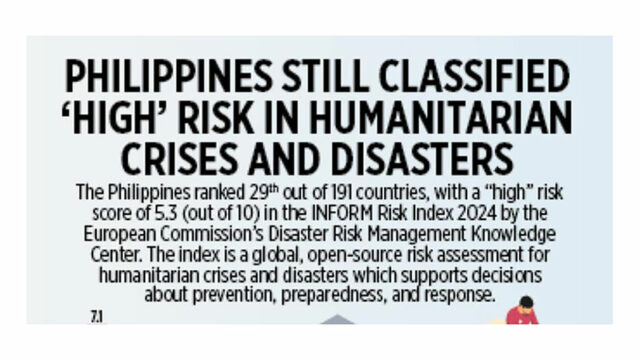
Philippines still classified ‘high’ risk in humanitarian crises and disasters

The Philippines ranked 29th out of 191 countries, with a “high” risk score of 5.3 (out of 10) in the INFORM Risk Index 2024 by the European Commission’s Disaster Risk Management Knowledge Center.  The index is a global, open-source risk assessment for humanitarian crises and disaster which supports decisions about prevention, preparedness, and preponse.


How PSEi member stocks performed — December 13, 2023

Here’s a quick glance at how PSEi stocks fared on TuesdayDecember 13, 2023.


Imported sugar helping keep millgate prices low — planters

WIKIMEDIA.ORG/PATRICKROQUE01

SUGAR farmers said low sugar prices at millgate level are due to the preference by traders to deal in imports, according to the Confederation of Sugar Producers Associations, Inc. (CONFED).

In a statement, CONFED said that more imported sugar is being withdrawn by traders, resulting in prices realized by planters remaining at P2,300–P2,500 per 50-kilogram bag.

“Compared to locally refined sugar, imported refined sugar is cheaper, and so it will deliver more profit for importers and traders,” CONFED President Aurelio J. Valderrama, Jr. said.

Citing data from the Sugar Regulatory Administration, it said that out of 209,408 metric tons (MT) of sugar withdrawn from stocks, 32% (66,608 MT) was locally refined sugar and 68% (142,800 MT) was imported.

Mr. Valderrama called for the intervention of the Department of Agriculture (DA) to grant priority to locally refined sugar.

It added that producers could suffer if locally refined sugar was not given priority as 40% of raw sugar is being withdrawn for refining.

“While millgate prices drop, retail prices remain high. Clearly, neither sugar farmers nor consumers are benefitting from this situation,” CONFED said.

It added that millgate prices will continue to drop due to the oversupply of raw sugar. In recent weeks prices have declined from P2,500 to P2,300 per 50-kg bag.

The SRA has said that it was pushing for a suggested retail price for refined sugar of P85 per kg.

In September, the SRA issued Resolution No. 2023-159 which required importers to distribute their allocations by Oct. 15.

The resolution also reclassified 150,000 MT of imported refined sugar as buffer stock.

“Sugar farmers want to know now, how much of the 150,000 MT was actually distributed and how much was left undistributed as a result of the Board Resolution,” CONFED said.

On Sunday, another producer’s group called for government intervention due to the continued divergence of raw sugar millgate prices with retail prices, according to the United Sugar Producers Federation of the Philippines (UNIFED).

UNIFED said the government should engage in sugar purchasing to help farmers.

The regulator earlier projected a trading price for the commodity of P3,000 per 50-kg bag.

Meanwhile, Mr. Valderrama said his organization has also urged President Ferdinand R. Marcos, Jr. to provide fuel subsidies to sugar producers “because production inputs continue to rise even as sugar prices go down.” — Adrian H. Halili

Energy developers form group to pool expertise in offshore wind operations

STOCK PHOTO | Image by Grahame Jenkins from Unsplash

AN ASSOCIATION has been formed by energy developers to pool expertise and technical resources in offshore wind power, with the goal of accelerating the Philippines’ clean-energy transition.

On Wednesday, Pilipinas Offshore Wind Energy Resource, Inc. (POWER) was launched by energy companies ACEN Corp., The Blue Circle, BlueFloat Energy, Citicore Renewable Energy Corp., Ignis ZA Global, and Marubeni Asian Power Philippines Corp.

“The primary aim is to collaborate. It’s a group of developers with wind energy service contracts (WESCs). Having said that, these are developers that are supposed to design, develop, build, operate, and maintain” wind projects, POWER President and BlueFloat Energy Philippines Country Manager Raymund M. Pascual told reporters during the launch in Taguig City.

“We have our own common concerns, common issues, and of course, common interests,” he added.

Asked if the members might form a consortium, he said: “Anything is possible at this point, also because of the very nature of projects — (which are in the) gigawatts.”

According to Mr. Pascual, the members of POWER have projects with a combined capacity of up to 60 gigawatts (GW).

To date, the Department of Energy has awarded a total of 82 offshore wind projects with potential capacity of 63.359 GW.

These projects are located north of Luzon, west of Metro Manila, north and south of Mindoro, Panay, and the Guimaras Strait. All these WESCs are currently in the pre-development stage, undergoing resource, site sustainability, and project viability studies.

Energy Secretary Raphael P.M. Lotilla said that developing offshore wind will require the support of local government units as “there are local issues that we have to contend with.”

“We need to be working together with not only the National Government… in the case of offshore wind, we would need to work with local government units as well,” he said.

Mr. Pascual said the association is open to other WESC holders.

“With the support from offshore wind energy actors, POWER can accelerate offshore wind development over the next decade by providing technical assistance and advisory (services) to various government agencies; coalition-building and advocacy other stakeholders critical for a successful transition to renewable energy,” POWER said in a statement. — Sheldeen Joy Talavera

World Bank expects developing countries’ debt service bills to rise 10% in 2023-2024

REUTERS

DEBT service costs are expected to rise by an average of 10% for developing countries, which will take away needed funding for development programs, the World Bank said.

“In 2022, the latest year for which data are available, low- and middle-income countries paid a record $443.5 billion to service their external public and publicly guaranteed debt. In a time of pinched government budgets, these payments divert spending away from health, education, and other critical needs,” it said in its International Debt Report.

“Debt service costs on public and publicly guaranteed debt are projected to grow by 10% for all developing countries over the 2023-24 period — and by nearly 40% for low-income countries,” it added.

The World Bank said that debt repayments rose 5% for developing countries in 2022.

The Philippine external debt stock was $111.217 billion in 2022. Long-term principal payments were at $5.671 billion with interest payments of $3.278 billion.

“Record debt levels and high interest rates have set many countries on a path to crisis. Every quarter that interest rates stay high results in more developing countries becoming distressed — and facing the difficult choice of servicing their public debts or investing in public health, education, and infrastructure,” Indermit Gill, the World Bank Group’s chief economist and senior vice-president, said.

In the Philippines, the Bangko Sentral ng Pilipinas kept the benchmark rate at a 16-year high 6.5% at its November meeting. The central bank has raised rates by 450 basis points since May 2022.

“The situation warrants quick and coordinated action by debtor governments, private and official creditors, and multilateral financial institutions — more transparency, better debt sustainability tools, and swifter restructuring arrangements. The alternative is another lost decade,” Mr. Gill added.

The bank said that in the last three years, there have been 18 sovereign defaults in 10 developing countries. Around 60% of low-income countries are also at “high risk of debt distress or already in it.”

“Interest payments consume an increasingly large share of low-income countries’ export (receipts). More than a third of their external debt, moreover, involves variable interest rates that could rise suddenly,” it said.

“Many of these countries face an additional burden: the accumulated principal, interest, and fees they incurred for the privilege of debt-service suspension under the G20’s Debt Service Suspension Initiative (DSSI). The stronger dollar is adding to their difficulties, making it even more expensive for countries to make payments. Under the circumstances, a further rise in interest rates or a sharp drop in export earnings could push them over the edge,” it added.

New financing options are also becoming increasingly slim. Last year, new external loan commitments to public and publicly guaranteed entities declined 23%.

“Countries eligible to borrow from the International Development Association (IDA) are likely to face a rough ride in the coming years: interest payments on their total external debt stock have quadrupled since 2012, to an all-time high of $23.6 billion,” the World Bank said.

“These payments are consuming an ever-larger share of export revenue, putting some countries just one shock away from a debt crisis. More than a third of this debt involves variable interest rates that could rise suddenly,” it added. — Luisa Maria Jacinta C. Jocson

Philippines joins 152 countries in favor of UN resolution for ceasefire in Gaza

By John Victor D. Ordoñez, Reporter

THE PHILIPPINES has joined 152 countries in favoring a United Nations (UN) General Assembly resolution calling for a humanitarian ceasefire between Israel and Hamas in Gaza, including the unconditional release of all hostages.

The resolution, which was adopted on Dec. 12, is nonbinding but serves as a barometer of global opinion as the war between Israel and the Islamist-Hamas nears its 70th day.

Israel and the United States were among the 10 countries that voted against the resolution, with 23 states abstaining.

“The Philippines believes that a humanitarian ceasefire is crucial to halt the loss of life and suffering,” Antonio Manuel R. Lagdameo, permanent representative of the Philippines to the UN, said in a speech during the 10th emergency special session of the General Assembly, a copy of which was sent to reporters via WhatsApp.
“This ceasefire is a necessary step to facilitate the delivery of urgent humanitarian aid to all affected civilians.”

He said countries should weigh the impact of any military action on civilians and eliminate collateral damage.

Last week, the US vetoed a similar UN Security Council resolution calling for a ceasefire in Gaza. Thirteen of the 15 members voted yes. The United Kingdom abstained.

US Deputy Ambassador and Representative for Special Political Affairs Robert A. Wood earlier said the resolution had failed to condemn Hamas’ Oct. 7 attack that killed more than 1,200 Israelis.

He said the resolution did not acknowledge Israel’s right to defend itself and that halting military action would only allow Hamas to continue ruling over Gaza and “plant the seeds for the next war.”

“Hamas has no desire to see a durable peace, to see a two-state solution,” he said before voting on the security council resolution.
“While the United States strongly supports a durable peace, in which both Israelis and Palestinians can live in peace and security, we do not support calls for an immediate ceasefire.”

Israel launched waves of airstrikes in Gaza in retaliation after Hamas militants backed by waves of rockets stormed from the blockaded Gaza Strip into nearby Israeli towns on Oct. 7.

The Hamas-run Health Ministry in Gaza on Tuesday said at least 18,400 people have died in the war. At least four Filipinos died.

In October, the Philippines was one of 45 countries that abstained from a similar UN resolution that called for an immediate “humanitarian truce” in Gaza. The US and Israel also voted no to the resolution, which was drafted by a group of 22 Arab countries.

A month later, the Philippines joined 144 nations in favoring a UN General Assembly resolution condemning Israeli settlements in Occupied Palestinian Territory including East Jerusalem and Syrian Gowan.

“Manila’s vote represents a continuous people-centric approach in the face of critical humanitarian atrocities,” Don McLain Gill, who teaches international relations at De La Salle University in Manila, said in Facebook Messenger chat.
“While Manila condemns any form of terrorism, it equally condemns the loss of lives of innocent civilians.”

At least 362 overseas Filipino Workers from Israel have returned to the Philippines amid the hostilities, Migrant Workers officer-in-charge Hans Leo J. Cacdac told a news briefing on Monday. The Department of Foreign Affairs has said 111 of 137 Filipinos in Gaza have come home.

Last month, Israel and Hamas entered into a four-day truce, with the latter releasing more than 100 captives since then. Israel has freed more than 240 Palestinian prisoners in exchange.

Two Filipino caregivers were released as part of the truce, including a 60-year-old who had been held captive for 53 days.

“The Philippines seeks to contribute to a solution that respects the rights and needs of both Palestinian and Israeli civilians,” Mr. Lagdameo said.

“We advocate a peaceful resolution that upholds international law and leads to lasting peace and security in the region.”

Lawmakers accuse China of ‘blatant display of aggression’ after water cannon incident

BW FILE PHOTO

THREE PHILIPPINE congressmen on Wednesday scored China for its “blatant display of aggression” when it fired water cannons at Philippine ships on a resupply mission at Second Thomas Shoal at the weekend.

They said China’s recent actions against Philippine boats pose a serious threat to regional peace and stability.

“The use of water cannons and dangerous maneuvers by Chinese agents against Philippine fisheries bureau vessels delivering essential supplies to Filipino fishermen in Scarborough Shoal and to resupply missions for Filipino troops stationed at the corrugated warship in the Second Thomas Shoal is a blatant display of aggression,” the lawmakers said in House Resolution 1527.

The lawmakers — Party-list Reps. France L. Castro, Arlene D. Brosas and Raoul Danniel A. Manuel — want the House foreign affairs committee to investigate the incident.

The government of Philippine President Ferdinand R. Marcos, Jr. has filed 130 diplomatic protests against China, the Department of Foreign Affairs (DFA) said on Tuesday.

Foreign Affairs spokesperson Ma. Teresita C. Daza said 63 of these protests were filed this year, including one at the weekend after Chinese Coast Guard and militia ships fired water cannons at Philippine boats on a resupply mission at Second Thomas Shoal.

The Philippines on Monday accused China of “serious escalation” after it sprayed water on three Philippine vessels and ramming one that carried military chief Romeo S. Brawner, Jr.

It later summoned China’s ambassador in Manila over his country’s “aggressive” actions in the disputed waterway.

China on Monday said it had lodged “solemn representations” and a strong protest over the Philippines’ accusations over the incident.

Philippine vessels had ignored the Chinese Coast Guard’s warnings and rushed into waters near Second Thomas Shoal, Chinese Foreign Ministry spokesperson Mao Ning told a news briefing.

China urged the Philippines to halt its “maritime violations and provocations” and “groundless attacks and smears.”

The congressmen cited another incident at the weekend when China’s coast guard fired water cannons at Philippine Fisheries bureau ships near Scarborough Shoal.

China has ignored a 2016 ruling by a United Nations-backed arbitration court that voided its claim to more than 80% of the South China Sea based on a 1940s map.

The House of Representatives on Tuesday approved on final reading a bill that sets Philippine archipelagic sea and air routes where foreign vessels and aircraft may pass through without obstruction. — Beatriz Marie D. Cruz

Philippines bats for rules on ethical use of autonomous weapon systems

THE PHILIPPINES is pushing for the creation of international guidelines on the ethical use of autonomous weapon systems powered by artificial intelligence (AI), according to the Department of Foreign Affairs (DFA), saying their improper use could risk innocent lives.

“The Philippines supports the development of ethical rules for the responsible use of such technologies through a coherent and effective global governance structure, building on existing international treaties and the work of the United Nations (UN),” Foreign Affairs Secretary Enrique A. Manalo said in a speech at the meeting on the Indo-Pacific Perspectives on Autonomous Weapons Systems in Makati City.

The Philippines is working with 14 other countries on a draft protocol and roadmap that will outlaw fully autonomous weapon systems Under the Convention on Conventional Weapons.

An autonomous weapon is programmed to kill a specific target. The weapon is deployed into an environment where its AI searches for the target using sensor data such as facial recognition, according to autonomousweapons.org.

Mr. Manalo said automated weapon systems pose risks to peace since they are “machines that can operate without meaningful human control, run by algorithms that are empowered to undertake decisions involving human life or death.”

Envoys and experts from 30 countries are participating in the discourse on the ethical and responsible use of autonomous weapons.

The first regional meet on lethal autonomous weapons will be held on Dec. 13 and 14.

“The discourse is not just a conversation about technology; it’s a critical dialogue about the ethical and moral implications of humanity’s future,” Foreign Affairs Assistant Secretary Maria Teresa T. Almojuela said in a statement.

In September last year at the UN General Assembly, President Ferdinand R. Marcos, Jr. called on the international community to come up with governance structures to prevent the weaponization of unmanned weapon systems.

He said the Philippines is eyeing a nonpermanent seat in the 15-member Security Council, saying the country is qualified due to its peace-building efforts.

The elections for new members in the council will be held in 2026.

Last month, the UN General Assembly adopted a resolution calling on the international community to address the challenges and concerns autonomous weapon systems bring to global and regional security.

“We are now aiming to shape the trajectory of international discourse on autonomous systems,” Mr. Manalo said.

“Our discourse must account for our society’s values and priorities, and it must be informed by an appreciation of regional dynamics and actors.” — John Victor D. Ordoñez

Marcos aims to counter El Niño effect on prices of Philippine agri products

By John Victor D. Ordoñez, Reporter

PRESIDENT Ferdinand R. Marcos, Jr. instructed the Department of Agriculture (DA) on Wednesday to study the potential effect of the El Niño weather phenomenon on prices of agricultural products in the country in order for concerned agencies to prepare countermeasures.

“We are doing an analysis now of prices of food to see what the appropriate fiscal measures… we can undertake,” the President told a press briefing.

Mr. Marcos said the data gathered would be added to an online interagency database on the government’s efforts to address the effects of El Niño, which is associated with lack of rainfall.

He added that the DA was also exploring new methods to boost farmers’ yields.

“We are putting together data from the Department of Science and Technology, Department of Environment and Natural Resources… and others so that the concerned agencies can come up with a model using the data,” he said.

On Tuesday, The President ordered the creation of an interagency task force to address the effects of El Niño, which is expected to cause dry spells nationwide until the second quarter of 2024.

State agencies would focus on coming up with ways to effectively manage energy and food supplies to brace for impending dry spells.

Mr. Marcos on Wednesday led the turnover of P776 million worth of excavators in Nueva Ecija, which would be used by the National Irrigation Administration (NIA) for irrigation projects that would help farmers boost their yield next year amid expected episodes of a drought.

He also ordered the NIA and the DA to fast-track construction of supporting structure of the Balbalungao small reservoir irrigation project in Nueva Ecija, which he visited Wednesday.

“When we hear that there is a drought coming, we need to ensure our food supply and our irrigation systems are functional,” the President said.

In an advisory on Dec. 6, the Philippine Atmospheric, Geophysical and Astronomical Services Administration (PAGASA) said a strong El Niño has intensified in the tropical Pacific, with sea temperature anomalies exceeding 1.5 degrees centigrade from normal levels.

About 77% of the provinces in the Philippines may experience drought, while 65% of the provinces may see a dry spell, Science and Technology Secretary U. Solidum, Jr. told Tuesday’s Palace briefing.

PAGASA defines a drought as three consecutive months of below-normal rainfall or two straight months of significantly below-normal rainfall. A dry spell means two straight months of below-normal rainfall.