Home Blog Page 3860

Countdown to 2024 at Rizal Park Hotel

Get ready to ring in 2024 with a BANG in the heart of Manila as Rizal Park Hotel invites guests to an exceptional New Year’s Eve Countdown at its rooftop bar, The Deck on Dec. 31, 2023, from 9:00 PM to 1:00 AM. The hotel has prepared an immersive experience and activities for all ages ensuring a memorable start to 2024.

Guests can choose from the Upper Deck at P2,500 and Lower Deck at P2,000. Each ticket includes access to the vibrant New Year’s Eve party and countdown, a welcome drink, lively party favors, complimentary sparklers, a raffle entry for exciting prizes, and a delectable Media Noche buffet to satisfy culinary cravings.

Ticket for kids, priced at P2,000, offers access to the lively party and countdown, a welcome drink with a choice of chocolate shake, strawberry shake, or orange juice, and a special access to kids’ corner for added fun. They are also entitled to a raffle entry and Media Buffet dinner.

Entertainment highlights for the night include a live band, countdown, and a breathtaking fireworks display featuring the Manila skyline.

As the year transitions, Rizal Park Hotel presents the New Year’s Eve Room Package, from Dec. 31, 2023, to Jan. 1, 2024. The package includes an overnight stay in a Deluxe Room, two tickets to the New Year’s Eve Countdown Party at The Deck, and a New Year’s Brunch buffet for two, priced at P18,000.

Guests are invited to join Rizal Park Hotel for an evening of celebration, live entertainment, and culinary delights as they usher in a promising New Year.

For New Year’s Countdown tickets, call or message on Viber at 09276687839.

For room inquiries and reservations, call 09176571334.

To know more about Rizal Park Hotel and its facilities follow https://www.facebook.com/RizalParkHotel and https://www.instagram.com/rizalparkhotel1911/.


Spotlight is BusinessWorld’s sponsored section that allows advertisers to amplify their brand and connect with BusinessWorld’s audience by enabling them to publish their stories directly on the BusinessWorld website. For more information, send an email to online@bworldonline.com.

Join us on Viber at https://bit.ly/3hv6bLA to get more updates and subscribe to BusinessWorld’s titles and get exclusive content through www.bworld-x.com.

4 groups submit bids for NAIA rehab

Passengers disembark from their vehicles in front of the Ninoy Aquino International Airport (NAIA) Terminal 1 in Pasay City, Oct. 6, 2023. — REUTERS

ONLY FOUR GROUPS have submitted bids for the P170.6-billion public-private partnership (PPP) project to upgrade the Ninoy Aquino International Airport (NAIA), the Department of Transportation (DoTr) said on Wednesday.   

The DoTr identified the four bidders as the Manila International Airport Consortium (MIAC), Asia Airport Consortium, GMR Airports Consortium, and SMC SAP and Company Consortium.    

“This is a very important project of the government. This airport is very congested, and we are expecting that when we turn this airport to the private sector we can increase the capacity per annum,” Transportation Secretary Jaime J. Bautista said during the submission and opening of technical documents for the NAIA PPP project that was held online on Wednesday.

Eight groups had earlier purchased bid documents, but only four decided to submit their bids on Wednesday.

The MIAC consortium is composed of the companies owned by the country’s tycoons, namely Aboitiz InfraCapital, Inc. (AIC); Ayala-led AC Infrastructure Holdings Corp.; Andrew L. Tan’s Alliance Global InfraCorp Development, Inc.; Lucio Tan’s Asia’s Emerging Dragon Corp.; Gotianuns’ Filinvest Development Corp.; Gokongwei-led JG Summit Infrastructure Holdings Corp.; and GIP EM MIAC Pte., Ltd.

To recall, MIAC had previously submitted a P267-billion unsolicited proposal to operate and modernize the NAIA, but this was rejected by the government.

The GMR Airports Consortium is composed of GMR Airports International B.V.; Virata-led Cavitex Holdings, Inc.; and Yuchengco-led House of Investments, Inc. GMR Airports had partnered with Megawide Construction Corp. to operate the Mactan Cebu International Airport, but has since sold its stake to AIC.

The SMC SAP and Company Consortium is composed of San Miguel Holdings Corp.; RMM Asian Logistics, Inc.; RLW Aviation Development, Inc.; and Incheon International Airport Corp. The San Miguel group is currently building the New Manila International Airport in Bulacan. 

The Asian Airport Consortium is comprised of Lucio Co’s Cosco Capital, Inc.; Asian Infrastructure and Management Corp.; Philippine Skylanders International, Inc.; and  PT Angkasa Pura II.

Mr. Bautista said the DoTr will conduct a technical review of the bid submissions after 10 days which will be followed by a financial review.

He said the DoTr hopes to announce the winning bidder by the first quarter of next year.

The NAIA contract will initially cover 15 years, but can be extended by another 10 years. This will be under a rehabilitate-operate-expand-transfer arrangement, as provided for under the Build-Operate-and-Transfer law.

The project aims to increase the current annual passenger capacity of the NAIA to at least 62 million from the current 35 million.

“This would help further increase the air passenger and cargo capacity of NAIA that would help further boost local and foreign tourism in the country as a low hanging fruit that could be a major pillar for economic growth and development,” Rizal Commercial Banking Corp. Chief Economist Michael L. Ricafort said in a Viber message. — AEOJ

Extension of tariff cuts seen to mitigate El Niño impact on food prices

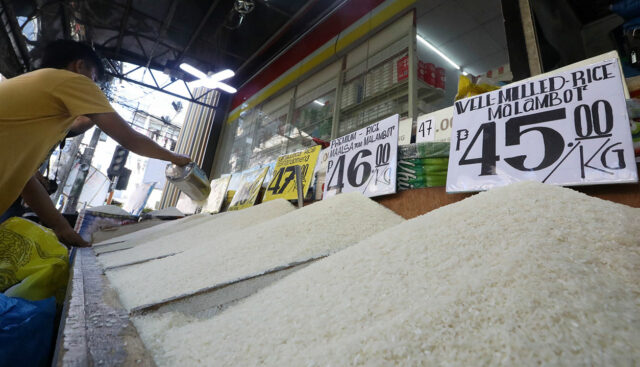
Rice dealers display rice in Trabajo Market, Sampaloc, Manila, Aug. 10, 2023. — PHILIPPINE STAR/EDD GUMBAN

THE EXTENSION of reduced tariffs on rice and other key agricultural commodities will help cushion the inflationary impact of the El Niño weather phenomenon, analysts said.

“This will ensure stable, if not lower, prices for these products, particularly during the El Niño next year which will hit our agriculture sector. This move is most welcome,” former Agriculture Undersecretary Fermin D. Adriano said in a Viber message.

President Ferdinand R. Marcos, Jr. last week signed Executive Order (EO) No. 50, which extends the reduced Most Favored Nation (MFN) tariff rates on rice, corn, and pork until Dec. 31, 2024.

The rates for rice imports will be kept at 35% for shipments both within or over the minimum access volume (MAV) quota.

Tariff rates for swine, fresh, chilled or frozen meat are retained at 15% for in-quota and 25% for out-quota imports.

Imports for corn maintained the MFN duty at 5% and 15% for in-quota and out-quota shipments, respectively.

“The present economic condition warrants the continued application of the reduced tariff rates on rice, corn, and meat of swine (fresh, chilled or frozen) to maintain affordable prices for the purpose of ensuring food security, managing inflationary pressures, help augment the supply of basic agricultural commodities in the country, and diversify the country’s market sources,” the EO stated.

There will also be a review of the tariff rates on rice, pork, and corn every six months, it added.

Philippine Chamber of Commerce and Industry President George T. Barcelon said that the lower tariff rates will help tame inflation.

“Extending the tariffs on key food commodities (will help) deal with inflation. That would help somewhat, because of the projected El Niño there could be price increases for these food commodities. I think that’s a good move,” he said via phone call.

In the first 11 months of the year, inflation averaged 6.2%. This was still above the central bank’s 6% full-year forecast and 2-4% target range.

“The reduced MFN tariff rates would help cushion agriculture and food production and supply and eventually price and inflation issues that may be brought by El Niño — a positive impact,” retired Pampanga State Agricultural University professor Roy S. Kempis said in a Viber message.

Mr. Kempis said that domestic production will be adversely affected by the dry weather event, particularly palay (unmilled rice) and corn.

“Supply would be compromised for these crops and eventually rice and feeds; following the value chain, feeds will also be a challenge — which uses corn as an ingredient to the extent of 70% per unit volume or weight, and pork may be more expensive,” he added.

The latest bulletin by the Philippine Atmospheric, Geophysical and Astronomical Services Administration (PAGASA) showed that a strong El Niño is seen to persist in the country until January 2024.

The weather event increases the likelihood of below-normal rainfall conditions, which could bring dry spells and droughts in some areas of the country.

The state weather bureau also projected that by the end of May 2024, 65 provinces will experience a drought while six will face a dry spell.

PAGASA also reported in its latest crop condition assessment that most of the provinces in Luzon received “inadequate amounts of water required to support both the rice and corn crops.”

FRONTLOADING IMPORTS?
National Economic and Development Authority (NEDA) Secretary Arsenio M. Balisacan earlier recommended frontloading rice imports to mitigate inflationary pressures.

“Frontloading of imports next year is an act to bring in imported goods for the year at the earliest possible time. Since domestic supply grows as a result of the frontloading, prices tend to go down, thus, inflation is tamed,” Mr. Kempis said.

However, he noted that the scheduling of these frontloaded imports must be consistent with the country’s agricultural production patterns.

“Timing is important such that frontloading happens way before and/or months after domestic production is available for harvesting. This is a way of a counterbalance to have decent farmgate prices for palay, swine, and corn such that rice, pork, and feeds are reasonably priced,” he added.

The reduced tariff rates will also boost free trade and improve the country’s trade relations, Mr. Kempis said.

“The countries from where the Philippines gets its imported rice, pork, and corn are able to export more because Philippine importers find it cheaper to import the commodities involved, from these exporting countries,” he said.

On the other hand, Samahang Industriya ng Agrikultura Executive Director Jayson H. Cainglet said that the extension of lower tariffs will only benefit importers and traders.

“Local producers have nothing to do with the spiraling costs of staples, especially rice. Local traders and even those not usually involved in local production have been scrambling to source palay given the rising global prices of rice,” he said in a Viber message.

“It is this mindset of ‘importation as the only solution’ that has put us in this dire situation. The greatest tragedy of our times is this self-inflicted destruction of our capacity to produce our own food. The folly to rely on the global markets is again exposed as expensive, unreliable, and reckless,” he added.

Mr. Cainglet noted the foregone revenues from these tariff cuts, which could have been used to support the agriculture sector.

“There is a downside though in extending the reduced MFN treatment by the Philippines. Revenue collection primarily from import taxes on the above-said products that are covered by the reduced MFN tariff rates, is consequently reduced,” Mr. Kempis said. 

Mr. Kempis also said that there may be a need for more subsidies and overall government spending to manage the impacts of the weather event.

In 2019, the El Niño caused agricultural damage of up to P8 billion in the Philippines. — Luisa Maria Jacinta C. Jocson


Business groups support Go’s appointment as economic adviser

FREDERICK D. GO —PHILSTAR FILE PHOTO

By Luisa Maria Jacinta C. Jocson, Reporter

REFORMS to improve the ease of doing business and the Philippines’ investment environment should be on the top of the agenda for the newly appointed special assistant to the President, analysts said.

The appointment of Frederick D. Go as the head of the Office of the Special Assistant to the President for Investment and Economic Affairs (OSAPIEA) has received widespread support from business groups that believe his private sector experience will be valuable in crafting government policy.

“Under his helm, we expect the full and expedited implementation of reform initiatives which will remove red tape and promote the ease of doing business in the country,” Anti-Red Tape Authority (ARTA) Secretary Ernesto V. Perez said in a Viber message.

American Chamber of Commerce of the Philippines Executive Director Ebb Hinchliffe welcomed Mr. Go’s appointment.

“In my interactions with (Mr. Go), I was encouraged by his desire to remove roadblocks to investment and to doing business in the Philippines,” Mr. Hinchliffe said in a Viber message.

“I am hopeful that this will translate into his new role and in the policies that the government’s economic cluster will pursue,” he added.

Philippine Chamber of Commerce and Industry (PCCI) President George T. Barcelon said that Mr. Go will be “an effective overseer of investment plans for the country.”

“He is a well-seasoned businessman, and he has (experience) on what’s happening in retail business and realty business. The fact is being a businessman, his mindset is on the delivery of what is (best) for the business sector,” he said in a phone interview.

Earlier this month, President Ferdinand R. Marcos, Jr. signed Executive Order No. 49, which creates the OSAPIEA. It aims to “ensure effective integration, coordination and implementation of the various investment and economic policies and programs of the government.”

The special assistant to the President on investment and economic affairs will have the Cabinet-level rank of secretary and serve as chairperson of the Economic Development Group.

Mr. Go is relinquishing his role as president and chief executive officer of Robinsons Land Corp., effective Jan. 8, 2024.

“As a businessman whose leadership was vital in advancing various sectors, he has the advantage of understanding what needs to be prioritized and improved in government investment and economic policies to encourage more local and foreign investments,” ARTA’s Mr. Perez added.

Mr. Perez said he expects Mr. Go to formulate and implement new strategies to attract more investments with the support of the private sector.

“We are ready to assist them as they take the lead in fostering an inclusive, enabling and competitive business environment that will foster more local and foreign investments through our mandate under the Ease of Doing Business law,” he added.

Foreign Buyers Association of the Philippines President Robert M. Young said that since Mr. Go is coming from the private sector, he will be able to easily identify the key issues being faced by various industries.

“Being in the private sector, Secretary Go can relate to the problems in the private sector, of private players… He is a practitioner. Secretary Go will be the right person. We see him as the savior because he can relate to our problems,” he said in a phone call interview.

Mr. Barcelon said addressing high inflation and attracting investments should be among the priority areas that Mr. Go must focus on.

“He is aware that (high) inflation is something that we do not like… on investment, he must look at what key issues that need to be addressed for more investors to come in,” Mr. Barcelon added.

Mr. Young said that Mr. Go should be able to expedite key policies to improve the country’s investment climate.

“We have so many pending matters with the government that are not moving. Some for years and years already,” he said.

Mr. Young cited the Magna Carta for Micro, Small, and Medium Enterprises and policies to lower Customs fees to make exports more competitive, among others.

“I think he can solve all this. He will be able to target these issues. This is urgent because these can generate jobs, it can generate revenues for the Philippine economy,” he added.

Mr. Young also noted that Mr. Go’s position is crucial to coordinate strategies among agencies.

The Foundation for Economic Freedom (FEF) in a statement said that persistent inflation is among the top concerns that Mr. Go must immediately address.

“Mr. Go will only succeed if he can get the different egos of various departments to work together, set a realistic plan with a clear set of priorities and timetable, and marshal the political will, backed by the President, to execute this plan,” the FEF said.

“A coherent economic program and swift execution will boost investor confidence and stimulate the capital markets, which are now in the doldrums,” it added.

Meanwhile, GlobalSource Country Analyst Diwa C. Guinigundo said that Mr. Go must continue the government’s fiscal consolidation path.

“One major challenge to many governments, including the Philippines, is keeping fiscal and debt sustainability especially after the pandemic. Mr. Go’s competence will be tested on how he could orchestrate public policy formulation and execution to achieve economic growth while keeping debt levels manageable, and taxes more progressive than regressive,” he said in a brief dated Dec. 22

Mr. Guinigundo said that Mr. Go will need to keep the fiscal deficit under control, assess big-ticket infrastructure projects with “questionable priority and fiscal feasibility,” and ensure the budget is allocated to priority areas such as education, health, and food security, among others.

BSP streamlines public disclosure rules for banks 

A woman withdraws cash money at an automated teller machine in Makati City, June 23, 2016. — REUTERS

By Keisha B. Ta-asan, Reporter

THE BANGKO SENTRAL ng Pilipinas (BSP) is streamlining rules for banks on the publication of their quarterly balance sheets, giving them a choice to publish either in print or online.

In Circular No. 1186 signed by BSP Governor Eli M. Remolona, Jr. on Dec. 21, a bank’s quarterly balance sheet report can either be published in print or online within 35 banking days following the end of the reference quarter.

“As an alternative mode of compliance…, a bank may upload its quarterly balance sheet and consolidated balance sheet on its website and shared for a period of at least one year,” the BSP circular stated.

“In addition to this, banks may also display a tabletop standee with QR (quick response) codes in a conspicuous place in the head office, all its branches and other offices, or through other digital/electronic means to make available their balance sheets, as applicable, in digital format,” it added.

The BSP previously required the publication of balance sheets for lenders with resources of P1 billion and above in a newspaper circulated in the city or province where the principal office is located.

The new rules now allow banks to publish their balance sheets in the printed or online version of a newspaper in general circulation.

The new circular stated that stand-alone small banks can publish their balance sheets in print or online version of a newspaper or post in the “most conspicuous area of its premises.” The printed copy must be of sufficient size and easily readable by the public and shared for a period of at least three months. 

Previous rules stated that thrift, rural, and cooperative banks with resources of less than P1 billion, should publish their balance sheets on a 12”x18” white paper in an area of its premises, such as in the municipal building, barangay hall, or a public market. 

Banks are required by the BSP to publish reports which reflect their financial condition, performance, corporate governance policies, and risk management strategies.

“It is the thrust of the Bangko Sentral to promote market discipline and greater transparency through the provision of comprehensive, relevant, reliable, and comparable disclosures,” the BSP said. 

The BSP said the bank’s board of directors must also ensure that information intended for public disclosure is supported by an effective internal control structure, has undergone review and approval by its management, and is compliant with governance processes. 

“The board of directors shall have the overall responsibility in ensuring that reports prescribed under this Section fully disclose the minimum information required. The board of directors may delegate its oversight function to a board-level committee,” it added.

China Bank Capital Corp. Managing Director Juan Paolo E. Colet said the amendments will benefit the banking industry and the investing public, as it gives the public more access to banks’ financial information.

“Online posting is not only cost-efficient for banks, but it also makes information more accessible to the public. The amendments also align with broader moves by the BSP and the banking industry toward increased digitalization of operations and the promotion of online channels for service delivery,” he said in a Viber message.

Regina Capital Development Corp. Head of Sales Luis A. Limlingan said that online disclosure of financial information will benefit the public.

“Especially for publicly listed banks, this will create more accessibility to all participants who want to get as much readily available information as easily as possible,” he said in a Viber message.

The circular amends Section 175 of the Manual of Regulations for Banks. The prescribed reportorial template of the published or posted balance sheet for banks on both solo and consolidated bases is attached on the circular posted on BSP’s website. 

The circular will take effect in 15 days following its publication in the Official Gazette or in a newspaper.

First Gen, Prime Infra sign LNG terminal lease

REUTERS

FIRST GEN Corp. and Prime Infrastructure Capital, Inc., through their subsidiaries, signed a 15-year lease agreement over the former’s liquefied natural gas (LNG) storage and regasification terminal in Batangas City.

In a stock exchange disclosure on Wednesday, the Lopez-led energy company said the agreement was inked between FGEN LNG Corp. and Gas Aggregator Philippines, Inc. with the effectivity dependent “upon the satisfaction of a number of conditions precedent.”

“The lease of the FGEN LNG Terminal will form part of Prime Infra’s proposed gas aggregation strategy that will enable it to deploy a tolling business model, which will in turn allow it to leverage on its existing Malampaya project facilities and its expertise in the natural gas market,” the company said.

Prime Energy Resources Development B.V., a subsidiary of Prime Infra, holds a 45% operating stake in the Malampaya consortium. Gas Aggregator is a subsidiary of Prime Infra.

The Malampaya gas field, the country’s sole natural gas provider, is expected to be depleted by 2027.

In May, President Ferdinand R. Marcos, Jr. signed an agreement with the representatives of the Malampaya consortium renewing Service Contract 38 covering the Malampaya gas field until 2039.

Prime Energy said last week that the planned expenditure in 2024 for the drilling of at least two deepwater wells in Camago and Malampaya East fields is about $187 million.

This includes the procurement of drilling equipment, subsea equipment and umbilicals, pipelines, and securing a drilling rig.

In June, First Gen and Prime Infra inked a memorandum of understanding for the proposed lease and operation of the LNG terminal.

Last week, First Gen said it had awarded a contract to TotalEnergies Gas & Power Asia Pte. Ltd. (TEGPA) for an LNG cargo after a successful tender.

TEGPA will supply an LNG cargo of around 154,500 cubic meters for delivery in early February 2024 to First Gen’s subsidiary First Gen Singapore Pte. Ltd.

The cargo will be delivered by an LNG carrier, which will be unloaded into the storage tanks of the BW Batangas floating storage regasification unit (FSRU).

The FSRU is berthed at the First Gen Clean Energy Complex in Batangas City. The LNG will be used by FGEN’s existing gas-fired power plants in the complex.

FGEN LNG has approximately 2,000 megawatts (MW) in operating gas assets composed of four gas-fired power plants, which are the 1,000 MW Sta. Rita power plant, the 500-MW San Lorenzo power plant, the 414-MW San Gabriel power plant, and the 97-MW Avion power plant.

At the local bourse on Wednesday, shares of First Gen went down by P0.26 or 1.51% to close at P17 apiece. — Sheldeen Joy Talavera

Meralco’s Pangilinan takes over SPNEC

BW FILE PHOTO

MANUEL V. Pangilinan, chairman and chief executive officer (CEO) of Manila Electric Co. (Meralco), has taken over the Leviste-led SP New Energy Corp. (SPNEC) after the completion of a P15.9-billion investment.

In a regulatory filing on Wednesday, SPNEC said that MGEN Renewable Energy, Inc. (MGreen) had given the balance payment of about P8.89 billion to complete the acquisition.

Following the transaction, MGreen will own 15.7 billion common shares and 19.4 billion preferred shares in SPNEC, translating to a total voting interest of 50.5%.

MGreen is the renewable energy development arm of Meralco Powergen Corp., a wholly owned subsidiary of Meralco.

Also on Wednesday, SPNEC said that its board of directors approved the appointment of Mr. Pangilinan as chairman, president, and chief executive of SPNEC, and Leandro Antonio L. Leviste as vice-chairman.

SPNEC also appointed Amanda Roselle A. Bengson as director, chief compliance officer, and corporate secretary; Pedro Emilio O. Roxas as independent director; Dominador M. Camu Jr. as chief operating officer; Anthony Matthew N. Co as assistant treasurer; and Jo Marianni P. Ocampo as assistant corporate secretary.

“All of us shareholders are extremely fortunate for this opportunity. We are optimistic that becoming the newest member of the MVP Group of Companies will help SPNEC grow even beyond what we have planned, for the benefit of all shareholders and other stakeholders,” Mr. Leviste said.

Earlier, Solar Philippines Power Project Holdings, Inc. sold 1.6 billion shares of its secondary shares to Mr. Pangilinan’s Metro Pacific Investment Corp. for P2 billion.

The two entities signed a deal to sell up to 7.4 billion secondary shares for up to P9.25 billion. Based on 50.1 billion shares outstanding, this would value SPNEC at P63 billion.

In October, MGreen signed an investment agreement with SPNEC and Solar Philippines to develop a solar and battery energy storage systems project.

Under the agreement, SPNEC will serve as the primary vehicle to develop 3,500 megawatts (MW) of solar panels and 4,000 MW of battery energy storage systems in Luzon.

Meralco has estimated the project cost of the solar projects that the parties intend to pursue to reach P200 billion.

“It’s a big project. It has attracted a lot of interest from foreign investors because it’s big. It’s transformative for the Philippines,” Mr. Pangilinan said.

Meralco’s controlling stakeholder, Beacon Electric Asset Holdings, Inc., is partly owned by PLDT Inc.

Hastings Holdings, Inc., a unit of PLDT Beneficial Trust Fund subsidiary MediaQuest Holdings, Inc., has an interest in BusinessWorld through the Philippine Star Group, which it controls. — Sheldeen Joy Talavera

ACEN acquires two firms under Yoma Micro Power

AYALA-LED ACEN Corp., through its subsidiary, took over two companies under Yoma Micro Power Pte. Ltd. to provide solar power to telecommunication towers as well as commercial and industrial sectors.

In a regulatory filing on Wednesday, ACEN said that Belenos Energy Corp. acquired YMP Telecom Power, Inc. and its affiliate YMP Industrial Power, Inc. on Dec. 22 by purchasing 100% of the outstanding shares held by Yoma.

The shares were bought at a price “less than 10% of the book value of ACEN,” the company said.

Meanwhile, ACEN has also agreed to lend up to P200 million to YMP Telecom to fund the latter’s development costs of certain energy efficiency and renewable energy projects.

In July, the company said its executive committee had approved the proposed joint venture with the Norwegian Investment Fund and investment into YMP.

On its website, YMP described itself as a leading company in Southeast Asia engaged in distributed renewable energy that encourages telecom operators and tower companies to decarbonize.

The company designs, procures, installs, and maintains solar and solar-hybrid power plants to allow telecom companies to save on diesel, YMP said.

ACEN has approximately 4,430 megawatts of attributable capacity spanning the Philippines, Vietnam, Indonesia, India, and Australia.

On Wednesday, shares of the company went down by five centavos or 1.2% to close at P4.10 apiece. — Sheldeen Joy Talavera

SEC approves Filinvest, Dagupan Electric offerings

THE Securities and Exchange Commission (SEC) said on Wednesday that it had approved the public offering of two companies.

The Commission En Bank of SEC had allowed the registration statement of Filinvest Development Corp. for P32 billion fixed rate bonds and Dagupan Electric Corp. for 14.66 million common shares, it said in a media release.

The SEC said Filinvest Development will issue the peso-denominated bonds in tranches within three years, with the first tranche to be made up of P7 billion and an oversubscription allotment of up to P3 billion.

If realized, Filinvest Development could raise up to P9.87 billion from the offering, which it intends to use to partially fund its capital expenditures, general corporate purposes as well as redemption of maturing bonds, the SEC said.

The bonds are set to be issued from Jan. 25 to 31, 2024 “in time for listing on the Philippine Dealing and Exchange Corp. by February 7, 2024, according to the latest timeline submitted to the Commission.”

Filinvest Development has tapped BDO Capital & Investment Corp., BPI Capital Corporation, China Bank Capital Corp., East West Bank, First Metro, Land Bank of the Philippines, RCBC Capital Corp., and SB Capital Investment Corp. as joint lead underwriters and bookrunners for the transaction.

Meanwhile, the SEC said Dagupan Electric is set to hold its public offering for 2.2 million shares priced at P533 each to fund its capital projects including its electricity distribution services for three years.

“This includes the construction of a new substation in Sta. Barbara, Pangasinan and line extension, rehabilitation, and upgrades, among others,” SEC said.

The company is expecting to raise about P1.12 billion from the offering which it intends to offer from Jan. 8 to 12, 2024. It has tapped  Penta Capital & Investment Corp. as the underwriter for the offering. — Ashley Erika O. Jose

Maynilad, JGC-Hitachi consortium  to upgrade five wastewater acilities

MAYNILAD Water Services, Inc. has awarded a P998-million contract to the consortium of JGC Philippines, Inc. and Hitachi Asia, Ltd. to upgrade five of its sewage treatment plants (STPs) in Metro Manila.

The west-zone concessionaire said the project would ensure that the treated wastewater discharged by the STPs complies with the revised effluent standards of the Department of Environment and Natural Resources (DENR).

The STPs are those located in Bagbag, Congressional, Project 7, and Tatalon in Quezon City; and in Paco, Manila.

Maynilad has allocated more than P3 billion to upgrade 17 of its existing 22 STPs over the next five years.

The STP upgrade is part of the company’s P178-billion wastewater management spending plan from 2023 to 2046 in a bid to expand sewer coverage and manage pollution loading in bodies of water.

The company said that this will guarantee “adherence to legal requirements while enhancing customer service and protecting the environment.”

Under a department administrative order released in 2021, the DENR updated the water quality guidelines for selected parameters based on the current classification of water bodies and their beneficial use.

Effluent standards have also been updated for selected parameters based on the perceived impact on the activities in the area and on the environment.

Maynilad serves Manila, except portions of San Andres and Sta. Ana. It also operates in Quezon City, Makati, Caloocan, Pasay, Parañaque, Las Piñas, Muntinlupa, Valenzuela, Navotas, and Malabon.

It also supplies the cities of Cavite, Bacoor, and Imus, and the towns of Kawit, Noveleta, and Rosario, all in Cavite province.

Metro Pacific Investments Corp., which has a majority stake in Maynilad, is one of three Philippine units of Hong Kong-based First Pacific Co. Ltd., the others being Philex Mining Corp. and PLDT Inc.

Hastings Holdings, Inc., a unit of PLDT Beneficial Trust Fund subsidiary MediaQuest Holdings, Inc., has an interest in BusinessWorld through the Philippine Star Group, which it controls. — Sheldeen Joy Talavera

Wellness retreat is expanding

YOGA by the famous lagoon at The Farm.

While plans are vague, The Farm at San Benito is looking into villas, magical wishing mango tree willing

By Joseph L. Garcia, Senior Reporter

THE FARM at San Benito in Batangas has been chugging along with expansion plans.

According to one of the owners, Rajan Uttamchandani, during a tour of the property on Dec. 14, the resort (which had been hailed as the country’s Best Wellness Retreat by the World Spa Awards in October) has gone from just over 20 rooms in 2018, to more than 60 today. Furthermore, in the future, the property plans to expand from the 11-hectare space which they currently occupy to make full use of the 52 hectares The Farm sits on.

They’ve already started: businesswoman and philanthropist Pinky Tobiano has already built a villa on the farm, with nine more villa-sized spaces allotted for their brand ambassadors. “We don’t envision selling more in the first phase,” said Mr. Uttamchandani. “When we do develop the larger real estate in the back, there would be some expansion plans to bring in tourists and foreigners to also invest in the Philippines,” he told BusinessWorld. But plans are still somewhat vague. “We don’t know yet, to be honest, we’re still conceptualizing the master plan for the larger property.”

Right now, they’re looking to develop 26 or 27 hectares more. “We’re looking at an international wellness community,” he said. “The idea is to really expand, but to expand with a purpose.”

LONG TERM PANDEMIC GUESTS
The Dec. 14 tour was ostensibly for their Christmas tree lighting, but it was also a way for them to celebrate the property’s 21st anniversary. The Farm was founded by Eckard Rempe in the early 2000s and was acquired by CG Hospitality Holdings Chairman Binod K. Chaudhary in 2018. “In the ’90s, nobody was talking about wellness,” said Mr. Uttamchandani.

“I think the pandemic really propelled people taking care of their bodies and health,” he said, remembering that they pivoted to medical solutions during the COVID-19 pandemic, bringing in their first guest during the lockdowns in July 2020. A number of the pandemic guests were long-term, with some staying up to one and a half years. “After the pandemic, they realized that their real wealth is your health. Why not invest in yourself? The joke is, if you spend a night here, you extend your life by a year.” He gave his own body as an example: he once stayed for four days and left six kilos lighter. “These are all medically proven,” he said of the resort’s treatments. “These are European machines that do the diagnostics.”

The pandemic also skewed guest nationality figures: while guests at The Farm were once an equal 50/50 mix between domestic visitors and foreign guests, 70% of The Farm’s guests are now locals.

MAGICAL WISHING MANGO TREE
Meanwhile, with the land around The Farm about to be redeveloped, Mr. Uttamchandani talked about the alleged mystical properties in the area. Its German founder had believed there is an energy source at the foot of the Malarayat mountains where The Farm is located. Near those mountains sits the resort’s storied tree, about 300 years old, where the property’s 15 or so peacocks come to roost. “That 300-year-old mango tree is said to have strong blessings. I can give you personal experiences. Things I have wished for on that mango tree — no biases — have come true. But you have to do it with a clean heart,” said Mr. Uttamchandani.

Celebrity ambassador for The Farm, actress Iza Calzado, who was present for the tree-lighting, said that she has wished upon the mango tree herself. “A lot of the things that I wished for came true,” she said, saying that she first visited The Farm in 2011. She recalled that with her husband, Ben Wintle, “We also wished for something. Actually, someone,” she said, introducing her daughter, Deia Amihan, who was celebrating her first Christmas party at The Farm.

The Farm at San Benito is hosting a New Year’s Eve Dinner and Countdown at its restaurants Alive! (which had just received its Halal certification), Prana, and Pesce.

GCash for Business powers payroll transformation: Embracing contactless disbursement for a modern workforce

In the age of digital transformation, the way customers approach their interactions with businesses has undergone a significant shift — but so have employees. While workplace trends point to flexibility as a key factor for employee satisfaction, most companies address this through hybrid or work-from-anywhere arrangements.

However, there is an untapped opportunity for innovation that highly impacts the employee experience: payroll.

“The pandemic highlighted many of the challenges we’ve always known about traditional payroll — security vulnerabilities, inefficiencies, and inconveniences for both the employer and the employee,” said Kate Cruz, Head of B2B Growth Marketing.

Throughout the pandemic, GCash for Business provided over 217,000 individuals with financial assistance, disbursing over PHP200 million without disruption from lockdowns and mobility restrictions. Even government agencies were able to provide uninterrupted services. The Makati Local Government Unit was able to disburse financial aid during this time, providing cash directly to their constituents’ Makatizen eWallet app powered by GCash.

Since then, the finance super app has fulfilled over 19 million disbursements servicing over 700,000 monthly users both in the public and private sectors.

“The COVID-19 pandemic is not the last disruption businesses will face in their lifetimes, so the flexibility of their payroll and disbursement systems dictate how employees and other business stakeholders receive — or don’t receive — their due compensation,” added Ms. Cruz.

While company innovation usually focuses on customer obsession, employee expectations have also evolved to reflect the new capabilities and opportunities enabled by technology.

“Companies tend to focus on other areas to streamline and improve operations, but GCash for Business makes it easy for businesses to develop a robust contactless fund disbursement system that can significantly impact not just employee morale but deliver tangible business results,” Ms. Cruz said.

Simplifying Payroll, Enhancing Security, and Elevating Employee Engagement

A study by the PCI Security Standards Council found that contactless payments can lead to increased employee satisfaction due to convenience and better security. At the same time, employers can streamline the time and money spent on disbursements and reduce incidents of fraud.

To help businesses empower their employees, GCash for Business makes it easy for companies to access the finance super app’s various features:

  • Easy Access to cash, compensation, and incentives 

With GCash for Business, companies can easily and quickly disburse loans, incentives, rewards, and even government subsidies directly to their employees’ GCash e-wallet, eliminating processing time and manpower otherwise needed if these disbursements were done via physical checks and other forms of paper trail.

Streamlining enterprises’ payroll system further, GCash for Business also supports the onboarding of new employees within 24 hours and offers no minimum balance requirements.

Payouts can be done securely, safely, and effortlessly with the Funds Disbursement System. This intuitive disbursement portal allows employers to customize disbursement schedules, generate reports, and view their fund history.  

  • Easy Access to Lending Products 

Employees with a verified GCash account can easily access lending solutions such as GCredit, GGives, and GLoan with 0% collateral to fund their goals and other life needs. This allows employers to extend financial support without the need to manage and maintain a separate fund for their employees.

  • Easy Access to Digital Savings 

To help maximize their earnings, employees have access to GSave to open digital bank accounts with higher interest rates. Since they are verified GCash users, GSave makes it easy to open new savings accounts with some of the country’s most reputable banking institutions without the long processes and tedious requirements.

  • Easy Access to Investment Products 

Employees with verified GCash accounts can further expedite their earning potential with investment options available through the app. They can choose to invest in local stocks via GStocks, take advantage of expertly managed funds through GInvest, or try their hand at crypto trading via GCrypto.

  • Easy Access to Financial Empowerment 

By leveraging the disbursement solutions of GCash for Business, employers ultimately expand their employees’ access to financial tools that empower them to take better control of their financial future. With access to features like Pay Bills, Insurance, International Remittance, and GCash Pro, employers empower their employees with the capability to manage, track, and grow their finances all in one single app.

In today’s fast-paced world, financial stability and security are crushing for employees. GCash for Business is a powerful tool that enables businesses to empower their employees to reach their financial goals and at the same time streamline the payroll processes and operations.

“In a world where technology and innovation are rapidly transforming the way we live and work, GCash for Business offers powerful solutions for local companies to leverage on to delight their customers, innovate on their operations, and empower and retain their employees,” said Cruz. “It may sound complicated, but GCash for Business makes it easy.”


Spotlight is BusinessWorld’s sponsored section that allows advertisers to amplify their brand and connect with BusinessWorld’s audience by enabling them to publish their stories directly on the BusinessWorld website. For more information, send an email to online@bworldonline.com.

Join us on Viber at https://bit.ly/3hv6bLA to get more updates and subscribe to BusinessWorld’s titles and get exclusive content through www.bworld-x.com.

ADVERTISEMENT
ADVERTISEMENT