Home Blog Page 3849

Queen Margrethe II announces surprise abdication on live TV

DENMARK’S Queen Margrethe II, Europe’s longest-serving monarch, will abdicate on Jan. 14 after 52 years on the throne and will be succeeded by her eldest son Crown Prince Frederik, she announced on Sunday.

The 83-year-old queen, who ascended the throne in 1972, made the surprise announcement on live TV during her traditional New Year’s Eve speech, which is viewed by many in the country of 5.9 million people.

Referring to a successful back operation she underwent in February, she said, “The surgery naturally gave rise to thinking about the future — whether the time had come to leave the responsibility to the next generation.”

“I have decided that now is the right time. On 14 January 2024 — 52 years after I succeeded my beloved father — I will step down as queen of Denmark,” she said.

“I leave the throne to my son, Crown Prince Frederik,” she said.

The queen became the longest-serving monarch in Europe following the death of Britain’s Queen Elizabeth II in September 2022. In July, she became the longest-sitting monarch in Denmark’s history.

In Denmark, formal power resides with the elected parliament and its government. The monarch is expected to stay above partisan politics, representing the nation with traditional duties ranging from state visits to national day celebrations.

Denmark’s Prime Minister Mette Frederiksen thanked the queen for her life-long dedication to duty.

“It is still difficult to understand that the time has now come for a change of throne,” Ms. Frederiksen said in a statement, adding that many Danes had never known another monarch.

“Queen Margrethe is the epitome of Denmark and throughout the years has put words and feelings into who we are as a people and as a nation,” she said.

Born in 1940 to Denmark’s former monarch King Frederik IX and Queen Ingrid, Margrethe has throughout her life enjoyed broad support from Danes, who are fond of her tactful and yet creative personality.

She is also known for her love of archaeology and has taken part in several excavations.

She became heir to her father in 1953 at the age of 31, after a constitutional amendment allowed women to inherit the throne.

In 1967, she married French diplomat Henri de Laborde de Monpezat, who served as her royal consort until his death in 2018.

The couple’s two sons are Crown Prince Frederik, who will become King Frederik X, and Prince Joachim. Frederik married Mary Elizabeth Donaldson, an Australian, in 2004. — Reuters

Real estate stress is brewing in Asian markets other than China

BLOOMBERG

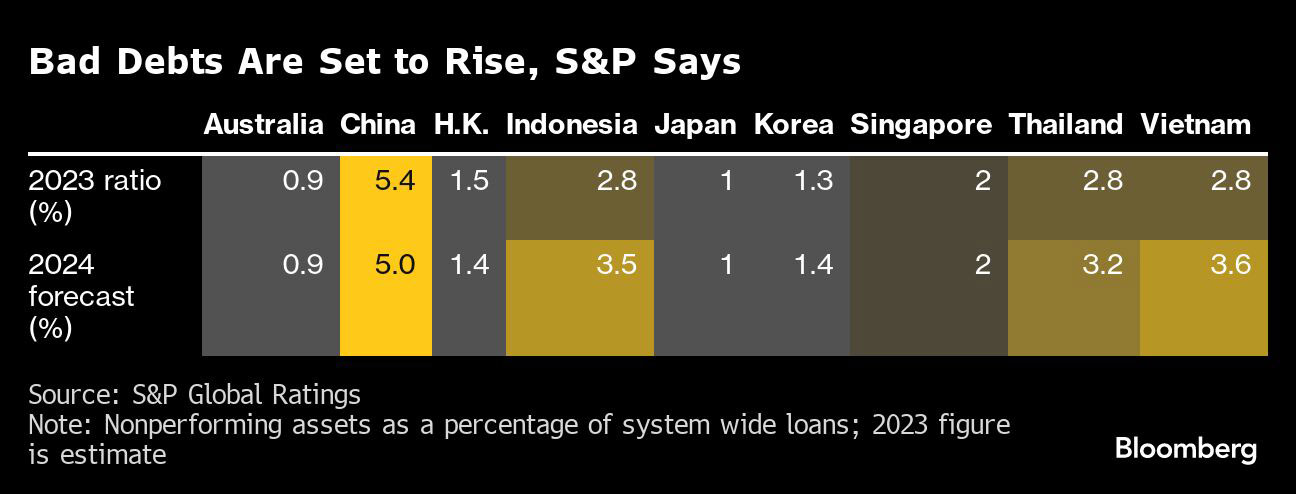
SURGING interest rates and regulatory scrutiny are causing distress for builders and creditors in Asian economies from South Korea to Vietnam, highlighting the breadth of housing woes in a region overshadowed by China’s crisis.

While aggressive monetary tightening and the pandemic have had a more pronounced impact on commercial property in the US and Europe, it’s residential housing that is under more strain in Asia. One of the worst hit nations, South Korea, saw  the steepest home price slump in 25 years while a construction firm’s repayment struggle has rekindled fears of repeating the credit market turmoil in 2022.

“Countries that had high consumer debt or balance sheet burden will be areas that you want to focus on,” said Kheng Siang Ng, head of Asia Pacific fixed income at State Street Global Advisors. “Korea is one of them. Housing markets have been softening.”

Here are some places where property market risks have the potential to boil over in 2024:

SOUTH KOREA
Korea’s property market is showing the most strain after China in the region, with prices in 2023 falling by the most in a quarter of a century after years of growth. The weakness is the direct outcome of moves by the Bank of Korea — the first major Asian central bank to kick off the current monetary tightening cycle in 2021 — to push its policy rate to a 15-year high.    

Turning the weakness into a crisis was a theme-park developer’s debt blowup in late 2022 that snowballed into the worst meltdown in the country’s credit market since the global financial crisis. While a suite of government rescue measures stabilized the situation, an engineering and construction company’s request to reschedule debt in late December prompted authorities to pledge more support.

Bad debts for both households and companies are piling up and the Bank of Korea said risks related to project financing debt — a type of security used to finance construction that triggered the 2022 crisis — are likely to increase next year. Even so, officials say the country’s financial system will generally remain stable. 

The “potential restructuring of real estate project financing loans from the middle of 2024 following the election in April 2024 could raise volatility in the short-term money market at least temporarily,” said Citigroup, Inc. economist Kim Jin-wook.

INDONESIA
The local central bank’s most aggressive rate hikes since 2005 put heavily indebted home builders such as PT Lippo Karawaci and PT Agung Podomoro under pressure, as it crimped household purchasing power. A weak currency made matters worse, by increasing the cost of servicing their soon-to-mature dollar debt, forcing them to resort to asset sales to raise cash.

Fitch Ratings said at the end of November that “some kind of default is probable” on Agung Podomoro’s $132-million bond due in June 2024 after it has canceled an offer to buy back part of the unsecured notes. Refinancing risks for Lippo Karawaci, Lippo Group’s Indonesia unit, also are rising, according to Fitch, which downgraded the firm’s dollar note due in January 2025 to CCC+ in November.

But the prospect of an end to Indonesia’s policy tightening is giving dollar-denominated property notes an uplift, as investors anticipate an improvement to real estate demand.

Fitch has predicted a recovery in local corporate bond sales, citing increased refinancing needs and a more supportive economic environment. Borrowers are expected to continue to prefer shorter-tenor issuance in 2024, as there is higher demand for short-term notes amid rate uncertainty, Fitch said.
VIETNAM
The government’s ambitious anti-graft campaign upended Vietnam’s property sector already plagued by oversupply, impeding corporate bond issuance that triggered a liquidity crunch and missed payments by borrowers. But regulatory interventions and multiple interest rate cuts have slowed the downward spiral.

“Vietnam’s real estate market has had an extraordinarily challenging year, but we believe the worst of the downturn has now passed,” Michael Kokalari, chief economist at VinaCapital Group Ltd., wrote in a report. “Mortgage rates peaked at as high as 16% at some banks in early 2023 but subsequently dropped dramatically.”

Still, signs of trouble remain. Some banks have thin capital buffers and some have high exposure to real estate, according to Sue Ong, credit analyst at S&P Global Ratings.

The poster child of the property woes is Novaland Investment Group Corp., one of the country’s biggest developers, notable for having a US-currency bond. The company agreed a maturity extension on holders of its $300-million convertible note, after an interest payment failure in July.

While the price of the note picked up on news the firm had struck a deal with creditors, the note is still indicated at 36 cents on the dollar, according to Bloomberg-compiled data. That’s a deeply distressed level showing low investor expectations for full debt recovery.

Perpetual dollar bonds issued by several of the city’s developers suffered their worst selloff in years in August, amid worries about soaring financing costs and the spillover impact of China’s real estate woes. Leading the declines were New World Development, Co. — one of Hong Kong’s most indebted developers. It’s debt underperformed industry peers this year.

Behind investors’ nervousness is a local property slump that saw the city’s home prices drop to the lowest in almost seven years. Revenues from office buildings and retail space have also weakened following three years of stringent COVID curbs and the Federal Reserve’s historic monetary tightening.

Demand was so depressed that Hong Kong developers were forced to cut home prices significantly, a tactic they hadn’t deployed for years, while banks struggled to lure buyers for foreclosed homes at equally deep discounts.

“We are cautious about developers in Hong Kong with large exposure to residential and commercial properties in lower tier cities in mainland China as well as those with large office portfolios outside prime districts due to the elevated vacancy rate and continued negative rental revisions,” said Zerlina Zeng, senior credit analyst at Creditsights. “We continue to underweigh Hong Kong developers with higher leverage due to the rising HKD funding costs, which would persist in 1H24.”

AUSTRALIA
It’s a slightly different form of property stress in Down Under, where the Reserve Bank of Australia’s (RBA) aggressive tightening cycle has raised concerns over households’ ability to stomach higher interest rates.

The International Monetary Fund (IMF) has indicated the country is liable to feel the effect of higher borrowing costs, at a time when a large chunk of home loans fixed at record-low rates during the pandemic are set to be rolled over to higher, floating rates. In Australia, more than 50% of mortgages have variable rates, according to the IMF.

The RBA warned in October that a small but growing number of households were in the early stages of financial stress. About 14% fixed-rate borrowers expected to face a rise in mortgage payments of more than 60% once their maturities expire, it said.

Data from the Australian Prudential Regulation Authority on banks’ residential property exposure show new non-performing loans climbing to a three-year high though they still remain relatively low. — Bloomberg


Public warned vs two unregistered investment firms

BW FILE PHOTO

THE Securities and Exchange Commission (SEC) has warned Filipinos against investing in two entities without a license to solicit investments.

In separate advisories posted on its website, the corporate regulator flagged BNY PAL (Benta Paluwagan)/BNYPAL & Trading and Pecado, saying these are unregistered firms.

BNY PAL invites people to invest at least P20,000 via “paluwagan slots or cash benta slots,” according to the SEC.

“The scheme employed by BNY PAL has the characteristics of a Ponzi scheme, where monies from new investors are used in paying fake profits to prior investors and is designed mainly to favor its top recruiters and prior risk takers and is detrimental to subsequent members in case of scarcity of new investors,” the SEC said.

It added that BNY PAL offers various paluwagan slots and income for different maturity periods, but there is no matrix on how much income investors will get.

“Based on one of the contracts posted, BNY PAL (Benta Paluwagan)/BNYPAL & Trading offers a minimum of 30% (income) in just 10 days,” the SEC said.  

“The Securities Regulation Code requires that said offer and sale of securities must be duly registered with the commission and that the concerned entity and/or its agents should have the appropriate registration and/or license to sell such securities to the public,” it added.

Meanwhile, the SEC said Pecado or P/E Capital Assetized Digital Offerings is an interactive digital investment platform that urges the public to invest in its digital assets. It also acts as a stockbroker.

It said Pecado is wholly owned by the US SEC registered investment advisory firm Ashtree Block Ventures LLC. It is operated by Ashtree Block Ventures UAB, which is a unit of Ashtree Block Ventures.

“While Ashtree Block Ventures is a registered investment advisory firm overseas, it is not registered with the commission as a corporation or as a partnership,” the SEC said. “However, an entity named Ashtree Consultancy, Inc., an affiliate firm incorporated in the Philippines, holds a service contract agreement to manage the back-office operations of Pecado.”

A company must have a license and should be registered locally before being allowed to do business in the Philippines, the SEC said. — Revin Mikhael D. Ochave

Top 10 energy and climate stories of 2023

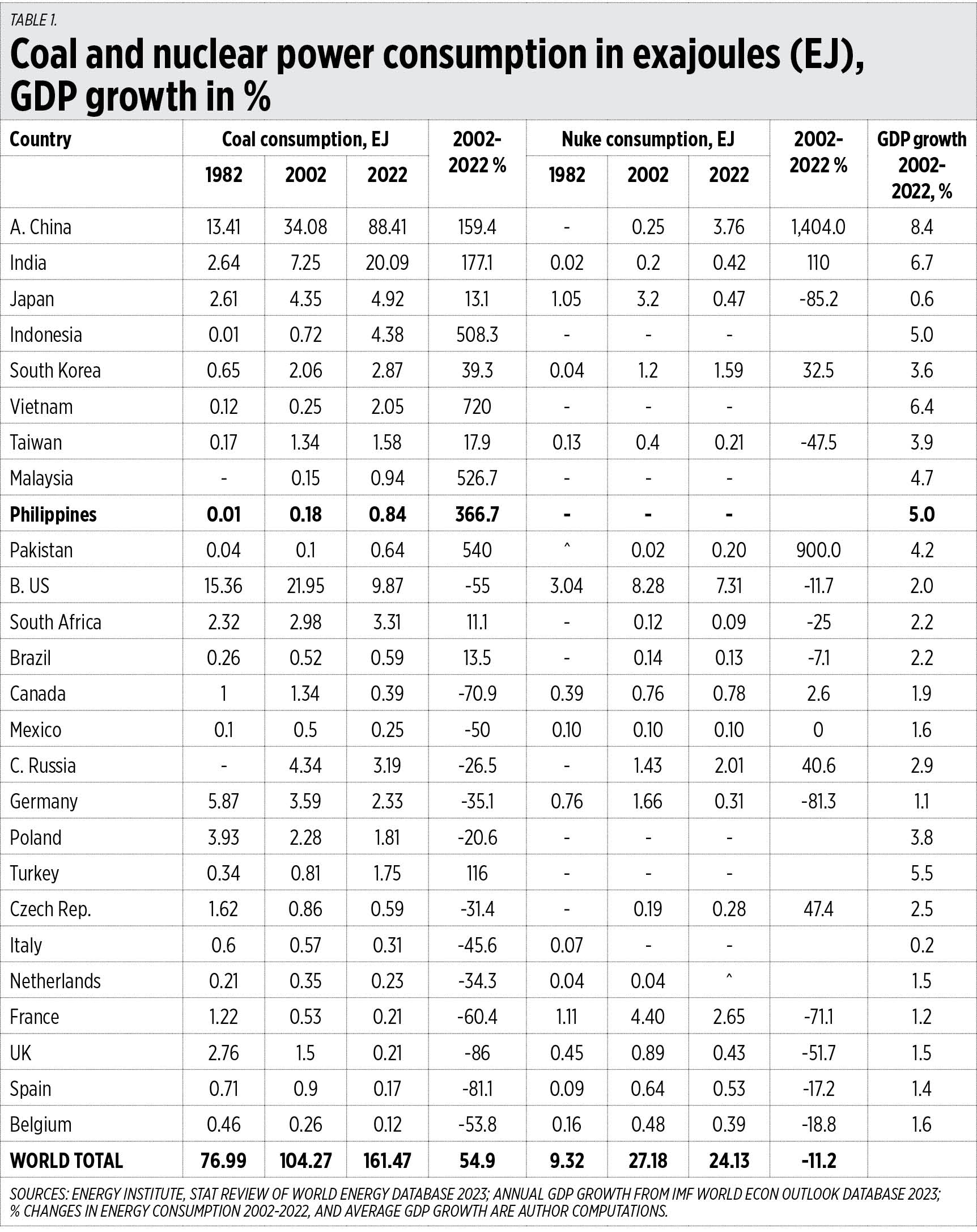
Happy New Year, dear readers. Here’s a lookback of important developments in the global energy industry. In the table below, I grouped the countries into three — group for Asia, group B for the Americas plus South Africa and group C for Europe.

First, “decarbonization” and coal phasedown continued in Europe and developed economies in North America and Asia, while developing Asia added more coal capacity and consumption. Global coal consumption from 2002-2022 expanded by 55%.

Second, “denuclearization” of the power system also continued in Europe. Germany shut down all its remaining nuclear power plants in April; France had targeted to cut its nuclear power share to 50% from 75% of the total by 2035, but was forced to abandon the goal; Spain announced a nuclear phaseout by 2035. In Asia, only Japan and Taiwan have joined this trend. Global nuclear consumption in the past two decades declined by 11%.

Third, slow, anemic economic growth continued to plague “decarbonizing” Europe in the past two decades, and some countries there likely to have contracted in 2023 (Germany, Poland, Ireland, etc.). “Carbonizing” Asians that need cheap, stable energy sources keep humming with high growth except Japan (Table 1).

Fourth, all the gloom and doom scenarios in oil prices because of the continuing war between Russia and Ukraine plus NATO, and even with the war between Israel and Hamas plus Hezbollah and Houthis since early October 2023 did not happen. WTI crude price ended 2023 at below $73/barrel while it was $90 days before the Russian invasion in late February 2022.

Fifth, it’s the same trend for gas and coal. The end-2023 US natural gas price of about $2.5/mmbtu was much lower than $4.5/mmbtu in mid-February 2022 before the Ukraine war. The end-2023 coal (Newcastle) price of about $146/ton is again much lower than the pre-Ukraine war price of $240/ton.

Sixth, both the solar energy index and wind energy index are below $300, the lowest since October 2020. The EU carbon permits are below $85/ton, another low level since December 2021. In contrast, the nuclear energy index reached an all-time high of $2,007 in December.

Seventh, the biggest annual UN meeting, Conference of Parties (COP) 28 in Dubai from Nov. 30 to Dec. 12 attracted more than 70,000 foreign participants including media, activists and billionaires who lambasted fossil fuels while using lots of it flying from around the world to Dubai. The key agreement was not the phaseout of fossil fuels but the transition away from fossil fuels.

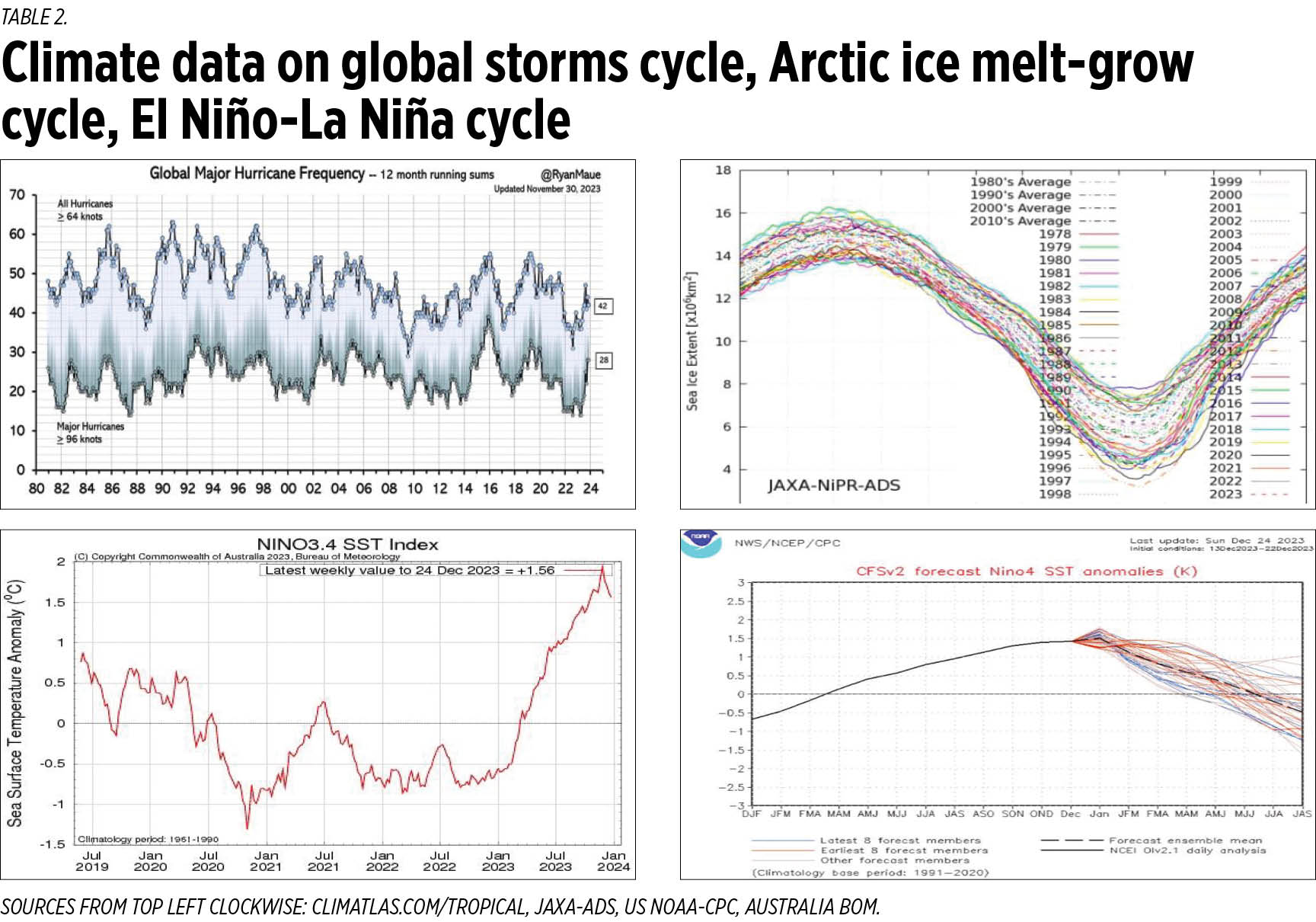
Eighth, the gloom and doom climate scenarios of the ever-warming, ice-melting and sea level-rising planet, more and stronger storms, did not happen, as shown by the two charts below from the Japan Aerospace Exploration Agency (JAXA) Arctic and Antarctica Data archive System (ADS), and climatlas.com/tropical by Ryan Maue. The JAXA-ADS data from 1978 to December 2023 showed ice-melt growing each year, or a 100% natural cycle. Arctic ice is lowest in September each year with only about 4 million sq. km, then the ice starts growing to the highest in March each year with up to 16 million sq. km of ice.  For context, the total land area of the Philippines is only 0.3 million sq. km; the lowest level Arctic ice is 13x larger, and the highest level Arctic ice is 53x larger than the total land area of the Philippines.

Ninth, the “scary droughty” El Niño of 2023 showed a fast rise in ocean temperatures, but was quickly followed by a fast decline in temperatures. This occurred after a triple-dip La Niña. Two lower charts below are from the Australia Bureau of Meteorology (BoM) and US National Oceanic and Atmospheric Administration (NOAA) Climate Prediction Center (CPC). The BoM data from May 2019 to Dec. 24, 2023 showed that the triple-dip La Niña and global cooling occurred from July 2019 to March 2021. Triple-dip La Niña is rare, and the last time it happened was 21 years ago. The NOAA-CPC data as of Dec. 24, 2023 showed that the current El Niño would end by May 2024, go to a neutral stage and go back to La Niña by September 2024 (Table 2).

Tenth, Uranium prices are at an all-time high. From the end-December 2021 price of only $44/lb, it went up to $49/lb by end-December 2022. During the COP28 meeting, it was up to $82. A week after COP28 ended, it went up to $86, and two weeks after it further rose to $91. It seems that the COP resolution of the “transition away from fossil fuels” means countries and companies will start investing in nuclear power, and not in intermittent wind-solar.

Philippines economic and energy policies should focus on sustaining fast growth to help create more jobs and attract more businesses. A number of big companies from Germany, the UK, Italy, etc. have either moved to other countries partly due to expensive energy in their home countries. The Philippines should attract more foreign companies and professionals by not following the folly of “decarbonization” and “net zero” fetishism and obsession.


Bienvenido S. Oplas, Jr. is the president of Bienvenido S. Oplas, Jr. Research Consultancy Services, and Minimal Government Thinkers. He is an international fellow of the Tholos Foundation.

minimalgovernment@gmail.com

FCDU loans up at end-Sept.

OUTSTANDING LOANS granted by banks’ foreign currency deposit units (FCDU) inched up as of end-September 2023 from the previous quarter, as disbursements exceeded principal repayments.

Loans granted by the FCDUs of banks went up by 0.7% to $15.5 billion as of September from $15.39 billion at end-June, the Bangko Sentral ng Pilipinas (BSP) said in a statement late Friday.

Year on year, outstanding FCDU loans declined by 1.1% from $15.67 billion.

FCDUs are BSP-approved bank units that perform transactions involving foreign currencies, including deposits and loans.

Gross disbursements rose by 18.8% to $17.1 billion as of September from $14.4 billion as of end-June due to higher funding requirements of a foreign bank branch affiliate, the BSP said. 

Loan repayments also increased by 17.4% to $17 billion from end-September, which resulted to an overall net disbursement.

The bulk of banks’ FCDU loan portfolio was made up of medium- to long-term debt, or those payable in more than a year, which stood at $12.032 billion and made up 77.6% of the total. This was lower than the previous quarter’s 78.3% share.

FCDU loans granted to residents amounted to $9.396 billion or 60.6% of the total loans at end-September, with $9.274 billion of this amount (59.8%) going to private firms.

Most of these loans went to power generation companies ($2.4 billion or 25.3%), merchandise and service exporters ($2.3 billion or 24.5%), and towing, tanker, trucking, forwarding, personal and other industries ($1.3 billion or 13.5%). 

FCDU loans to nonresidents totaled $6.105 billion during the nine-month period.

Meanwhile, FCDU deposit liabilities increased by 5.7% to a fresh record high of $51.8 billion as of end-September 2023 from $49 billion in the previous quarter.

“The bulk of these deposits ($50.4 billion or 97.3%) continued to be owned by residents, essentially constituting an additional buffer to the country’s gross international reserves,” the BSP said.

Year on year, FCDU deposit liabilities went up by 6% from $45.8 billion at end-September 2022.

The overall FCDU loans-to-deposit ratio stood at 29.9% in the January-to-September period, down from the 31.4% recorded at end-June and the 34.2% seen a year prior. — Keisha B. Ta-asan

China’s fireworks ban sparks fiery debate online ahead of Lunar New Year

CHINESE lawmakers on Friday weighed in on a fiery online debate on whether fireworks should be used to ring in the Lunar New Year in February, saying a total ban on pyrotechnics in the country credited with inventing them would be hard to implement.

In an unusually frank response, lawmakers said air pollution prevention laws and fire safety regulations have led to “differences in understanding” of the ban on fireworks, which was never absolute.

In 2017, official data showed 444 cities had banned fireworks. Since then, some cities have scaled back curbs, allowing fireworks at certain times of the year and at designated venues.

This month, however, many counties rolled out notices prohibiting fireworks, rekindling discussion on the ban.

“We’ve the right to fireworks,” wrote a user of Weibo, a popular Chinese microblog.

According to folklore, the earliest fireworks were invented 2,000 years ago to drive away the nian, a mythical beast that preyed on people and livestock on the eve of the Lunar New Year, or Spring Festival.

Since then, fireworks have been used to celebrate other occasions: this January, after three years of COVID-19 curbs were lifted, some people defied bans — and authorities — and set off firecrackers.

But some Chinese said the firework bans were necessary to protect the environment.

“It should be regulated due to pollution and safety (fire) hazards,” a Weibo user said.

In an online poll by the official Beijing Youth Daily this week, however, over 80% of respondents expressed support for fireworks during the Spring Festival, the most important holiday on the Chinese calendar.

Some also said the ban was ironic after the United Nations last week adopted the Spring Festival as an official holiday, a move cheered by Chinese officials.

“The Spring Festival belongs to the world, but China’s is almost gone,” wrote another Weibo user.

In southern Hunan province, a major fireworks manufacturing hub, exports totaled 4.11 billion yuan ($579 million) in January to November, state media reported, far exceeding domestic sales. — Reuters

Filinvest Land opens amenity area for Tanauan City dev’t

FILINVEST LAND, Inc. (FLI) has opened its latest amenity area for its Sandia Homes residential development in Tanauan City, Batangas.

Sandia Homes’ amenities include a clubhouse, basketball court, playground area, and a swimming pool.

“These amenities are more than just recreational spaces; they are designed to foster a sense of community, promote wellness, and enrich the lives of those who call Sandia Homes their home,” Ethel Balicanta, FLI vice-president, said in a statement.

FLI aims to provide “a complete living experience” to raise the well-being of residents, she added.

Named after the Sandia mountain range in New Mexico, Sandia Homes is a community development under the smart-value brand Future of FLI.

Sandia Homes currently has 266 units available for sale. Lot sizes range from 60 to 75 square meters.

The property is situated near the South Luzon Expressway with easy access to schools and churches. It is 10 minutes away from the Tanauan City and Sto. Tomas City proper. — M. H. L. Antivola

SP New Energy fast-tracking clearing for P200-B solar project

STOCK PHOTO | Image from Pixabay

SP NEW ENERGY Corp. through its unit is fast-tracking site-clearing activities for the construction of its P200-billion Terra Solar project.

“Work has begun on clearing the site, which will eventually cover approximately 3,500 hectares in Nueva Ecija and Bulacan,” the company said in a statement at the weekend.

The site-clearing activities are conducted ahead of the construction of the project’s interconnection facilities with the national grid and the installation of more than five million solar panels.

The Terra Solar project will house 3,500 megawatts of solar panels and 4,000 megawatt-hours of battery storage system. It is expected to generate more than 5 billion kilowatt-hours of electricity yearly.

The total investment for the project is estimated at P200 billion.

SP New Energy last month said it had bought the entire stake of Prime Infrastructure, Inc. in a joint venture company, Terra Solar Philippines, Inc. for P6 billion.

In October, MGen Renewable Energy, Inc. (MGreen) took over SP New Energy with a P15.9-billion investment. MGreen is the renewable energy development arm of Meralco Powergen Corp., a wholly owned unit of Manila Electric Co.

SP New Energy last week said MGreen had completed the acquisition by paying the balance of P8.89 billion.

MGreen will own 15.7 billion common shares and 19.4 billion preferred shares in SP New Energy, for a total voting interest of 50.5%.

SP New Energy posted an attributable net loss of P49.73 million in the third quarter. S.J. Talavera

Globe expects wider adoption of AI

Words reading “Artificial intelligence AI” of miniature robot and toy hand are pictured in this illustration taken on Dec. 14, 2023. — REUTERS/DADO RUVIC/ILLUSTRATION

GLOBE Telecom, Inc. expects wider adoption of artificial intelligence (AI) among Philippine companies, the company’s cloud unit Cascadeo said.

“We foresee generative AI refocusing — but not necessarily replacing — the digital transformation and managed services that power our customers’ success in the cloud,” Jared Reimer, president and chief technology officer at Cascadeo, said in a statement on Monday. “As the use of generative AI increases, businesses must learn to adopt instead of resisting the changes.”

The telecommunication company expects corporations this year to “fully embrace AI across every role and aspect of business” due to the growing interest in the use of AI-enabled applications.

About 80% of enterprises are projected to adopt AI application programming interfaces by 2026, Globe said, citing a Gartner study in October.

“With our industry-leading tech and expertise, Cascadeo is ready to help companies take their first steps into adopting generative AI and guide them through implementation,” Mr. Reimer said. “We will be there to guide them in migrating to a cloud environment that’s scalable and adaptive as AI evolves.”

Meanwhile, Aboitiz Data Innovation Pte. Ltd. (ADI) said cyber-attacks are driving the adoption of AI among enterprises.

“With the increase of digitalization, the increase of technology adoption, we have to unfortunately acknowledge that the bad actors are also going to increase,” David R. Hardoon, chief executive officer of ADI, said in a recent interview. “We should be, and we are effectively using AI to detect any irregularities.”

The company earlier said it seeks to integrate AI across the Aboitiz Group’s units to enhance its operations, specifically in financial services. — Ashley Erika O. Jose

A Filipino micropreneur’s tale of resilience

In the vibrant heart of Taft Avenue, Manila, my micropreneurial journey has been a tapestry woven with challenges and triumphs. As we stand on the cusp of a new year, reflecting on the management principles shaping my entrepreneurial narrative becomes imperative. Optimism, a crucial entrepreneurial trait, must co-exist with an understanding of the intricate business landscape. Embracing failures as invaluable lessons cultivates resilience and insight into the need for adaptive strategies, meticulous planning and commitment to action to navigate unpredictable seas of entrepreneurship.

This article will use the PESTEL (political, economic, social, technological, environmental and legal) framework to describe my micropreneurial journey. As a university lecturer tired of merely talking about business theories, I ventured to “walk the talk” by establishing my own food business. Despite facing setbacks and deciding to close before the New Year, I wish to share the lessons I have learned. Additionally, I would like to share insights gained from my trip to Vietnam and offer a unique perspective on the shared experiences of small businesses in diverse cultures.

The political climate was characterized by the cutthroat food market around schools. Witnessing the competition sidestep regulations on selling alcohol to students and violate safety regulations without suffering consequences stung. As a teacher of business ethics, I needed to set an example not only for my students but also for the broader community. I did not waver in my commitment to ethical standards and refused to go below the minimum threshold of the law. In this turbulent sea, understanding the intricate dance with local government emerged as a crucial skill. Our lessor’s unresponsiveness added complexity and underscored the need for astute formal and informal political navigation in entrepreneurial waters.

Like relentless tides, economic forces presented formidable challenges. Overhead expenses, notably rent and salaries, created a persistent undertow against the delicate financial balance of our small food business. The minimum wage in the Philippines for small businesses with 15 employees and below is P573, while in Vietnam, it is the equivalent of P410. However, this is fitting, considering Vietnam’s generally lower food cost and living expenses. Unfortunately, unintentional overstaffing in my business added to my financial burden, underscoring the need for finance managers to control various facets of an agile business.

In the vast sea of social dynamics, understanding the pulse of the community became paramount. In Vietnam, where three or more coffee shops line the same street, the preference for coffee over alcohol aligns with shifting preferences at Taft, where the price-sensitive student population is enamored with coffee over hearty meals. The fierce competition demanded creative and cost-effective strategies for us to stay afloat.

As the business world continues to sail through the digital age, technological hurdles persist. Navigating online food platforms, compounded by stiff contracts and exorbitant commissions, proved tricky. Troubleshooting login issues was like venturing into uncharted waters, where the supposed lighthouses, the customer service function of online food platforms, were difficult to find, leaving me in the dark. From troubles in Taft’s digital seas to the slower pace of technology in Vietnam, the pulse of innovation beats differently in every corner of the world. I realized that resilience and adaptability are the lifebuoys for micropreneurs.

In the ever-changing landscape, environmental forces revealed underlying considerations not taught in schools. For example, maintaining harmony with nearby competitors that blocked driveways and left trash lying around became an art of its own, demanding resilience and a commitment to community coexistence.

Daunting taxation requirements and ever-changing policies and processes required agile compliance. The intricacies of legal compliance became a test of micropreneurial mettle because one wrong move could lead to tumultuous waters. In this challenging journey, the captain must champion compliance and steer the ship through deep and murky legal waters.

Furthermore, despite the challenges posed by poor partnerships in the business, aspiring entrepreneurs should cultivate assertiveness and strategic foresight. This involves fostering open communication, conducting thorough due diligence in choosing partners and adapting swiftly when challenges arise.

As we start the new year, let this reflection remind us that despite the silent struggles faced by entrepreneurs, positive change is within reach. Let us embrace new beginnings, adapt to ever-changing seas and let resilience guide us toward a prosperous 2024.


Charisse Ang is an entrepreneur, family business owner and part-time lecturer at De La Salle University.

charisse.ang@dlsu.edu.ph

Depardieu accusations of sexual harassment expose divide in France

AN OPEN letter penned by dozens of actresses and other artists in defense of Gerard Depardieu, the cinema giant accused of sexual harassment, has laid bare divisions in France over the #Metoo reckoning with sexism.

Actresses Nathalie Baye and Carole Bouquet — a former partner of Depardieu — as well as singer and former first lady Carla Bruni were among the more than 50 household cultural figures who called Depardieu the victim of a public “lynching.”

Entitled ‘Don’t Cancel Gerard Depardieu,’ the letter published this week in conservative daily Le Figaro alleged Mr. Depardieu had been the recipient of a “torrent of hatred.”

“We can no longer remain silent in the face of the lynching that has descended upon him,” the letter’s authors wrote.

“Gerard Depardieu is probably the greatest of all actors. When you attack Gerard Depardieu like this, it is art you are attacking.”

Mr. Depardieu, 75, who has starred in scores of French-language movies, rising to prominence in 1974 with Going Places, has been at the center of a growing number of sexual assault allegations in recent years.

In March, 2022, investigative magistrates placed Mr. Depardieu under formal investigation in one case on suspicion of rape and sexual assault. Actress Charlotte Arnould, 28, later revealed she was behind those accusations, saying she could not bear remaining silent any longer. Since then, more than ten women have accused Mr. Depardieu of sexual violence.

Mr. Depardieu has consistently denied any wrongdoing and through his lawyers previously “firmly rejected” the accusations against him. 

“Never, absolutely never, have I abused a woman,” he wrote in an Oct. 2 letter also published in Le Figaro. He has not been convicted of any of the accusations against him.

President Emmanuel Macron rallied to the defense of Mr. Depardieu shortly before Christmas, when asked in an interview about his culture minister’s plans to review Mr. Depardieu’s Legion d’Honneur medal — France’s highest decoration.

Mr. Macron condemned the “manhunt” against Mr. Depardieu without expressing sympathy for his alleged victims. “He’s an immense actor, a genius of his art,” Mr. Macron said. “He makes France proud.”

GENERATIONAL DIVIDE
The president’s remarks and Monday’s letter drew dismay from feminists and younger actresses who decry an attempt to drown out the voices of victims of sexual violence and undermine the #Metoo movement against sexual harassment in France.

“There’s a generation that still doesn’t understand this societal evolution,” Murielle Reus, vice president of #MeTooMedia which campaigns against sexism and sexual misconduct in the media, said in a radio interview this week.

Critics of the #Metoo campaign in France accuse it of a puritanical fight fueled by a contempt for men and the art of seduction.

Catherine Deneuve, one of France’s best-known actresses, was among 100 French women who in 2018 wrote a newspaper column accusing the #Metoo campaign of going too far.

“We defend a right to pester, which is vital to sexual freedom,” they said.

Earlier this month, public broadcaster France 2 ran a documentary, Depardieu: The Fall of an Ogre, which showed the actor making lewd comments to women during a 2018 trip to North Korea and featured interviews with Arnould and another actress, Helene Darras, who in September filed a lawsuit against Mr. Depardieu alleging sexual assault.

Berenice Hamidi, a lecturer at the Lumiere Lyon 2 University said it was unsurprising the global #Metoo movement was born out of the US cinema industry, where she said livelihoods can be precarious and the boundaries of fact and fiction blurred.

“There is a real cultural exception in French cinema, which refuses to consider acts committed by artists as violence and to condemn them,” Ms. Hamidi told franceinfo radio.

Depardieu told RTL radio he considered those who wrote this week’s open letter to be “very courageous.” — Reuters

Why your dream home need not be 2,000 square feet

SUBURBAN dwellers might finally be embracing what those of us in cities have known for a long time: You don’t need a lot of square footage to have a comfortable living environment.

After decades of ever-swelling footprints, the size of Americans’ newly built homes has begun to shrink, as high mortgage rates and increased building costs nudge both developers and buyers to look for ways to trim expenses. The median single-family home completed in 2022 was 2,299 square feet, down from 2,467 in 2015.

I understand the frustration about more homes being squeezed in per neighborhood if you dreamed of having a big yard, but the size of homes around America today is outrageous. It’s likely that those in the millennial and Gen Z cohort who grew up in homes with spacious bedrooms, spare rooms earmarked for the occasional guest and as many bathrooms as bedrooms became acclimated to larger houses. But it’s time to readjust expectations of our own homes to the reality of the current housing market and the environmental toll of living in such big spaces. With the average household hovering at around 2.5 people, we just don’t need such large dwellings.

It has always boggled my mind that many Americans assume 2,000 square feet is needed to accommodate a family of four. I’ve spent my entire post-college adult life living in New York City — one of the areas in the United States known for compact living. I also spent nearly six years of my childhood living in Japan, another place famous for small but efficient living spaces.

The desire to have extensive square footage is a largely American phenomenon. (Not uniquely American, though. Australia, New Zealand and Canada all have large homes.) Twenty-seven states have an average home size of more than 2,000 square feet, according to the 2022 American Home Size Index, which analyzes Zillow data. The next nine states had square footage north of 1,900.

Compare those numbers with the 1960s, when the median square footage of a single-family home was 1,500 square feet, according to census data, despite generally larger family sizes.

In the 1960s, only 16.8% of homes had four or more bedrooms, and only 10.1% had 2.5 or more bathrooms. By 2009, around one-third of homes had four or more bedrooms and nearly half had at least 2.5 bathrooms, according to a Census Bureau paper. By 2015, 38% of homes had three or more bathrooms, a figure not even tracked until 1987.

What about the emergence of tiny houses or #vanlife, you say? Those fads, in part a reaction to the Great Recession and the housing market crash, attract a lot of attention for their novelty, but zoning laws and practical considerations mean they will likely remain niche causes.

Personally, I’m not so diehard about small space living that I want to live in a 500-square-foot tiny house (generally seen as the maximum to qualify for that designation) with my husband, dog and any future children. However, I do generally find it strange to prioritize square footage for things like massive primary bedrooms, when you spend so little waking time there, instead of allocating square footage to common spaces and storage and being able to reduce the overall size of a home.

Even if potential homebuyers are wary of losing square footage and lot size, there are two major perks. Reducing the size of your home has significant financial benefits with lower utility bills, likely lower property taxes and the need to buy less stuff to furnish your space. Homebuyers can also feel good about reducing their overall environmental impact.

Given the rise in climate anxiety and environmental engagement among millennials and Gen Z, the shift to smaller-space living is a way to truly put their money where their mouth is. — Bloomberg Opinion

ADVERTISEMENT
ADVERTISEMENT