Notice: Function _load_textdomain_just_in_time was called incorrectly. Translation loading for the Newsmag domain was triggered too early. This is usually an indicator for some code in the plugin or theme running too early. Translations should be loaded at the init action or later. Please see Debugging in WordPress for more information. (This message was added in version 6.7.0.) in /data/bwonline/walaakomaisip/wp-includes/functions.php on line 6131
BusinessWorld Online | BusinessWorld: The leading and most trusted source of business news and analysis in the Philippines | Page 3786                                   
Home Blog Page 3786

Revenue challenges faced by new Finance chief
HONG KONG — As my family’s belated vacation here is ending, I see that Hong Kong as a tourist and investment hub is back to where it was in 2019, or even better. The big crowds at Central, Tsim Shia Tsui, Mong Kok and other areas in Kowloon, the huge volume of passengers inside long trains, the huge construction projects at the airport, these are among the reasons why I say this.

Hong Kong’s extensive infrastructure — its smooth wide roads, its huge suspension bridges, tunnels, and flyovers, its subway train-walkway-shop complexes, its large modern airport, its huge, long seaports, its brightly lit roads and streets, etc. — they were all built with little public borrowing. Until 2019, its public debt to GDP ratio was only 0.3%. This went up to 4.2% in 2022 and is projected to reach 7% this year. In contrast, the Philippines had a debt/GDP ratio of 37% in 2019, and this increased to 57.7% between 2022 to 2024.

If the Philippines, or at least the Metro Manila-Cavite-Bulacan area, would strive to be at par with Hong Kong at the current pace of infrastructure development in the country, I think it would take us at least 40 years get to where Hong Kong’s infrastructure is now.

But if we get huge infrastructure financing (both public and private), and the various political hurdles and bureaucracies (both national and local) are removed, perhaps we will do it in 25-30 years. And this is the big challenge facing the new Secretary of the Department of Finance, Ralph G. Recto.

The previous Finance Secretary, Benjamin Diokno, as leader of the economic team, laid down a good foundation. The Philippines’ GDP growth was high at 7.6% in 2022, and 5.6% in Q1-Q3 2023 — the third highest among the world’s top 40 largest economies last year. Revenues overall have recovered even without any major tax hikes. Hats off to Sir Ben.

Here is the situation and the challenges the new secretary will face at the Department of Finance (DoF) in 10 points:

1. Expanding the tax base. Considering revenues were at P3.45 trillion in 2022 and are projected to be around P3.90 trillion in 2023, the target of at least P4.5 trillion this year should be attainable even without tax hikes because the recently enacted law Ease Of Paying Taxes (EOPT) Act (RA 11976, signed Jan. 5) should be able to expand the tax base. Other proposed revenue bills can help if they are enacted soon.

2. A busy BIR. The Bureau of Internal Revenue (BIR) in particular can target at least P3.3 trillion (about 67% of total revenues) this year as the EOPT law applies more to it than to the Bureau of Customs (BoC) and broadening of the tax base applies more to domestic than international business.

3. The need to control smuggling. The BoC may target collecting P1.8 trillion by significantly controlling smuggling and illicit trade. From the estimates Representative Joey Salceda gave last October, tobacco smuggling alone results in about P60 billion/year in revenue losses. The BoC plus other lead enforcement agencies like the Philippine National Police and the Coast Guard should work harder in controlling illicit trade because their annual budgets are huge and come from taxes, so they should strive to control tax leakage.

4. Keeping the budget deficit under control. In partnership with the Department of Budget and Management, the Finance department must control some spending so the budget deficit this year does not exceed P1.4 trillion and the deficit/GDP ratio is limited to 6.5% or lower.

5. Keeping a lid on borrowing. Financing or borrowings, which averaged P2.2 trillion/year from 2020-2022, should be controlled so as not to exceed P1.8 trillion this year. If revenues increase significantly and the deficit is controlled, the need for borrowing is reduced and interest payments will be reduced in the succeeding years.

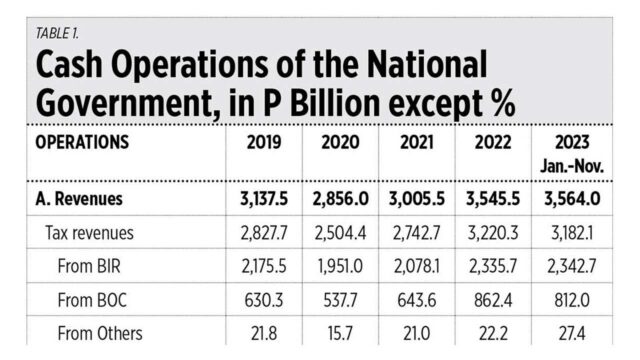
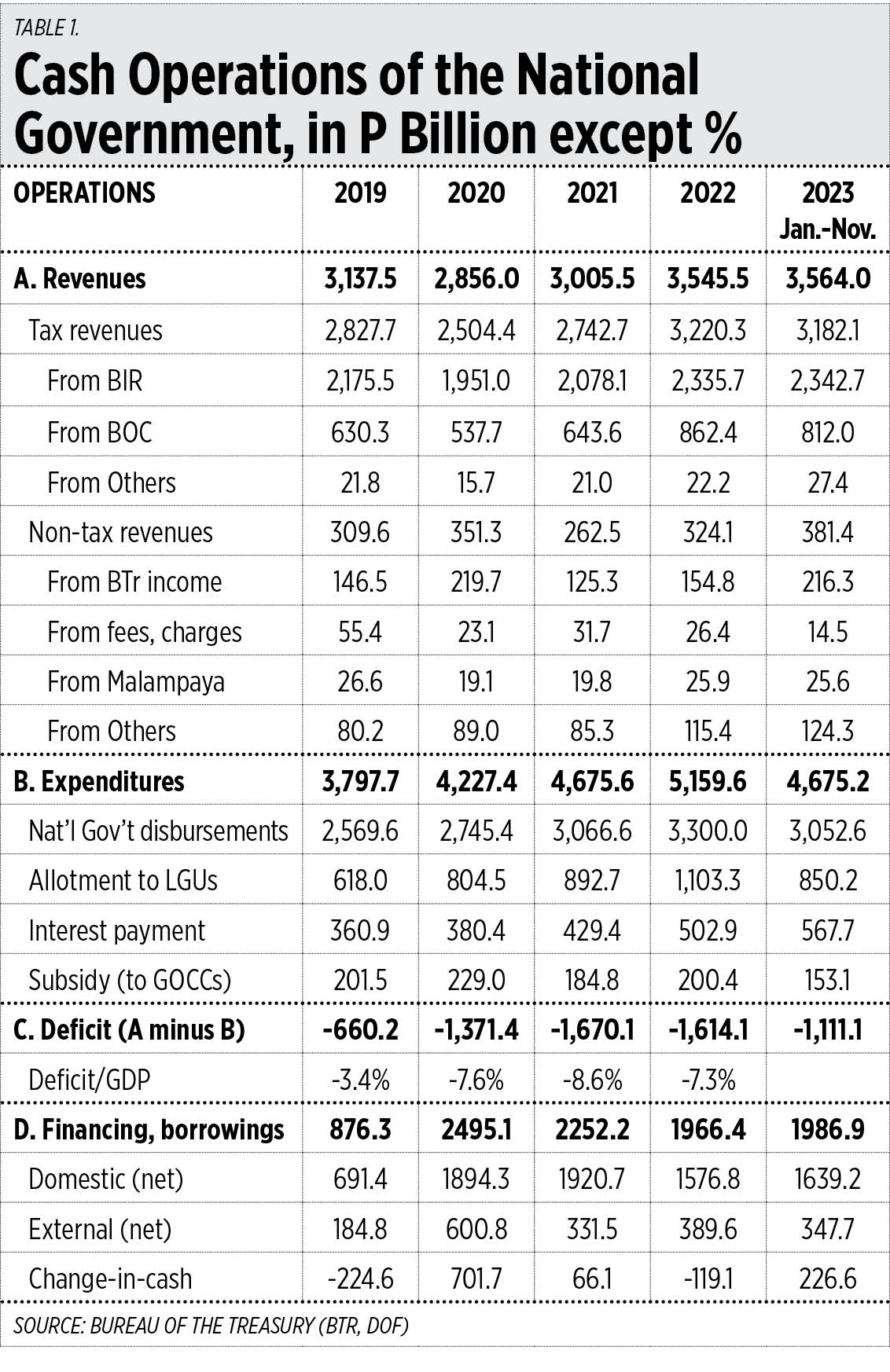
Accompanying this column is a table featuring the actual numbers in cash operations from 2019 (pre-lockdown) to 2023 (post lockdown) and on which my proposals for fiscal targets in 2024 are based (see Table 1).
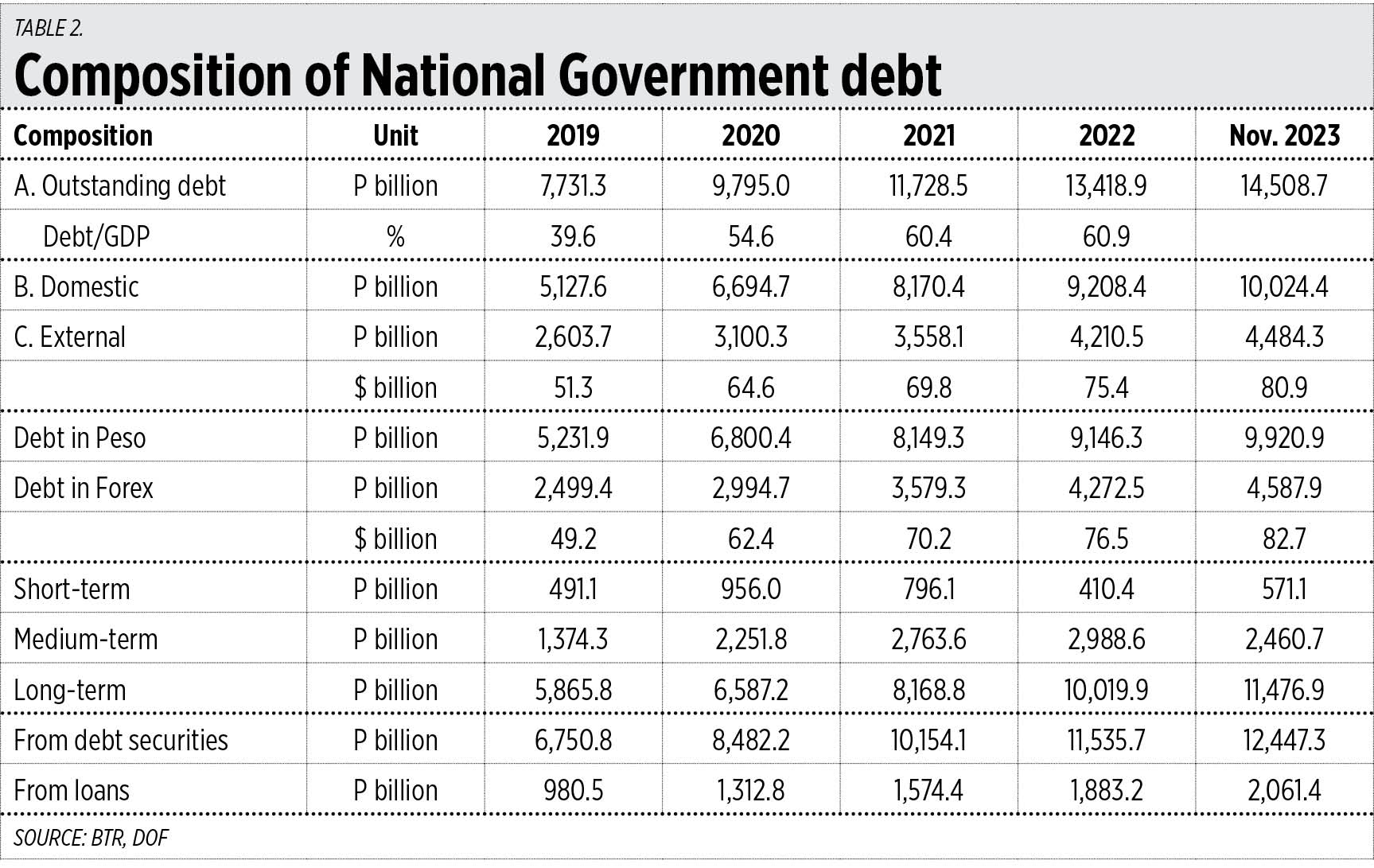
6. Lowering the debt/GDP ratio. The outstanding debt stock (excluding contingent liabilities) should peak this year at around P16.5 trillion, then plateau for a year or two, and begin to decline by 2027. We should strive to bring back 2019’s debt/GDP ratio of 40% by 2028, down from 61% in 2022.

7. Avoiding long-term loans. We should reduce long-term loans even if the interest rates are lower because they create a big moral hazards problem. Agencies contracting the long-term debt can afford to be wasteful because the ones that will pay these off will be two to four administrations (six to 20 years) away. In November 2023, long-term debt constituted 79% of the total outstanding debt, up from 76% in 2019. Leave long-term financing to PPP projects and Maharlika funding. The vetting process and financial discipline in private financing is more strict and less political than government and foreign aid/ODA funding.

8. Avoiding forex risks. There is also a need to reduce borrowings from commercial or debt securities, not only because of higher interest rates, but also due to rising forex risks as the US$ is under constant and rising threat of large-scale instability because of huge increases in US federal debt.

Accompanying this column is a table of the actual numbers in public debt and their distribution (see Table 2).
9. Controlling spending. The major spending control challenges must be addressed by the economic team as a whole. These include reforming the huge and ever-rising military and uniformed personnel (MUP) pension which may reach P200+ billion this year alone. Then there are the subsidies which seem to stretch forever, with no timetable — freebies should have a limit. And war-mongering lobbies that say that we should buy very costly jet fighters, battleships, submarines, and missiles should be kept at bay. Our priority should be more domestic infrastructure and more job creation here, not more war mongering on faraway shores.

10. Sustaining the high GDP growth target. We ought to keep a high GDP growth target of 6.5% to 8% yearly until 2028 and beyond. Our deficit/GDP ratio and public debt/GDP ratio can easily decline if the denominator, our GDP size, expands fast at sustained level.

Ralph Recto has the maturity and wisdom of a seasoned legislator and statesman (he has been a senator, a congressman, and secretary of the National Economic and Development Authority or NEDA). His overview of economics and politics has been sharpened by long years of government experience and he has an extensive network with the public, especially tax-paying entrepreneurs and investors.

I extend my congratulations to Mr. Recto for taking up the challenge. The best is yet to come, here’s to a wealthy and prosperous Philippines.


Bienvenido S. Oplas, Jr. is the president of Bienvenido S. Oplas, Jr. Research Consultancy Services, and Minimal Government Thinkers. He is an international fellow of the Tholos Foundation.

minimalgovernment@gmail.com

UK housing market gains momentum at start of year

BUILDINGS in the City of London are seen behind Waterloo Bridge in London, Britain, Oct. 20, 2017. — REUTERS

LONDON — Average asking prices for British homes made the strongest start to the year since 2020, according to a Rightmove survey on Monday that added to signs that the slowdown in the sector could be easing as demand picked up in January.

The average price of homes put on sale between Dec. 3 and Jan. 6 was 1.3% higher than the month before, the biggest December to January rise since 2020 and more than double the average increase for this time of year, Rightmove said.

House prices in Britain typically pick up at the start of January after a lull in the run-up to Christmas.

“For now, the data at the start of 2024 points to building momentum, and reasons for growing market optimism,” Tim Bannister, director of property science at Rightmove, said.

Rightmove said the number of agreed sales was 20% higher in the first week of January compared to the same period last year, and buyer demand was up 5%. The number of homes coming to the market rose by 15%.

British house prices, like those in many other rich countries, surged during the COVID-19 pandemic, rising by more than 25% according to official data.

But transactions slowed sharply in late 2022 after then-Prime Minister Liz Truss’ budget plans caused turmoil in bond markets, which pushed up the cost of mortgages, while rising Bank of England rates acted as a brake through 2023.

Asking prices in Rightmove’s January period are still 0.7% lower than the year before.

Average mortgage rates have fallen, however, from a peak of 6.11% for a five-year fixed term in July 2023 to 4.86% now, Rightmove said.

Financial markets expect the Bank of England to start cutting rates from their current 15-year high of 5.25% in May.

Other indicators have also shown a rise in house prices. Britain’s biggest mortgage lender Halifax earlier this month reported a 1.1% monthly increase in prices in December and the first annual rise in eight months. 

That said, buyers were still likely to feel the squeeze from elevated mortgage rates and the cost-of-living crisis this year, Mr. Bannister said.

And while the housing market appears to be gaining momentum, Mr. Bannister said activity was likely to slow in the weeks leading up to the national election which Prime Minister Rishi Sunak has suggested will be held in the second half of this year. — Reuters

Entertainment News (01/16/24)


Cinemalaya 2024 calls for short film entries

THE Cultural Center of the Philippines (CCP) and the Cinemalaya Foundation, Inc. are now accepting submissions to the Short Film Category of the Cinemalaya Philippine Independent Film Festival 2024. The deadline is before 6 p.m. on March 8. Interested parties may submit a maximum of three entries that were produced between March 3, 2023, and March 8, 2024. For full mechanics, visit the CCP website (www.culturalcenter.gov.ph) or the Cinemalaya website (www.cinemalaya.org).


Le Ciné Club shows French films on Wednesdays

Every Wednesday this January, Alliance Française de Manille hosts Le Ciné Club Manila’s screenings of French films. On Jan. 17, catch Poly, a 2019 film by Nicolas Vanier centered on the challenges of 10-year-old Cecile integrating into the social scene of her village in southern France. On Jan. 24, two films by Lola Quivoron will be shown. One is the 2021 film Annie colere (Angry Annie), set in 1970s rural France where the titular Annie finds herself pregnant on top of being a mother to two teens and explores the notions of abortion. The other is 2022 film Rodeo, which follows Julia, a teenager seeking solace in her love for motorcycles and urban rodeos despite its hyper-masculine culture. Visit Le Cine Club (https://www.facebook.com/LeCineClubAFM/) for more information.


Philippine Circuit Show 2024 to hold 4-day dog tilt

THE biggest dog competition in Asia, the Philippine Circuit Show, is back for its 2024 edition in Araneta City in Cubao, Quezon City. The Dog Fashion Show jumpstarted the events on Jan. 14 at the Quantum Skyview in Gateway Mall 2 in Cubao, Quezon City. Select entries from thousands of participants were paraded as this year’s opening stars. The four-day competition proper will take place next door at the Smart Araneta Coliseum in Araneta City from Jan. 18 to 21, with a series of challenges in varied categories to distinguish the 2024 champions. For more details on the competition, visit Araneta City’s social media pages.


SB19’s PABLO drops new single

BLENDING hip-hop with rock music influences, songwriter-producer PABLO has released a new bop, “DETERMINADO,” his first song this year under Sony Music Entertainment. The track experiments with hip-hop and rock. “We’re a team. We always work hand in hand, always learning from each other, and drawing inspiration back and forth,” said PABLO on having his brother Josue as a producer on the track. Integrating dense instrumentals with gloomy synths and booming beats, “DETERMINADO” is about confronting fears but still moving forward. It is out now on all digital music platforms worldwide.


NIKI kicks off 2024 with introspective new single

JAKARTA-born, LA-based singer-songwriter NIKI has released her intimate new single “24,” out now via 88rising. The song points towards a new sonic era for NIKI, combining lyrics and melodic sensibilities with a musical palette heavily inspired by Joni Mitchell’s performance of “Both Sides Now” at the 2022 Newport Folk Festival. “I came across that performance and was so unbelievably moved by it. I felt struck by some lightning bolt of inspiration and just ran to my studio and picked up my guitar and out flowed the words to ‘24,’ NIKI said in a statement. The song attempts to synthesize her early twenties. Grammy-nominated producer Tyler Chester and James Krausse produced the track, while multi-instrumentalist Rob Moose contributes and arranges strings. The song is out now on all streaming platforms.


Docuseries on K-pop group BTS now on Disney+

THE eight-episode docuseries BTS Monuments: Beyond The Star can now be viewed exclusively on Disney+. It takes audiences on an in-depth journey across the K-pop band’s 10-year career, highlighting their highs and lows through never-before-seen interviews, performances, and moments with band members RM, Jin, SUGA, j-hope, Jimin, V, and Jung Kook. It delves into how the band came to be, what it was like preparing for their debut, and what it was like winning the Best New Artist award at the 2013 Melon Music Awards. All eight episodes of BTS Monuments: Beyond The Star can now be streamed on Disney+.


Leah Halili releases electronic-tinged pop single

THE Ransom Collective’s Leah Halili reflects on the difficulties of navigating the recent events in her life on her new single, “Change,” out now on all digital music platforms worldwide. “The song touches on the brevity of life and the richness of experiences,” Ms. Halili said in a statement. “It emphasizes the belief in enduring truths despite pain, focusing on the positive and hope that surround us.” Produced by experimental/indie artist Nick Lazaro, “Change” integrates dreamy, textured guitar lines with electronic elements, temporarily veering away from the stripped-down and folk vibe of Ms. Halili’s previous releases.

Solicited bidding for MRT-3, expiring contract draw concerns

By Ashley Erika O. Jose, Reporter

THE government’s choice of a solicited scheme for the operations and maintenance (O&M) of the Metro Rail Transit Line 3 (MRT-3) could be challenging as the build, lease, and transfer agreement with its operator is set to expire next year, according to analysts.

“Solicited mode could bring more competition, especially with new PPP (Public-Private Partnership) Code and revised Public Service Act. The latter removes the 40% limit on foreign ownership in railways,”  Rene S. Santiago, former president of the Transportation Science Society of the Philippines, said in a Viber message on Monday.

“However, it could lead to delays — especially with the Department (DoTr) of Transportation’s plan to merge the MRT-3 and LRT-2 (Light Rail Transit) privatization,” he also said, adding that the two projects should have separate biddings and concessions as the two lines have different technologies.

San Miguel Corp. was declared the original proponent for MRT-3’s O&M contract in 2022, followed by another bid submitted in September last year by Metro Pacific Investments Corp. (MPIC).

The PPP Center said it is hoping to release the study on LRT-2—MRT-3 bundling by the second quarter of the year. 

The build, lease, and transfer (BLT) agreement of MRT-3 operator Metro Rail Transit Corp. (MRTC) is set to expire in 2025.

“The DoTr should clarify whether its  solicited bidding proceedings will be concluded in time with the expiration of the original build-lease-transfer deal in 2025. This is a critical concern because the BLT contract obligates the government to pay at least P600 million a month in equity rental payments to its private partner,” Terry L. Ridon, a public investment analyst and convenor of think tank InfraWatch PH, said in a Viber message.

Under the BLT agreement,  Sobrepeña-led MRTC is mandated to turn over the MRT-3 to the government once the contract expires in 2025, which includes the operations of rail system and assets maintenance. 

Under the BLT agreement with the Sobrepeña group, the government pays P7 billion a year as equity rental payments, or about P600 million to P900 million a month, depending on inflation.

Mr. Ridon said it would be “unacceptable” if the BLT agreement will be extended due to DoTr’s failure to meet the deadline and conclude the privatization proceedings.

MPIC is one of the three key Philippine units of Hong Kong-based First Pacific, the others being Philex Mining Corp. and PLDT Inc.

Hastings Holdings, Inc., a unit of PLDT Beneficial Trust Fund subsidiary MediaQuest Holdings, Inc., has a majority share in BusinessWorld through the Philippine Star Group, which it controls.

Overseas Filipinos’ cash remittances (Nov. 2023)

MONEY SENT HOME by overseas Filipino workers (OFWs) reached $2.719 billion in November — the lowest in six months — amid geopolitical tensions in the Middle East and a stronger peso against the dollar. Read the full story.


Overseas Filipinos' cash remittances (Nov. 2023)

BSP to grant incentive to early adopters of new small business loan form

BW FILE PHOTO

THE BANGKO SENTRAL ng Pilipinas (BSP) will grant a regulatory incentive for banks and financial institutions that are already using the standard business loan application form (SBLAF) ahead of the mandatory adoption in April. 

The central bank, in a memo signed by BSP Deputy Governor Chuchi G. Fonacier on Jan. 10, said the Monetary Board has approved the grant of an incentive for the early adoption of the SBLAF templates as provided in Circular No. 1156 dated Sept. 30, 2022. 

“The regulatory incentive for early adoption by covered entities under Circular No. 1156 shall be in the form of a reduction in the annual supervisory fee (ASF) for each of the years 2024 and 2025. The reduction shall be equivalent to twenty percent (20%) of the assessed ASF or P2 million, whichever is lower,” it said. 

Banks, BSP-supervised non-bank government financial institutions, and leasing companies with quasi-banking licenses that are not subsidiaries of banks are considered as covered entities, the BSP said.

These entities must also fully implement the SBLAF templates six months before the start of the mandatory adoption on April 28. 

The templates must be used for all covered loan applications, the BSP said. It should also be accessible through all applicable channels such as in bank branches, offices, agents, online portals, or apps where borrowers may submit their loan applications. 

“The submission of SBLAF reporting requirements as stipulated in Circular No. 1156 is not a condition for the early adoption, thus, the said report will be submitted in the same manner and submission deadline for those covered entities that have not early adopted,” the BSP said. 

In October 2022, the BSP started requiring financial institutions to use the SBLAF to make credit more accessible for small businesses. 

The SBLAF is expected to help borrowers better familiarize themselves with the loan process and find loan applications less intimidating. 

To be eligible for the regulatory incentive, the president or an officer of the bank should issue a certification and a sworn statement attesting to their full implementation of the SBLAF templates.

An electronic copy of the signed certification and certified true copy of the resolutions should be submitted within 15 banking days to the BSP. 

“Post-verification of the covered entity’s eligibility for the early adoption incentive may be conducted, as deemed necessary,” the BSP said.

Any misrepresentation will require an institution to return the incentive, the central bank said. The financial institution will also be subjected to applicable enforcement actions. — Keisha B. Ta-asan

Canals aren’t even the world’s biggest shipping chokepoints

FREEPIK

WHEN traffic through the Suez Canal ground to a halt in 2021, the extraordinary cost and disruptions to global commerce seemed overwhelming. But 5,000 miles from the canals of Suez and Panama lie even more important shipping lanes, chokepoints that could cripple global trade should any disaster befall them.

More than a quarter of goods transport passes through a 25-mile wide stretch of water that separates Indonesia to the southwest from Singapore and Malaysia to the northeast, known as the Malacca Strait. By value, the 27.9% of merchandise sent around the world that traverses this body of water far exceeds the 16.6% that move along the Suez Canal in Egypt, according to research by Professor Lincoln Pratson at Duke University’s Nicholas School of the Environment.

In a paper published last month in the journal Communications in Transportation Research, Pratson painstakingly details trade patterns, shipping routes, and the shortest paths across the oceans to assess the potential impact of closing any of the 13 chokepoints he identified around the world. He used 2019 data as that’s the most recent year in which trade could be considered “normal” before COVID-19 disrupted global commerce, and ran the analysis on commerce between non-neighboring countries because those that share a border are likely to use land routes.

Around 1,000 miles northeast of the Malacca Strait, swathes of the South China Sea are claimed by no less than seven nations, making military conflict the most obvious risk. “The chokepoints estimated to carry the most trade in terms of both total value and total weight are the Malacca Strait and South China Sea,” Pratson writes. The South China Sea alone carries trade equivalent to 5% of global GDP, which would make it the fourth-largest economy in the world.

Exactly how much trade transits the South China Sea is a much debated point. The Washington-based Center for Strategic and International Studies estimated the value at $3.4 trillion for 2016, 36% less than other assessments for the same time period. Pratson puts it at $4.1 trillion for 2019, with $3.9 trillion going via the Malacca Strait. There’s some overlap, because goods pass through multiple sea lanes on the way to their final destination.

The precise number doesn’t really matter. What’s important for shippers, manufacturers, and governments is to understand the severity of the impact should a disaster happen. The ripple effect from the complete closure of any waterway can be felt thousands of miles away.

When the Ever Given cargo ship shut down the Suez Canal three years ago, it added around nine days to a Taiwan-Netherlands trip, Pratson notes, with the cost to global trade climbing close to $10 billion per day. The 20-mile wide Ombai Strait, 7,000 miles away — between Indonesia’s Alor Island and Timor — would suffer a 90% drop in traffic from a Suez closure. Even the Gibraltar Strait that separates Europe and Africa — 2,000 miles northwest of the Suez — would lose 28% of shipping flows, by value.

But perhaps the biggest impact would be from a closure of the Malacca Strait or South China Sea. Should maritime passage get halted here, the nearby and little-known Lombok-Makassar Strait — north of Bali — would experience a 14-fold rise in trade flow. We’ve yet to see whether this stretch of water has the capacity to carry such volume safely.

More than 20%, by value, of all mechanical machinery, electrical equipment, mineral fuels like coal, gas, and oil, and rare metals or minerals pass through the Malacca Strait. Similar figures apply to the South China Sea, while the East China Sea — connecting Taiwan with Japan, South Korea, and China’s northeast — also ranks high. Each of these three passages surpass Panama and Suez, with only the English Channel and Gibraltar Strait holding similar importance.

The risks to these Asian waterways needn’t be confined to war — currently impacting the Suez Canal as Houthi rebels fire missiles at ships passing through the adjoining Red Sea, and slowing trade through Turkey’s Bosporus Strait that takes traffic from the Black Sea where Ukraine is fending off a Russian invasion.

A drought, like the one that’s hurting Panama Canal flows, won’t dry up the South China Sea or Malacca Strait. But there’s a multitude of other disasters that could hit maritime transport. Think earthquakes and their resultant tsunamis, typhoons, which are common to the region, chemical spills and nuclear accidents that force ships to change course, or forest fires sending plumes of thick smoke across the waters, impacting navigation.

Even without one-time incidents, the region is already the most treacherous in the world. A quarter of all ships lost in 2022 were in the area spanning South China through to Indonesia, according to analysis by Allianz Group. Still, though tragic, the rare sunk or stranded ship won’t much affect the trajectory of global trade.

What matters most is that the global system of logistics and transport, as it’s presently structured, is overly dependent on smooth and orderly flows in just a few of the world’s hotspots that make up a tiny fraction of the Earth’s surface. Just 21.5% of global trade does not pass through one of the 13 chokepoints.

This hasn’t been a problem, so far. Supply chains have been resilient enough, with sufficient spare capacity along shipping routes to allow the sector to get through relatively small crises unscathed. But we need to be ready in case the planet encounters a major event. The knock-on effects for port operations, global manufacturing, and energy security could be devastating.

BLOOMBERG OPINION

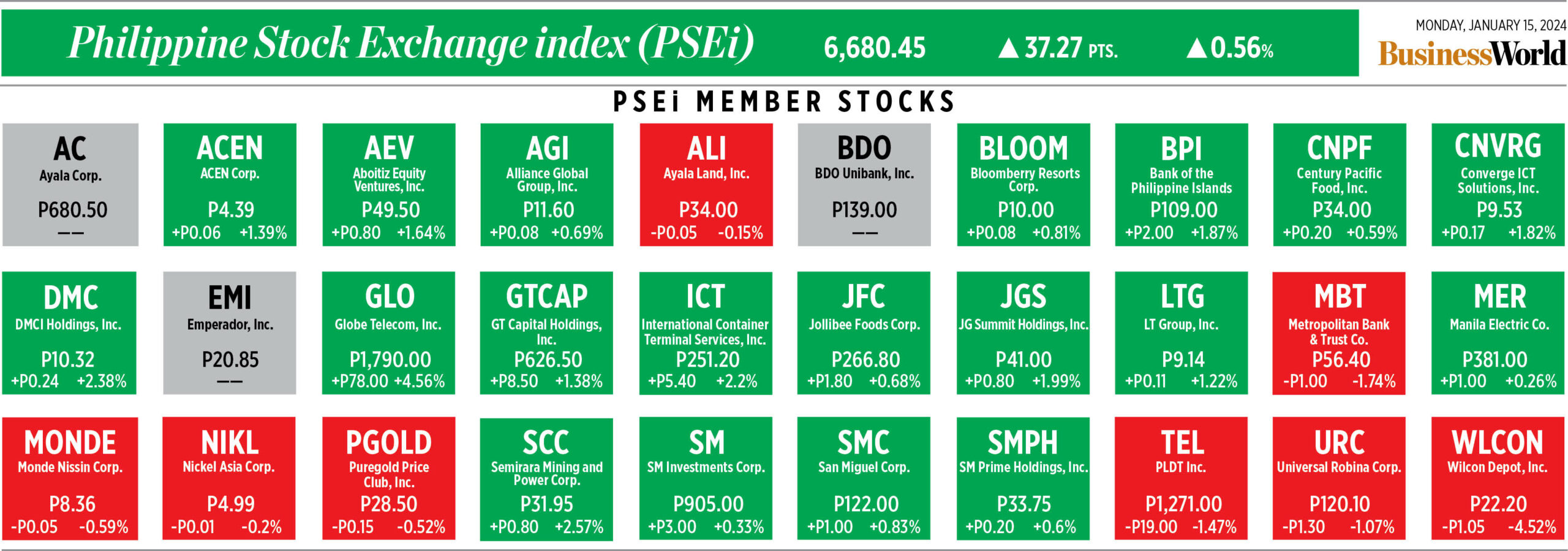
How PSEi member stocks performed — January 15, 2024

Here’s a quick glance at how PSEi stocks fared on Monday, January 15, 2024.


PSEi advances as US CPI data boost Fed cut hopes

PHILIPPINE SHARES climbed further on Monday following the release of US consumer price index (CPI) data, which could affect the next move of the US Federal Reserve.

The Philippine Stock Exchange index (PSEi) rose by 37.27 points or 0.56% to end at 6,680.45 on Monday, while the broader all shares index went up by 17.16 points or 0.48% to close at 3,523.77.   

“The index sustained last week’s positive momentum as it closed higher on the back of softer than expected US December producer price data and increasing market bets that the Federal Reserve will start cutting its policy rate in March,” China Bank Capital Corp. Managing Director Juan Paolo E. Colet said in a Viber message. 

US producer prices unexpectedly fell in December amid declining costs for goods such as diesel fuel and food, suggesting inflation would continue to subside and allow the Federal Reserve to start cutting interest rates this year, Reuters reported.

The producer price index (PPI) for final demand dipped 0.1% last month, the Labor department’s Bureau of Labor Statistics said. Data for November was revised to show the PPI falling 0.1% instead of being unchanged as previously reported. The PPI has now declined for three consecutive months.

In the 12 months through December, the PPI increased 1% after advancing 0.8% in November.

“Philippine shares continued to be bought up in January as funds continued to make bets on the issues that would outperform for 2024,” Regina Capital Development Corp. Head of Sales Luis A. Limlingan said in a Viber message.

Shares rose following the appointment of Ralph G. Recto as Finance chief, Philstocks Financial, Inc. Research Analyst Claire T. Alviar said in a Viber message.

“The local bourse extended its gains, up by 37.27 points, attributed to the expectation that the country will use non-monetary measures moving forward to stabilize prices this year, a strategy we believe is crucial to addressing inflation,” Ms. Alviar said. “If this materializes, investors can anticipate further rate cuts ahead, boosting the market sentiment.”

All sectoral indices ended higher on Monday. Mining and oil went up by 128.60 points or 1.35% to 9,637.49; services rose by 16.43 points or 1% to 1,644.71; holding firms jumped by 46.87 points or 0.73% to 6,407.62; financials climbed by 7.13 points or 0.38% to 1,843.15; property increased by 9.14 points or 0.31% to 2,900.93; and industrials added 22.24 points or 0.24% to end at 9,225.82. 

“Among the index members, Globe Telecom, Inc. led the gainers, increasing by 4.56%, while Wilcon Depot, Inc. found itself at the bottom, losing by 4.52%,” Ms. Alviar said.

Value turnover increased to P5.82 billion on Monday with 460.92 million issues changing hands from the P5.64 billion with 362.59 million shares seen on Friday.

Advancers outnumbered decliners, 107 versus 78, while 52 names ended unchanged.

Net foreign selling stood at P244.01 million versus the P360.76 million in net buying seen the previous trading day. — R.M.D. Ochave with Reuters

Peso advances vs dollar after BSP posts higher Nov. remittances

BW FILE PHOTO

THE PESO strengthened further against the dollar on Monday as data from the Bangko Sentral ng Pilipinas (BSP) showed remittance inflows grew in November.

The local currency ended at P55.77 against the greenback on Monday, up by 14.1 centavos from Friday’s P55.911 close, data from the Bankers Association of the Philippines’ website showed.

The peso opened Monday’s session stronger at P55.85 per dollar. Its weakest showing for the day stood at P55.95, while its intraday best was its close of P55.77 versus the greenback.

Dollars traded dropped to $1.31 billion from $1.69 billion on Friday.

The peso appreciated on Monday following the continued growth in cash remittances in November, Rizal Commercial Banking Corp. Chief Economist Michael L. Ricafort said in a Viber message.

Money sent home by overseas Filipino workers (OFWs) grew by 2.8% to $2.719 billion in November from $2.644 billion seen in November 2022, BSP data released on Monday showed.

The growth in cash remittances was the slowest annual pace in two months or since 2.6% in September.   

On the other hand, the amount of money sent by OFWs in November was also the lowest in six months or since $2.494 billion in May 2023. It also declined by 9.3% from $2.998 billion in October.

For the January-to-November period, cash remittances coursed through banks rose by 2.8% to $30.211 billion from $29.38 billion a year earlier.

This was below the BSP’s 3% remittance growth projection for 2023.

The peso strengthened on Monday as the local stock market continued to gain for the third straight day, Mr. Ricafort added. 

Security Bank Corp. Chief Economist Robert Dan J. Roces added that the lower-than-expected US producer price index (PPI) in December “fueled selling opportunities despite ongoing rallies.” 

Data from the US Labor department released on Friday showed the US PPI dipped by 0.1% in December, marking its third straight month of decline.

Mr. Ricafort said easing producer prices in the US could support rate cuts from the Federal Reserve in the second half of 2024.

“As a result, the gauge of the US dollar versus major global currencies also corrected slightly lower recently from three-week highs,” he said.

The Fed kept borrowing costs steady at 5.25-5.5% for the third straight time at its December meeting. This was after it hiked policy rates by 525 basis points (bps) from March 2022 to July 2023.

Back home, the BSP raised interest rates by 450 bps from May 2022 to October 2023 to tame inflation and mirror the US Fed, bringing the key rate to 6.5%, the highest level in 16 years.

For Tuesday, Mr. Ricafort gave a forecast range of P55.70 to P55.90, while Mr. Roces expects the local unit to move within a wider range of P55.70 to P56 per dollar. — Keisha B. Ta-asan

First SRP price hikes approved after holiday-delayed DTI rulings

PHILIPPINE STAR/MIGUEL DE GUZMAN

THE Department of Trade and Industry (DTI) started to approve on Friday pending price increases for some products covered by the suggested retail price (SRP) scheme for basic necessities and prime commodities (BNPCs).

On Monday, Amanda Marie F. Nograles, assistant secretary for the DTI Consumer Protection Group, told BusinessWorld that the updated SRP bulletin reflects price increases for nine SKUs (stock keeping units).

“We still have pending notices of price adjustments. The updated bulletin does not reflect all the price adjustments yet,” Ms. Nograles said via Viber message.

“Our target is to publish the fully updated SRP bulletin by March,” she added.

The government had asked producers to hold the line on prices until after the holidays to prevent a spike in inflation.

Among the products for which price increases were Blend 45 3-in-1 Original 18 grams coffee now priced at P4.10. The previous price was P4.10 per 20-gram pack.

All Fidel coarse salt products had price hikes ranging from 50 centavos to P2.50, depending on the variety, weight and where the product is sold.

Safeguard Pure White bath soap 60-gram and 130-gram variants now cost P20.50 and P49, respectively.

Meanwhile, Nescafé Classic coffee refills saw weight and price reductions, according to the bulletin. The previous 25-gram Nescafé Classic will now sell for P20 per 23 grams, while the 50-gram item will now sell P40 per 46 grams.

In a previous briefing, Ms. Nograles said that a 6% average price increase of BNPCs is expected this year, lower than the 10% average increase seen a year earlier.

The DTI said that it will be working on the price increase applications covering 63 SKUs this year, out of the 217 products in the bulletin.

The expected price increases will range from 25 centavos to P7.25, the DTI said.

Out of the 63 SKUs, 59 items had a general price increase, two items reduced weights and raised prices increase, and two items reduced weight and price.

The DTI said 71% or 154 of the products listed in the SRP bulletin will not feature price adjustments.

“It is also important to note that even if (the approvals) are already released, the manufacturer will need some time to implement the price adjustments,” Ms. Nograles said.

“So, there will be some lag from the time that the DTI releases the notice of approval or letter of concurrence to the time that the actual price increases in the market are effective,” she added. — Justine Irish D. Tabile

Vegetable cold storage facility planned for FTI site in Taguig City

REUTERS

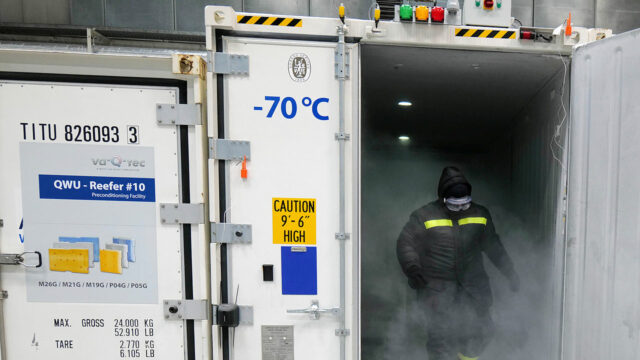
THE Department of Agriculture (DA) said it will build a P500-million cold storage facility for stockpiling vegetables and other high-value crops in Taguig City.

Agriculture Secretary Francisco Tiu Laurel, Jr. said the facility will rise on a 1.3-hectare site at the Food Terminal, Inc. (FTI) complex.

“The facility will also be equipped with a processing plant and trading area, and will prioritize farmers’ produce for buffer stocking,” Mr. Laurel said in a statement on Monday.

He said the availability of cold storage will minimize post-harvest losses and allow commodities to be stored during periods of oversupply.

He added that half of the facility will employ evaporator-type storage for short-term storage of high-value crops, while the rest will use coil-type equipment for longer-term storage.

“The immediate problem I see is the oversupply, from time to time, of tomatoes and cabbage. So, we should build storage at FTI immediately,” Mr. Laurel said. “My direction is to build a network of cold storage (facilities).”

Separately, DA Assistant Secretary and spokesperson Arnel V. de Mesa said: “The Secretary’s plan is to put up a network of cold storage facilities in La Union or Baguio, Taguig, Quezon, and Mindoro. The primary focus would be mainly on vegetables and then other commodities,” Mr. De Mesa told reporters on Monday. 

“They are programmed for this year,” he added.

Additionally, Mr. Laurel said that the DA is also organizing a logistics office, which will centralize all agriculture logistics management matters, including the operations of FTI.

“All DA cold storage (functions) will be transferred to the logistics office, which will conduct an inventory of all facilities within the Philippines,” he added.

Mr. De Mesa said that the new logistics office will help reduce post-harvest crop losses.

“We are expecting… that losses will be reduced by more than P10 billion. Eventually, the ones who will benefit the most from this are the farmers, because the losses they currently experience are large,” he added.

Mr. De Mesa said there are currently no oversupply problems with vegetables.

“If we look at the data, we can see that there was a slight decline, year on year, in overall production. But during the last quarter, there was an increase in some highland vegetables because there were no typhoons,” he added.

Last week, farmers from the Cordillera Administrative Region (CAR) urged the government to intervene due to the low price offered by traders for highland vegetables, forcing them to dump their crops.

The DA’s regional office in CAR reported that the drop in prices was due to a lack of buyers for the crops between Dec. 28 and Jan. 3.

Mr. Laurel had ordered FTI to purchase excess crops from producers and sell them in Kadiwa centers.

Kung may overproduction, kaysa itapon, bilhin na lang ng FTI, mailalagay pa natin iyan sa Kadiwa program (For any instances of overproduction, FTI needs to buy the excess rather than leave the produce to be dumped. Those items can be sold via Kadiwa stores). The plan is also to strengthen the Kadiwa program ng DA,” he added, referring to the government-supported store network offering produce purchased directly from producers. — Adrian H. Halili

ADVERTISEMENT
ADVERTISEMENT