Home Blog Page 3775

October FDI net inflows drop by 29%

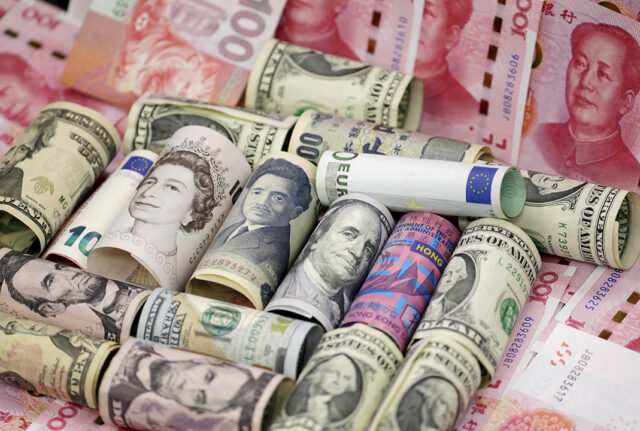
Foreign direct investment (FDI) recorded $655 million in net inflows in October, central bank data showed. — REUTERS

By Keisha B. Ta-asan, Reporter

NET INFLOWS of foreign direct investment (FDI) slumped in October amid heightened global economic uncertainties, the Philippine central bank said.

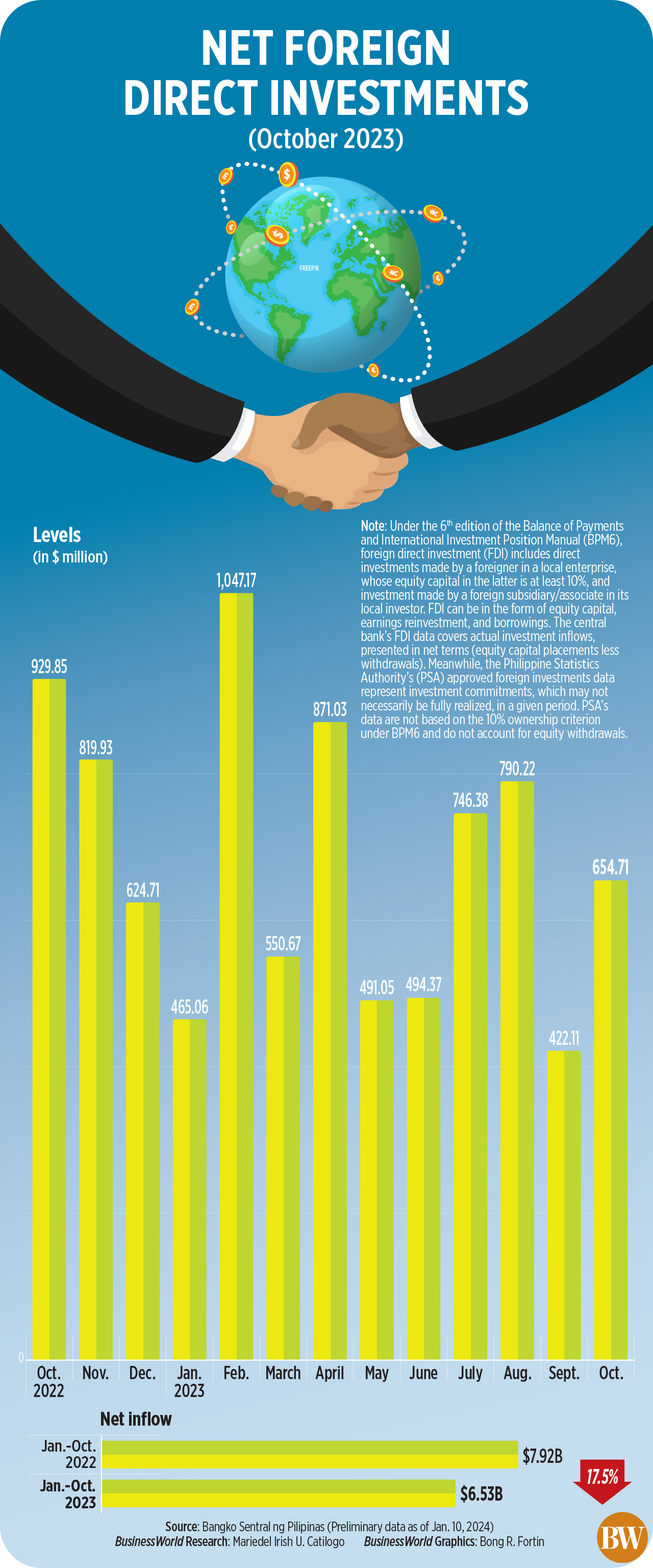
Data released by the Bangko Sentral ng Pilipinas (BSP) on Wednesday showed FDI net inflows dropping by 29.6% to $655 million in October from $930 million a year earlier.

Month on month, it was 55.2% higher than the $422-million net inflows in September.

Net Foreign Direct Investment (Octoberber 2023)Despite the year-on-year decline, the October figure was the highest monthly net FDI inflow in two months, or since $790 million in August.

“FDI continues to come into the country. However, the pace has admittedly been on the decline,” ING Bank N.V. Manila Senior Economist Nicholas Antonio T. Mapa said in an e-mail.   

“Slower FDI inflows can be tagged to the global slowdown in growth, linked to substantial policy tightening both here and abroad,” he added.

In late October, the BSP delivered a 25-basis-point (bp) off-cycle rate hike, bringing the benchmark interest rate to 6.5%, the highest in 16 years. The BSP tightened rates by 450 bps from May 2022 to October 2023 to curb inflation.

“With rates at these levels, financing costs will be more difficult and thus we can expect overall investment activity to moderate,” Mr. Mapa added.

In a statement, the BSP said the annual drop in FDI net inflows was due to the drop in net investments in debt instruments.

Nonresidents’ net investments in debt instruments of local affiliates fell by 26.1% to $504 million from $682 million a year earlier. 

Investments in equity and investment fund shares slid by 39.3% to $150 million from $248 million a year ago.

Equity other than reinvested earnings slumped by 54.4% year on year to $74 million from $163 million a year ago. Gross placements went down by 44% to $101 million, while withdrawals rose by 50.9% to $27 million.

Equity capital infusion mostly came from Japan, the United States and Singapore, the BSP said. These were mostly invested in industries such as manufacturing (54%), real estate (18%), as well as financial and insurance (15%).

Meanwhile, reinvestment of earnings declined by 10.3% to $76 million from $85 million a year ago.

“The lower net FDI inflow compared with last year was still likely due to challenging economic conditions. Hamas’ attack on Israel last October and subsequent concerns of regional escalation also added to global uncertainties,” China Banking Corp. Chief Economist Domini S. Velasquez said in a Viber message.

For the January-to-October period, FDI net inflows declined by 17.5% to $6.533 billion, BSP data showed.

Foreign investments in debt instruments slipped by 18.3% to $4.57 billion in the first 10 months from $5.59 billion a year earlier.

Investments in equity and investment fund shares declined by 15.7% to $1.96 billion.

Net foreign investments in equity capital decreased by 22.9% to $1.019 billion. Equity capital placements dipped by 2.8% to $1.494 billion, while withdrawals surged by 120% to $475 million. 

Most of the placements during the 10-month period were from Japan, the United States, Singapore and Germany.   

Reinvested earnings for January to October fell by 6.4% year on year to $945 million.

“Looking ahead, the continued slowdown of the global economy this year may keep FDI inflow to emerging markets such as the Philippines subdued,” Ms. Velasquez said.

“Hence, government support such as improving the ease of doing business, implementing investment-friendly policies, and further developing key infrastructure are crucial to boost the country’s prospects as an investment destination,” she said.

Ms. Velasquez added that the recently signed law simplifying tax payments and slowing inflation could boost investor sentiment in the coming months.

President Ferdinand R. Marcos, Jr. has signed into law the Ease of Paying Taxes bill, which seeks to update the country’s taxation system and boost government revenues.

Inflation slowed to 3.9% in December, bringing the full-year average to 6%, higher than 5.8% in 2022. It marked the second straight year that average inflation breached the BSP’s 2-4% target.

“We hope that the bevy of investment pledges collected over the past few months can eventually translate to actual FDI given the still robust growth prospects for the economy,” Mr. Mapa said.

The BSP expects FDI net inflows to have reached $8 billion at the end of 2023, and $10 billion by end-2024.

WB sees PHL as fastest-growing economy in Southeast Asia this year

Motorists drive along the Jose Abad Santos Avenue in San Fernando, Pampanga, Nov. 7, 2022. — PHILIPPINE STAR/MIGUEL DE GUZMAN

By Luisa Maria Jacinta C. Jocson, Reporter

THE WORLD BANK (WB) expects the Philippines to be among the fastest-growing economies in Southeast Asia this year.

In its latest Global Economic Prospects, the multilateral lender projected Philippine gross domestic product (GDP) to expand by 5.8% in 2024, same as its forecast in December.

The Philippine growth projection is the fastest among Southeast Asian economies, tied with Cambodia (5.8%), and ahead of Vietnam (5.5%), Indonesia (4.9%), Malaysia (4.3%), Lao People’s Democratic Republic (4.1%), Timor-Leste (3.5%), Thailand (3.2%) and Myanmar (2%).

However, this is below the Development Budget Coordination Committee’s (DBCC) 6.5-7.5% growth target for 2024.

The World Bank’s growth forecast for the Philippines is also higher than its 4.5% projection for East Asia and the Pacific.

The multilateral lender sees slower growth in the region due to the “anticipated deceleration in economic activity in China.”

Other risks to the growth outlook include geopolitical tensions in the Middle East that could lead to higher oil prices, dampened global trade, tightening financial conditions and climate-related disasters, it said.

“Extreme weather events, the frequency of which has increased in recent decades as a result of climate change, also pose a downside risk to the regional outlook,” it added.

In the Philippines, the government is preparing for the potential impact of the El Niño weather event this year.

The latest bulletin from the state weather bureau showed that El Niño will likely persist from March to May, when dry season crops are often harvested.

National Economic and Development Authority (NEDA) Secretary Arsenio M. Balisacan earlier said El Niño would likely affect the agriculture sector and drive food prices higher, which could threaten the inflation downtrend.

On the other hand, the multilateral lender said resilient domestic demand could spur growth drivers in the East Asia and Pacific region.

“Modest inflation, and in many cases robust labor markets supported by buoyant service activity, are anticipated to sustain household spending,” it said.

“In some economies, increased government spending, including on social protection and public sector wages, will also support demand,” it added.

However, investment inflows may be dampened due to lagged effects from policy tightening and elevated public debt, the World Bank said.

For 2025, the World Bank maintained its GDP projection for the Philippines at 5.8%, the same as its previous forecast. This would be below the government’s 6.5-8% growth goal.

At 5.8%, the Philippines is expected to be the third-fastest growing economy in Southeast Asia next year, behind Cambodia (6.1%) and Vietnam (6%).

The bank also kept its growth forecast for 2023 at 5.6%, which would fall short of the government’s 6-7% GDP target.

The Philippine Statistics Authority (PSA) is set to release fourth-quarter and full-year 2023 GDP data on Jan. 31.

INFLATION
Meanwhile, the World Bank said headline inflation in the East Asia and Pacific region might ease slightly amid “moderating global commodity prices, improved food supplies and well-anchored inflation expectations.”

In its December update, the multilateral lender projected Philippine inflation to settle at 3.6% this year and 3% in 2025.

In 2023, inflation averaged 6%, the highest in 14 years. This also marked the second straight year average inflation breached the 2-4% target.

The Bangko Sentral ng Pilipinas (BSP) expects inflation to average 3.7% this year and 3.2% in 2025.

“Despite inflation receding below target in many economies, interest rates are expected to remain broadly unchanged in 2024 on account of tight monetary policy in major advanced economies, lingering concerns about weakening exchange rates and capital outflows, and the potential for a resurgence in inflation,” the World Bank said.

The Philippine central bank raised borrowing costs by 450 basis points from May 2022 to October last year, bringing the key rate to a 16-year high of 6.5%.

BSP Governor Eli M. Remolona, Jr. has said the central bank would only consider policy easing if inflation settles comfortably within the target.

Meralco rates to go up slightly in January

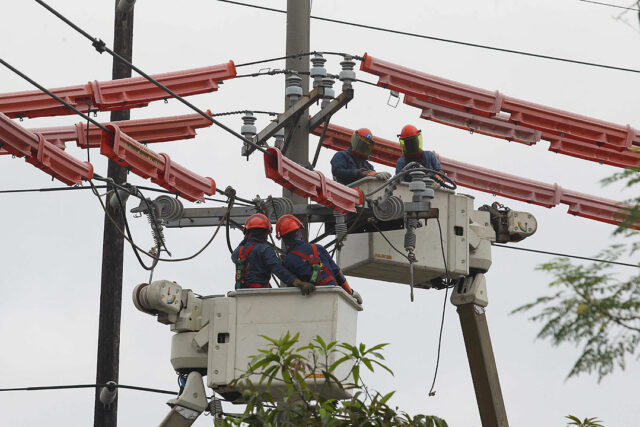
Linemen fix the electricity posts in Tondo, Manila. Customers of Manila Electric Co. can expect slightly higher electric bills in January. — PHILIPPINE STAR/ RUSSELL PALMA

By Sheldeen Joy Talavera, Reporter

TYPICAL HOUSEHOLDS served by Manila Electric Co. (Meralco) will see a slight increase in their electricity bills this month due to the higher cost of power from suppliers.

In a statement on Wednesday, Meralco said the overall rate would increase by P0.0846 per kilowatt-hour (kWh) to P11.3430 in January from P11.2584 in December.

Residential customers consuming 200 kWh must pay about P17 more in their January bill.

Meanwhile, households consuming 300 kWh, 400 kWh and 500 kWh will see their monthly electricity bills go up by P25, P33, and P39, respectively. 

Meralco said the minimal increase was brought by the P0.1136 rise in generation charge to P6.6468 per kWh, mainly due to higher charges from the Wholesale Electricity Spot Market (WESM) and independent power producers (IPP).

The generation charge accounted for about 74% of the total monthly electricity bill.

“We can’t actually have full control on what the generation cost will be based on the prices that will be sold to us both in the market and by our suppliers,” Joe R. Zaldarriaga, Meralco spokesperson and vice-president for corporate communications, said at a briefing.

During the month, WESM charges climbed by P0.5611 per kWh, which was attributed to the “higher average capacity on outage in the Luzon grid.” Some power plants are undergoing scheduled maintenance shutdown this month in preparation for the summer.

The distribution utility said charges from IPPs likewise inched up by P0.1384 per kWh due to higher fuel costs incurred by the Sta. Rita and San Lorenzo plants operated by First Gas in Batangas. The plants used more imported liquefied natural gas (LNG) in the testing and commission of its LNG terminal.

Charges from power supply agreements (PSA) dropped by P0.1522 per kWh.

“The increases in the WESM and IPPs were mitigated by the reduction from our power supply agreements due to lower cost of the emergency PSA of Meralco with Therma Luzon and South Premiere,” Mr. Zaldarriaga said in Filipino.

Higher excess energy deliveries from some PSAs also contributed to the decrease, Meralco said.

WESM, IPPs and PSAs accounted for 20.5%, 36.5% and 43% for the December supply month.

Meanwhile, transmission and other charges — including taxes and subsidies — fell by P0.0290 per kWh, the power distributor said.

The collection of feed-in tariff allowance (FIT-All) remained suspended, as directed by the Energy Regulatory Commission (ERC).

“Pass-through charges for generation and transmission are paid by Meralco to the power suppliers and the grid operator, respectively, while taxes, universal charges and FIT-All are all remitted to the government,” Meralco said.

Distribution charge has remained unchanged at P0.0360 per kWh since August 2022.

El NIÑO IMPACT
In preparation for the impact of El Niño, Meralco is encouraging  large business establishments to join its interruptible load program.

“The forecast of DoE (Department of Energy) so far is we will not have red and yellow alerts this year even with the El Niño, but even then, they reminded us to continue with our preparations including attracting more customers to join the interruptible load program,” Lawrence S. Fernandez, vice-president and head of utility economics of Meralco, said.

In 2023, the Philippines was placed under two red alerts and eight yellow alerts, data from the DoE showed. This was lower than the 12 yellow alerts it expected.

Meralco launched last week the bidding for interim power supply agreements (IPSAs) covering 260-megawatt (MW) peaking requirement and 400-MW baseload requirements in preparation for the expected increase in demand during the dry months.

Meanwhile, Meralco is urging qualified consumers, particularly the beneficiaries of the Pantawid Pamilyang Pilipino Program, to apply for the lifeline rate to continue getting discounts on electricity bills.

In December last year, the ERC, together with the DoE and the Department of Social Welfare and Development, announced that they will proceed with the full implementation of the program starting on Jan. 1.

The lifeline rate is a subsidy provided to customers with a monthly power consumption of 100 kWh and below.

Qualified consumers will be provided a percentage discount which usually ranges from 20% to 100%, depending on their power consumption.

As of Jan. 5, there are a total of 29,576 approved applications for the program, Meralco data showed.

Meralco’s controlling stakeholder, Beacon Electric Asset Holdings, Inc., is partly owned by PLDT Inc.

Hastings Holdings, Inc., a unit of PLDT Beneficial Trust Fund subsidiary MediaQuest Holdings, Inc., has an interest in BusinessWorld through the Philippine Star Group, which it controls.

The best of Japan under one roof

Standard Hospitality Group’s John Concepcion plans expansion of Kiwami as he continues to honor tradition

SOME of the best restaurants in Japan can be found all under one roof in the Philippines, thanks to the efforts of The Standard Hospitality Group’s chief executive officer (CEO), John Concepcion.

Earlier this week, BusinessWorld got a taste of some of Japan’s best, right in Taguig’s Bonifacio Global City (BGC) where the food court Kiwami has operated since 2021. Another branch in Alabang opened late last year.

Kiwami isn’t playing around with the word “best.” The word kiwami (roughly translated from Japanese as “ultimate” or “extreme”) is subjective, but with the brands under Kiwami, heritage and talent try to reflect the definition. For example, Yabu, brought here in 2011, was made in partnership with Michelin Bib Gourmand chef Kazuya Takeda. Ippudo Ramen, meanwhile, has roots with “Ramen King” Shigemi Kawahara (a three-time Ramen Master Chef Hall of Famer), with the brand beginning in 1985. Hachibei, with a concentration on grilled meats (yakitori-style), began in 1983 and uses traditional Binchotan charcoal (made of hardwood). Finally, Hannosuke, an expert in tempura which attracts crowds in their Japanese outlets, was founded back in the 1950s.

“Many of these brands are heritage, family-run businesses that have been operating for decades. Most of them love the idea of expansion but are not necessarily geared for it due to the challenges of the language barrier and not having a technical team to transfer their technology,” said Mr. Concepcion in an e-mail. “However, the idea of sharing their work is certainly exciting for them, and that’s where we come in. As the Standard Group, we are able to work closely with these partners to bring the same quality work they do here to the Philippines.”

While most of these restaurants have standalone units, Mr. Concepcion discussed why it makes sense for them to be under one roof. “In the case of Kiwami, it became a more thoughtful idea on how we could offer the convenience of choice without losing the specialized kitchens. Hence, we came up with the idea of master kitchens within one large space,” he said. “The idea is quite simple, really. We wanted to honor the specialization and dish-specific nature that you find in Japan — doing one thing but doing it extremely well.”

FROM OYSTERS TO RAMEN
BusinessWorld sat down to lunch with at least one dish from all the outlets under Kiwami.

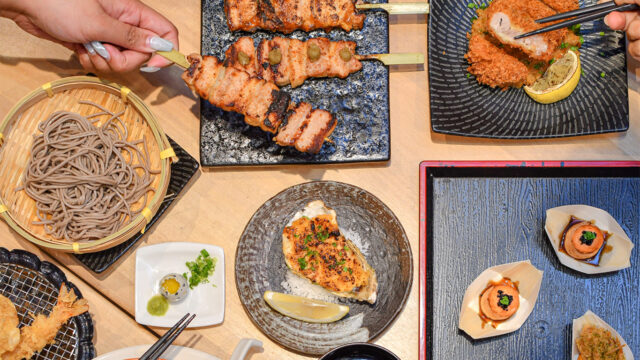
We started the meal with Hachibei’s Baked Hokkaido Miso Oysters, flown straight from Japan, and topped with Japanese mayo, yellow miso paste, and the Japanese spice mix togarashi. Dexter Supena, Back of House Technical Manager for Kiwami, described Hokkaido oysters as incredibly sweet: a credit to Hokkaido’s seas, for despite all the additions on top, the gentle oceanic flavors of the oysters still shone through.

The next dish was Hachibei’s Sukiyaki Spinach Enoki — beef rolled around stalks of Japanese spinach and enoki mushrooms. It’s an innovation on the Japanese hotpot dish sukiyaki, so diners dip the rolls into a cured egg yolk as in the original dish before taking a bite. A Buta Bara platter followed, with Binchotan-grilled pork belly seasoned with shio (salt), tare (yakitori sauce), miso (sesame-flavored miso paste), then Yuzu Kosho (citrus and pepper). Uniformly, the sweetish and tender pork skewers were a hit, but the clear winner was the Yuzo Kosho, with bright flavors giving the pork some lightness.

We were excited to try Hannosuke’s recipe from the 1950s, and we were not disappointed. We’ve gotten too used to mediocre tempura with more flour than seafood, with a fried crust that turns chewy at the slightest drop in temperature. At Hannosuke, the casing simply becomes a complement to the seafood, and we marveled at how moist and tender the shrimp, squid, and scallop within the crispy breading still was.

Yabu, the oldest unit in the Philippines within group, offered up their Rosu Tornado Omelette Curry Set. This had a tornado-style omelet over rice, served with their signature curry sauce and classic Yabu katsu. Mr. Supena explained that the tornado-style omelet was achieved by swirling three eggs with long chopsticks as they slowly cooked in a ceramic pan. As for the katsu, he told us that the rosu (pork loin) had layers of meat, fiber, and fat (though a leaner version is available). The crispy coating was made with panko (breadcrumbs) which they make themselves. Aged for three days, the bread is shredded in a special machine and the crumbs are sifted. The spikiest bits are reserved for breading, while finer crumbs are used for other recipes.

We ended the savories with Mushroom Ramen, the vegetarian option at Ippudo. We lowered our expectations a bit and thought we’d have a calm sip of the broth, but this meatless option was not taking it easy. Made with seven types of mushrooms (three of them being shimeji, white button, and king oyster), it had a dairy base flavored with mushroom paste, and with tofu substituting for the pork chashu. The flavors were dense and intense, and not for one minute did we miss the usual pork.

“We want you to have a five-star experience for a three-star price,” Mr. Concepcion said. A lot of these brands aren’t exactly household names in the Philippines, and before Mr. Concepcion got his way, were to be experienced only in Japan.

“With the exception of Ippudo, these brands are not the chain-type restaurants, and that’s not what we want either. We like to focus on brands that have been practicing their craft for decades. We don’t prefer to work with the trendy, of-the-moment names; instead, we see ourselves as stewards of these brands and focus on building relationships with these artisans.”

GOODBYE SELECTA
Mr. Concepcion is so taken with the Japanese food experience that he is stepping down as Managing Director and CEO of the Selecta ice cream brand to concentrate on The Standard Hospitality Group.

Mr. Concepcion led Selecta for the last 33 years. He is also a member of the Concepcion cooling family, listed in Forbes collectively in 2016 in the country’s 50 Richest list.

According to a press release, “As Mr. Concepcion bids farewell to Selecta, he is set to embark on a new and exciting journey in his career. Leveraging his extensive expertise gained over three decades in the multinational company, he will focus his efforts on leading The Standard Hospitality Group to greater success in hospitality and restaurant management.”  Within the next three years, they expect to have a total of 100 outlets.

“Kiwami has been a great success, and you will be seeing two new locations within the next 18 months, as well as a strong rollout for Yabu this year with the introduction of our updated architectural look,” Mr. Concepcion told BusinessWorld.  “Exciting new spaces are on the horizon. Additionally, we are working on new concepts to add to the portfolio, which is super exciting.”

Kiwami has branches in Bonifacio High Street Central in BGC, Taguig, and in Alabang Town Center in Muntinlupa. — Joseph L. Garcia

Small plates are over, here’s what restaurants in NY and London are doing in 2024

WINTER Martini Garden at the Ham Yard Hotel —FIRMDALEHOTELS.COM

THERE’S good news for diners who don’t like to share: Those tapas-size plates loaded with mini bruschettas and spicy tuna-topped crispy rice are out. Individual portions are in this year.

That’s one of the top trends emerging in new restaurants across London and New York (NY). Another: When you order a drink, be prepared for bartenders to turn up the heat, literally.

The culinary capitals on either side of the Atlantic aren’t always in sync. Last year, new places in New York specialized in world-class noodles, from pasta to soba, and destination pizza spots expanded to prime locations. In London, the trend was to elevate classic dishes including snails, roast chicken and ice cream, and Caribbean restaurants and bars shone bright.

But this year, the restaurant stars aligned, and the top trends in the two cities have notable similarities. Among them is seafood, especially places where the buzzword isn’t “fresh” but “aged.” Another is the proliferation of wine bars. The concept makes sense for operators whether their places are small vino-focused spots or a counter at a restaurant — because you don’t need an expensive kitchen setup to make the drinkers happy.

Will devout drinks enthusiasts be ordering the hot Negroni at Jimmy in New York and the hot martini at the Ham Yard Hotel in London? These libations might be hard to avoid — as are these other food and drink trends you’ll see in New York and London in 2024.

SO LONG, SMALL PLATES
Small plates have taken up space on restaurant tables for years, offering diners the chance to turn a meal into a cocktail party as they share bowls of greasy Padrón peppers and a couple of fried arancini balls. Now chefs are cutting out the menus’ snack sections and giving customers more straightforward options of first courses and main dishes that don’t require an awkward negotiation over the last bite.

Among the new London spots where you can eat like a grown-up is Wolseley City, where the menu is essentially divided into single serving starters (goats curd tart and smoked mackerel salad) and mains. At the art deco palace Bébé Bob, there’s no room in the middle of the table for sharing platters. Instead, guests have starters like prawn cocktail, and the signature rotisserie chicken is plated by servers tableside. Star chef Tom Sellers has also had enough of small plates: His recently opened Dovetale eschews dishes that are passed around.

In New York, chef Angie Mar has flipped her buttoned-up French tasting-menu spot Les Trois Chevaux into the slightly more relaxed, à la carte affair, Le B. Among the dishes that aren’t made to be shared: one whole deviled egg, flecked with black truffle, and Bird’s Nest soup, the nucleus of which is a slice of foie gras with bok choy in a game bird consommé.

At the grand new Café Carmellini, chef Andrew Carmellini is also focused on first and second courses and entrées. One could kick off a meal with a delicate, three-tiered stack of crab mille-feuille before moving to a pasta course of five duck-filled tortellini in foie gras sauce, then ending with squab en croûte.

REGIONAL OPEN-FIRE COOKING HEATS UP
Cooking over fire has been a longtime obsession of chefs. Credit goes to Patagonia’s Francis Mallmann, who in the early 1990s made flame cooking the sexiest way to serve meat. (And, more recently, vegetables.)

The trend is burning brightly, so to speak, at new places where the grills have a regional accent. In London, chef Tomos Parry and his protégés have opened restaurants around town featuring open fires, building on the success of his Basque-focused Brat. At his new place, Mountain, Mr. Perry puts a lot of the menu on the grill, from langoustines and John Dory to ribs of Jersey sirloin beef and the signature lobster caldereta casserole. Ben Allen, a Brat alum, has recently started serving a Sunday roast cooked over flames at the Parakeet, the fire-minded pub that he opened last spring.

At the Devonshire in Piccadilly, the buzzy pub’s custom-made grill employs embers that come from a wood fire to cook the aged British meat.

Over in the US, open fire is the main focus of the popular new Ilis in Brooklyn. Danish chef Mads Refslund had to wait 18 months to receive approval from the New York City Fire Department for his hearth-centered restaurant because of its tricked-out custom grill. It’s worth the effort, because many dishes are prepped over that grill, including brown trout that’s been bundled in grape leaves and birch wood and Refslund’s signature barbecued eels, inspired by ones he ate as a child, cooked over a mix of wood sourced from upstate New York.

When acclaimed New York chef Ignacio Mattos (of Estela) opens the 750-square-foot Amado Grill in downtown’s Nine Orchard hotel later this year, his $125 set menu will highlight simple, elegant dishes prepared over charcoal, such as quince-accented squab à l’orange.

SEAFOOD GETS OLDER
Chefs are employing more specialized techniques on seafood this year — especially dry aging, a practice usually confined to high-end sushi spots.

Later this year, chef-owner Tomer Blechman of Brooklyn’s Mediterranean staple Miss Ada will open Theodora, focused on dry-aged fish. Blechman ages local seafood for up to a week, controlling humidity and temperature. Among the dishes he plans to serve are a salmon belly that’s been aged three days and laced with lovage cream .

The first winner of Top Chef, Harold Dieterle, also sees the appeal of rested fish for his upcoming southern Italian restaurant, Il Totano, in Greenwich Village. In the center of the dining room is a temperature- and humidity-controlled fridge. Beyond the flavor-enhancing benefits, Dieterle notes that dry-aged fish is easier to cook: “It comes out moist every time.” His branzino in tuna collar sauce will be aged for a few days, he says, while bluefin tonatto vitello will mature for around two weeks. And at the popular, six-month-old Foxface Natural in the East Village, chef David Santos recently unveiled bluefin tuna crudo in a smoked chive oil. He ages the fish for around three weeks, one of those weeks in soy sauce, all to amp up its umami flavor.

In London, the innovative the Sea, the Sea has been pushing aged fish at its Hackney counter since it opened two years ago. Now, chef Leandro Carreira has turned his attention to shellfish, including line-caught squid that he keeps for almost a week, sometimes coated in beeswax to maximize the subtle sweetness. He’s also started aging scallops and cuttlefish. At Humo in Mayfair, where the South American-minded dishes are cooked on a four-meter (13 foot) grill, chef Miller Prada is serving 10-day aged yellowtail with citrus sauce, 11-day aged turbot with mole sauce, and 12-day aged wild Cornish monkfish with almond emulsion.

THE UBIQUITOUS WINE BAR
This will be a good year to be in the wine-glass business in London. A seemingly endless and exciting list of wine bars and wine-focused restaurants are opening their doors in the next few months. Coming soon to Borough Market: Camille, from Clare Lattin and Tom Hill, the team behind the popular natural wine bar Ducksoup. It will focus on small, French producers to accompany the Borough Market-driven menu.

July on Charlotte Street will also specialize in natural French vins that will complement the Alsatian-centered menu from chef Holly Hayes, an alum of the iconic wine spot 40 Maltby Street. Even the city’s notable new restaurants increasingly look like wine bars. When star chef Claude Bosi opens Josephine in a few weeks in Chelsea, he’ll adopt the bouchon wine program of his native Lyon, serving white and red by the meter so you pay for what you drink. The upcoming Morchella in East London will have a dedicated wine bar spotlighting the kind of rising-star producers the owners are known for at their cult favorite restaurant Perilla.

Across the pond, New York is also welcoming an array of wine spots. A few months ago, chef Flynn McGarry relocated his popular low-intervention bottle boîte Gem Wine from Nolita to the more spacious home of his Lower East Side tasting menu spot, Gem. (He promises Gem will return in a new location in 2025.) Nearby, popular Spanish spot Ernesto’s is flipping the cafe space into a wine bar called Ernie’s. Some nights there could be pintxos (snacks) to go with glasses and bottles, while others will feature guest chefs for ever-changing, wine-focused dinners.

Chase Sinzer and chef Joshua Pinsky, meanwhile, are expanding the drinking options on East 10th Street. Their new endeavor, Penny, will debut this spring in the 1,400-square-foot space right above their wine-and-food spot, Claud. It will focus on minimalist seafood preparations and small production Champagnes and whites.

HOT COCKTAILS ARE HOT
The latest frontier for playful bartenders is drink temperatures.

Jimmy, the splashy rooftop bar in SoHo in New York, has started serving Midnight Negronis, a comforting cold-weather variation of the Italian classic with gin, Campari, sweet vermouth and blood-orange spiced syrup that’s topped with steaming hot chamomile tea. “It was a hit from the first day,” says bar manager Sayora Khamidova, who created the hot Negroni to keep customers warm on colder al fresco nights. “Guests get a kick out of the fact that this traditionally icy cold and bracing cocktail is unexpectedly hot and soothing,” she says.

An even bolder innovation is the hot-and-cold toddy at Shinji’s in the Flatiron: This drink is a Johnny Walker Black-infused chamomile and ginger punch that’s served simultaneously hot and cold in a tea cup; a divider initially keeps the two sides separate.

At this season’s Winter Martini Garden at the Ham Yard Hotel in London, hot drinks rule the classic cocktail list. The Beekeeper’s Martini is a warm version of the gin-and-honey Bee’s Knees; it’s finished with a puff of smoke, courtesy of a bee smoker. Likewise, the Warm Charlie is a Charlie Chaplin (sloe gin, lime, apricot brandy) served hot, and the Paloma-tini is a heated-up offering of the gin-and-grapefruit classic, made with thyme syrup, too. — Bloomberg


China likely dethroned Japan as world’s top auto exporter

PHOTO FROM HONDA CARS PHILIPPINES

BEIJING/SHANGHAI — China is estimated to have overtaken Japan as the world’s largest auto exporter in 2023, the China Passenger Car Association (CPCA) said on Tuesday, as BYD, Chery and other domestic automakers made major strides overseas.

The world’s biggest auto market also became the top auto exporter for the first time in 2023, with the CPCA announcing at a press conference that exports of cars jumped 62% to a record 3.83 million vehicles. Japanese customs data showed passenger car exports at 3.5 million for the first 11 months of the year, excluding second-hand vehicles.

China’s total auto exports were estimated to hit 5.26 million units for the whole of last year valued at about $102 billion, while Japan’s full-year exports were forecast at about 4.3 million units, according to the association.

The numbers offer the latest indication of the global auto exports powerhouse that China has now become, riding largely on the strength of its nimble electric vehicle automakers. BYD overtook Tesla, Inc. as the world’s top seller of EVs in the fourth quarter, though based mostly on China sales.

The increasing Chinese clout overseas has caused consternation in some governments, who are fearful of the repercussions of that trend on their domestic automakers.

In September, the European Commission launched a probe into Chinese-made electric vehicles (EVs) over subsidies they may have received, which was branded by Beijing as “protectionist.” The Biden administration in the United States is discussing raising tariffs on some Chinese goods including EVs, the Wall Street Journal reported last month.

Chinese customs are due to publish trade numbers for December on Friday.

Tesla, which exported 344,078 China-made electric vehicles, also contributed to the export boom.

DOMESTIC MARKET
China’s domestic auto market, the world’s biggest, chugged along in 2023, with vehicle sales rising 5.3% to 21.93 million for its third consecutive year of growth amid a bruising price war as car makers sought to woo consumers unnerved by a faltering economic recovery.

Sales of pure battery-powered vehicles in China climbed 20.8% last year after a 74.2% jump in 2022. Sales of plug-in hybrids, more economically affordable than pure electrics, grew 82.5% last year after a 160.5% surge a year earlier.

Domestic brands in China’s total sales are expected to further increase to 63% in 2024 from 56% last year, bolstered by strengthening brand recognition in the EV segment and a rapid electrification of the industry, UBS auto analyst Paul Gong told a roundtable on Tuesday.

BYD, which is 7.98% owned by Warren Buffett’s Berkshire Hathaway, has expanded aggressively in Southeast Asia and Europe, although most of its deliveries are in China, where it has spurred sales with hefty incentives to dealers.

Tesla, however, operates with more efficiency in China, selling far more cars per store than BYD.

French auto brands lost the most ground this year in China with sales down 41%, according to data for the first 11 months of the year. Sales of Japanese cars skidded 10.7% while US brands saw sales decline 1.4%. In contrast, German vehicle sales were up 2.5% while those for Chinese cars jumped 15.7%.

Competition is only expected to heat up further.

Popular Chinese smartphone maker Xiaomi took the wraps off its first electric vehicle last month and promptly announced it was aiming to become one of the world’s top five automakers. — Reuters

Aboitiz’s Laguindingan airport plan to undergo Swiss challenge in Q1 — DoTr

STOCK PHOTO | Image by L.Filipe C.Sousa from Unsplash

By Ashley Erika O. Jose, Reporter

THE Department of Transportation (DoTr) is set to invite other parties in the first quarter (Q1) to challenge the Aboitiz group’s proposal to upgrade, operate, and maintain the Laguindingan International Airport in Misamis Oriental, an official said on Wednesday.

“Swiss challenge is targeted to commence within the first quarter of 2024 with the publication of the invitation for submission of comparative proposals pursuant to the public–private partnership (PPP),” Transportation Undersecretary Timothy John R. Batan said in a Viber message to BusinessWorld.

The Swiss challenge is a process where other companies can submit alternative proposals to a project, and the original proponent has the right to match them.

The company has “already completed our negotiations and the  DoTr will now secure approval for the Swiss challenge,” Cosette V. Canilao,  Aboitiz InfraCapital, Inc. president and chief executive officer, said in a separate phone message.

The Transportation department is awaiting approval from the National Economic and Development Authority’s (NEDA) Investment Coordination Committee and Board, according to Mr. Batan.

Last year, the NEDA Board approved the inclusion of the upgrade, expansion, operation, and maintenance of the Laguindingan International Airport under its Infrastructure Flagship Project program.

With the inclusion, the project will be prioritized in the government’s annual budget preparation and will benefit from the expedited issuance of applicable permits and licenses, according to NEDA Secretary Arsenio M. Balisacan.

The PPP project has a total cost of P45.75 billion and aims to improve and expand the terminal facilities and operations of the airport.

The department has said that it is looking at implementing the first phase of the Laguindingan International Airport PPP project from 2024 to 2026.

The airport will have a capacity of 1.6 million passengers a year, which will increase to 3.9 million by the end of the first phase and to 6.1 million by the end of the second phase.

Aside from the Laguindingan International Airport, the infrastructure arm of the Aboitiz group has also submitted unsolicited proposals for Bohol-Panglao International Airport and Bicol International Airport.

In 2022, Aboitiz InfraCapital finalized a deal with Megawide Construction Corp. and GMR Airports International, B.V., allowing it to acquire shares in GMR-Megawide Cebu Airport Corp., the company behind the Mactan-Cebu International Airport.

Starbucks India to more than double store count by 2028

HENRY & CO.—UNSPLASH

TATA Starbucks, a joint venture between Starbucks and Tata Consumer Products, said on Tuesday it plans to operate 1,000 cafes in India and double its workforce by 2028, amid fierce competition from local chains.

Since opening its first cafe in October 2012, Tata Starbucks’ store count has grown to 390. It has opened 57 stores so far this fiscal year and had added 71 in the previous fiscal.

The coffee chain said it plans to enter Tier-2 and Tier-3 cities in India and increase the number of its drive-through, airport-based and 24-hour cafes. It aims to double its headcount to 8,600.

The US giant competes with Bengaluru-based Cafe Coffee Day and foreign entrant Barista, among others. It also faces growing competition from private equity-backed Third Wave and Blue Tokai which have opened about 150 stores between them in the last three years.

Tata Starbucks’ 14% on-year revenue growth in the three months to Sept. 30, 2023, was the slowest since the March quarter of 2020 when it had to close all its stores due to the COVID-19 pandemic.

Among the first foreign coffee brands to enter India, Starbucks has been revamping its strategy in India since last year, launching a six-ounce drink starting at $2.24 and milkshakes in an attempt to woo customers in the tea-loving country. — Reuters

Manila Water’s Antipolo sewage treatment plant seen operational by Dec.

MANILA WATER Co., Inc. announced on Wednesday that its P2.5-billion Hinulugang Taktak sewage treatment plant (STP) in Antipolo City is now over 60% complete and is expected to be operational by December this year.

“The project aims to maintain and rehabilitate the ecological balance in the area by treating up to 16 million liters per day of wastewater from households before discharging it to the falls,” Manila Water said in an e-mailed statement.

Upon completion, more than 148,000 residents of Antipolo, specifically from Barangays Dela Paz, San Isidro, San Roque, and San Jose, are expected to be provided with sewerage service, the company also said.

In 2020, Manila Water, the Department of Environment and Natural Resources, and the local government of Antipolo entered into an agreement to construct the Hinulugang Taktak STP.

Once completed, the Hinulugang Taktak STP will be the fifth and largest wastewater treatment facility built by Manila Water in Rizal Province.

“Aside from providing 24/7 water supply to our customers, sanitation remains at the forefront of our service improvement efforts. We believe that by providing quality sanitation, we are contributing to better community health and environmental sustainability in the province,” said Jeric T. Sevilla, Manila Water’s corporate strategic affairs group head.

Currently, Manila Water is seeking the approval of the Metropolitan Waterworks and Sewerage System for the extension of the expiration date of its revised concession agreement from 2037 to 2047, to coincide with its 25-year legislative franchise.

At the local bourse on Wednesday, shares of Manila Water went down by six centavos or 0.32% to close at P18.96 apiece.

The water concessionaire serves the east zone network of Metro Manila, covering parts of Marikina, Pasig, Makati, Taguig, Pateros, Mandaluyong, San Juan, portions of Quezon City and Manila, and several towns in Rizal province. Sheldeen Joy Talavera

Baby Yoda heads to big screen in new Star Wars movie

BABY YODA in a scene from The Mandalorian. —IMDB.COM

LOS ANGELES — Baby Yoda’s next adventure will take the young alien, seen only on a hit Star Wars streaming series, to movie theaters.

The first feature film inspired by The Mandalorian series will start production this year, Walt Disney’s Lucasfilm said on Tuesday. The title character, a helmeted bounty hunter, and his companion, known as Baby Yoda or Grogu, debuted on the Disney+ streaming service in 2019.

Jon Favreau, creator of the series, will direct the movie called The Mandalorian and Grogu. Disney did not announce a release date. Pedro Pascal, who plays the Mandalorian in the series, is expected to return to the role.

Disney had paused development of new Star Wars films and scrapped a few projects as it worked to figure out a new strategy for the franchise, one of its biggest. The last Star Wars film, The Rise of Skywalker, was released in 2019 and took in nearly $1.1 billion at global box offices. — Reuters

Term deposit yields decline on BSP rate cut hints

BW FILE PHOTO

YIELDS on the Bangko Sentral ng Pilipinas’ (BSP) term deposits went down on Wednesday, with investors betting on rate cuts this year amid easing inflation.

The central bank’s term deposit facility (TDF) attracted bids amounting to P345.778 billion on Wednesday, below the P360 billion on the auction block as well as the P368.126 billion seen a week ago for a P300-billion offer.

Broken down, tenders for the seven-day papers reached P189 billion, a tad higher than the P185 billion auctioned off by the central bank. However, this was below the P203.117 billion in bids for a P160-billion offer seen the previous week.

Banks asked for yields ranging from 6.5% to 6.615%, a wider and lower band compared with the 6.5525% to 6.6175% seen a week ago. This caused the average rate of the one-week deposits to decline by 1.06 basis points (bps) to 6.5877% from 6.5983% previously.

Meanwhile, bids for the 14-day term deposits amounted to P156.778 billion, lower than the P175-billion offering and the P165.009 billion in tenders for a P140-billion offer on Jan. 3.

Accepted rates were at 6.5675% to 6.65%, narrower than the 6.5625% to 6.65% margin recorded a week ago. With this, the average rate for the two-week deposits inched down by 0.03 bp to 6.6200% from the 6.6203% logged in the prior auction.

The BSP has not auctioned off 28-day term deposits for more than three years to give way to its weekly offerings of securities with the same tenor.

The term deposits and the 28-day bills are used by the central bank to mop up excess liquidity in the financial system and to better guide market rates.

TDF yields went down following signals of possible cuts in borrowing costs after inflation eased to a 20-month low in December, Rizal Commercial Banking Corp. Chief Economist Michael L. Ricafort said in a Viber message.

Finance Secretary and Monetary Board member Benjamin E. Diokno on Monday said the BSP could cut borrowing costs by as much as 100 bps this year and mirror the future policy moves of the US Federal Reserve.

“So, a 75-basis-point cut by the Fed this year could actually be matched by the central bank. Or even 100 bps. Right now, the policy rate is at 6.5%, so I see something like 5.5% by the end of 2024,” Mr. Diokno said in an interview with Bloomberg TV. 

The BSP kept its policy rate steady at a 16-year high of 6.5% at its December meeting. This was after the Monetary Board tightened rates by 450 bps from May 2022 to October 2023 to help bring down elevated inflation.

Preliminary data released by the Philippine Statistics Authority on Friday showed headline inflation slowed to 3.9% in December from 4.1% in November and 8.1% a year ago.

This is the first time inflation hit the 2-4% target in nearly two years and was the slowest reading in 22 months or since 3% in February 2022.

However, the 2023 inflation average stood at a 14-year high of 6%. This was above the 5.8% in 2022 and marked the second straight year that average inflation breached the BSP’s 2-4% target.

BSP Governor Eli M. Remolona, Jr. earlier said the Monetary Board is not considering any rate cuts in the coming months or until inflation is firmly within their 2-4% goal.

The BSP will have its first policy review for this year on Feb. 15. — Keisha B. Ta-asan

Bottled danger?

HANS-PIXABAY

A recent US study validated previous research that every time people drink water from a plastic bottle, they are also drinking very small bits of plastic along with it. As a follow up to a 2018 study, which found about 300 particles of “nano plastics” in every liter of bottled water, the new research indicates that the number could go as high as 370,000 particles if not more.

The new findings, by researchers from Columbia University, were aided by their use of a new technology that allowed them to better analyze contents of plastic bottled water, including those that could not be seen by microscope. The new study was published in the journal Proceedings of the National Academy of Sciences, and was reported by CNN.

A previous study in 2018 covered 11 brands sold in nine countries and found that each “tainted liter of water” had an average of 10 plastic particles wider than a human hair, along with 300 smaller particles. But the new research now shows that plastic bits in three popular brands of bottled water sold in the US were actually “between 110,000 and 370,000, if not higher.”

In 2018, the most common type of plastic fragment found in bottled water was polypropylene, which is used to make bottle caps. The bottles examined then were from the US, China, Brazil, India, Indonesia, Mexico, Lebanon, Kenya, and Thailand. Of the 259 bottles examined, only 17 bottles were reportedly free of plastic.

In my opinion, nano plastic in bottled water is like carcinogens in cigarettes and processed foods that can cause cancer. While the public is warned graphically about the dangers of cigarette smoking, processed food packaging does not carry similar warnings. Moving forward, should plastic-bottled water and beverages also carry health warnings regarding consuming hundreds of thousands of plastic particles in every liter?

CNN’s Sandee LaMotte reported, “at 1,000th the average width of a human hair, nano plastics are so teeny they can migrate through the tissues of the digestive tract or lungs into the bloodstream, distributing potentially harmful synthetic chemicals throughout the body and into cells.” Quoting the new study, she added, “one liter of water — the equivalent of two standard-size bottled waters — contained an average of 240,000 plastic particles from seven types of plastics, of which 90% were identified as nano plastics and the rest were microplastics.”

Talking to Sherri “Sam” Mason, director of sustainability at Penn State Behrend in Erie, Pennsylvania, LaMotte quoted her as saying, “People don’t think of plastics as shedding but they do… In almost the same way we’re constantly shedding skin cells, plastics are constantly shedding little bits that break off, such as when you open that plastic container for your store-bought salad or a cheese that’s wrapped in plastic.”

As early as five years ago, in 2018, scientists were already warning that people were also drinking nano plastic when they drank water from plastic bottles. Research findings “suggest widespread human exposures to minuscule plastic particles posing largely unstudied risks,” claimed Jane Houlihan, research director for Healthy Babies, Bright Futures, an alliance of nonprofits, scientists, and donors committed to reducing babies’ exposures to neurotoxic chemicals. In an e-mail to CNN, she added, “Infants and young children may face the greatest risks, as their developing brains and bodies are often more vulnerable to impacts from toxic exposures.”

In response to the recent research findings, a spokesperson for the International Bottled Water Association e-mailed CNN’s LaMotte that the new method of analyzing nano plastics in bottled water “needs to be fully reviewed by the scientific community and more research needs to be done to develop standardized methods for measuring and quantifying nano plastics in our environment.”

The spokesperson added, “There currently is both a lack of standardized methods and no scientific consensus on the potential health impacts of nano- and microplastic particles. Therefore, media reports about these particles in drinking water do nothing more than unnecessarily scare consumers.”

It is easy enough for water bottling companies to claim that their products are safe for human consumption. After all, I do not think there are enough studies out there to indicate otherwise. However, common sense dictates that plastic particles, no matter how small, have no place in the human body. It is then safe to assume that “consuming” plastic, intended or otherwise, and in any amount, can pose harm.

The challenge, I believe, is to now prove or disprove that nano plastic consumption is indeed a danger to people. Citing experts, CNN reported that “nano plastics are the most worrisome type of plastic pollution for human health… because the minuscule particles can invade individual cells and tissues in major organs, potentially interrupting cellular processes and depositing endocrine-disrupting chemicals such as bisphenols, phthalates, flame retardants, per- and polyfluorinated substances, or PFAS, and heavy metals.”

Added Penn State’s Mason, “All of those chemicals are used in the manufacturing of plastic, so if a plastic makes its way into us, it’s carrying those chemicals with it. And because the temperature of the body is higher than the outside, those chemicals are going to migrate out of that plastic and end up in our body… The chemicals can be carried to your liver and your kidney and your brain and even make their way across the placental boundary and end up in an unborn child.”

Obviously, before any definitive conclusions can be made, more studies are needed. For one, nano plastics may be coming from the source water itself, and not from the bottle. So, any water from a tainted source will already be tainted when bottled. That said, this can also mean that tap water is not necessarily safer. More importantly, we need to determine the actual effect of nano plastic consumption on the human body.

As early as 2017, San Miguel Corp. already decided to end its bottled water business under the “Purewater” brand, supposedly to reduce the company’s impact on the environment. “The plastic bottled water business has given us good returns, but we are choosing to forego it in favor of our long-term sustainability goals,” SMC President Ramon S. Ang said at the time.

But he also said that “Purewater” would live on, “not as a plastic water bottle business but through SMC’s investment in filtration technology that will be deployed during calamities to make safe drinking water available to displaced and affected families in lieu of environmentally unsustainable bottled water.”

As I noted in a column back then, for sure there was more to the SMC decision in 2017 than just sustainability issues. But with recent research findings suggesting the possibility of bottled water doing more harm than good to people, maybe San Miguel made the right decision after all. It was on the right track. I wonder if other water bottlers using plastic packaging can make a similar move.


Marvin Tort is a former managing editor of BusinessWorld, and a former chairman of the Philippine Press Council

matort@yahoo.com