Home Blog Page 3733

Are you guilty of virtue signaling?

MATHEUS VIANA-UNSPLASH

In recent years, the term “virtue signaling” has infiltrated public discourse, reflecting a phenomenon where individuals or organizations proclaim their commitment to certain values, often without substantial action. As we navigate the complexities of this societal trend, let’s delve into instances of virtue signaling within various organizations.

THE PROS OF VIRTUE SIGNALING

Awareness and Advocacy: One of the primary advantages of virtue signaling is its potential to raise awareness and advocate for important social causes. When individuals or organizations use their platforms to speak out on issues like environmental conservation, human rights, or social justice, they can contribute to broader conversations and mobilize support.

Brand Loyalty and Customer Engagement: Consumers increasingly seek out brands that align with their values. Virtue signaling, when authentic and backed by genuine efforts, can foster a sense of connection and loyalty among consumers. Brands that actively participate in social and environmental causes may find that their customers are more engaged and committed.

Cultural and Social Progress: Virtue signaling can be a catalyst for cultural and social progress. When influential figures or organizations publicly endorse inclusive values, they contribute to shaping a more tolerant and accepting society. This can lead to positive shifts in public discourse and policies.

THE CONS OF VIRTUE SIGNALING

Hypocrisy and Inconsistency: A major criticism of virtue signaling is the potential for hypocrisy and inconsistency. Accusations often arise when individuals or organizations proclaim support for a cause but fail to implement meaningful changes internally. This disjunction between public declarations and actual practices can erode trust.

Tokenism and Superficiality: In some cases, virtue signaling is seen as being merely symbolic, with little substance behind the gestures. When brands or personalities engage in tokenism — making superficial changes without addressing deeper issues — it can be perceived as opportunistic and insincere.

Backlash and Cynicism: Virtue signaling can attract a backlash, especially when it is perceived as opportunistic or insincere. Critics argue that some individuals and organizations exploit social issues for personal gain or to enhance their public image. This can lead to public cynicism, where genuine efforts are met with skepticism.

There are several examples of controversies that surround the issue of virtue signaling.

Several brands have faced criticism for engaging in greenwashing — a form of virtue signaling where companies exaggerate or falsely claim their commitment to environmentally friendly practices. In 2019, a car company faced a backlash for promoting their electric vehicles while simultaneously being embroiled in a scandal involving diesel emissions. Celebrities are often under the spotlight for their public statements and actions. A popular singer, for instance, faced criticism for posting a black square on social media without concrete actions to address racial injustice. Several corporations have been criticized for virtue signaling in the realm of diversity and inclusion. Allegations often center on companies making public commitments to diversity without implementing substantive changes in their hiring practices or organizational culture.

Indeed, virtue signaling, on the surface, appears noble — a declaration of values and principles that align with societal expectations. However, its authenticity often comes under scrutiny when actions fail to substantiate the declared virtues.

In the Asian corporate sphere, this trend has become increasingly conspicuous. Many organizations are quick to jump on social justice bandwagons, aligning their brands with popular causes to resonate with consumers and stakeholders. However, the effectiveness and authenticity of these gestures remain questionable.

Take, for instance, a recent campaign by a major fast-food chain. The company launched an initiative to promote environmental sustainability, pledging to reduce plastic usage in its packaging. While this may seem like a laudable move, critics argue that it merely scratches the surface of the environmental issues plaguing the country. The organization’s core operations, they argue, continue to contribute significantly to ecological degradation.

In the tech industry, some Asian giants have also embraced virtue signaling, particularly in the realm of diversity and inclusion. A multinational tech corporation recently celebrated its commitment to gender equality, with colorful social media campaigns and statements during corporate events. However, insiders argue that the company’s leadership still lacks gender diversity, and women remain underrepresented in key decision-making roles.

The essence of virtue signaling lies in the disjunction between words and actions. It often involves carefully curated public relations maneuvers that prioritize optics over substance. As organizations become increasingly attuned to the demands of a socially conscious audience, there’s a danger of performative activism overshadowing genuine efforts toward positive change.

In the Philippines, where social media has a significant influence on public perception, virtue signaling has found fertile ground. Companies are keenly aware that aligning themselves with popular causes can enhance their brand image. However, the discerning consumer base is becoming more adept at distinguishing between authentic commitment and mere posturing.

Virtue signaling isn’t solely confined to the corporate sector; it permeates various facets of society. Even political figures and non-profit organizations are not immune. The challenge lies in fostering a culture where genuine action aligns with professed values.

As we navigate this landscape, it is crucial for consumers and stakeholders to demand transparency and accountability from the entities they engage with. Scrutiny of virtue signaling practices can prompt organizations to shift from mere symbolic gestures to meaningful, impactful actions.

Virtue signaling is a complex and multifaceted phenomenon that permeates various aspects of contemporary discourse. While it can serve as a powerful tool for raising awareness and advocating for positive change, the pitfalls of hypocrisy and superficiality underscore the importance of authenticity.

As individuals and organizations navigate the delicate balance between expressing values and taking meaningful action, the scrutiny of public discourse will continue to shape the evolving dynamics of virtue signaling. As we reflect on the examples of controversies surrounding virtue signaling, it becomes evident that the public demands a higher standard of accountability and sincerity from those who seek to signal virtue in the public sphere. Ultimately, the challenge lies in fostering a culture where expressions of moral values are not just performative but are rooted in genuine efforts toward positive change.

Indeed, the rise of virtue signaling calls for a nuanced examination of the motivations and actions behind these declarations. Genuine commitment to values requires more than rhetoric — it demands tangible, sustained efforts. As consumers and citizens, we hold the power to encourage authenticity, pushing organizations to move beyond the superficial and truly embody the virtues they claim to champion.


Ron F. Jabal, DBA, APR, is the chairman and CEO of the PAGEONE Group (www.pageonegroup.ph) and founder of Advocacy Partners Asia (www.advocacy.ph).


ron.jabal@pageone.ph

rfjabal@gmail.com

France drops plan to decrease farmers’ diesel discount but protests to continue 

REUTERS

MONTASTRUC-DE-SALIES, France — The French government dropped plans to gradually reduce state subsidies on agricultural diesel but that seems not enough for angry farmers surrounding Paris and still threatening to converge on the capital in their tractors.

After two weeks of protests that have spread across France, with irate farmers on Friday blocking a major highway out of Paris, Prime Minister Gabriel Attal announced a series of measures to ease financial and administrative pressure on farmers.

“We have decided to pursue our movement. The prime minister had not responded to all of our questions,” Arnaud Rousseau, head of FNSEA, France’s biggest farming union, told French TV station TF1.

Speaking earlier in a mountain village farm near the Spanish border, with his notes on a bale of hay, Mr. Attal said: “We will put agriculture above everything else.”

He said a plan to phase out state support on diesel would be scrapped, red tape simplified and an appeal lodged with the European Union for a waiver on bloc-wide rules on fallow land. “We will stop this Kafka-esque system,” said Mr. Attal, 34, France’s new prime minister, in response to the first big crisis of his premiership.

“We will stop this planned trajectory of increasing tax on non-road diesel fuel.” Mr. Attal also announced a raft of other steps designed to quell the unrest that has seen farmers spray manure over a public building and supermarket, dump hay bales in highways and empty the contents of trucks carrying fresh produce from neighboring countries.

France would remain opposed to signing the Mercosur free-trade deal, which farmers say will flood the country with cheaper Latin American meat and produce, he said.

France will also push to ease European Union rules forcing farmers to leave some of their land fallow.

Ahead of Mr. Attal’s announcements, farmers had threatened to take their protest into central Paris. “We will go right into Paris to highlight our rage, our grievances,” said farmer Matteo Legrand.

Some farmers called Mr. Attal’s pledges an encouraging start, with the road blockade in southern France, where the French prime minister spoke with demonstrators after his announcements, to be lifted on Saturday.

“That is one blockade but there are 100 more blockades. What was announced (…) does not calm the anger,” Mr. Rousseau said, adding he was waiting for an invitation from Mr. Attal to resume talks.

Earlier on Friday, the finance and farm ministers held emergency talks with food industry officials about fair prices for produce — a “number one priority” for farmers who say they are on the sharp end of the government’s drive to lower consumer prices.

Finance Minister Bruno Le Maire said the government would “double down” on enforcing a law aimed at guaranteeing fair farmgate prices and vowed to be “pitiless” towards the supermarkets.

Mr. Le Maire has previously spent months pressuring food retail giants such as Carrefour and Danone to lower their prices after a phase of high inflation, thereby earning the ire of farmers.

France is the European Union’s biggest agricultural producer. France’s protests follow similar action in other European countries, including Germany and Poland, six months ahead of European elections in which the far right — for whom farmers represent a growing constituency — are seen making gains. — Reuters

Artist Richard Prince to pay photographers in copyright fight

RICHARDPRINCE.COM

AMERICAN PAINTER and photographer Richard Prince can no longer sell artworks that incorporate pictures taken by a pair of photographers and has agreed to hand over five times what he earned from their sales, a Manhattan federal judge said in court orders. US District Judge Sidney Stein issued the final judgments on Thursday in long-running lawsuits brought by Donald Graham and Eric McNatt, who accused the prominent appropriation artist Prince of misusing their photos in his work.

A trial in Mr. McNatt’s case was scheduled to start Monday, and Mr. Graham’s trial was set to start Feb. 20. The judgments did not specify how much Mr. Prince must pay the pair.

The cases had been considered potential tests for further defining the copyright doctrine of fair use.

Prince’s studio manager Matt Gaughan said that the artist was “pleased to have finally resolved these long-standing matters without the spectacle and burden of further litigation.”

Mr. Graham called his judgment a “victory I share with other artists who depend on copyright protection to secure a return for their creative contributions.” The photographers’ lawyer David Marriott said that the judgments “demonstrate that there is not a fair use exception to copyright law that applies to the famous and another that applies to everyone else.”

Mr. Prince is a New York-based modern artist whose works have appeared in galleries including New York’s Guggenheim Museum and the San Francisco Museum of Modern Art. His series New Portraits featured photos taken from Instagram accounts and printed onto large canvasses with selected user comments displayed underneath.

Mr. Graham said in a 2015 lawsuit that Prince misused his photo of a Rastafarian man smoking a joint in the series. Mr. McNatt accused Prince of misusing his picture of Sonic Youth band member Kim Gordon the next year.

Mr. Prince has defeated similar allegations before. The 2nd US Circuit Court of Appeals decided in 2013 that works from his Canal Zone series made fair use of photographer Patrick Cariou’s pictures of Rastafarians by transforming them with an “entirely different aesthetic.” Mr. Prince told the Manhattan district court that he similarly transformed Mr. McNatt and Mr. Graham’s pictures, arguing that he turned “austere” depictions of “a female rocker in a defiant pose” and “a Rastafarian smoking marijuana” into an “ode to social media.”

The photographers responded that Prince’s work was “a paradigmatic example of the exploitive behavior the copyright laws were enacted to prevent.”

Mr. Stein said in May that Mr. Prince’s fair-use argument was not strong enough to end the case. — Reuters

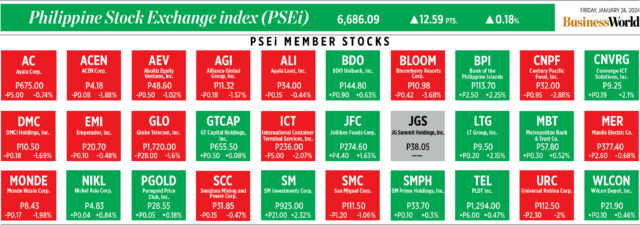
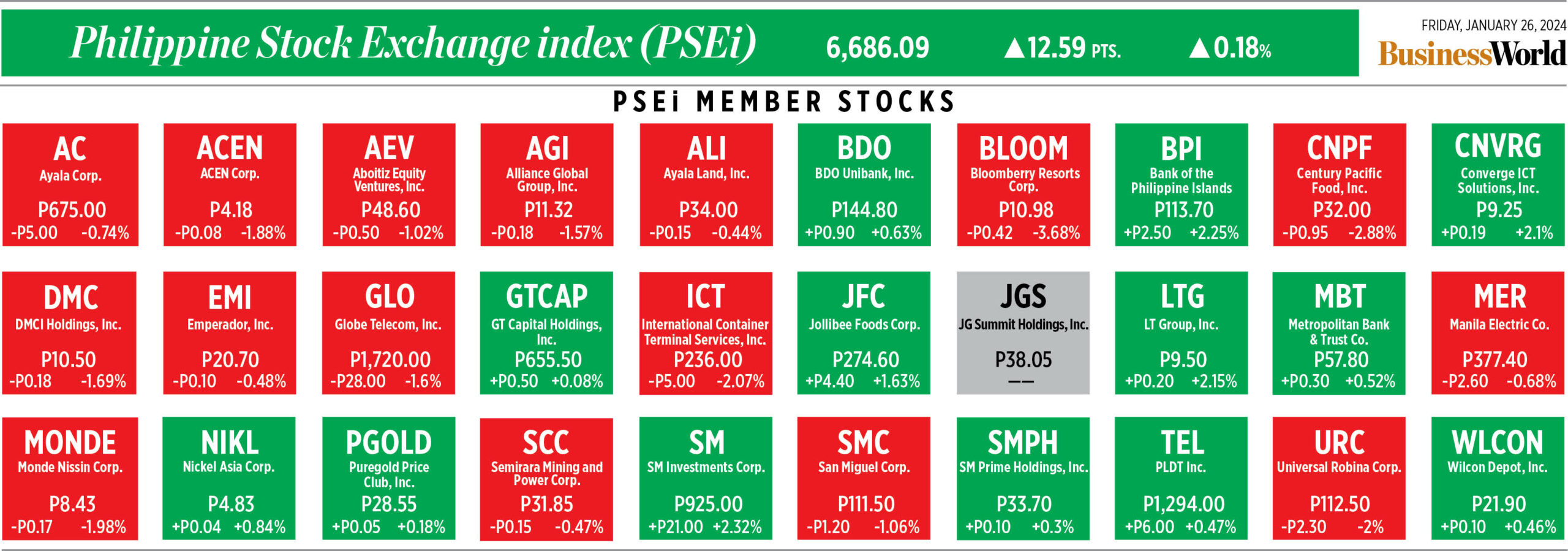
How PSEi member stocks performed — January 26, 2024

Here’s a quick glance at how PSEi stocks fared on Friday, January 26, 2024.


Market to stay cautious before PHL GDP report

INVESTORS are expected to take a cautious stance this trading week as they await the release of fourth quarter and full-year 2023 Philippine gross domestic product (GDP) data.

The Philippine Stock Exchange index (PSEi) rose by 12.59 points or 0.18% to end at 6,686.09 on Friday, while the broader all shares index climbed by 0.42 point or 0.01% to close at 3,508.61.

Week on week, the PSEi went up by 182.55 points or 2.81% compared to its 6,503.54 close on Jan. 19.

“The local bourse resumed its upward trend, banking on regional markets’ strength supported by China’s stimulus measures and higher-than-expected US GDP in the fourth quarter of 2023,” online brokerage 2TradeAsia.com said in a report. 

The US economy grew faster than expected in the fourth quarter amid strong consumer spending, and shrugged off dire predictions of a recession after the US Federal Reserve aggressively raised interest rates, with growth for the full year coming in at 2.5%, Reuters reported.

Gross domestic product increased at a 3.3% annualized rate last quarter after advancing at a 4.9% pace in the third quarter, the Commerce department’s Bureau of Economic Analysis said. Economists polled by Reuters had forecast GDP rising at a 2% rate.

Growth last year accelerated from 1.9% in 2022, and was the fastest in two years.

For this week, the market may stay cautious before the release of Philippine GDP data on Wednesday, Philstocks Financial, Inc. Senior Research Analyst Japhet Louis O. Tantiangco said in a Viber message

“Investors are expected to watch out primarily for our fourth quarter and full-year 2023 GDP data. Investors may also continue to watch out for clues with respect to the outlook of our country’s inflation and interest rates,” Mr. Tantiangco said.

“The record high performances in Wall Street, if they continue, are expected to give the market a boost. However, the current weakness seen in the local currency, if sustained, may weigh on the local bourse,” he added.

Any discussions about an interest rate cut during the Fed’s policy meeting this week could also affect the local market, China Bank Capital Corp. Managing Director Juan Paolo E. Colet said in a Viber message.

“Amidst a slew of economic data and month-end trading, the market is likely to react mainly to the Philippines’ fourth quarter GDP growth print and, more crucially, the remarks of Federal Reserve Chair Jerome Powell after US central bankers conclude their policy meeting on Wednesday,” Mr. Colet said.

“Any indication of a US rate cut as soon as March or May this year could fuel bullish bets and propel our market higher. Conversely, any erosion in the probability of an early dovish pivot in US monetary policy could lead to further market consolidation,” he added.

2TradeAsia.com put the PSEi’s immediate support at 6,500 and resistance at 6,700-6,800. — R.M.D. Ochave with Reuters

Peso to stay at P56 level ahead of PHL GDP data

JULIAN PAOLO DAYAG-UNSPLASH

THE PESO is expected to remain at the P56-per-dollar level this week as the market awaits the release of Philippine gross domestic product (GDP) data and the US Federal Reserve’s policy decision.

The local unit closed at P56.29 per dollar on Friday, strengthening by 24 centavos from its P56.53 finish on Thursday, Bankers Association of the Philippines data showed.

Week on week, the peso weakened by 32 centavos from its P55.97 finish on Jan. 19.

The peso opened Friday’s session at P56.50 against the dollar. Its intraday best was at P56.29, while its weakest showing was at P56.54 versus the greenback.

Dollars exchanged went down to $1.38 billion on Friday from $1.47 billion on Thursday.

The peso strengthened against the dollar on Friday amid hawkish signals from the Bangko Sentral ng Pilipinas (BSP) chief, Rizal Commercial Banking Corp. Chief Economist Michael L. Ricafort said in a Viber message.

BSP Governor Eli M. Remolona, Jr. said last week that the central bank is unlikely to cut rates at its Feb. 15 meeting amid lingering risks to inflation.

“At this point, a rate cut is not likely (on) Feb. 15,” Mr. Remolona said in mixed English and Filipino, adding that the “numbers we are seeing” show the need to keep policy settings sufficiently tight for some time.   

The Monetary Board hiked borrowing costs by 450 basis points (bps) from May 2022 to October 2023, bringing the key interest rate to a 16-year high of 6.5%.

“[The peso-dollar] pair was supported on dips today, following the robust US GDP data overnight,” Security Bank Corp. Chief Economist Robert Dan J. Roces said in a Viber message on Friday.

The US economy grew faster than expected in the fourth quarter amid strong consumer spending, and shrugged off dire predictions of a recession after the Federal Reserve aggressively raised interest rates, with growth for the full year coming in at 2.5%, Reuters reported.

Gross domestic product increased at a 3.3% annualized rate last quarter after advancing at a 4.9% pace in the third quarter, the Commerce Department’s Bureau of Economic Analysis said.

Economists polled by Reuters had forecast GDP rising at a 2.0% rate. Estimates ranged from a 0.8% rate to a 2.8% pace. The economy is expanding at a pace above what Fed officials regard as the non-inflationary growth rate of 1.8%.

Growth last year accelerated from 1.9% in 2022, and was the fastest in two years. From the fourth quarter of 2022 through the fourth quarter of 2023, the economy grew 3.1%, blowing away economists’ estimates for a 0.1% contraction back in December 2022.

For this week, the peso could stay at the P56 level as the market awaits the release of fourth quarter and full-year 2023 Philippine GDP data, Mr. Roces said.

Philippine economic growth likely slowed in the fourth quarter of 2023 to bring the full-year expansion below the government’s target, analysts polled by BusinessWorld said.

GDP likely grew by 5.7% in the fourth quarter of 2023, based on the median estimate of 20 economists polled by BusinessWorld.

This would be slower than the 5.9% growth logged in the third quarter of 2023 and the 7.1% expansion seen in the same period in 2022.

For 2023, GDP growth may have averaged 5.5%, short of the government’s 6-7% target. This would be well below the 7.6% expansion in 2022.

The market will also await the Fed’s policy decision this week, Mr. Ricafort added.

The US central bank is widely expected to keep the fed funds rate steady at the 5.25-5.5% range during its Jan. 30-31 meeting.

The Federal Open Market Committee raised borrowing costs by a total of 525 bps from March 2022 to July 2023.

Mr. Roces expects the peso to move between P56.20 and P56.80 per dollar this week, while Mr. Ricafort sees it ranging from P56 to P56.50 against the greenback. — A.M.C. Sy with Reuters

Agriculture output rebound seen possible in 2023 on base effects

PHILIPPINE STAR/KRIZ JOHN ROSALES

By Adrian H. Halili, Reporter

A REBOUND in agricultural output was deemed likely in 2023, with analysts citing the low base the industry is coming off  in 2022.

“We forecast growth of 1.3% this 2023 with crops and poultry contributing significantly,” former Agriculture Secretary William D. Dar said in a text message.

“Very hard to determine. But since we are coming from a low base in 2022, I would not be surprised if there is a slight uptick in output in real terms,” Federation of Free Farmers National Manager Raul Q. Montemayor said in a Viber message.

If the forecasts are borne out, they would reverse the 0.1% contraction in the value of production in agriculture and fisheries in 2022, at constant 2018 prices.

The decline in 2022 output was due to weak production in crops and fisheries, according to the Philippine Statistics Authority (PSA).

Agriculture production fell 0.3% in the third quarter of 2023.

Agriculture accounts for about a tenth of gross domestic product  and around a quarter of all jobs.

Earlier, Agriculture Assistant Secretary and Spokesperson Arnel V. de Mesa told reporters that the DA is expecting “positive growth” in agriculture output for 2023 though the growth would fall below 3-4%.

Mr. De Mesa said that the lack of major typhoons and disasters during the fourth quarter likely improved overall farm output for the year.

The DA’s official target is 2.3%-2.5% growth in 2023.

Mr. Montemayor said that the growth in production would be buoyed by “generally good weather” and higher farmgate prices, mainly for palay or unmilled rice.

The National Food Authority (NFA) raised buying prices for palay in September to P19-23 per kilogram for dry and P16-19 per kilo for wet palay.

Palay production for 2023 was initially estimated to have grown 1.53% to 20.06 million metric tons (MT), exceeding the 20 million MT target set earlier by the DA.

“Historical high, yes, but actually a minimal increase, not even enough to offset population and demand growth. (Gross Value Added) palay grew much larger due to an increase in farmgate prices,” Mr. Montemayor added.

The national farmgate price for palay rose 14% to an average of P19.89 per kilo in 2023.

National daily consumption of rice is equivalent to 33,983.5 MT or 679,670 bags, according to the NFA.

Elias Jose M. Inciong, president of the United Broiler Raisers Association, said the poultry segment has continued to be a growth driver in overall agricultural production.

However, the H5N1 Highly Pathogenic Avian Influenza (HPAI), or bird flu, continues to hinder further growth, Mr. Inciong added.

“HPAI will always be a concern unless and until we have effective vaccines for breeders and layers,” he said.

In November, the DA released guidelines for the deployment of bird flu vaccines to be administered to commercial farms for layer chicken, layer chicken breeders, broiler chicken breeders, free-range breeders, grandparent broiler breeders, as well as small-hold layer/native chicken, duck, game fowl, turkey, and goose farms.

The DA said that it will give priority in deploying protective emergency vaccines to areas with a high concentration of HPAI cases.

He said that the poultry industry will likely post 4% to 6% growth this year, “if we can minimize disruptions from imports and provide strong domestic support.”

“Livestock and fisheries are still struggling. There is African Swine Fever (ASF) contributing largely to the level of performance of the pig industry,” Mr. Dar added.

About 21 provinces have active cases of ASF as of Jan. 18, according to the Bureau of Animal Industry (BAI).

Production in the fisheries sector contracted 5% in 2022, and 6.1% during the third quarter of 2023.

The Bureau of Fisheries and Aquatic Resources (BFAR) is enforcing closed season on several major fisheries.

Last year, sardine fishing was banned between Nov. 15 and Feb. 15. This coincided with the closure of fishing in the Visayan Sea for small pelagic fish, including sardines.

Sardine fishing was also banned in northern Palawan between Nov. 1 and Jan. 31, while a closed season for herring and mackerel in the Visayan Sea was declared between Nov. 15 and Feb. 15.

The PSA is set to release its fourth quarter and full-year data for agricultural output on Jan. 30.

‘No-new-taxes’ pledge highlights balancing act between taxpayer relief, hitting revenue goals

President Ferdinand R. Marcos, Jr. with his new Finance Secretary Ralph G. Recto after the oath-taking at the Malacañan Palace, Friday, Jan. 12, 2024. — PHILIPPINE STAR/KRIZ JOHN ROSALES

By Luisa Maria Jacinta C. Jocson, Reporter

THE Department of Finance (DoF) decision not to introduce new taxes this year points to a focus on improving tax collection efficiency and providing relief to the public, though it runs the risk of failing to raise sufficient revenue, analysts said.

“No new or additional tax this year is a brilliant move,”  Bienvenido S. Oplas, Jr., president of a research consultancy and of the Minimal Government Thinkers think tank, said in a Viber message, noting that tax hikes have short- to long-term inflationary impact.

Finance Secretary Ralph G. Recto has said he does not plan to introduce any new taxes, citing the need to minimize inflation and improve tax administration.

“The focus on improving tax administration is also good. High incidence of smuggling and illicit trade is a clear example of poor tax administration…so this is a good fiscal consolidation measure,” Mr. Oplas said.

Albay Rep. Jose Maria Clemente S. Salceda earlier estimated that taxes forgone from tobacco smuggling at P60 billion in 2023.

“It is also prudent first to maximize tax revenue collections from existing tax laws and intensify compliance as well as encourage the payment of the right taxes, before adding new tax laws or raising tax rates,” Rizal Commercial Banking Corp. Chief Economist Michael L. Ricafort said in a Viber message.

Mr. Ricafort said that new or higher taxes may be considered once inflation is no longer a risk.

“Inflation has been the priority for more than a year already. It is a tough balancing act in fulfilling the mandates of price stability and fiscal performance sustainability in terms of increasing recurring sources of revenues for the National Government while also having more disciplined government spending through good governance standards,” he added.

Headline inflation averaged 6% for 2023, slightly higher than the 5.8% in 2022. This also marked the second straight year that inflation breached the central bank’s 2-4% target band.

Filomeno S. Sta. Ana III, coordinator of Action for Economic Reforms, said that optimizing tax collection may not be enough to generate much-needed revenue.

“Tax administration by itself will not significantly boost tax effort especially in the short term. We tried that route before but it was not responsive to the problem especially when the fiscal space is a binding constraint,” he said via Facebook Messenger chat.

Mr. Recto has said that the DoF is currently working on tweaking current tax proposals to make them fairer and easier to collect.

In particular, Mr. Recto said that the department fine-tuned proposals for the motor vehicle user charges (MVUC) reform and the Passive Income and Financial Intermediary Taxation Act (PIFITA).

He noted that other priority tax proposals will be “more or less be the same,” such as the rationalization of the mining regime, the tax on single-use plastics, and value-added tax (VAT) on digital service providers.

However, the Finance Secretary also said that revenue gains from priority tax reforms are expected to be lower than initially projected.

“The revenue gains we will frontload. The revenue losses we will backload,” Mr. Recto told reporters on the sidelines of an event Friday.

The DoF estimates that revenue from the PIFITA will yield P12.2 billion between this year and 2028. Earlier projections had estimated revenue at P21.2 billion between 2024 and 2026.

The PIFITA seeks to “encourage growth in key financial markets by simplifying the tax structure on passive income, and on certain instruments and other financial products,” the DoF said in an earlier statement.

“Under the proposal, the DoF seeks to maintain the structure of some products and instruments while deferring the implementation of certain provisions by 2028 or when the government will have been in a better fiscal position,” it added.

Mr. Recto said the DoF has also fine-tuned the MVUC proposal to “consider the impact of the new rates on inflation, particularly in the transportation and logistics sectors.”

The reform is expected to raise P36 billion between 2024 and 2028. This is lower than earlier estimates of P46.8 billion for 2025 to 2026.

The rationalization of the mining fiscal regime will help “encourage growth in the sector while ensuring that the government still gets its fair share of the profits from mining activities.”

It is estimated to generate P47 billion in incremental revenue between 2024 and 2028. Previous projections indicated that the reform would generate P52.6 billion between 2025 and 2028.

The DoF hopes to raise P4.3 trillion in revenue this year.

Meanwhile, Mr. Recto said that there has been interest from investors in the Maharlika Investment Fund (MIF).

He and the rest of the Maharlika Investment Corp. (MIC) board met last week. “We are still organizing. I think it will take time… There seems to be interest in investing in Maharlika from what I’ve heard. There are potential investors,” he said.

In a statement on Sunday, the DoF said the board approved the remittance of funds from the account of the Bureau of the Treasury (BTr) to the sovereign wealth fund.

“The BTr shall transfer the contributions to the account of MIC within five business days from receipt of the relevant Board Resolution,” it said.

The MIC has an authorized capital stock of P500 billion. Initial capital of P125 billion will be provided by the Land Bank of the Philippines (LANDBANK) and Development Bank of the Philippines (DBP), which will supply P50 billion and P25 billion, respectively. The National Government will also contribute P50 billion.

Both state banks remitted their contributions to the sovereign wealth fund to the BTr last year.

“The Board likewise approved the motion to appoint the LANDBANK and DBP as depository banks of the MIC which is consistent with DoF Department Circular No. 002.2022 stating that GOCCs (government-owned and -controlled corporations) may deposit and maintain government funds with the two banks without the need for prior approval from the Secretary of Finance,” it added.

The fund will prioritize investments in infrastructure, oil, gas, and power, agroforestry industrial urbanization, mineral processing, tourism, transportation, and aerospace and aviation.

“The commercial objective of the MIC is geared towards obtaining optimal absolute returns and maximizing financial gains on its investments in the short to medium term,” the DoF said.

“In the long term, the developmental objective is to promote economic development by making strategic and profitable investments in key sectors,” it added.

The MIC Board is set to meet again in February.

Tourism recovery seen held back by delayed return of China visitors

Tourists are seen at the beach of Boracay island, Aklan province. — PHILIPPINE STAR/KRIZ JOHN ROSALES

THE RECOVERY of the tourism market lags the rest of the region due to infrastructure constraints and the slow rebound of visitor arrivals from China, analysts said.

Michael L. Ricafort, chief economist of Rizal Commercial Banking Corp., said the Philippines’ tourism performance was lagging even before the pandemic.

“There has been a lot of catching up since the pandemic and also even before the pandemic with other ASEAN or Asian neighboring countries,” Mr. Ricafort said in a Viber message.

“This is largely due to infrastructure constraints that limit the capacity of airports and accommodation and MICE (meetings, incentives, conferences, & exhibitions) facilities to cater to a much larger number of foreign tourists,” he added.

In 2023, the Philippines logged 5.4 million international visitors which is only 65% of the 8.24 million foreign arrivals seen in 2019, but at par with the 65% average within Asia and the Pacific.

Mr. Ricafort said upgrades are needed to airports, particularly the Ninoy Aquino International Airport (NAIA), which will share future traffic to and from the capital with the Bulacan and Sangley airports.

“There is a need as well as for integrated tour packages that will be cheaper and more convenient to attract more foreign tourists,” he said.

“There is also a need for more mass transport systems such as railways that are integrated into major airports to make it more convenient for local and foreign tourists to travel,” he added.

China Banking Corp. Chief Economist Domini S. Velasquez said slow growth can be attributed to geographical constraints and absence of Chinese tourists.

“The Philippines lags behind its other ASEAN neighbors in terms of tourist arrivals, which can be attributed partly to geographical constraints, as the country cannot be accessed by land,” Ms. Velasquez said in a Viber message.

“However, another factor contributing to the below-target numbers, especially during the pandemic, is the absence of Chinese tourists,” she added.

Before the pandemic, China was the country’s second top source of international arrivals after South Korea. However, China only ranked fifth last year.

South Korea remained the top source of international visitors accounting for 26.41%, followed by the US (16.57%), Japan (5.61%), Australia (4.89%), and China (4.84 %).

“The sluggish growth and high unemployment in China have hindered the phenomenon known as “revenge travel,” wherein Chinese tourists typically exhibit strong travel demand. As a result, the expected influx of Chinese tourists has been limited,” Ms. Velasquez said.

Mr. Ricafort said the Philippines has strong potential in further growing the tourism economy with much room to improve in many elements of the product offering.

“The tourism business is low-hanging fruit that can generate more business, employment, and other economic activities as a major source of growth or a bright spot for the economy,” he said.

The United Nations World Tourism Organization (UNWTO) projected international tourism to fully recover to pre-pandemic levels this year, with some markets expected to surpass 2019 levels by 2%.

However, the UNWTO said that the rebound is subject to the pace of recovery in Asia and the resolution of various conflicts.

“There is still significant room for recovery across Asia. The reopening of several source markets and destinations will boost recovery in the region and globally,” it said.

“Chinese outbound and inbound tourism is expected to accelerate in 2024, due to visa facilitation and improved air capacity. China is applying for visa-free travel for citizens of France, Germany, Italy, the Netherlands, Spain and Malaysia for a year to Nov. 30,” it added.

The Manila International Airport Authority (MIAA) said it remains optimistic in the growth of passenger traffic in NAIA this year.

“As stated in our earlier release, 2023 passenger movements hit 45.39 million. This is still lower than our 2019 data or pre-pandemic levels, where we handled 47.69 million passengers,” MIAA said in a Viber message.

“But… from 2020 to 2022, passenger traffic has been growing. So we are expecting higher passenger traffic this year compared to 2023, possibly reaching pre-pandemic levels,” it added.

The MIAA said passenger traffic rose 47% last year versus the 30.94 million passengers seen in 2022.

The Department of Tourism set a 7.7 million international visitor target this year, which if borne out would be equivalent to 93% of the foreign arrivals in 2019. — Justine Irish D. Tabile

BCDA extends filing deadline for Clark ICT project bidders

NEW CLARK CITY

THE Bases Conversion and Development Authority (BCDA) said that it will be extending the deadline to submit the eligibility requirements for an information and communications technology (ICT) project in New Clark City to Feb. 16.

In a statement, the BCDA said the extension was granted at the request of prospective bidders.

“We understand that to do this project effectively, we will need the expertise of the private sector who can help us create a vibrant and innovative competitive market for ICT services via an Open Access Model,” BCDA President and Chief Executive Officer Joshua M. Bingcang said.

“This project is key to unlocking the potential of New Clark City as a smart and sustainable metropolis where its citizens have equal access to fast, reliable and affordable internet services,” he added.

The project involves building the foundation of fiber infrastructure and providing retail internet services across the 9,450-hectare zone.

It will be executed through a joint venture, with the bidder expected to handle the commercialization, expansion, repair, and maintenance of the passive ICT infrastructure.

The project seeks to incorporate an open access model in its underground network which will allow multiple data transmission providers to use it to offer retail services in the area.

The commercialization of the passive ICT infrastructure is viewed as a first step in developing a smart city with enhanced connectivity and the capacity to host data centers.

“Once fully developed, New Clark City is projected to become the home of about one million residents, with projected employment of about 200,000 workers,” the BCDA said.

Mr. Bingcang said in a recent briefing that the head of BCDA’s Joint Venture Committee is working with the Asian Development Bank to work out the procurement process for the ICT project.

He added that 18 companies attended the pre-bid conference, with at least three companies purchasing the bidding documents.

“But because this is a multi-discipline project, I think most of them will consolidate and form a consortium because some are contractors, others are IT (information technology) providers, the others are funders, etc. And you all need that in this project,” he said. — Justine Irish D. Tabile

Formal employment in establishments rises in August 2022 survey — PSA

PHILIPPINE STAR/RUSSELL A. PALMA

THE NUMBER of people employed in formal establishments rose to 5.37 million in August 2022 from 5.32 million in June 2020, the Philippine Statistics Authority (PSA) reported.

The results were contained in the PSA’s 2021/2022 Integrated Survey on Labor and Employment. The comparative periods are irregular due to disruptions from the pandemic.

The services sector had the largest workforce with 3.78 million, followed by industry with 1.45 million and agriculture, forestry and fishing with 139,190. — Abigail Marie P. Yraola

How agile corporate reporting builds confidence

As businesses grow, finance leaders face increasing stakeholder demand for timely and accurate financial and non-financial corporate reporting. Moreover, organizations must consider how they can keep up with current and future demands, and how they can provide accurate stakeholder reports in a timely manner.  

CORPORATE REPORTING AND STAKEHOLDER DEMANDS
Corporate reporting provides a comprehensive picture of an organization’s financial and non-financial information, which can assist stakeholders and other relevant users in their decision-making. Furthermore, finance leaders can use corporate reporting to communicate the value their businesses create for people, society, and the environment.

There is also increasing stakeholder demand for non-financial information, such as sustainability reports that highlight a company’s environmental, social, and governance (ESG) commitments. This development continually influences businesses, encouraging more responsible and sustainable practices. Moreover, evolving accounting principles and other regulatory requirements are continually obliging organizations to report more reliable and relevant information about their performances, positions and their level of compliance. The increasing stakeholder demands trigger the need for finance leaders to revisit their transformation agenda on their finance functions.

According to the 2023 Global EY DNA of the CFO Report, 16% of finance leaders believe their finance function delivers best-in-class performance, with only 14% of respondents planning to pursue a bold transformation agenda over the next three years.  The small number may imply that there is a hesitancy to adopt new and inventive ways of working.

COMMON PITFALLS
Through the years, finance leaders have faced the challenge of meeting internal and external stakeholder demands to comply with the financial reporting standards and regulatory guidelines. As such, some corporate reporting policies, processes, and controls have not yet been transformed to align with organizational needs and demands, resulting in a lack of confidence among stakeholders.   

There are some common pitfalls to watch out for in corporate reporting:

Substantial reliance on manual processes. Even though some organizations have Enterprise Resource Planning (ERP) systems, there are still some corporate reporting processes being done manually. In the 2021 EY 7th Global Corporate Reporting Survey, 56% of finance leaders said that “there has been resistance to some of the changes we have had to introduce.” In addition, 51% said “finance team members have sometimes failed to adopt new processes, reverting to traditional ways of doing things.” These entities normally have siloed systems that rely on spreadsheets to reconcile corporate reports from different systems. Spreadsheets are prone to human error, making them unsustainable since processes may become more complex as entities evolve.

Policies are not aligned with regulatory reporting requirements and business demands. Policies are vital to corporate reporting controls. If they are not aligned with regulatory requirements and business demands, they can reduce efficiency and effectiveness in decision-making. Recently, there have been significant changes with regulatory reporting requirements, such as financial reporting standards. Despite these changes, some organizations have not yet updated their policies, which may lead to the inappropriate and inconsistent application of procedures and processes. Consequently, this misalignment may result in fines, litigations, or other consequences to an organization if this non-compliance has a material effect on its corporate reporting.

Outdated employee skillsets. Due to today’s fast-paced technological innovations, regulatory changes, and consumer demands, some employees may need to upskill. Moreover, limited skill development may lead to poor performance and outdated corporate reports. According to the 2023 EY Global DNA of the CFO survey, 19% of the finance leaders surveyed said that talent together with risk are the least priorities for finance transformation over the next three years.

BUILDING CONFIDENCE
Addressing these pitfalls can help organizations achieve agile corporate reporting. To do so, finance leaders need to integrate their processes, policies, and people. Additionally, they need to focus on the following areas:

Invest in technology to digitalize processes. The 2023 EY Global DNA of the CFO survey shares that 44% and 36% of the finance leaders are now prioritizing technology transformation and advanced analytics, respectively. Finance leaders need to leverage investments in technology and digitalization to standardize and simplify the corporate reporting process. They must also explore new ways of working where data is integral to unlocking the value of business portfolios. They need to implement integrated systems to provide accurate and real-time reports, leveraging automation from technology. These solutions will enable faster and better decision-making, shifting the focus of finance from back-office bookkeeping to being a trusted business advisor within the organization.

Align policies with regulatory reporting requirements and business demands. In aligning policies, finance leaders need to ask themselves whether their organizations have all the necessary policies in place. They also need to determine how their policies compare to those of their industry peers, and if their internal users and customers are satisfied with the policies. Lastly, after determining if the policies are user-friendly, they need to identify the key policy gaps related to regulatory requirements and business demands.

Once policies are aligned and updated, finance leaders must ensure their organizations also have a “policy on policies.” This overarching guidance will help define when to create, update, or decommission policies, including approval requirements for these changes.

Equip next generation leaders with the right skills and tools. Finance leaders can assess the skill gaps of their existing employees, encourage professional development, and reconcile both to align with business requirements. Any updated policies and processes should be cascaded to employees, especially those that require continuous training and education. These steps will help organizations ensure that the talent assigned to their tasks are aligned with current business and stakeholder demands.

THE FUTURE OF CORPORATE REPORTING
Finance leaders need to transform their corporate reporting agenda beyond the numbers, starting with a cultural change on their mindset and behavior. This journey can serve as a challenge and an opportunity to create long-term value for the whole enterprise, improve current ways of working and develop next-generation leaders. When finance leaders consider these, they can rebuild confidence and drive value for the organization today and tomorrow. 

 This article is for general information only and is not a substitute for professional advice where the facts and circumstances warrant. The views and opinions expressed above are those of the authors and do not necessarily represent the views of SGV & Co.


Anna Maria Rubi B. Diaz is an assurance partner under Financial Accounting Advisory Services (FAAS) and Sheena Dyan C. Suarez is a FAAS director of SGV & Co.

ADVERTISEMENT
ADVERTISEMENT