Home Blog Page 3733

Peso inches up on US PCE report

PHILSTAR FILE PHOTO

THE PESO rose against the dollar on Monday as soft US inflation data supported expectations of policy easing by the US Federal Reserve this year.

The local unit closed at P56.27 per dollar on Monday, strengthening by two centavos from its P56.29 finish on Friday, Bankers Association of the Philippines data showed.

The peso opened Monday’s session weaker at P56.40 against the dollar. Its intraday best was at P56.26, while its worst showing was at P56.54 versus the greenback.

Dollars exchanged went down to $1.17 billion on Monday from $1.38 billion on Friday.

“The peso appreciated as the softer-than-expected US PCE (personal consumption expenditures) inflation supported views of Fed policy rate cuts this year,” a trader said in an e-mail.

US prices rose marginally in December, keeping the annual increase in inflation below 3% for a third straight month, bolstering expectations that the Federal Reserve will start cutting interest rates this year, Reuters reported.

The PCE price index increased 0.2% last month after dropping 0.1% in November, the Commerce department’s Bureau of Economic Analysis said. Food prices rose 0.1% and the cost of energy products increased 0.3%

In the 12 months through December, the PCE price index advanced 2.6%, matching November’s gain. The inflation readings were in line with economists’ expectations.

Excluding the volatile food and energy components, the PCE price index climbed 0.2% after rising 0.1% in November. The so-called core PCE price index increased 2.9% year on year, the smallest gain since March 2021, after rising 3.2% in November.

The Fed tracks the PCE price measures for its 2% inflation target. Monthly inflation readings of 0.2% over time are necessary to bring inflation back to target.

The US central bank raised borrowing costs by a cumulative 525 basis points from March 2022 to July 2023 to the 5.25-5.5% range.

The peso was also supported by comments from the Bangko Sentral ng Pilipinas (BSP) chief that stronger gross domestic product (GDP) growth in the fourth quarter of 2023 could give them room to hike rates if needed, Rizal Commercial Banking Corp. Chief Economist Michael L. Ricafort said in a Viber message.

BSP Governor Eli M. Remolona, Jr. said on Friday that they are unlikely to ease their policy stance this semester and remain ready to deliver more rate hikes if needed, especially if data show economic growth picked up in the last quarter of 2023. The BSP hiked borrowing costs by 450 bps from May 2022 to October 2023, bringing the policy rate to a 16-year high of 6.5%.Fourth-quarter and full-year 2023 Philippine GDP data will be released on Wednesday.

For Tuesday, the trader said the peso could weaken anew ahead of the GDP data release. The trader sees the peso moving between P56.15 and P56.40 per dollar, while Mr. Ricafort expects it to range from P56.20 to P56.40. — AMCS with Reuters

Marcos hits back at Duterte after drug tirade

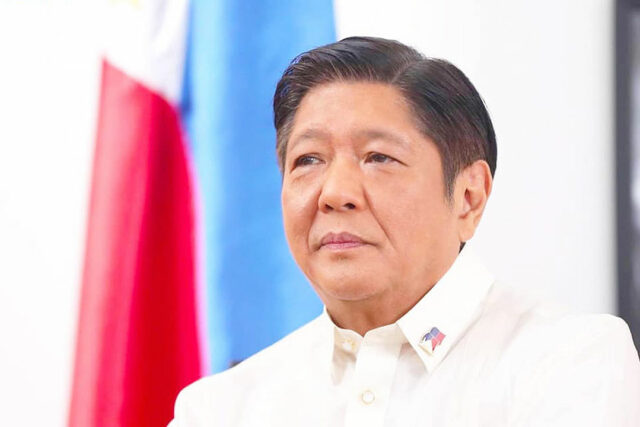
FACEBOOK.COM/BONGBONGMARCOS

By Kyle Aristophere T. Atienza and Beatriz Marie D. Cruz Reporters

PHILIPPINE President Ferdinand R. Marcos, Jr. struck back on Monday at his predecessor Rodrigo R. Duterte, who called him a “drug addict,” saying the firebrand leader’s fentanyl use could have affected his judgment.

“I think it’s the fentanyl,” Mr. Marcos told reporters shortly before leaving for Vietnam in response to claims made by Mr. Duterte on Sunday while speaking at a rally in his hometown Davao against moves to amend the country’s Constitution.

When asked about the drug use accusations and the call for him to step down, Mr. Marcos said the former president “has been taking the drug for a very long time now… After five, six years, it has to affect him.”

In 2016, Mr. Duterte admitted he used to take the highly addictive synthetic opioid fentanyl for pain relief after a motorcyle accident. “I hope his doctors take better care of him,” Mr. Marcos said.

Mr. Duterte also said Mr. Marcos was on the drug agency’s so called “narco-list” that was submitted to him when he was still mayor of Davao city, a charge that the Philippine Drug Enforcement Agency vehemently denied.

House Speaker and presidential cousin Martin G. Romualdez urged Mr. Duterte to show proof about his drug allegations.

“The current discourse between the two warring factions is definitely not helping the community of people who use drugs who have historically been bearing the brunt of public stigma,” medical doctor RJ Naguit, who heads the Youth for Mental Health Coalition, Inc., said in a Viber message.

“Their statements, which seem to use drug use as political bullets, further divert the public discourse away from conversations that center on public health interventions and other ways to support people whose lives involve drugs,” he added.

“Pharmaceutical fentanyl is a synthetic opioid approved for treating severe pain, typically advanced cancer pain,” according to the US Centers for Disease Control and Prevention.

Anthony Borja, who teaches political science at De La Salle University, said the exchange between Mr. Marcos and the Duterte father-and-son tandem “can be construed not only as intense yet petty, but also as something situated between contradictory tendencies of family and professionalism in politics.”

“This is considering how Imee Marcos and Sara Duterte are trying to stay away from the fray by focusing on policy issues,” he said via Messenger chat.

Their supporters can either condemn them for not taking a clear stand in defense of their family members, or appreciate their efforts to stay above the mudslinging, he said.

‘CLIENTELIST ALLIANCE’
Meanwhile, the House of Representatives affirmed its “strong and unqualified support” for President Ferdinand R. Marcos, Jr. through a resolution after Mr. Duterte’s tirade.

During a political rally in Davao City on Sunday, city Mayor Sebastian Z. Duterte, son of the ex-President, urged Mr. Marcos to step down.

Deputy Speaker and Quezon Rep. David C. Suarez called the younger Mr. Duterte’s remarks “totally disrespectful of the man given the position that he holds.”

During the Davao rally, Mr. Duterte accused Mr. Romualdez and First Lady Liza Araneta-Marcos of being behind the push to amend the 1987 Constitution through a people’s initiative.

The anti-Charter change rally, which was also attended by presidential sister Senator Maria Imelda “Imee” Marcos, happened on the same day the government held a rally in Manila to launch its brand of governance called “Bagong Pilipinas” (New Philippines), which was attended by Vice President Sara Duterte-Carpio. She also attended the Davao rally later.

The quarrel between Mr. Marcos and the Dutertes were all “on their families” and not about the issues facing ordinary Filipinos, Jean Encinas-Franco, who teaches political science at the University of the Philippines, said in a Facebook Messenger chat.

“These are all consistent with how clientelist the alliance is — it favors each other, zero policy honesty and invokes tribalist/traditional Filipino values,” Hansley A. Juliano, a political science lecturer at the Ateneo de Manila University, said via Messenger chat.

In a statement, the Speaker said he’s stumped by the seemingly conflicted stance of Mr. Duterte in moves to amend the Charter, noting that the tough-talking leader had based his entire presidential campaign on a shift to a parliamentary form of government.

The Commission on Elections (Comelec) on Monday suspended all proceedings related to a people’s initiative for constitutional changes.

House leaders declared their support for Resolution of Both Houses 6 filed in the Senate, which proposes amendments to the Charter’s economic provisions.

The Senate resolution was authored by Senate President Juan Miguel F. Zubiri and Senators Loren Legarda and Juan Edgardo Angara.

The House’s collaboration with the Senate is a “shared commitment to nurturing an economic landscape that is dynamic, inclusive and forward-thinking, ensuring that prosperity reaches every corner of our nation,” the political party leaders in the House said in their joint manifesto.

Last week, the 24-member Senate issued a statement against the people’s initiative, saying it is “ridiculous” for the Senate to have a “dispensable and diluted role” in the “Cha-cha” push.

Also on Monday, Mr. Zubiri said the President is set to ask the House to repeal its push to amend the Constitution through a people’s initiative.

“The President is set to appeal to the House of Representatives and the other initiators of the people’s initiative to stop this,” he told the plenary.

Presidential Communications Office chief Cheloy Velicaria-Garafil did not immediately reply to a Viber message seeking comment.

“The President expressed the need to protect the bicameral nature of Congress, which upholds the system of checks and balances within the legislative branch,” he said a privilege speech. — with Reuters


Sea cooperation a bedrock of Vietnam visit — Marcos

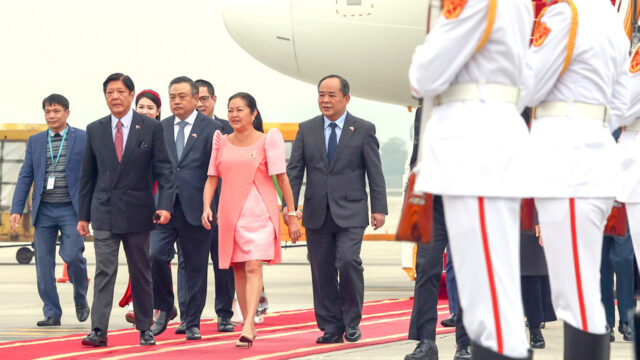
PRESIDENT Ferdinand R. Marcos, Jr. and First Lady Liza Araneta-Marcos arrived at the Noi Bai International Airport in Hanoi, Vietnam on Monday for a two-day state visit focused on possible deals on maritime and food security, and agriculture. —PPA POOL/KRIZJOHN ROSALES

PHILIPPINE President Ferdinand R. Marcos, Jr. on Monday said talks on maritime cooperation between his country and Vietnam would be one of the cornerstones of a strategic partnership between the two.

“We hope to strengthen this aspect during my visit to promote peace and stability in our region,” he said in a statement before leaving for Hanoi for a two-day state visit.

The President is expected to meet Vietnam’s top officials and work on agreements on coast guard cooperation and rice supply. Vietnam is a major rice exporter, and the Philippines is one of the world’s biggest importers of the grain.

Mr. Marcos said he hopes his visit would bring their relations to greater heights and “usher in a new era of friendship and cooperation,” with talks on trade, investment, education and tourism, as well as “regional and multilateral issues of concern.”

Vietnam and the Philippines have overlapping claims in the South China Sea, but have generally friendly relations compared with the heightened tensions between Manila and Beijing over disputed waters.

Ties between the Philippines and China have deteriorated this past year, coinciding with a tougher stand by Manila and overtures by Mr. Marcos to forge stronger military relations with the United States.

The South China Sea, a conduit for more than $3 trillion in annual ship-borne commerce, is claimed almost entirely by China via a U-shaped line policed by its vast coast guard fleet that cuts into the exclusive economic zones of Vietnam, the Philippines, Malaysia, Brunei and Indonesia.

In 2016, the Permanent Court of Arbitration in the Hague said China’s claims were illegal, a decision Beijing has rejected.

“The plane carrying President Marcos and the First Lady arrived at around 3:05 p.m. (Vietnam time) at the Noi Bai International Airport where they were warmly welcomed by the Vietnamese officials,” the presidential palace said in a statement.

Mr. Marcos will visit Vingroup Co. later in the day to deepen the Philippines’ engagement with them. It is Vietnam’s largest private company with a market capitalization of $21.1. billion as of April 2023 through its unit VinFast, which is valued at $15 billion.

VinFast plans to sell and launch its electric vehicles (EVs) in the Philippines through a dealership business in April to test the local market first as it expressed its intention to engage in the manufacture and assembly of CKD EVs.

Several Philippine private sector leaders would join the President during the meeting, the palace said.

Bernard B. Espeña, who teaches international relations at the Polytechnic University of the Philippines, earlier said the Philippine Coast Guard (PCG) should also boost maritime cooperation with other Southeast Asian nations other than Vietnam amid the slow development in the push for a code of conduct (CoC) in the South China Sea.

A possible cooperation deal between the Philippine Coast Guard (PCG) and its Vietnamese counterpart, which they have been working on since 2018 and is expected to be sealed this month, could be an “informal model” for the proposed South China Sea code of conduct, he said.

Mr. Espeña said the lack of operational models for a legally binding instrument has delayed the approval of the code of conduct.

The Philippine Coast Guard on Jan. 23 gave a “comprehensive briefing” to Vietnamese officials, including Vietnam’s Standing Deputy Minister of Foreign Affairs Nguyen Minh Vu and Ambassador to the Philippines Lai Thai Binh, on Manila’s maritime security operations in the South China Sea. —

The two countries also sought to advance a memorandum of understanding between the PCG and its Vietnamese counterpart, which they have been working on since 2018.

Mr. Marcos, 66, said during his visit to the United States last year his government was seeking to set up a separate code of conduct with Vietnam and Malaysia.

The Philippine leader cited the slow progress of the code between China and ASEAN members.

After the Philippines’ push for a separate code of conduct, China warned that any departure from the Declaration on Conduct of the Parties in the South China Sea, which provided the framework for the regional code, would be void.

Vietnam was said to be the “last man standing” in the South China Sea conundrum when the Philippines pivoted to China during the previous administration.

Hanoi conducted major expansion activities such as dredging and landfill work at most of its South China Sea outposts in 2022. — with Reuters

ICC arrest warrants may take time — human rights lawyers

PHILSTAR FILE PHOTO

IT WOULD probably take time for the International Criminal Court (ICC) to issue arrest warrants against Philippine state officials connected to President Rodrigo R. Duterte’s deadly drug war, according to human rights lawyers.

“We expect warrants to be issued, but we will not pressure the ICC within timelines,” Maria Kristina C. Conti, National Union of Peoples’ Lawyers (NUPL) National Capital Region secretary general who lawyers for several victims of the drug war, said in an e-mail.

“We are well aware of the quantum of evidence necessary to proceed with the formal trial and we prefer investigators to focus on the quality of information,” she added.

On Jan. 23, Philippine President Ferdinand R. Marcos, Jr. said ICC investigators would be allowed to come to the Philippines as “ordinary people,” but his government would not help in the probe.

“The Philippine government will not lift a finger to help any investigation that the ICC conducts,” he told reporters.

The Department of Justice said last week said the international tribunal had yet to inform them of its investigators’ visit, adding that the government is not legally bound to cooperate with the investigation.

In an X message to BusinessWorld on Jan. 24, iDefend human rights group said it has been submitting evidence to the ICC since it reopened its probe in January.

“iDefend hopes to participate in any way at the trial stage through the victims’ participation processes with our potential legal counsel,” it said.

The group reiterated that cooperating with the ICC would not violate Philippine sovereignty, adding that it would affirm the country’s commitment to prevent human rights abuses.

In January last year, the ICC pre-trial chamber resumed its investigation into killings and so-called crimes against humanity under former Mr. Duterte’s drug war, saying it was not satisfied with Philippine efforts to probe the deaths.

Philippine Solicitor General Menardo I. Guevarra in July said Philippine officials who could face arrest would likely hire their own defense lawyers. The solicitor general would only represent the state at the ICC hearings, he added.

In November, Mr. Marcos said the government was considering rejoining the ICC. He had ruled out cooperation, saying the probe violates Philippine sovereignty given the country’s fully functioning justice system.

Mr. Duterte canceled Philippine membership in the ICC in 2018 amid criticisms that his government had systematically murdered drug suspects in police raids. It took effect a year later.

The tribunal, which tries people charged with crimes against humanity, genocide, war crimes and aggression, was also set to probe vigilante-style killings in Davao City when he was still its vice mayor and mayor.

“President Marcos should rethink his position and listen to the clamor for investigation from the victims and the public,” NUPL Secretary-General Josalee S. Deinla said in a Viber message. “Under the Rome Statute, states that were once parties to ICC continue to have an obligation to cooperate with investigations initiated prior to their withdrawal.”

The United Nations Human Rights Committee has said the Philippines should comply with international human rights mechanisms and cooperate with the ICC’s drug war probe.

The Philippine government estimates that at least 6,117 drug dealers were killed in police operations. Human rights groups say as many as 30,000 drug suspects died. — John Victor D. Ordoñez

10 agroforestry projects in Iloilo to push dev’t, help environment

FIRST Secretary and Agriculture Attaché Tachikawa Jumpei of the Japanese Embassy in Manila attends the official turnover of the completed agroforestry support facilities under the Forestland Management Project in Calinog, Iloilo. —EMBASSY OF JAPAN IN THE PHILIPPINES

By Adrian H. Halili Reporter

THE DEPARTMENT of Environment and Natural Resources (DENR), in partnership with the Japan International Cooperation Agency (JICA), has completed and turned over 10 agroforestry infrastructure projects seen to boost development and help protect the environment in Iloilo province.

“These facilities include irrigation pipeline systems, access roads, pathways, and bridges which aim to connect communities to markets, boost their access to social services and help sustain community-based forestry initiatives,” the Embassy of Japan in Manila said in a statement on Monday.

It added that a coffee processing facility was also constructed in the municipality of Janiuay to further develop the local coffee industry and boost the livelihoods of farmers in the area.

First Secretary and Agriculture Attaché Jumpei Tachikawa of the Embassy of Japan said that the projects would help efforts to “improve livelihoods and sustained flow of development in the municipalities, creating a positive ripple effect in neighboring communities.”

Funded through the P1.8-billion cooperation project targeted at building or rehabilitating agroforestry support facilities under the management of the Forestland Management Project (FMP), the projects are also seen to contribute environment protection and mitigate climate change.

“The FMP seeks to protect 71,300 hectares of forests in the country’s watershed areas Upper Magat and Cagayan River Basins, Pampanga River Basin, and the Jalaur River Basin, covering the provinces of Ifugao, Nueva Vizcaya, Quirino, Nueva Ecija, and Iloilo,” said the embassy.

“Launched 10 years ago, the FMP highlighted environmental protection including forestland management as one of the major pillars of collaboration between the Philippines and Japan,” it added.

No reef ‘arrangement’ with China

THE PHILIPPINES denied on Monday that China had a “temporary special arrangement” with Manila to allow the delivery of supplies to Philippine troops occupying a disputed South China Sea reef, calling it “a figment of imagination.”

The Chinese Coast Guard said on Saturday it had temporarily allowed the Philippines to provide food and water to soldiers stationed at the BRP Sierra Madre, a vessel grounded in 1999 at the Second Thomas Shoal, 190 km off Palawan, to assert Manila’s territorial claims.

“This is a figment of the imagination of the Chinese Coast Guard. There is no truth to this,” National Security Council spokesperson Jonathan Malaya told state-run broadcaster PTV-4.

The Chinese Coast Guard said the Philippines air-dropped supplies to the navy vessel on Jan. 21. Mr. Malaya did not confirm nor deny the airdrop but said supplying troops was his country’s right.

“We do not need to get the permission of anyone, including the Chinese coastguard, when we bring supplies through whatever means, whether by ship or air,” Mr. Malaya said.

The Philippines’ occupation of the shoal has irked Beijing and has been a flashpoint in recent disputes between them, which have intensified under President Ferdinand R. Marcos Jr., who has sought stronger ties with the US military.

China claims almost the entire South China Sea, a conduit for more than $3 trillion (about P1.69 trillion) in annual ship commerce. Its territorial claims overlap with the exclusive economic zones of the Philippines, Vietnam, Indonesia, Malaysia and Brunei, some of which have competing claims to various islands and reefs.

In 2016, the Permanent Court of Arbitration in the Hague said China’s claims had no legal basis, a decision Beijing has rejected.

Last weekend, top officials of the Northern Luzon Command (NOLCOM) inspected its two farthest naval detachments — the ones on Basco and Mavulis islands in the Batanes Group of Islands — to ensure their readiness to respond to any territorial defense situation in the northernmost tip of the country.

Lt. Gen. Fernyl G. Buca led the inspection, along with other Nolcom officials and Baliktatan 39-2024 planners with the aim of reviewing operational procedures to strengthen the defense posture in the Nolcom’s Joint Operational Area.

The two naval detachments are responsible for securing and controlling the Luzon Strait, which includes the Balintang and Bashi Channels. Major Al Pueblas, commander of Nolcom’s Civil Relations Group (CRG), stressed the Batanes area’s strategic importance as a chokepoint for naval and air traffic, influencing forces for strategic advantage.

In October last year, officials inaugurated the Naval Detachment in Mavulis Island which bolsters the Philippines’ defense and strategic security capabilities in Northern Luzon. It plays a pivotal role in safeguarding Philippine territory, sovereignty, and sovereign rights to protect maritime borders and interests.

Mr. Buca cited the dedication of the 14-man team from the Philippine Navy (Marines) and Civilian Active Auxiliary deployed at the detachment. In turn, Marine Sergeant Harley Calicaran expressed gratitude for their commanders’ visit which has boosted their morale.

The weekend visit also demonstrates the Nolcom’s commitment to national defense and security, part of the transitional phase toward territorial defense operations and a site inspection for the upcoming Balikatan Exercises 39–24, the largest bilateral military exercise with the United States military. — Reuters with a report from Artemio A. Dumlao

Changes to education bill OK’d

A HOUSE committee ironed out some provisions of a bill proposing optional senior high school education in the country to include a requirement for students to undergo an assessment exam that would determine their fitness for higher learning, a lawmaker said on Monday.

Pasig Rep. Roman T. Romulo, chair of the House Committee on Basic Education, said the proposed measure would require a diagnostic exam to be given to Grades 3, 6, 10, and 12 learners to assess “age-appropriate” reading comprehension and mathematics knowledge.

Under House Bill No. 7893, the Department of Education (DepEd) would oblige a student to take “special classes” if their assessment exam performance points to a “deficiency.”

The bill seeks to amend Republic Act No. 10533 (Enhanced Basic Education Act of 2013), which implemented the Kindergarten to Grade 12 or K-to-12 program.

Lawmakers and stakeholders have deemed it ineffective in producing job-ready and college-ready graduates. “All surveys show that neither was fulfilled. Most surveys of even industry players have said that still they prefer an individual who has gone to college rather than one who has finished K-to-12,” said Mr. Romulo.

The measure also mandates that Grade 10 learners must take up Grades 11 and 12 if they seek to enroll in a university course. Otherwise, they may choose a technical-vocational (techvoc) education track for a more skills-based training.

“The curriculum will be industry-driven,” Mr. Romulo said, referring to the techvoc track to be handled by the Technical Education and Skills Development Authority (TESDA). “It will really be mostly skills training outside with the industry concerned.” — Beatriz Marie D. Cruz

Metro water allocation stable

THE NATIONAL Water Resources Board (NWRB) has approved maintaining Metro Manila’s water allocation at 50 cubic meters per second (cms) for February, ensuring sufficient water supply.

Patrick James B. Dizon of the Metropolitan Waterworks and Sewerage System (MWSS) Angat/Ipo Operations Management Division said the decision was reached during the NWRB meeting last Jan. 26 after the MWSS was granted its request for a reservoir elevation of 240 meters by yearend, based on the Angat Technical Working Group’s projection.

“So, we have a sufficient amount of water or additional buffer for the summer,” Mr. Dizon said.

“The water releases shall be subjected to daily monitoring and assessment to determine if there is a need to modify, reduce or terminate the releases.”

He added that based on their projection, the water elevation will not drop to 180 meters by May.

Angat Dam is the primary water source for Metro Manila, providing approximately 90% of the capital’s potable water.

In a separate development on Monday, Manila Water Co., Inc. expressed openness to continue its partnership with the Pangasinan provincial government after the termination of a 25-year bulk water supply deal.

In an emailed statement, the east-zone concessionaire said that Manila Water Philippine Ventures (MWPV) has reached out to the province to explore the revival of their terminated concession agreement.

“This presents an opportunity to revisit the conditions precedent of the old contract and renew partnership for the benefit of Pangasinenses,” it said.

The terminated agreement, with a capital expenditure of about P8 billion, aimed to supply Pangasinan with an additional 200 million liters per day. — Sheldeen Joy Talavera

P53M released for medical needs

OFFICIALS of the Bangsamoro social services ministry inspect the emergency bags filled with basic life-saving supplies for distribution to poor families in Maguindanao del Norte. —THE PHILIPPINE STAR/JOHN FELIX M. UNSON

COTABATO CITY — The Bangsamoro region’s social welfare ministry has disbursed a total of P53.2 million in separate allocations for humanitarian projects benefitting the poor, of which P40 million was released last December to a local branch of Mercury Drug.

Social Services and Development Minister Raisa H. Jajurie said the advance payment is intended for medicines prescribed by physicians in both private and government medical facilities catering to the needs of marginalized residents.

The Ministry of Social Services and Development in the Bangsamoro Autonomous Region in Muslim Mindanao also allocated P10 million to the Cotabato Regional Medical Center to cover the medical bills of poor patients.

In addition, an orphanage operated by the Turkish non-government organization Insani Yardim Vakfi received P1.9 million for the provision of food and necessities for orphans in its care. The Matanog Orphanage Center and the Ribat Islamic Center Orphanage also obtained grants of P480,000 and P468,000, respectively.

Finally, the MSSD-BARMM earmarked P300,000 for the Glang Eye Care Clinic, which focuses on treating elderly eye patients and supplying reading glasses to residents in Bangsamoro towns. — John Felix M. Unson

Philmech disburses farm equipment, coconut facility funding

THE Philippine Center for Postharvest Development and Mechanization (PhilMech) has allocated a total of P82.97 million to fund the disbursement of farming equipment and the construction of a processing facility.

In a statement, PhilMech said that it had granted P36.27 million worth of farming machineries to farmers from Zambales. It had also funded a P46.7-million coconut processing facility in Misamis Oriental.

The agency said that 20 units of hand tractors, six units of four-wheel tractors, six units of rice combine harvesters, four units of riding type transplanter, two units of precision seeder, and one unit of single pass rice mill were handed to 26 farmers cooperatives and local government units in Zambales.

To date, Zambales has received 303 units of various agricultural machinery and postharvest facilities already, amounting to P232.14 million.

Additionally, PhilMech said that an integrated white copra and coconut oil processing facility in Misamis Oriental. This was funded by the Coconut Farmers and Industry Development Program (CFIDP).

The facility is aimed at benefiting over 200 coconut farmer-beneficiaries in the area. —  Adrian H. Halili

Thai economy in recession, needs a boost — official

A view of traffic during sunrise in Bangkok, Thailand, Jan. 5, 2024. _ REUTERS

BANGKOK — Thailand’s economy is in a state of recession owing to a high level of household debt, a deputy finance minister said on Monday, raising pressure on the central bank to cut interest rates.

Deputy Finance Minister Julapun Amornvivat also said the government was committed to delivering on its signature 500 billion baht ($14 billion) handout plan of transferring 10,000 baht ($281) each to 50 million Thais, and hoped a delay in its rollout would not be long.

He said the country’s policy interest rate, which is at a decade-high of 2.50%, should be cut at the central bank’s next policy review on Feb. 7 to help lower high borrowing costs.

“The rate should be lowered as high rates now are people’s burden. People can’t survive,” he told reporters.

Prime Minister Srettha Thavisin has also urged the central bank to cut the key rate to help Southeast Asia’s second-largest economy he says is in crisis.

Bank of Thailand Governor Sethaput Suthiwartnarueput, who has come under fire from the premier for not cutting rates despite negative inflation, told Reuters last week growth had been slower than expected but the economy was not in crisis.

Mr. Sethaput said the current policy rate was “broadly neutral.”

The central bank left its policy rate unchanged at 2.50% at its last rate meeting in November, having raised it by 200 basis points since August 2022 to curb inflation.

The government last week slashed its 2024 growth projections for Southeast Asia’s second-largest economy to 2.8% from an earlier forecast of 3.2% on weaker exports and lower foreign tourist numbers.

It also lowered the 2023 growth estimate to 1.8% from 2.7%, below 2022’s 2.6% growth. Official 2023 gross domestic product (GDP) is due to be released by the planning agency on Feb. 19.

“If you ask, now it’s at the dangerous level. It’s a kind of economic recession,” Mr. Julapun said, adding the situation was driven by the high debt burden of households and the private sector.

“It’s difficult to drive the economy forward. That’s why we’ve seen economic growth that has always been sluggish.”

Mr. Julapun also said Thailand is planning to issue bonds overseas in the next one or two years in dollar, yuan and yen to create benchmarks for businesses to raise funds.

He said there would be a sale of government savings bonds worth about 100 billion baht ($2.8 billion) in the 2024 fiscal year, with the first batch of 40 billion baht in March. —  Reuters

Global watchdog proposes new ethics code to help combat greenwashing

REUTERS

LONDON — Firms that check environmental, social and governance claims made by companies will be asked to follow a proposed new ethics code to help combat greenwashing, the chief of a global standards body told Reuters.

Trillions of dollars have flowed into investment funds touting green credentials, but these can be misleading, a practice known as greenwashing. As a result, companies are increasingly being asked to disclose more about their actions on climate change and other issues such as board diversity.

Companies in the European Union (EU) and globally from this year will have to use new, mandatory disclosures on ESG and climate-related factors in their annual reports for 2024 and onwards.

These disclosures will need checking by external auditors as a safeguard against greenwashing.

Gabriela Figueiredo Dias, chair of the International Ethics Standards Board for Accountants (IESBA), said it was proposing revisions and additions to its ethics standards for auditing sustainability information from companies.

The IESBA is an independent global body that sets ethics standards for business and other organizations.

The standards spell out best practice for verifying a company’s sustainability claims by offering detailed instructions in areas such as accounting for the impact of corporate actions on emissions, relying on outside experts, and identifying and tackling conflicts of interest.

“There is nothing more central to sustainable finance than the information that is provided to those who decide to invest or fund projects and businesses.”

Ms. Dias said the proposed standards, which will be open for public consultation until May, would complement the development of new technical assurance standards from the International Auditing and Assurance Standards Board.

“Ethics is the baseline for the whole infrastructure. If you think about… greenwashing and misinformation, (it) always has behavioral issues at its root and not technical reporting reasons.”

“It’s not because preparers and providers don’t know what they have to report and assure, it’s because there are ethical or independence issues such as conflicts of interest,” she said, for example, financial interests, pressure from client companies or their management, inducements or a lack of competence.

Global securities watchdog IOSCO has encouraged the moves by IESBA to update its standards as climate related disclosures under mandatory rules, rather than private sector guidance, are rolled out, making enforcement against greenwashing easier.

IOSCO board Chair Jean-Paul Servais said he welcomed IESBA’s action to call on issuers, investors and assurance providers to participate in the consultation.

“Trust in such disclosures will be enhanced when they receive external assurance based upon globally accepted standards regarding ethical behavior and independence.”

IESBA said the proposed new standards could also be used by firms other than professional accountants for auditing sustainability disclosures, such as consultants, engineers or lawyers, responsible for more than half of sustainability reports.

EU rules allow non-accounting firms to audit sustainability disclosures — which will be checked to a lower standard than financial statements — to provide competition for KPMG, EY, Deloitte and PwC, dubbed the Big Four who dominate corporate auditing. —  Reuters

ADVERTISEMENT
ADVERTISEMENT