Home Blog Page 3728

Philippines and US intend to hold ‘2-plus-2’ meeting in March, envoy says

BW FILE PHOTO

MANILA – The Philippines and the United States intend to hold a “2-plus-2 meeting” of top diplomatic and defence officials in Manila in March, the Philippine ambassador to Washington said on Monday.

In a phone message, Jose Manuel G. Romualdez confirmed a Nikkei report citing sources on the discussions. He said there is an “intention” to hold a meeting, and the plan is “still a work in progress.”

US Secretary of State Antony Blinken and Secretary of Defense Lloyd Austin are expected to meet with counterparts Enrique A. Manalo and Gilberto C. Teodoro Jr. in March, the first of such dialogue in the Philippines since the format began in 2012, Nikkei reported.

Romualdez did not respond to a question on what will be the agenda of the planned meeting, which comes at a time of simmering tensions between the Philippines and China over the South China Sea.

The Philippines is a treaty ally of the United States.

There was no immediate comment from the Philippines’ defense secretary, the Philippine foreign ministry and the US State Department. A spokesperson at the US embassy in Manila said they had nothing to announce at this time.

The top foreign and defense officials of the United States and the Philippines met in Washington in April, resuming high-level dialogues after a seven-year halt that underlined moves by Philippine President Ferdinand R. Marcos Jr.’s government to reaffirm ties strained by his predecessor’s anti-US stance. — Reuters

GDP growth likely slowed in Q4 — poll

Philippine economic growth may have slowed in the fourth quarter of 2023. — PHILIPPINE STAR/WALTER BOLLOZOS

By Abigail Marie P. Yraola, Researcher

THE PHILIPPINE ECONOMY may have slowed in the fourth quarter of 2023, which likely resulted in gross domestic product (GDP) growth falling below the government’s full-year target, according to analysts.

GDP likely expanded by 5.7% in the October-to-December period in 2023, based on a median forecast of 20 economists polled by BusinessWorld, slower than the 5.9% growth in the third quarter and the 7.1% expansion in the same period in 2022.

The poll also yielded a median estimate growth of 5.5% for the full year of 2023, missing the Development Budget Coordination Committee’s 6-7% GDP growth target.
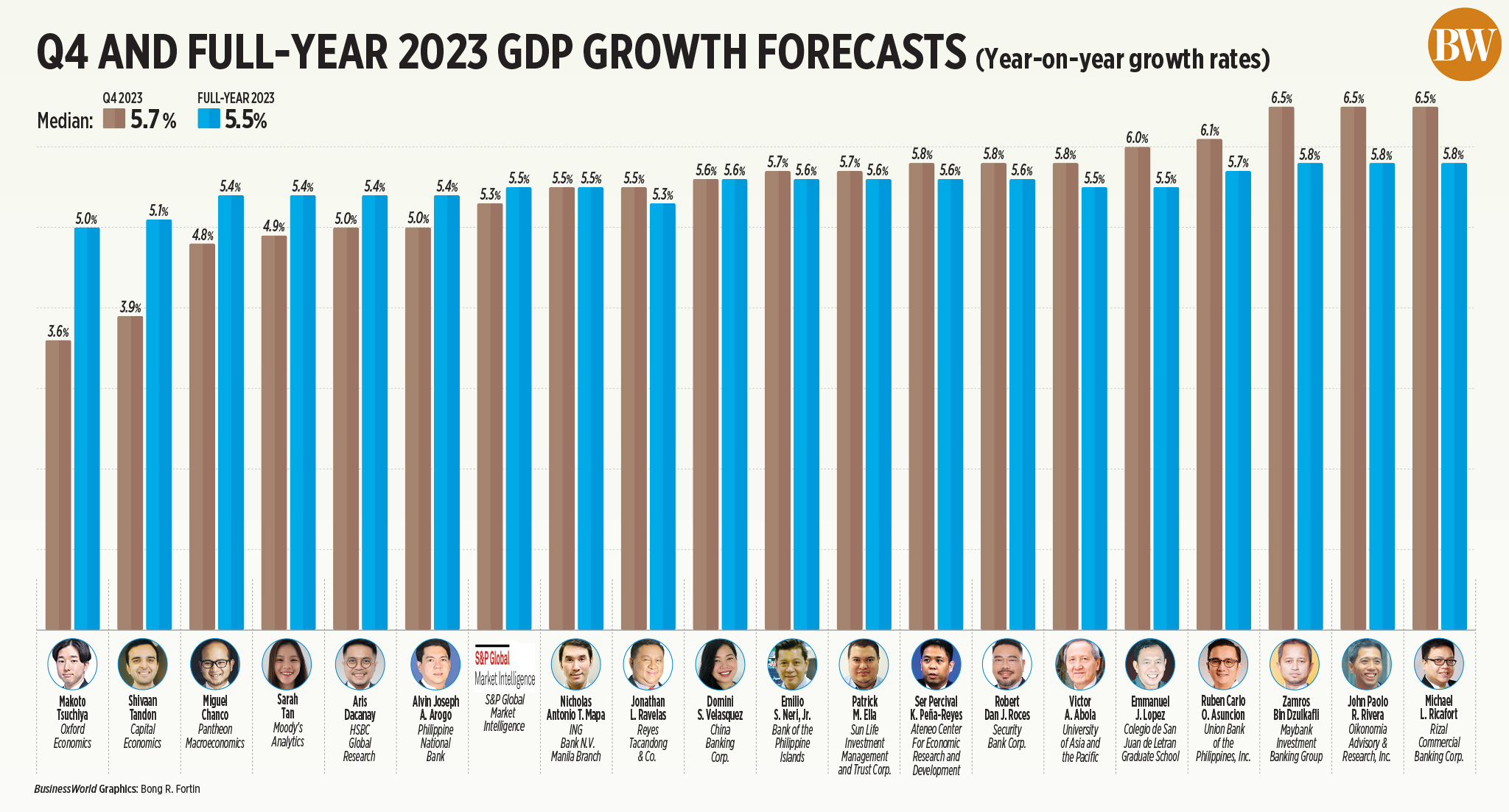
Q4 and Full-year 2023 GDP Growth Forecasts

If realized, the full-year growth estimate for 2023 would be slower than the 7.6% expansion in 2022 and the slowest since the 9.5% contraction in 2020.

The BusinessWorld poll’s 5.5% GDP median estimate for 2023 is lower than the World Bank’s estimate of 5.6% and the Asian Development Bank’s estimate of 5.7% but higher than the International Monetary Fund’s estimate of 5.3%.

The Philippine Statistics Authority (PSA) will release the fourth-quarter and full-year 2023 GDP data on Wednesday (Jan. 31).

Economists said that slower growth in the last three months of 2023 was primarily due to reduced domestic demand and consumer spending.

“The slowdown from the previous quarter was likely due to lower consumer spending and export growth,” Makoto Tsuchiya, economist at Oxford Economics said.

He noted the pent-up demand in certain service sectors is fading, while soft global growth and maturing recovery in the tourism sector led to an export slowdown.

For Zamros Bin Dzulkafli, economist at Maybank Investment Banking Group, the fourth-quarter GDP growth was driven by domestic demand due to ongoing infrastructure projects, a pickup in government spending, and low unemployment rate.

HSBC ASEAN (Association of Southeast Asian Nations) economist Aris Dacanay said that the country is still exposed to a slump in global demand but is expected to be among the fastest-growing economies in the region even with risks tilted to the upside, thanks to the robust and resilient labor force.

In the third quarter of 2023, GDP expanded by 5.9%, due to the pickup in government spending which ended three straight quarters of slowing growth.

Meanwhile, merchandise exports dropped by 0.5% to $5.78 billion in December, slower than the 7.5% decline in December 2022. This resulted in exports contracting by 7.6% to $73.52 billion in 2023.

Similarly, imports fell by 5.1% to $9.79 billion in December, bringing the full-year import haul down by 8.2% to $125.95 billion.

This brought the full-year trade deficit to $52.42 billion from the $57.65-billion gap in 2022, narrowing by 9.1%.

Meanwhile, latest PSA data showed that the unemployment rate slipped to 3.6% in November 2023. This marked the lowest rate of unemployment since April 2005, when the statistics agency revised its definition of unemployment to refer to people aged 15 years and older, who do not have a job, are available for work, and are actively seeking employment.

In November, the number of unemployed Filipinos decreased by 12.3% or 257,000 to 1.83 million from 2.09 million in October 2023.

“We believe that the unhealthy rise in consumer prices and a sharp increase in interest rates weighed down household spending and fixed capital formation,” Alvin Joseph A. Arogo, economist at Philippine National Bank, said in an e-mail.

He also added that government spending and reduced imports cannot sustainably drive a strong rate of economic expansion due to fiscal constraints.

Headline inflation slowed to 3.9% in December bringing the full-year 2023 average to 6%, the highest reading since the 8.2% posted in 2008.

Meanwhile, the central bank kept its benchmark interest rate at a 16-year high of 6.5% in its latest policy meeting. The central bank hiked interest rates by a cumulative of 450 basis points between May 2022 and October 2023 in its efforts to tame inflation.

Due to broad-based weakness, the Philippine economy slowed from the third quarter, said Shivaan Tandon, economist at Capital Economics.

“Admittedly, price pressures eased in the last quarter, which will have supported real incomes. But this is likely to have been partially offset by other factors… Elevated interest rates are also likely to have weighed on domestic demand,” he said in an e-mail exchange.

Sarah Tan, an economist from Moody’s Analytics, said the economy likely expanded by 4.9% in the fourth quarter, supported by the improvement in private consumption due to easing inflation, a tight labor market, and robust remittances.

She added that government agencies ramped up spending by yearend, while a softening global economy likely moderated private investment and trade.

Cash remittances coursed through banks during the January-to-November period grew by 2.8% to $30.211 billion, falling below the Bangko Sentral ng Pilipinas’ (BSP) remittance growth projection of 3% for 2023.

GLOBAL SLOWDOWN
In 2023, Ms. Tan said monetary tightening and the global economic slowdown impacted the Philippine economy.

“High borrowing costs kept Philippine households and businesses cautious in their spending through 2023, capping private consumption and investment growth,” she added.

Miguel Chanco, chief emerging Asia economist at Pantheon Macroeconomics, said that the economy seems to have suffered a general reduction in domestic demand in the fourth quarter, but this may have been offset by a boost in net trade due to a pullback in imports.

He also added that external developments impacted exports, but the main concern was the slowdown in private consumption growth throughout the entire year.

“Monetary policy affects the economy with a lag, and the BSP’s overly aggressive rate hiking cycle, in our view, will continue to depress domestic demand this year, as it did in the last 12 months,” he said.

For Nicholas Antonio T. Mapa, senior economist at ING Bank N.V. Manila, the economy is less reliant on global developments and more driven by domestic factors. He noted GDP could have expanded at a faster pace if the BSP had not hiked interest rates aggressively.

This could have also resulted in a negligible and negative contribution from capital formation during the second and third quarters of 2023.

Gross capital formation — the investment component of the economy — fell by 1.6% in the third quarter of 2023, ending nine straight quarters of growth.

OUTLOOK
For this year, economists expect slower economic growth due to the global slowdown, decelerating inflation, and declining interest rates, among others.

Economic managers target GDP growth to settle within 6.5%-7.5% in 2024.

“We think most of the headwinds will likely persist into 2024. Particularly, the impact of past monetary tightening will continue to weigh on domestic demand even if the BSP pivots to rate cuts during the year, as monetary policy works with lags,” Oxford Economics’ Mr. Tsuchiya said.

He also added that the global economic slowdown will weigh on external demand.

Maybank’s Mr. Dzulkafli said he expects slower growth in the first quarter of 2024 due to elevated food inflation, high-interest rates, and global uncertainty. However, growth is expected to pick up in the second half of the year as the central bank is seen to start cutting policy interest rates.

Ser Percival K. Peña-Reyes, director of the Ateneo Center for Economic Research and Development, said he has a cautious outlook for 2024, adding the economy’s performance would depend on the ability to attract investments.

Domini S. Velasquez, chief economist at China Banking Corp., said that the economy will improve in 2024 due to slowing inflation, monetary easing in the second half of the year, and an increased government budget.

“However, we note that the economy would still have to contend with headwinds such as a global economic slowdown and heightened geopolitical tensions,” she added.

Diwa Guinigundo, Philippines analyst at GlobalSource Partners said that there are still risks to economic growth this year, adding that if geopolitical tensions persist, supply chains may not be mitigated while the drift towards geo-economic fragmentation could weaken international trade.

Resource-wise, he said that the current level of public debt could cause a diversion of public funds from the provision of infrastructure and social services to debt servicing.


BSP says ready to hike rates if Q4 growth remained ‘strong’

BANGKO SENTRAL ng Pilipinas Governor Eli M. Remolona, Jr. — COURTESY OF BANGKO SENTRAL NG PILIPINAS

By Keisha B. Ta-asan, Reporter

THE BANGKO SEntral ng Pilipinas (BSP) is ready to deliver more policy rate hikes this year if economic growth picked up in the last quarter of 2023, its governor said on Friday.

BSP Governor Eli M. Remolona, Jr. said fourth-quarter gross domestic product (GDP) may be higher than the 5.9% growth in the third quarter.

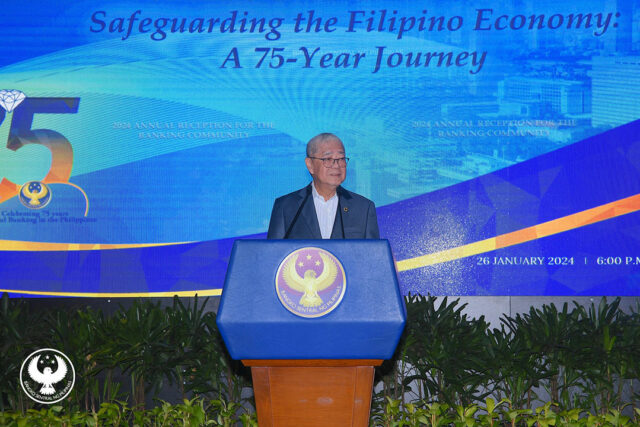
“If the growth is strong, that gives us a bit more room to hike,” he told reporters on the sidelines of the 2024 Annual Reception for the Banking Community.

Mr. Remolona said the Philippine central bank is still hawkish despite easing inflation and talks about rate cuts this year.

He noted the Philippine economy could still take on further monetary policy tightening by the BSP.

“But the natural rate, we estimate… is very imprecise. Which means, we could hike and it’s still okay, but we’re not sure because it’s an imprecise (estimate),” he said.

However, gross domestic product (GDP) growth may have slowed down in the fourth quarter of 2023, as a BusinessWorld poll of 20 economists yielded a median forecast of 5.7%.

If realized, this would be slower than the 5.9% growth in the third quarter and the 7.1% expansion in the same period in 2022.

The BusinessWorld poll also yielded a median estimate of 5.5% GDP growth for the entire 2023, missing the Development Budget Coordination Committee’s 6-7% full-year target. This is slower than the 7.6% expansion in 2022 and the slowest since the 9.5% contraction in 2020.

The Philippine Statistics Authority (PSA) will release the fourth-quarter and full-year 2023 GDP data on Jan. 31.

Meanwhile, Mr. Remolona said that a rate cut is possible this year amid easing inflation.

“Yes, it’s possible within the year. But maybe the first semester is too soon. We’ll see,” he said in mixed English and Filipino.

He also noted that inflation will continue to be low in January due to base effects, but inflation may still pick up in the second quarter of this year.   

Based on PSA data, headline inflation eased to a 22-month low of 3.9% in December from 4.1% in November. It marked the first time that inflation eased within the BSP’s 2-4% target after 20 straight months, from a peak of 8.7% in January 2023.

For the full-year, inflation accelerated to 6% in 2023 from 5.8% in 2022. It breached the 2-4% target band for the second straight year amid soaring food and oil prices.

Finance Secretary Ralph G. Recto said borrowing costs may go down this year in the Philippines and in the United States but “nothing is set in stone.”

“We expect interest rates to go down in the second half, but that will depend on the external environment. So far, the market consensus is inflation and interest rates will go down globally, in the US, and in the Philippines,” he said in mixed English and Filipino.

Mr. Recto said policy rate cuts would not only lower the government’s borrowing costs, but it would also be easier for investments to come into the country.

The newly appointed finance chief took his oath as a member of the Monetary Board last week, representing President Ferdinand R. Marcos, Jr.’s Cabinet at the BSP’s highest policy-making body.

The central bank also said the full impact of the Monetary Board’s aggressive tightening may be felt this year, but authorities are still ready to adjust borrowing costs if necessary.

In an open letter to Mr. Marcos, Mr. Remolona said the BSP paused its tightening in the second half last year due to the slowdown in headline and core inflation.

However, when prices and inflation expectations picked up, the BSP responded with an off-cycle rate hike in October 2023. Since then, the Monetary Board has held fire and kept borrowing costs steady.

“The pause in policy interest rate adjustments has allowed the BSP to further observe and assess how firms and households continue to respond to tighter monetary policy conditions, as lagged effects of prior policy interest rate adjustments are expected to manifest fully in 2024,” he said.

The central bank’s key interest rate currently stands at 6.5%, the highest in 16 years. This was after the BSP emerged as the most aggressive central bank in the region after raising key policy rates by 450 basis points (bps) from May 2022 to October 2023.

Mr. Remolona said inflation may settle within the 2-4% of the government in 2024 and 2025, as shown by the central bank’s baseline forecast. The central bank sees inflation averaging 3.7% this year and 3.2% in 2025.

“However, the balance of risks to the inflation outlook continues to be significantly skewed towards the upside for 2024 and 2025,” he said.

The BSP chief said higher transport fares, increased electricity rates, upticks in oil and food prices due to supply constraints, and the impact of a strong El Niño weather event until the second quarter this year are upside risks to the inflation outlook.

“Should these risks materialize, the BSP’s risk-adjusted forecasts indicate that inflation could settle above target at 4.2% in 2024 before reverting towards the target band at 3.4% in 2025,” he said.

Thus, it is crucial for the government to implement non-monetary measures given the upside risks to food and transport prices, Mr. Remolona said.

“On the part of the BSP, we stand ready to adjust monetary policy settings as necessary to mitigate second-round effects and better anchor inflation expectations, as we continue to prioritize safeguarding price stability in line with our primary mandate,” he added.

The BSP will hold its first policy meeting this year on Feb. 15.

Charter change needs to be limited to just economic provisions — NEDA secretary

BUILDINGS at the Makati central business district are seen in this file photo. — PHILIPPINE STAR/ MIGUEL DE GUZMAN

By Luisa Maria Jacinta C. Jocson, Reporter

NATIONAL ECONOMIC and Development Authority (NEDA) Secretary Arsenio M. Balisacan said that he would prefer that any amendments to the Constitution only be restricted to its economic provisions.

“All these economic restrictions in the Constitution, especially with all these major developments in the region, there are so many other places to go for investment. You can go to Thailand, Indonesia, Vietnam, or Cambodia,” Mr. Balisacan told reporters on the sidelines of the Bangko Sentral ng Pilipinas’ (BSP) 2024 Annual Reception for the Banking Community on Friday.

“If you don’t fix or make our country open to investment, they won’t come to us. We need all these investments,” he added.

Asked if he would prefer limiting the amendments to just the economic provisions, Mr. Balisacan said: “That’s what we’ve been saying. It has to be. Otherwise, you may create more uncertainty. At least the economic provisions, you know what’s in there.”

President Ferdinand R. Marcos, Jr. last week said he supports proposals to amend the economic provisions of the 1987 Constitution, which he said was “not written for a globalized world.”

However, he was not in favor of allowing full foreign ownership of land, media and power generation.

Mr. Balisacan said that opening up the economy will further encourage competition and benefit the public.

“We really need to put competitive pressure on the economy so that efficiency can improve, quality of goods and services can improve, prices are contained at competitive levels… That’s what we don’t get if we have so much concentration on just a few hands,” he said.

“They also bring in new technologies, new ways of doing things. We need those kinds of externalities in the economy. There are many benefits of being open, not just growth in the short term. It creates dynamics,” he added.

The government has been implementing reforms to further open up sectors of the economy. In 2022, it amended the 85-year-old Public Service Act (PSA) to allow full foreign ownership in telecommunications, domestic shipping, railways and subways, airlines, expressways and tollways, and airports.

“As far as the economy is concerned, we need to open the economy, whether by constitutional amendments or other means, but that can only go so far with other laws,” Mr. Balisacan said.

Mr. Balisacan said that one sector that can be opened to foreign ownership is education to boost the quality of learning, research, and innovation.

Last week, senators issued a statement opposing a proposal for both chambers of Congress to vote jointly to revise the Constitution.

The Constitution may be amended either through a constitutional convention composed of delegates, by Congress sitting as a constituent assembly or through a people’s initiative.

GROWTH PROSPECTS
Meanwhile, Mr. Balisacan said that he is “hopeful” that gross domestic product (GDP) growth in the last quarter of 2023 will outperform economic growth in the third quarter.

“I haven’t seen the numbers, but I hope it will be good, because our leading indicators are good, like our labor market (figures),” he said.

A BusinessWorld poll of 20 economists showed that GDP likely expanded by 5.7% in the fourth quarter. If realized, this would be slower than the 5.9% growth in the third quarter and the 7.1% expansion in the same period in 2022.

The economy grew by 5.5% in the nine-month period. To meet the lower end of the government’s 6-7% goal for 2023, GDP would need to grow by 7.2% in the fourth quarter.

Fourth-quarter and full-year 2023 GDP data is set to be released on Jan. 31.

Mr. Balisacan also said economic growth will be driven by easing inflation.

“(The economy) is largely domestic… I think despite the high inflation, domestic spending is quite robust. Of course, it could have been much better if inflation had declined faster than what we’ve seen. The fact that inflation is seen to continue to decline should give confidence to our people,” he added.

Inflation eased to 3.9% in December, the lowest print in 22 months.

Last year, inflation averaged 6%. This marked the second straight year that inflation breached the central bank’s 2-4% target.

PPP PROJECTS
Meanwhile, Mr. Balisacan said that the NEDA is studying the possibility of a public-private partnership (PPP) to help finance the Bataan-Cavite Interlink Bridge project.

“We would want to see the Bataan-Cavite bridge eventually as a PPP. If it’s profitable, it may be attractive for the private sector,” he said.

The private sector may take on the operations and management of the bridge and eventually buy the project’s debt, Mr. Balisacan said.

“If it’s profitable enough, even the debt can be transferred to the private sector so they can continue servicing the debt, pay back the government, those kinds of things,” he added.

Last month, the Asian Development Bank (ADB) approved up to $2.1 billion in financing for the bridge, which will link the provinces of Bataan and Cavite across Manila Bay.

The project involves the construction of a 32.15-kilometer (km) “climate resilient” bridge, 24 km of marine viaducts and eight kilometers of approach road.

Mr. Balisacan said that NEDA is also hoping to push for airport PPP projects.

“The only one been approved for Swiss challenge is Laguindingan…if we do well in the Laguindingan airport, that would be a good window for doing the other airports. We have so many other projects that are candidate for PPPs,” he said.

At a Palace briefing on Friday, Mr. Balisacan announced that the NEDA Board approved the negotiated parameters, terms, and conditions of the upgrade, expansion, operations, and maintenance of the Laguindingan International Airport Project in Northern Mindanao.

The project will now undergo the comparative challenge process following the recently enacted PPP Code.

“Prospective challengers will be given 90 days from the publication of the invitation for comparative proposals to submit their proposals. The original proponent will be given 30 calendar days to match responsive comparative proposals. If no comparative proposals are received, the project shall be awarded to the original proponent by May 2024,” Mr. Balisacan said.

DTI invites creative startups to jump-start businesses with IDEA, ADVanCE programs

The programs and services of the Marikina Creative and Innovation Hub were officially unveiled during the launch event held last Dec. 4 at the Center for Innovation and Technology for Enterprises (CITE), Marikina City. Introduced as well during the launch was the 2nd cohort of DTI’s IDEA Program and ADVanCE Program. Present during the event were (seated, from L-R) Dir. Lilian Salonga, DTI-CIG; Usec. Rafaelita Aldaba, DTI-CIG; Congresswoman Stella Quimbo, Marikina City, 2nd District Representative; OIC Regional Director Ma. Sofia Narag, DTI-NCRO; and Vishal Aditya Potluri, social sector specialist, Asian Development Bank; (standing, from left) ED Maria Rita Matute, DCP; DED Lucky Lopez, DCP; OIC Asst. RD Revelyn Cortez, DTI Region IV-A; Aurelien Chu, co-founder, Eskwelabs; Bing Icamina, team leader, Certeza + Techno Earth JV; Asst. Sec. Domingo Tolentino, Jr., DTI-ROG; Jojo Flores, co-founder Plug and Play Tech Center; Jay Fajardo, CEO Launchgarage; Jundio Salvador, president of PCCI-New Marikina; Roger Py, Jr., PFFI; Sam Ang, consultant, ADB; and Engr. Liza Lopez.

The Department of Trade and Industry (DTI), through the Competitiveness and Innovation Group (CIG), is looking for creative startup companies to onboard to its two programs designed to support and strengthen the creative industries in the Philippines.

The DTI-CIG, led by Undersecretary Rafaelita M. Aldaba, in partnership with startup accelerator Launchgarage, has launched the creatives edition of the Incubation, Development, and Entrepreneurial Assistance (IDEA) and Accelerating Development, Valuation, and Corporate Entrepreneurship (ADVanCE) programs aimed at providing customized support to creative startups in the Philippines to help them become market- and investment-ready.

“The programs are a testament to the Philippine government’s belief in the immense potential of Filipino creativity and entrepreneurship. By providing the much-needed support and platform, we are setting the stage for creative startups to not only thrive locally but also make a significant impact on the global stage. The creative sector is a vital component of our economy and cultural identity, and through initiatives like these, we aim to foster an environment where ideas can flourish, talents are honed, and success stories are born,” Ms. Aldaba said.

The Philippine creative industries play a significant role in the national economy. Data from the Philippine Statistics Authority (PSA) revealed the creative economy amounted to P1.60 trillion in 2022, contributing 7.3% to the country’s gross domestic product (GDP). Furthermore, the sector was responsible for employing almost 7 million Filipinos that year.

The IDEA for Creatives edition will onboard 10 early-stage creative startups and enterprises to support and enhance their entrepreneurial capacity and readiness. Under the program, selected startups will participate in various educational workshops aimed at transforming their inventive business concepts into successful enterprises. Each will be paired with experienced mentors and coaches to guide them in their startup journey.

The program culminates with a showcase event, where startups can present their ventures to program stakeholders, angel investors, venture capitalists, corporate representatives, and key figures in the ecosystem.

Early-stage startups that are operating in the Philippines with a minimum viable product, registered or in the process of registration to the Securities and Exchange Commission (SEC) or DTI, with 60% of its founders Filipino, and with at least two founders committed to the IDEA program, are eligible to apply.

Meanwhile, an initial pool of 10-15 startups will be chosen to participate in the ADVanCE for Creatives. After the preliminary screening, they will be assessed based on organizational capacity, business maturity, and readiness levels. From there, five participating startups will be selected to proceed to the acceleration phase and undergo intensive training based on the specific interventions identified from the needs assessment.

To be eligible, startups should be in their growth and expansion stage and are based in the country with at least two years of operations with revenue, SEC or DTI-registered, with 60% of its founders Filipino, and with at least two founders committed to the ADVanCE program.

DTI welcomes all creative startups within the domains of audiovisual media, digital interactive media, creative services, design, publishing and printed media, performing arts, visual arts, traditional cultural expressions, and cultural sites to apply to the programs.

“We call on all eligible creative startups to seize this unparalleled opportunity. Join us in this endeavor to transform your innovative ideas into successful enterprises and become part of a movement that celebrates and elevates Filipino talent and ingenuity,” Ms. Aldaba shares.

The IDEA and ADVanCE programs are aligned with Republic Act 11337, or the Innovative Startup Act, aimed at providing benefits and programs to strengthen, promote, and develop the Philippine startup ecosystem. Their latest cohorts will focus on the creative industries in accordance with Republic Act No. 11904 or the Philippine Creative Industries Development Act (PCIDA), which mandates the development of a vibrant and globally competitive Philippine creative sector by protecting and enhancing their rights and boosting economic capacities.

The application period is until Jan. 31. To know more about the programs and submit applications, interested parties can visit the official websites of the IDEA program-creatives edition (https://bit.ly/IDEAforCreatives) and the ADVanCE program (https://bit.ly/ADVANCEforCreatives), as well as the DTI-CIG Facebook page.

Young Filipino innovators immerse in world of design thinking

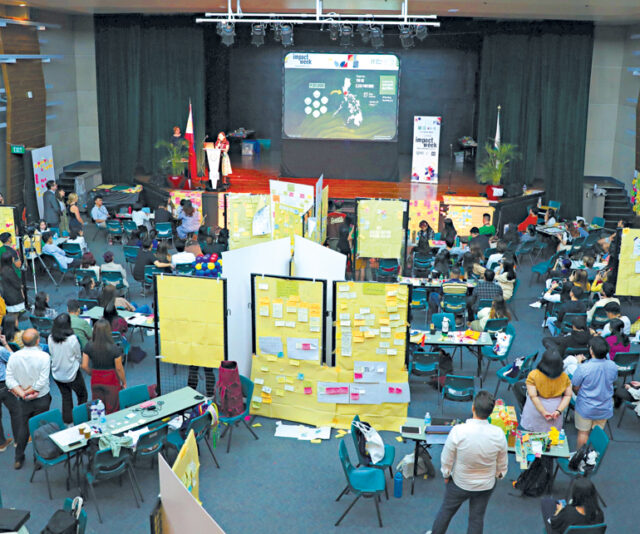
Impact Week Philippines, a design thinking challenge, gathered industry experts from across the world and students from the De La Salle-College of Saint Benilde (DLS-CSB) to create innovative solutions for local problems.

The nonprofit program aims to promote creativity, entrepreneurship, and intercultural exchange among developing and emerging economies.

The four-day workshop encouraged participants to formulate feasible strategies that address inclusion, sustainable urban planning and tourism, energy transition in mobility, digitalization, and disaster relief.

A group of international coaches from different countries likewise offered mentoring opportunities and guidance to the students.

The initiative was organized by Impact Week in collaboration with the college’s Hub of Innovation for Inclusion (HiFi), Center for Partnership Advancement, and School of Diplomacy and Governance (SDG).

TIP develops own version of hand rehabilitation device for stroke patients

What started as a thesis project for a group of Technological Institute of the Philippines (TIP) electronics engineering (ECE) graduates turned into a promising rehabilitation device that seeks to aid recovering stroke patients.

TIP Quezon City alumni Joanna Keith Ildefonso, Orwell Orit, Liezl Lalaine Patrimonio, and Keanu Readova developed their project called “HandMATE,” which recently won “Best Project of the Year” at the 2023 BPI-DoST Innovation Awards.

Collectively known as “RAD Tech,” the team worked with their adviser ECE faculty member Engr. John Joel Martinez to create a glove-like device made of light materials that uses a network of cost-effective internet-based technologies to facilitate the therapy of patients.

“The HandMATE has been specifically designed to address the extended healing period associated with hand rehabilitation, a process influenced by limited blood circulation,” the team wrote in the abstract of their study.

“By leveraging neuroplasticity, it aims to reestablish connections between nerve cells, restore lost motor skills, and meticulously monitor the healing progress, thereby contributing to an enhanced quality of life for post-stroke patients,” they added.

Neuroplasticity refers to the ability of our nervous system to change its activity in response to intrinsic or extrinsic stimuli by reorganizing its structure, functions, or connections after a stroke or other types of traumatic brain injuries, according to the National Library of Medicine.

Engr. Martinez said his students worked on the “HandMATE” project for one and a half years. They also tested the prototype “numerous times with satisfactory results,” which notably became their competitive edge.

“This device stands out for its capacity to facilitate both passive and active exercises, prioritizing rehabilitation, integrating IoT (internet of things)-based control and data retention functionalities, and providing an affordable solution,” Team RAD Tech noted.

The team accepted their award in a ceremony organized by the Bank of the Philippine Islands (BPI) Foundation and the Department of Science and Technology (DoST) Science Education Institute last Dec. 11 at the Makati Diamond Residences.

Renewables unlikely to top coal in PHL energy by 2025 — analysts

STOCK PHOTO | Image from Freepik

By Sheldeen Joy Talavera, Reporter

RENEWABLES surpassing coal as the Philippines’ top energy source by 2025 may face challenges in power generation capacity, financing, and land acquisition, according to analysts.

“Intermittent wind-solar cannot and will not be able to replace or substitute coal generation unless we embrace and endure large-scale daily blackout,” Bienvenido S. Oplas, Jr., president of Minimal Government Thinkers, said in a Viber message last week.

The International Energy Agency (IEA) has projected that renewable energy is poised to surpass coal as the top source of global power supply by 2025.

“Renewables are expected to generate more than one-third of the world’s electricity in 2025, overtaking coal as the largest source of supply,” the IEA said in its annual report on the electricity market.

The share of renewables in power generation is expected to increase to 37% in 2026 from 30% in 2023, “with the growth largely supported by the expansion of ever-cheaper solar PV (photovoltaic),” the report also said.

Citing data from the Department of Energy (DoE), Mr. Oplas said that the combined power generation of wind and solar was 2,582 gigawatt-hours (GWh) or 2.6% of the total generation of 111,516 GWh in 2022, while coal accounted for 66,430 GWh or 57.7% of the total.

Mr. Oplas also noted the need for a significant addition to renewable capacity to meet economic growth and avoid frequent blackouts.

“Challenges to renewables especially intermittent wind-solar is that the Philippines is growing fast economically… We need at least 7-8 TWh (terawatt-hours)/year addition in 2024-2026… otherwise we cannot grow (GDP) 6% or more yearly as we will have frequent rotational blackout as demand keeps rising and supply is not catching up,” Mr. Oplas said.

Erel B. Narida, president of the Renewable Energy Association of the Philippines, said that with only a few takers in the recent green energy auction (GEA), it is “something that you would look into” due to the “financial sensitivity because of the rate.”

“There’s only a few that really have the financial muscle to do that and with that, you require foreign direct investments for that,” he said.

During the second round of the GEA conducted last year, the DoE offered a total capacity of 11,600 megawatts (MW), but only 3,440 MW of renewable energy capacity was auctioned off.

The GEA program aims to promote renewable energy as a primary source of energy through competitive selection.

“The most challenging in the development is actually land acquisition, that’s one thing that really hinders some of the development,” Mr. Narida said.

Terry L. Ridon, a public analyst and convenor of think tank InfraWatch PH, said that developing economies such as the Philippines “are not under obligation” to make binding commitments to climate and renewable energy goals, unlike developed nations with their “massive industrialization.”

“At our current stage of economic development and limited land areas for food production, the nation cannot yet dispense with baseload technologies such as coal, oil, and gas, without incurring significant energy costs detrimental to the public,” he said in a Viber message.

With the share of renewables at 22% in the country’s power mix, the government is targeting an increase to 35% by 2030 and 50% by 2040.

Web3PH unveils calendar of events for 2024

Looking ahead to 2024, independent organization Web3PH is gearing up for a series of groundbreaking events that mark just the beginning of its ambitious plans for the year.

These events include the insightful “Panimula: Kasaysayan At Kinabukasan” in January, an exclusive gathering for key technology figures in the public and private sectors; “Crypto Night” in February and May, a community meetup for both seasoned and new crypto enthusiasts; “The Beauty of Crypto” in March, a fusion of technology and aesthetics; “CODECAMP” in July, an initiative to onboard the next million Filipinos into web3; “UNDOXXED” in September, a token-gated event for the web3 elite; “Web3PH Summit” in October; and the much-anticipated return of “Block Party” in November.

Each event is carefully curated to foster collaboration, policy-making, industry growth, and community engagement, reflecting Web3PH’s commitment to propelling the country into the forefront of the digital era.

As it continues to broaden its scope, Web3PH is actively seeking dynamic partnerships and sponsorships. This presents a unique opportunity for forward-thinking organizations to become key players in the evolving web3 landscape in the Philippines. By contributing resources, expertise, and vision, partners can play an instrumental role in shaping a future where technology and community interconnect seamlessly.

The organization also extends an open invitation to potential sponsors and partners to embark on a transformative journey with Web3PH, which does not only involve backing successful events but forging lasting impacts in the realms of innovation and collaboration.

Following the resounding success of its Block Party event last November on the sidelines of YGG Games Summit 2023, Web3PH encourages everyone to stay engaged and connected.

“We’re just getting started,” adds Justin Wee, a core member of Web3PH. “2024 is set to be a pivotal year for us, and we’re thrilled to continue this journey with the support of our community. Together, we’re shaping the future of technology in the Philippines.”

Paris Fashion Week: Viktor & Rolf takes a snip; Giorgio Armani goes shimmery; Chanel has a light touch

VIKTOR & ROLF — VIKTOR-ROLF.COM

PARIS — For their spring summer couture show, Viktor Horsting and Rolf Snoeren, the Dutch design duo behind the label Viktor & Rolf, showed an all-black lineup of ballgowns, tiered dresses and a tuxedo jumpsuit that looked as though they had been attacked by a pair of scissors. (See the show here: https://www.viktor-rolf.com/collection/haute-couture-viktor-rolf-scissorhands-spring-summer-2024 )

Bright spotlights switched on at the start of the show, startling the chattering audience.

The first model walked out slowly in a full-skirted dress covered with a hulking, satin coat, cinched at the waist, its upturned collar framing her face. The silhouettes that followed appeared to be the same design, but with patches snipped away, to show legs, part of an arm, or the ivory lining.

Other looks were similarly rearranged into entirely new shapes, including one gown that had ragged material trailing on each side, and another that was sliced nearly down the middle — leaving one shoulder bare.

“It’s about our love for couture and as well the irreverence for it, to live in both at the same time,” Mr. Horsting said backstage after the show.

Mr. Snoeren explained why they used black throughout the collection.

“We wanted to focus on silhouettes and black makes everything more abstract,” he said.

The label belongs to Italian fashion group OTB.

YUIMA NAKAZATO
Yuima Nakazato showed an elaborate haute couture lineup at the Palais de Tokyo in Paris on Wednesday, sending models down a stark white runway in pleated, scrunched, shredded, and dyed fabrics, embellished with spikes and patches of shiny armor. (All the outfits can be seen here: www.yuimanakazato.com/collection/couture_ss2024.html)

The Japanese designer drew up costumes for an upcoming performance of the opera Idomeneo, debuting next month in Geneva, and the spring-summer runway collection was linked to the collaboration.

Male models were wrapped in layers of fabric — one wore an airy, sheer scarf wound around strips of silvery armor, while another moved with piles of bunched up ruffles trailing behind.

Draped dresses and skirts were embellished with huge, shimmery coins, and a suit jacket had patches that seemed barely stitched together.

The show closed with a performance by dancer Pau Aran Gimeno, who, dressed all in white, stepped into a pool of red paint and smeared it over the runway with the fabric of his trousers.

GIORGIO ARMANI
Italian designer Giorgio Armani took a shimmery haute couture lineup to a Paris runway on Tuesday, showing slim trouser ensembles and full skirted gowns in pastel hues. (View the show here: https://www.youtube.com/watch?v=BwueX7ST9VI. )

His Armani Privè spring summer collection drew crowds to the show venue, the Palais de Tokyo, as onlookers gathered to catch the arrivals of celebrities including actresses Glenn Close, Gwyneth Paltrow, and Juliette Binoche.

Models moved slowly down the slim runway parading bustier gowns with piles of ruffles, tapered trousers paired with silky, collarless vests and sheer tops decorated with ornate embroidered flower patterns.

Accessories included looping necklaces and earrings made of beads, as well as round, pleated hats set atop the head at an angle, forming a broad halo. Some models carried small, dangling purses, while others grasped clutches.

When the show ended, the room went dark, and the Italian designer emerged into the spotlight, offering a nod and a wave to the applauding audience.

Mr. Armani, 89, is also chief executive officer of his company, that he set up with his late partner in the 1970s.

CHANEL
Chanel creative director Virginie Viard whipped extra airiness into the luxury label’s spring/summer haute couture show, with thin veils and tufts of tulle that floated down a carpeted runway. (See the show here: https://www.chanel.com/us/haute-couture/spring-summer-2024/ )

The audience sat in a ring under a gigantic button — stamped with the label’s logo. Moving down from the ceiling, it announced the start of the show, tilting toward the photographers’ podium.

Leading the line-up, actress Margaret Qualley was all in white. She wore the label’s signature tweed jacket embellished with shiny buttons, square pockets, and a ruff collar, paired with shimmery white tights and a miniskirt. Black heeled sandals and a matching hair bow — worn by others throughout the show — finished the look.

The ensembles that followed were varied and distinct. Ms. Viard added a sheer, black train to a white bustier minidress, and trimmed a tweed jacket, with transparent, white balloon sleeves that puffed out just below the elbow.

While jackets were cut short, miniskirts were slung low, revealing white, shimmery skin-hugging material underneath.

The pastel color palette and shiny, crystal embellishments brought a light touch to the collection, offset with occasional veils of black tulle — that even took the form of trousers.

The Paris spring/summer haute couture shows ran through Jan. 25. — Reuters

Jollibee opens 100th North American branch

LISTED fast-food giant Jollibee Foods Corp. (JFC) now has 100 stores in North America after opening a branch on Jan. 25 in the city of Surrey, British Columbia, Canada, the company’s president said.

Over the weekend, JFC announced the opening of the new Jollibee branch at the Strawberry Hill Shopping Center. This marks the second branch in Surrey.

“The launch of our 100th store in North America is a crucial milestone for us, demonstrating the strength of our Jollibee North America team,” JFC President and Chief Executive Officer Ernesto Tanmantiong said.

He also expressed optimism for the future, saying, “We hope you will continue to cheer us on as we open the next 100 stores in North America and achieve our vision of becoming among the top five restaurant companies in the world.”

Highlighting the company’s accelerated push in North America, JFC noted the recent store opening as a part of its strategic expansion plans in the world’s largest quick-service restaurant market.

The Canadian expansion follows the recent inauguration of a Jollibee branch in Sterling Heights, Michigan, United States, on Jan. 12, marking the company’s first entry into the state.

JFC encompasses eight wholly owned brands, including Jollibee, Chowking, Greenwich, Red Ribbon, Mang Inasal, Yonghe King, Hong Zhuang Yuan, and Smashburger. It also operates four franchised brands — Burger King, Panda Express, Yoshinoya in the Philippines, and Tim Ho Wan in certain territories in China.

The group also owns 80% of The Coffee Bean & Tea Leaf; 60% in the SuperFoods Group that owns Vietnamese coffee brand Highlands Coffee; and 51% of Taiwanese bubble tea brand Milksha.

Shares of JFC were last traded on Jan. 26 at P274.60 apiece. — Revin Mikhael D. Ochave

Charge to experience luxe

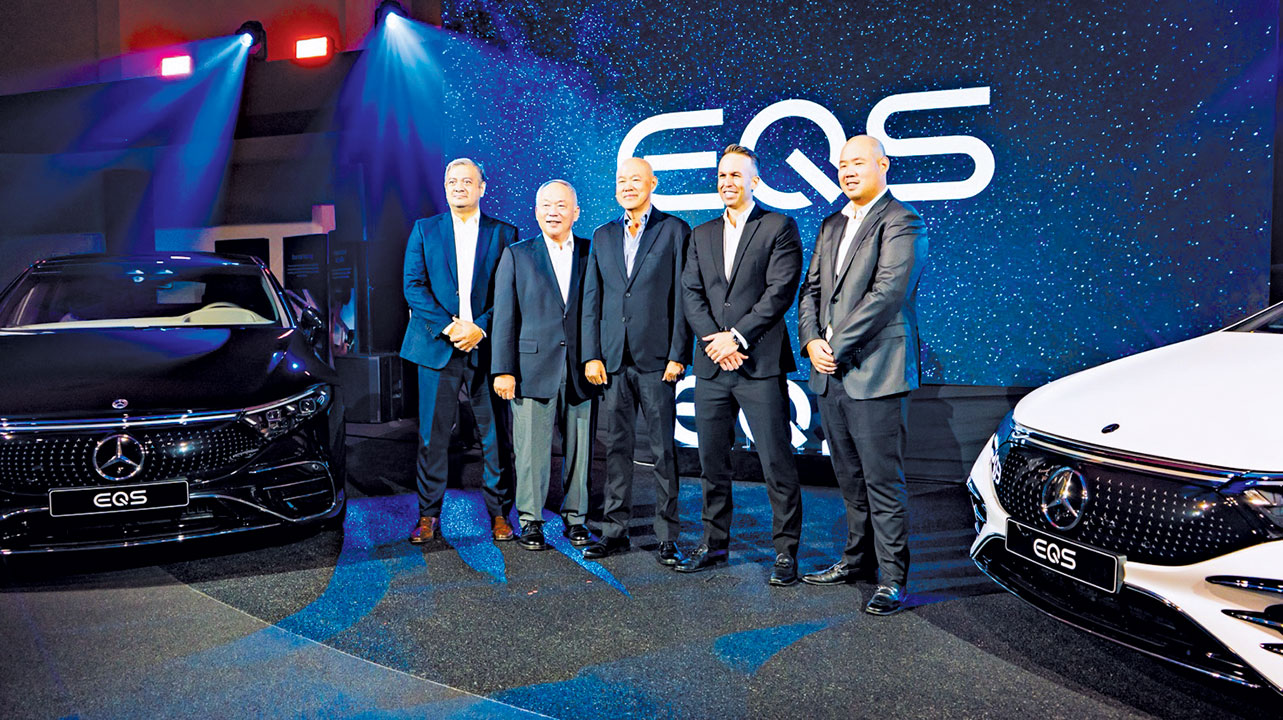
Priced at P9.99 million, the EQS grows the number of all-electric offerings from Mercedes-Benz Philippines. — PHOTO BY KAP MACEDA AGUILA

The Mercedes-Benz EQS is the all-electric version of the S-Class

THE FLOODGATES have truly been thrown wide open. Electric vehicles have long ceased to be novelties but represent the inevitability of our mobility fate.

That’s certainly how it looks like with the local Mercedes-Benz stable of models. Following a trio of electric releases (EQA, EQB, and EQE) in September of last year, IC Star Automotive, Inc., official distributor of Mercedes-Benz vehicles in the Philippines, unveiled the flagship EQS. Coming in a lone EQS 450 4Matic AMG Line guise, the electric vehicle is the all-electric equivalent of the top-rung S-Class.

Amid the influx of EVs, the distributor is bullish about prospects. Intimated Mercedes-Benz Philippines Product Planning and Training AVP Benjie Bautista to “Velocity,” “The reception has been very good, with many of our customers being early adopters. Some are our previous customers who want to experience change. They also have their own personal advocacies in sustainability, reducing CO2 emissions, carbon neutrality, and the like. It has also been a success because I think we’ve been able to position and price the vehicles competitively.”

By the executive’s reckoning, about 15% of the EQ-model buyers here thus far are repeat customers.

Introduced globally just last year, the EQS luxury sedan is said to be the first Mercedes-Benz model “built on the modular design intended for executive and luxury-class electric cars,” according to a Mercedes-Benz Philippines release. The company continues that the sedan “seamlessly combines design, technology, safety, and connectivity.”

The exterior shape is highlighted by the brand’s signature “one-bow design” featuring a “coupé-like roof line, which extends in an arc over the vehicle, over the frameless doors to the rear.” A truncated nose and clamshell hood mark the forward area, while an attractive fastback rear gets the viewer’s attention. The profile is not just for show, either. The sleek shape helps the EQS get down to a 0.20 coefficient of drag, which makes it the most aerodynamic production vehicle in the world.

The EQS boasts a so-called Digital Light with Ultra Range High Beam, which can adjust to the driving situation for “relaxed and safe driving.” On the other hand, the rear lights get a curved 3D helix shape and are connected by an illuminated strip.

Mercedes-Benz reported that the EQS already banners Artificial Intelligence, which allows it to “make decisions almost instantaneously and learn over time about how the car is used.” A so-called Zero-Layer interface allows vehicle function, display, and infotainment parameters to adjust to the user. It even makes context-based personalization of comfort, entertainment, and vehicle modes. Integrated in the MBUX infotainment system is adaptive software that ensures most relevant or used applications are available most readily. The car bears “up to 350 sensors, feeding control units and algorithms information to process.” It can read distance, speed and acceleration, deceleration, lighting conditions, precipitation, temperatures, and seat occupancy.

The centerpiece in the vehicle’s cabin is the MBUX Hyperscreen, a huge 56-inch curved display that allows the user to “view all information and issue voice commands more easily.” Covered by a length of bonded glass are three screens — an OLED 12.3-inch one for the driver, 17.7-inch display at the center, and 12.3-inch screen for the front passenger. A Burmester 3D surround sound system employs 15 speakers, wireless charging, and wireless Apple CarPlay and Android Auto connectivity.

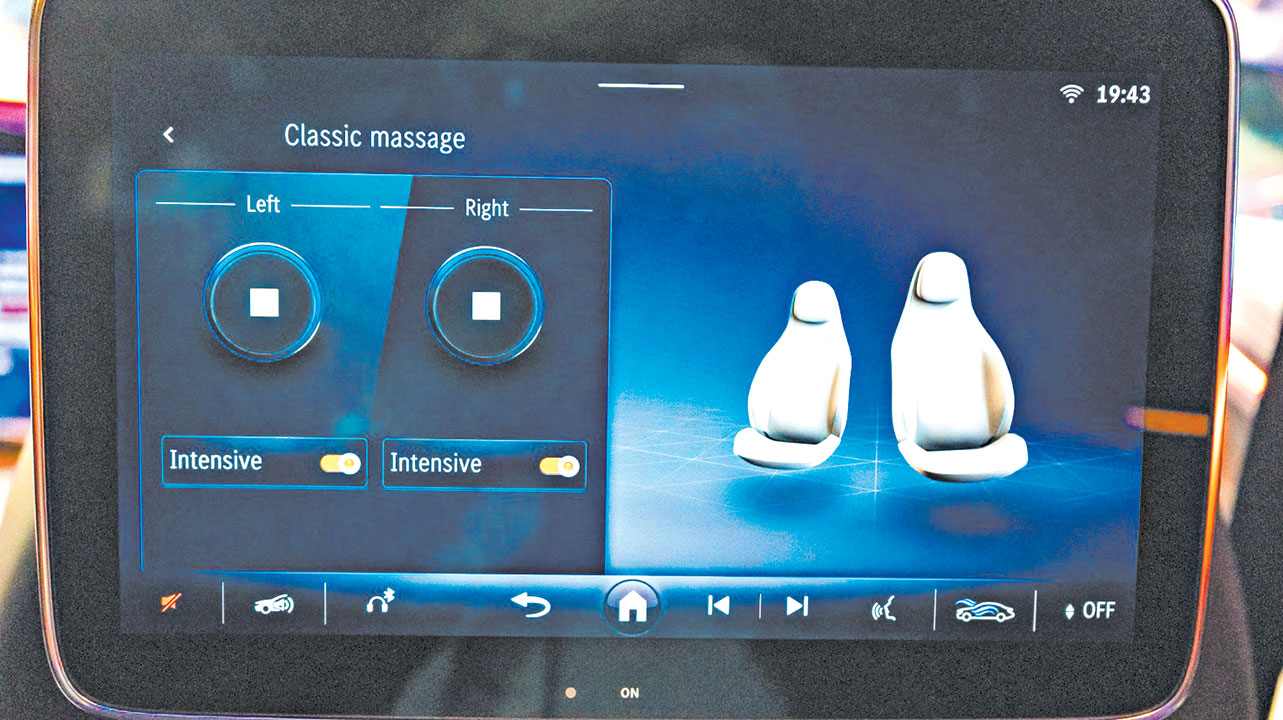
The second row boasts the MBUX High-End Rear Seat Entertainment System, predicated on two 11.6-inch displays with touch controls on the backrests of the driver and front passenger seats. In addition, the MBUX rear tablet also comes standard. The independent tablet can be used outside the EQS. Android apps may be installed in the tablet, and it can be used as a remote control for all rear-seat entertainment functions. As for the seats, backrests are electronically adjustable. The front and rear seats are climatized and a comfort armrest is available in the rear.

And as it bears the hallowed “S” letter, the EQS receives a four-link front and multi-link rear suspension found in the S-Class, promising superior ride comfort. An Airmatic air suspension adjusts damping and allows for real-time adjustment to road conditions. Cabin lighting consists of 190 LEDs in wraparound light strips and elements. Active Ambient Lighting offers 64 colors, and can be operated and tailored through the MBUX voice assistant, which recognizes the position of the person speaking.

The EQS 450 4Matic AMG Line is powered by a next-generation lithium-ion battery. The 108.4-kWh cell pack can muster a maximum range of 717km (WLTP-certified). This can translate insisted Mercedes-Benz Philippines, to a “worry-free” trip from Manila to Baguio — depending on one’s driving habits and the vehicle load, of course. Its 4Matic all-wheel drive determines the most efficient all-wheel-drive distribution depending on situation, and the electric powertrain dishes out 360hp and 800Nm — translating to a standstill-to-100kph time of 5.6 seconds.

Finally, the Mercedes-Benz Driving Assistance Package Plus enhances safety through “modern, intelligently networked sensor systems” that yield semi-automated driving.

“We believe that the EQS is equally competitive in its segment,” added Mr. Bautista. “We’re expecting to build even more on our EV sales from last year… It’s very good that the government has been able to support the EV industry. We hope the support continues.”

The executive trusts that electrics will continue to be more attractive to buyers as public charging infrastructure is set up. “As infrastructure is being established, we’re confident that our customers can travel from, say, the northern tip of Luzon to the southern tip, and they’ll have chargers they can use along the way.”

Meanwhile, Mercedes-Benz Philippines Passenger Cars Distribution General Manager Rhomel Franco revealed to “Velocity” that a viable target strategy the company is looking at for its electric vehicles is to appeal to sustainable-minded firms’ executives. The Mercedes-Benz premium cache and green values are definitely aspirational sets for the, well, enlightened C-suite.

The 2024 Mercedes-Benz EQS 450 AMG Line has an introductory price of P9.99 million.