Home Blog Page 3717

Lunar New Year celebrations around the metro

THE city’s hotels are gearing up to celebrate Lunar New Year, with treats from lucky trees and cakes to auspicious room rates.

PENINSULA MANILA
On Feb. 10, the Peninsula Manila will be holding a Lion and Dragon Dance to spook away bad spirits, from 9:08 a.m to 11:30 a.m.

In honor of the Year of the Dragon, The Peninsula Boutique also unveils a limited-edition line of Lunar New Year edible fine chocolate trees: a Mandarin Orange Tree and a Golden Fortune Money Tree. Painstakingly molded and finished by hand, even the “soil,” trunk, branches, leaves, and fruit of the Mandarin Orange Tree and the goldfish-embossed gold coins of the Golden Fortune Money Tree are made of chocolate. The mandarin orange fruits are filled with an intense mandarin-flavored ganache while the gold-dusted coins embossed with lucky goldfish are made using dark chocolate. The large Mandarin Orange Tree and Golden Fortune Money Tree are available at The Peninsula Boutique for P3,888 while the small trees are P2,888 (inclusive of taxes). Also available are mandarin orange, green tea and lemon, mango jasmine, rum, and strawberry Chinese New Year Chocolate Pralines for P88 each (inclusive of taxes).

In the Lobby, The Pen offers the lo hei prosperity toss salad to greet good luck. First to be tossed into the platter are slices of smoked salmon, with everyone cheering “nin nin yau yu” (“let there be abundance every year”). Then the carrots are added, followed by a roar of “hong wen dong tau” (“good luck”). Then everyone puts in their chopsticks and mixes the ingredients together, tossing them as high as they can. This goes on for a while, as various components of the traditional Chinese New Year lo hei — or prosperity toss — are mixed and thrown in, and the higher they are mixed and lifted, the more good luck there will be in the new year. The Peninsula Chinese New Year lo hei is available for lunch and dinner at The Lobby on Feb. 9 and 10 for P5,888 (exclusive of taxes).

Also on Feb. 10, at Escolta, the lunch rate for the Lunar New Year celebration is set at P2,600 for adults and P1,300 for children six to 12 years old. The dinner rate for the special occasion is set at P3,000 for adults and P1,500 for children six to 12 years old. For inquiries, call The Peninsula Manila at 8887-2888 ext. 6694 (Restaurant Reservations), or e-mail diningPMN@peninsula.com.or visit peninsula.com.

SOLAIRE
At Solaire, guests can get a glimpse of their destiny in wealth, health, and romance with exclusive fortune readings by Feng Shui Master Clement Chan. There will be a vibrant Dragon and Lion Dance on Feb. 10, plus other performances like a Chinese orchestra, Chinese Fan Dance, Wushu exhibition, and a War Drums exhibition from Feb. 9 to 11 at The Gallery at The Shoppes.

Toast to the  Year of the Wood Dragon with an abundance of food offerings like of Red Lantern’s Chinese New Year Eat-All-You-Can Dim Sum Buffet, which includes crispy fried prawn salad, Dong Po-style braised pork belly, steamed dim sum, Wok-fried noodles with assorted meat, and more. Indulge in premium set menus that highlight rich flavors of the Prosperity Yu Sheng salad toss with smoked salmon, steamed rock lobster, stir-fried wagyu beef, and a pan-fried rice cake.

Lunar Gift Hampers by Solaire contain treats like homemade cookies, homemade caramel almond sea salt candies, a glutinous rice cake bar, 30 Years Pu-er tea, Macallan 18 Years Sherry Oak, Remy Martin Louis XIII 700ml, and more. These are also available at Red Lantern.

As a preview to Valentine’s Day, Solaire is offering 20% off on bookings for all room types until Feb. 1. Valentine’s Day activities at Solaire include Our Time: A Solaire Valentine Concert featuring Marco Sison, Hajji Alejandro, Nonoy Zuniga, Nanette Inventor and Mitch Valdez. The concert is on Feb. 14 at 8 p.m. For inquires and reservations, call 8888-8888 or e-mail reservations@solaireresort.com.

MAKATI SHANGRI-LA
The hotel welcomes the Lunar New Year with a traditional Lion and Dragon Dance for its guests at the hotel lobby on Chinese New Year’s Eve, Feb. 9, at 10:30 p.m., and on Chinese New Year Day, Feb. 10, at 12:30 p.m.

Special Lunar New Year set menus at Shang Palace are available from Jan. 29 to Feb. 18. Rates start at P36,800 ++ for the Harmoney set menu, P46,800++ for the Prosperity set menu, and P49,800++ for the Good Fortune set menu. Diners can indulge in classic signatures such as braised e-fu noodles with wild mushrooms and black truffles, braised pork tendon with dried oysters and mushrooms and Yee Sang (another name for the prosperity toss salad) to bring in favorable blessings for the year ahead. All set menus are good for 10 persons.

Makati Shangri-La’s nian nao (sticky rice cakes) are also up for grabs, variations of which include the prosperity fish and the traditional gold bar. Nian gao rates start at P2,088 nett per single box. These fortune favors are available at the hotel’s main lobby from 9 a.m. to 9 p.m. For inquiries, call 813-8888 or send an e-mail to dining.makati@shangri-la.com.

CONRAD MANILA
China Blue by Jeremy Leung at the Conrad is offering two luxurious Lunar New Year menus, with one at P49,888 nett (Auspicious Reunions) and another at P68,888 (Grand Fortune). Both menus are good for 10 people.

As another New Year treat, Conrad Manila is offering nian gao with each set at P2,388 nett in two shapes and flavors (Big Koi Fish in white almond, and Small Koi Fish in brown coconut caramel and citrus). For inquiries, call 0917-650-4043.

CRIMSON HOTEL FILINVEST CITY
For 2,888 nett, Cafe Eight at Crimson Hotel offers a family style platter good for two to four people. The platter contains a soup, rice, a main dish, and noodles. For table reservations, call 8863-2222 or e-mail dining@crimsonhotel.com.

Universal Music to not renew licensing agreement with TikTok

UNIVERSAL Music Group (UMG) will cease licensing content to TikTok and TikTok Music services, as the music label said on Tuesday that its agreement with the social media platform expiring on Jan. 31 has not been renewed.

UMG has been pressing TikTok for appropriate artist and songwriter compensations in their contract renewal discussions, among other things, it said in a letter addressed to its artist and songwriter community.

If UMG fails to reach an agreement with TikTok, all its songs will be removed from the service once the deal expires on Wednesday, a UMG spokesperson said.

In its letter, UMG accused TikTok of “trying to build a music-based business, without paying fair value for the music.”

UMG said TikTok proposed paying artists and songwriters at a rate that is a “fraction of the rate” that similarly situated major social platforms pay.

TikTok accounts for only about 1% of UMG’s total revenue, the music label said.

TikTok did not immediately respond to a Reuters request for comment.

The company had reached a deal with social media platform TikTok in February 2021, which allowed users on the app to be able to incorporate clips from UMG’s music catalog on their videos.

Among the artists on UMG’s roster are Justin Bieber, Taylor Swift, BTS, BlackPink, Elton John, Billie Eilish, and Boys Republic. — Reuters

TDF yields mixed as GDP data boost rate cut hopes

BW FILE PHOTO

Yields on the central bank’s term deposits were mixed on Wednesday following the release of data showing that gross domestic product (GDP) growth slowed in 2023, which may prompt the Bangko Sentral ng Pilipinas (BSP) to consider rate cuts to support the economy.

The BSP’s term deposit facility (TDF) fetched bids amounting to P257.394 billion on Wednesday, below the P310 billion on the auction block as well as the P281.954 billion in tenders for a P340-billion offer seen a week ago.

Broken down, tenders for the seven-day papers reached P125.356 billion, lower than the P160 billion auctioned off by the central bank and the P136.488 billion in bids for a P180-billion offering seen the previous week.

Banks asked for yields ranging from 6.5% to 6.612%, slightly wider than the 6.56% to 6.612% band seen a week ago. This caused the average rate of the one-week deposits to increase by 0.24 basis point (bp) to 6.5871% from 6.5847% previously.

Meanwhile, bids for the 14-day term deposits amounted to P132.038 billion, below the P150-billion offering and the P145.466 billion in tenders seen on Jan. 24 for P160 billion on the auction block.

Accepted rates for the tenor were from 6.45% to 6.64%, lower than the 6.6% to 6.6499% margin seen a week ago. With this, the average rate for the two-week deposits slipped by 0.81 bp to 6.6106% from 6.6187% logged in the prior auction.

The BSP has not auctioned off 28-day term deposits for more than three years to give way to its weekly offerings of securities with the same tenor.

The term deposits and the 28-day bills are used by the BSP to mop up excess liquidity in the financial system and to better guide market rates.

Term deposit yields were mixed following the release of Philippine GDP data, Rizal Commercial Banking Corp. Chief Economist Michael L. Ricafort said in a Viber message.

“The latest GDP growth data could still support possible local policy rate cuts, especially if the Federal Reserve starts cutting rates later in 2024, provided inflation remains within the central bank target,” Mr. Ricafort said.

The Philippine economy grew by 5.6% in 2023, falling short of the government’s 6-7% full-year target, the Philippine Statistics Authority reported on Wednesday.

This was slower than the 7.6% expansion in 2022 but was a tad higher than the 5.5% median estimate of 20 economists in a BusinessWorld poll last week.

In the fourth quarter alone, GDP grew by 5.6%. This was slower than the revised 6% in the third quarter and 7.1% in the same quarter in 2022.

The BSP hiked borrowing costs by 450 bps from May 2022 to October 2023, bringing its policy rate to a 16-year high of 6.5%.

BSP Governor Eli M. Remolona, Jr. last month said the Monetary Board may cut borrowing costs this year, but this is unlikely to happen within this semester amid lingering risks to the inflation outlook.

Inflation stood at 3.9% in December 2023, bringing the full-year 2023 average to 6% in 2023, above the BSP’s 2-4% target.

The BSP sees inflation easing to 3.7% this year and to 3.2% in 2025.

Meanwhile, the US central bank raised borrowing costs by 525 bps from March 2022 to July 2023, bringing the fed funds rate to 5.25-5.5%.

Markets now expect a 47% chance of a Fed rate cut in March, the CME FedWatch tool showed, down from 88% a month earlier, Reuters reported. They currently anticipate 134 bps of cuts in the year, compared with 160 bps of easing a month earlier.

TDF yield movements were also affected by global crude prices’ recent rise, Mr. Ricafort added. — Keisha B. Ta-asan

Chinese transformation of Hong Kong almost complete

ANDRES GARCIA—UNSPLASH

HONG KONG was once one of the world’s most storied international centers. With the planned proposals for a new security law, the government is transforming it into yet another mainland Chinese city, with even more control exerted from Beijing. This will not just be bad for business, but also for the financial hub’s global reputation.

Watching Chief Executive John Lee deliver his press briefing on the public consultation of Article 23 was an exercise in surrealism. He consistently put forward the idea that the city needs this on top of the National Security Law, which was passed in 2020 by China’s top legislative body, and endorsed by President Xi Jinping without public debate. At the time, Beijing said the measures were intended to bring calm back to Hong Kong’s streets, which had been rocked by pro-democracy protests. In reality, it was about control. The Hong Kong government is making similar arguments for its new law, saying it is intended to keep the financial hub safe and attract investors. It is yet another poor attempt at justifying even further restraints.

By any measure, Hong Kong is a shadow of its former self, both in terms of economic vibrancy and political activity. With this new plan, the Chinese transformation of the city is now almost complete, and Article 23 is just the latest piece of the jigsaw. The government says this will attract foreign interest and funds, but the strategy is at best disingenuous, and at worst, a charade that officials are hoping the international business community will buy.

More security laws are not what the financial hub needs. But Lee was adamant that it does despite the fact that the city has changed so much in the last few years. Covering the 2019 protests against a then unpopular extradition bill, I remember meeting with scores of angry, defiant protesters out on the streets. Looking back at those images today, it is hard to believe those scenes even happened. The likelihood of any significant dissent during the public consultation period this time around is low.

“They saw their window of opportunity,” Timothy McLaughlin, co-author of Among the Braves, a recent book documenting Hong Kong’s now failed democracy movement said, explaining the government’s decision to launch this consultation. “There’s no opposition in the government, there’s no opposition in the district council, there will be no protests on the streets. This is a done deal.”

McLaughlin also points to an expanded focus on espionage in the document that in his view references the way the mainland has been handling state secrets. “There’s a provision here that seems to broaden the definition of a public figure and that puts greater risk on those divulging information,” he said. “You have to assume that this will put a chill on people in terms of sharing information they might have or would have liked to discuss more openly.”

The nod to how the mainland handles things will no doubt spook investors, and this is already being reflected in the markets. Hong Kong stocks have been hammered. Some of that is down to concerns over the Chinese economy, but also about the difficulties of doing business in the mainland as a foreign firm. In the last year, American consultancies have been questioned by authorities, who didn’t reveal details on the nature of the investigation. Foreigners have been detained or imprisoned, ostensibly for divulging information and intelligence, according to China’s foreign ministry.

The worry now is that with this new proposed legislation, Hong Kong will begin to resemble China even more.  Overseas companies are already nervous, with the latest survey from the US Chamber of Commerce in the city saying, “that members continued to worry about US-China relations and overseas perception of Hong Kong.” The hushed question being asked in boardrooms across the island is no doubt, “How do we make sure not to fall afoul of these new proposed regulations, when they are so vague and ambivalent?”

That may be precisely the point; the more ambiguous and wide-ranging the plan, the more of public and private life it will cover. This latest move — instead of attracting investment — will bring further damage to the city’s reputation and international business image, argues Willy Lam, senior fellow at The Jamestown Foundation, a Washington-based think tank. “What they are doing is hastening the pace of Hong Kong’s decline,” he told me. “It’s no longer the third financial center in the world, expat workers are leaving, and locals are too — and if they haven’t left yet, they’re planning their exit.”

As Westerners are leaving, professionals from the mainland are taking their place. Hong Kong likely overtook Switzerland to become the world’s largest cross-border financial center last year, as a result of the inflow of Chinese wealth. All of this further emphasizes the city’s dependence on China, and its transformation into another mainland city. Hong Kong’s new reality is one where the openness and transparency that were once its hallmarks, are now a sepia-toned memory. — Bloomberg Opinion

Ovialand eyes bigger IPO, awaits better market conditions — president

REAL ESTATE developer Ovialand, Inc. is considering a bigger initial public offering (IPO) but is waiting for more favorable market conditions before proceeding with its public listing, its president said.

“[It would be] more than what we had initially filed for. The initial filing was up to P2.2 billion. When we had to defer our IPO, we put all our efforts into still growing the company. So we have growth in 2023,” Ovialand President and Chief Executive Officer Pammy Olivares-Vital told reporters on Jan. 29.

“We expect substantial growth again in 2024, so that number will most likely be changing,” she added.

In June last year, Ovialand announced the postponement of its planned P2.2 billion IPO, citing poor market conditions.

Ovialand is currently observing the market’s response to planned IPOs, including SM Prime Holdings’ real estate investment trust (REIT) offer and ports tycoon Enrique K. Razon, Jr.’s Prime Infrastructure listing, Ms. Vital said.

The company will decide on its own listing plan based on the market conditions and the success of these offerings, she said.

“That’s the advice we’re getting from the bank that once those are going to be successful, then that’s the signal that foreign investors are back, and we’ll have a better chance of having a good IPO.”

On Monday, Ovialand partnered with Takara Leben to bring more premium affordable homes to Filipino families. The partnership’s first project will be the 6.5-hectare Savana South development in Laguna, which will have 657 homes that will generate P1.97 billion worth of sales over four years.

Ovialand and Takara Leben will establish a joint venture company to serve as project developer. The partnership also seeks to develop at least five projects within three years.

Ovialand has developments in Southern Luzon and Bulacan. Some of its developments include Savana, Santevi, and Sannera in Laguna; Caliya in Quezon; and Terrazza de Sto. Tomas in Batangas; as well as Seriya in Bulacan.

Established in August 1989, Takara Leben is a Japanese company involved in the development and sale of condominiums, leasing of real estate, and distribution of real estate. — Revin Mikhael D. Ochave

Artificial intelligence integration to improve job matching

UNSPLASH

ARTIFICIAL intelligence (AI) is expected to improve the search and hiring process for both jobseekers and employers, online employment marketplace group SEEK said.

SEEK has integrated its JobStreet and JobsDB marketplaces under an AI-powered platform to improve search recommendations and data processing, it said.

“This new technology allows us to really scale up and move faster with more features the Philippine market can expect to come in the next months and years ahead,” Dannah Majarocon, managing director for the Philippines at JobStreet by SEEK, said at a briefing on Tuesday.

“[It] can now seamlessly match them based on specific skills, job roles, and career aspirations, which is crucial in the Philippines’ highly dynamic and evolving employment landscape,” she added.

Improvements include personalized recommendations, processing larger datasets from candidates’ profiles, job ad descriptions, and employers’ past behaviors.

The new natural language search feature to be rolled out this year also allows job queries through phrases or a sentence.

“They do not need to rely solely on keyword phrases,” JobStreet by SEEK said in a statement.

The use of AI on the job marketplace can help boost the hiring process in the Philippines, Ms. Majarocon said.

“Unemployment and underemployment have improved, but it still remains to be a challenge for the Philippines,” she said.

Preliminary results of the Philippine Statistics Authority’s Labor Force Survey showed the unemployment rate fell to 3.6% in November from 4.2% in the previous month and in November 2022.

The underemployment rate remained at 11.7% for a second straight month in November. Year on year, it was lower than the 14.4% in November 2022.

“The volume of hirers has doubled from pre-pandemic, and we anticipate that this is going to continue forward,” Ms. Majarocon said.

There was a 45% growth in average monthly active employers on JobStreet Philippines last year, she said.

“We also see a lot more active candidates, employed or unemployed. It makes sense to give more access to options for our fellow Filipinos,” she added.

She noted that 61% of employers are confident that the job market will be more active in the first half of the year, with 71% planning to increase their permanent employee head count.

Hybrid work has dominated work arrangements in the country, with employers exploring other benefits and allowances to attract and retain talent, she added.

To aid in upskilling, Jobstreet launched its seekMAX digital platform last year, which provides training resources and enables a community for knowledge sharing across industries. — Miguel Hanz L. Antivola

X lifts ban on Taylor Swift searches after spread of fake explicit images

TAYLOR SWIFT

SOCIAL-MEDIA company X lifted the ban on searches for Taylor Swift Monday evening, after blocking users from searching for her following the spread of fake sexually explicit images of the pop singer on the social media site last week.

The search has been reactivated and the social media platform “will continue to be vigilant for any attempt to spread this content and will remove it if we find it,” Joe Benarroch, head of business operations at X, said in a statement on Monday

Searches for Taylor Swift’s name on Sunday afternoon on the social media platform formerly known as Twitter yielded the error message, “Something went wrong. Try reloading.” X had called the measure a temporary action done with “abundance of caution.”

One image of Ms. Swift, who was named Time Magazine’s “Person of the Year” in 2023, shared on X was viewed 47 million times before the account was suspended, according to a New York Times report.

The ban on searches came after White House weighed in on Friday, calling the fake images “alarming” and highlighting that social media companies have a responsibility to prevent the spread of such misinformation.

Since billionaire Elon Musk acquired Twitter in 2022, he has faced criticism for his own controversial posts, prompting many advertisers on the platform to pull back spending out of fear of being associated with harmful content. — Reuters

Abuse of discretion?

PHILSTAR FILE PHOTO / BOY SANTOS

THE NATIONAL Federation of UV Express, Inc. went to court recently to force the government to take motorcycle “taxis” off the streets. The group, composed of UV Express operators, wants a Mandaluyong trial court to stop the ongoing government trial temporarily allowing the use of motorcycles as public transportation. The group claims two-wheeled taxis are stealing their customers.

Angkas, Joy Ride, and Move It are currently offering motorcycle (MC) taxi services under a pilot study of the Land Transportation Office (LTO). UV Express operators, in a report on GMA News Online, claimed that over a third of their revenues were already affected by these MC taxis, and adding more MC taxi operators would halve their revenues.

Their issue? Other than directly competing with them for commuters, the UV Express operators claimed that it was unfair for MC taxis to continue operating without franchises. Other public transportation like jeepneys and buses, UV Express, Grab cars, and even school and tourist buses all secure franchises from the Land Transportation Franchising and Regulatory Board or LTFRB.

If memory serves me, the pilot study for MC taxis started in 2019. Angkas, I believe, started even earlier. I am uncertain when it should have ended. But the fact is, four years later, the operation of MC taxis is still under a “pilot” program. In short, a temporary permit. And Congress has not passed a law to regularize the operation of motorcycles as public transport. Tricycles are different as they get franchises from local governments and not LTFRB.

In a column in October 2023, I already posed the following questions: Do we need more motorcycle taxis, not just in Metro Manila but in other parts of the country? Based on what parameters or data? And, how should we go about “regulating” them and their fares? And how do we best “institutionalize” the MC taxi service? Should they be required to obtain franchises as well?

MC taxis have now become a permanent fixture on Metro Manila roads. A lot of commuters rely on them. And while safety standards and regulations have been set, it does not seem right that the service continues to exist merely on temporary permits under a “pilot” program. The LTO, and maybe the LTFRB, should have four years of data by now. An informed decision can already be made on the matter.

Reader Rene Santiago, an international consultant on transportation, past President of the Transportation Science Society of the Philippines, and a Fellow of the Foundation for Economic Freedom, e-mailed me previously to note that MC taxis, or “two-wheeled improvised public transport of local origin” have been around for about three decades — “hiding in plain sight, so to speak.”

Santiago wrote, “Habal-habal [MC taxis] only became a national concern when Angkas rode into the urban transport scene… It forced a national agency to launch a pilot project allowing an arguably illegitimate mode to operate — on a very limited scale. A welcome but perplexing move: launching a pilot study supervised by a technical committee devoid of a hypothesis, lacking in criteria on when (and how) to end a trial period.”

He added, “On the other hand, a science-based pilot study would have to re-examine the necessity (or superfluity) of government regulation over a transport mode that has thrived over the years without one. And realize that the experiment has been going on, successfully, for three decades.” Outside of Metro Manila, he said, “there is overwhelming support” for MC taxis, and “no strident call to franchise, control, much less ban, the service.”

In this line, perhaps a court case is timely. At this point, it needs to be ascertained whether the LTO, and perhaps the LTFRB, are abusing their discretion in allowing MC taxis to operate seemingly indefinitely under the guise of pilot testing and without a franchise. In the same manner, it also needs to be ascertained whether parties like UV Express have the legal standing to question the continued existence of MC taxis.

Moreover, the government should already end its “pilot” study and come out with its findings and recommendations with respect to the operation of MC taxis nationwide. Rightly or wrongly, I favor some form of regulation. Not necessarily national franchising, but perhaps safety and fare regulation. LGU “franchising,” like for tricycles, may not work as MC taxis go beyond local boundaries.

Santiago argued against LTFRB franchising and regulation given that there are an estimated 14 million motorcycles on the road, with roughly 1.4 million operating as MC taxis full-time or part-time. He also noted that for road safety, “economic regulation is the wrong tool. The correct one is technical regulation via the 3 Es (engineering, enforcement, education). Annual vehicle inspections should be strengthened.”

He added that the “ideal regulatory framework” should have the following: “Perform criminal and driving background checks of taxi drivers; Ensure drivers have valid licenses and competences; Lay out basic safety standards for vehicles; Require that drivers are adequately insured; Real-time monitoring quality by tracking drivers using GPS; Users are able to communicate complaints more easily and rapidly, and vice-versa; Drivers and passengers can rate each other after every ride (two-way feedback mechanism); Optimize travel path, distance and time for taxi response and passenger journey via an algorithm.”

Obviously, most of these things are already available via the app-based MC taxis that are “ordered” by commuters through their mobile phones. The thing is, these apps are all privately developed and operated. And the information and data gathered through these apps may be shared with government agencies.

In this sense, Santiago argued that the “best move” for the government is to “get out of the way, and let the market work its magic.” And I believe this is where Congress, and the courts, should come in with a proper determination whether MC taxis should be required franchises, local or national. Technology and current developments will continue to outpace regulatory frameworks for land transport for years to come unless the government gets ahead and opts for practical but dynamic regulation of public conveyances.


MARVIN TORT is a former managing editor of BusinessWorld, and a former chairman of the Philippine Press Council
matort @yahoo.com

Sotheby’s defeats Russian oligarch in art fraud case

A SCENE from the 2021 documentary The Lost Leonardo

NEW YORK — A federal jury on Tuesday ruled in favor of Sotheby’s at a trial in which the Russian billionaire oligarch Dmitry Rybolovlev accused the auction house of defrauding him out of tens of millions of dollars in art sales.

Mr. Rybolovlev accused Sotheby’s of conspiring with Swiss art dealer Yves Bouvier to trick him into paying inflated prices for four works including Salvator Mundi, a depiction of Christ attributed to Leonardo da Vinci that would become the most expensive artwork sold at auction.

Sotheby’s, which is privately held, had long maintained that it had no knowledge that Mr. Bouvier might have lied, and that it was not liable for his dealings with Mr. Rybolovlev.

Mr. Bouvier was not a defendant and has maintained he did nothing wrong.

Mr. Rybolovlev, 57, is worth $6.4 billion after building his fortune in potash fertilizer, according to Forbes magazine. He is also majority owner of the AS Monaco soccer team, though has been reported this year to be exploring a sale.

Daniel Kornstein, a lawyer for Mr. Rybolovlev, said the case “achieved our goal of shining a light on the lack of transparency that plagues the art market. That secrecy made it difficult to prove a complex aiding and abetting fraud case.”

Sotheby’s said the verdict reaffirmed its commitment to upholding the highest standards of integrity, ethics and professionalism, and reflected a “glaring lack of evidence” that it cheated Mr. Rybolovlev.

The case has been among the highest-profile art fraud disputes in recent years, offering a view into an often secretive industry where wealthy buyers sometimes don’t know who they are buying from.

Jurors in Manhattan federal court needed less than a day to reach a verdict, in a trial that lasted about three weeks.

US District Judge Jesse Furman had last March let Mr. Rybolovlev pursue fraud-based claims over the Da Vinci, and works by Gustav Klimt, Rene Magritte, and Amedeo Modigliani.

Mr. Rybolovlev originally sued over 15 pieces of world-class art for which he paid more than $1 billion, and accused Mr. Bouvier of charging hundreds of millions of dollars in hidden markups.

Judge Furman dismissed fraud-based claims over the other 11 works, including art from Pablo Picasso, Auguste Rodin, and Henri de Toulouse-Lautrec.

Mr. Rybolovlev was allowed to sue over Salvator Mundi even though his ownership had proven unusually profitable.

According to court papers, Mr. Bouvier bought the Da Vinci for $83 million in 2013 and sold it the next day to Rybolovlev for $127.5 million.

Mr. Rybolovlev went on to sell Salvator Mundi at Christie’s in 2017 for $450.3 million, a record price for an artwork at auction. — Reuters

Philippines has third-fastest growth among world’s top 40 largest economies

THE PHILIPPINE Statistics Authority (PSA) released the fourth quarter (Q4) 2023 GDP data yesterday — it showed that GDP grew by 5.6%. Full year 2023 growth was also 5.6% — good.

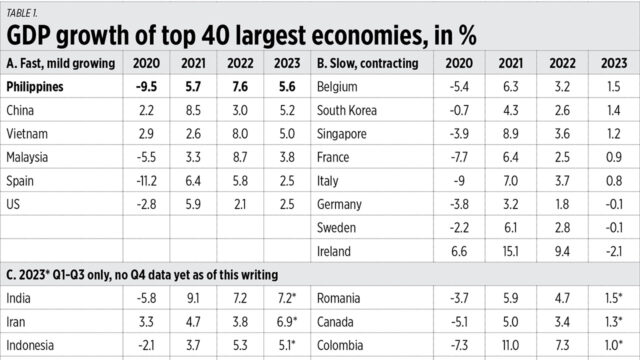
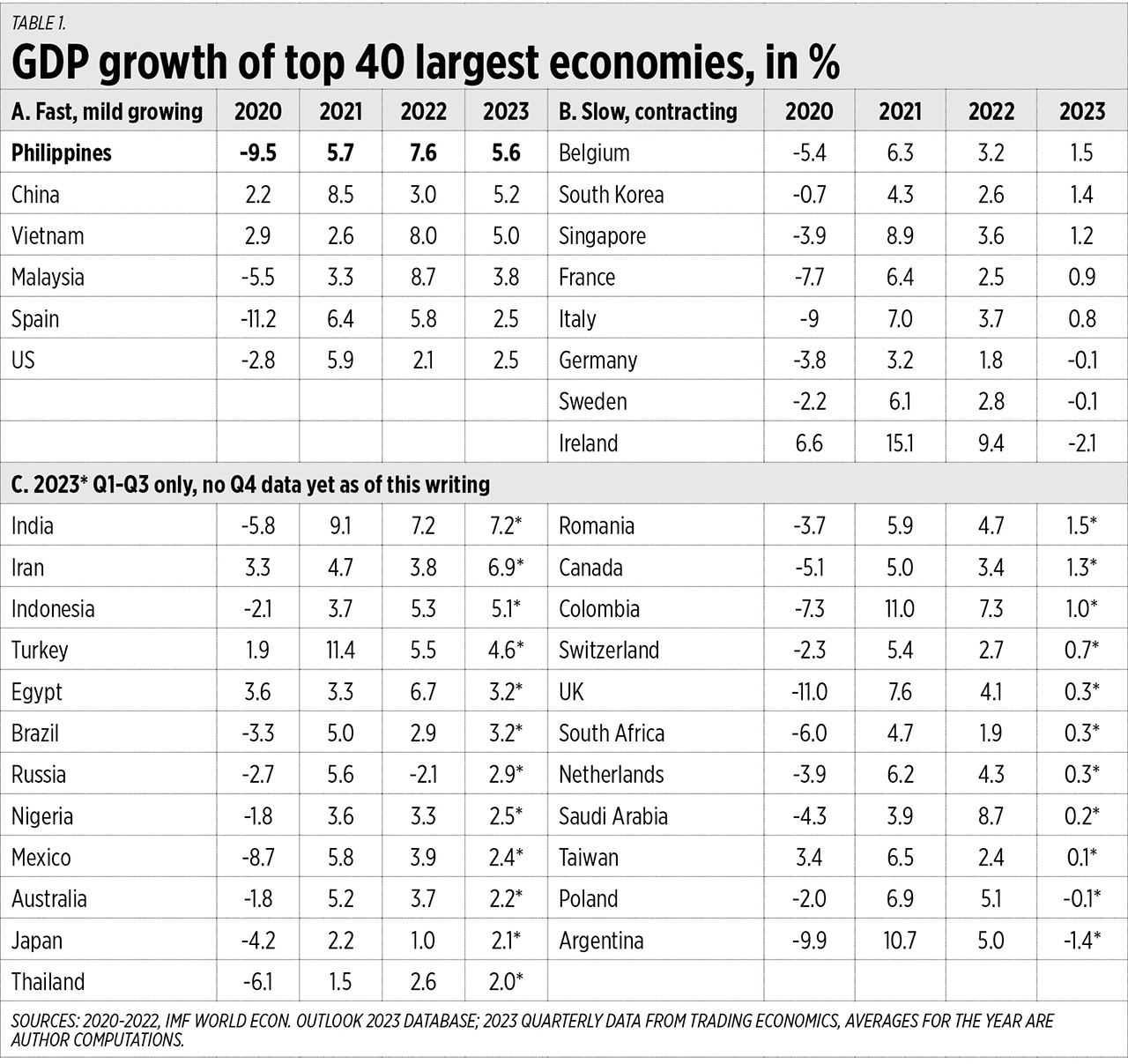
For this column, I monitored the growth of the top 40 largest economies in the world, those with GDPs of at least $700 billion in purchasing power parity (PPP) values in 2022. Two of the countries had no quarterly GDP data: Bangladesh and Pakistan. One country had data for Q1 and Q2 2023 only (for an average of 3.8%), the United Arab Emirates (UAE). So these three countries are not included among the 37 countries listed in Table 1.

I grouped the countries into three. Those in Group A have full 2023 data with growth of 2.5% and above. Those in Group B grew by 2.4% and below. And those in Group C had data for Q1-Q3 2023 only, with no Q4 data available yet. The results are interesting.

1. The Philippines has the fastest growth among the countries with full 2023 data. If those in Group C are included, the Philippines had the third-fastest growth after India and Iran.

2. The Philippines’ 5.6% growth in 2023 is high growth over a high base (which was the high growth in 2022) and hence, there is no so-called “base effect.” China’s 5.2% growth in 2023 is high growth over a low base, since it had low growth of 3% in 2022.

3. The European economies, except Spain and Turkey, are either crawling at 0.1% to 1.5% growth, or are contracting (Germany, Sweden, Ireland, Poland). Other European countries not in the top 40, those ranked among the 41st to 50th largest economies, are also contracting — Austria (-0.6%), the Czech Republic (-0.5%), and Finland (-0.5%) (see Table 1).

The US growth of 2.5% seems deceptive, as it is due to heavily debt-driven government spending. The US federal debt has increased from $31 trillion in 2022 to $34 trillion in 2023, a huge $3 trillion increase in just one year. In their fiscal year 2024 budget of about $6.7 trillion, $1 trillion is earmarked for interest payments alone. Meaning their leeway for public infrastructure and social services is now drastically affected. As of Jan. 29, 2024, the US federal debt was $31.14 trillion.

HIGH GROWTH IN HOUSEHOLD SPENDING, INVESTMENTS, SERVICES SECTORS
GDP is measured in two ways: by expenditure or demand side, and by industrial origin or supply side. GDP by demand is equal to GDP by supply.

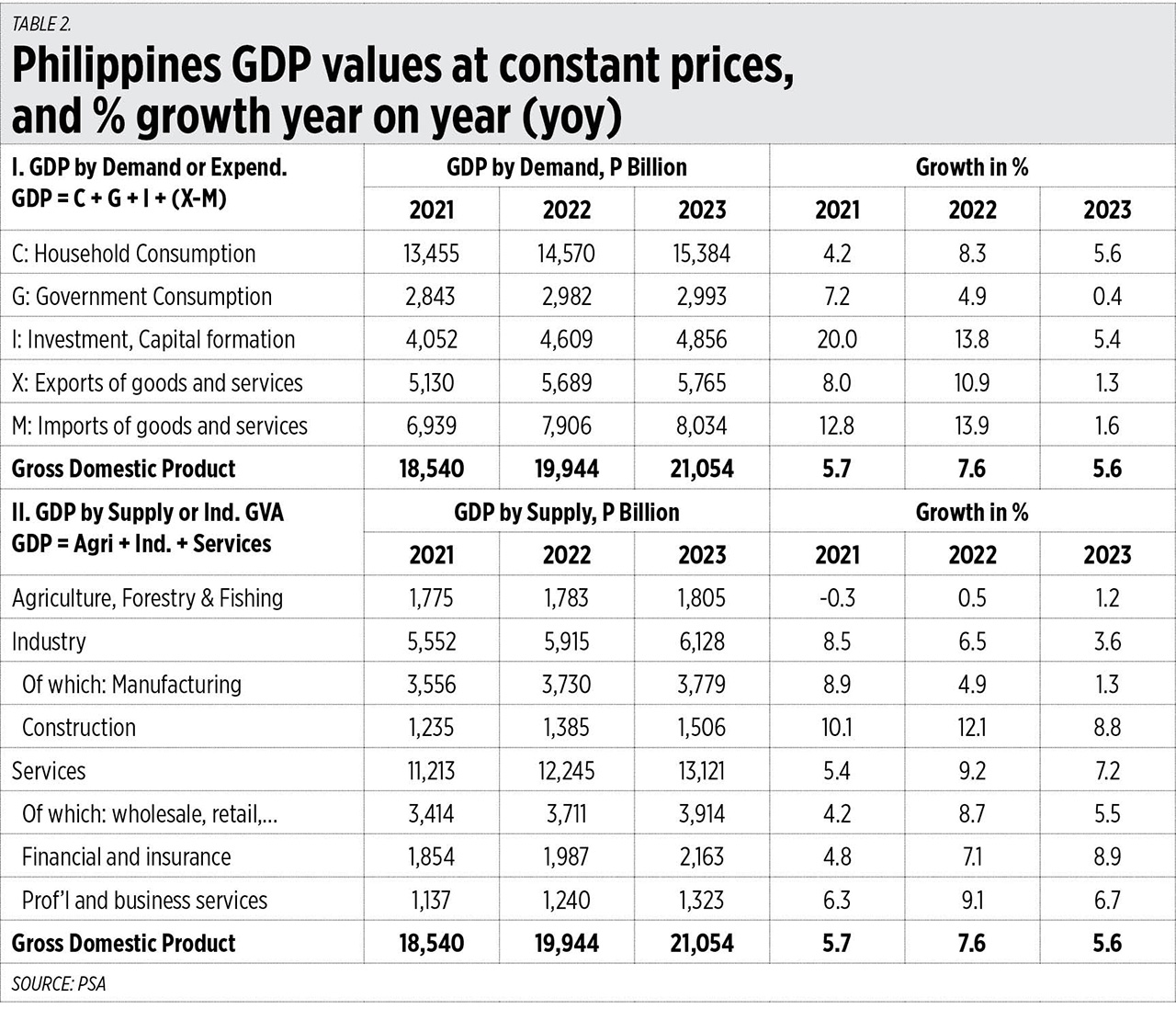
In the Philippines’ GDP by demand, household consumption constitutes 73% of GDP and it grew 5.6% in 2023. Investments grew by 5.4%, but government consumption tanked at 0.4%. This is mainly due to base effect.

Budget Secretary Amenah F. Pangandaman noted that: “There were some large government spending and subsidies in Q4 2022, like high vaccine procurement and ‘Libreng Sakay’ for Metro Manila buses, that were downscaled or discontinued in Q4 2023 to help control the deficit and borrowings. That fiscal consolidation move will give us wider fiscal space this year to continue high government spending on infrastructure. Public infrastructure last year remained high but is counted in investment or capital formation where there was high growth of 11.2% in Q4.” Good decision there, Madam Secretary.

In GDP by supply, the services sector constitutes 61% of GDP and it grew by 7.2% last year. The industry sector makes up 29% of GDP and it grew at a modest 3.6% (see Table 2).

The world economy will remain in a bad shape this year, led by the US and Europe, but Asian economies will anchor modest to high growth levels, led by India, China, Indonesia, Japan, Iran, Vietnam, and the Philippines.

A debt-financed growth is unsustainable and will lead to the bubble bursting in the short to medium term. The economic team led by Finance Secretary Ralph Recto must continue to aim for sustained high growth of 6% and up, a low inflation rate, a low interest rate, and a low unemployment rate of below 4%.

Secretary Recto’s “no new taxes” plan for this year and possibly beyond is a brilliant move. Allow the households and companies to keep more of their income and savings because they will spend or invest it anyway, mostly in the domestic economy.


BIENVENIDO S. OPLAS, JR.is the president of Bienvenido S. Oplas, Jr. Research Consultancy Services, and Minimal Government Thinkers. He is an international fellow of the Tholos Foundation.

minimalgovernment@gmail.com

Concepcion Industrial earnings up 86% in 2023

LISTED Concepcion Industrial Corp. (CIC) said its consolidated earnings grew by 86% to P667.3 million last year, led by higher net sales.

The company said in a regulatory filing on Wednesday that its full-year net sales rose 11% to P14.7 billion carried by strong fourth quarter results.

During the fourth quarter, CIC recorded a 195% increase in consolidated earnings to P177.9 million on the back of better margins and solid sales performance.

The company added that its net sales for the October to December period grew by 9% year on year to P3.8 billion due to sales growth in its commercial business. The commercial business was driven by heat, ventilation, and air conditioning (HVAC) equipment sales and progress in both air conditioning and elevator projects.

Net sales of CIC’s consumer business saw a 1% decline to P2.4 billion due to weaker demand for window room air conditioners and direct cool refrigerators.

“CIC has shown time and again our ability to overcome challenges as our resilient business allows us to adapt quickly and pivot when the situation calls for it. As we reflect on our achievements in 2023, we look ahead with opti-mism, ready to welcome opportunities and face the challenges of 2024,” CIC Chairman and Chief Executive Officer Raul Joseph A. Concepcion said.

“CIC is well positioned to capitalize on emerging opportunities, and our commitment to innovation, customer satisfaction, and operational excellence remains firm. We continue to embark on a promising journey, confident in our ability to drive growth and deliver value to our stakeholders,” he added.

Shares of CIC fell by 94 centavos or 6.91% to P12.66 apiece on Wednesday. — Revin Mikhael D. Ochave

Real-time digital payment system means business for Philippines

UNSPLASH

By Leslie Choo

REAL-TIME payments allow the transfer of money between businesses and consumers within seconds instead of days. This instantaneous process enables a more seamless transaction, improving liquidity and overall market effi-ciency toward unlocking economic growth.

According to the 2023 Prime Time for Real-Time report published by ACI Worldwide, 195 billion real-time payment transactions were recorded globally in 2022 and are forecasted to reach 511.7 billion by 2027, representing a compound annual growth rate (CAGR) of 21.3%. In the Philippines, real-time payment transactions are expected to grow to 1.5 billion by 2027 from 625 million in 2022, representing a CAGR of 18.7%.

A PROMISING GREENFIELD MARKET FOR DIGITAL PAYMENTS

As one of the fastest-growing economies in the Association of Southeast Asian Nations (ASEAN) region, the Philippines posted a high gross domestic product (GDP) growth rate of 7.6% in 2022 and 6% in the third quarter of 2023. With a population of more than 116 million, the Philippine economy is driven by a digital-savvy citizenry with an internet penetration rate of 73.1% of the total population. But even with this tech-forward populace, the country’s banking penetration is relatively low at 56%.

Recognizing the pivotal role of digital finance in fueling economic growth, the Philippine government is making significant strides in its push for digitization. Under its Digital Payments Transformation Roadmap, the Bangko Sentral ng Pilipinas (BSP) aims to shift 50% of total retail transactions to electronic channels and increase the number of Filipino adults with bank accounts to 70% in 2023. InstaPay and PESONet recorded 557 million transactions as of August 2023, 38.9% higher than the 401 million in the same period a year prior.

Against the backdrop of a robust economy and the government’s push for digitization lies a burgeoning, but still largely untapped, demand for digital financial services in the Philippines.

REMITTANCE AND CROSS-BORDER PAYMENTS AS KEY GROWTH ENGINES

Remittances are an important factor supporting domestic consumer spending in the Philippines. According to BSP, personal cash remittances grew by 3.6% to $36.14 billion in 2022, accounting for 8.9% of the Philippines’ GDP. The strong demand for cross-border digital remittances and a large unbanked population represents huge potential for banks in the Philippines to capitalize on real-time payments as a growth catalyst.

Enhancing the efficiency of cross-border payments will help lessen frictions such as high remittance costs, lengthy processing times, and inadequate transparency regarding service fees and processing status. BSP — with the central banks of Indonesia, Malaysia, Singapore, Thailand, and Vietnam — established the Regional Payment Connectivity (RPC) initiative to strengthen and enhance collaboration on payment connectivity by developing faster, cheaper, more transparent, and more inclusive cross-border payments.

Cross-border real-time payments encourage the use of local currency and are vital in strengthening financial resilience in the region. In the long term, cross-border payment cooperation in the region can keep the countries’ currency exchange rates more stable, reducing the reliance on external currencies such as the US dollar. When regional cooperation between countries becomes more economically integrated and sustainable, it stimulates the growth of ASEAN as a whole.

REAL-TIME PAYMENTS ARE TABLE STAKES FOR BANKS

Philippine banks are realizing that real-time payment enablement is more than just a technological upgrade; it is important for customer acquisition and retention, innovation, and efficiency. Traditional banks running on siloed legacy banking systems often lack integration capabilities and require manual processes, leading to inefficiencies and errors. With the industry moving towards the ISO 20022 messaging standard, banks should look to overhaul their systems and take advantage of the opportunities generated by the enriched data to capture customer insights. An ISO 20022-native real-time payments system improves processing time and accuracy, enhances security, and facilitates effective real-time controls against fraud and money laundering.

Digital overlays are integrated value-added services that drive new sophisticated use cases for consumers and businesses and help expand the reach and ubiquity of real-time payment services. An example is Malaysia’s DuitNow Request, which allows payees to send a digital payment request to collect funds from a payer via e-wallet, mobile, or Internet banking. This is particularly useful for businesses that have a variable payment amount or need to re-quest payment for services rendered. With Request to Pay, banks can offer an alternative, digital mode of payment acceptance to the end merchants, billers, and corporates that provides businesses real-time visibility of their in-coming payments while lowering transaction costs, fraud, and disputes.

In Thailand, the National Interbank Transaction Management and Exchange (ITMX) implemented ACI’s real-time payments solution to modernize its bulk payments processing system. Its critical payments infrastructure is utilized for corporate payments, including payroll, dividends, interest, loans, securities, government bonds, tax refunds, goods, and services. Real-time bulk payments can assist with government disbursements such as the senior citizen welfare fund, farmer’s subsidies, COVID-19 relief fund, and emergency support measures. However, for this to be successful, processors and banks need to be backed by scalable and high-performing solutions.

Similar to the Philippines, Indonesia previously faced challenges with slow transactions, high fees, and limited accessibility in remote areas. The Indonesia Fast Payment System (BI-FAST) was introduced by the country’s central bank in December 2021 to transform Indonesia’s payment landscape. BI-FAST serves as an integral part of the Indonesia Payment System Blueprint 2025 vision for inclusive economic growth. ACI provides the central infrastructure for Indonesia’s BI-FAST as well as the gateway for banks and multi-tenant aggregators. BI-FAST, one of the world’s largest real-time payment systems, which will incorporate 135 banks, is accelerating the digital transformation of Indonesia’s economy, driving economic growth and bringing millions of unbanked citizens into the formal financial sector.

By looking at other ASEAN countries’ experiences and successful use cases, the Philippines can enhance its real-time payment system to enable faster, more efficient, and secure transactions, ultimately driving economic growth and financial inclusion.

SECURITY BANK PARTNERS WITH ACI

ACI partnered with Security Bank Corp. in the Philippines to build the bank’s next-generation cloud-native enterprise payment hub, a single platform for retail and corporate banking. Through the partnership, ACI is helping Security Bank realize a unified, omnichannel payment experience and bolstering the bank’s technology transformation journey to meet evolving customer requirements and demands. The new modernized payment hub empowers Security Bank to roll out innovative products and services to customers faster and add new payment types to its core infrastructure seamlessly and cost-effectively.

Guided by our mission to accelerate global commerce through real-time payments, ACI is committed to helping Philippines banks harness the full potential of real-time payments and provide Filipinos with a modernized, secure, and delightful banking experience.


Leslie Choo is a ACI Worldwide’s senior vice-president and managing director for Asia Pacific.

ADVERTISEMENT
ADVERTISEMENT