Home Blog Page 3641

BARMM labor code pushed

Laborers work at a construction site in Manila. — PHILIPPINE STAR/ RUSSELL PALMA

COTABATO CITY — Members of the Bangsamoro Parliament are keen on approving the proposed regional labor and employment code for three cities and provinces in the Bangsamoro Autonomous Region in Muslim Mindanao (BARMM) before May this year.

On Monday, Parliament Member Romeo K. Sema, one of the authors of Bangsamoro Transition Authority Bill 59, the Bangsamoro Labor and Employment Code (BLEC), told reporters that he will prod his colleagues to accelerate its enactment into law.

Last Friday at the House of Representatives in Quezon City, Deputy Speaker Raymond Democrito C. Mendoza of the Trade Union Congress Party-list expressed support for the measure during a public hearing.

Mr. Mendoza said the code’s passage will affirm “Bangsamoro’s promise for sustainable and inclusive jobs, justice, and equity, ensuring workers have a seat at the table and access to decent work.”

Mr. Sema said the BLEC is “tailored-fit” to the socio-cultural and religious settings of the region.

Under the Bangsamoro Organic Law, the regional government guarantees fundamental workers’ rights, something Mr. Mendoza said would be realized once the BLEC is approved.

It would include rights for self-organization, collective bargaining, negotiations, and the right to strike, aligning with the Constitution and the Labor Code of the Philippines.

Mr. Sema, who is representing the Moro National Liberation Front in the BARMM parliament, said the BLEC was premised on insights shared by various sectors, including employers, during cross-section dialogues on its intricacies and ramifications.

“We have also consulted Muslim and Christian religious leaders as we drafted its provisions,” Mr. Sema said.

The BLEC was co-authored by four lawyers in the BARMM parliament, Raisa H. Jadjurie, Jose I. Lorena, Randolph C. Parcasio, Paisalin P. Tago and a known peace-activist, Eddie M. Alih.

The lawyer-entrepreneur Ronald Hallid D. Torres, chairman of the Bangsamoro Business Council, said they are thankful to Mr. Mendoza for expressing support for the BLEC. — John Felix M. Unson

Peace, dev’t center eyed in Baguio

PHILSTAR FILE PHOTO

BAGUIO CITY — Officials are setting their sights on building Northern Luzon’s first-ever peace and development center in this city.

The proposed center, with a budget of P50 million, was included in the Payapa at Masaganang Pamayanan (PAMANA) Program fund for fiscal year 2024, following site validation by Office of the Presidential Adviser on Peace, Reconciliation and Unity (OPAPRU) personnel.

“Secretary [Carlito G.] Galvez and I have been together [in public service] for a while,” Baguio City Mayor Benjamin Magalong said as he led the groundbreaking rites at the proposed site on Upper Session Road with the presidential peace adviser last Friday. “We both agreed to suggest that we can put up a peace and development center here in Baguio City.” 

It will house the Cordillera-based OPAPRU, according to the memorandum of agreement (MoA) they signed.

Mr. Galvez said the peace center shall serve as a concrete symbol of OPAPRU’s recognition of the Cordillera region’s “key role in peacebuilding that is deeply rooted in its rich culture and traditions such as the Bodong system, Pechen, Tung-Tong and Mediation.”

He said it will be dedicated to promoting peace, conflict resolution, reconciliation, and the prevention of violence in the region.Artemio A. Dumlao

FIRB reviewable threshold hike to P15B seen improving EoDB

BW FILE PHOTO

THE Fiscal Incentives Review Board (FIRB) decision to raise the threshold of investment projects subject to its review to P15 billion from P1 billion previously has been pitched as an improvement to the ease of doing business (EoDB), by pushing more project approvals down to the investment promotion agency (IPA) level without delays imposed by a board review.

In an FIRB resolution dated Feb. 2 but released this week, the FIRB said the new threshold was adopted to facilitate EoDB by giving IPAs more leeway to approve projects falling under the threshold.

Under the resolution, all applications for tax incentives on projects involving investment capital of P15 billion or more are reviewable by the FIRB, with IPAs retaining approval authority for investments under the threshold.

Finance Secretary Ralph G. Recto, who chairs the FIRB, said in a statement that the new resolution will help improve competitiveness.

“IPAs play a vital role in attracting more productivity-enhancing investments, and we will continue to support them by acting fast on measures that will further promote ease of doing business and cultivate an investment-friendly climate,” Mr. Recto said.

The new resolution was also welcomed by the Philippine Economic Zone Authority (PEZA) and business chambers, who expect it to fast-track project approvals.

PEZA Director General Tereso O. Panga said that the new process will empower IPAs to evaluate and approve projects.

“This will definitely strengthen PEZA and the IPAs’ capacity to promote and facilitate investments given the faster gestation period in registering projects, particularly big-ticket investments,” Mr. Panga told BusinessWorld via Viber.

“With this power restored to the IPAs, this reform will not only enhance EoDB and investor trust and confidence in the Philippines, but also accelerate the implementation of projects that can generate the much needed jobs, exports and other economic opportunities for the country,” he added.

British Chamber of Commerce of the Philippines Executive Director Chris Nelson said by telephone that the new resolution is “ a very positive development.”

“It will allow those IPAs greater flexibility in what they can do, because obviously, now the amount is significantly higher,” Mr. Nelson said.

He said the new policy could further help attract more big-ticket investments by coupling it with measures that will ease doing business in the Philippines.

“This is one move along with others, right? Of course, we, along with many of the business groups, have advocated for removing or further reduction of the economic barriers, right? But, yes, this will help,” he said.

He added that there is a need for investors to see constant effort from the government to improve ease of doing business to compete with other countries in Southeast Asia.

The Philippine Chamber of Commerce and Industry also welcomed the new policy and gives IPAs more authority.

“This would mean more projects will have to be decided quickly at the IPA level without going through the approval of FIRB, which became the bottleneck for incentives,” PCCI President Enunina V. Mangio said in a statement on Monday.

“One of the bottlenecks we have in government is the ease of doing business. We need to streamline our processes and policies so we become an attractive investment destination,” she said, citing the need to catch up with ASEAN neighbors.

She added that the policy could also help encourage more investors to participate in big-ticket projects through public-private partnerships (PPP).

The FIRB said that the revised threshold aligns with the PPP Code of the Philippines, which states that PPP projects with a cost of P15 billion and higher are reviewable by the National Economic and Development Authority Board at the recommendation of the Investment Coordination Committee. — Justine Irish D. Tabile

Revenue regulations for EoPT expected by April

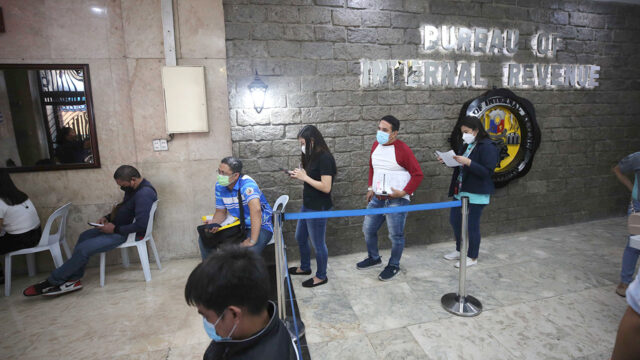
UNDER Republic Act No. 11976 or the Ease of Paying Taxes Act, taxes may be filed and paid anywhere, whether manually or electronically. — PHILIPPINE STAR/RUSSELL PALMA

THE Bureau of Internal Revenue (BIR) said it will release seven revenue regulations (RR) to clarify provisions of the Ease of Paying Taxes (EoPT) Act by April.

BIR Deputy Commissioner for legal Marissa O. Cabreros told the House ways and means committee on Monday that “Seven RRs are in the pipeline to implement the Ease of Paying Taxes Act, and they are arranged per topic.”

The RRs for Republic Act (RA) No. 11976 or the Ease of Paying Taxes Act are scheduled for release on April 21, Ms. Cabreros told the legislators.

RRs are issuances signed by the Finance Secretary, on the recommendation of the BIR Commissioner, specifying rules and regulations for the effective implementation of the National Internal Revenue Code (NIRC).

President Ferdinand R. Marcos, Jr. signed the Ease of Paying Taxes Act in January. It seeks to amend provisions of the NIRC to simplify and digitalize the tax collection process.

The law is expected to “encourage more taxpayers to enter into and comply with the tax system by streamlining processes and minimizing the burden on taxpayers, thereby increasing the country’s revenue collection,” the Department of Finance said.

It also seeks to classify taxpayers into micro, small, medium, and large based on their gross sales. It would also classify value-added tax refund claims into low-, medium-, and high-risk.

The bureau has also yet to release revenue memorandum orders (RMOs) and revenue memorandum circulars (RMCs) to ensure the streamlined implementation of the law, Ms. Cabreros added.

“As early as now, while the RRs are being drafted, we have RMOs and RMCs in the pipeline,” she said.

After releasing its RRs, the BIR will also conduct roadshows to discuss with taxpayers their concerns or queries, according to Ms. Cabreros.

“Commissioner (Romeo D. Lumagui, Jr.) himself will go to all our revenue regions,” Ms. Cabreros told the panel. “We want to go down to the taxpaying public to talk to the BIR.”

The bureau will also release uniform guidelines for BIR personnel to avoid diverging interpretations of the law.

Under RA 11976, taxes may be filed and paid anywhere, whether manually or electronically.

The BIR is studying a mechanism in which taxpayers can process their electronic Certificate Authorizing Registration (eCAR) at the respective regional district office (RDO) where personal or real property is located, according to Ms. Cabreros.

“We have to respect the file-and-pay anywhere (provision), but we have to have an internal mechanism where the processing of the eCAR should be where the property is located,” Ms. Cabreros said.

An eCAR would confirm whether requisite tax has been paid, and is necessary for the transfer of ownership of real or personal property.

“The RDO that received the return and the payment should immediately transmit the documents (and) information to the RDO where property is located to immediately process the eCAR,” Ms. Cabreros said. — Beatriz Marie D. Cruz

Main index falls to 6,700 level on profit taking

COURTESY OF PHILIPPINE STOCK EXCHANGE, INC.

PHILIPPINE STOCKS declined on Monday on profit taking and amid a lack of fresh leads, with Wall Street’s drop on Friday also affecting investor sentiment.

The Philippine Stock Exchange index (PSEi) fell by 1.08% or 74.62 points to close at 6,798.61 on Monday, while the broader all shares dropped by 0.97% or 35.06 points to end at 3,562.61.

“Philippine shares started the week with some profit taking as the latest Financial Times Stock Exchange results indicated that several names would be removed during the next rebalancing date,” Regina Capital Development Corp. Head of Sales Luis A. Limlingan said in a Viber message.

“The key economic data releases in the US this week are the jobless claims report on Thursday and the existing home sales report on Friday. The minutes from the January FOMC (Federal Open Market Committee) meeting will be released on Wednesday… Meanwhile, a quiet week ahead of us here in the Philippines, with only the balance of payments data for January scheduled to be released this week,” Mr. Limlingan added.

US shares’ performance on Friday also affected local trading on Monday, Philstocks Financial, Inc. Research Analyst Claire T. Alviar said in a Viber message.

“The local bourse declined… as investors extended their profit taking after the market rallied for four straight weeks. The negative cues from the US markets last Friday amid the rise in the US January producers price index weighed further on sentiment,” Ms. Alviar said.

US stocks fell on Friday with the Nasdaq showing the largest decline after a hotter-than-expected producer prices report eroded hopes for imminent interest rate cuts by the US Federal Reserve, Reuters reported.

A Labor department report showed producer prices increased more than expected in January, feeding fears inflation was picking up after months of cooling. After five consecutive weeks of gains, all three indexes posted a weekly decline.

The S&P 500 lost 24.16 points or 0.48% to end at 5,005.57 points, while the Nasdaq Composite lost 130.52 points or 0.82% to 15,775.65. The Dow Jones Industrial Average fell 145.13 points or 0.37% to 38,627.99.

Back home, all sectoral indices fell on Monday. Property declined by 1.71% or 50.14 points to 2,877.08; industrials went down by 1.51% or 141.73 points to 9,199.86; services dropped by 1.24% or 21.72 points to 1,725.51; holding firms retreated by 1.01% or 64.75 points to 6,343.95; mining and oil decreased by 0.16% or 14.58 points to 8,823.83; and financials inched down by 0.02% or 0.57 point to 1,982.93.

Value turnover dropped to P4.22 billion on Monday with 637.72 million shares switching hands from the P4.58 billion with 1.48 billion issues traded on Friday.

Decliners beat advancers, 134 versus 59, while 49 names ended unchanged.

Net foreign buying rose to P339.37 million on Monday from P258.91 million on Friday. — R.M.D. Ochave with Reuters

Peso drops as PPI data boost views of late Fed cut

peso-bills-coins-currency-022420

THE PESO depreciated against the dollar on Monday after faster-than-expected US producer inflation bolstered views of a delayed rate cut by the US Federal Reserve.

The local unit closed at P56.07 per dollar on Monday, weakening by 11 centavos from its P55.96 finish on Friday, Bankers Association of the Philippines data showed.

The peso opened Monday’s session stronger at P55.87 against the dollar. Its weakest showing was at P56.13, while its intraday best was at P55.86 versus the greenback.

Dollars exchanged went up to $1.51 billion on Monday from $925.2 million on Friday.

“The peso weakened today amid firmer expectations of delayed Fed rate cuts from the strong US producer inflation report,” a trader said in an e-mail on Monday.

US producer prices increased more than expected in January amid strong gains in the costs of services such as hospital outpatient care and portfolio management, Reuters reported.

The increase reported by the Labor department on Friday was the largest in five months. The report prompted financial markets to dial back expectations that the Federal Reserve would start cutting interest rates in June.

The producer price index (PPI) for final demand rose by 0.3% last month, the largest increase since August 2023, after declining by a revised 0.1% in December, the Labor department’s Bureau of Labor Statistics said. Economists polled by Reuters had forecast the PPI gaining 0.1% following a previously reported 0.2% drop.

In the 12 months through January, the PPI increased 0.9% after climbing 1% in December.

The peso weakened against the dollar as Philippine stocks declined, Rizal Commercial Banking Corp. Chief Economist Michael L. Ricafort said in a Viber message. The Philippine Stock Exchange index fell by 1.08% or 74.62 points to close at 6,798.61 on Monday, while the broader all shares index went down by 0.97% or 35.06 points to finish at 3,562.61.

For Tuesday, the trader said the peso could continue depreciating against the dollar as China’s central bank is expected to cut rates.

The trader sees the peso moving between P55.90 and P56.15 on Tuesday, while Mr. Ricafort sees it ranging from P55.95 to P56.15. — AMCS with Reuters

New Clark City to host $152-M food logistics hub

THE Department of Trade and Industry (DTI) and the Clark International Airport Corp. (CIAC) have signed an agreement on Monday to build a $152-million food hub in New Clark City.

At the signing event, the Trade Secretary Alfredo E. Pascual said that the Clark National Food Hub brings forward the DTI’s food logistics strategy centered on improving distribution networks.

“This memorandum of understanding (MoU) will accelerate the government’s efforts to make food available, accessible, and more affordable to the consuming public,” Mr. Pascual said.

“It will be a catalyst in the region for developing a food and agro-industrial corridor that we hope to expand to Region 1 and possibly Region 2,” he added.

Under the MoU, the DTI is responsible for assisting the parties in attracting investment for the construction and management of the food hub.

Aside from the DTI, the Department of Agriculture (DA) is also a signatory to the MoU and is tasked to leading the development of a policy framework, raising public investment, and arranging support services for domestic and export-oriented businesses.

The DA pre-signed the MoU prior to the signing ceremony on Feb. 19 in Makati.

One of the flagship projects of the CIAC, Clark National Food Hub is a 64-hectare agriculture trading hub within the Clark Civil Aviation Complex.

CIAC President Arrey A. Perez said the food hub’s feasibility study will be completed by the third quarter, aided by the Public-Private Partnership (PPP) Center and the Asian Development Bank.

“We are making much headway with the PPP Center in completing the project preparation stages, and working round the clock to identify key investors, major food conglomerates, and other private-sector partners so we can break ground soonest,” Mr. Perez said.

With the completion of the study, the CIAC will be open the project for bidding by late this year and award the project next year.

CIAC has six other projects — the Clark Entertainment and Events Center, Urban Renewal and Heritage Conservation Program, Clark Direct Access Link, Entertainment and Events Center Connector Road, the new CIAC headquarters and a second runway for the airport.

“I think these projects will have an estimated cost of about P30 billion,” Mr. Perez said, noting that the first phases of the projects are targeted for completion by 2028.

The infrastructure projects, such as those that involve roads and utilities, are targeted for completion by next year. — Justine Irish D. Tabile

P1-billion quick response fund activated to ease impact of calamities on farmers

THE Department of Agriculture (DA) said it is set to activate its P1-billion quick response fund (QRF) targeted at farmers affected by disasters.

“The (DA) plays a pivotal role before, during, and after disaster operations because agricultural producers, who constitute the department’s primary stakeholders, are susceptible to the adverse effects of climate change and seasonal fluctuations,” it said.

In Memorandum Order No. 9, the DA said that the QRF will serve as a standby fund for the procurement of agricultural inputs, crops, livestock and poultry, and fisheries.

The funding will also be used to repair production, post-production, and small-scale irrigation facilities.

Farmers also receive cash assistance for culled live animals or for the provision of farming tools and supplies.

“To address the sector’s longer-term vulnerabilities and challenges, the department provides an opportunity to increase the capacity of farmers and fisherfolk to cope and reduce the risk of future disasters through its rehabilitation and recovery programs, projects, and activities,” the DA added.

The disbursement of inputs for crops, fisheries, livestock, and poultry will take place within six months, while infrastructure repairs will be completed within the QRF’s validity period.

“Requests for the rehabilitation of small-scale irrigation systems shall be coordinated with the Bureau of Soils and Water Management for technical assistance and validation,” it said. — Adrian H. Halili

2024 budget release rate hits 78% at end of Jan. 

THE Department of Budget and Management (DBM) said it released 77.9% of the 2024 national budget as of end-January.

According to the DBM Status of Allotment Release report, the releases amounted to P4.49 trillion of the P5.768-trillion budget.

Some P1.27 trillion remains undistributed from the budget.

The release rate at the end of last month was well ahead of the year-earlier pace of 56.4%.

Releases to government agencies and departments amounted to P3.32 trillion or 94.7% of their allocations.

Special Purpose funds released by the end of the month stood at P15.88 billion, representing 30.1% of the funds allocated.

Meanwhile, Automatic Appropriation releases were at 58.1% or P1.02 trillion.

These include retirement and life insurance premiums of various National Government agencies and P10 billion for the Rice Competitiveness Enhancement Fund.

This year’s budget is 9.5% higher than last year’s and is equivalent to 21.7% of the country’s gross domestic product. — Luisa Maria Jacinta C. Jocson

PEZA investment approvals at P9.88 billion in year to date

THE Philippine Economic Zone Authority (PEZA) said on Monday that investment approvals were sharply higher in the year to date at P9.88 billion.

In a statement, the investment promotion agency (IPA) said that 16 projects comprising ecozone enterprises (9), information technology enterprises (3), economic zone logistics (2), domestic enterprises (1) and developer projects (1), were approved in February.

“These projects are anticipated to yield an investment of P9.88 billion, generating $591.476 million in exports and creating 2,243 direct jobs,” PEZA said.

“In comparison to the corresponding period in 2023, the investments, exports, and jobs are 160.08%, 135.31%, and 319.25% higher, respectively,” it added.

The new projects will be located in First Philippine Industrial Park II, Daiichi Industrial Park, Light Industry & Science Park III, Laguna Technopark, PHIVIDEC Industrial Estate – Economic Zone, Lima Technology Center, Mactan Economic Zone II, People Technology Complex, 1 Nito Tower in Cebu City, Embarcadero De Legazpi in Legazpi City, Light Industry & Science Park IV and Hermosa Ecozone Industrial Park.

“Notably, one of the new projects pre-qualified by the PEZA board is engaged in the manufacture of solar wafer cells and will start its operations in July 2024,” the IPA said.

PEZA said that it has so far approved 28 new and expansion projects worth P12.1 billion in the first two months, which are expected to generate $661.1 million in exports and 3,580 direct jobs.

“The significant upswing in our investment performance within two months underscores our commitment to achieving our target of P250-billion investments for this year,” PEZA Director General Tereso O. Panga said, without specifying the exact end-date in February for the investment total.

PEZA held its recent board meeting on Feb. 16 at the LIMA Technology Center – Special Economic Zone in Malvar, Batangas.

It was attended by four board members representing the Departments of Finance, Labor and Employment, and Interior and Local Government, as well as the National Economic and Development Authority.

The PEZA board also toured the facilities of Epson Precision (Philippines), Inc. and Grandsun Advanced Electronics (Philippines) Co., Inc. whose investments, as of last year, were worth P18.837 billion and P75 million, respectively. — Justine Irish D. Tabile

Rice price shocks seen producing ‘lasting’ second-round effects — BSP

BW FILE PHOTO

RICE price shocks will lead to persistent second-round effects, while oil price shocks will directly affect the market’s inflation expectations, the Bangko Sentral ng Pilipinas (BSP) said.

In its February monetary policy report, the BSP delivered an analysis of direct and second-round effects of supply shocks to oil and food prices on the various measures of inflation as well as inflation expectations.

The central bank defined direct effects as the impact of shocks on either food or energy headline inflation, while second-round effects reflect the overall impact of shocks to core inflation.

“A 1% increase in global food inflation is found to have a significant and persistent direct impact on non-core food inflation but minimal second-round effects with the impact on core inflation being insignificant over the horizon,” the central bank said.

“By contrast, the impact of a 1% increase in domestic rice prices leads to significant second-round effects that appear by the third month and persist for a year with a peak of 0.11 percentage points (ppt) on the 10th month,” it said.

The Philippine Statistics Authority estimated rice inflation at 22.6% in January from 19.6% in December. This is the highest reading in nearly 15 years, or since the 22.9% posted in March 2009.

The average price of regular-milled rice rose 2.4% to P49.65 per kilo month-on-month in January. It also rose 25.4% from a year earlier.

The average price of well-milled rice rose 2% to P54.91 per kilo in January from a month earlier. Year on year, prices rose 25%.

Rice had the biggest impact on the consumer price index (CPI) in January, accounting for 1.3 percentage points of the 2.8% reading. The commodity has the biggest weight on the overall CPI basket at 8.87%.

“Compared with the impact of oil price shocks, the impact of domestic rice price shocks has larger direct effects on headline inflation relative to the contribution of second-round effects,” the BSP said.

In the report, the BSP said that a 10% increase in Dubai crude oil prices produces longer-lasting second-round effects, but they are smaller than the direct effects.

“This combined impact on core and non-core food inflation builds and persists for 18 months and, at its peak, reaches 0.28 ppt on the 13th month. The combined direct and second-round effects of global oil price shocks on headline inflation last for a year and reach a peak of 0.40 ppt on the 11th month,” it said.

Second-round effects also appear to outweigh the contribution of direct effects on headline inflation, as oil serves as an intermediate input to the production of other goods and services.

“Gasoline and diesel prices account for only 2.4% of the CPI basket while items affected by higher oil prices such as transport services have higher CPI weights,” the BSP said.

Transport inflation declined 0.3% in January, a turnaround from 0.4% growth in December.

As for inflation expectations, the BSP said these “appear to respond asymmetrically towards price shocks coming from global food and Dubai crude oil.”

“Comparing shocks of the same magnitude, positive price shocks tend to raise inflation expectations more than negative price shocks tend to decrease inflation expectations,” it said.

Inflation expectations in response to price shocks could also be “stickier” even in the face of downward price adjustments, the BSP said.

“In the case of domestic rice price shocks, positive price shocks trigger an increase in inflation expectations that is more dispersed, possibly indicating higher uncertainty,” the BSP said.

After emerging as the most aggressive central bank in the region, the BSP kept the key rate at 6.5% — the highest in nearly 17 years — for a third straight meeting at its first policy review of the year.

The Monetary Board hiked borrowing costs by 450 basis points from May 2022 to October 2023 to tame inflation and help support the peso.

“Given the large swings in oil and food prices, assessing the inflation outlook requires an understanding of how these price changes affect domestic inflation including the indirect or so-called second-round effects,” the BSP said.

Headline inflation, the overall year-on-year increase in prices of widely used goods and services, decelerated to an over three-year low of 2.8% in January from 3.9% in December and 8.7% a year earlier.

January marked the second straight month inflation fell within the BSP’s 2-4% target.

“The standard view is that monetary policy should look through transitory supply shocks if there are no observed second-round effects due to the lags in monetary policy transmission,” the BSP said.

“However, looking through supply shocks in the presence of second-round effects may not be optimal since the central bank can bring inflation closer to the target with a corresponding policy response,” it added.  — Keisha B. Ta-asan

New consumer protection bill hurdles House committee

ROBERTO CORTESE-UNSPLASH

A HOUSE of Representatives committee approved a measure on Monday, proposing to align Philippine consumer protection law with international standards, to account for business practices that emerged during the shift to electronic commerce (e-commerce) platforms.

The House Committee on Trade and Industry approved an unnumbered substitute measure that seeks to amend Republic Act No. 7394 or the Consumer Act of the Philippines, which was signed more than 30 years ago.

“The draft bill seeks to amend certain provisions of the old code and harmonize it with current developments particularly brought about by technological advancement and the globalized economy that directly affect consumer transactions,” Rizal Rep. Emigdio P. Tanjuatco III, who headed the technical working group that fine-tuned the bill, said.

The new consumer law seeks to adopt the United Nations guidelines on consumer protection as the basis for enhancing and strengthening consumer protections, Mr. Tanjuatco told the committee.

The bill requires foreign-language product labels to include an English or Filipino translation. It also requires manufacturers, distributors, retailers, and service establishments to maintain consumer hotlines or service centers.

“We are confident that the New Consumer Act of the Philippines will go a long way in promoting fair trade practices, promoting consumers, and fostering a more equitable business environment,” Mr. Tanjuatco told the committee. — Beatriz Marie D. Cruz

ADVERTISEMENT
ADVERTISEMENT