Home Blog Page 3573

Vaccinating against the AI chatbot hype

GOOGLE-DEEPMIND-UNSPLASH

If we want to harness artificial intelligence or AI to enhance productivity in the workplace and accelerate national development, we need to eradicate the prevailing nonsense about AI. To be clear, AI includes many mathematically based computer technologies mimicking human intelligence that we already use every day. Voice recognition, computer vision, video recommendation systems, internet searches, GPS navigation, among many others, are examples of useful AI. The main problem is the hype and resulting nonsense around the most popular AI chatbots based on large language models such as GPT-4 and its contenders. For simplicity, I will refer to these as “chatbots.”

As the AI arms race led by Microsoft and Google continues to heat up, the market capitalization of Alphabet (the parent company of Google) recently dropped by several billion dollars. The stock price drop was triggered when Google’s Gemini chatbot, the recently released successor of Bard, generated images and statements that social media users found objectionable for one reason or another.

I was not surprised by the Gemini fiasco since it is just the most recent in a string of chatbot scandals since the release of ChatGPT by OpenAI in November 2022. The rush by the top technology firms to market AI products guarantees that corners will be cut, and adequate testing will not be done. What is disappointing, however, is how people persist in their misconceptions about chatbots and how the technology companies keep promoting these misconceptions through mindless, misleading, and exploitative hype. This leads to people having flawed mental models of chatbots, causing the repeated cycles of hyped expectations and scandalous disappointments since the release of ChatGPT.

At De La Salle University, we aim to teach critical thinking, defined as “examining information to bring to light assumptions and evidence behind them before accepting or acting on them.” Critical thinking is the vaccine we need to stop the spread of chatbot nonsense. We badly need critical thinking and discussion in order to deeply understand how chatbots work and what they can and cannot do.

The challenge is that discussions around this topic often trigger more emotion than clarity because as humans, we are deeply invested in our mental models. However, we need to continue such discussions and be less sensitive about them because they will reveal our assumptions about AI and challenge us to present evidence to support these assumptions. As a result, we will have a genuine, not artificial, understanding of chatbots.

Taking the critical thinking vaccine against AI chatbot nonsense simply means remembering two basic things in mind:

A chatbot is programmed to be fluent, but not necessarily factual. People who are disappointed by the mistakes of chatbots (technically referred to as “hallucinations”) assume that chatbots are supposed to give factual answers. This is simply not true. The programming and training of chatbots aim to produce fluent and human-like answers to questions based on statistical patterns derived from huge amounts of digital texts. Since the texts used to train chatbots have not been checked for factual accuracy, why do we tend to expect these chatbots to produce factually accurate output? The fluency and seeming confidence in their outputs lead our minds to assume that the chatbot is sticking to the facts. Actually, any factual statement produced by a chatbot is a statistical accident.

A chatbot is a statistical statement generator, but not a search engine. Because chatbots are trained using internet data, people assume that their outputs must contain statements that actually exist on the internet. This is not the case. A moderator for a conference where I was to give a talk used ChatGPT and introduced me as a doctoral graduate from Oxford University, a consultant to the World Bank, and the Chairman of the Asian Institute of Management. None of these are true. A Google search will not produce a single web page that claims these as facts. So, where did these claims come from? The chatbot generated them from statistical patterns. Simply put, the chatbot made them up!

In conclusion, chatbots are powerful tools for language processing and generation, but they are not truly intelligent. Users must approach chatbot content critically and verify information using other sources. For their part, chatbot developers should make accurate, transparent, and verifiable claims about the capabilities and limitations of their products and services. As the field of AI progresses, ongoing critical thinking and dialogue among developers and users, accompanied by continuing education for all stakeholders, are essential to bridge the gap between human expectations and the true capabilities of chatbots.

Meanwhile, let’s stop the nonsense.


Dr. Benito L. Teehankee is a full professor at De La Salle University and co-chair of the Shared Prosperity Committee of the Management Association of the Philippines.

benito.teehankee@dlsu.edu.ph

How do Filipinas fare in terms of legal gender equality?

LEGAL AND ECONOMIC gender equality in the Philippines is the second highest in Southeast Asia, the World Bank  said in a report. Read the full story.

How do Filipinas fare in terms of legal gender equality?

How PSEi member stocks performed — March 4, 2024

Here’s a quick glance at how PSEi stocks fared on Monday, March 4, 2024.


Marcos: Philippines to push back against China

PRESIDENT FERDINAND R. MARCOS, JR. — PHILIPPINE STAR/KJ ROSALES

By John Victor D. Ordoñez, Reporter

PRESIDENT Ferdinand R. Marcos, Jr. on Monday said the Philippines would cooperate with China despite increased tensions but would push back when its sovereign rights in the South China Sea are ignored.

Ties between the Philippines and China have soured since Mr. Marcos took office in 2022, with repeated spats over disputed features in the South China Sea at a time when Manila has been forging closer defense ties with the United States.

Speaking at a Lowy Institute forum during a visit to Australia, Mr. Marcos said too much emphasis was being placed on the superpower rivalry between the US and China, at the expense of legitimate maritime interests of other countries in the region.

“It distracts us from calling out aggressive, unilateral, illegal and unlawful actions for what they are — attacks against the rule of international law and the principles of the charter of United Nations,” he said.

In a departure from his predecessor’s pro-China stance, Mr. Marcos has accused China of aggressive acts within the Philippines’ exclusive economic zone in the waterway, including the use of water cannon and collision tactics to drive away Philippine vessels in areas China claims as its own territory.

Under Mr. Marcos, the Philippines has nearly doubled the number of its bases accessible to US forces, including three new sites facing Taiwan.

US-Philippines military exercises have taken place regularly for decades, but maneuvers have extended recently to include joint air and sea patrols over the South China Sea and close to Taiwan, actions China has seen as provocations and “stirring up trouble.”

China, which claims sovereignty over most of the South China Sea, has accused the Philippines of repeatedly trespassing on its territory, while urging dialogue to prevent mishaps.

“There are those who sometimes justify such provocations under the pretext of geopolitics and mischaracterize the remedies availed of by the aggrieved as mere tactics in this grand strategic game,” Mr. Marcos said.

“Our independent foreign policy compels us to cooperate with them on matters where our interests align, to respectfully disagree on areas where our views differ, and to push back when our sworn principles such as our sovereignty, our sovereign rights and our jurisdiction… are questioned or ignored,” he added.

Meanwhile, the Philippines’ Department of Foreign Affairs (DFA) said joint patrols in the South China Sea are legal.

“Activities that infringe upon the Philippines’ sovereignty and jurisdiction in Bajo de Masinloc (Scarborough Shoal) and its surrounding territorial sea are violations of international law, particularly UNCLOS (United Nations Convention on the Law on the Sea) and the 2016 arbitral award,” Foreign Affairs spokesperson Ma. Teresita C. Daza told reporters in a WhatsApp message.

China’s Defense Ministry earlier said the patrols threaten regional peace.

Last month, the Philippines started patrols around Scarborough Shoal as China continued to block Filipino fishermen from their traditional fishing ground that Beijing has occupied since 2012.

This came after Chinese Defense spokesperson Zhang Xiaogang said Philippine joint military exercises and patrols would jeopardize regional peace and stability and violate the principles of the Declaration on the Conduct of Parties in the South China Sea.

In 2002, member-states of the Association of Southeast Asian Nations (ASEAN) and China signed the declaration that aimed to “enhance favorable conditions for a peaceful and durable solution of differences” in the waterway.

A United Nations-backed tribunal in 2016 said China’s claims were illegal.

Also on Monday, the US government through its Trade Development Agency (USTDA) would give the Philippine Department of Transportation a P55-million grant to boost the Philippine Coast Guard’s maritime traffic monitoring capacity, the US Embassy in Manila said in a statement.

“The USTDA grant will provide the DoTr and PCG with the necessary technical expertise and cutting-edge US solutions to implement the project,” US Ambassador to the Philippines Mary Kay L. Carlson said during the signing ceremony in Mandaluyong City.

Meanwhile, Foreign Affairs Secretary Enrique A. Manalo told a maritime forum in Melbourne that the Philippines would continue pushing cooperation and diplomacy over the use of force in the South China Sea.

“For the South China Sea and the seas and oceans of the Indo-Pacific to be unifying domains of peace, stability and prosperity, we need to gather more strongly around a collective responsibility, as well as a shared sense of stewardship,” he said in his speech, a copy of which was sent to reporters via WhatsApp.

“The shared stewardship of the seas and oceans in the region behooves us to unite in preserving the primacy of international law so we can ensure equitable and sustainable outcomes for all.”

“The Philippines and China continue to engage each other through dialogue and diplomacy,” DFA said in a separate statement.

“However, the Philippines abides by the principle of respect for sovereignty, sovereign rights and jurisdiction in accordance with international law and the rules-based international order.” — with Reuters

PCG sends ship to Benham after China vessels show up

OCEANA.ORG

THE PHILIPPINE Coast Guard (PCG) on Monday deployed a patrol vessel for a two-week mission to Benham Rise, days after the country detected the presence of Chinese research vessels there.

The 84-meter BRP Gabriela Silang was deployed to patrol the northernmost province of Batanes and Benham Rise, it said in a statement.

The mission seeks to “intensify Coast Guard presence in Northern Luzon and monitor local fishermen,” it said. “We will also check the reported Chinese research vessels in Benham Rise.”

PCG said air assets were on standby for possible augmentation “specifically in performing aerial surveillance.”

A US-based think tank last week said two Chinese research vessels were loitering around Benham Rise, an extinct volcanic ridge in the Philippine Sea about 250 kilometers east of the northern coastline of Dinapigue, Isabela.

The research vessels left Longxue Island in Guangzhou on Feb. 26 and were “loitering east of Luzon in the northeast corner” of the Philippine Rise, Gordian Knot Center for National Security Innovation fellow Raymond M. Powell said on Mar. 1.

The Philippine Navy on Sunday confirmed the report and said the vessels had left the area.

The United Nations in 2012 declared Benham Rise, which is on the eastern side of the Philippines, as part of the country’s continental shelf. Manila renamed it Philippine Rise in 2017.

The Chinese research vessels entered the area without the Philippine government’s permission, National Security Council spokesman Jonathan Malaya told a news briefing on Monday.

“The Philippines is the only country that has rights over that area,” he said. “They do not have the rights to do research there or do any exploration without the expressed consent of the Philippine government.”

While the vessels had the right to innocent passage, they did not have the right to loiter in and explore the area, Mr. Malaya said.

He said the Philippine Navy and Philippine Coast Guard have been ordered to investigate whether the Chinese research vessels were conducting studies or simply passing by.

Meanwhile, Speaker and Leyte Rep. Ferdinand Martin G. Romualdez said the government would not compromise its territorial integrity.

“The Philippines will not compromise its territorial integrity or allow any encroachment upon its sovereign rights,” he said in a statement. “The Philippine Rise is unquestionably within our exclusive economic zone, and we will assert our authority to safeguard our maritime domain.”

Cagayan de Oro Rep. Rufus Rodriguez also urged the Department of Foreign Affairs (DFA) to file a diplomatic protest over the presence of Chinese vessels in the area.

“The intrusion of Chinese survey ships into the Philippine Rise east of our country, which is inside our exclusive economic zone, is concerning,” he said in a separate statement. “The government should lodge a protest with Beijing every time they trespass on our territory, whether in Benham Rise or the West Philippine Sea.”

The Chinese research vessels were identified as Haiyang Dizhi Shihao and Haiyang Dizhi Liuhao.

Chinese survey ships were spotted in the region in 2017, and ex-President Rodrigo R. Duterte suggested that the plateau be renamed to emphasize Philippine sovereignty over the area. — Kyle Aristophere T. Atienza and Kenneth Christiane L. Basilio

DepEd, CHED disagree on opening up education to foreigners

PHILIPPINE STAR/ WALTER BOLLOZOS

By Kenneth Christiane L. Basilio

THE DEPARTMENT of Education (DepEd) and Commission on Higher Education (CHED) found themselves on opposing sides on the issue of opening up the education sector to foreign investors.

DepEd rejected the proposal at a House of Representatives hearing on Monday, saying it could affect the sense of nationalism of students. On the other hand, CHED said liberalizing the sector could make local colleges and universities more competitive.

“The proposed amendments by both houses of Congress have far-reaching consequences and serious implications with respect to the mandate of the department and the exercise of its function,” Education Undersecretary Omar Alexander V. Romero told congressmen.

He said allowing foreigners to run local educational institutions could dilute “fundamental aspects of Filipino identity, culture and values.”

But CHED Chairman Prospero E. De Vera III said allowing foreign ownership in the sector would help colleges and universities become more globally competitive.

“The commission does not object to the constitutional amendment that will open up control and administration of educational institutions to foreign nationals,” he told the hearing.

Mr. De Vera noted that while the law provides limited educational internationalization activities by local institutions, it remains ineffective in attracting foreign institutions compared with neighboring countries with a fully liberalized education sector.

The Philippines is one of the strictest countries when it comes to foreign ownership compared with its neighbors, according to a report by the Second Congressional Commission on Education.

“Only the Philippines has full ownership, establishment and enrollment restrictions stipulated in the Constitution,” commission chief legal officer Joseph Noel M. Estrada told congressmen.

Allowing foreign ownership is the first step aside from state incentives and policy adjustments by DepEd and CHED in fully realizing the benefits of education liberalization.

Meanwhile, House Deputy Speaker and Quezon Rep. David C. Suarez said proposed changes to the 1987 Constitution should be approved by plebiscite separate from the midterm elections next year to avoid politicizing the issue.

“We cannot allow the Constitution to undergo political mudslinging and be politicized by what happens during the midterm elections where politicians go back and forth,” he told a news briefing.

Philippine President Ferdinand R. Marcos, Jr. earlier said that his government might hold a plebiscite on Charter change (“Cha-cha”) alongside the midterm elections.

But Bataan Rep. Geraldine B. Roman said this would be “counterproductive.” “Holding the plebiscite earlier would be much better as it would allow the people to truly understand [the issue],” she told the same briefing.

“It’s a bit difficult to trust the same people who are part of the same previous coalitions whose push for Charter change has been mostly comprehensive, pro-administration and rarely backed by appropriate technical inputs from all affected sectors,” Ateneo de Manila University political science lecturer Hansley A. Juliano said in a Facebook Messenger chat.

“The House has been composed of the same people who uncritically vote for the policy agenda of the incumbent President of the day out of reliance on patronage and budgetary insertions,” he added.

Meanwhile, Senator Ana Theresia N. Hontiveros-Baraquel said at least seven senators are likely to oppose a Senate measure seeking to ease foreign ownership restrictions in the Constitution, which would be enough to block the proposal.

“They need at least 18 votes to approve Resolution of Both Houses No. 6, so we just need seven to stop this,” she told reporters in Filipino, based on a transcript e-mailed by her office. “The situation is still fluid, but I’m very hopeful to get at least seven.”

The committee on constitutional amendments will hold a similar hearing on Tuesday where education experts are expected to speak.

Ms. Hontiveros -Baraquel said Senate Minority Leader Aquilino Martin “Koko” D. Pimentel III spoke with several senators on Charter change to gauge those in favor of amending the 1987 Constitution.

Senator Cynthia A. Villar has said she is against changing the 1987 Constitution, adding that the government should instead improve the ease of doing business in the country and deter corruption. — with John Victor D. Ordoñez

Australia warns Southeast Asian countries about ‘coercive actions’

PHILIPPINE COAST GUARD FILE PHOTO

SYDNEY — Australia said on Monday Indo-Pacific and Southeast Asian countries are facing serious defense threats as it set aside more funds for maritime security projects with ASEAN countries during a summit with regional leaders in Melbourne.

Foreign Minister Penny Wong announced A$286.5 million ($186.7 million) in funding for ASEAN projects in areas including maritime security, amid tensions over China’s growing assertiveness and its disputed claims to the South China Sea.

“We face destabilizing, provocative and coercive actions including unsafe conduct at sea and in the air,” Ms. Wong said in a speech at the summit, without naming China.

“What happens in the South China Sea, in the Taiwan Strait, in the Mekong subregion, across the Indo-Pacific, affects us all.”

Melbourne is hosting leaders and officials from the 10-member Association of Southeast Asian Countries (ASEAN) for a summit from Monday to Wednesday. ASEAN member Myanmar was excluded due to the ongoing conflict in the country.

Australia is using the 50th anniversary of its ties with ASEAN to bolster ties with the region as it deals with China’s growing diplomatic and military reach.

China claims almost the entire South China Sea, a conduit for more than $3 trillion of annual ship-borne commerce, including parts claimed by ASEAN members the Philippines, Vietnam, Indonesia, Malaysia and Brunei. The Permanent Court of Arbitration in 2016 said China’s claims had no legal basis.

Speaking alongside Ms. Wong, Philippines Secretary of Foreign Affairs Enrique Manalo said the South China Sea was of strategic importance and had a promising future as long as “nations in the region resolved to uphold cooperation over confrontation”.

Australia and the Philippines began their first joint sea and air patrols in the South China Sea in November.

The Philippines is ramping up efforts to counter what it describes as China’s “aggressive activities” in the South China Sea, which has also become a flashpoint for Chinese and US tensions around freedom-of-navigation operations. 

MYANMAR CONFLICT
Just over a month since ASEAN foreign ministers called for an end to the bloody conflict in member state Myanmar, hundreds of protesters gathered outside the downtown Melbourne venue to call for concrete punitive action against the military junta.

ASEAN has barred Myanmar’s top generals from attending its meetings until they commit to a peace plan, but has stopped short of further action. The junta has been furious over what it calls ASEAN’s interference in its internal affairs.

One activist called for international recognition of the parallel National Unity Government, which controls militias in the country.

“ASEAN countries and Australia please act. We need action, please don’t wait for (ASEAN’s) plan, it is useless,” activist Yuyu Chit said. — Reuters

Senate OK’s rebel amnesty

BW FILE PHOTO

THE PHILIPPINE Senate on Monday adopted resolutions concurring with President Ferdinand R. Marcos, Jr.’s proclamations granting amnesty to former rebels of the Moro Islamic Liberation Front (MILF) and Moro National Liberation Front (MNLF), among other groups.

The chamber approved House Concurrent Resolutions Nos. 19, 21 and 22, which concur with Presidential Proclamations 403, 405 and 406, which all grant amnesty to ex-rebel members of MILF, MNLF and the Rebolusyonaryong Partido ng Manggagawa ng Pilipinas-Revolutionary Proletarian Army-Alex Boncayao Brigade.

The Senate is still set to deliberate on a separate House resolution concurring with Proclamation 404, which seeks to grant amnesty to former members of the Communist Party of the Philippines-New People’s Army-National Democratic Front.

“The congressional concurrence to the presidential proclamations signifies the Filipino people’s support for the comprehensive peace efforts and genuine commitment of the government to attaining lasting peace,” Senator Jose “Jinggoy” P. Estrada, Jr., said in a statement. — John Victor D. Ordoñez

Strike notice filed vs Ninja Van

By Chloe Mari A. Hufana

THE LABOR union of Ninja Van Philippines has filed a notice of strike at the National Conciliation and Mediation Board (NCMB) for unfair labor practices, according to its leader.

About 300 regular employees were being “unfairly treated” by Wall Street Courier Services, Inc., which operates Ninja Van Philippines, by limiting each rider’s daily parcel delivery, Ninja Van Rider’s Union-Federation of Free Workers (NVRU-FFW) President Dick P. Pacioles said in an interview.

Ninja Van handles deliveries of e-commerce platforms Lazada and Zalora.

Ninja Van riders does not have a “government-recognized union,” Ninja Van Philippines communications head Ralph Angelo V. Ty said in an e-mail.

“Riders have always been free to raise their concerns with the team, as we have open and transparent lines of communication,” he said. “More importantly, we have also always worked with DoLE to resolve any concerns our riders might have, including those raised by the specific group mentioned.”

The Department of Labor and Employment (DoLE) in a separate statement said the union has a certificate of creation as a local chapter of FFW issued in October 2023 by DoLE-National Capital Region.

Unfair labor practice, discrimination and harassment were among the complaints filed against the logistics company, union lawyer Jose Sonny G. Matula said in an interview.

He said Ninja Van removes union members and discriminates in giving parcels for delivery.

“Instead of prioritizing regular employees, Ninja Van resorts to independent contractors,” he said. “There is also a diminution of benefits, so there are benefits given before that aren’t now.”

Mr. Ty said gasoline and maintenance allowances and other incentives are given to high-performing riders based on the company’s metrics, Mr. Ty separately said in a Viber message.

Ronald R. Castro, a Ninja Van rider, said he earns P3,000 weekly, a far cry from the P32,000 he used to earn for two weeks during the coronavirus pandemic.

One time, he said, he was assigned 36 packages to deliver instead of the usual 65 even if as many as 700 packages had arrived at his area.

“They just sent me home after that,” he said in an interview in Filipino. Days later, several regular employees got suspended for no reason, he added.

Mr. Pacioles said that they had to fight Ninja Van to force it to recognize them as regular employees.

The NCMB said its role is to ensure that both parties reach an agreement within 30 days. The National Labor Relations Commission will have to intervene in case of a deadlock.

The parties are set to meet on March 11.

Probe of NFA rice deal sought

PHILSTAR FILE PHOTO

A PHILIPPINE senator on Monday filed a resolution seeking to investigate the National Food Authority’s (NFA) “highly suspicious” sale of 75,000 bags of rice worth P93.75 million to traders at lower prices.

“The Philippines is now the world’s largest rice importer, and the dire market situation today will only worsen in the coming months,” Senator Maria Imelda “Imee” R. Marcos, who filed Senate Resolution 940, said in a statement on Monday.

She said NFA officials had allowed the sale of aging rice stocks by as low as 10% lower than the standard price of P22.50 to P25 a kilo. NFA officials had allegedly bypassed the bidding process.

Last week, Agriculture Secretary Francis P. Tiu Laurel, Jr. ordered agriculture officials to look into the alleged unauthorized sale of thousands of tons of rice to traders.

The Philippines is expected to remain the world’s top importer of rice, with shipments projected at 3.9 million metric tons this year, according to the US Department of Agriculture. — John Victor D. Ordoñez

Charges over ‘ghost receipts’ filed

DOJ.GOV.PH

THE DEPARTMENT of Justice (DoJ) has filed tax fraud charges against a corporation, its officers and accountant for using fictitious receipts and invoices.

In a statement, Justice Secretary Jesus Crispin C. Remulla affirmed the agency’s hard stance against tax evaders.

“We cannot simply tolerate tax evaders,” he said. “The filing of cases is a welcome development in our fight against tax evasion. More cases are expected to be filed in the coming days.”

A panel of prosecutors filed before a Quezon City court one count each of tax evasion, willful failure to supply correct and accurate information in income tax return, and four counts of willful failure to supply correct and accurate information in quarterly VAT returns against the corporation and its two officers.

The accountant was charged with one count of creating false entries, records, or reports before the court. — Chloe Mari A. Hufana

Senate OK’s jail integration bill 

PHILIPPINE STAR/ MIGUEL DE GUZMAN

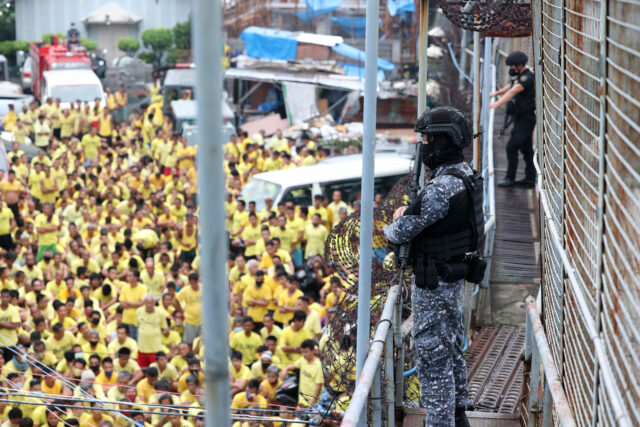
THE PHILIPPINE Senate on Monday approved on third and final reading a bill that seeks to transfer the supervision of provincial jails from local governments to the Bureau of Jail Management and Penology (BJMP) to ease jail congestion. 

Nineteen senators approved Senate Bill 2352, which would give provincial governments three years to turn over control of provincial jails to BJMP, including their compliance with the BJMP’s cleanliness and sanitation requirements. 

“By turning over the provincial and sub-provincial jails under the jurisdiction of the BJMP, we shall be giving more freedom to our provincial governments to direct their resources in accordance with their respective priorities,” Senator Ronald “Bato” M. dela Rosa, a former national police chief and the bill’s sponsor, said in a statement. 

Local governments would still pay for the food and water expenses of their jails and inmates during the three-year period. 

BJMP, an attached agency of the Department of the Interior and Local Government, handles city, district and municipal jails. 

Jail employees who wish to quit their jobs during the transition would be entitled to separation benefits, according to the bill. 

Many of the country’s jails fail to meet United Nations minimum standards, with Human Rights Watch pointing out inadequate food, poor nutrition and unsanitary conditions. — John Victor D. Ordoñez