Home Blog Page 3571

China vows to ‘transform’ economic model, targets growth at around 5%

People in raincoats stand at the closed gates of the Forbidden City during heavy rain in Beijing, China, July 30, 2023. — REUTERS/THOMAS PETER

BEIJING – China will target economic growth of around 5% this year as it works to transform its development model, curb industrial overcapacity, defuse property sector risks and cut wasteful spending by local governments, Premier Li Qiang said on Tuesday.

Li delivered his maiden work report at the annual meeting of the National People’s Congress (NPC), China’s rubber-stamp legislature, in the cavernous Great Hall of the People in Tiananmen Square.

The growth target was similar to last year’s but will require stronger government stimulus for China to reach it, as the economy remains reliant on state investments in infrastructure that have led to a mountain of municipal debt.

A stuttering post-COVID recovery in the past year has laid bare China’s deep structural imbalances, from weak household consumption to increasingly lower returns on investment, prompting calls for a new development model.

A property crisis, deepening deflation, a stock market rout, and mounting local government debt woes have increased the pressure on China’s leaders to respond to these calls.

“We should not lose sight of worst-case scenarios and should be well prepared for all risks and challenges,” Li said.

“In particular, we must push ahead with transforming the growth model, making structural adjustments, improving quality, and enhancing performance.”

There were no immediate details on the changes China intended to implement.

In setting the growth target, policymakers “have taken into account the need to boost employment and incomes and prevent and defuse risks,” Li said, adding China intended to have a “proactive” fiscal stance and “prudent” monetary policy.

China plans to run a budget deficit of 3% of economic output, down from a revised 3.8% last year. But crucially, it plans to issue 1 trillion yuan ($139 billion) in special ultra-long term treasury bonds, which are not included in the budget.

The special bond issuance quota for local governments was set at 3.9 trillion yuan, versus 3.8 trillion yuan in 2023. China also set the consumer inflation target at 3% and aims to create over 12 million urban jobs this year, keeping the jobless rate at around 5.5%.

“The Chinese government does not want to stimulate the economy too much, … and also wants to keep leverage relatively low,” said Xia Qingjie, economics professor at Peking University. The budget deficit target can be adjusted later this year, if needed, Xia added.

Analysts expect China to lower its annual growth ambitions in the future. The International Monetary Fund projects China’s economic growth at 4.6% this year, declining further in the medium term to about 3.5% in 2028.

‘NEW PRODUCTIVE FORCES’

China will continue to pour resources into tech innovation and advanced manufacturing, in line with President Xi Jinping’s push for “new productive forces,” Li said.

Some analysts have criticized this policy, however, saying it exacerbates industrial overcapacity, deepens deflation and heightens trade tensions with the West.

Reform advocates, worried about record low consumer confidence and plunging investor and business sentiment, want China to return to a path of pro-market policies and boost household demand.

The NPC is not the traditional venue for sharp policy shifts, which are usually reserved for events known as plenums, held by the Communist Party between its once-every-five-year congresses.

One such plenum was initially expected in the final months of 2023. While it could still take place later this year, the fact that it has not yet been scheduled has fuelled investor concerns over policy inaction. — Reuters

Philippine inflation quickens for the first time in five months in February

PHILIPPINE STAR/KRIZ JOHN ROSALES

MANILA – Philippine annual inflation sped up for the first time in five months in February due to faster increases in food and transport costs, likely giving the central bank little reason to consider lowering interest rates.

The consumer price index (CPI) rose 3.4% in February from a year earlier, the statistics agency said on Tuesday, which was above the previous month’s 2.8%, but still within the central bank’s 2% to 4% target for the year.

Economists in a Reuters poll had forecast annual inflation at 3.1% in February, within the central bank’s 2.8% to 3.6% projection for the month.

One of the main culprits behind the February uptick was rice inflation, which accelerated to 23.7% from last year, the fastest in 15 years, in a move blamed on base effects and elevated rice prices in the world market.

Core inflation, which strips out volatile food and energy items in the consumer basket, eased to 3.6% versus the previous month’s 3.8%.

The central bank last month kept its benchmark rate steady at 6.50% for a third straight meeting, expecting inflation to settle within target this year. It meets next to review policy on April 4.

ING Economist Nicholas Mapa said the central bank would likely keep rates at current levels for an extended period, in a post on social media platform X. — Reuters

China coast guard says it takes measures against Philippine vessels at Second Thomas Shoal

REUTERS

BEIJING – China’s coast guard said on Tuesday that it took control measures against Philippine vessels that illegally intruded into waters adjacent to the Second Thomas Shoal, which is a disputed atoll in the South China Sea.

The Coast Guard statement said the incident happened near waters adjacent to Renai Reef, also known as the Second Thomas Shoal, an area in the South China Sea that has seen numerous run-ins by China’s coast guard and Philippine vessels over the past few months.

A resupply mission for Philippine troops stationed at a grounded warship in Second Thomas Shoal is underway, the Philippine military said in a statement on Tuesday.

The China Coast Guard issued a brief statement on the latest incident between the countries along with other past coast guard actions, including a link to what it called the “illegal invasion of Scarborough Shoal” on Feb. 23.

In that incident it said a China Coast Guard ship took necessary measures to drive a Philippine vessel away in accordance with the law.

China claims sovereignty over most of the South China Sea, a claim that cuts into the exclusive economic zones (EEZ) of Vietnam, the Philippines, Malaysia, Brunei and Indonesia. The Permanent Court of Arbitration in 2016 found China’s claims had no legal basis. — Reuters

Singapore’s exclusive deal with Taylor Swift not a hostile act towards neighbors, PM says

TAYLOR SWIFT in the concert film Taylor Swift: The Eras Tour.

SYDNEY – Singapore Prime Minister Lee Hsien Loong said on Tuesday an incentive provided to Taylor Swift to make Singapore the only stop in Southeast Asia on her world tour was not a hostile act towards its neighbours.

“(Our) agencies negotiated an arrangement with her to come to Singapore and perform and to make Singapore her only stop in Southeast Asia,” Mr.Lee told a press conference in Melbourne, where he is attending a regional summit.

“It has turned out to be a very successful arrangement. I don’t see that as being unfriendly.”

Ms. Swift is currently part way though six sold-out shows in Singapore, her only stop in Southeast Asia.

Singapore’s government previously said it had given Ms. Swift a grant to play in the city-state, without mentioning the terms of the deal.

The announcement annoyed other countries in the region, with the Thai prime minister saying the grant was made on condition that it would be Ms. Swift’s only show in Southeast Asia, while a Filipino lawmaker said it “isn’t what good neighbors do”.

Last month, Singapore’s tourism board and culture ministry referred to the economic benefits brought by Ms. Swift’s concerts around the world due to her popularity, and said the ministry had worked with concert promoter AEG Presents to get Ms. Swift to perform in Singapore. — Reuters

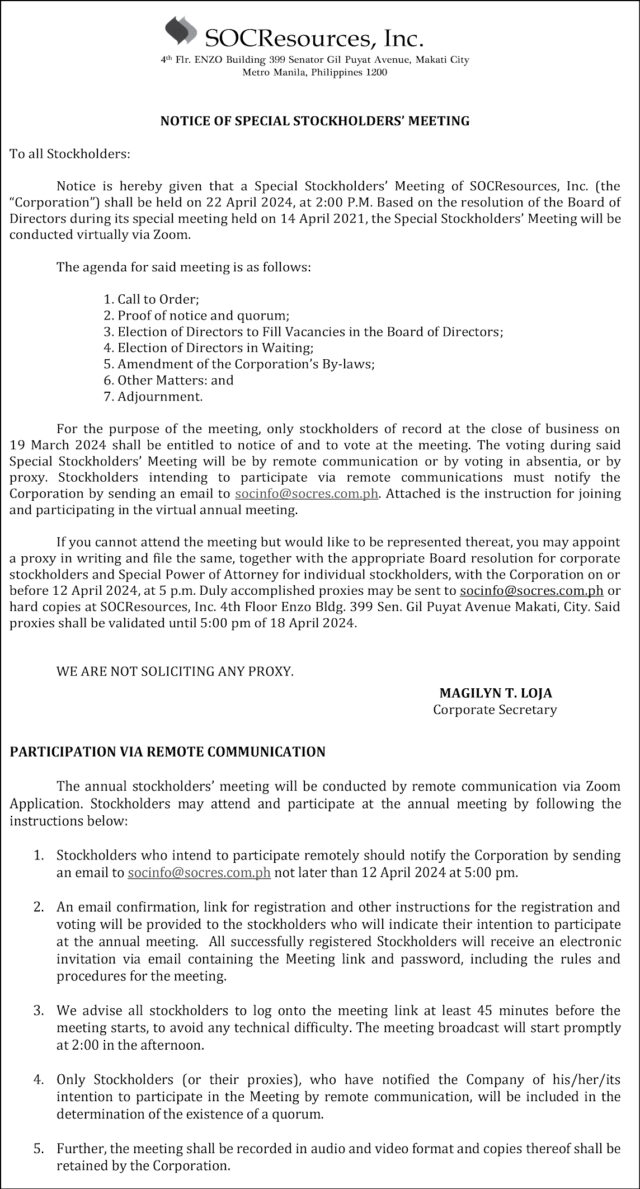
SOCResources, Inc. to hold Special Stockholders’ Meeting virtually on April 22


Spotlight is BusinessWorld’s sponsored section that allows advertisers to amplify their brand and connect with BusinessWorld’s audience by enabling them to publish their stories directly on the BusinessWorld Web site. For more information, send an email to online@bworldonline.com.

Join us on Viber at https://bit.ly/3hv6bLA to get more updates and subscribe to BusinessWorld’s titles and get exclusive content through www.bworld-x.coml

ACEN RES partners with Xavier School Nuvali in shift to renewable energy

(From left) Sheila Mina, AVP for Commercial Operations, ACEN; Dobbin Tan, Treasurer, Xavier School Nuvali; Fr. Aristotle C. Dy, SJ, PhD, President, Xavier School Nuvali; Miguel de Jesus, COO, Philippine Operations, ACEN; and Tony Valdez, SVP, Market Transformation, ACEN.

ACEN Renewable Energy Solutions (ACEN RES), the retail electricity unit of ACEN, recently partnered with Xavier School Nuvali to fully transition the educational institution to 100% renewable energy. This strategic collaboration aligns with ACEN’s goal of supporting Philippine schools in their journey toward carbon neutrality and marks a significant milestone in the renewable energy landscape.

The agreement with Xavier School Nuvali, which is now powered entirely by ACEN’s renewable energy portfolio including wind, solar, and geothermal sources, underscores the commitment of ACEN RES in promoting sustainable development. The green energy supplied to the campus is projected to make a significant environmental impact, akin to removing 114 cars from the road each year, aligning with global carbon reduction efforts.

The switch to renewable energy was commemorated with a signing event at the Jesuit school’s 15-hectare campus in Laguna. Executives from ACEN RES joined the school’s leadership, faculty, trustees, and student body to celebrate this green milestone.

Fr. Aristotle Dy, SJ, President of Xavier School, welcomed the partnership with ACEN: “ACEN’s collaboration with Xavier School Nuvali is not just about the renewable energy supply; it is also about instilling the mindset of sustainability within the educational community. Our commitment to renewable power serves as a beacon, guiding our faculty and young minds toward an eco- friendly future.”

Tony Valdez, senior vice president for market transformation and retail at ACEN, said: “Today’s foremost Jesuit, Pope Francis, wrote Laudato Si, the encyclical that promotes care for the planet. ACEN is happy to be part of the Jesuit-run Xavier School in love for planet and alignment with the encyclical.”

ACEN, is the listed energy platform of the Ayala group. The company has 4,800 MW of attributable capacity from owned facilities in the Philippines, Australia, Vietnam, Indonesia and India, with a renewable share of 99%, which is among the highest in the region. ACEN’s aspiration is to be the largest listed renewables platform in Southeast Asia, with a goal of reaching 20 GW of renewables capacity by 2030. ACEN is committed to transition the company’s generation portfolio to 100% renewable energy by 2025 and to become a Net Zero greenhouse gas emissions company by 2050.


Spotlight is BusinessWorld’s sponsored section that allows advertisers to amplify their brand and connect with BusinessWorld’s audience by enabling them to publish their stories directly on the BusinessWorld Web site. For more information, send an email to online@bworldonline.com.

Join us on Viber at https://bit.ly/3hv6bLA to get more updates and subscribe to BusinessWorld’s titles and get exclusive content through www.bworld-x.com.

PHL secures $1.5-B investment deals

Philippine President Ferdinand R. Marcos, Jr. speaks at the Philippine Business Forum in Melbourne, Australia, March 5. — NOEL PABALATE/ PPA POOL

By Kyle Aristophere T. Atienza, Reporter

AUSTRALIAN COMPANIES on Monday pledged $1.5 billion (around P86 billion) worth of investments to the Philippines, as President Ferdinand R. Marcos, Jr. sought to boost economic and security ties with Australia in the face of an increasingly aggressive China.

The Presidential Palace said in a statement that the signed deals consist of 10 memoranda of understanding (MoU) and two letters of intent from Australian business leaders who plan to invest in the Philippines.

The Philippines is an ideal destination for partnerships in manufacturing and services, Mr. Marcos told the Philippine Business Forum in Melbourne on Monday.

He also urged Australian businessmen to consider investments that would help facilitate the Philippines’ energy transition.

Among the deals signed was an MoU among Kaisan PTY Limited, the Bases Conversion and Development Authority (BCDA) and Poro Point Management Corp. for the development, construction and funding of a data center within the Poro Point Freeport Zone.

The BCDA also signed an MoU with StB Giga-Factory, Inc. for the expansion of next-generation battery manufacturing and export operations in New Clark City. It also inked MoUs with Energy Decarb PTY Limited for the deployment of “decarbonization solutions” to new Clark City Stadium, and with Passenger Urban and Rapid Electric Vehicles Solutions, Inc. for the development of electric transportation frameworks.

The Palace said Kaisan Pty Ltd also signed a memo with the Department of Human Settlements and Urban Development for the latter’s housing projects.

Paco Industries PTY Ltd, FP Paradigm Pty Ltd and Pristine Sustainable Plastics Philippines, Inc. signed a deal with the University of New South Wales on plastic recycling.

An MoU was signed between Integrated Micro Electronics, Inc. and RRR Manufacturing Pty Ltd for the manufacture of portable automated external defibrillator solutions branded as CellAED.

The National Development Company (NDC) in the Philippines and Cyclion Holdings Pty Ltd also signed a deal for the transfer of the latter’s waste-to-energy technology that converts biowaste to green fuel.

The Palace said Philippine-based companies ACEN Corp. and Ayala Corp. signed an MoU with Marubeni Australia for the development of a 200- to 400-megawatt battery energy storage system in New South Wales and with Zen Energy for a solar project in Australia.

Southern Infrastructure Pty Ltd has also signified strong interest in the development of a biomass fuel power plant with a 40-megawatt base load in the Philippines, Malacañang said.

Medgate (Asia) Holdings Pty Ltd also expressed interest in the development of artificial intelligence-driven digital health services in the Philippines “with a particular focus on tuberculosis and other respiratory illnesses.”

“It’s hard to indicate the debit side of all these agreements,” Leonardo A. Lanzona, who teaches economics at the Ateneo de Manila University, said in a Facebook Messenger chat. “Surely, these negotiations had been underway even before the trip was done.”

Mr. Lanzona said the investment pledges might have no effect on the pressing short-term issues of inflation and hunger.

“Their immediate effects on the daily needs of the poor remain questionable,” he said. “On the whole, these still do not justify the billions of travel expenses incurred by the country for these types of trips which can be handled online.”

Public investment analyst Terry L. Ridon said he is hoping these pledges will translate into actual foreign direct investments “in the soonest time.”

“The challenge to government in each and every foreign trip has always been to ensure that MoUs and letters of intent will ripen into more definitive agreements within a realistic investment timeframe,” he said in a Facebook Messenger chat.

Mr. Marcos was in Melbourne for a three-day special summit between Australia and Southeast Asian nations.

The Association of Southeast Asian Nations (ASEAN), Australia and New Zealand signed a free trade agreement (FTA) in Thailand in 2009.

Canberra and Manila are among the members of the Regional Comprehensive Economic Partnership (RCEP) agreement, which is dubbed as the world’s largest FTA.

Also on Monday, Mr. Marcos led the launch for the expansion of Victoria International Container Terminal (VICT), a unit of Razon-led International Container Terminal Services, Inc. (ICTSI).

“VICT is a Philippine success story, and I hope it will only be the beginning,” he said.

VICT, which started operations in 2017, is ICTSI’s first entry point into Australia. ICTSI is now one of the world’s largest independent terminal operators with 33 terminals in 19 countries.

The Philippines and Australia last year turned their partnership into a strategic one, as they confront authoritarian threats in the Indo-Pacific region.

Mr. Marcos said the strategic partnership would pave the way for more economic deals between the two countries.

In his address to the Australian Parliament last week, he vowed to work with Australia to keep the region stable and free, saying his country has been on the frontline of a battle for regional peace.

Mr. Marcos has veered away from his predecessor’s pivot to China, boosting Manila’s ties with the US and its Indo-Pacific allies such as Japan and Australia.

It seems the two countries have learned that reducing economic dependence on China means finding alternatives with like-minded partners, said Joshua Bernard B. Espeña, vice-president at Manila-based International Development and Security Cooperation.

“It also compels Washington to support these initiatives to strengthen the alliance network on economic grounds.”

The government of Prime Minister Anthony Norman Albanese, a Labor politician, has been dealing with a protracted trade war with China, which in 2020 began blocking the import of almost a dozen Australian goods, including wine, which accounts for $45.5 billion of the Australian economy.

The Philippines has been standing up to China’s intrusions in its waters in the South China Sea, and a Chinese envoy last month said the two countries’ relations now stand at a crossroad.

“The Marcos government, however, must ensure that these investments would translate into policy realities or else lose the optics needed to strengthen geoeconomic resolve in confronting China,” Mr. Espeña said.

MAHARLIKA FUND
Meanwhile, Finance chief Ralph G. Recto invited Australian investors to look at potential opportunities with the Maharlika Investment Fund (MIF).

“Australian investors seeking to broaden their portfolios into rapidly expanding markets such as the Philippines should explore potential ventures within the Fund,” he said in a speech at the Philippine Business Forum.

“It provides an opportunity for private-sector engagement in financing our big-ticket infrastructure projects,” he added.

The Maharlika Investment Corp. (MIC) is set to announce its first commitment in the next two to three months, which would likely be an energy-related project.

Its priority sectors include energy, physical and digital infrastructure, food security, aviation and aerospace, mineral processing, transportation and tourism.

Mr. Recto also invited Australian investors to explore investments in recently liberalized sectors such as telecommunications, transportation, banking, mining and energy.

“In addition, we are currently refining the country’s fiscal incentives system to further tailor-fit incentives and attract international enterprises to invest in strategically important projects,” he added.

The Finance chief also noted the Philippines’ young population and potential to become “demographic partners” with Australia.

“Our young, tech-savvy, English-speaking workforce complements Australia’s forward-thinking businesses and highly skilled labor force. This sweet spot provides an opportunity for the Philippines and Australia to become demographic partners,” he added.

He also cited growth prospects of the country, which is the fastest-growing economy in the region. — with Luisa Maria Jacinta C. Jocson


BSP to cut rates by 25 bps in June — BofA Research

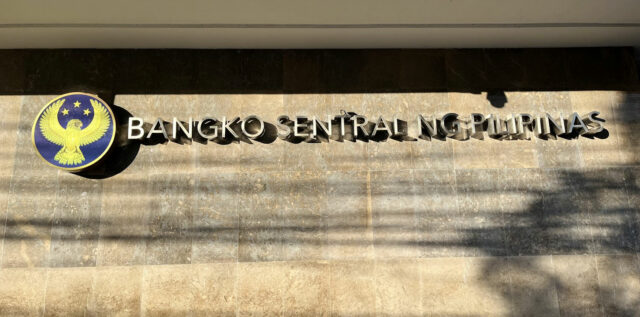
The main office of the Bangko Sentral ng Pilipinas in Manila. — BW FILE PHOTO

By Luisa Maria Jacinta C. Jocson, Reporter

THE BANGKO SENTRAL ng Pilipinas (BSP) will likely begin its policy easing cycle with a 25-basis-point (bp) cut in June, Bank of America (BofA) Global Research said.

In a report dated March 4, it said the BSP is expected to slash policy rates by a total of 100 bps this year, starting with a 25-bp cut in the second quarter. This would be followed by a reduction of 50 bps in the third quarter and 25 bps in the fourth quarter.

BofA Global Research said the first policy cut will be delivered in June as this would be “in sync with the Fed.”

“The Bank Indonesia (BI) and BSP are more sensitive to capital flows and foreign exchange movements, and should follow the Fed’s gradual easing cycle closely, facilitated by high real policy rates in both,” it added.

The Monetary Board has kept its benchmark rate steady at a near 17-year high of 6.5% for a third straight meeting in February.

From May 2022 to October, the BSP raised borrowing costs by 450 bps, making it among the most aggressive central banks in the region.

The Monetary Board is set to hold its next policy meeting on April 4.

BSP Governor Eli M. Remolona, Jr. in January said a rate cut in the first semester could be “too soon,” adding that the central bank remains hawkish despite easing inflation.

Markets are widely anticipating the US Federal Reserve to begin easing rates by midyear. The Fed raised its policy rate by 525 bps to 5.25-5.5% from March 2022 to July 2023.

Meanwhile, BofA Global Research said it expects Philippine inflation to stay “well within or below target” this year.

Inflation likely picked up to 3% in February, according to a BusinessWorld poll of 16 analysts. This would be slightly faster than the 2.8% print in January and mark the third straight month that inflation was within the 2-4% target range.

This would also be the first time since September 2023 that inflation picked up on a month-on-month basis.

The Philippine Statistics Authority (PSA) is scheduled to release February inflation data today (March 5).

ING Bank N.V. Manila Senior Economist Nicholas Antonio T. Mapa said the recent downgrade in the BSP’s risk-adjusted forecasts is a signal for room to begin policy easing.

“We note that even in the worst-case scenario, inflation is still tipped to slide within target, which would likely suggest that the BSP may not have needed that ‘insurance’ rate hike late last year,” he said in an e-mail.

“As such, it also points to a BSP having much space to reduce policy rates with real policy rates now at more than 3%,” he added.

The BSP lowered its risk-adjusted inflation forecast for this year to 3.9% from 4.2% at its February meeting, falling within its 2-4% target.

Union Bank of the Philippines, Inc. Chief Economist Ruben Carlo O. Asuncion said the decision to cut rates would depend on core inflation.

“While core consumer price index would not be spared the base effects, our monthly trajectory yielded a steady core path in the upper half (3-4%) of the BSP’s inflation target range. This year’s core average would ease to 3.5% from 6.6% in 2023,” he said in an e-mail.

“We reiterate the likelihood of core inflation (and its components) as less susceptible to the risk of high food price shocks from El Niño,” he added.

Mr. Asuncion also noted their “benign” core inflation projection was due to the expectation of below 6% gross domestic product (GDP) growth this year amid less robust domestic demand.

In January, core inflation, which excludes volatile prices of food and fuel, slowed to 3.8% from 4.4% in December. This was the first time that core inflation settled within the target after 17 months.

Philippines ranks 2nd highest in legal, economic gender equality in SE Asia

The Manila City Hall clock tower is illuminated in purple as part of the local government’s observance of International Women’s Month, March 3. — PHILIPPINE STAR/MIGUEL DE GUZMAN

LEGAL AND ECONOMIC gender equality in the Philippines is the second highest in Southeast Asia, the World Bank  said in a report.

In the World Bank’s Women, Business, and the Law (WBL) 2024 report, the Philippines got a score of 70 out of 100 under its expanded WBL 2.0 index. The WBL report assesses the laws and regulations that restrict economic opportunity and the gap between legal reforms and outcomes for women in 190 economies. A score of 100 indicates complete legal parity.

Among Southeast Asian economies, the Philippines was second only to Vietnam, which scored 85.

How do Filipinas fare in terms of legal gender equality?However, it was ahead of Singapore (65), Thailand and Indonesia (60), Malaysia (47.5) and Brunei (35).

The Philippines’ score was also above the global average of 64.2 and the East Asia and Pacific average of 57.8.

The 2024 report introduces new measurements to track progress toward legal gender equality, including a framework that measures the enabling environment for women’s economic opportunities.

The WBL 1.0 index covers indicators such as pay, mobility, workplace, marriage, parenthood, entrepreneurship, assets and pension, while the latest index adds safety from violence and access to childcare services.

The World Bank said the gender gap for women in the global workplace is “massive” and “much wider than previously thought.”

“Women have the power to turbocharge the sputtering global economy. Yet, all over the world, discriminatory laws and practices prevent women from working or starting businesses on an equal footing with men,” Indermit Gill, chief economist of the World Bank Group and senior vice-president for development economics, said in a statement.

“Closing this gap could raise global gross domestic product by more than 20% — essentially doubling the global growth rate over the next decade — but reforms have slowed to a crawl.”

Despite equal opportunity laws, the multilateral lender noted that women now enjoy less than two-thirds of the legal rights available to men, not three-quarters as previously reported. There were 37 economies that granted women less than half of the legal rights of men, with eight coming from the East Asia and Pacific region, according to the report,

The World Bank also noted that nearly all economies performed poorly in terms of safety and childcare.

“The weakness is greatest in women’s safety. The global average score is just 36, meaning women enjoy barely a third of the legal protections they need from domestic violence, sexual harassment, child marriage, and femicide,” it said.

Under the WBL 1.0 index, the Philippines’ score of 78.8 was unchanged for the third consecutive year. This was lower than Vietnam (88.1) and Singapore (82.5) but ahead of Thailand (78.1), Indonesia, (70.6), Malaysia (60.6) and Brunei (53.1).

Its score was also higher than the East Asia and Pacific as well as the global average of 73 and 77.9, respectively.

Anna Leah Colina, women coordinator of the Federation of Free Workers (FFW) said that the Philippines is unable to effectively implement laws promoting gender equality in the workforce.

“The legal framework may be there but… its implementation on the ground may fall short of what the law wants to achieve or protect,” she said by telephone.

She said many cases of gender discrimination and abuse against women go unreported.

“[In the Philippines,] the mobility of many women depends primarily on their economic independence, [which explains] why many females who are victims of violence and abuse cannot leave their [more self-sufficient but] abusive partners,” Ms. Colina said in Filipino.

There were 502 reported cases of violence against women from Jan. 1 to March 3, according to the Child Protection Network Foundation, Inc.

FFW’s Ms. Colina also said women get low-paying jobs due to perceptions that they are the “weaker” sex.

“For example, in food packaging… men would occupy the machine-related [jobs,] which are higher-paying than women, who occupy menial tasks like closing a box or tacking,” she said, citing FFW data from its own Women Workers Agenda report, set for release next month.

Ms. Colina added that the Philippines has yet to pass laws that cover informal economy workers, which make up 80% of the total workforce.

“When you classify where female workers are, they’re mostly in the informal sector,” she said.

FFW urged Congress to amend Presidential Decree No. 442 or the Labor Code to include informal economy workers, and approve the Magna Carta for Workers in the informal economy. Both bills are still pending at the committee level at the House of Representatives and the Senate. 

The World Bank report said women around the world face significant obstacles in entrepreneurship, pay, nationality rights and retirement.

“Women earn just 77 cents for every dollar paid to men,” it said.

To accelerate gender equality in business and law, the World Bank said countries should improve laws related to women’s safety, access to childcare and business opportunities; enact legal reforms that mandate equal pay for work of equal value; and implement legally binding quotas for women on corporate boards. — Beatriz Marie D. Cruz

Emerging markets’ assets at risk as more governments clash with central banks

BLOOMBERG

CENTRAL BANK INDEPENDENCE is becoming an increasingly key battleground in emerging markets (EM), and one that bodes ill for currency and bond investors.

The Thai baht has come under recurring pressure in recent weeks due to a standoff between the prime minister and policy makers over the timing of interest rate cuts. Hungary’s forint neared a one-year low versus the euro this past week amid a clash between Prime Minister Viktor Orban and the country’s central bank chief. Brazil’s real and the Turkish lira have long been whipsawed by the two countries’ leaders calling for lower borrowing costs.

“For investors, the autonomy of central banks is a pivotal consideration in the allocation of capital within EM currencies and sovereign debt,” said Rajeev De Mello, a global macro portfolio manager at Gama Asset Management SA in Geneva. “I prefer to invest in bonds and currencies of those countries that proactively addressed inflationary upticks and have been reticent towards markets where central banks are encumbered by political interference.”

Fractious relations between central banks and governments are nothing new. But the challenges facing the global economy, where the highest interest rates in decades are starting to crimp growth, mean tensions have ratcheted up to an unusually high level, flaring up even in developed countries.

Traders typically react to such conflicts by selling currencies. That’s because the standoffs tend to begin with a government pushing back against hawkish monetary policy, as the former prefer stimulating the economy over containing inflation. Lower rates and sustained price pressures then drive capital outflows and lower returns from currencies and bonds.

The baht has slumped by about 5% this year as Prime Minister Srettha Thavisin has stepped up pressure on the central bank to cut rates to cushion an economic slowdown. Mr. Srettha and his advisers have campaigned on television and social media to argue commercial banks are profiting from the unnecessary high rates.

Central bank Governor Sethaput Suthiwartnarueput has responded by saying rate cuts are no panacea for the structural problems plaguing the economy.

Traders took note by boosting pricing on a rate cut over the next six months, while global funds have pulled out $478 million from Thai bonds since the start of January, the biggest outflow in emerging Asia for economies that provide updated data.

‘SIGNIFICANT ATTACK’
In Hungary, the long-running feud deepened when central bank Governor Gyorgy Matolcsy warned on Thursday that Orban’s government was planning regulatory changes that represent a “significant attack”  against central bank independence. The comments hit the forint just two days after policy makers accelerated the pace of easing amid pressure to deliver more stimulus.

The planned legislation seeks to broaden the purview of the central bank’s supervisory board, which includes government appointees. It would allow the board to look into investments, including controversial foundations the central bank set up and which the European Central Bank has also scrutinized in the past.

The government said it respects central bank independence and only aims to boost transparency and prudent financial management in areas unrelated to monetary policy, according to a Facebook post by Finance Minister Mihaly Varga. Investors would be awaiting speeches from Orban, Economy Minister Marton Nagy and Finance Minister Mihaly Varga on Monday to see if they comment on tensions with the central bank.

POSSIBLE HOTSPOT
The next potential hotspot may be Indonesia, where the incoming president’s plans to boost spending risks widening the budget deficit and creating a conflict with the monetary authority.

“When people are already saying that there will be a potential risk to fiscal spending — i.e., higher fiscal spending — there could also be another push for cuts,” said Jerome Tay, an investment manager at Abrdn in Singapore. At the same time, Indonesia has inflation under control, so investors may not react too negatively if the central bank does cut rates, he said.

While conflict over central bank policy has been increasing in recent months, it has long been a part of the investment landscape.

“Question marks over central bank independence in emerging markets is just part of the game,” said Philip McNicholas, an Asia sovereign strategist at Robeco Group in Singapore. Politicians will always seek to pressure hawkish central banks as this will harm their re-election chances, he said. — Bloomberg

Making music in the social media era

Rising Filipino musicians talk strategies

LOLA AMOUR, a Filipino pop rock band known for hits like “Fallen” and “Raining in Manila,” is one of many rising local musicians who attribute their success to online audiences and even virality.

Social media, now cited as more integral to the music industry than ever, especially since the pandemic, has become a vital part of artists’ careers.

“It was during the pandemic that we began releasing online content regularly. We went viral twice — when we were sharing the story behind our song “Pwede Ba,” and when our song “Fallen,” released in 2021, went viral a year later, after someone posted a video of us performing it,” Pio Dumayas, vocalist of Lola Amour, said at a music event hosted by TikTok on Feb. 28.

Though the eight-piece band doesn’t tailor their music specifically for online audience’s tastes, they have learned to “strategize on how to present it,” he added.

As a short-form mobile video platform, TikTok recently launched the “TikTok Rising” campaign in the Philippines (after it was launched in other countries last year) just for musicians with a social media-savvy approach.

The campaign includes a #BehindTheSong hashtag, which hosts content from songwriters and music makers who want to share how they created their tracks, and the Music Tab that curates artists’ catalogs so that fans can easily explore the rest of their discography.

For indie pop artist TONEEJAY (full name TJ de Ocampo), known for hits like “711,” building a career on social media can be a double-edged sword.

“On one hand, you have a community of people, but there’s an aspect of wanting to be honest with what you’re going through, regardless of what others think,” he said. “It’s really tricky, but I think it’s not mutually exclusive.”

Mr. De Ocampo also described platforms like TikTok as having the role of “democratizing the music industry.”

“We don’t have a lot of resources to promote music because we’re not a corporate machine, but being online has helped us reach a target audience, a target market that is younger,” he added. “If you’re honest about who you are, all the other people who think like you will find you.”

Even the newest musician at the event’s roster of headliners, up-and-coming singer-songwriter Maki, knew that building confidence as a musician couldn’t come completely from online platforms.

“I remember when I released my first song, “Saan” from my Tanong EP, I didn’t expect it to be a big milestone … There was so much content and I always watched whenever a TikTok user would use the song,” he told BusinessWorld.

However, he first started off as an “overthinker” who would obsess over likes. “Now, I believe in my craft and share whatever personal fun stuff I want to share on Twitter. I also keep some things to myself,” Maki said.

Denise Julia, a Filipino R&B pop artist known for viral songs like “NVMD” and “B.A.D.,” recalled how she got branded “the patron saint of situationships,” referring to relationships with no labels, by talking about experiences with love.

“I feel like that’s really my way of connecting with fans,” she said at the event. “But honestly, I was scared because everything happened so fast. I was nervous because I wasn’t planning to go viral, so I was like, what am I going to do now that people know me?”

Ms. Julia found that, as a woman, a lot more words go around about her as an artist and as a person. “I cope with it by being with friends. With them I’m not my alter ego; I’m actually really sweet. With people who know me, I can let my guard down, let go of my persona, and detach from work as a public figure.”

After the four musicians discussed their approaches to making and promoting music, they discussed future projects as well.

Lola Amour will be releasing a song titled “Namimiss Ko Na” around mid-March while TONEEJAY revealed that he is in the middle of recording new music. Maki said that he hopes to one day collaborate with Denise Julia, who in turn is working on a new song called “Bet.”

Mr. Dumayas of Lola Amour told BusinessWorld before performing a set that night that what they all had in common was their “passion and authenticity.” “We make music the way we want, and we try to communicate it well,” he said.    Brontë H. Lacsamana

Actress Jaclyn Jose, 60

JACLYN JOSE in a scene from the film Ma’ Rosa for which she won the Best Actress award at the 2016 Cannes Film Festival.

JACLYN JOSE (née Mary Jane Guck), the only Filipina to have won an award from the Cannes Film Festival for Best Actress, passed away on March 2, according to her daughter, Andrea “Andi” Eigenmann.

In tears, Ms. Eigenmann, accompanied by her brother Gabby Eigenmann, said in a press conference at Arlington Memorial Chapels in Quezon City, “It’s with great sadness that I announce the untimely passing of my Nanay, Mary Jane Guck, better known as Jaclyn Jose, at the age of 60, on the morning of March 2nd, 2024, due to a myocardial infarction, or a heart attack.

“We’d like to thank everyone who has since extended their prayers and condolences to us, as our family is trying to come to terms with this unfortunate incident. Please provide us with the respect and privacy to grieve, and we hope that this would put all speculations to rest,” she said.

“I would just like to say that her undeniable legacy will definitely forever live on through her work, through her children, grandchildren, and the many lives she’s touched.

“She herself, her life itself, was her greatest obra maestra. Thank you.”

Talent agency PPL Entertainment Inc., which manages her career, had earlier confirmed the actress’ death on social media posts: “It saddens us to inform everyone of the untimely passing of Miss Jaclyn Jose (real name Mary Jane Guck). More details will be shared as soon as they are available. The Guck and Eigenmann families are requesting for everyone to please pray for the eternal repose of Miss Jaclyn Jose and for them to be allowed the respect and privacy to mourn her passing, and navigate these difficult times.”

Initial reports said that Ms. Jose had passed away on March 3, although her daughter, who spoke after the original reports came out, said she died on March 2.

Born the daughter of a stage performer and a US serviceman near Clark Air Base, Ms. Jose got her first taste of showbiz from working as an assistant for her sister, former actress Veronica Jones. She would eventually become an actress herself, starring in what were then called “bold” movies. She found critical recognition for performing in Lino Brocka’s White Slavery in 1986, for which she was nominated for a Gawad Urian.  She later earned her first Gawad Urian Best Actress award for her appearance in Takaw Tukso (1987) and kept bagging awards and nominations throughout the 1980s and ’90s.

Her acting chops were best displayed when playing fallen female characters toughened by circumstance. She made many memorable appearances on telenovelas, such as playing acid attack victim Magda in Mula sa Puso, and her last known role in another TV series, FPJ’s Batang Quiapo, where she played a hardened corrections officer.

Arguably though, her greatest acting achievement would be winning the Prix d’interprétation féminine (Best Actress Award) at the Cannes Film Festival in 2016 for her work in Ma’ Rosa, directed by Brillante Mendoza, with whom she frequently collaborated. In the film, she played a desperate small-time drug dealer. So far, she is the only Filipino to win the award.

Angel Locsin, who starred with Ms. Jose in various movie and television projects, shared clips of their scenes together on Facebook with the caption: “Your contribution to the entertainment industry will never be forgotten.”

Actress Dimples Romana’s Instagram post said: “Tita Jane, I remember all the laughter, the lessons you generously taught me as a young actor back when we were shooting this movie in 2001 and for our May Minamahal remake,” Ms. Romana wrote. “You will never be forgotten.”

In a Facebook post, alternative film director Raymond Red recalled working with Jose on the films Sakay in 1993 and Kamada in 1996 with Francis Magalona and Bembol Roco, and lamenting that despite saying that they would work together again, it did not come to pass.

Jose is survived by two children: celebrity Andrea “Andi” Eigenmann (with actor Mark Gil who passed away in 2014) and Gwen Garimond Guck (with musician Kenneth Ilagan). — Brontë H. Lacsamana and Joseph L. Garcia

ADVERTISEMENT
ADVERTISEMENT