Home Blog Page 3562

Cancer-causing chemical found in Clinique, Clearasil acne treatments, US lab reports

High levels of cancer-causing chemical benzene were detected in some acne treatments from brands including Estee Lauder’s Clinique, Target’s Up & Up and Reckitt Benckiser-owned Clearasil, said independent US laboratory Valisure.

Valisure has also filed a petition with the US Food and Drug Administration, calling on the regulator to recall the products, conduct an investigation and revise industry guidance, the New Haven, Connecticut-based lab said on Wednesday.

Estee Lauder shares dropped about 2% following the report. Benzene was also detected in Proactiv, PanOxyl, Walgreens’ WBA.O acne soap bar and Walmart’s WMT.N Equate Beauty acne cream among others, according to Valisure.

Target, Estee Lauder, Walmart and Reckitt RKT.L did not respond to Reuters requests for comment. The FDA has not yet responded to Valisure’s petition.

Benzene could form at “unacceptably high levels” in both prescription and over-the-counter benzoyl peroxide acne treatment products, Valisure said.

The carcinogen has already been found in several consumer products, including sunscreens, hand sanitizers and dry shampoo, leading to recalls of products made by companies including Procter & Gamble and Johnson & Johnson.

But the detection of benzene in the acne treatment products was “substantially different” from the other cases, Valisure said.

“The benzene we found in sunscreens and other consumer products were impurities that came from contaminated ingredients; however, the benzene in benzoyl peroxide products is coming from the benzoyl peroxide itself,” said Valisure Co-Founder and President David Light.

Valisure’s tests showed some products could form more than 800 times the conditionally restricted FDA concentration limit for benzene.

High levels of benzene were not only found in the acne products, but also in the air around incubated products, indicating that the carcinogen could leak out of some of the packages, posing a potential inhalation risk, Valisure said.

Bloomberg News had reported the development earlier in the day. – Reuters

Britain eyes new tax on vaping from 2026

STOCK PHOTO | Image by Trần Tiến Lộc Đỗ from Pixabay

 – British finance minister Jeremy Hunt said he is planning to introduce an extra tax on vaping products from October 2026, aiming to make the habit more expensive to deter non-smokers from taking it up.

Hunt said the government would introduce a one-off increase in tobacco duty at the same time to maintain the financial incentive to choose vaping over smoking.

“To discourage non-smokers from taking up vaping, we are today confirming the introduction of an excise duty on vaping products from October 2026 and publishing a consultation on its design,” Hunt said in his budget speech to parliament on Wednesday.

Many tobacco control advocates say vapes or e-cigarettes offer a way to reduce the death and disease caused by smoking. Others however point to health risks and concerns around a new generation of nicotine users.

Amid ever-stricter tobacco regulations and falling smoking rates in some markets, tobacco giants like British American Tobacco hope vapes will become an increasingly important revenue stream.

Jefferies analyst Owen Bennett said the tax could benefit larger players like BAT by making it harder for smaller players to compete.

“BAT, especially given its highly profitable broader cigarette business, can afford to swallow the tax and not adjust prices,” he said, whereas it could make smaller firms’ products unviable.

BAT’s shares were flat at 1451 GMT, while rival Imperial Brand’s were just over 1% higher.

A sharp rise in vape usage by non-smokers and young people has forced the British government – a relative proponent of vaping as a way to reduce the harms of smoking – to consider tougher controls.

Currently most vapes are subject to value-added tax at the standard 20% rate, but there is no extra levy applied.

Maggie Rae, president of the Epidemiology & Public Health Section of the Royal Society of Medicine, said any tax must be carefully considered to ensure it benefits public health.

“It’s imperative we ensure medicinal use of vapes continues to be encouraged, as smoking cessation remains the matter of greater importance,” she said. – Reuters

Egypt secures IMF deal after pound plunge, bumper rate hike

STOCK PHOTO | Image by DEZALB from Pixabay

 – Egypt secured on Wednesday an expanded $8 billion deal with the International Monetary Fund, hours after the central bank unshackled its currency and delivered a 600 basis points rate hike in a push stabilize the economy.

Additionally, Egypt secured another $1.2 billion loan for environmental sustainability, bringing its total loan from the IMF to more than $9 billion, the government and Fund officials said. This was towards the lower end of what some analysts had expected.

The currency weakened to beyond 50 Egyptian pounds to the dollar – far beyond previous records – from about 30.85 pounds, a level Egypt has for months tried to defend. It closed at 49.4 to the dollar.

A more flexible exchange rate had been a key demand of the IMF, which had been in talks with officials to expand the Fund’s current, $3 billion support program with Egypt.

Egypt has in the past said it would shift to a more flexible exchange rate, only to return to closely managing the currency whenever the pound weakened.

This time, it may be betting that hard currency inflows from investment projects, including a $35 billion investment deal signed in late February with the United Arab Emirates, will prevent a freefall.

Egypt has been suffering from a chronic shortage of foreign currency. The central bank said its actions were “backed by the steadfast support of multilateral and bilateral partners” and that “sufficient funding has been secured to avail foreign exchange liquidity”.

Egypt’s international bonds had soared in early trading in anticipation of the IMF deal, with longer-dated bonds jumping around 4 cents before shedding some of the gains. After the announcement of the $8 billion deal, bonds trimmed gains back further. By 1457 GMT, the 2047 bond was up 1.4 cents at 81.1 cent, according to Tradeweb data.

The premium demanded by investors to hold Egypt’s international bonds over safe-haven U.S. Treasuries tightened to as little as 529 basis points, its lowest level since June 2021, according to JPMorgan.

The central bank said it had raised the overnight lending rate to 28.25% and its overnight deposit rate to 27.25%, as part of a decision to accelerate monetary tightening and bring down inflation, which rose to record levels last year.

“To ensure a smooth transition, the CBE will continue to target inflation as its nominal anchor, allowing the exchange rate to be determined by market forces,” it said in a statement.


CLEARING BACKLOGS

The foreign currency shortage has curbed local business activity and led to backlogs at ports and delays in payments for commodities.

Remittances from Egyptians working abroad, the country’s top single source of foreign currency, have slowed sharply amid expectations that the pound would fall.

The war in Gaza and attacks by Houthis in Yemen on Red Sea shipping have put at risk receipts from tourism and Suez Canal traffic, two other key sources of hard currency.

“The unification of the exchange rate is crucial, as it facilitates the elimination of foreign exchange backlogs,” the central bank said.

Since early 2022, when the foreign currency shortage worsened, the pound has lost about half its value against the dollar in a series of staggered devaluations.

Though the central bank already had an inflation target, it also sought to manage the pound.

The announcement on Feb. 23 that Emirati sovereign fund ADQ will invest $24 billion in new money and convert $11 billion of existing deposits within two months for real estate development and other projects had eased pressure on the currency, with the black market rate strengthening to less than 50 pounds from more than 60 pounds previously.

On currency markets on Wednesday, one-month non-deliverable forwards stood at around 51 to the dollar – a touch above the spot rate – but 12-month contracts traded at just over 55 to the dollar, indicating the currency might have to adjust some more in the months ahead.

Another return to managing the exchange rate would limit the benefits of Wednesday’s decision, said Kaan Nazli, portfolio manager at Neuberger Berman.

“I guess the proof will be in the pudding, but there is a bigger chance than before thanks to the UAE funding,” he said.

Analysts say doubts remain over Egypt’s commitment to structural reforms that it has often put off, including reducing the state’s and the military’s sway over the economy.

Along with arrears to foreign companies, the country also faces a heavy foreign debt repayment schedule.

The banking system, including the central bank, had a net foreign asset deficit of 841 billion Egyptian pounds ($27.2 billion) as of Dec 31. – Reuters


Sam Altman’s iris-scanning Worldcoin temporarily banned in Spain

Source: Worldcoin Foundation | https://worldcoin.org/press

 – Spain has banned Sam Altman’s Worldcoin for up to three months amid perceived privacy risks from the venture which scans irises in exchange for a digital ID and free cryptocurrency.

Spanish data protection regulator AEPD said on Wednesday it demanded Worldcoin immediately cease the collection of personal information and stop using data it has already gathered.

The AEPD’s move came after several complaints regarding insufficient information, the collection of data from minors or withdrawal of consent is not allowed, the agency said.

Worldcoin did not immediately respond to a request for comment on the Spanish move. It has previously said that the biometric data is either deleted or stored in encrypted form, and that it is “committed” to working with regulators.

The Spanish regulator said the processing of biometric data, which has special protection under the European Union’s General Data Protection Regulation (GDPR), “entails high risks for people’s rights, taking into account their sensitive nature”.

It said in a statement that urgent measures temporarily prohibiting Worldcoin’s activities were justified “in order to avoid potentially irreparable damage”, adding that not acting would deprive people of the protection they are entitled to.

Neighbouring Portugal’s data authority said it was liaising with its counterpart in the German state of Bavaria while it analysed whether Worldcoin’s data processing complied with GDPR and said it was speaking with companies involved in the project.

More than 4 million people in 120 countries have signed up to have their irises scanned by Worldcoin’s “orb” devices, according to its website. But the project has drawn criticism from privacy campaigners from Argentina to Germany over the collection, storage and use of personal data.

Altman says its ID will allow users to, among other things, prove online that they are human, notably in a future world dominated by artificial intelligence.

Worldcoin is backed by some of the most prominent venture capital names, including a16z crypto and Bain Capital Crypto. – Reuters

Philippines chides China for ‘stirring up trouble’ in South China Sea

PHILIPPINE COAST GUARD/HANDOUT VIA REUTERS

 – A dramatic stand-off with Beijing in the South China Sea this week was the most serious incident yet for the Philippines, its top security officials said on Wednesday, vowing not to back down in asserting the country’s sovereign rights.

The Philippines has been incensed by what it calls repeated aggressive conduct by China’s coastguard, accusing its ships of using water cannon and blocking and harassing a Philippine resupply mission on Tuesday for troops stationed at the disputed Second Thomas Shoal.

The Philippines’ South China Sea task force said a top admiral was on board a vessel that was water cannoned by China’s coastguard, shattering its windshield and wounding four navy personnel. The admiral was unharmed.

“This is the most serious incident yet,” task force spokesperson Jonathan Malaya said, accusing China of “deliberately stirring up trouble” and “maliciously inciting hype”.

China accused the Philippines of intruding on its territory, claiming indisputable sovereignty over the reef, located 1,300 km (808 miles) off its mainland. China claims most of the South China Sea as its own, despite an international arbitration panel concluding that position had no basis under international law.

Philippine Defense Secretary Gilberto Teodoro on Wednesday said China’s claims were baseless and its actions this week were “patently illegal and downright uncivilized”.

“This claim is, simply put, one that no right-thinking state in the world agrees with and which many outright condemn,” Teodoro said in a statement.

“(Its) vain attempt to manufacture and sell this story falters in the face of real, incontrovertible facts.”


FLARE-UPS

Tuesday’s incident was the latest in a series of run-ins between the Philippines and China over disputed areas of the South China Sea, coinciding with a recent surge in defense activities between the militaries of Manila and Washington.

Australia and Southeast Asian nations on Wednesday called for restraint in the contested South China Sea and adherence to a “rules-based” order in the Indo-Pacific.

“We encourage all countries to avoid any unilateral actions that endanger peace, security and stability in the region,” they said in a joint statement after a three-day meeting.

A spokesperson for the Chinese foreign ministry said the situation was generally stable and China’s position on the Second Thomas Shoal was consistent and clear.

“We stand with our Philippine allies,” a Pentagon spokesman said on Wednesday, a day after the U.S. State Department reiterated its support and cited China’s “provocative actions.”

The Philippines and United States have a Mutual Defence Treaty binding them to defend each other if attacked, raising the stakes in a region where tensions have simmered for decades over Beijing’s claims to territory in the South China Sea, a key conduit for global commerce.

Philippine officials on Wednesday said invoking that pact would be a serious matter, although consultations were taking place between both countries.

Speaking while in Australia, however, Philippine President Ferdinand Marcos Jr said it was not the time nor reason to invoke the treaty, but the incident was being viewed “with great alarm”.

The Philippine foreign ministry said its embassy in China has issued a “demarche” or formal reprimand to its Beijing counterpart. – Reuters

Villar seeks six more years of RCEF, funding boost to P20B

CARDPH.COM

THE SENATOR who chairs the chamber’s agriculture and food committee expressed her support for a six-year extension of the Rice Competitiveness Enhancement Fund (RCEF), with funding raised to P20 billion a year.

“(Another) six years. (We plan to change) some aspects of the law,” Senator Cynthia A. Villar told reporters at the sidelines of a poultry industry conference on Wednesday.

The RCEF is intended to modernize the rice industry and is funded by import tariffs generated as a result of Republic Act 11203, or the Rice Tariffication Law.

The fund supports the supply of machinery, seed, and fertilizer, among others to farmers. The rice tariffs support RCEF to the tune of P10 billion annually. The tariff allocations are set to expire in June.

The law, which took effect in 2019, allowed private traders to bring in rice shipments without restriction. At the time, they had to pay a 35% tariff on Southeast Asian grain.

Ms. Villar added that changes being planned for the extension period include a dedicated budget for water impounding and to support organic fertilizer production.

Magdagdag kami sa water impounding facilities at dagdagan ang composting machines to make organic fertilizer para may regular na budget para doon (we will add provisions to fund water impounding and composting),” she said.

Ms. Villar added that she is proposing an increase in annual RCEF funding to P20 billion, also funded by tariffs collected by the Bureau of Customs (BoC).

The Philippines collected P30 billion in rice tariffs in 2023, according to the BoC.

Executive Order No. 50, signed by President Ferdinand R. Marcos, Jr., extended the lowered tariff regime for rice imports, which was at 35% for shipments both within or over the minimum access volume quota.

Ms. Villar added that she will seek approval of the RCEF extension by June. — Adrian H. Halili

House committee approves RBH on charter economic amendments

PHILIPPINE STAR/KJ ROSALES

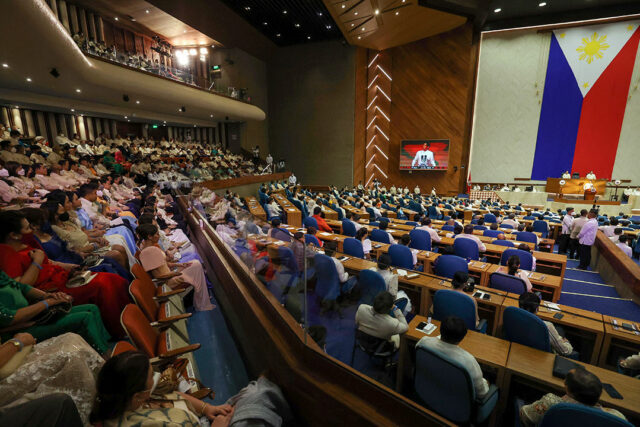
THE HOUSE Committee of the Whole approved on Wednesday Resolution of Both Houses (RBH) No. 7 via voice vote, paving the way for amendments to the Constitution’s economic provisions to move forward.

House Deputy Majority Leader Neptali M. Gonzales II said that the House deliberations on liberalizing economic provisions of the Constitution are on track.

The House seeks to approve the proposed constitutional amendments before the Easter break on March 23.

On the last day of RBH deliberations, legislators heard arguments from the Department of Foreign Affairs, a representative of which testified that foreign ownership limits in the Constitution violate World Trade Organization (WTO) rules on equal treatment and restrict government participation in free trade deals.

Undersecretary Jesus Gary S. Domingo told the panel reviewing RBH 7 that the foreign-ownership restrictions in the charter run counter to the national treatment exception rules of the WTO.

Under WTO rules, economies are allowed to make exceptions regarding foreign entry for industries like media and aviation. Mr. Domingo said, “But not economy-wide restrictions.”

“The WTO principles recognize the right of members to regulate foreign investments for prudential reasons, but no blanket restriction bans,” he said in his statement to the committee.

Mr. Domingo said the principles of non-discrimination promoted by the United Nations (UN) are also meant to protect foreign companies and investors.

“Non-discrimination, a core UN principle outlined in agreements and charters such as the Universal Declaration of Human Rights, applies to discrimination against foreign companies and investors,” he told the panel.

The WTO also promotes the principle of progressive liberalization of markets to allow the entry of foreign entities and investors, increasing their market participation over time, he added.

Mr. Domingo also said economic integration in Southeast Asia has been hindered by the Constitutional limits on foreign participation.

“The trend in ASEAN (Association of Southeast Asian Nations) is towards regional economic integration,” he said. “It is very difficult to harmonize our policies and activities given that our neighbors have liberal investment regimes,” Mr. Domingo said.

“If the phrase ‘unless otherwise provided by law’ is added… Congress would have control over lifting restrictions (via) regular legislation,” he added. “The addition of the suggested phrase provides flexibility.”

Former Finance Secretary Margarito B. Teves said that “removing these restrictive provisions in our Constitution would send a clear and compelling message to foreign investors” that their investments are welcome in the Philippines.

“Our investment environment should be at par with our ASEAN counterparts to be more competitive in attracting foreign direct investment,” he said. “Removing the restrictive provisions in the Constitution will enable the Philippines to have the flexibility to adjust quickly to changing international and domestic economic conditions,” he added.

Emmanuel Santos, an economist for the South Australia state government, noted that Vietnam has recently overtaken the Philippines in per capita gross domestic product (GDP) due to its economic liberalization in 1986.

“In 1985, the Philippine per capita GDP was three times that of Vietnam,” he said. “But due to their opening up through the Doi Moi economic reforms of ‘86, they have finally overtaken us 35 years later.”

Mr. Santos also included in his discussion the need for an affordable and reliable domestic power distribution system to allow industries uninterrupted operations that could spur economic growth.

“Our energy-intensive industries are not able to thrive as a result of high energy costs,” he said. “Highest (electricity costs for consumers) in the region, double that of Vietnam.”

Electrical distribution expenses in the Philippines account for 30% of the charge paid by consumers. — Kenneth Christiane L. Basilio

Marcos expects to reap benefits from Australia’s pivot to Southeast Asia

NOEL PABALATE/ PPA POOL

PRESIDENT Ferdinand R. Marcos, Jr. said on Wednesday that he is looking forward to a bigger Australian footprint in the region in the wake of Canberra’s economic pivot to Southeast Asia to better leverage the free trade agreement (FTA) which it and New Zealand signed with the Association of Southeast Asian Nations (ASEAN).

In a speech at the Asean-Australia special summit in Melbourne, Mr. Marcos also invited Australia to invest in the Philippines’ green-economy initiatives.

Mr. Marcos was quoted as saying by his press office in Manila that he looks forward to Australian participation in developing Philippine agriculture, infrastructure, health, tourism and the digital economy.

Australia’s Southeast Asia Economic Strategy to 2024 seeks to broaden and deepen Canberra’s economic ties with ASEAN.

Mr. Marcos noted the signing by his government last month of the second protocol to the FTA among ASEAN, Australia, and New Zealand, which he said would benefit micro, small and medium enterprises (MSMEs) and boost the digitalization efforts of member countries.

The second protocol boosts MSMEs’ participation in international trade by “improving their access to markets and participation in the global value chains, as well as promoting the use of e-commerce,” he said. 

The FTA should be responsive to “multidimensional challenges in the business environment and complement region-to-region efforts to strengthen supply chain resilience.” 

Like the Philippines, Australia is a member of the Regional Comprehensive Economic Partnership, thought to be the world’s largest FTA.

Mr. Marcos, meanwhile, reiterated the Philippines’ offer to host the Board of the United Nations’ Loss and Damage Fund, which was approved last year. 

“Hosting the Board in the Philippines would showcase global commitment to inclusivity, ensuring that the voices and experiences of the most affected countries are heard and considered in shaping the most urgent of global climate policies,” he said. 

Mr. Marcos also urged Australia to pursue more green projects with the Philippines.

In 2022, the Philippines amended the implementing rules and regulations of the Renewable Energy Act of 2008 to allow 100% foreign ownership of renewable energy projects. — Kyle Aristophere T. Atienza

PSEi tracks Wall Street dip as inflation picks up

BW FILE PHOTO

By Revin Mikhael D. Ochave, Reporter

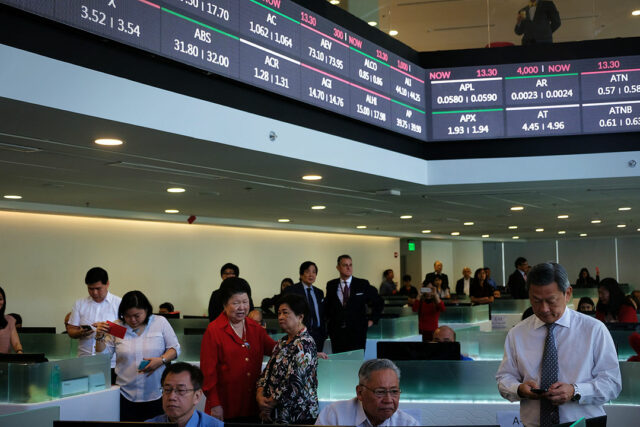
PHILIPPINE stocks fell for the second straight day on Wednesday, tracking Wall Street’s decline overnight and after consumer prices picked up last month.

The bellwether Philippine Stock Exchange index (PSEi) dropped by 0.39% or 26.92 points to close at 6,878.54. The broader all-share index fell by 0.46% or 16.68 points to 3,587.59.

“Negative cues from Wall Street overnight weighed on sentiment,” Philstocks Financial, Inc. Research Analyst Claire T. Alviar said in a Viber message. Investors also continued to digest inflation, which quickened to 3.4% in February, she added.

US stocks closed lower on March 5, with the Dow Jones Industrial Average index dropping by 1.04% or 404.64 points to 38,585.19. The S&P 500 index fell by 1.02% or 52.30 points to 5,078.65; the Nasdaq Composite index declined by 1.65% or 267.92 points to 15,939.59; and the New York Stock Exchange index dipped by 0.45% or 79.21 points to 17,669.49.

On Tuesday, the Philippine Statistics Authority said inflation accelerated from 2.8% in January amid rising prices of food, particularly rice, though it was slower than 8.6% a year earlier.

Jovis L. Vistan, president at AB Capital Securities, Inc., attributed the local bourse’s decline to investors booking profits.

“Stocks experienced a period of profit-taking, exacerbated by the recent release of February’s inflation figures, which surpassed expectations,” he said in a Viber message. “The market’s vulnerability was further compounded by technical corrections in major global markets, which have been lingering near all-time highs.”

“Additionally, many investors are adopting a cautious stance, awaiting crucial US job data that will shed light on the trajectory of US interest rates,” he added.

Almost all sectoral indices closed lower on Wednesday.

Industrials fell by 1.29% or 118.58 points to 9,077.02, while property declined by 0.71% or 20.46 points to 2,862.79. Holding companies lost 0.52% or 34.29 points to 6,534.06, while services shed 0.45% or 8.02 points to 1,763.94. Mining and oil dropped by 0.35% or 30.49 points to 8,516.77.

The financial subindex gained 0.79% or 15.79 points to 2,006.39.

“Among the index members, Puregold Price Club, Inc. was at the top, increasing by 1.65%, while Century Pacific Food, Inc. lost the most by 5.07%,” Ms. Alviar said.

Value turnover fell to P4.85 billion with 503.78 million shares switching hands compared with 425.75 million stocks worth P5.37 billion on Tuesday.

Decliners beat advancers 104 to 78, while 58 stocks were unchanged. Net foreign buying fell to P50.33 million from P308.84 million on Tuesday.

Peso strengthens after hawkish comments from BSP governor

BANGKO SENTRAL ng Pilipinas Governor Eli M. Remolona, Jr. — COURTESY OF BANGKO SENTRAL NG PILIPINAS

By Aaron Michael C. Sy, Reporter

THE PHILIPPINE peso strengthened against the dollar on Wednesday after hawkish comments from the central bank governor.

It closed at P55.87 a dollar, eight centavos stronger than Tuesday, according to data posted on the Bankers Association of the Philippines website.

The peso opened at P55.93, which was also its weakest showing. It appreciated to as much as P55.85 against the greenback.

Dollars exchanged went up to $905.5 million from $821.65 million on Tuesday.

The peso was supported by hawkish signals from the central bank, Michael L. Ricafort, chief economist at Rizal Commercial Banking Corp., said in a Viber message.

“The peso also strengthened after the gauge of the US dollar versus major global currencies slightly eased further to new one-month lows,” he added.

Bangko Sentral ng Pilipinas (BSP) Governor Eli M. Remolona, Jr. on Wednesday said it was too soon to declare victory against inflation.

Inflation quickened to 3.4% last month from 2.8% in January and 8.6% a year ago. It was above the 3% median estimate in a BusinessWorld poll of 16 analysts last week but within the central bank’s 2.8-3.6% forecast.

This was the first time that inflation picked up month on month since September. For the first two months, it averaged 3.1%, within the BSP’s 2-4% annual target.

“I can’t say that we’re going to ease soon,” Mr. Remolona said at a media briefing. “It’s unlikely that we will tighten it some more, but we’ll see what the data say.”

The Monetary Board raised its benchmark interest rate by 450 basis points to a near 17-year high of 6.5% from May 2022 to October 2023.

“The peso strengthened as the softer US service report for February raised concerns about the health of the US economy,” a trader said in an e-mail.

The growth slowed in February amid a decline in employment, but a measure of new orders increased to a six-month high, pointing to underlying strength in the sector, Reuters reported.

The Institute for Supply Management (ISM) said its nonmanufacturing Purchasing Managers’ Index (PMI) slipped to 52.6 last month from 53.4 in January.

A reading above 50 indicates growth in the service industry, which accounts for more than two-thirds of the US economy. Economists polled by Reuters had forecast the index to be little changed at 53.

The trader expects the peso to weaken to Thursday due to some caution ahead of US Federal Reserve Chairman Jerome H. Powell’s testimony before the US House of Representatives.

The trader sees the peso to trade from P55.75 to P56 a dollar, while Mr. Ricafort expects it at P55.80 to P56.

Agricultural trade deficit narrows in Q4 to $3.02B

BW FILE PHOTO

THE DEFICIT in the trade of agricultural goods declined 6.6% year on year to $3.02 billion in the fourth quarter, according to preliminary data issued by the Philippine Statistics Authority (PSA).

In a report, the PSA said that the overall trade in agriculture — or the sum of exports and imports — slipped 0.9% to $6.27 billion during the quarter, a reversal of the 5.1% growth posted a year earlier.

Agricultural imports, which accounted for 14.7% of overall imports for the period, dropped 2.9% to $4.78 billion during the quarter.

Cereals remained the top agricultural import during the quarter, accounting for 22% of the total, or $1.02 billion.

Agricultural imports from the Association of Southeast Asian Nations (ASEAN) amounted to $1.67 billion, or 17.8% of all farm shipments.

“Vietnam was the leading supplier of agricultural products to the Philippines among ASEAN member countries. It contributed $479.29 million, or 28.6%, to the country’s total value of agricultural imports from ASEAN,” the PSA said.

Meat and edible meat offal were the top imports from the European Union (EU) during the fourth quarter.

“Agricultural imports from EU member countries amounted to $391.29 million or 19.7% of the total value of imports in the fourth quarter,” it added.

During the quarter, Spain was the Philippines’ top supplier of agricultural commodities, with its shipments valued at $101.5 million.

The PSA reported that exports of farm goods increased 5% to $1.63 billion during the period.

“In the fourth quarter, the value of agricultural exports accounted for 8.8% of total exports,” it added.

The leading exports were edible fruit and nuts, as well as peel of citrus fruit and melons, valued at $501.12 million or 30.8% of the total.

Exports to ASEAN during the fourth quarter totaled $204.31 million, equivalent to 7.2% of farm exports for the period.

Tobacco and manufactured tobacco substitutes were the top exports during the quarter.

Malaysia remained the top buyer of Philippine farm products with $52.02 million.

“Exports of agricultural goods to EU member countries in the fourth quarter of 2023 reached $270.81 million, which (accounted for) 13.6% of all exports to the EU, the PSA said.

The Netherlands remained the top buyer of agricultural goods within the EU. It purchased $270.81 million or 13.6% of Philippine farm exports to the region.

Animal or vegetable fats and oils and their cleavage products, prepared edible fats and animal or vegetable waxes remained the top agricultural exports to the EU. — Adrian H. Halili

DoE studying SC ruling authorizing emergency takeover of oil companies

PHILSTAR

THE Department of Energy (DoE) said it is determining how to proceed after the Supreme Court (SC) confirmed that the department has the power to temporarily take over the downstream oil industry during national emergencies.

In a statement on Wednesday, the DoE said that it will study the ruling with the Department of Justice (DoJ) and the Office of the Solicitor General and take necessary steps to ensure that any takeover of oil companies “is properly exercised whenever needed.”

In a 37-page decision, the SC sitting en banc upheld the constitutionality of Section 14 (e) of Republic Act No. 8479 or the Downstream Oil Industry Deregulation Act of 1998.

The SC ruling reversed the 2013 decision issued by the Court of Appeals (CA), which had declared the provision unconstitutional.

The provision states that “in times of national emergency, when the public interest so requires, the DoE may, during the emergency and under reasonable terms prescribed by it, temporarily take over or direct the operation of any person or entity engaged in the industry.”

“All told, Section 14 (e) of RA 8479 is a proper delegation of takeover power to the Department of Energy. Absent any actual proof from respondents that the exercise of this provision has caused it harm or injury, we hold that the challenge claiming the provision unconstitutional must fail,” the SC said.

The Court’s decision was promulgated on Feb. 21, but made public only on March 4.

“The DoE is committed to implementing Section 14(e) of the said law as the public interest may require in times of national emergency, in accordance with the Constitution and the applicable laws and consistent with the President’s intent or instructions,” the DoE said.

The DoE said it will work “to maximize and diversify sources of energy” as well as enhance their distribution and availability to the public at reasonable prices.”

The case arose from the petition filed by Pilipinas Shell Petroleum Corp. before a regional trial court, challenging the validity of Executive Order No. 839 issued by then-President Gloria Macapagal-Arroyo and a provision in RA 8479.

EO 839 directed the oil industry to freeze prices of their petroleum products during the state of calamity brought about by Tropical Storm Ondoy and Super Typhoon Pepeng in 2009.

Shell filed a petition for prohibition, mandamus, and injunction against former Executive Secretary Eduardo R. Ermita, the joint task force of the DoE and DoJ, and the late Energy Secretary Angelo Reyes.

The petition asserted that “these formed an unreasonable, oppressive, and invalid delegation of emergency powers to the Executive.”

In 2010, the lower court issued a decision granting Shell’s amended petition and declared the provision void. This was affirmed by the CA in 2013 and also denied the appeal of the respondents.

In its decision, the SC cited Section 17 of the 1987 Constitution, which allows for the temporary takeover of the operations of privately-owned public utilities or businesses imbued with public interest during emergencies.

It also cited Section 23 which states that Congress may grant the President temporary emergency powers for a limited period. The President may then delegate responsibilities to government agencies.

Asked to comment, Manuel S. Castañeda, Jr., media relations and internal communications manager of Shell, said that the company has received the copy of the SC’s decision and is “still assessing our next steps.”

Bienvenido S. Oplas, president of the free market think tank Minimal Government Thinkers, said that the decision sends a “very bad signal” to the oil industry and potential entrants.

“The consumers are worse off under price control. Same will happen in government taking over of business (in whatever sectwor) due to national ‘emergency’ that can be arbitrarily imposed and implemented,” he said in a Viber message.

Michael L. Ricafort, chief economist at Rizal Commercial Banking Corp., said “safeguards must always be in place to avoid abuse.” — Sheldeen Joy Talavera

ADVERTISEMENT
ADVERTISEMENT