Home Blog Page 3558

Meralco sees decline in generation charge for March

MANILA ELECTRIC Co. (Meralco) is expecting a decrease in power cost from suppliers this month, the company’s spokesman said on Wednesday.

“While we have yet to receive all the billings from our suppliers, initial indications show lower generation charge this March,” Joe R. Zaldarriaga, Meralco spokesperson and vice-president for corporate communications, said in a Viber message.

The generation charge mostly makes up the bulk of a consumer’s monthly electricity bill.

Mr. Zaldarriaga attributed the potential decline to lower power prices in the Wholesale Electricity Spot Market (WESM) and resumption of operations of the 455-megawatt power plant of San Buenaventura Power Ltd. Co.

San Buenaventura Power is a partnership between the Meralco PowerGen Corp., a subsidiary of Meralco, and New Growth B.V., a subsidiary of Thailand-based Electricity Generating Public Co. Ltd.

The average WESM price system-wide dropped to P3.91 per kilowatt-hour (kWh) in early February as supply outpaced demand, according to the Independent Electricity Market Operator of the Philippines.

“Also contributing to this expected decrease is the refund of incremental Malampaya gas charges under the new Gas Sale and Purchase Agreements (GSPA) as recently directed by the Energy Regulatory Commission (ERC),” he said.

In February, the power distributor implemented an increase from P11.3430 per kWh to P11.9168 per kWh on higher generation charge due to increases in the costs from independent power producers and power supply agreements.

Meralco said that the price of Malampaya gas to Sta. Rita power plant climbed by nearly 12% following the signing of new GSPA between First Gas Corp. and Malampaya consortium.

The ERC has instructed Meralco to complete validation of the costs to justify the rate adjustment.

Meralco has estimated that the refund would range between four to five centavos per kWh.

“We are hoping that this reduction in the generation charge will be able to temper the anticipated increase in transmission charge due to higher ancillary service charges,” Mr. Zaldarriaga said.

Meralco’s controlling stakeholder, Beacon Electric Asset Holdings, Inc., is partly owned by PLDT Inc.

Hastings Holdings, Inc., a unit of PLDT Beneficial Trust Fund subsidiary MediaQuest Holdings, Inc., has an interest in BusinessWorld through the Philippine Star Group, which it controls. — Sheldeen Joy Talavera


DMCI Holdings income drops 20% to P24.9 billion

DMCI Holdings, Inc. announced on Wednesday a 20% decrease in its 2023 consolidated net income to P24.9 billion, mainly due to the normalizing prices of utilities.

Consolidated revenues dropped by 14% to P122.8 billion in 2023 from P142.6 billion the previous year, led by stabilizing coal, nickel, and electricity prices, a slowdown in construction and real estate activities, and a surge in revenue reversals stemming from the cancellation of real estate sales, DMCI Holdings said in a stock exchange disclosure on Wednesday.

Meanwhile, consolidated revenues dropped by 14% to P122.8 billion in 2023 from P142.6 billion the previous year, led by stabilizing coal, nickel, and electricity prices, a slowdown in construction and real estate activities, and a surge in revenue reversals stemming from the cancellation of real estate sales, as stated by DMCI Holdings in a stock exchange disclosure on Wednesday.

In the fourth quarter, DMCI Holdings saw a 36% increase in its consolidated net income to P4.7 billion from P3.5 billion. The conglomerate’s revenues rose by 8% to P30.4 billion on higher coal exports.

“We saw sharp corrections in commodity and energy prices in 2023 but because our businesses did very well in terms of production and sales volume, we managed to prevent a severe decline in our profitability,” DMCI Holdings Chairman and President Isidro A. Consunji said.

According to the company, the Average Newcastle and Indonesian Coal Index 4 prices dropped by 64% and 26%, respectively, while Philippine Freight on Board nickel price (for 1.3% Ni) fell by 30%.

It said that the average effective spot settlement price for all grids across the Philippines declined by 18%.

For full-year 2023 results, DMCI Holdings said it observed higher net income contributions from its real estate, off-grid energy, and water utility businesses, while lower contributions were observed from integrated energy, nickel, and construction subsidiaries.

Semirara Mining and Power Corp. saw a 30% drop in its contribution to P15.8 billion due to the combined effect of all-time high coal shipments and electricity sales amid stabilizing prices.

DMCI Homes contributed 2% higher core earnings to P4.6 billion led by better selling prices and higher income from rental and forfeiture fees.

 DMCI Power’s contribution rose by 29% to P959 million from P742 million on higher gross generation and electricity dispatch.

D.M. Consunji, Inc. had a 2% drop in net income to P573 million due to lower project accomplishments on fewer ongoing projects.

Contribution of DMCI Mining fell by 49% to P655 million on the back of lower nickel prices and higher shipping costs.

Meanwhile, DMCI Holdings’ affiliate Maynilad Water Services, Inc. contributed P2.1 in earnings, a 42% jump from P1.5 billion on higher water production, billed volume, and adjusted tariff. The conglomerate has a 25% stake in Maynilad.

DMCI Holdings shares fell by 2.94% or 34 centavos to P11.22 apiece on Wednesday. — Revin Mikhael D. Ochave

San Miguel’s food and beverage unit says net income climbs 10%

SAN MIGUEL Food and Beverage, Inc. (SMFB) saw a 10% increase in its 2023 net income to P38.1 billion, driven by stronger sales, the Ang-led company announced on Wednesday. 

SMFB’s consolidated sales improved by 6% to P379.8 billion on better volumes and pricing strategies, the company said in a regulatory filing.

The company’s earnings before interest, taxes, depreciation, and amortization (EBITDA) also climbed by 7% to P66.8 billion.

“We’re determined to build on our gains and continue finding ways to excite and delight our markets…,” SMFB President and Chief Executive Officer Ramon S. Ang said.

Net income of SMFB’s beer division rose by 16% to P25.3 billion while EBITDA rose by 9%.

Consolidated sales of SMFB’s beer division rose by 8% to P147.3 billion led by stronger demand in the local and international markets. However, domestic sales volumes are still 25% below pre-pandemic levels.

Domestic sales rose 8% to P131.7 billion. International revenue grew by 7% led by higher demand for the company’s global brands like Red Horse, which resulted in growth for exports as well as in areas such as South China and Thailand.

SMFB’s spirits division saw a 55% increase in net income to P7 billion while EBITDA climbed by 41% to P9.4 billion. Revenues also rose by 13% to P53.6 billion.

“This was driven by efforts to enhance brand equity through consistent advertising, consumer promotions, and expanding market reach,” SMFB said.

Meanwhile, the company’s food division saw a slight drop in its net income and EBITDA to P6.6 billion and P18.3 billion, respectively. Its revenues rose by 2% to P178.8 billion.

SMFB said the food division  had a slight decline in financial performance despite the challenges faced by its poultry segment such as capacity constraints and pressure from imported frozen chicken that impacted prices and overall performance.

“This was achieved through strategic pricing adjustments across segments, complemented by aggressive marketing to stimulate demand,” SMFB said.

On Wednesday, SMFB shares closed unchanged at P50.50 apiece. — Revin Mikhael D. Ochave

PHINMA net income hits P1.63 billion

LISTED conglomerate PHINMA Corp. saw a 6.5% increase in its 2023 net income to P1.63 billion from P1.53 billion the prior year due to higher revenues across its business units.

In a regulatory filing on Wednesday, PHINMA Corp. said its consolidated revenues rose by 20% to P21.27 billion while consolidated core net income improved by 40% to P1.67 billion.

 “PHINMA’s stronger financial results were driven by the sustained growth in the education business which continued to see enrollment growth, along with the construction materials group (CMG) and PHINMA Property Holdings Corp.’s efforts to improve cost efficiency,” the conglomerate said.

 “The hospitality business likewise took advantage of the continued recovery in domestic travel and events, particularly in the Mall of Asia area,” it added.

 PHINMA Education Holdings, Inc. posted a P1.19-billion consolidated net income and P5.44 billion in consolidated revenues last year. The company saw an 18% increase in enrollment for the first semester of school year 2023-2024 at 146,546 students across the Philippines and Indonesia.

 “PHINMA Education remained steadfast in its commitment to provide accessible quality education to the affordable segment,” it said.

 PHINMA’s CMG, consisting of Union Galvasteel Corp., Philcement Corp., and PHINMA Solar Corp., saw a combined net income of P430.95 million and combined revenues of P13.27 billion in 2023.

 Union Galvasteel recorded a surge in sales volumes as construction activities rebounded in the second half of 2023, while Philcement implemented various cost-saving initiatives and strategic pricing amid the highly competitive environment.

 For its part, PHINMA Solar secured 58 projects totaling 9.39 megawatt peak in the government’s Green Energy Auction Program.

 PHINMA Property Holdings Corp. recorded a P281.99-million consolidated net income for the second half of 2023, which offset the P63.87-million net loss in the first half.

 In July last year, PHINMA Corp. increased its ownership of PHINMA Property Holdings to 76.81% from 40.1%.

 Meanwhile, PHINMA Corp.’s consolidated net earnings of Coral Way, PHINMA Hospitality, and PHINMA Microtel reached P26.56 million in 2023. The net earnings included the equitized net income in Coral Way worth P5.25 million during the first half of 2023.

 PHINMA Corp. acquired PHINMA Hospitality and PHINMA Microtel shares in July last year.

 “Coral Way benefited from the resurgence of conventions, events and corporate bookings in the Mall of Asia area,” PHINMA Corp. said.

 In a separate stock exchange disclosure, PHINMA Corp. said its board approved the appointment of Edmund Alan A. Qua Hiansen as the conglomerate’s chief financial officer (CFO) effective April 1.

 Aside from being PHINMA Corp.’s CFO, Mr. Hiansen holds concurrent positions as vice-president – finance for the PHINMA Construction Materials Group companies, chief financial officer of Song Lam Cement Joint Stock Co. and deputy chief finance officer of PHINMA Prism Development Corp.

On Wednesday, PHINMA Corp. shares rose by 2.46% or 48 centavos to P19.98 per share. — Revin Mikhael D. Ochave

PHL sets world record for number of pork dishes

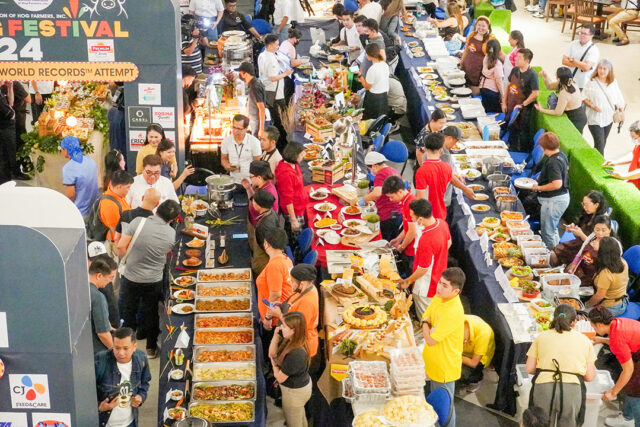
A SCENE from the National Hog Festival in Quezon City.

Record-breaking attempt was part of effort to revitalize the pork industry

A NEW Guinness World Record has been set in Quezon City. On March 1, the National Federation of Hog Farmers, Inc. set the world record for the Most Variety of Pork Dishes on Display during the National Hog Festival.

The Guinness World Records, founded in 1955, is a reference for the world’s extremes: the most, the biggest, the longest. Some of their records that have involved the Philippines include a record for the most people brushing their teeth simultaneously (2007); and quite recently, the record for the largest human mattress dominoes (2335 in 2023). And most infamously, before the entry was placed under review (still accessible through https://tinyurl.com/3fmxktpm), the record for the greatest robbery of a government, set by dictator Ferdinand Marcos.

“The minimum is 300,” said Guinness World Records Official Adjudicator Sonia Ushiroguchi during the attempt to set the world record in Gateway Mall 2 in Araneta City. “Today, we have 341 dishes,” she said, which was greeted with cheers. However, she asked for a bit of quiet to make something clear — “We have 341 dishes that were submitted,” and this time, she was greeted with groans. “I know. I’m very happy that everyone is so passionate here. However, we have some disqualifications.

“Some of the dishes did not meet the guidelines. We have 28 dishes that did not meet the guidelines. So, with a total of 313, we have a new Guinness World Record! Congratulations!”

The crowd cheered, and Jan Buenaflor, Project Director for the National Hog Festival, the record attempt, and a member of the Ways and means Committee of the National Federation of Hog Farmers. burst into tears. In an interview with BusinessWorld, she said, “I am very, very happy. I’m actually [at a loss] for words.

“It’s very touching that we gathered all these people together to showcase their pork dishes. I’m very, very happy,” she said.

Participants included schools like National University – Dasmarinas, the University of Perpetual Help System, Perpetual Help College of Manila – College of International Hospitality Management, the Lyceum of the Philippines University – Manila, and the Manuel S. Enverga University Foundation, which collectively contributed 100 dishes.

Institutional partners like Robina Farms, Universal Robina, Del Monte, and restaurants such as Tung Lok Seafood, Mango Tree Café, Bacolod Chicken Inasal, Mesa, Tim Ho Wan, Pound Flatterie, Hawker Chan, Cabalen, Tindeli, and Vikings, also submitted entries.

Don’t ask us what we ate: we had more than 300 of them to go through.

Ms. Buenaflor said that the guidelines included using a minimum of three kilograms of pork per dish, multiplied by 313 (which comes out to 939 kilograms, a bit more than a ton of pork).

“The reason why we did this attempt is because we wanted really to showcase (not only) the culinary expertise of these people, but it’s because Filipinos love pork,” she said.

More than that, the world record attempt was made as an effort to revitalize the hog industry, in recovery since the African Swine Flu (ASF) outbreak in 2019, and the COVID-19 pandemic of 2020. “During ASF, talagang marami kaming nawalan ng hanapbuhay (a lot of us lost our livelihoods),” she said. “During the time when ASF happened, we really wanted to increase the per capita consumption of pork. Gusto naming manumbalik muli ang sigla ng pagbababoy (we want to return the vigor of hog raising),” she said.

In a story from BusinessWorld, “Pork inventory seen sufficient until first quarter of 2024,” it said that “Philippine pork production is expected to hit 925,000 metric tons representing a 5% downgrade of a previous forecast due to the continued presence of ASF in top producing regions,” according to the US Department of Agriculture. “We need more support, kailangan marami ulit ang mag-alaga (we need more people to raise pigs)… we have to do repopulation,” said Ms. Buenaflor.

Still, she said, “Walang imposible sa taong nangangarap ng bongga-bongga (nothing is impossible for a person with big dreams).”

Meanwhile, Ms. Ushiroguchi told BusinessWorld, “Any record that brings so many people together to work to make the world a more fun, positive, and interesting place deserves a place in the Guinness World Records.” — Joseph L. Garcia

TDF yields dip as inflation falls within forecast

BW FILE PHOTO

YIELDS on the Philippine central bank’s term deposits fell on Wednesday, with the seven- and 14-day tenors both oversubscribed as February inflation remained within forecast.

Demand for the term deposit facility (TDF) hit P303.661 billion, higher than the P270 billion on the auction block. Bids last week reached P190.891 billion against a P210-billion offer.

Tenders for the one-week term deposits reached P170.144 billion, more than the P150-billion offer. Last week, bids hit P115.931 billion against a P120-billion offer.

Banks asked for yields ranging from 6.53% to 6.57%, narrower than 6.51% to 6.85% at the Feb. 28 auction. The average rate of the seven-day debt fell by 0.33 basis point (bp) to 6.5617% from last week.    

Meanwhile, the 14-day deposits attracted P133.517 billion in bids, higher than the P120 billion sold by the Bangko Sentral ng Pilipinas (BSP). Last week, tenders hit P74.96 billion against the P90 billion on offer.

Accepted rates for the two-week debt ranged from 6.5745% to 6.6150%, lower than 6.575% to 6.625% last week. This caused the tenor’s average rate to dip by 0.03 bp to 6.5951%.

The BSP has not auctioned off 28-day term deposits for more than three years now to give way to its weekly sale of securities with the same tenor.

The central bank term deposits and 28-day bills are used to mop up excess liquidity in the financial system and to better guide market rates.

Term deposit yields went down as inflation remained within the central bank’s forecast despite picking up in February, Michael L. Ricafort, chief economist at Rizal Commercial Banking Corp., said in a Viber message.

Inflation quickened to 3.4% last month from 2.8% in January and 8.6% a year ago. It was above the 3% median estimate in a BusinessWorld poll of 16 analysts last week but within the central bank’s 2.8-3.6% forecast.

This was the first time that inflation picked up month on month since September. For the first two months, it averaged 3.1%, within the BSP’s 2-4% annual target. — Aaron Michael C. Sy

Nikkei’s new surprises

NIKKEI’S Hamachi Nigiri Sushi — INSTAGRAM.COM/NIKKEIPH

NIKKEI’S name is pretty straightforward: it’s the name for Japanese migrants in Peru, which means the restaurant will be serving Japanese-Peruvian cuisine.

Although the fusion of Japanese and Peruvian influences has been around for over 100 years since the late 19th century, not to mention its appearance in fashionable dining spots worldwide like Nobu, what greeted us at a tasting on Feb. 28 in Greenbelt’s Nikkei Robata (part of the Nikkei group of restaurants) was still a pleasant surprise. The restaurant presented a refreshed menu, developed with the help of two Japanese-Peruvian chefs, Renato Kanashiro and Jorge Tomita, co-owners of Shizen in Peru.

The late lunch’s wheels were greased by a Sake Sangria, with Havana Club 3 Years, sake, lychee syrup, orange juice, apple juice, and ginger syrup. The diverse set of flavors ranging from earthy to fruity, opened up the tastebuds, so our tongues were prepared for whatever else they had to offer.

The meal started with a selection of Tiradito (a Peruvian dish slightly resembling sashimi, but splashed with Peruvian dressings and spices). We then consumed the Usuzukuri, including an anonymous catch of the day, rocoto topping, tobiko, ponzu, and chili oil. It had a great texture, balanced heat, and vivid citrusy flavors. We had fun with the Kiiroi, with fish, and yellow chili sauce, and something else the chef drizzled in front of us, its lingering sharply herbal drops on the plate we had to spoon. We had the Yokai (salmon, batayaki parmesan, and rocoto leche de tigre), and the luxurious Bigmac (tuna, foie gras, truffle oil, garlic, and eel sauce), both of them displaying indulgent flavors, but a certain respect for the integrity of the fish’s flavor.

The Kazan (crab meat, avocado, furai prawn, parillero sauce, batayaki, and eel sauce) had an excellent sweetish taste of crab punctuated by a well-rounded kick. We also remember the Navajas (razor clams), and the Conchas Bataparme (scallops) which had sweetish and indulgent flavors. The meal ended with very rich udon noodles with sea urchin, garlic, and cilantro (Nikkei Yaki Udon); and then creamy rice with Smoked Seafood (Kai Meshi).

Mr. Kanashiro, one of the chefs from Peru who worked on the menu, acknowledged the seafood-centric nature of the menu. “We have a really rich coast,” he said about Peru, so seafood, much like it is in Japan, is very accessible.

He also makes a point about the convergence of the cuisines, a result of the stories of people’s movements across time and the ocean. “Peruvian and Japanese ingredients make a really nice fusion. Japanese soy sauce with Peruvian peppers go really well (together),” he said. “It has been so organic, so natural.” To that point, he points at a tattoo on his arm, bearing the crest of their restaurant, Shizen, which means “nature” in Japanese. “We want to feel that it (the seafood) was caught just minutes ago,” a point, we feel, they successfully made.

Perhaps the reason for Nikkei cuisine’s ability to satisfy the Filipino palate is the mixture of Latin American, European, and Asian influences that are marked in the story of both Nikkei people and Filipinos. Mr. Kanashiro pointed out that in the meals he has eaten in the Philippines, he has found counterparts in Peruvian cuisine, like Sinigang (sour soup), arroz caldo (spicy rice porridge), and kare-kare (peanut-based stew). “We’re really hoping that Filipinos understand and get familiar with these Peruvian flavors,” he said.

Meanwhile, Nikkei group co-founder Jackie Lorenzana (she shares the title with her husband Carlo), talked about the reason for the refreshed menu. “For some reason, we had evolved the Japanese menu part of it further, but the Peruvian side of it kind of, like, lagged. Probably because we have not exactly visited Peru in a long time,” she said.

The first Nikkei concept opened in 2015. Expansion plans for the group include the opening of another version of their BGC Terraza Martinez in Shangri-La Plaza, as well as another version of Nikkei in the same site (it will combine their traditional Japanese and sake bar concept Sakagura with Nikkei), as well as locations in Makati’s Poblacion and in surfing spot Siargao in Surigao. These are all set for completion by August. “It’s not something like really planned sometimes, it just falls into place. You have the right concept; the right location,” she said.

Nikkei has locations in Greenbelt 3 and in Legazpi Village. — Joseph L. Garcia

MPIC says income surges 89.7% to P19.9 billion

METRO PACIFIC Investments Corp. (MPIC) is expecting a double-digit profit for 2024 after its attributable net income surged to P19.92 billion last year, its chairman said on Wednesday.

“All of our core business segments performed consistently well in 2023. Meralco’s power generation business is becoming a steady contributor to its growth with promising expansion opportunities in the pipeline, traffic on our toll roads under MPTC (Metro Pacific Tollways Corp.) is rising by double digits, and Maynilad is benefiting from the catch-up of delayed tariff increases,” Manuel V. Pangilinan, MPIC chairman, president, and chief executive officer, said during a briefing.

MPIC’s 2023 attributable net income, which includes nonrecurring items, climbed by 89.7% to P19.92 billion from P10.5 billion last year as all of its business segments such as power, toll roads, and water business posted growth, Mr. Pangilinan said.

Among its core business segments, power pushed MPIC’s growth as its Manila Electric Co. (Meralco) had a 62% share in its net operating income of P15.2 billion, while MPTC, the company’s toll road business, had a P5.79 billion share and water at P4.38 billion. 

To recall, Meralco’s core net income, which includes one-time charges, ballooned to P37.1 billion in 2023, marking a 37% increase from the same period a year earlier. 

MPTC’s core net income expanded by 2% to P5.8 billion on revenue growth, said Chaye Cabal-Revilla, MPIC’s chief finance officer.

Maynilad Water Services, Inc.’s core net income also went up by 51% to P9.1 billion on lower operating costs.

In 2023, MPIC’s operating revenues went up to P61.33 billion, 20.5% higher than the P50.88 billion revenues in the same period in 2022. 

Its group-wide aggregate revenues for the full year of 2023 grew by 7% to P553.3 billion from P519.2 billion in the same period a year ago.

CAPEX
For 2024, MPIC is setting aside P140 billion for its capital expenditure (capex) budget, mainly for its power business, Ms. Revilla said. 

The company has allocated about P41 billion for Meralco, P31.4 billion for Maynilad, and P28 billion for MPTC, she said.

Its target budget will be funded by a combination of loans and internally generated funds.

“We are working hard to make 2024 another banner year for MPIC and our operating companies on the expectation that greater private sector participation in infrastructure development will help propel our nation to higher growth in the near term and further ahead,” Mr. Pangilinan said. 

For this year, MPIC is anticipating a double-digit income growth fueled by its power business.  

“Power will still contribute consistently,” Ms. Revilla said.

MPIC is one of the three key Philippine units of Hong Kong-based First Pacific Co. Ltd., the others being Philex Mining Corp. and PLDT Inc.

Hastings Holdings, Inc., a unit of PLDT Beneficial Trust Fund subsidiary MediaQuest Holdings, Inc., has a majority share in BusinessWorld through the Philippine Star Group, which it controls. — Ashley Erika O. Jose

Women’s work: time to recognize their critical role in agriculture — and invest in it!

TUAN ANH TRAN-UNSPLASH

DESPITE women’s significant contributions to our agrifood systems in the Asia-Pacific region, women continue to face persistent obstacles, including limited access to resources, services, and discriminatory practices all along the food value chain. As we gather to celebrate this year’s International Women’s Day (IWD), it is time for action, to fully recognize women’s indispensable role in the fields, in the factories, and those running small- and medium-sized companies, associations, and cooperatives — all of which produce the nutritious food we eat each day.

But recognizing and acknowledging this is not enough. In Asia and the Pacific, there is a critical need for financial investments to achieve gender equality in agrifood systems. This would play a huge role in the region’s agrifood systems transformation — now underway across the region — a transformation endorsed by 40 Food and Agriculture Organization (FAO) Member Nations at the recently convened FAO Regional Conference for Asia and the Pacific, in Colombo, Sri Lanka.

This year’s IWD theme, “Invest in Women. Accelerate Progress,” underscores the urgency not only to increase investments but also to ensure better investments for creating an enabling environment and sustainable results toward gender equality.

While the importance of investing in women’s economic empowerment is well-established, financial investments, specifically those geared towards gender equality within the economic and productive sectors, have remained inadequate. This underinvestment has contributed to insufficient progress in advancing women’s economic empowerment and hindering women’s opportunities in agrifood systems. According to FAO data from 2023, by narrowing the gender gap in farm productivity, and the wage gap in agrifood system employment, the world’s gross domestic product would rise by 1% (nearly $1 trillion). This would also reduce global food insecurity by about two percentage points, decreasing the number of food-insecure people by 45 million.

So, what can we, collectively, do to bridge this financial investment gap? In addressing this question, it is imperative to thoroughly review both traditional and innovative financial and policy instruments. Gender Responsive Budgeting (GRB) is a key approach, but it is essential to recognize the wide array of strategies available for investing in women. We need to hear more from women, we need to learn from their past successes and focus on impact by accelerating investment. This should create space for development partners, including rural women and their communities, to share experiences and join forces to create a realistic chance of achieving the 2030 agenda, where gender equality is essential.

While addressing visible gender gaps is crucial, efforts to promote the voice and leadership of women, and tackle the root causes of gender-based inequalities, are equally important for ensuring long-term results.

FAO TAKES ACTION TO ‘WALK THE TALK’
To “walk the talk,” at the FAO headquarters in Rome, the Director-General, Dr. QU Dongyu, recently announced the establishment of an Office for Youth and Women. Building on the work of the Women’s Committee, the Office will continue, among other things, to provide a “safe space” to discuss topics affecting women in the Organization, such as gender parity, sexual harassment, and parental leave provisions. The Office will also promote advocacy, communication, innovation, and outreach through regular dialogue forums to better connect female colleagues around the globe, exchange experiences on specific themes of common interest, and learn from successes from the FAO and other organizations in empowering women in the workplace and beyond. And it will further strengthen visible leadership and accountability of managers for gender mainstreaming through its “She Matters” initiative geared at fostering transformational leadership for women’s empowerment and the welfare of female staff at all levels of the Organization.

Worldwide, we see that discriminatory norms often expect women to take on most of the unpaid care work, exacerbating gender disparities in labor markets — both rural and urban. Globally, women dedicate 3.2 times as many hours to unpaid care work as men do. But in the Asia and Pacific region, the ratio is four-to-one. There is a need for acknowledgement, alleviation, and equitable distribution of unpaid care labor, as well as better and more accessible care systems. This will help to foster transformative changes to support families, urban as well as rural, in enhancing their livelihoods and wellbeing.

But we need to take that critical step beyond fostering and supporting. We need to invest in the technical and leadership skills of women to support their entrepreneurship and income generation, including the creation, and strengthening, of existing networking and learning platforms.

The FAO’s Regional Gender Strategy and Action Plan for Asia and the Pacific has identified the need to mobilize the participation of both men and women to transform our agrifood systems through an equitable distribution of responsibilities. Creating inclusive spaces for dialogue and reflection is vital for empowering women and reshaping power dynamics across different levels. Farmer Field Schools and relevant actions targeted at women are supported by the FAO in field projects as an inclusive approach to engage both men and women.

The FAO is committed to closely collaborating with its Member Nations and development partners in Asia and the Pacific to achieve gender equality in a sustainable agrifood systems transformation. Gender equality is indeed a collective endeavor, and we all have a part to play in advancing towards achieving gender equality and empowerment of all women and girls — one of the SDGs (SDG5). As we reflect on this International Women’s Day, let us not only recognize the challenges but also reaffirm our commitment to action. Let us unite our efforts, amplify our voices, champion change, and “Invest in Women. Accelerate Progress” towards a more equitable and sustainable agrifood systems transformation.


Jong-Jin Kim is the assistant director-general and regional representative of the Food and Agriculture Organization (FAO) of the United Nations.

48 HOURS: Tokyo street eats with Shake Shack’s Randy Garutti

DONKI.COM

TORONTO — Randy Garutti knows street food: He been Shake Shack’s chief executive officer since its inception as a hot dog cart in New York’s Madison Square Park.

But when Mr. Garutti visits Tokyo, which boasts seven of the country’s 13 Shake Shack locations, he makes sure to sample all aspects of traditional Japanese cuisine.

The following interview with Mr. Garutti, who plans to retire in 2024, is edited and condensed.

Where I Go First

My favorite place to start my trip is going immediately to Tonki (1 Chome-1-2 Shimomeguro) in Meguro — a multi-generational restaurant specializing in tonkatsu (fried pork cutlets).

It’s kind of like going to Katz’s Deli (for pastrami) when you’re in New York: the simple dedication to one amazing product is a hallmark of Japanese food, and Tonki is such a pleasure.

Where I Stay

Tokyo hotels are notoriously expensive and small, so no matter where you want to stay, it’s always a struggle. The Marriott in Shinagawa (4 Chome-7-36 Kitashinagawa) provides the best value for a large hotel and business setting.

It’s not the most convenient location for central Tokyo, but it’s close enough and a quick Tokyo Metro ride gets you where you need to go.

Best Place For Team Meetings

Most people would say the large hotels. But I prefer to find a small coffee shop or, in good weather, a great park like Gaien (1-1 Kasumigaokamachi) or near the Emperor’s Palace. Do it outside.

Worthwhile Tourist Trap

Bill’s for pancakes. Crazy lines, but years of hype make it a fun experience (2-6-12 Okura House 12F, Ginza).

Getting Around

Metro is the only answer. It’s so easy, cheap, clean, respectful and fun. But don’t walk in the wrong direction — Tokyo is about respect. Following the rules on the Metro and in the stations is essential.

The same is true, of course, for the bullet trains when you travel outside of Tokyo. It’s almost never worth driving or taking a taxi if you can avoid it.

Coffee Spots

Find a back alley, small, independent coffee shop and you can’t go wrong. I like to head to Cat Street in Omotesando and see who’s brewing.

But I also must admit that Blue Bottle (4 Chome−1−6 NEWoMan Shinjuku 1F) does an incredible job in Tokyo.

Insiders Only

Many of the best restaurants are not open to the public and can be found on upper floors of random buildings. Some of the greatest yakitori (skewered chicken), teppanyaki (food cooked on a metal plate) and other favorites can be found in hidden places — you’ve got to have Japanese friends to help.

Dinner Splurge

Going all-in on sushi. The best places have eight seats at the sushi bar, and that’s it.

If you’re not into sushi, my favorite yakiniku (Japanese barbecue) is Kirakutei (Minato City).

For yakitori, go to Hachibei (Roppongi 7-4-5 B1F, Minato-ku).

Biggest Misconception

Tokyo can be wildly expensive, but it doesn’t have to be. Some of my favorite meals and experiences are neighborhood ramen restaurants where you can eat for a few bucks. 

Best Memory

I finally got to bring my family for a recent trip. Touring with my wife and children around Tokyo and then spending time in the mountains in Hakone, the temples of Kyoto and so much more are my favorite memories.

Favorite Souvenir

Unfortunately, the Tsukiji fish market moved to a new location years ago, but the old market neighborhood is still robust for great meals and for shopping. I always find amazing Japanese pottery, plates, bowls, tea sets, and knives to bring home in the side streets.

Can’t-Miss Treats

For cheap and fun snacks, Don Quijote (various locations). It is kind of like a dollar store, but so much more. They have every snack available, including every flavor of Kit Kat imaginable. You might even find the really hard-to-get Japanese whiskeys on the upper floors.

Another fun excursion is Harajuku. Get whatever crazy crepe, cotton candy or other trend is hitting Takeshita street.

Shopping

My go-to store is Akomeya (various locations) for incredible food, housewares, and other options.

After that, go to the basement of any of the large department stores in Ginza and other neighborhoods. There are hundreds of incredible food options, souvenirs, and, of course, fashion on the upper floors. But first be prepared to indulge downstairs. — Reuters

PLDT secures P1-B green loan for fiber upgrade, expansion

PLDT Inc. has secured its first green loan at P1 billion from HSBC Philippines to fund the expansion and upgrade of its fiber network, the telecommunications company’s chief financial officer said on Wednesday.

“The availability of sustainable financing facilities will help PLDT’s commitment to ensuring long-term profitability by doing business responsibly,” Danny Y. Yu, PLDT’s chief financial officer and chief risk management officer, said in a stock exchange disclosure.

“We are pleased to start this journey with HSBC and anticipate further expanding our sustainable financing portfolio with other sustainability projects,” he added.

The project aims to support the company’s internet delivery platforms like fiber fixed broadband, mobile data services, and carrier-grade Wi-Fi, PLDT said.

Green loan is a form of financing allowing borrowers to use the proceeds to fund eligible green projects.

“The intended use of loan proceeds aligns with the Green Loan Principles, specifically on achieving energy efficiency. Studies show that compared with previous technologies, fiber cables generate less heat and no longer require cooling systems, thus, very minimal energy is lost to the environment,” PLDT said.

The listed telecommunications company said the fiber upgrade and expansion will help PLDT to reduce its carbon emissions, moving closer to its decarbonization goal.

Fiber technology generates less energy thus allowing the company to lessen its power requirements.

“PLDT’s first-ever Green Loan facility is affirmation that our efforts to pursue the twin goals of energy efficiency and reduced carbon emissions are appreciated and supported by the financial community. We are thankful to HSBC for helping PLDT carry out our commitment of stewardship of the planet for the next generation,” said Melissa Vergel De Dios, chief sustainability officer of PLDT.

To date, the company has a total of 1.1 million cable kilometers of fiber infrastructure.

At the local bourse on Wednesday, shares in the company closed P9 or 0.7% higher to end at P1,290 apiece.

Hastings Holdings, Inc., a unit of PLDT Beneficial Trust Fund subsidiary MediaQuest Holdings, Inc., has a majority stake in BusinessWorld through the Philippine Star Group, which it controls. — Ashley Erika O. Jose

‘Buy Now, Pay Later’ to spur gadget sales this year — UnaCash

LAZADA
LAZADA

ELECTRONICS AND GADGETS bought online are expected to grow by 7.9% to P397.7 billion this year, partly driven by banks’ “Buy Now, Pay Later” (BNPL) promotions, financial solution provider UnaCash said on Wednesday.

Food and beverage items are alco expected to benefit, with sales projected to increase by 11% to P114.1 billion, followed by appliances at P100 billion (10%) and fashion and beauty at P93.5 billion (8.5%), it said in a statement.

“The development of BNPL in the Philippines will be closely tied to e-commerce,” Erwin G. Ocampo, UnaCash product head, said in the statement.  “Online purchases of electronics, gadgets, furniture and home appliances reflect the dynamic nature of the online retail sector, making 2024 seem like a fruitful time for solution providers like UnaCash.”

The company 12% of Filipino internet users avail themselves of BNPL promos when shopping online.

It said fashion dominated the products bought online by Filipinos at 65%, followed by beauty and personal care (47%) and food and beverage (35%).

Electronics, gadgets and physical media had the largest market share at 45%, followed by food and personal hygiene (25%), furniture and appliances (16%) and fashion (10%).

UnaCash noted that as of February, 70.17% of purchases made through it were for electronics and gadgets.

This matched a Visa survey that showed 61% of respondents had used BNPL to buy electronics and gadgets, while 55% used it to buy fashion products.

“This matches with the key online shopping categories, displaying the natural synergy between BNPL and e-commerce,” UnaCash said.

It added that the growth of BNPL use will continue to be aligned with consumer preference for online shopping. — Aaron Michael C. Sy