Home Blog Page 3556

Struggling Spurs stun Golden State Warriors

KELDON JOHNSON scored 22 points and grabbed 11 rebounds and Jeremy Sochan and Malaki Branham added 20 points each as the visiting San Antonio Spurs rolled to a 126-113 win over the Golden State Warriors on Saturday in San Francisco.

The game was the first of a pair of home-and-home clashes between the teams over a three-day period, with the second contest on Monday in San Antonio.

The Spurs took charge midway through the first quarter and steadily pulled away, leading by 19 points at halftime and by 17 after three quarters as they weathered an early second-half run by Golden State.

San Antonio snapped a two-game losing streak but, at 14-50, are still at the bottom of the Western Conference standings. The teams were without their star players, as both the Warriors’ Stephen Curry and the Spurs’ Victor Wembanyama missed the game with respective ankle injuries.

San Antonio’s Devin Vassell (left hip contusion) also sat out.

Dominick Barlow scored 19 points and Julian Champagnie had 17 — both season-highs — for San Antonio. Tre Jones finished with 11 assists.

Klay Thompson had 27 points for Golden State while Jonathan Kuminga scored 26, Trayce Jackson-Davis and Andrew Wiggins scored 11 apiece and Chris Paul added 10 points.

The Warriors dropped their second straight and third of their past four games. The first quarter went back and forth and featured nine lead changes, with the Warriors going up by as many as two points before San Antonio leapfrogged to the front.

Mr. Sochan had 10 points in the period and Mr. Johnson scored seven as the Spurs carried a 32-27 advantage after the opening 12 minutes of play. The Spurs expanded their lead to 56-38 on a layup by Zach Collins with four minutes to play the second quarter.

Mr. Thompson responded with a jumper and then a 3-pointer to cut the deficit to 13, but San Antonio quickly answered. Mr. Champagnie hit a three-pointer and Mr. Collins added another with 45.3 seconds left to give the Spurs a 62-43 lead at the break.

Mr. Sochan led all scorers with 16 points before halftime while Johnson chipped in 10 for San Antonio. Mr. Thompson’s 13 points off the bench paced the Warriors. — Reuters

Lakers pull out a win vs Bucks

The Lakers appeared to be cooked heading into their set-to against the Bucks the other day. It wasn’t simply that they had just come off their second setback in three outings. It was that they had to take the measure of the surging Bucks sans leading scorer and playmaker LeBron James, sidelined due to a recurring left ankle injury. Prior to a stumble at Chase Center, the visitors had reeled off six straight victories that featured a renewed commitment to defense care of new head coach Doc Rivers.

As things turned out, the Lakers were, at the very least, prepared to keep pace. If nothing else, the closeness of the match from start to finish was a testament to their intrinsic competitiveness. Displaying the same tenacity that enabled them to defeat the rival Celtics on the road without James (and, it must be said, Anthony Davis) last month, they traded shots and stops until the final moments. And, under the circumstances, it’s no coincidence that D’Angelo Russell picked up the slack.

For a while there, it looked as if the Lakers’ efforts would still not be enough to put them over the top. Davis suffered a strain on his left shoulder after he tried to take a charge against the barreling Giannis Antetokounmpo near the end of the third quarter, rendering him all but immobile the rest of the way. After his normal rest to start the final canto, he managed to post a mere two points (off charity shots to boot) and two boards. That said, he did succeed in playing decoy and wound up with three crucial dimes to help their cause.

Needless to say, the Lakers would not have been able to eke out the triumph on the slimmest of margins without Russell’s heroics. While Austin Reaves did well to finish with 18, five, and seven, he was, without doubt, the difference maker; when the final buzzer sounded, he had to his name a career-high 44 (on 17-of-25 shooting from the field, including nine of 12 from three), six, and nine. He proved to be nothing short of otherworldly in the last minute and change of the contest, when the Bucks were already casting moist eyes on a favorable outcome. And it was, perhaps, only fitting that new acquisition Spencer Dinwiddie would preserve his heroics with an outstanding block against Damian Lillard to foil what could have otherwise been the game winner.

To be sure, a single win, no matter how inspiring, does not solve the Lakers’ problems. For all their exertions, they’re a measly half game out of the last play-in slot in West standings. And with James and Davis questionable from day to day, they will need to continue being greater than the sum of their individual parts. How well they do that, with or without their All-Stars, will determine their fate.


Anthony L. Cuaycong has been writing Courtside since BusinessWorld introduced a Sports section in 1994. He is a consultant on strategic planning, operations and human resources management, corporate communications, and business development.

Pope Francis says Ukraine should have courage of the ‘white flag’

ANNETT KLINGNER-PIXABAY

ROME — Pope Francis has said in an interview that Ukraine should have what he called the courage of the “white flag” and negotiate an end to the war with Russia that followed Moscow’s full-scale invasion two years ago and that has killed tens of thousands.

Pope Francis made his comments in an interview recorded last month with Swiss broadcaster RSI, well before Friday’s latest offer by Turkish President Tayyip Erdogan to host a summit between Ukraine and Russia to end the war.

Mr. Erdogan made the fresh offer after a meeting in Istanbul with his Ukrainian counterpart Volodymyr Zelensky. Mr. Zelensky has said while he wants peace he will not give up any territory.

The Ukrainian leader’s own peace plan calls for the withdrawal of Russian troops from all of Ukraine and the restoration of its state borders. The Kremlin has ruled out engaging in peace talks on terms set by Kyiv.

A spokesman for Mr. Zelensky did not immediately respond to a request for comment on the pope’s remarks.

In the interview Francis was asked for his position on a debate between those who say Ukraine should give up as it has not been able to repel Russian forces, and those who say doing so would legitimise actions by the strongest party. The interviewer used the term “white flag” in the question.

“It is one interpretation, that is true,” Pope Francis said, according to an advance transcript of the interview and a partial video made available to Reuters on Saturday. It is due to be broadcast on March 20 as part of a new cultural program.

“But I think that the strongest one is the one who looks at the situation, thinks about the people and has the courage of the white flag, and negotiates,” Pope Francis said, adding that talks should take place with the help of international powers.

“The word negotiate is a courageous word. When you see that you are defeated, that things are not going well, you have to have the courage to negotiate,” Pope Francis said.

It was believed to be the first time Francis has used terms such as “white flag” or “defeated” in discussing the Ukraine war, although he has spoken in the past about the need for negotiations.

In a statement, Vatican spokesman Matteo Bruni said the pope had picked up on the term “white flag” spoken by the interviewer and used it “to indicate a stop to hostilities (and) a truce achieved with the courage of negotiations”.

Last year the 87-year-old pope sent a peace envoy, Italian Cardinal Matteo Zuppi, to Kyiv, Moscow and Washington to sound out leaders in those countries.

“One may feel shame,” Pope Francis said about negotiating, “but how many dead will it (the war) end up with? (One should) negotiate in time, find a country that can be a mediator,” Francis said, mentioning Turkey among the countries that had offered.

“Do not be ashamed of negotiating, before things get worse,” said Francis, who has made hundreds of appeals for what he calls “martyred Ukraine.” Asked if he was willing to mediate, Francis said “I am here.”

In another part of the interview, speaking of the war between Israel and Hamas, Francis said: “Negotiating is never a surrender.”ß

Last month Mr. Zelensky said that 31,000 Ukrainian soldiers had been killed since the Russian invasion in February 2022 and that tens of thousands of civilians had been killed in the occupied areas of the country. — Reuters

Biden makes contradictory comments on Gaza ‘red line’ in MSNBC interview

REUTERS

WASHINGTON — US President Joseph R. Biden said in an MSNBC interview on Saturday that Israel’s threatened invasion of Rafah in southern Gaza would be his “red line” for Prime Minister Benjamin Netanyahu but then immediately backtracked, saying there was no red line and “I’m never going to leave Israel.”

In a somewhat contradictory exchange with his interviewer, Mr. Biden said “they cannot have 30,000 more Palestinians dead as a consequence of going after” Hamas militants.

Mr. Biden and his aides have urged Mr. Netanyahu in strong terms not to launch a major offensive in Rafah until Israel crafts a plan for mass evacuation of civilians from the last area of Gaza it has not yet invaded with ground forces. More than half of Gaza’s 2.3 million people are sheltering in the Rafah area.

“There’s other ways to deal, to get to, to deal with … the trauma caused by Hamas,” Mr. Biden said, referring to the Islamist group’s Oct. 7 rampage in southern Israel in which 1,200 people were killed.

Asked whether an Israeli invasion of Rafah would be a red line for him with Netanyahu, Biden said: “It is a red line but I’m never going to leave Israel. The defense of Israel is still critical. So there’s no red line (in which) I’m going to cut off all weapons so they don’t have the Iron Dome to protect them.”

Mr. Biden insisted, however, that Mr. Netanyahu “must pay more attention to the innocent lives being lost as a consequence of the actions taken.”

He reiterated his call for a six-week ceasefire for hostage releases and aid delivery, though negotiations appear to have stalled.

Asked whether a ceasefire could still be reached before the Muslim holy month of Ramadan, which begins on or around March 10, Biden said: “I think it’s always possible. I never give up on that.” — Reuters

Monaco and UAE are among the best countries for expats

MONACO has the most expensive real estate in the world. — BALINT PORNECZI/BLOOMBERG

THE United Kingdom (UK) announced Wednesday that it would scrap its non-dom status, which allows people who live there but have permanent residency abroad to avoid taxes on their foreign assets for 15 years.

The overhaul of a system that has provided preferential treatment for wealthy foreigners comes as the growing wealth gap in many western countries is pushing some to restrict tax and citizenship benefits aimed at expats. Portugal last October announced plans to get rid of its non-habitual resident program, a policy that let foreigners pay lower income and pension taxes than locals for 10 years.

So where can expats from the UK and other places go to protect their assets? Here are five countries around the world that offer benefits for foreigners.

ANTIGUA AND BARBUDA
Since a new tax law was implemented in 2016, residents and non-residents are not taxed on income earned in the country or on their foreign assets. This law has been a major driver for the country’s economy, attracting wealthy investors and boosting the real estate market. There are also no wealth or inheritance taxes in these tropical islands.

Foreigners can also secure citizenship that promises visa-free travel to Europe for as little as $100,000. Antigua and Barbuda citizens can travel to 154 countries without applying for a visa beforehand. Beware that the European Union (EU) is trying to crack down on this visa-free policy, and putting pressure on it and other Caribbean nations to either shut down their citizenship-by-investment programs or tighten them.

UNITED ARAB EMIRATES (UAE)
Dubai and its fellow emirates have attracted a flood of hedge fund managers and bankers from around the world in the past few years, thanks to its loose tax laws and amenities for the wealthy. The UAE doesn’t tax personal income, capital gains, inheritance, gifts or properties. And it has one of the lowest corporate tax rates in the world, at 9% for companies generating more than 375,000 dirhams ($102,000) in annual profits.

The country also recently increased the scope of people who can apply for long-term resident visas, including entrepreneurs and engineers. However, Dubai is becoming unaffordable as its popularity sends real estate prices rocketing. Waiting lists for international schools and private clubs are running pretty long.

ITALY
Italy’s generous tax system for foreigners established in 2017 has been very effective at attracting expats. The number of people moving to Milan and benefiting from these tax breaks more than doubled in 2021 to a total of more than 1,300 people. New residents pay an annual fee of €100,000 ($109,000) and are exempt from paying tax on foreign income. They can also pay no tax on 50% of their Italian income if they’ve not been a resident for the two preceding fiscal years.

The recent Milan rush has pushed up real estate prices and contributed to the city’s higher cost of living, stoking tensions among locals. Still, as the UK and Portugal withdraw incentives for foreigners, wealth consultants say Italy stands to be one of the main beneficiaries of global expats — especially from America and the Middle East — looking to park their cash in a low-tax European country.

SINGAPORE
Singapore is a mixed picture. While the Asian city-state has benefited from China’s clampdown on Hong Kong, last year’s move to raise its property tax to 60% for foreign buyers has made it less advantageous. The personal income tax rate for residents is low, capped at 22%. The standard corporate tax is 17%.

Still, to purchase a house worth $5 million, a foreign buyer will have to pay 65% in taxes in Singapore, including other levies, compared with about 4% in New York, 15% in London and 30% in Hong Kong, according to Savills calculations.

MONACO
Multi-millionaires have continued to flock to Monaco to enjoy the city’s casinos, glitzy lifestyle and low taxes. A playground for the European elite, the tiny country has no taxes on property, personal income or capital gains. Rental properties are taxed at 1% of the annual rent. Monaco eliminated taxes on dividends paid by local companies and doesn’t charge a general corporate income tax.

The European country has the most expensive real estate in the world, according to a recent report by wealth consultancy Knight Frank, where $1 million buys just 172 square feet of property. The country’s residence permit can be obtained by investing over €1 million ($1.1 million).

HIGHEST TAX BANDS
If you are curious about countries that tax more but also offer a good quality of life and public services, France, Belgium, Denmark and Japan have some of the world’s highest tax bands.

France’s income tax goes up to 45%, similar to Japan. France charges a 3% surtax on income exceeding €250,000 ($273,000) while capital gains tax is 19%. Denmark’s income taxes go up to 52%. In Belgium, any income over €46,440 is taxed at 50%. —  Bloomberg

‘Prepping’ for disaster diversifies as more Americans lose trust

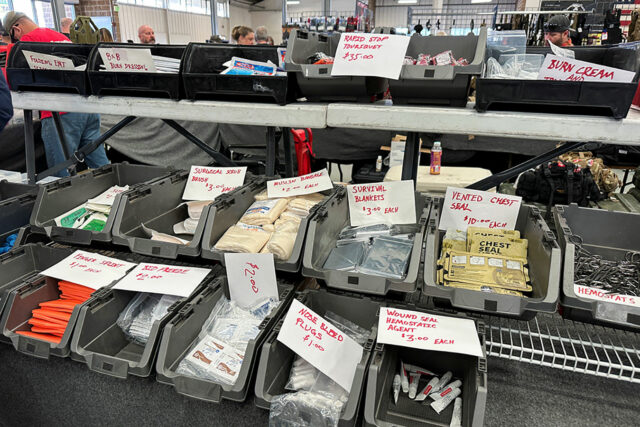
Trauma medical kit supplies are displayed for sale at the “Survival & Prepper Show” in Longmont, Colorado, U.S. March 2, 2024. — REUTERS

LONGMONT, Colorado — Brook Morgan surveyed booths at the “Survival & Prepper Show” in Colorado that were stocked with boxes of ammunition, mounds of trauma medical kits, and every type of knife imaginable.

A self-described “30-year-old lesbian from Indiana,” Morgan is one of a new breed of Americans getting ready to survive political upheaval and natural catastrophes, a pursuit that until recently was largely associated with far-right movements such as white nationalists since the 1980s.

Researchers say the number of preppers has doubled in size to about 20 million since 2017. Much of that growth is from minorities and people considered left-of-center politically, whose sense of insecurity was heightened by Donald Trump’s 2016 election, the COVID-19 pandemic, more frequent extreme weather and the 2020 racial justice protests following the murder of George Floyd.

“I’m really surprised by the number of people of color here,” Morgan said. “I always went to these shows with my family in Indiana and it was just white people who were my parents’ age. There are a lot of younger people here, too. It’s a real change.”

Morgan grew up in a prepper family and still considers herself self-reliant and ready to handle a disaster but she left the prepper world of her youth behind in part to escape the conservatism associated with the movement.

The diversification of prepping was clear last weekend at the Survival & Prepper show at the fairgrounds in Boulder County, a liberal district which President Joe Biden won in 2020 by nearly 57 percentage points over Trump. Over 2,700 people paid $10 each to attend the show, organizers said, and attendees were varied.

Bearded white men with closely cropped hair and heavily tattooed arms were there. But so were hippy moms carrying babies in rainbow colored slings and chatting about canning methods, Latino families looking over greenhouses and water filtration systems, and members of the local Mountain View Fire Rescue team, who in 2021 battled a devastating fire in the region, giving CPR demonstrations and encouraging citizens to be more prepared for extreme events.

Attendees and those running the booths said the show reflected the concerns of millions of Americans who no longer feel that they can always count on the government or private industry to provide the basics, like electricity, water and food.

They cited the pandemic disruption of supply chains, the 2021 power grid crisis in Texas that left millions without power, and the recent outages for thousands of AT&T mobile users.

Chris Ellis is a colonel in the U.S. Army who works on disaster preparedness and recovery and is a leading researcher into the prepper movement who has tracked its growth to 20 million people based on household resiliency data from the Federal Emergency Management Agency.

He said that what shapes individual preppers – which he defines as someone who can live for a month with no outside support – is how they react to a single question: “Do I feel safe?”

“People want to regain their agency, their sense of control, and do something to match their fears to their actions,” said Ellis, who underscored that he did not speak on behalf of the Department of Defense.

People motivated by climate change, Ellis said, tend to be homesteaders who grow their own food and move to more “climate proof” locations, such as the mild summer haven of Duluth, Minnesota.

Others whose main fear is lawlessness are frequently the gun enthusiasts stereotypically associated with the prepper movement. The super rich often respond to their fears by spending millions to build bunkers in remote spots.

For John Ramey, a former innovation advisor to the Obama administration and creator of the prepper website The Prepared, the community has grown to reflect American society at large in terms of political beliefs and demographic categories.

“The only real unifying denominator among preppers these days is people who are smart enough to be aware of what the world is like … and they have the gumption to do something about it,” Ramey said.

Back at the prepper show at the Boulder County fairgrounds, Jennifer Council strummed her thumb against the edge of an ax, balanced it in her hand and said it was perfect for both cutting down small trees and doing the delicate shaving work needed to create tinder.

Council, a 50-year-old mom of three adult children and self-described Black urban farmer, lives in a suburban home northwest of Denver.

“Preppers used to be seen as extreme weirdos,” Council said. “Then the pandemic happened and grocery stores were short on food. Then you had the unrest of protests around the police killings of young Black men. Then you had the storming of the Capitol in Washington.”

“People are realizing that it’s important to be able to depend on what you can do for yourself.” — Reuters

Alaska Airlines cooperates with DOJ in Boeing 737 MAX blowout probe

STOCK PHOTO | Image by Rudy Dong from Unsplash

Alaska Airlines said on Saturday it is cooperating with the U.S. Department of Justice after a criminal investigation was opened into the Boeing 737 MAX blowout on its flight in January.

“In an event like this, it’s normal for the DOJ to be conducting an investigation. We are fully cooperating and do not believe we are a target of the investigation,” Alaska Airlines said in an emailed statement to Reuters.

The Wall Street Journal earlier reported, citing documents and people familiar with the matter, that the investigators have contacted some passengers and crew on the Jan. 5 flight, which made an emergency landing in Portland, Oregon, after a fuselage panel ripped off midair.

The investigation would inform the DOJ’s review of whether Boeing complied with an earlier settlement that resolved a federal investigation following two fatal 737 MAX crashes in 2018 and 2019, the report added.

Boeing and DOJ did not immediately respond to Reuters request for comments.

The door plug panel blew off an Alaska Airlines-operated flight not long after taking off from a Portland, Oregon, airport on Jan. 5, forcing pilots to scramble to land the plane safely.

The U.S. Federal Aviation Administration (FAA) subsequently ordered the temporary grounding of 171 narrowbody MAX 9 jets with a similar configuration.

Days after the incident, Alaska Airlines on Jan. 26 resumed MAX 9 service after it said it had completed inspections on the first group of its Boeing 737 MAX 9 aircrafts.

In February, the US National Transportation Safety Board said the door panel that flew off appeared to be missing four key bolts. The plug was manufactured by Spirit AeroSystems SPR.N, the onetime subsidiary of Boeing that separated from its parent in 2005. – Reuters

Australian farmers rip out millions of vines amid wine glut

STOCK PHOTO | Image by Pexels from Pixabay

 – Millions of vines are being destroyed in Australia and tens of millions more must be pulled up to rein in overproduction that has crushed grape prices and threatens the livelihoods of growers and wine makers.

Falling consumption of wine worldwide has hit Australia particularly hard as demand shrinks fastest for the cheaper reds that are its biggest product, and in China, the market it has relied on for growth until recent years.

The world’s fifth largest exporter of wine had more than two billion liters, or about two years’ worth of production, in storage in mid-2023, the most recent figures show, and some is spoiling as owners rush to dispose of it at any price.

“There’s only so long we can go on growing a crop and losing money on it,” said fourth-generation grower James Cremasco, as he watched clanking yellow excavators strip out rows of vines his grandfather planted near the southeastern town of Griffith.

About two-thirds of Australia’s wine grapes are grown in irrigated inland areas such as Griffith, its landscape shaped by vine-growing techniques brought by Italian migrants arriving around the 1950s.

As major wine makers such as Treasury Wines and Carlyle Group’s Accolade Wines refocus on more expensive bottles that are selling better, the areas around Griffith are struggling, with unpicked grapes shriveling on vines.

“It feels like an era is ending,” said Andrew Calabria, a third-generation vineyard owner and wine maker at Calabria Wines.

“It’s hard for growers to look out the back window and see a pile of dirt instead of vines that have been there as long as they’ve known.”

Nearby, the remains of 1.1 million vines that once comprised one of Australia’s largest vineyards were piled in heaps of gnarled and twisted wood as far as the eye could see.

Red wine has suffered the most. In regions like Griffith, prices of the grapes going into it fell to an average of A$304 ($200) a ton last year, the lowest in decades and down from A$659 in 2020, data from industry body Wine Australia show.

The government, which forecasts lower prices again this year, said it recognizes the significant challenges facing growers and is committed to supporting the sector, though many growers say it can do more.

Mr. Cremasco said some of his red grapes sold for little more than A$100 a ton.

To balance the market and lift prices, up to a quarter of the vines in areas such as Griffith must be pulled up, said Jeremy Cass, head of Riverina Winegrape Growers, a farmers’ group there.

That would destroy more than 20 million vines across 12,000 hectares (30,000 acres), Reuters calculations based on Wine Australia data show, or about 8% of Australia’s total area under vine.

Growers and winemakers in other regions have also been pulling out vines.

“If half the vines in Australia were ripped out, it still might not solve the oversupply,” said a wine maker in Western Australia.

Still, many growers unwilling to pull up vines are losing money while hoping for the market to turn around.

“It’s chewing up wealth,” said KPMG wine analyst Tim Mableson, who estimates that 20,000 hectares (49,000 acres) of vines need to be taken out nationwide.


GIVING IT AWAY

Health concerns are prompting consumers worldwide to drink less alcohol and when they do drink wine, they pick pricier bottles.

Chile, France and the United States are among the other large wine producers also grappling with oversupply, with even prime areas such as Bordeaux uprooting thousands of hectares of vines.

When China blocked imports during a political dispute in 2020, Australia lost its biggest wine export market by value. And unlike Europe, it offers farmers no financial aid to help them destroy vines and excess wine.

Even though China is expected to allow imports again this month, that will not mop up the glut, as demand there has fallen much more rapidly than elsewhere.

Wine sold for less than A$10 a liter – most of it made from grapes grown in areas like Griffith – accounted for two-thirds of the value of Australian wine exports worth A$1.9 billion in the year to December 2023, Wine Australia says.

Some areas are faring better, such as Tasmania and the Yarra Valley in Victoria, which produce more white wines and lighter, more expensive reds that are growing in popularity.

But across Griffith there are clusters of metal storage tanks, each holding thousands of liters.

“Everyone is trying to clear wine,” said Bill Calabria, Andrew’s father, adding that wineries were “all but giving it away” to make room for the incoming vintage.

Many growers are turning to citrus and nut trees instead.

Cremasco hopes for greater profits from the prune trees he is planting in his grubbed-up acreage, while GoFARM, a corporation, is putting in more than 600 hectares (1,500 acres) of almonds nearby, also replacing vines.

“There’ll be no next generation of family grape growers,” Cremasco added. “It’ll be all big corporates, and all the local young guys will be working for them.” – Reuters


As Wall Street titans gather, finance museum searches for a home

REUTERS

 – Financial industry heavyweights convened in New York last week to raise funds for a finance museum that has lost its iconic Wall Street address.

At the Museum of American Finance gala, billionaire Ken Griffin welcomed attendees on enormous video screens in Manhattan’s art deco-style Ziegfeld Ballroom. Mark Carney, chair of Brookfield Asset Management and ex-Bank of England governor, honored former Federal Reserve Vice Chairman Richard Clarida. JPMorgan Chase and Wells Fargo bought tables.

“The philosopher Santayana said: those who are ignorant of history are doomed to repeat it,” Howard Marks, billionaire co-founder of Oaktree Capital Management, told Reuters before he received an award. “This is equally true in the investment business: those who are ignorant of history are doomed to lose money and/or miss opportunity.”

The 455 attendees raised $1.5 million for the museum. Yet its collection — which includes a bond signed by George Washington, a ticker tape from the 1929 stock market crash and early examples of US currency — languishes in temporary storage in Georgia after spending several years in the Queens borough of New York City.

At the gala, guests dined on burrata and braised beef short rib. They murmured in appreciation when a bond for the Louisiana purchase — which doubled the size of the US — was projected onto the jumbo screens. A reference to President Ronald Reagan got a smattering of applause.

Mr. Carney shared a lesson from his time at Goldman Sachs.

“If someone in our industry explains something to you… and that explanation doesn’t make sense to you, ask them to repeat it — and if it still doesn’t make sense, walk away,” he said. “When feigned knowledge masks real ignorance, that leads to panic.”

Mr. Clarida, who serves as a professor at Columbia University and advises asset manager PIMCO, expressed pride in the Fed’s pandemic response as he received an award.

“The Fed acted decisively and expansively in the spring of that year to prevent what could well have spiraled downwards into an economic depression and financial crisis,” he said. “The Fed’s nimble and creative response to the pandemic collapse represents the Fed at its best.”

Like many other businesses, the finance museum suffered during the Covid-19 pandemic after facing other setbacks.

Its previous home at 48 Wall Street was itself a part of financial history, serving as the original headquarters of the Bank of New York founded by Alexander Hamilton. The museum opened in 2008 on the eve of the global financial crisis.

Since then, its objects and documents have had a long journey. In 2018, they were displaced when a burst pipe damaged the museum’s three floors, including its grand exhibition hall. Last summer, the collection was loaded into a tractor trailer and transported from Queens to the Georgia archive.

“We haven’t lost sight of the value of a physical location for our museum,” finance museum President and CEO David Cowen told attendees. “We’re in conversations about discounted or donated space, but it’s not too late — if you’d like to house this incredible museum, come and talk to us.”

The museum still publishes a magazine, holds virtual lectures and organizes events hosted in other spaces. It has an eight-case traveling exhibition that can be rented to bring in revenue.

While it awaits a permanent space, the museum has digitized 500 boxes containing 300,000 pages, while 835 of its objects have also been processed by archivists.

Lina Lin, a freshman at Yale University who received a scholarship from the museum, has never seen the exhibits in person. Her interest in economics was sparked by taking the museum’s virtual personal finance course as a high school student.

“My most surprising takeaway was the amount of people who don’t have access to financial education,” Ms. Lin said. “I would prefer a physical location just because it’s more centralized… it’s more like a gathering place.” – Reuters

Packaging billionaires to help fund Trump campaign, FT reports

 – Conservative billionaires Liz and Dick Uihlein will help fund Donald Trump’s campaign, giving the former president financial support as he seeks to catch a fundraising lead built by President Joe Biden, the Financial Times said on Saturday.

The Uihleins, who founded the Uline shipping and packaging company from their basement in 1980, had donated to the Republican primary campaign of Florida Governor Ron DeSantis, who dropped out of the race in January.

Uline did not immediately respond to a request for comment from Reuters.

News of the couple’s decision came after the former president won 14 out of 15 states in the Super Tuesday primaries and his last Republican rival, Nikki Haley, quit the race, the FT said.

Her exit all but assured that Trump will be the party’s nominee and face off again against Biden, a Democrat.

Mr. Trump has fallen behind Mr. Biden in fundraising ahead of the Nov. 5 general election. Trump’s cash holdings dropped to just over $30 million at the end of January, down from around $33 million a month earlier, his campaign told the Federal Election Commission.

Mr. Biden, facing a less competitive process for his Democratic Party’s nomination, told the FEC his campaign ended January with about $56 million in cash, up from $46 million in December.

Mr. Trump’s legal expenses have grown to hundreds of millions of dollars as he grapples with 91 criminal counts across four cases. On Friday, he posted a $91.6 million bond to cover the defamation verdict in favor of writer E. Jean Carroll.

The Uihleins had each given $1.5 million to DeSantis and Liz Uihlein told the FT she would give a similar amount to Trump.

The Wisconsin-based couple have given more than $250 million to federal candidates and political groups since the 2016 election cycle, the FT said, citing the nonprofit OpenSecrets. They backed Trump in the two previous elections, before seeking an alternative candidate to support for the 2024 race.

In an interview with the newspaper, Liz Uihlein said both Trump and Biden were already well-known to voters and she wondered how much donations helped at this stage.

“These two guys are very well-defined,” she told the FT. “I don’t understand why everybody has to give all this money.”

She also expressed qualms over Mr. Trump’s rhetoric.

“Everybody likes Trump’s policies,” Liz Uihlein said. “But we have almost 10,000 people that work for us and I would never talk to them the way Trump talks to people.”

Charity loads food aid on to barge in Cyprus headed for Gaza

Palestinian children carry pots as they queue to receive food cooked by a charity kitchen, amid shortages in food supplies, as the conflict between Israel and Hamas continues, in Rafah in the southern Gaza Strip Dec. 14, 2023. — REUTERS

LARNACA, Cyprus – Charity workers loaded relief supplies bound for Gaza on to a barge in Cyprus on Saturday as part of an international effort to launch a maritime corridor to a Palestinian population on the brink of famine.

The European Commission had said a maritime aid corridor between Cyprus and Gaza could start operating as early as this weekend in a pilot project run by an international charity and financed by the UAE.

The Open Arms, a salvage vessel owned by a Spanish NGO and more accustomed to rescuing migrants at sea, was moored at a port in the coastal Cyprus town of Larnaca, 210 miles northwest of Gaza.

It will tow a barge with 200 tons of food sourced by charity World Central Kitchen (WCK) and mostly funded by the UAE. The timing of its departure from Cyprus was unclear.

Cyprus President Nikos Christodoulides, whose administration lobbied for months to establish the corridor, told journalists: “In the next 24 hours the vessel will depart from Larnaca. I can’t specify when, for security reasons.”

A spokesperson for WCK said the departure would take place “ASAP when all conditions are favorable,” without elaborating.

It is an estimated 15-hour journey by sea to Gaza, though a barge tow could make the journey longer.


TEMPORARY JETTY

The United States has said it plans to build a temporary jetty to bring aid into Gaza, which has no port infrastructure. It too plans to initially use Cyprus, which is offering a process for screening cargoes which will include Israel officials, removing the need for security checks in Gaza.

Negotiations on a possible ceasefire in Israel’s war against Hamas remain deadlocked.

Aid agencies have warned of a looming famine five months into Israel’s campaign against Hamas. Most of Gaza’s 2.3 million inhabitants are now internally displaced, with severe bottlenecks in aid deliveries at land border checkpoints.

A sea corridor from Cyprus would supplement attempts to boost aid supplies, which have included airdrops of food.

WCK has partnered with Spain’s Proactiva Open Arms.

“WCK and partners agree more than one ship will be needed and are working towards a constant flow of aid,” it said in a statement, adding that another 500 tons of aid was ready to follow the initial shipment.

A spokesperson for WCK said the intention was to sail to Gaza, where WCK and partners were building a jetty unrelated to the U.S. project.

Gaza has been under an Israeli navy blockade since 2007, when Hamas took control of the enclave. There have been few direct sea arrivals since then. Larnaca port was used by pro-Palestinian activists, who used small sail boats to get into Gaza harbor in 2008. – Reuters

How entrepreneurs can successfully apply to government TBIs

STOCK PHOTO | Image by Adrian from Pixabay

According to past applicants of technology business incubators (TBIs), agility, empathy, and a ready market are some factors Filipino entrepreneurs need to be successful “incubatees” of the programs. 

A TBI assists technology-driven entrepreneurs in the start-up and early development stage of their venture.  


Necessary factors 

Agility is a must amid fast-changing trends, according to John Vincent Q. Gastanes, CEO of Farm Konekt Holdings, which provides a farm management platform for data support and system integration. 

Equally important is empathy, he said in a March 4 SMS. At Farm Konekt, “our role is to provide the necessary service to prepare communities and train them to be adaptive to our clients…Service providers [such as ourselves] must know kick-a** service.”  

Patience in the process and the proper mindset are likewise key.   

“Revenue and market adoption are not easy, but – based on successful technology service providers around the world – it’s a matter of perseverance and grit to believe while others doubt,” he added.  

Innovative products plus having a ready market with goes a long way, according to Maresciel A. Yao, president and CEO of AV88 Corporation, which manufactures wall panels made of bamboo. 

“If they have a market to start with that would really benefit…the farmers, the fishermen, or people who are on that tier, then I think that can be both good for the business sector and the government agencies, plus the market they would be helping,” she said in a March 4 Zoom interview with BusinessWorld 

Yun yung nakikita ko na puwede, kasi (That’s what is doable as I see it, because) everybody will be benefiting from everybody’s effort,” she added. 

Both Farm Konekt and AV88 Corporation received assistance from the Department of Science and Technology’s Technology Application and Promotion Institute (DoST-TAPI)’s technopreneurship programs. 

The DoST alone funds more than 50 technology business incubators in the country, a 2023 study by the Asian Development Bank found. 


Application basics 

The “basic requirement” for entrepreneurs applying for assistance to a TBI is a willingness to learn the ropes of running a business, said Marlon M. Tambis, assistant director of The Philippine Root Crops Research and Training Center (PhilRootcrops) and Assistant Professor I at Visayas State University (VSU). 

VSU has a TBI in partnership with the DoST’s agriculture arm, the Philippine Council for Agriculture, Aquatic and Natural Resources Research and Development (PCAARRD), and PhilRootcrops. 

“Aside from learning the technology or the technical aspects of producing their products, they must also learn the business-related aspects [of it,] like proper recording, costing, marketing, product packaging, promotion, etc.,” Mr. Tambis added on Messenger on February 21. 

Applying as an incubatee is “almost similar” across the different TBIs, he also said in a February 19 Zoom call. 

A technology licensing agreement will need to be signed before a transfer of technological know-how can occur, he said. Once officially in the program, an incubatee will then be trained based on where he is in his business journey. 

The fees vary depending on the need, added Mr. Tambis, noting that the regular process involves an upfront fee of P10,000.  

A royalty fee of between 1-3% is also needed for protected technologies. 


Tailored support 

Maraming assistance puwede gawin ang TBI, depende sa need ng aming incubatee (A TBI can offer a lot of assistance, depending on the need of the incubatee),” Mr. Tambis said. 

Kung negosyante na siya, yung technical na lang about the product ang ibibigay namin (If the incubatee is already an established businessman, then all we need to do is train him on the technical aspects of the product),” he told BusinessWorld. 

Pero kung kailangan pa ng knowledge on how to start a business, puwede namin siyang tulungan sa marketing, promotion, at product design (But if he still needs knowledge on how to start a business, then we can also train him in other aspects, including in marketing, promotion, and product design),” he added. 


Technology transfer 

PhilRootcrops, together with the DoST-PCAARRD and the VSU, has been improving the value chain of sweet potato by turning the root crop into products like flour, powder, noodles, bread, ice cream, and fries. 

These are examples of food products that the VSU TBI can help entrepreneurs learn how to replicate for their own businesses, Mr. Tambis shared. 

A plan is already in the pipeline to offer the use of sweet potatoes to Potato Corner, a food cart franchise, he told BusinessWorld. 

Since mentorship and market linkages are included in TBI programs, entrepreneurs who are willing “can be taught how to do this,” added Mr. Tambis.Patricia B. Mirasol

ADVERTISEMENT
ADVERTISEMENT