Home Blog Page 3430

PhilRice eyes inbred rice yields of 5 MT/ha

THE Philippine Rice Research Institute (PhilRice) said it is seeking to increase the average yield of the inbred rice seed handed out to farmers.

Flordeliza H. Bordey, PhilRice director for the Rice Competitiveness Enhancement Fund (RCEF) Program Management Office, said the agency is planning to improve the yield of the rice seed variety to beyond 5 metric tons (MT) per hectare (/ha).

“We started with 3.6 (MT per hectare). So we have seen improvements over the years. Pero medyo baka mabitin tayo dun sa 5 (MT per hectare) (But we might fall short of the stretch target of 5 MT)” Ms. Bordey said in an interview.

RCEF Seed and Rice Extension Services programs are components of Republic Act 11203, or the Rice Tariffication Law, which sets aside P10 billion a year from rice import tariffs to make rice farmers more competitive.

The program’s target is to increase yields to 5 MT per hectare by 2025.

“So that’s what we’ll try to do in the next phase… we’ll definitely set a new target,” she added.

PhiRice said that the average yield of inbred seeds provided by RCEF increased to 4.36 MT per hectare last year, from 3.63 MT per hectare in 2022.

Among the government’s goals is to increase self-sufficiency for rice to 95% by 2028.

Ms. Bordey said that this could be attained through the distribution of both inbred and hybrid seed to production areas where they are best suited.

She added that under RCEF, inbred seed is distributed to 42 provinces with low to medium yields, while hybrid seed is given to 25 high-yielding areas.

The inbred seed is distributed to Negros Occidental, Leyte, Samar and Panay, while hybrid seed varieties are sent to 15 provinces, including Nueva Ecija, Isabela and Pangasinan.

“According to the Philippine Statistics Authority (PSA), rice harvest (is set to) increase slightly for the first quarter compared to the previous year… so prospects are good. We are hoping that the harvest would improve or at least not be lower than 2023,” she said.

The PSA is projecting the palay or unmilled harvest to increase 1.1% to 4.83 million MT.

The Department of Agriculture is projecting a palay harvest of above 20 million MT this year. The harvest in 2023 was 20.05 million MT, equivalent to about 13 million MT in milled rice. — Adrian H. Halili

We stand for integrity

SASUN BUGHDARYAN-UNSPLASH

The Philippine government has achieved milestones when it comes to the campaign for integrity in the healthcare community. In 2011, the Mexico City Principles for Voluntary Codes of Business Ethics for the Biopharmaceutical Sector was endorsed by Asia-Pacific Economic Cooperation (APEC) member economies, including the Philippines.

The Philippine Food and Drug Administration also adopted and implemented the Mexico City Principles in September 2013. The Department of Health (DoH), meanwhile, created a Committee for the Creation and Adoption of the Mexico City Principles (MCP) and Kuala Lumpur Principles for Medical Device Sector Codes of Business Ethics. In enforcing the MCP, the DoH has put in effect Administrative Order No. 2015-0053 relating to the Implementing Guidelines on the Promotion and Marketing of Prescription Pharmaceutical Products and Medical Devices.

All these have been put in place due to the recognition that ethical interactions between the pharmaceutical industry and the healthcare community benefit the patients as well as propel the advancement of science and medical information.

Prior to the adoption of the APEC Mexico City Principles, the Pharmaceutical and Healthcare Association of the Philippines (PHAP) adopted its own Code of Practice in the early 1990s. As a member of the International Federation of Pharmaceutical Manufacturers and Associations (IFPMA), PHAP fully subscribes to the rigid international code.

The Code is a requirement for PHAP membership, a non-negotiable component to be part of our roster. Previous members who could not comply with the Code for various reasons, including their failure to understand the importance of being bound by a stringent code of conduct, left the association. Our current members, composed of 40 pharmaceutical companies, are those that have been at the forefront of the research and development of medicines and vaccines for COVID-19, among others.

Among the principles that the Code espouses are trust, care, quality, innovation, quality, fairness, and integrity.

Specifically, “trust” is where all PHAP members are expected to act with integrity and honesty to improve patient care and build trust with those they serve. Also crucial in promoting this principle is respecting the independence of healthcare providers, patients, and other stakeholders.

Another principle is “care” where PHAP members must protect the safety of those who use their medicines and vaccines — from the conduct of clinical trials and throughout the product life cycle. The next principle is “quality” which is about the commitment to providing high quality medicines and vaccines that have proven clinical efficacy and have a reliable safety profile. Also crucial is “fairness” which supports and respects fair trade practices and open competition.

“Integrity,” on the other hand, is acting responsibly, ethically, and professionally. This refers to not offering, promising, providing, or accepting anything of value in order to inappropriately influence a decision, or gain an unfair advantage.

These principles are backed by specific provisions and rigid enforcement mechanisms. The Code of Practice is implemented through an independent Ethics Committee comprised of leading ethicists and health luminaries.

For example, Section 11.2 of the Code states that venues that are considered as beach resorts as well as those that primarily offer leisure or recreational facilities and those that operate casino and or golf courses within their premises are considered inappropriate venues for events. The PHAP has time and again been asked to comment on a venue’s appropriateness by various groups, including medical societies, and our stance has always been to refer to said Section 11.2.

Meanwhile, Section 12 of the Code, titled “Independence of Healthcare Professionals,” states that PHAP member companies’ relationships with healthcare professionals and other stakeholders are intended to benefit patients and to enhance the practice of medicine. Interactions should be focused on informing healthcare professionals about medicines, providing scientific and educational information, and supporting medical research and education.

The said provision adds that no financial benefit or benefit-in-kind may be provided or offered to a healthcare professional in exchange for prescribing, recommending, purchasing, supplying, or administering products or for a commitment to continue to do so. Gifts of any kind for the personal benefit of healthcare professionals are not allowed, irrespective of value, kind, or occasion.

The Code is cascaded to PHAP members through a pioneering module called the Integrity and Proficiency Program for the Pharmaceutical Sector (IPPS). The IPPS, registered under the Professional Regulation Commission, offers not just science-related information. It also provides modules on various laws and codes that must guide all interactions with healthcare professionals, the government, and patients among others.

In the healthcare community, unethical behavior hurts not just businesses. It also brings harm to patients and deprives them of the quality and appropriate healthcare they deserve. Ethical interactions, meanwhile, help ensure that medical decisions are made in the best interests of patients. They also level the playing field and encourage robust competition in the industry.

Due to the unique role of ethical behavior in positively affecting the health and lives of patients, the pharmaceutical industry must always be committed to ethical behavior. For this reason, we are, we will, and we continue to stand for integrity.


Teodoro B. Padilla is the executive director of Pharmaceutical and Healthcare Association of the Philippines (PHAP). PHAP represents the biopharmaceutical medicines and vaccines industry in the country. Its members are in the forefront of research and development efforts for COVID-19 and other diseases that affect Filipinos.


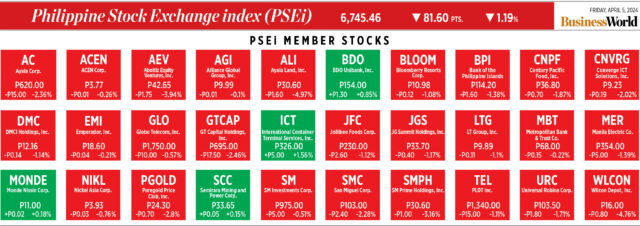
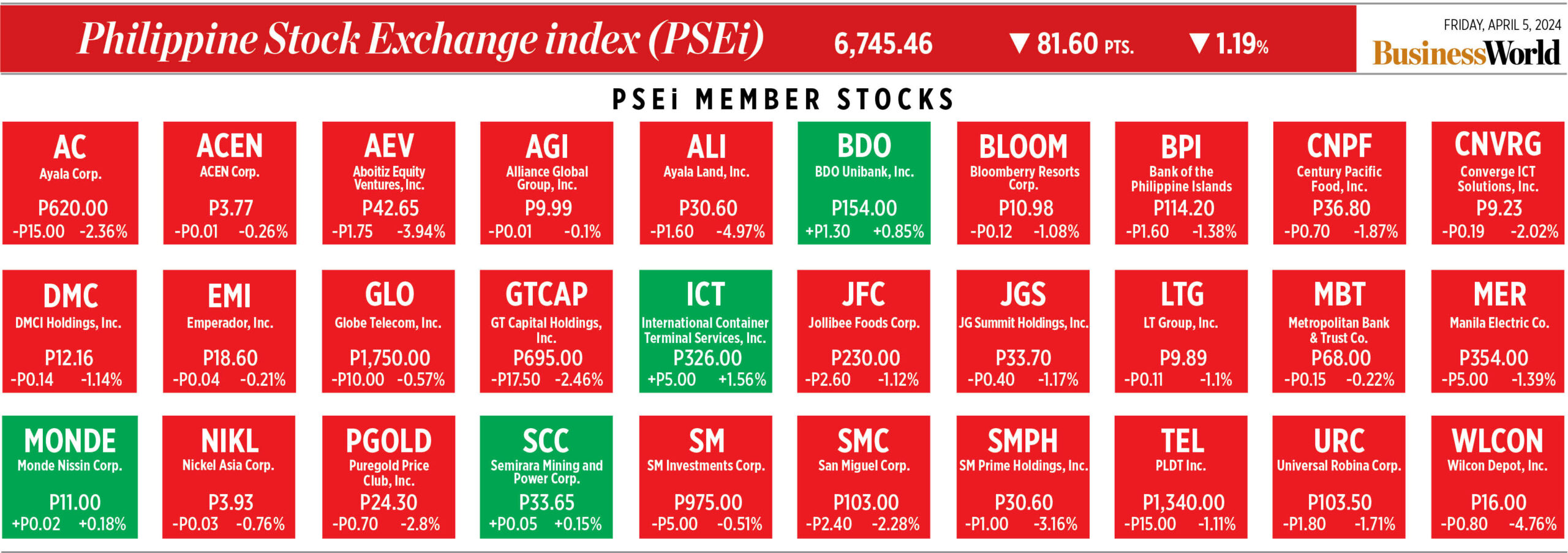
How PSEi member stocks performed — April 5, 2024

Here’s a quick glance at how PSEi stocks fared on Friday, April 5, 2024.


Stocks may drop as BSP holds policy meeting

BW FILE PHOTO

PHILIPPINE STOCKS could decline further this shortened trading week as the Philippine central bank is set to hold its policy meeting on Monday and amid a lack of fresh catalysts.

On Friday, the benchmark Philippine Stock Exchange index (PSEi) dropped by 1.19% or 81.60 points to close at 6,745.46, while the broader all shares index fell by 0.7% or 25.14 points to end at 3,555.18.

Week on week, the PSEi fell by 2.29% or 158.07 points from the 6,903.53 close on March 27.

“The local bourse started the week strong, hitting above 7,000, but sentiment quickly soured after the release of US Federal Reserve comments plus the Philippine inflation print for March,” online brokerage firm 2TradeAsia.com said in a market note.

Federal Reserve officials including US central bank chief Jerome H. Powell on Wednesday continued focusing on the need for more debate and data before interest rates are cut, a move financial markets expect to occur in June, Reuters reported.

“Recent readings on both job gains and inflation have come in higher than expected,” Mr. Powell said in a speech to the Stanford Graduate School of Business. While policy makers generally agree that rates can fall later this year, he said this will happen only when they “have greater confidence that inflation is moving sustainably down” to the Fed’s 2% target.

Meanwhile, Philippine headline inflation quickened to 3.7% year on year in March from 3.4% in February. This was slower than the 7.6% clip in the same month last year.

March inflation was within the Bangko Sentral ng Pilipinas’ (BSP) 3.4-4.2% forecast for the month. This was also slightly below the 3.8% median estimate in a BusinessWorld poll of 17 analysts and marked the fourth straight month that inflation was within the BSP’s 2-4% target range.

For the first three months, inflation averaged 3.3%, below the BSP’s 3.6% forecast for this year.

This week, the PSEi could take cues from the BSP’s policy meeting on Monday, Philstocks Financial, Inc. Senior Research Analyst Japhet Louis O. Tantiangco said in a Viber message.

“While policy rates will most likely be held at current levels, investors are expected to watch out for the BSP’s cues on their policy outlook. Cues of prolonged monetary tightening are expected to dampen sentiment, while cues of rate cuts are expected to do the opposite,” Mr. Tantiangco said.

“With last week’s decline, bargain hunting opportunities are seen. However, with the bearish factors at play, and the lack of a positive catalyst, we may not see a strong rally yet from the market. A further decline for the bourse is still possible,” he added.

Mr. Tantiangco put the PSEi’s major support at the 6,700 level.

Meanwhile, Rizal Commercial Banking Corp. Chief Economist Michael L. Ricafort placed the PSEi’s immediate minor support at 6,630-6,700 and immediate major support at 6,360-6,500.

2TradeAsia.com put immediate support at the 6,800 level and resistance at the 7,000 level. — R.M.D. Ochave with Reuters

BSP decision to drive peso-dollar trading this week

THE PESO could move sideways against the dollar this week, with trading to be mostly driven by the Bangko Sentral ng Pilipinas’ (BSP) policy decision on Monday.

The local unit closed at P56.50 per dollar on Friday, weakening by 14.5 centavos from its P56.355 finish on Thursday, Bankers Association of the Philippines data showed.

This was the peso’s weakest close in more than two months or since its P56.53-per-dollar finish on Jan. 25.

Week on week, the peso depreciated by 26 centavos from its P56.24 close on March 27.

The peso slumped against the dollar on Friday after inflation picked up in March, Rizal Commercial Banking Corp. Chief Economist Michael L. Ricafort said in a Viber message.

Headline inflation quickened for a second straight month in March to 3.7% year on year from 3.4% in February. Still, this was slower than the 7.6% clip in the same month last year.

The March consumer price index (CPI) was also slightly below the 3.8% median estimate in a BusinessWorld poll conducted last week but was within the BSP’s 3.4-4.2% forecast for the month. It also marked the fourth straight month that the CPI was within the central bank’s 2-4% annual target.

For the first quarter, headline inflation averaged 3.3%, below the BSP’s 3.6% forecast for the year.

The peso was also dragged down by mixed comments from US Federal Reserve officials, Security Bank Corp. Chief Economist Robert Dan J. Roces said in a Viber message.

Comments last week from Fed Chair Jerome H. Powell had reinforced the view that rate cuts were likely to commence in 2024, Reuters reported. But on Thursday, Minneapolis Fed President Neel Kashkari said rate cuts might not be required this year.

For this week, peso-dollar trading will depend on the BSP’s policy decision on Monday, Mr. Ricafort said.

The BSP is widely expected to keep benchmark interest rates steady this week amid lingering inflation risks, analysts said.

All 16 analysts in a BusinessWorld poll conducted last week expect the Monetary Board to maintain the target reverse repurchase rate at a near 17-year high of 6.5% at its policy meeting on April 8.

If realized, it would be the fourth straight meeting the BSP kept its policy rate unchanged since the 25-basis-point (bp) off-cycle hike on Oct. 26, 2023.

The Monetary Board raised borrowing costs by 450 bps from May 2022 to October 2023 to help bring down elevated inflation. BSP Governor Eli M. Remolona, Jr. has said that they could consider cutting rates by the second semester if inflation is firmly within their 2-4% annual goal.

Mr. Roces added that the market could take cues from US nonfarm payrolls data released on Friday.

The US Labor department reported that nonfarm payrolls increased by 303,000 in March, far ahead of a forecast rise of 200,000 from economists polled by Reuters.

Mr. Ricafort sees the peso moving between P56.20 and P56.70 per dollar this week, while Mr. Roces expects it to range from P56.35 to P56.80. — A.M.C. Sy with Reuters

World Bank cites upside to GDP view with enhanced investment

REUTERS

PHILIPPINE gross domestic product (GDP) is expected to rise around 5.5% to 6% this year, with possible upside provided by accelerated investment and productivity reforms, according to the World Bank (WB).

“Over the past few years, what you see is that the economy has been very close to that potential output growth,” Gonzalo Varela, lead economist and program leader of the Equitable Growth, Finance and Institutions Practice Group for Brunei, Malaysia, the Philippines, and Thailand, said at a briefing at the World Bank office in Taguig City last week.

In its April update, the bank estimated Philippine economic growth at 5.8% this year and 5.9% next year.

If realized, this would fall within the Development Budget Coordination Committee’s revised 6-7% growth target for 2024.

The economy grew by a revised 5.5% in 2023, weaker than the World Bank’s 6% forecast at the time. It also failed to meet the government’s 6-7% target for the year.

“The important thing is that you get investment acceleration, you get reforms that stimulate productivity growth, so that potential output growth keeps rising and the economy can grow accordingly, sustainably, in a way that creates good quality jobs,” Mr. Varela said.

Growth in emerging markets and developing economies, which includes the Philippines and excludes China, is expected to accelerate this year, with average GDP growth estimated at 4%.

“There is growth, but that growth is somewhat subdued if you put it in a historical context and compare with the growth average prior to the pandemic,” according to Ayhan Kose, World Bank deputy chief economist and director of the Prospects Group.

Mr. Kose also noted that the US, one of the Philippines’ major export markets, will stay resilient this year.

Meanwhile, the global economy is expected to slow for a third consecutive year due to post-pandemic effects and ongoing geopolitical turmoil.

Other downside risks affecting the growth outlook include continued high interest rates, fragmented trade, disruptions in food and energy markets, climate change, and financial stress.

Possible inflation shocks, as well as “weaker-than-expected” near-term growth in major economies may also limit global growth, according to the WB.

“Global growth over the period 2020 (to) 2024 on average, in the first half of this decade, will be the lowest we have seen since the early 1990s,” Mr. Kose said at the briefing.

The World Bank expects the global economy to slow to 2.4% this year from 2.6% in 2023.

“That, in turn, could again, fuel inflation and will lead to a more protracted period of elevated real interest rates,” Mr. Kose said.

The WB expects major central banks to cut interest rates by the second half of the year if inflation cools further.

In the Philippines, headline inflation accelerated for a second consecutive month to 3.7% in February, due to surging prices of rice and other basic commodities.

Weakening trade, as well as a contraction in goods trade, also hampered global growth, Mr. Kose said.

“Excessive inventory accumulation, still challenges associated with geopolitical tensions, weak manufacturing activity… they all together led to the weak trade performance last year.”

“This year, we are expecting trade growth to be north of 2%, but still much lower than what we saw over the period 2010 (to) 2019 on average,” he added.

The WB called for greater global cooperation to address food security issues, climate change, debt distress, and trade fragmentation. — Beatriz Marie D. Cruz

Exporters warned of new EU rules on deforestation

WIRESTOCK-FREEPIK

EXPORTERS of cattle, soy, coffee, palm oil, rubber and wood will be subject to new European Union (EU) deforestation regulations restricting access to products that benefited from the clearing of forest cover, according to the Department of Trade and Industry (DTI).

“Exporting products to the EU has become increasingly challenging with its new and emerging regulations as part of the EU Green Deal,” the Philippine Exporters Confederation, Inc. said, citing Bianca Pearl Sykimte, director of the DTI’s Export Management Bureau at a seminar.

“These regulations aim to make the EU the first climate-neutral continent by 2050,” it added.

Under the EU Green Deal, exporters of the seven products are required to demonstrate that their products are deforestation-free and not linked to forest degradation or risk not being admitted into the EU.

The deal was first adopted in June to curb forest loss and land degradation, giving companies until Dec. 30 to be compliant, except for micro and small companies which have until June 30, 2025.

The deforestation regulation will cover products derived from the seven commodities, like meat products, leather, chocolate, coffee, palm nuts, and palm oil derivatives, among others.

The regulation takes effect on goods produced after June 29, except for timber and timber products.

Commodities covered by the regulation are required to be deforestation-free and produced in a country with relevant legislation on environment protection. Their producers must also provide a due diligence statement.

Aside from blocked market access, non-compliance could also result in penalties such as fines amounting to up to 4% of the company’s EU turnover, confiscation, or exclusion from public funding or contracts.

The EU was the Philippines’ sixth largest export market in 2023 with $8.4-billion total export sales. — Justine Irish D. Tabile

European consumer industry investment seen creating at least 5,000 jobs in PHL

EMS.COM.PH

AT LEAST 5,000 jobs in the consumer products industry are expected to be created by new investment from Europe, according to EMS Group., a provider of recruitment and engineering services to international firms.

“Successfully, we were able to attract a couple of big investors in the Philippines. So, we’re in the process now of finalizing their entry into the Philippines,” Ferdinand A. Ferrer, chairman and chief executive officer of EMS Group, told reporters on Friday.

“This will be big. You know, our advocacy in EMS is about creating jobs. And this one will probably create 4,000 to 5,000 jobs just for this one company,” Mr. Ferrer said.

He said that the investment will be in partnership with EMS and will cover the operations of a large plant in Batangas that will manufacture consumer products for women.

He said the target for the Batangas site to obtain international certification will be in the fourth quarter with the start of operation set for the first quarter next year.

Meanwhile, he said that EMS is also working on expansion at the Laguna Technopark, banking on the growing interest from foreign companies diversifying from China.

“We’re working on it now. The first phase is now successful in Laguna Technopark. Our phase two, hopefully, is going to be much larger,” he said.

“There’s a lot of (foreign) companies that are saying ‘Anywhere but China’ (ABC) … we don’t want to always have this type of scenario, but the Philippines is in the right spot to take advantage of those who are trying to exit,” he added.

He said the trade war with the US is behind the divestment from China.

“There are several different products or services leaving China. And those are what we are trying to look for a partner here, not necessarily with EMS. If it doesn’t suit us, we will make introductions to other Philippine companies,” he added.

In particular, he said that the group is talking with semiconductor companies from the US and Japan, which could potentially create 2,600 jobs and invest $700 million–$750 million.

“Potentially, EMS could be their partner, but that is not the priority; the priority is to bring them here, potentially to Calabarzon,” he added. — Justine Irish D. Tabile

GOCC subsidies rise in February

SUBSIDIES provided to government-owned and -controlled corporations (GOCCs) rose to P12.715 billion in February, the Bureau of the Treasury said.

Budgetary support to GOCCs rose 35.3% from the P9.401 billion a year earlier.

No subsidies were provided in January.

In February, the National Irrigation Administration received the most subsidies with P7.093 billion or 55.8% of the total.

This was followed by the National Food Authority, which got P2.25 billion.

The Social Housing Finance Corp. was granted P667 million for the month.

Other top recipients in February were the Philippine Heart Center (P303 million), Sugar Regulatory Administration (P284 million), Small Business Corp. (P250 million), Philippine Children’s Medical Center (P228 million), National Kidney and Transplant Institute (P207 million), National Power Corp. (P181 million), Light Rail Transit Authority (P144 million), Philippine Rice Research Institute (P135 million), National Home Mortgage Finance Corp. (P112 million) and Philippine Coconut Authority (P100 million).

Other GOCCs that were given at least P50 million were the Lung Center of the Philippines (P94 million), Philippine Postal Corp. (P70 million), Development Academy of the Philippines (P68 million), Cultural Center of the Philippines (P60 million), and Local Water Utilities Administration (P51 million).

All GOCCs received subsidies during the month.

The government provides subsidies to GOCCs to help cover operational expenses not supported by revenue.

Last year, GOCCs were provided P163.535 billion. — Luisa Maria Jacinta C. Jocson

DENR streamlined-approval rules for exploration, processing due this year

NEW GUIDELINES that will reduce application processing time for exploration permits and mineral processing operations are due out this year, according to the Office of the Special Assistant to the President for Investment and Economic Affairs (OSAPIEA).

On the sidelines of the Philippine Chamber of Commerce and Industry (PCCI) General Membership Meeting on Friday, OSAPIEA Secretary Frederick D. Go said that the guidelines will be issued by the Department of Environment and Natural Resources (DENR).

“Many foreign investors are interested, of course, to look at the exploration opportunities in the Philippines … because we have a lot of potential,” Mr. Go said.

Asked when he expects the guidelines to come out, he said, “Within the year.”

In a speech, Mr. Go named mining as one of the OSAPIEA’s priority sectors for investment, along with electronics and semiconductors, steel, food and agriculture, and pharmaceuticals.

“For mining, we aim to encourage investments by reducing the processing time to get exploration permits going and to follow the roadmap Indonesia has taken for downstream nickel processing,” he said.

“The Philippines is actually the number one nickel ore exporter in the world,” he added. “That means we are exporting the raw material without processing it. So our goal is to go downstream and start processing the nickel to enhance the value that we export.”

Mr. Go said that the end goal is for the country to develop its electric vehicle industry by laying the foundations today.

“So in a perfect world, we go from nickel ore, nickel processing, copper processing, and electric batteries, to electric vehicles,” he said.

“Again, in a perfect world, therefore, we will probably get to electric vehicles far beyond my term. But again, it’s important that we lay the foundations now,” he added.

Philippine Chamber of Commerce and Industry Vice-President for Industry Affairs Ferdinand A. Ferrer said that the chamber is also working on improving foreign ties to find new markets and invite more investment.

“We’re trying to look for new markets for our members, and we’re working with different foreign partners to bring their technology here,” Mr. Ferrer said.

“There is a lot of genuine interest in our country. Maybe it’s because of geopolitical happenings, but regardless of that, now they’re seeing the benefits of the Philippines geographically and also in its people,” he added.

He said that the Philippines has the talent and the resources to process minerals, which is why the country must invest in the sector.

“We have the resources; we have the nickel, as you heard. So why will we just export ore? We must process the mineral and add value to it so that we will not be shortchanged,” he added.

He said that bringing in new technology from overseas will push the country to upskill its human resources.

“That’s why we will bring in high-tech and future-type businesses, and we are working with our government agencies now on upskilling. And we’re not doing it on our own; we’re also seeking collaboration with our international partners,” Mr. Ferrer said.

He said that the PCCI is working with various overseas partners on upskilling and training in preparation for the entry of advanced manufacturing and services projects. — Justine Irish D. Tabile

PHL 53 GW away from hitting RE goal — DoE

FREEPIK

THE PHILIPPINES is around 53 gigawatts (GW) away from hitting its 2040 renewable energy (RE) capacity goal, the Department of Energy (DoE) said.

“We would be needing around 53 gigawatts of additional renewable energy capacity by 2040, with an equivalent of 175 terawatt-hours of renewable energy generation,” Energy Assistant Secretary Mylene C. Capongcol said in a forum in Iloilo City last week.

The government is aiming to raise the share of renewable energy in the power mix to 35% by 2030 and 50% by 2040.

The target is “almost seven times” the current capacity of 8,264 megawatts, Ms. Capongcol said.

In 2022, the Department of Energy (DoE) raised the share requirement of on-grid power suppliers to 2.52% from 1% previously under the renewable portfolio standards (RPS) program.

RPS requires distribution utilities, generation companies, and retail electricity suppliers to source a certain portion of their energy supply from eligible renewable energy resources.

Ms. Capongcol said that the renewable energy goal has yet to include the share of nuclear energy as envisioned in the Clean Energy Scenario 1 and Clean Energy Scenario 2.

“While we have already implemented most of the renewable energy policy and development mechanisms, there are still actions and strategies that we need to undertake,” Ms. Capongcol said.

Aside from RPS, she said that the DoE has been implementing other mechanisms such as allowing 100% foreign ownership of renewable energy projects, the development of an offshore wind policy framework, and the green energy auction program.

“We’re looking forward to renewable energy market operations and soon, we will be coming out with the revised omnibus guidelines for the awarding of the service contract,” Ms. Capongcol said.

As of January, the DoE has awarded 1,282 renewable energy contracts with an equivalent total potential capacity of 130.3 GW. — Sheldeen Joy Talavera

ADVERTISEMENT
ADVERTISEMENT