Home Blog Page 3378

Remolona says rate cut more likely in 2025 on inflation risks
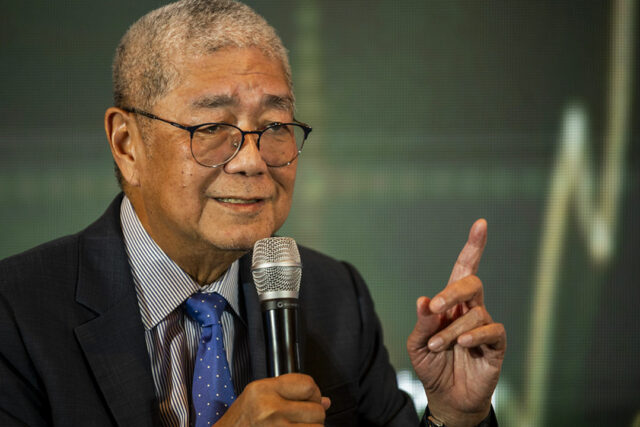
Bangko Sentral ng Pilipinas (BSP) Governor Eli M. Remolona, Jr. — BLOOMBERG

THE WINDOW for the Philippine central bank to start reducing the key rate in the second half of 2024 is narrowing as the risk that inflation may breach its target for a third straight year rises, according to Philippine central bank Governor Eli M. Remolona, Jr.

“The upside risks have become worse than before, and that’s the reason we’ve stayed hawkish,” Mr. Remolona said in an interview on Monday at the Bangko Sentral ng Pilipinas (BSP) office in Manila. “The policy rate is on the tight side. So, by being hawkish, what we mean is we will stay where we are,” he said.

Monetary easing will more likely begin in the first quarter of 2025, and the cuts won’t be “huge” — just enough to bring the benchmark closer to the neutral rate of about 6% from the current 6.5%, the governor said.

As things stand, the odds are “over 56%” that inflation may breach the BSP’s 2%-4% target again this year and “that’s a reason to be hawkish,” Mr. Remolona said. “That has to change significantly before we decide to cut,” he said.

Policy makers across the world, including in the Philippines, have signaled they’re not in a rush to lower borrowing costs and wanted to see more evidence of firmly decelerating price pressures before pivoting to easing. Since taking over in July 2023, the BSP governor, who has worked at the Bank for International Settlements and the Federal Reserve of New York, has adopted a broadly hawkish stance.

Price risks in the Philippines have lingered even after the BSP’s most-aggressive tightening campaign in two decades that has taken the key rate to a 17-year high. Mr. Remolona presided over the last increase in October, done out of the cycle, to rein in inflation. It helped that economic growth remained among the fastest in the region.

Rice inflation in the Philippines hit a fresh 15-year high in March while the peso has touched a seven-month low, weakening along with other emerging currencies as the Middle East conflict intensifies. Mr. Remolona said he’s comfortable with the peso’s current level and that the BSP has hardly been intervening in the foreign currency market. The peso fell for a fourth day.

An “extraordinarily weak” economy would increase the need for a rate cut, the governor said, but he pointed out that the BSP’s latest growth estimate for 2024 was better than the 4.5% forecast he gave last year, without disclosing details.

The Philippines is seen to expand by 5.8% this year, according to a median estimate in a Bloomberg survey of economists, after rising by 5.5% in 2023.

Philippine inflation, meanwhile, quickened for a second month to 3.7% in March with price pressures seen persisting until next quarter, longer than the BSP previously expected. The peso fell as much as 0.3% against the dollar on Tuesday to P56.99, the lowest since Sept. 6, 2023.

“Things have gotten worse in terms of inflation. So yes, if the trend continues, it won’t happen this year,” the governor said of the rate cut.

An escalation in the Israel-Iran conflict that could impact global oil supplies is a potential risk to the Philippine economy, Mr. Remolona said. The Southeast Asian nation imports nearly all of its fuel needs and is among the world’s top buyers of rice.

“The broadly hawkish stance is prudent given upside risks to inflation and perhaps the BSP is seeing growth will remain intact,” said Robert Dan J. Roces, chief economist at Security Bank Corp. in Manila. “Add to these recent bets that the Fed won’t rush to cut rates. This should be supportive of the peso.”

Below are Mr. Remolona’s comments on other matters:

On cutting the reserve requirement:

“If we’re going to lower it, we don’t want to do it while we’re hawkish. We definitely want to lower it significantly. One question is by how much and the other questions is when.”

On push for capital market reforms:

“It’s very important for our transmission mechanism. Right now, the policy rate is an overnight rate. There are no significant economic decisions that are being made based on an overnight rate. You need one year, a mortgage is five years. So that’s how a deeper capital market helps the transmission mechanism.”

On shift to market-determined overnight reverse repurchase facility:

“It took a little bit of adjustments, but we’re now where we want to be. When we do the auctions, on some days it’s above the policy rate, on some days it’s below. We want the policy rate to be in the middle. When we started doing it, it was always below the policy rate, which means there’s just too much liquidity in the market. Now it’s sometimes above, sometimes below, that’s where we want it to be.” — Bloomberg

Red tape poses challenge for foreign investors, says German ambassador

A German national flag flies atop the illuminated Reichstag building in Berlin, Germany. — REUTERS

By Justine Irish D. Tabile, Reporter

BUREAUCRATIC RED TAPE and foreign ownership restrictions remain some of the challenges facing foreign investors in the Philippines, Germany’s ambassador to the Philippine said on Tuesday.

German Ambassador to the Philippines Andreas Michael Pfaffernoschke told reporters on Tuesday that foreign businesses still face hurdles in terms of securing permits, especially at the local level.

“There are many permits you need in the Philippines; there is sometimes corruption involved, and there are different layers of government units that are involved in getting permits,” he said.

“So, making these things easier, streamlining the processes, and reducing red tape are definitely among the key concerns.”

Mr. Pfaffernoschke said issues involving red tape are not just a concern of German businesses, but of the broader business community.

“When it comes to red tape… it’s the number of permits you need, it’s the time it takes to get a permit… I think it’s not unique to German businesses, you will hear this from the whole business community in the Philippines,” he said. 

David Klebbs, economic counselor of the German Embassy, said that the typical obstacles faced by German businesses doing business in the Philippines involve bureaucracy.

“It’s sometimes not easy to get the right permissions; there are different levels, local government units, and (other) different things,” Mr. Klebbs said.

While some German businesses may say that doing business in the Philippines is easier, he noted most still say that it is difficult.

“Most businesses say (that) they feel it’s difficult. They feel it’s not so easy to understand what’s happening. So it really helps to have certain things. What usually helps is a one-stop shop, which is also being done already by the Filipino government,” he said.

Mr. Klebbs said the government should try to make the permits processing “as easy and transparent as possible.”

The Philippines may look into lifting the foreign restrictions on ownership and procurement, which may lead help attract more investments, he said.

“If you look, for example, at the Procurement Law, it is one of the magical tools that the country has to be open to foreign investors … In the end, you can get many offers if you do it well, and you can choose the best provider,” Mr. Klebbs said.

“There are companies that started on the procurement contracts in the Philippines and were not in the Philippines before, and now they’re very successful,” he added.

He said that the procurement law should be more open and procurement procedures should be less complicated and time-consuming.

“Same as foreign ownership. It is really difficult for foreign companies to do business if they’re not able to own their businesses,” he said. “Also with the ownership of land. Sometimes you need land to do business. If you can’t own the land, you can’t do the business because it’s too risky.”

“But we think that it is better to allow it. But I do understand this notion that certain things should stay for the people, but it’s a balanced approach,” he added.

The House of Representatives has already approved Resolution of Both Houses (RBH) No. 7, which seeks to amend the restrictive economic provisions of the Constitution.

Under Article 12 of the Constitution, foreign ownership of land and businesses is only limited to 40%.

Germany was the top source of foreign-approved investments in the Philippines last year, accounting for P393.99 billion, and among the leading sources of foreign direct investments, contributing $149.89 million.

Data from the Philippine Statistics Authority showed that total trade between the Philippines and Germany was valued at $4.65 billion in 2023.

More yellow alerts expected in Luzon grid by mid-May

The Luzon grid was placed on red and yellow alerts on Tuesday. — PHILIPPINE STAR/RYAN BALDEMOR

By Sheldeen Joy Talavera and Ashley Erika O. Jose, Reporters

THE LUZON and Visayas grids were placed on red and yellow alerts on Tuesday after several power plants went on forced outage.

The Institute for Climate and Sustainable Cities (ICSC) on Tuesday said the Luzon power grid will likely experience a shortfall in power supply until May as the majority of hydroelectric power plants are expected to run on derated capacity.

“We are [seeing] the threat of power supply deficiency especially since power supply conditions are exacerbated which is expected to impact the hydropower capacity,” Jephraim C. Manansala, chief data scientist at the Institute for Climate and Sustainable Cities (ICSC), said at a briefing on Tuesday.

The Luzon power grid is projected to be the most affected by the looming power supply deficiency as the majority of hydroelectric power plants supplying the grid will be running on low capacity, the think tank said.

“The threat of power supply deficiency during the dry season is looming, where the major concern is the higher-than-usual temperatures associated with the El Niño weather phenomenon, which are expected to impact hydropower capacity across the country,” the Manila-based climate and energy policy group said.

ICSC said that around 1,435 megawatts (MW) or 70% of the 2,050-MW hydroelectric capacity will be unavailable in the Luzon grid during the dry season.

Power demand typically surges during the hot summer months. Mr. Manansala said Luzon is expected to experience the tightest power supply between May 16 and May 30, adding that yellow alerts are expected from April 29 to May 26.

Peak demand is expected in May, reaching 13,917 MW in Luzon, 2,834 MW in Visayas, and 2,584 MW in Mindanao, ICSC said.

“El Niño reduces the available capacity from hydroelectric power plants. All baseload power plants need to be compliant with the grid operating and maintenance program and any unplanned outages may deplete operating reserves levels,” Mr. Manansala said.

The El Niño weather phenomenon has started weakening but will still persist until May, the state weather bureau said, adding that its effects may last until August.

ICSC said there will be minimal impact on the Visayas grid as the region has limited hydroelectric capacity, while the Mindanao grid is expected to maintain normal reserves during the period.

The sufficient power reserves in Visayas and Mindanao is also due to the high-voltage direct current (HVDC) imports from Mindanao with the expanded operations of Cebu-Negros-Panay transmission and the Mindanao-Visayas Interconnection Project (MVIP). The MVIP allows Mindanao to export up to 450 MW to Visayas allowing the region to have power supply security.

The country’s recurring power supply problems stem from the centralized and baseload-reliant plants, Pedro H. Maniego, Jr., senior policy advisor of ICSC, said.

Baseload power plants, like coal-fired plants, are those that can continuously generate power to meet the power demand.

Alberto R. Dalusung III, energy transition advisor at the ICSC, said the government must focus on the timely delivery of the committed power plants and the improvement of the grid to accommodate additional power capacity.

“There has to be expansion of the transmission system. So, we can definitely absorb more renewables and more [technologies] like biomass, geothermal, and this imposes less requirements on the grid,” Mr. Dalusung said.

YELLOW, RED ALERTS
Meanwhile, the National Grid Corp. of the Philippines (NGCP) said that a red alert was placed over Luzon between 2-4 p.m. and 6-9 p.m. on Tuesday.

A yellow alert was placed over Luzon from 1-2 p.m.; 4-6 p.m.; and 9-11 p.m.

Yellow alerts are issued when the supply available to the grid falls below a designated safety threshold. If the supply-demand balance deteriorates further, a red alert is declared.

The NGCP said that the peak demand was at 13,024 MW, which nearly outpaced the available capacity of 13,537 MW.

“Nineteen power plants are on forced outage, while three others are running on derated capacities, for a total of 2,117.3 MW unavailable to the grid,” the grid operator said.

Based on the data from the NGCP, power plants that went on forced outages in Luzon include Pagbilao units 1 and 2, Masinloc 1, Sta. Rita 40, Southwest Luzon Power Generation Corp. 2, Bakun 1 and 2, Ambuklao 1 and 2, Binga 1 and 4, Bineng, BT2020, the generating unit of the National Irrigation Administration, VS Gripal Power Corp., Maris 1 and 2, NMH, and Irisan.

As of 5:09 p.m., the NGCP extended the red alert status in Luzon to 11 p.m. due to the outage of two additional plants: Kalayaan 1 and 2 at 180 MW each.

Sought for comment, First Gen Corp. Vice-President for Corporate Communications Ramon A. Carandang said that the Sta. Rita plant is targeted to sync with the grid on Wednesday morning.

“The protection system activated Sunday due to a minor issue, so they had to repair it. They’re supposed to be online, they’re supposed to be functioning again, Sta. Rita, by (Tuesday night),” Mr. Carandang said on the sidelines of an event.

A yellow alert was also declared over the Visayas grid between 2-4 p.m. and 6-9 p.m. During the period, the available capacity was at 2,742 MW while the peak demand was 2,440 MW.

The NGCP said that 12 power plants are on forced outage, while five are at limited capacity, bringing the unavailable capacity to 676.5 MW.

A red alert in Visayas was later raised between 5-9 p.m. due to an outage of an additional power plant, KEPC SPC Power Corp. 1 at 103 MW.

Energy Regulatory Commission (ERC) Chairperson Monalisa C. Dimalanta said that they will investigate the power outages that took place.

“There are those plants that are on planned outages that have extended their period of repair. So those are the complications that we really cannot anticipate,” Ms. Dimalanta told BusinessWorld on the sidelines of an event.

The NGCP said as of 4:16 p.m. that MLD was implemented in parts of Baguio City, Benguet, Ilocos Sur, Nueva Ecija, and Aurora, to protect the integrity of the power system.

MORE POWER PROJECTS
In a separate statement, the NGCP has called for more power generation projects to avoid outages in the Visayas amid the full energization of the Cebu-Negros-Panay 230-kilovolt Backbone Project Stage 3 (CNP3).

“The project’s completion was touted by some parties as the primary solution to the recent spate of power outages in Negros and Panay. But CNP3 is not the sole or primary solution to the woes of Panay consumers,” the grid operator said.

The NGCP said that the development of sufficient power generation supported by reliable transmission is the key “for optimized energy development.”

“While the line will help improve the delivery of power, more baseload plants in Negros and more in-island generation in Panay are needed to prevent the occurrence of power outages,” the NGCP said.

DoubleDragon says net income soars 23.3% to P15.93 billion

SIA and Caktiong-led property developer DoubleDragon Corp. (DD) saw a 23.3% increase in its 2023 net income to P15.93 billion, attributed to higher revenue.

The company’s revenue improved by 75% to P24.74 billion in 2023 from P14.13 billion in 2022, DD said in a regulatory filing on Tuesday.

As of end-December, DD’s total assets increased by 15.6% to P181.24 billion, while total equity rose by 15.9% to P94.57 billion.

DD Chairman Edgar “Injap” J. Sia II said the company’s assets are set to increase with the upcoming completion of seven additional buildings that will be added to its portfolio this year.

He added that the company’s balance sheet will also improve once DD’s hotel unit, Hotel101 Global Pte. Ltd., completes its listing on the Nasdaq Stock Exchange.

 “We believe the Hotel101 novel and unique concept and business model that has never been done yet in any other country, and is ready for export to other parts of the world,” Mr. Sia said.

Hotel101 is set to list on Nasdaq with a valuation of over $2.3 billion (P130 billion) from a merger deal with special purpose acquisition company JVSPAC Acquisition Corp. in the United States.

The listing is expected to be done in the third quarter. Hotel101 will be listed with the ticker “HBNB.”

According to Mr. Sia, DD already completed 1.3 million square meters of recurring revenue from a string of provincial community malls, warehouse complexes, office buildings, and hotels.

“We expect to all become mature assets generating optimum levels of revenues and income to DD by 2025,” Mr. Sia said.

Hotel101 is targeting to have one million rooms across more than 100 countries.

It aims to have presence in 25 countries by 2026. These include Philippines, Japan, Spain, United States, United Kingdom, the United Arab Emirates, India, China, Thailand, Malaysia, Vietnam, Indonesia, Singapore, Cambodia, Bangladesh, Mexico, South Korea, Australia, Canada, Switzerland, Turkey, Italy, Germany, France, and Saudi Arabia.

Hotel101 recently started the development of a 680-room hotel in Madrid, Spain. It is also building a 482-room hotel in Hokkaido, Japan.

The company also previously secured a 3,647-square meter commercial lot in Los Angeles, California, for its first hotel in the US.

DD shares retreated by 3.19% or 26 centavos to P7.90 apiece on Tuesday. — Revin Mikhael D. Ochave

Villar-led Vista Land says profit climbs 39% to P10.3 billion

VILLAR-LED property developer Vista Land & Lifescapes, Inc. saw a 39% increase in its net income to P10.3 billion in 2023, led by higher revenues and new project launches.

Vista Land’s consolidated revenue increased by 18% to P35.2 billion, the company said in a statement on Tuesday.

Real estate revenue grew by 19% to P15.2 billion, while rental income totaled P16 billion. The company’s earnings before interest, taxes, depreciation, and amortization rose by 21% to P20.6 billion.

Vista Land launched 34 projects valued at P50.7 billion as of end-2023.

“Our 2023 results showed our optimism in the real estate industry. These launches were key to our reservation sales reaching about P72 billion. We are on our way with our maximization of resources strategy as the majority of our launches were vertical developments across the country and we will continue to do so in 2024,” Vista Land Chairman Manuel B. Villar, Jr. said.

 Vista Land President and Chief Executive Officer Manuel Paolo A. Villar said the company aims to sustain the development of its various projects.

“We will continue to pursue our residential segment now with the launch of more vertical, as well as higher-end products. This has been part of our overall strategy of asset optimization. We also continued with our master planned developments through Vista Estates, now at 26, across the country,” Mr. Villar said.

“Our leasing business on the other hand, sustained its growth as we ended 2023 with a total gross floor area of 1.6 million square meters or over 100 investment properties consisting of 42 malls, 56 commercial buildings, and 7 office buildings,” he added.

Vista Land has P342.4 billion worth of total assets as of end-2023, up by 6% from end-2022, while equity reached P132.9 billion.

 The company spent P27.1 billion on capital expenditures last year, with the majority allocated to construction and land development.

It added that land acquisition remains muted as the company plans to utilize its existing land bank.

 The property developer hopes to continue to maximize its land assets through Vista Estate developments nationwide and increased involvement in upscale projects such as its Brittany and Crown Asia initiatives.

It also plans to prioritize mixed-use developments that combine vertical and commercial elements in its ongoing and planned projects.

Vista Land’s business units include Camella Homes, Communities Philippines, Crown Asia, Brittany, Vista Residences, and Vista malls.

 On Tuesday, Vista Land shares dropped by 0.65% or one centavo to P1.53 apiece. — Revin Mikhael D. Ochave

Alliance Global’s income reaches P19.6 billion

ALLIANCEGLOBALINC.COM

TAN-LED holding company Alliance Global Group, Inc. (AGI) said it saw a 21% increase in its attributable net profit to P19.6 billion last year, driven by better performances across its businesses.

 Consolidated revenues reached “an unprecedented level” of P211.2 billion in 2023, up by 15% from P183.6 billion in 2022, AGI said in a stock exchange disclosure on Tuesday.

“2023 was a historic year for the group as it delivered excellent performance across all of its businesses, led by its real estate, tourism, and consumer segments,” AGI Chief Executive Officer Kevin L. Tan said.

“This was achieved even amid heightened competition in the domestic and global market, various macro challenges in some key markets, rising cost pressures and higher interest rates,” he added.

AGI’s real estate arm Megaworld Corp. saw a 29% increase in its attributable net income to P17.3 billion as revenues jumped by 17% to P69.7 billion.

The revenue growth was driven by the “16% year-on-year growth in real estate sales, the sharp recovery in the revenues of Megaworld Lifestyle Malls by 54% and Megaworld Hotels by 46%, in addition to the 3% rise in rentals of Megaworld Premier Offices,” AGI said.

Newport World Resorts owner and operator Travellers International Hotel Group, Inc. recorded an 89% jump in net income to P2 billion, while net revenues increased by 19% to P31.9 billion.

 “This was driven by the resurgence in tourism and meetings, incentives, conferences, and exhibition activities, which allowed for a stellar 40% year-on-year increase in hotel and other revenues to P7.4 billion, while its gross gaming revenues went up by 7% to a new high of P34.2 billion,” AGI said.

Brandy and whiskey manufacturer Emperador, Inc. posted a 10.5% decline in its net income to P8.64 billion due to the weaker performance of its brandy business.

The company saw a 5% increase in its consolidated revenue to P65.6 billion.

“This was driven by the sustained improvement in international whisky sales as Whyte & Mackay’s single malt brands The Dalmore, Fettercairn, Jura, and Tamnavulin continue to make significant inroads in major markets like Asia, North America, and travel retail,” AGI said.

Golden Arches Development Corp., the master franchise holder of fast food giant McDonald’s in the Phillippines, logged a 39% growth in attributable profit to P2.5 billion in 2023 from P1.8 billion a year ago.

 The company’s sales revenue rose by 24% to P42.8 billion in 2023 from P34.4 billion in 2022. It has 740 stores nationwide as of end-2023.

 “For 2024, we look forward to the much-anticipated policy rate cuts as inflation begins to ease, improving the economic and business environment with the resurgence in consumer spending, as well as demand for housing, tourism and staycation activities. Armed with our superior product offerings, AGI is well-positioned to take advantage of these enormous opportunities as they unfold,” Mr. Tan said.

On Tuesday, AGI shares dropped by 0.42% or four centavos to P9.50 apiece. Megaworld stocks fell by 2.25% or four centavos to P1.74 per share. Emperador shares rose by 0.11% or two centavos to P18.18 each. — Revin Mikhael D. Ochave

GSIS acquires 8.18% stake in Robinsons Land’s REIT

GSIS FACEBOOK PAGE

THE government Service Insurance System (GSIS) has acquired an 8.18% stake in the real estate investment trust (REIT) of Gokongwei-led Robinsons Land Corp. (RLC) as the government agency bolsters its investment portfolio.

GSIS now owns 877.43 million common shares of RL Commercial REIT, Inc. (RCR), equivalent to an 8.18% stake, the listed REIT said in a stock exchange disclosure on Tuesday.

The deal has an estimated value of over P4.3 billion using RCR’s stock price of P4.95 apiece on Tuesday.

 “Jose Arnulfo A. Veloso, GSIS president and general manager or his representative, has the sole power to vote/direct the voting or dispose/direct the disposition of said shares,” RCR said.

“For the past 60 days, GSIS acquired a total of 790.22 million common shares of RCR,” it added.

The announcement came as RLC recently sold 1.73 billion common shares of RCR to “high-quality long-only institutional investors” at P4.92 apiece worth P8.5 billion. The move increased RCR’s public float to 49.95% from the previous 33.86%.

According to RLC, the deal allows RCR to obtain accretive assets from the property developer’s pipeline of investment properties.

“Investing in REITs would benefit GSIS by providing them a recurring source of dividend income,” COL Financial Group, Inc. Chief Equity Strategist April Lynn Lee-Tan said in a Viber message.

China Bank Capital Corp. Managing Director Juan Paolo E. Colet said that the move by GSIS is a “good long-term investment in a top quality REIT.” 

 “Based on its acquisition price, GSIS will enjoy a high dividend yield of around 8% with the potential for growth as more yield-accretive assets are infused into RCR,” Mr. Colet said.

“They are number two in terms of market capitalization,” he added.

As of Tuesday, RCR has a market capitalization of P53.1 billion at P4.95 per share. The company has 10.73 billion outstanding shares.

Ayala-led AREIT, Inc. has the highest market capitalization among REITs at P78.05 billion.

AP Securities, Inc. Research Head Alfred Benjamin R. Garcia said in a Viber message that the entry of GSIS would bode well for the company’s stock price.

“RCR has been one of the underperformers in the REIT space, with -8.8% total returns (capital gains plus dividends) since listing. The entry of GSIS could provide the much-needed vote of confidence in the stock that could turn the price action around,” Mr. Garcia said.

“Looking at the broader picture, this recent spate of deals in the REIT segment could be indicative that the worst is over for dividend-yielding securities in particular and for equities in general. While the Bangko Sentral ng Pilipinas is still maintaining its hawkish tone, it seems that GSIS is already positioning for the advent of easier monetary policy and lower risk-free returns,” he added. — Revin Mikhael D. Ochave

GMA Network’s profit down 42% as ad revenue falls

GMA Network, Inc. saw a decrease in its attributable net income to P3.16 billion last year, mainly due to lower advertising revenue.

The company’s net income attributable to parent fell by 42.1% to P3.16 billion last year from P5.46 billion in 2022, the company’s financial statement showed.

The network’s revenues stood at P18.64 billion, 13.5% lower than the P21.56 billion recorded previously.

Of its top line, the network’s advertising revenue declined to P17.18 billion, marking a 15.1% decrease from the P20.23 billion in 2022; sales of services revenue went up to P1.14 billion from P992.77 million a year earlier, while sales of goods contracted by 8.6% to P311.62 million from P340.87 million.

“GMA Network and subsidiaries made a last-ditch effort to close the gap in the top line for the year 2023, with a stronger performance in the second half of the year, which partly mitigated the slow start during the first semester,” the company said.

“However, the absence of a little over P3-billion worth of political advocacies and advertisements made a huge dent on the company’s top line,” it added.

It noted that online and digital licensing managed to mitigate the lack of election-related placements. “These revenue sources saw considerable improvements in 2023, which were crucial in addressing the challenges faced by the traditional advertising segment of the company,” the company said.

The company’s total expenses declined to P14.59 billion, 1.2% lower than the P14.42 billion in 2022.

At the local bourse on Tuesday, shares in the company fell by four centavos or 0.45% to end at P8.85 apiece. — Ashley Erika O. Jose

Ballerinas, hip-hop artists, and folk dancers get together to bust a move for Int’l Dance Day

MEMBERS of Airdance, the Ramon Obusan Folkloric Group, Galaw Company Dance Theater, and Ballet Manila came together for a preview of the International Dance Day Festival. — BRONTË H. LACSAMANA

OVER 500 dancers will take to the stage in a week-long celebration of International Dance Day (IDD) in Makati. The Samsung Performing Arts Theater will be hosting the 1st IDD Festival on April 24 to 28 in Circuit, Makati.

The festival aims to represent “a kaleidoscope of genres, from folkloric traditions to urban beats, classical elegance, and contemporary styles — plus an engaging workshop focused on dance in film,” Samsung Performing Arts Theater managing director Christopher Mohnani said at an April 11 press conference and preview at the JZA Hall in Circuit, Makati. “The idea really is to galvanize audiences through dance.”

The theme, “Dance for All,” highlights how the various performances will showcase the art of movement and music. IDD, which is held every year on April 29, was started in 1982 by the Dance Committee of the International Theater Institute-UNESCO as a tribute to French ballet master Jean-Georges Noverre. Now, it makes its way to the Philippines by tapping over 500 artists to represent the best of local dance talent from various genres during the weeklong festival.

“There’s post-pandemic revenge theater watching now. There are so many productions all at the same time, and all of them are selling out. There is no reason that can’t happen for dance,” Mr. Mohnani said, noting that Filipino dancers and choreographers are fantastic and deserve to be seen more.

FOLK DANCE
On April 25, a tapestry of Filipino folk dance will be unveiled. This includes the graceful dance “Bungad,” choreographed by Nicole Primero of Airdance and performed by Carlos Deriada, Jr.

The Ramon Obusan Folkloric Group will also present “Pindulas” that day. It is a portrayal of courtship rituals of Basilan’s Yakan indigenous people. The dance is known for its languorous “broken arm” movements and Indian influences.

Other groups gracing the stage that day are Bayanihan, The National Folk Dance Company, the UST Salinggawi Dance Troupe, The Kalilayan Folkloric Group, and the PNU Kislap Sining Dance Troupe.

HIP-HOP
On April 26, it will be hip-hop’s turn to dance to the rhythm. The featured street dance crews are UPeepz, Sayawatha, The Crew, Junior Electro Groovers, Mixed Nuts, TPM (Team Package Makers), Femme MNL, Dancehall Manila, and VPeepz.

Fans of this genre will have something to look forward to since each of the groups will be debuting completely new choreographies.

“That’s why the street dance gala is not here at the preview, because they’re still coming up with their numbers,” Mr. Mohnani told BusinessWorld.

BALLET
The ballet segment on April 27 will be special as it brings together the biggest ballet companies in the Philippines for the first time in eight years.

“We were able to do this a long time ago through DANCE MNL, organized by Paul Morales of Ballet Philippines. We all got together and did Giselle and it was a great initiative,” Ballet Manila artistic director Lisa Macuja-Elizalde, speaking at the press conference, said of the event eight years ago.

“I feel that International Dance Day Fest is taking a step way above that because this is including everybody else,” she added.

Mr. Mohnani said that Ballet Manila will grace the stage with a pas de deux, Alice Reyes Dance Philippines will do a contemporary piece, Philippine Ballet Theater will perform a tried-and-tested Filipino dance combining folk and ballet, and Ballet Philippines will perform a modern theatrical dance.

Other companies which will perform at the ballet gala are the Hong Kong Ballet, the Steps Dance Project, the Association of Ballet Academies in the Philippines, the Hope Dance Academy Philippines, and the Halili Cruz School of Dance.

CONTEMPORARY DANCE
On April 28, it is contemporary dance’s turn with Galaw Co. Dance Theater’s piece “Tahan Na,” directed and choreographed by PJ Rebullida and performed by Abby Bonifacio, as one of the dances.

The Contemporary Dance Network Philippines is bringing together the showcase that day that includes Myra Beltran’s Dance Forum, the University of the Philippines Dance Company, the Guang Ming College, Airdance, Nude Floor, Nunoy Revlon, the Daloy Dance Company, and the Hiraya Dance Company.

For Myra Beltran, one of the foremost contemporary choreographers in the country, revisiting old works is a major event, especially after the pandemic.

“This is the first big coming together. It was really difficult for many dancers during the pandemic, just working out in the studio and via Zoom, and there were a lot of mental health issues,” she said at the press conference.

“Now is the time to reiterate dance as a healing art,” she added.

The IDD Fest will culminate with a Dance in Film workshop led by Fifth Wall, a “revolutionary movement platform” founded by dance artist Madge Reyes.

All performances will be at 7:30 p.m. Tickets to the various performances and workshops are available via TicketWorld. — Brontë H. Lacsamana

AbaCore says income jumps 20% to P2.4 billion

FREEPIK

LISTED holding company AbaCore Capital Holdings, Inc. on Tuesday said its net income improved by 20% to P2.4 billion in 2023 from P2 billion in 2022, led by gains from land assets.

“The growth in income can be primarily attributed to an increase in its recorded gains of revaluation, which grew on a year-over-year basis to P2.6 billion from P1.9 billion. This includes acquisition by the company of additional land assets at below market value,” AbaCore said in an e-mailed statement.

AbaCore saw a 5.7% decline in its gross income to P459.4 million from P487.2 million in 2022, attributed to the company’s shift in policy towards developing its own projects to secure a more stable source of recurring income, as opposed to its previous focus on selling investment properties.

The company’s gross income comprised gains of P374.9 million from investment properties sold in Batangas and other provinces, a gain of P75.8 million from the sale of shares in Montemaria Shrine in Batangas, and dividend income of P6.3 million from subsidiaries Pacific Online Systems Corp. (LOTO) and Pride Star Development Bank.

“AbaCore’s financial results for 2023 reflect the company’s success in leveraging its strengths and by partnering with entities who can maximize the capabilities of our assets,” AbaCore Vice-Chairman Antonio Victoriano F. Gregorio III said.

“We also expect our long-term strategic change of developing more projects on our own to bolster our future financial results as it would allow us to be more aggressive with our expansion and growth plans,” he added.

AbaCore aims to continue its planned projects, such as the development of the Montemaria Shrine as a lifestyle destination, and to sell off its investment properties to boost revenue.

The company also continues to maintain an agreement with Oriental Vision Mining Philippines Corp. to monetize its coal assets in Surigao del Sur, while LOTO has an agreement with the Philippine Charity Sweepstakes Office to develop an online lottery platform.

“Moving forward into 2024 and beyond, AbaCore will continue pursuing a long-term strategy of diversifying revenue and income sources. This includes the ongoing development of Montemaria Shrine — with the addition of facilities such as a water park, glass walkway, and a hotel — and implementing our existing business partnerships,” Mr. Gregorio said.

“We will also continue making strategic investments into our property bank and working with local and foreign venture entities to maximize the financial potential of our assets,” he added.

AbaCore is a holding company with interests in various sectors such as real estate, tourism, finance, and mining.

On Tuesday, AbaCore shares fell by 5.41% or six centavos to P1.05 per share. — Revin Mikhael D. Ochave

Pop culture nostalgia reborn

Sam Concepcion and Anna Luna as Popoy and Basha. — BRONTË H. LACSAMANA

By Brontë H. Lacsamana, Reporter

Theater Review
One More Chance, the Musical
Presented by the Philippine Educational Theater Association (PETA)

ONE MORE CHANCE is a 2007 Filipino film that follows the travails of Popoy and Basha, who find themselves in a rocky relationship. For many, their breakup is a bedrock of Pinoy pop culture, quoting lines or making memes out of them, from Popoy’s heartbreaking “She had me at my worst. You had me at my best,” to Basha’s iconic “Sana ako pa rin, ako na lang, ako na lang ulit!” (If only it was still me, me instead, me again!)

Those who loved the dramatic, hugot-filled film now range from their mid-20s to mid-40s, and its return in a different medium — theater — has captured their imaginations once more.

The latest production of the Philippine Educational Theater Association (PETA), One More Chance, the Musical, is a clear love letter to the legacy left by the movie. The three-hour play expounds on its narrative by providing angles to the original story that weren’t obvious in the film, giving voices to many of the side characters, and setting the mood with the songs of arguably the biggest Filipino pop band today, Ben&Ben.

The musical follows a couple — Popoy, an engineer, and Basha, an architect — who plan to get married in a year but quickly falter under the weight of glaring relationship issues. Popoy is controlling and unable to listen, while Basha has allowed her freedom to be stifled in the name of love. They break up, and yet are unable to stop from crossing paths due to close ties with their shared barkada (friend’s group) and a promise made to an aunt to help build her dream house.

Sam Concepcion and Anna Luna have big shoes to fill. On press night, they played the central couple, originally brought to life in the movie by John Lloyd Cruz and Bea Alonzo. Impressively, they fill those shoes and more, taking the emotional beats of the characters to a whole other level. Concepcion has a similar look to the original Popoy, but his facial and body reactions heighten his complicated personality very well. Luna has her own earnest, vulnerable take on Basha, making her extremely easy to root for.

The play progresses with not much deviation from the film, with the recreations of the scenes instead taking new life through the creative direction of Maribel Legarda, the adapted script by Michelle Ngu-Nario, and the production design by Ohm David.

A large rotating platform in the center of the stage allowed for fluid movement as characters either danced together or sang alone in contemplation. The main set piece is metal scaffolding that can be split into parts with stairs on either end, sometimes stressful to look at, fearing for the actors performing on the second level, but which was a dynamic use of space.

Since some of Popoy and Basha’s arguments, reunions, and tense moments (alone, or with Popoy’s fleeting rebound girlfriend Tricia) take place in a car, a unique prop is the skeletal, battery-operated car that actually moves. However, it malfunctioned on press night, which director Ms. Legarda said afterwards was the only time it had done so since they had it built.

The Thursday barkada are a pleasant surprise to watch, since they weren’t fleshed out as characters in the movie, only serving their role as friends. In the musical, they have their own hopes, dreams, struggles, and motivations. The calm, blind friend Kenneth (played by Poppert Bernadas) and the motherly friend Krizzy (Rica Laguardia) are just as inspiring a couple as the original, yet they have their own unique presence onstage.

Via Antonio as Anj, the friend closest to Basha, had different dimensions — comic relief, voice of reason, and a secretly heartbroken woman. Jon Abella as JP, the friend everyone thinks is gay, turns out to be just a hopeless romantic harboring an unrequited love for Krizzy. Johnie Moran as Chinno was more than just loyal; he got an arc of heartbreak similar to Popoy’s.

PETA productions always adapt old material for modern audiences well, and One More Chance, the Musical is no different. The 2007 film did not have smartphones, video conference calls, terms for toxic behavior (“red flags,” which Popoy had many), and faux Korean aunties riding on the wave of hallyu (shoutout to the hilarious Neomi Gonzales who played this minor role to perfection). Here, all these details and nuances fill out the world with ease.

THE RIGHT MUSIC
Popoy and Basha’s story was ultimately elevated by the 23 Ben&Ben songs integrated into the play. Though they were picked from the band’s growing discography and not written specifically for the story, musical director Myke Salomon did a great job with his selection.

Perhaps the synergy lies in the fact that Ben&Ben’s music captures the Filipino penchant for drama, emotion, and hugot that already permeates the story of Popoy and Basha. One must admit it makes a great union of pop culture, whether you’re a fan of both, or just one, or neither.

“Maybe the Night” fit the flirting scene it was placed in, while “Magpahinga” was a poignant choice for Basha’s mom in the scene where she comforts her daughter. JP’s pining after married friend Krizzy was set to the track of “Pagtingin,” whereas Chinno’s destructive heartbreak was given an apt song in “Leaves.”

However, the standout match-ups are “Sa Susunod na Habang Buhay,” which embodies the longing between Popoy and Basha as they grieve the relationship they could not fix; and the hit song “Kathang Isip,” sung so beautifully by Sheena Belarmino’s Tricia in a scene where she is scorned by being Popoy’s rebound.

Ms. Legarda told BusinessWorld on the press night that neither the movie nor the band’s music are influential to her generation, so her approach as a director was to surround herself with people who admired both, this allowed her to see the beauty in their perfect union. The result speaks for itself.

One More Chance, the Musical stands on its own by paying tribute to the original movie while adding new elements of its own. People may take joy in immersing themselves in a story told differently, 17 years after the first time, nostalgia reborn in a unique way that goes beyond watching the film yet again.

One More Chance, the Musical runs until June 30 at PETA Theater Center in New Manila, Quezon City. Tickets for all 50 shows were sold out well before opening night on April 12. One can hope that like PETA’s extremely popular jukebox musical Rak of Aegis which had multiple runs, One More Chance will return to the stage to give more people one more chance to watch it.

MPTC unit offers to buy gov’t stake in Cavitex

CAVITEX.PH

CAVITEX Infrastructure Corp. (CIC), a unit of Metro Pacific Tollways Corp. (MPTC), aims to acquire the government’s residual shares in the Manila-Cavite Expressway (Cavitex), its president said on Tuesday.

“It was a surprise to me that despite privatization, some operations and maintenance are still handled by the government,” MPTC President and Chief Executive Officer Rogelio L. Singson said during a virtual briefing.

This follows a case filed by a unit of the Philippine Reclamation Authority (PRA) before the appellate court to take over toll road operations.

Under the Public Estates Authority Tollway Corp.’s (PEATC) petition dated April 8, the PRA unit is asking the Court of Appeals to operate, maintain, and collect toll fees over Cavitex. PEATC is a non-chartered government-owned and -controlled corporation (GOCC).

“We are open to full privatization by acquiring whatever residual value or estimates they have in terms of their projects. Ultimately, it reverts back to the government,” Mr. Singson said, adding that the company is actively discussing the possibility of acquiring PEATC’s share.

“I understand there are some initial discussions. We have already been open; we have included this as a topic of discussion.”

Mr. Singson said that under the joint venture agreement, CIC’s role is the design, financing, and construction of the Manila-Cavite toll expressway project covering a total of 23.8 kilometers.

The joint venture agreement spells out a revenue-sharing model of 90:10, with CIC receiving 90%, and the remainder going to PEATC.

Mr. Singson also said that the operations and maintenance model for Cavitex is different, as the government handles operations and maintenance while CIC provides the operating expenses (OPEX).

“On the NLEX (North Luzon Expressway) and other concessions, it is run by the private sector,” he said.

Mr. Singson said the company is seeking a public–private partnership (PPP) model for the project, offering P2.5 billion to take over the government’s residual interest and also offering to take over toll road operations.

“That is our intention, to follow the spirit of PPP. Apparently, we have submitted over four times in the past,” he said.

MPTC is the tollways unit of Metro Pacific Investments Corp., one of three key Philippine units of Hong Kong-based First Pacific Co. Ltd., the others being Philex Mining Corp. and PLDT, Inc.

Hastings Holdings, Inc., a unit of PLDT Beneficial Trust Fund subsidiary MediaQuest Holdings, Inc., has a majority stake in BusinessWorld through the Philippine Star Group, which it controls. — Ashley Erika O. Jose

ADVERTISEMENT
ADVERTISEMENT