Home Blog Page 3313

ERC to suspend WESM trading when Luzon and Visayas are under red alert
Electricity prices are expected to rise due to increased demand during the summer months. — PHILIPPINE STAR/RYAN BALDEMOR

THE ENERGY Regulatory Commission (ERC) on Tuesday ordered the suspension of trading in the Wholesale Electricity Spot Market (WESM) during red alerts to prevent a spike in electricity prices.

“Due to the extreme heat, electricity consumption has risen, adding to the price hike. (On Tuesday) the ERC acted to temporarily suspend the operation of the WESM when the system operator or NGCP (National Grid Corp. of the Philippines) declares a red alert,” President Ferdinand R. Marcos, Jr. said in Filipino during a speech at a Labor Day event on Wednesday.

In an order dated April 30, the ERC said WESM trading will be suspended for the Luzon and/or Visayas grid during red alerts based on notices issued by the system operator or NGCP.

WESM is the trading floor for electricity. Under the Republic Act No. 9136 or the Electric Power Industry Reform Act of 2001, the ERC can suspend the operation of the WESM or declare a temporary WESM failure “in cases of national and international security emergencies or natural calamities.”

During the period of market suspension, the ERC said that the administrative price, or the price imposed by the market operator to the trading participants during market suspension or market intervention, will be applied.

If a dispatch interval is subject to both a price mitigation and the administered price, “the lower of the two prices shall apply in the settlement of transactions for such interval,” the ERC said.

“The Commission is working doubly hard to alleviate the impact of El Niño on our power system, and we are finding ways to mitigate the impact of the extremely high demand resulting from the high heat index as these ultimately affect our consumers,” ERC Chairperson and Chief Executive Officer Monalisa C. Dimalanta was quoted as saying in a statement.

The ERC said the average spot prices per day increased by 11% in Luzon and by 53% in the Visayas when alert notices were issued due to the high heat index. These increases would have “a significant impact in the consumers’ electricity bill,” it added.

Based on ERC data as of April 25, Luzon grid has been under red alert for 20 hours and 46 minutes and under yellow alert for 57 hours and 50 minutes. There were no yellow and red alerts in Luzon during the same period last year.

The Visayas grid has been under red alert for 24 hours and 14 minutes, and under yellow alert for 46 hours and 40 minutes. During the same period in 2023, the Visayas grid was only under red alert for three hours and 59 minutes.

“This clearly shows that the alert issuances this 2024 are significantly affecting the condition of the power system attributable to the aforementioned reasons,” the ERC said.

With over 100 cities and municipalities already declared a state of calamity due to the extreme heat conditions nationwide, the ERC said it has determined that such a condition is equal or comparable to a natural calamity.

The WESM trading suspension will be lifted “only if the regional available capacity, less actual regional demand, reaches above zero for 24 consecutive hours.”

“We are also reiterating our call for distribution utilities sourcing from the WESM to be proactive in exploring ways to lessen their exposure,” Ms. Dimalanta said in a statement.

“Impact of high prices can also be alleviated by existing programs, such as the Anti Bill Shock Lending Program of the Land Bank of the Philippines, to at least allow consumers to pay through installment the incremental increases in their electricity bill,” she added.

YELLOW ALERT
Meanwhile, the Luzon power grid was placed under yellow alert for the 12th time this month after more than 1,000 megawatts (MW) worth of capacities were unavailable to the grid, the NGCP said.

In a statement on Wednesday, the NGCP said a total of 20 power plants were on forced outage in the Luzon grid resulting in 1,409 MW worth of power supply unavailable to the grid.

Of the 20 power plants, four were offline since last year, three between February and March, and 13 have been on forced outage this month.

The grid operator said a yellow alert will be raised in the Luzon power grid from 8-10 p.m.

Yellow alerts are issued when the supply available to the grid falls below a designated safety threshold. If the supply-demand balance deteriorates further, a red alert is declared.

Luzon’s peak demand hit 12,899 MW while the available capacity is 15,026 MW, data from the NGCP said.

In a statement, the Philippine Energy Efficiency Alliance (PE2) said the Philippines’ must reduce a total of 3,340 MW of the peak demand to manage the power supply deficit.

“PE2 believes that our limited power supply capacities can be optimally planned and dispatched if we try to flatten our steep peak demand curves as an initial step. There is so much talk about beefing up our thinning reserves by accelerating the addition of new power plants, but there are no conscious and concerted efforts toward shaving or shifting peak demand toward off-peak periods,” Alexander D. Ablaza, president of PE2, said in a media release.

The group suggested the management of peak demand before deploying new generating and transmission capacities across the main grids to address the country’s insufficient power supply. — Sheldeen Joy Talavera and Ashley Erika O. Jose

‘Hot money’ outflows rise to $236M in March

A US dollar note is seen in this June 22, 2017 illustration photo. — REUTERS

By Luisa Maria Jacinta C. Jocson, Reporter

MORE FOREIGN PORTFOLIO investments left the Philippines in March, as investors anticipated a delay in rate cuts by the US Federal Reserve, data from the Bangko Sentral ng Pilipinas (BSP) showed.

Transactions on foreign investments registered with the central bank through authorized agent banks posted a net outflow of $236.02 million in March, significantly higher than the $70.26-million outflows in the same month a year ago.

This was also a reversal of the $689.27-million net inflows recorded in February.

Foreign portfolio investments are called “hot money” because of the ease with which they can enter or leave a jurisdiction, as opposed to foreign direct investments, which are considered less fickle.

Central bank data showed that gross outflows for the month nearly doubled (91.4%) to $1.6 billion from $859.07 million in February.

Year on year, gross outflows jumped by 24% from the $1.3-billion outflows in March 2023.

The US received more than half (53.9%) of total outward remittances, equivalent to $887 million.

Meanwhile, gross inflows declined by 9.1% to $1.4 billion in March from $1.5 billion in the previous month. On the other hand, it rose by 12.1% from $1.25 billion in the year-ago period.

The bulk of investments (56.7%) went to Philippine Stock Exchange-listed securities, mainly banks, holding firms, property, transportation services, and food, beverage and tobacco.

The remaining 43.3% of the inflows went to investments in peso government securities and other instruments.

In March, investments mostly came from the United Kingdom, Singapore, the United States, Switzerland, and Luxembourg, which accounted for 83.6% of the total foreign inflows.

For the first quarter, hot money yielded a net inflow of $377.42 million, a turnaround from the $328.2-million net outflow a year ago.

Rizal Commercial Banking Corp. Chief Economist Michael L. Ricafort said more short-term foreign capital exited the country in March as investors had anticipated a delay in rate cuts by the Fed.

Fed policy makers have given more hawkish signals due to sticky US inflation, with rate cut bets being pushed back to as late as September.

“For the coming months, US and local inflation moving closer to central bank targets would lead to possible cut in Fed and local policy rates later in 2024, which would lead to further gains in financial markets and support further improvement in the foreign portfolio investments,” Mr. Ricafort said.

BSP Governor Eli M. Remolona, Jr. earlier said that the central bank may reduce rates by the fourth quarter. However, this could be delayed to the first quarter of 2025 if inflation risks persist.

At its policy meeting last month, the Monetary Board stood pat for a fourth straight meeting, keeping its benchmark rate at a near 17-year high of 6.5%.

From May 2022 to October 2023, the BSP has raised borrowing costs by 450 basis points.

Mr. Ricafort said that a better-than-expected gross domestic product (GDP) growth would also support investments.

Finance Secretary Ralph G. Recto earlier said that growth in the first quarter may range from 5.8-6.3%. The government is targeting 6-7% growth this year.

First-quarter GDP data will be released by the local statistics authority on May 9.

The BSP expects foreign portfolio investments to end the year at a $1.3-billion net inflow.

No need to revise revenue targets yet — Finance chief

TAXPAYERS line up to file their income tax returns at the Bureau of Internal Revenue office in Manila. — PHILIPPINE STAR/EDD GUMBAN

THERE IS NO NEED to revise revenue targets yet as the government is still on track to meet its fiscal targets on the back of efforts to enhance tax administration, Finance Secretary Ralph G. Recto said.

“Our revenue collection today seems to be on target. No need to revise it yet,” Mr. Recto told reporters on Monday.

Latest data from the Treasury showed that the National Government’s budget gap widened by 0.65% to P272.6 billion in the first quarter, as state revenues jumped by 14.05% to P933.7 billion.

Broken down, tax revenues rose by 12.83% to P820.3 billion as Bureau of Internal Revenue (BIR) collection climbed by 17.15% to P591.8 billion and Bureau of Customs (BoC) collections went up by 2.35% to P218.9 billion.

This year, the government is expected to generate P4.3 trillion in revenues, equivalent to 16.1% of gross domestic product (GDP).

Mr. Recto said he will meet with BIR and Customs officials soon to discuss revenue targets for this year and until 2028.

He noted that the BIR’s collections are “pretty good” so far. The agency is responsible for generating about 70% of the government’s revenues.

“If you follow that growth rate, there’s no need to borrow more. We’re hitting the targets. We hope that continues all the way up to the end of the year,” Mr. Recto added.

The BIR is expected to raise P3.055 trillion this year.

EYE ON E-COMMERCE
Mr. Recto said they are also looking for ways to better tax the digital economy. In 2023, the digital economy contributed 8.4% to the country’s GDP or equivalent to P2.05 trillion.

“We have to be able to collect those taxes in e-commerce. It’s harder to collect from them. That will be part of our strategy,” Mr. Recto said.

One of the Finance department’s priority measures is the bill seeking to impose a 12% value-added tax on digital transactions. Senators are set to hold plenary debates on the measure.

The BIR also recently issued a revenue regulation which imposes a withholding tax on the gross remittances made by electronic marketplace operators and digital financial services providers to sellers and merchants.

“It’s important that we’re able to catch up with how consumers behave and that we’re able to collect taxes and revenues through digital platforms as well,” Mr. Recto added.

Apart from tax collection, Mr. Recto said the department is also looking at ramping up nontax revenues through privatization, Treasury income and dividends. 

The Finance chief recently ordered government-owned or -controlled corporations (GOCCs) to increase the mandatory dividend remittances to 75% of their annual net earnings in 2023 from 50% previously.

Mr. Recto said he is also looking to continue to implement the higher remittance rate in the coming years.

Data from the Department of Finance showed that dividend collections from GOCCs surged to P39.8 billion as of April 24 from P8 billion a year earlier. — Luisa Maria Jacinta C. Jocson

Exploring world cuisines in the heart of Hong Kong Disneyland

EXPLORER'S SEMI-BUFFET

(It really is a small world, after all)

THE APPEAL of Disneyland is nostalgia. People come in headbands with Mickey or Minnie Mouse ears and relive the characters and places that remind them of their childhood classics. However, there’s more to experience in the themed resort than what meets the eye — particularly the food.

Instead of usual amusement park fare like popcorn, burgers, and ice cream (though parts of Hong Kong Disneyland offer those, too), visitors can opt to try new things at the Explorer’s Semi-Buffet at Explorer’s Club Restaurant. On April 25, a media lunch allowed us to sample its international cuisines.

Inspired by one of the theme park’s original characters Lord Henry Mystic, a well-travelled globetrotter and lord of Mystic Point, the buffet’s upgraded menu offers cuisines from Morocco, Italy, India, China, Russia, and Egypt.

“We’re inviting guests to go on a culinary adventure and discover these flavors that the Lord Mystic character has picked up on his travels,” said Rakesh Kumar, the sous chef at the Explorer’s Club Restaurant.

The buffet has salads of all types, from Russian eggplant caviar and mimosa salad to a tangy Egyptian salad with pomegranates. One can try them all to see which salad will take your fancy.

Of the main courses for lunch, most notable is the Indian Butter Chicken. The chicken marinated in curry sauce is delicious, best eaten with the cucumber raita on the side. Crispy papadam is available to pair with this, but it’s heavenly with the biryani rice.

The Moroccan lamb is also an interesting choice, though it isn’t for everyone’s tastebuds. Adventurous foodies will enjoy the different textures in the dish — couscous, chickpeas, yogurt, and the very tender lamb.

Of the main courses for dinner, the Indian spice-crusted sea bass was the star. Its spices were a subtle punctuation to the creamy tandoori crushed potato and soft sea bass. Based on this and the butter chicken alone, it seems the Explorer’s Semi-Buffet shines best through its Indian dishes.

“Aside from dining here, guests can also appreciate the decorations around the restaurant that are basically Lord Henry Mystic’s artefacts from his travels,” said Danny Leung, the executive sous chef of the restaurant.

He pointed out that, for dessert, there is again a wide array of flavors to choose from. The apple crumble is comforting, the exact way you’d expect a classic apple pie to taste, while the madeleine is delicate yet creamy. Chocolate lovers will enjoy the sinful chocolate palmiers.

The Explorer’s Semi-Buffet lets guests choose one main course, along with the appetizers, salads, desserts, and drinks from the buffet. It can be found at the Explorer’s Club Restaurant in Mystic Point, Hong Kong Disneyland.

Prices are HKD$298 for adults and HKD$198 for children. Online reservations must be made via Klook or the official website: https://www.hongkongdisneyland.com/book/general-dine/explorers-semi-buffet.Brontë H. Lacsamana

SEC yet to implement fee hikes, awaits assessment

THE Securities and Exchange Commission (SEC) said its proposed higher fees and charges have not yet been implemented as it is awaiting a third-party assessment.

“We just have the increased fines and penalties,” SEC Commissioner McJill Bryant T. Fernandez told reporters on the sidelines of a forum in Taguig City on April 29.

“We have not implemented the fees and charges yet,” he added.

SEC Chairperson Emilio B. Aquino said the commission had already sent a regulatory impact assessment of the proposal to the Anti-Red Tape Authority (ARTA).

“If it passes, we will implement whatever gets passed. That’s the agreement. We’re waiting for ARTA,” Mr. Aquino said.

“We referred it there. There’s still continuing conversations about it, but it’s not about us imposing. In fact, we’re listening. It should be both ways,” he added.

In August last year, the SEC released the proposed schedule of new fees and charges for stakeholders’ comments.

The regulator said the proposed hike aims to develop its digital services for the transacting public. The current rates have not been changed since 2017.

However, business groups led by the Philippine Chamber of Commerce and Industry and Philippine Exporters Confederation, Inc. opposed the proposal, describing it as “obscene” and “unconscionable.”

Among the SEC’s proposed changes is the charge of one-fourth of 1% of total indebtedness to corporate issuers when creating bonded indebtedness.

Meanwhile, Mr. Aquino reminded businesses to comply with the SEC’s reportorial requirements or face penalties.

“Businesses should comply with their submissions and reportorial requirements because they’re going to get hit by high penalties,” he said.

“We’re not happy penalizing them at all. There is an exercise of good corporate governance, submitting your financials, general information sheet to your regulators, complying with orders of the SEC,” he added.

In March, the SEC issued Memorandum Circular No. 6 that increased the fines and penalties for the late and non-filing of reportorial requirements by corporations.

The previous scale of fines was implemented in July 2002, prior to the increase. — Revin Mikhael D. Ochave

2GO eyes new routes by third quarter

LOGISTICS company 2GO Group, Inc. plans to add more routes this year in anticipation of increased sea travel, a company official said.

“We’re studying other routes; there are other routes that would complement those near those areas,” William Howell, chief financial officer of 2GO, told reporters last week.

Mr. Howell declined to identify the new routes other than describing the company planned areas as “tourist destinations that have surfing” activities.

For now, 2GO is just going through regulatory and clearance processes before launching its planned new routes, Mr. Howell said.

“It should be, if not before the end of the second quarter, maybe the third quarter. The vessels already arrived, we are just going through the regulatory clearances  before we can get in,” he said.

Last week, the logistics company launched its newest roll-on roll-off vessel — the MV Masigla sailing to Iloilo, Bacolod, and Cagayan. 

Since 2021, the company has invested in five vessels, with the MV Masigla being the fourth of the company’s five investments.

The fifth vessel is expected to be announced in the next two months, he said.

Meanwhile, 2GO will not be acquiring new fleets this year following the expected launch of its fifth vessel within the year.

“For now, we’re probably set this year with our fleet. But in the future, as we continue to grow the business. We will certainly study those plans to expand even further,” Mr. Howell said. 

For the year, the company is setting aside up to P2 billion for its capital expenditures (capex) budget mainly allocated for new containers, machine handling equipment, and service enhancements.

“In our financials for 2023, we probably did a billion and a half to P2 billion and we are going to continue that… It should be very comparable,” he said.

For 2024, 2GO expects to continue its growth from the previous year.

“The freight business remains strong. It is not just about shipping. We do have a special container and projects business that continues to do very well,” he said, adding that the shipping business is just one component of its business. 

2GO is an end-to-end transportation, logistics, and distribution provider in the country under Sy-led conglomerate SM Investments Corp. — Ashley Erika O. Jose

BPI eyes full integration of RBC into its system in 12-18 months

The Philippine central bank is set to unwind the relief measure allowing banks to use loans to small businesses and large enterprises as alternative compliance with the reserve requirements. — REUTERS

BANK of the Philippine Islands (BPI) expects to fully integrate Robinsons Bank Corp.’s (RBC) systems into its own within 12-18 months, the top official of the latter said.

“All the branches of Robinson’s Bank are still open and labeled Robinsons Bank simply because the system is still a Robinsons Bank system. I think [BPI Chief Technology Officer Alexander G. Seminiano] will try to do this in phases in over the 12 to 18 months to convert,” Robinsons Bank President and Chief Executive Officer Elfren Antonio S. Sarte said during BPI’s annual stockholders’ meeting last week.

BPI President and Chief Executive Officer Jose Teodoro K. Limcaoco earlier said the full integration of RBC into BPI’s systems could take two years.

“It will take about two years to transform all the RBC branches because you have to change the logos,… we have to change the systems, we have to move the people who are RBC accountholders and move them to BPI systems. So, our integration plan will take about two years,” Mr. Limcaoco said.

The merger between BPI and RBC took effect on Jan. 1, with BPI as the surviving entity.

BPI Chief Financial Officer Eric M. Luchangco previously said BPI’s loans are expected to grow by 11-12% this year, driven by a 6% boost following its merger with RBC.

“Apart from what is already in the books, the bigger opportunity really is the ecosystem play… The other opportunity or the strength that we have that we’re bringing to BPI is our capability to touch the Gokongwei ecosystem. We are serving a lot of their financial needs or banking services,” Mr. Sarte said.

“That’s the model that we want to bring into BPI. One is we were bringing in the Gokongwei ecosystem as a natural customer within BPI,” he said.

He added that RBC is now cross-selling its consumer loan products to BPI customers, which will contribute to the Ayala-led bank’s profits.

“Our people in Robinsons Bank are very good at cross-selling. So, we’re confident they will contribute to the targets of BPI this year,” he said.

Mr. Sarte added that one of the RBC products now being offered to BPI’s clients is teachers’ loans.

“This came from Legazpi Savings Bank, which is really a very small savings bank with 27 branches primarily located in the Bicol area… So, what we bring to the table is really a full suite of savings, protection, and loan products. That will differentiate us from our competitors,” he said.

BPI’s vast network could help bring this product to a wider array of customers, he said.

BPI saw its net income grow by 25.8% year on year in the first quarter to P15.3 billion as higher revenues offset increased provisions and expenses.

Its shares dropped by P1.50 or 1.16% to close at P127.50 apiece on Tuesday. — A.M.C. Sy

Personal mobility and public safety

PHILIPPINE STAR/RYAN BALDEMOR

On April 15, authorities started restricting certain types of light vehicles from major roads in Metro Manila. The ban was imposed particularly on tricycles, light electric vehicles such as e-bikes and e-scooters, and other electric personal transport. The ban supposedly aims to ensure road safety and reduce the number of accidents involving these vehicles.

In Singapore, as reported in the Straits Times, there are also discussions about the regulation of what they call personal mobility aids, including speed restrictions and medical certification for persons with disabilities (PWDs) using light electric vehicles. In both cases, here and there, the issues revolve around urban mobility and safety.

The debates highlight the tension between improving road safety and promoting inclusive mobility in densely populated urban environments. The regulatory objective is to curtail misuse or abuse and promote public safety. In Singapore, the regulation advocate is the Active Mobility Advisory Panel (AMAP). Here, it is the Metro Manila Development Authority (MMDA).

The contention is that regulations have a negative impact on accessibility and individual mobility, particularly of some sectors relying on these nontraditional solutions. The argument is that restrictions disproportionately affect the working class, students, those with disabilities and small business operators who rely on light electric vehicles for daily commuting and economic activities.

The issue points to the challenge of balancing safety and inclusivity. To ensure safety, segregated lanes and clear demarcations are suggested, instead of outright bans. Critics of the ban also point out that improving infrastructure to accommodate all forms of mobility, rather than restricting them, would be a more effective and equitable solution to traffic congestion and safety.

Locally, the MMDA road ban is also seen as being at odds with the Electric Vehicle Industry Development Act, which promotes the use of electric vehicles to reduce urban air pollution. Similarly, in Singapore, while the focus is on safety and proper usage of light electric vehicles as personal mobility aids, there is a call for regulations to also consider environmental sustainability and the promotion of energy-efficient vehicles.

Moving forward, perhaps regulations should consider integrated solutions that satisfactorily address safety, inclusivity and environmental impact. For instance, much like the use of dedicated bicycle lanes and pedestrian pathways, perhaps something similar can be considered to accommodate light electric vehicles. But there should be speed limits and usage guidelines.

More important, public transportations systems should be improved to offer options that provide viable alternatives to light electric vehicles and address concerns about accessibility and connectivity. If there are safer, more convenient and cheaper alternatives to e-bikes and e-scooters, as well as cars, then more people will most likely take public transportation.

The crux of the matter is that necessity heeds no law. Desperate people take desperate measures. And those who need to get from one point to another, especially as a matter of livelihood, will be ready to violate rules and risk penalties. This is also because traffic enforcers will not be around 24-7. In short, there will be “windows of opportunity” for people to use their light electric vehicles even on banned roads.

I believe that these vehicles may be allowed on some public roads, but there should be clearer guidelines on where and how they can be used. Regulations particularly for personal mobility devices, which include e-scooters, hoverboards and other similar transportation tools, should be realistic and consistently enforced. For instance, safety helmets are required.

But any light electric vehicles smaller than a motorcycle should have special lanes on national roads, or any city road for that matter, much like bicycles. They may be allowed on private, subdivision and maybe village roads. But on any other public road, these should have specially built pathways beside or alongside sidewalks or bicycle lanes.

Speed limits should also be set for every mobility device. Also, any vehicle type allowed on public roads should be registered, issued license or registration plates, and the owner must have insurance for accidents. Light electric vehicle users must be licensed and age limits set. Sidewalks should be limited to pedestrians, wheelchairs and low-speed personal mobility devices.

Obviously, any regulatory action should be preceded by a process of harmonizing standards. Light electric vehicles and personal mobility devices should be covered by global definitions and technical specifications. Most of them are produced abroad. There should be Philippine National Standards to cover these mobility devices.

Also, rules should be dynamic and consider the needs of the times. Given the pace of technological change, modes of transport can change very quickly. Big changes in infrastructure are always difficult to undo. Policy makers should always be ahead of the curve and future-proof regulations to ensure they lead to as little disruption as possible at every change point.

The challenge, of course, is to always ensure that rules and regulations consider public safety, decongestion, the diverse needs of urban dwellers and road users and promote an inclusive approach to zoning and city planning. The overall aim is to promote long-term environmental and social goals, ensuring that cities remain healthy, livable and efficient.

More important, pedestrians should always be a part of the equation. Cities should, first and foremost, be walkable. The rights of motorists and users of light electric vehicles and other mobility aids should not take priority over those of pedestrians. Walking is the most basic form of mobility, and in any public space, pedestrians are the most vulnerable. They should have the most protection under the law.

But such protection requires reciprocity by way of pedestrians being mindful and respectful of other road users. Mutual respect is necessary. Pedestrians should also be responsible users of public space. If erring motorists are penalized, there should be penalties for erring pedestrians as well. In this regard, effective pedestrian and driver education are the most important interventions.


Marvin Tort is a former managing editor of BusinessWorld, and a former chairman of the Philippine Press Council.

matort@yahoo.com

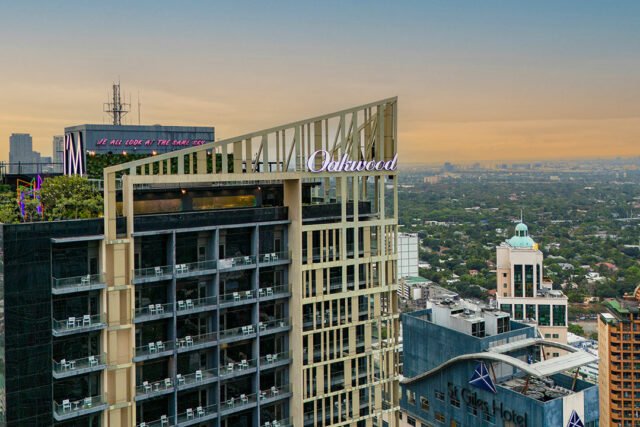
Oakwood has a new home in Makati

ASCOTT’s Oakwood has a new home in Makati, sharing space with Worldhotel Inc.’s I’M Hotel in the intersection of Makati and Kalayaan Avenues in Makati’s Poblacion.

“We actually have two properties under one roof,” said Melissa Lim, General Manager of Oakwood Makati Avenue, during the April 16 launch. The property has 434 rooms in total. 150 of them, all suites, belong to the Oakwood brand, occupying floors 22 through 34. The remaining 284 rooms belong to I’M Hotel, occupying floors nine through 21.

“We want to take I’M to the next level essentially. We saw the opportunity to rebrand some of our suite rooms,” she said. “It’s the suites that needed more push.”

BusinessWorld took a tour of the property. The suites have been given touch-ups, with balconies and voice-activated smart television sets, and fully equipped modular kitchenettes. The rooms range in size from the Studio Premier at 44 sqm., to the two-bedroom executive suite at 100 sqm., with prices beginning at P10,000. The hotel is also pet-friendly. “For I’M Hotel, what we’re trying to attract is the leisure traveler,” said Ms. Lim. “Whereas for Oakwood, what we’re trying to attract is the corporate guests as well as long stays.”

Along with the rebranding of the suites, I’M Hotel also announced the opening of two new food and beverage outlets: Osteria M and Barangay Bar.

Osteria M is led by Ms. Lim herself (who happened to be a finalist of Singapore MasterChef’s second season). This will feature Italian cuisine infused with Filipino ingredients, as well as handmade pastas, and sourdough Naples-style pizzas. Meanwhile, Barangay Bar (punnily pronounced as Barang-gay) is their LGBQ+-friendly bar, located by the poolside. “Because we’re situated in Poblacion, I think it’s high time that Poblacion supports the community with an LGBTQ+-friendly bar,” she told BusinessWorld.

I’M Hotel’s I’M Onsen Spa, according to Ms. Lim, will also venture into aesthetic treatments as well. As for the hotel itself, she said, “In the next three to five year-window, we’re going to actually be franchising I’M Hotel as a brand to the provinces. We wanted to get the blueprint.”

Oakwood Makati Avenue is located in Kalayaan Ave. corner Makati Ave., Brgy Poblacion, Makati City. — JL Garcia

PHINMA Corp. says it’s boosting cement capacity with new Mindanao facilities

LISTED conglomerate PHINMA Corp. is set to increase the capacity of its cement business with new facilities in Mindanao, a company official said.

The company is putting up a cement plant in Davao valued at around P2 billion, said Eduardo A. Sahagun, PHINMA Corp. director and executive vice-president for the construction materials group (CMG), during a briefing last week.

“We’re putting (up) our Davao plant, which is almost similar to Mariveles, Bataan. That is a joint venture with some of our partners in Davao. That will bring our total capacity to like five million tons if all those things will be completed in a couple of years,” he said.

“The Davao plant is about to start. We’re just working on its environmental clearance certificate,” he added.

PHINMA Corp. has presence in the cement business through its subsidiary Philcement Corp., which is part of the conglomerate’s CMG consisting of Union Galvasteel Corp. and PHINMA Solar Energy Corp.

The company’s Mariveles plant, located at the Freeport Area of Bataan, has an initial annual capacity of two million tons.

In addition, Mr. Sahagun said Petra Plant in Zamboanga del Norte has also started and is expected to help boost the company’s cement business.

Philcement signed a manufacturing and sale agreement with Petra Cement, Inc. in January, allowing the former to operate the latter’s Petra Plant.

“It has started and after that, we’re almost there for the actual purchase for the Petra Plant. We actually look at that as an opportunity. When we look at where it is located, it is almost like we’re the only one there serving Northern Mindanao,” he said.

“We think that has a good potential for us. And bring us closer to where we want to be as we actually put in together our model of being more sustainable for our cement business,” he added.

The Petra Plant has a cement grinding facility with a capacity of 500,000 metric tons per annum.

Meanwhile, PHINMA Properties said in a separate statement that it plans to explore the provision of socialized housing to the underserved and low-income sector.

“What we hope to do is develop a successful model for this, finding a balance between serving our mission of making lives better and compliance with the price ceiling for these properties as set by the government,” PHINMA Properties President and Chief Executive Officer (CEO) Raphael B. Felix said.

PHINMA Hospitality, Inc. President and CEO Jose Mari R. del Rosario said the company is exploring expansion and more franchising opportunities for the Microtel brand, along with a Visayas venture for TRYP.

The company is currently working on a TRYP condotel project in partnership with Damosa Land, Inc. in Samal Island, Davao.

“This will, in effect, disperse the locations of Microtels in the countryside where they are much needed,” he said.

PHINMA Corp. shares were last traded on April 30 at P20 per share. — Revin Mikhael D. Ochave

LANDBANK seeks to tap capital markets faster through charter amendments

BW FILE PHOTO

LAND BANK of the Philippines (LANDBANK) wants to be able to tap the capital markets faster as part of its proposed charter amendments, its top official said.

“We’re looking at a lot of different aspects with the aim of making LANDBANK more competitive and to allow us the ability to go to market in a swifter manner,” LANDBANK President and Chief Executive Officer Lynette V. Ortiz told BusinessWorld in an interview.

The official said part of the goals for the planned changes to its current charter is to improve LANDBANK’s “ability to be able to access the debt markets in a more nimble way, as well as proper representation in the board of a wider industry, including infrastructure.”

Department of Finance Secretary Ralph G. Recto said in March that bills seeking to amend the charters of LANDBANK and the Development Bank of the Philippines will be filed with Congress soon.

The charter changes will also increase the two state-run banks’ authorized capital stock and allow them to conduct an initial public offering (IPO).

Ms. Ortiz added that the amount LANDBANK will seek to raise through the IPO will depend on the provisions that will be approved by Congress, and that it will be a percentage of their capital.

Meanwhile, LANDBANK has also received regulatory relief following its capital contribution to the Maharlika Investment Corp. (MIC), she said.

LANDBANK was mandated to contribute P50 billion to the MIC for its initial funding.

“But generally, I think if you look at our financials, our common equity Tier 1 (CET1) ratio and capital adequacy ratio (CAR), we are well above [the mandated levels],” Ms. Ortiz said.

As of end-2023, LANDBANK’s CAR stood at 16.35%, while its CET1 ratio was at 15.46%, both above the Bangko Sentral ng Pilipinas’ (BSP) minimum requirements of a 10% CAR and 6% CET1 ratio.

BSP Governor Eli M. Remolona, Jr. previously said both LANDBANK and DBP remained compliant with the regulator’s capital requirements, even after remitting their contributions to the MIC.

LANDBANK’s net income grew by 34% to P40.3 billion last year, driven by revenues from loans and investments and improved cost management. — Aaron Michael C. Sy

PHL cyberattacks averaged 5B daily in 1st quarter, report shows

STOCK PHOTO | Image from Freepik

By Aubrey Rose A. Inosante

THE PHILIPPINES was hit by an average of five billion cyberattacks per day in the first quarter, with 87% of those targeting the gambling and gaming industry, according to cloud services and cybersecurity provider Cloudflare, Inc.

This marked a 28% increase from 3.9 billion cyberattacks in the fourth quarter of 2023, Cloudflare said in its Quarterly Global Internet Trends & Insights Report released on April 17.

The most targeted sector was the gaming and gambling industry with an 87% share, followed by telecommunications at 6%, hospitality at 5%, and media with 1%, it said.

“There have been more high-volume cyberattacks, e.g. denial-of-service (DDoS) attacks, targeting the Philippines’ Internet properties protected by Cloudflare in the last quarter than in the previous one,” Cloudflare said in an e-mailed statement on April 26.

A DDoS attack aims to disrupt Internet services such as websites or mobile applications and make them unavailable for users.

Gambling and gaming were also the top targeted industries in Asia, seeing 53% of total threats, Cloudflare said.

Thailand and Indonesia saw two billion cyberattacks per day with the same top-targeted industry, while Singapore was hit by six billion attacks daily, with its most attacked industry being cryptocurrency, the report showed.

“We observed around two trillion Hypertext Transfer Protocol (HTTP) requests blocked as potential threats (not only DDoS) in the previous quarter in Asia related to the gaming/gambling industry,” it said.

This was also the case globally, as over seven of every 100 DDoS requests mitigated attacked the gaming and gambling industry, followed by the information technology and Internet sector and marketing and advertising, it added.

The online gaming industry is competing for customers in cyberspace, with some even acquiring the services of DDoS attackers to gain market share, according to Allan S. Cabanlong, regional director for Southeast Asia at the Global Forum on Cyber Expertise.

These attacks can cause downtime in gaming sites, leading to a loss in revenue and a decline in player retention, he said.

Extortion is also one of the main objectives of those targeting the gambling industry, said e-commerce advocate Janette Toral.

“Gambling platforms use e-commerce transactions and payments connectivity elements,” Ms. Toral said.

Cloudflare said it served an average of 44 billion daily content requests to the Philippines, with three billion or 6% classified as DDoS attacks originating locally.

Globally, it mitigated 10.5 trillion HTTP DDoS attack requests in the first quarter and blocked 59 petabytes of DDoS attack traffic on the network layer, it said.

The source countries were the United States (19.8%), China (7.73%), Germany (6.5%), Indonesia (6.07%), and Brazil (5.96%).

The quarterly DDoS threat report provides a comprehensive overview of DDoS attack insights and trends over three months. Cloudflare sends an automated survey to victims of a DDoS attack or a ransom note.

Digital Pinoys National Campaigner Ronald B. Gustilo said there must be stiffer fines and penalties for government agencies and private institutions that will be affected by data breaches, depending on the severity of these incidents.

ADVERTISEMENT
ADVERTISEMENT