
How PSEi member stocks performed — May 3, 2024

Here’s a quick glance at how PSEi stocks fared on Friday, May 3, 2024.


Here’s a quick glance at how PSEi stocks fared on Friday, May 3, 2024.

PHILIPPINE April inflation that exceeds 4% could hurt market sentiment, but a pickup in economic growth from 5.5% in the fourth quarter of last year could spur optimism, analysts said.
“Investors are expected to watch out first for our April inflation report,” Philstocks Financial, Inc. Senior Research Analyst Japhet Louis O. Tantiangco said in a Viber message last week.
“An inflation print exceeding the upper end of the government’s 2-4% target may cause negative sentiment. A first quarter gross domestic product (GDP) growth above 5.6% may spur optimism, while one that falls below that could weigh on the bourse,” he added.
The local statistics agency will release April inflation and first-quarter GDP data on May 7 and 9. Inflation quickened to 3.7% in March from 3.4% in February.
On Friday, the benchmark Philippine Stock Exchange index (PSEi) fell by 0.46% or 31 points to close at 6,615.55. The broader all-share index shed 0.18% or 6.41 points to 3,498.17.
The PSEi dropped by 0.2% or 13.2 points from a week earlier.
“An expected nonmove from the US Federal Reserve barely moved the bellwether index to action, as locals look ahead to April inflation next week,” online brokerage 2TradeAsia.com said in a market note.
Mr. Tantiangco said the market might also resort to bargain-hunting ahead of the data release.
“At its current level, the market is trading at a price-earnings ratio of 13.2x, below its 2019-2023 average of 18.2x,” he said. “This shows that the market is at attractive levels. Given this, we may see episodes of bargain-hunting next week.”
He placed market support at 6,400 points and resistance at 6,700.
Michael L. Ricafort, chief economist at Rizal Commercial Banking Corp., put immediate support at 6,360 and resistance at 6,800 to 6,820.
“The PSEi corrected lower for the third consecutive trading day [on Friday] ahead of the local inflation and GDP data [this] week as potential local market catalysts, after local market sentiment was partly weighed by China’s water cannon attack on some Philippine ships in disputed waters,” he said in a Viber message.
2TradeAsia.com placed the market’s immediate support at 6,400 to 6,500 and resistance at 6,750.
“Index movement has been capped by intraday selling pressure, keeping rallies short and the overall trend generally unexciting,” it said. “Positive gaps in the chart open up opportunities for range-trading and modest gains in the very short term. A deluge of analyst briefings and corporate guidance in the coming week may help rouse animal spirits.” — Revin Mikhael D. Ochave

THE PHILIPPINE PESO is expected to trade sideways against the dollar this week as markets await inflation and economic growth data.
Slower-than-expected April job growth in the US could also lead to a weaker dollar, analysts said.
‘[Markets will consider] the recent labor data in the US, where unemployment is pointing upwards again, while locally we have inflation and gross domestic product (GDP) growth data,” Robert Dan J. Roces, chief economist at Security Bank Corp., said in a Viber message.
The peso closed at P57.345 a dollar on Friday, 19 centavos stronger than a day earlier, according to Bankers Association of the Philippines data posted on its website. Week on week, the peso appreciated by 36.5 centavos.
The peso strengthened against the dollar due to lower oil prices amid easing tensions between Israel and Iran, Michael L. Ricafort, chief economist at Rizal Commercial Banking Corp., said in a Viber message.
The peso was also supported by the slower-than-expected US jobs growth, Mr. Roces said.
Inflation probably quickened to 4.1% in April, according to a median estimate of 16 analysts in a BusinessWorld poll last week.
This is within the 3.5-4.3% forecast of the Bangko Sentral ng Pilipinas (BSP) but beyond its 2-4% target. Inflation was 3.7% in March and 6.6% a year ago.
The local statistics agency will report April consumer price index (CPI) and first-quarter GDP data on May 7 and 9.
Finance Secretary Ralph G. Recto last week said the Philippine economy likely grew by 5.8-6.3% last quarter.
The lower end of Mr. Recto’s forecast is faster than the 5.5% growth in the fourth quarter, but slower than the 6.4% expansion a year earlier.
The government expects economic growth at 6-7% this year after expanding by 5.5% last year.
Mr. Roces expects the peso to move between P57.20 and P57.60 a dollar this week, while Mr. Ricafort sees it ranging from P57.10 to P57.60. — Aaron Michael C. Sy
By John Victor D. Ordoñez, Reporter
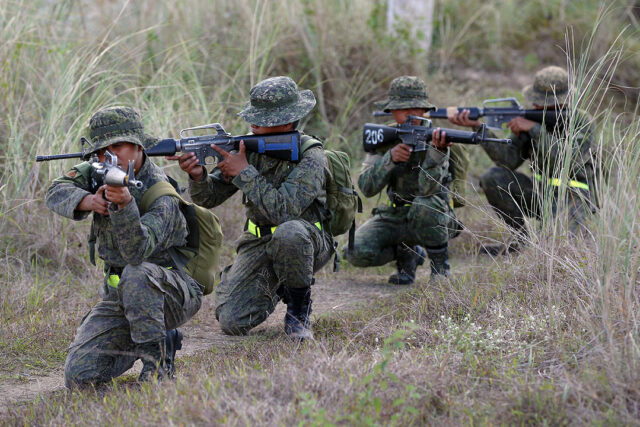
THE PHILIPPINES must seek out more defense partnerships with its global allies amid increasing aggression by China’s coast guard in areas of the South China Sea that are well within Manila’s exclusive economic zone, security analysts said at the weekend.
“Manila must leverage its partnerships to improve its national manufacturing capabilities in critical industries and motivate partners to engage in technology transfers beyond the buyer-seller framework,” Don Mclain Gill, who teaches international relations at De La Salle University, said in a Facebook Messenger chat.
Last week, the Philippines summoned China’s envoy to protest its coast guard’s use of water cannons that damaged two of Manila’s vessels in the South China Sea.
Philippine officials called out China when a Philippine Coast Guard (PCG) ship and a fishery vessel were damaged after Chinese coast guard vessels fired water cannons at them while on their way to the disputed Scarborough Shoal to help Filipino fishermen.
“While this internationalization of its maritime security problem may not immediately push China’s aggressions back, it is extremely important to building the Philippines’ long-term security capacity, as well as increasing its leverage in dealing with Beijing in the future,” Raymond M. Powell, a fellow at Stanford University’s Gordian Knot Center for National Security Innovation, said in an X message.
Aaron Jed Rabena, who specializes in geopolitics and foreign policy at the University of Philippines Asian Center, said there has been a shift in public sentiment on the Philippine government’s efforts in the South China Sea.
“There has been a shift from resentment towards China to the feeling of inadequacy with the response of our coast guard,” he said in a Facebook Messenger chat. “There is a clamor now from the public, if you would look at any comment section on news reports about this, most of them would say that the Philippine side needs to do more and needs to resist.”
Last Tuesday, the PCG said two China Coast Guard ships had used jet stream water cannons against its vessel sailing some 1,000 yards away from the Scarborough Shoal, resulting in damage to its railing and canopy.
A Bureau of Fisheries and Aquatic Resources vessel’s electrical, navigation and radio systems were also damaged after being rammed thrice by Beijing’s coast guard vessels,
Manila summoned Zhou Zhiyong, deputy chief of mission of the Chinese Embassy in Manila in March after the Chinese coast guard fired a water cannon at a Philippine resupply mission near Second Thomas Shoal, where Manila grounded a World War II-era ship in 1999 to assert its sovereignty.
Lucio B. Pitlo III, who is also a research fellow at the Asia-Pacific Pathways to Progress Foundation, said the government of President Ferdinand R. Marcos, Jr. is likely to continue deepening its security ties with the United States, Australia and Japan to counter Chinese aggression.
“Manila will likely coordinate with these countries in how to respond to China’s increased assertiveness in the West Philippine Sea,” he said in a Facebook Messenger chat.
The Philippines and the US are holding their annual Balikatan (shoulder-to-shoulder) military exercises until May 18 with 5,000 Filipino soldiers and 11,000 American servicemen participating in the war games. Mr. Marcos earlier said he was considering to include Japan in the exercises amid worsening tensions in the South China Sea.
The Philippine Senate last year passed a bill that seeks to boost the country’s defense program through investments in local defense equipment manufacturing amid tensions with Beijing.
Tensions between the Philippines and China have worsened in the past year as Beijing continues to block Manila’s resupply missions to Second Thomas Shoal, where it grounded a World War II-era ship in 1999 to assert its sovereignty.
In 2016, a United Nations-backed tribunal in the Hague voided China’s expansive claims in the South China Sea. It also upheld the rights of small-scale Filipino and Chinese fishermen to fish at Scarborough Shoal.
“Practically speaking, China has shown that it has no incentive to tone down its salami-slicing strategy in the South China Sea,” Mr. Gill said.
“While it is difficult to change China’s behavior for the short term, Manila must give great focus to improving its national capabilities to better position itself in the region in the long term.”

By Kyle Aristophere T. Atienza, Reporter
THE PHILIPPINE Department of National Defense (DND) denied on Sunday that it had been involved in any agreement with China over Second Thomas Shoal, following the Chinese embassy’s statement that the two sides had agreed on a new model for the South China Sea feature.
Defense Secretary Gilberto C. Teodoro, Jr. in a statement called the insinuation a “devious machination of China through their Embassy in Manila”’ and a “falsehood” aimed at distracting Filipinos away from China’s intrusions into the Philippines’ exclusive economic zone (EEZ) in the South China Sea.
The Chinese Embassy in Manila on Saturday said the Armed Forces of the Philippines Western Command and China “early this year” had agreed on a so-called “new model” for managing tensions in the Second Thomas Shoal.
The agreement, according to the statement, was “approved by all key officials in the Philippine chain of command, including the Secretary of National Defense and the National Security Advisor.”
Mr. Teodoro said he has not allowed any contact between the Defense agency and the Chinese Embassy since the courtesy call of Chinese Ambassador Huang Xilian a few days after he took office in July 2023.
“During the said courtesy call, there was no discussion or briefing on any ‘gentleman’s agreement’ or ‘new model,’ which is contrary to the Chinese Embassy’s pronouncements,” said the Philippine defense chief.
Mr. Teodoro said the claim was made right after China’s aggressive moves within the Philippine EEZ were condemned in a recent meeting in Hawaii with his counterparts from the US, Japan, and Australia.
“I am issuing this statement to generate awareness of this clear attempt by China to advance another falsehood in order to divide our people and distract us from their unlawful presence and actions in our EEZ,” he said.
Beijing’s coast guard ships backed by maritime militia vessels have been firing water cannons at Philippine vessels delivering supplies to BRP Sierra Madre, a Navy vessel that Manila grounded in Second Thomas Shoal in 1999 years after China’s seizure of Mischief Reef.
The shoal is located 240 kilometers off the coast of Palawan province and is about 900 kilometers from Hainan, the nearest major Chinese landmass.
Second Thomas Shoal was among the five features most frequented by patrols of the Chinese Coast Guard last year, according to the Asia Maritime Transparency Initiative.
The supposed new model followed a revelation from former presidential spokesman Herminio L. Roque, Jr. in March that Mr. Marcos’ predecessor, Rodrigo R. Duterte, had entered into a “gentleman’s agreement” with China over the shoal.
Under the alleged agreement, the two nations supposedly agreed to keep the “status quo” in Second Thomas Shoal, which meant only basic supplies and not building materials would be delivered to the BRP Sierra Madre.
The Philippine foreign affairs department in March said Beijing had raised the supposed gentleman’s agreement in its proposals to Manila on how to de-escalate their tensions in the South China Sea.
“We advise our citizens, the media, and the international community to beware of China’s methods of manipulation, interference, and malign influence in furthering its own interests,” Mr. Teodoro said.

By Chloe Mari A. Hufana
THE PHILIPPINE government has been urged to adopt climate-smart practices to mitigate the effects of climate change, which a group said over the weekend would take decades and trillions of pesos worth of funding to address.
Speaking at a media briefing on Sunday, John Leo C. Algo, national coordinator of Aksyon Klima Pilipinas, said the government must take decisive action while committing to sustained efforts over decades to address the deep-seated challenges posed by climate change.
“We need investment in implementing solutions, either for the government, businesses, or society,” he said, explaining how climate-smart practices are strategies, techniques, and actions that adapt to climate change, mitigate their adverse effects and promote sustainable development.
He said these practices typically involve reducing greenhouse gas emissions, enhancing resilience to climate impacts, and ensuring food security, all while minimizing negative environmental and social consequences.
The Department of Environment and Natural Resources Secretary Maria Antonia Yulo-Loyzaga echoed this sentiment in the past, warning that without intervention, climate change could result in substantial economic losses amounting to approximately P1.4 trillion by 2030.
Earlier, she stressed the urgent need for significant investments, estimating a requirement of P3.6 trillion by 2030 to mitigate these adverse effects.
“When we look at the GDP, the needed investments, or the kind of losses and damages our country will experience, those trillions of pesos that we would lose because of climate change, that could have gone to other development projects,” Mr. Algo told BusinessWorld on the sidelines of the same media briefing on Sunday.
He added that the budget could go to other development programs, such as housing, agriculture, or health.
“But instead, because of climate change, it would significantly impact the Philippines’ pursuit of sustainable development,” he added.
By adopting climate-smart practices in the agriculture sector, he said farmers would be educated on resilient farming techniques to safeguard crop yields and ensure food security amidst evolving climatic challenges.
Recent findings from the Department of Agriculture underscore the severity of the situation, with El Niño-induced damages nearing P6 billion, with rice still the most affected crop, absorbing P3.1 billion in losses.
It said MIMAROPA, Cordillera Administrative Region, and Western Visayas are the three most affected regions.
“There’s a strong El Niño and there’s global warming and we’re seeing the same patterns, the same trends from before to now, only now is worse,” he said.
“For people to say that what they’re feeling in their skin right now is worse than eight years ago, even though many factors are the same, indicates that from first-hand experience of many Filipinos, global warming is becoming worse because we are now really feeling it.”

CELEBRATING its 37th anniversary this month, the Commission on Human Rights (CHR) has made human rights more attainable on all levels of Philippine society through the launch of its online client portal.
The CHR will have this online complaints portal called CHR MISMO accessible to Filipinos by May 13, 10 days after the government agency’s anniversary.
“[It] will enable us to reach our clients, especially the most vulnerable ones, [in] real-time, anywhere in the country, including remote areas. This is our response to the fast-evolving digital world where emerging issues on human rights continually surface,” said CHR Chairperson Richard P. Palpal-latoc in a statement.
The commission also shared its milestones in 2023, such as the “Lakbay Karapatan Tungo sa Kamalayan or Lakaran,” a program that disseminates information on human rights in local communities.
The CHR has brought this initiative to nine provinces since its inception last year.
“Through this program, CHR was able to establish over a hundred Barangay Human Rights Action Center in partnership with local government units across all regions as well as around fifty-eight (58) Center for Human Rights Education in partnership with various educational institutions across the country,” the CHR said in a statement.
It also has various partnerships with agencies, such as the Department of Justice – Board of Claims (DoJ-BoC), the Bureau of Jail Management and Penology (BJMP), and the Department of Labor and Employment (DoLE) for the advancement and promotion of human rights.
Meantime, Mr. Palpal-latoc is hoping for the immediate passage of the CHR Charter Bill, Senate Bill No. 2440, to broaden his office’s mandate and reach.
It said the passage of the bill will enable the CHR to “realize its independence” and “establish its role as a watchdog, monitor, advocate, and educator of the government.”
“CHR has prevailed over challenges in the past and will consistently strive to improve and adapt to advance the rights of all individuals across all sectors and spectrum,” said Mr. Palpal-latoc. — Chloe Mari A. Hufana

A PHILIPPINE senator has filed a bill seeking to establish a mechanism ensuring anticipatory actions or preventive measures ahead of climatic and natural disasters.
“In view of further strengthening national policies on disaster resilience amid the increasing threats of climate change and natural calamities, and shifting away from a reactive response toward a more proactive approach to disasters, the passage of this legislation is hereby endorsed,” said Senator Jose “Jinggoy” P. Estrada, who filed Senate Bill No. 2643 on April 23.
Under the bill, a State of Imminent Disaster is declared in anticipation of a natural disaster that is very likely to happen based on risk assessment made by state agencies.
The President would declare this through the recommendation of the National Disaster Risk Reduction and Management Council (NDRRMC).
Before its declaration, the NDRRMC and its local offices are tasked to determine if the disaster will cause significant damage to shelter, critical infrastructure and facilities needed for disaster response.
Disruptions to electricity supply, drinkable water, and health services will also be considered in declaring this, based on a copy of the bill.
A similar bill was filed before the House of Representatives in February.
“It shall be the policy of the state to protect the lives, properties, and livelihoods of its citizens by addressing risks, particularly the root causes of vulnerabilities, exposure to hazards, and the capacity to anticipate and cope with such hazards,” according to the Senate bill. — John Victor D. Ordoñez
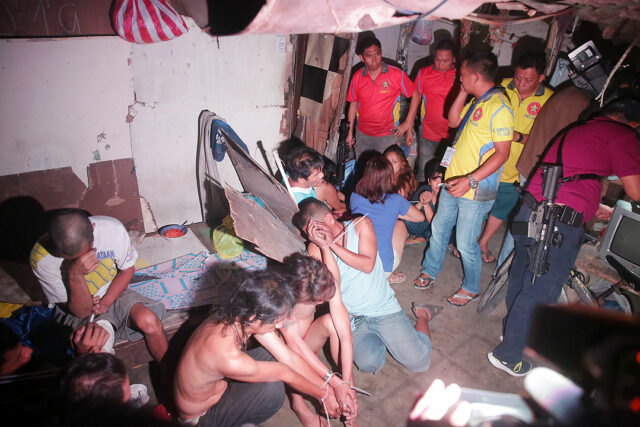
THE COMMISSION on Human Rights (CHR) should work with the International Criminal Court (ICC) in investigating former Philippine president Rodrigo R. Duterte’s blood war on drugs, a congressman said Sunday.
“I urge the Commission on Human Rights to work with the ICC, the United Nations, and (the) international community in seeking justice for the multitudes of victims of the inhumane war on drugs,” Manila Rep. Joel R. Chua said in a statement.
At least 8,663 Filipinos have been killed under Mr. Duterte’s anti-drug campaign, according to a report by the United Nations (UN) Office of the High Commissioner for Human Rights. Estimates by Philippine human rights groups indicate that around 27,000 to 30,000 were killed, three times more than the UN figure.
President Ferdinand R. Marcos, Jr. said in January that his government will not aid the ICC’s investigation into the former administration’s drug war killings.
“I consider it as a threat to our sovereignty. Therefore, the Philippine government will not lift a finger to help any investigation that the ICC conducts,” Mr. Marcos told reporters earlier this year. — Kenneth Christiane L. Basilio

DAVAO CITY — The city council recently passed a resolution for Davao City to enter into a sisterhood agreement with Gunsan City, South Korea, with which an agricultural exchange program has been established.
The resolution, filed by Councilor Marissa S. Abella, chairperson of the Committee on Agriculture, states that the local governments of Davao and Gunsan desire to maximize respective efforts towards the promotion of agricultural sustainability through people-to-people interaction in the area of agriculture.
It also outlined the city government’s various programs to ensure and enhance the quality of agricultural production in every barangay in this city.
Ms. Abella cited her visit to a research project site in Barangays Sirib and Manuel Guianga in Calinan District on Durian and cacao being undertaken by the Korea International Cooperation Agency (KOICA) in partnership with the Mindanao Development Authority (MinDA).
“This is to improve the yield of cacao and Durian and improve the cultural practices of the crops,” she said, hoping that Korea will open the market for Durian from the Philippines. — Maya M. Padillo
COTABATO CITY — Up to 300 Islamic teachers in Cotabato province each received a P1,500 cash allowance for January to March from their provincial government in support of their efforts to promote religious solidarity among local Muslim and Christian communities.
Islamic teachers in Cotabato province are active in programs addressing violent religious extremism being espoused by misguided radical groups fomenting animosity for non-Muslims.
Radio reports in this city and in nearby provinces on Sunday stated that the program, pioneered by the office of Gov. Emmylou T. Mendoza, complements the peace process between Malacañang and Mindanao’s Moro sectors.
The grant of a P500 monthly stipend to Islamic teachers in Madaris, or religious schools in Cotabato, which covers 17 towns and more than 40 barangays in its capital, Kidapawan City, shall be a continuing program of the office of Ms. Mendoza, who is chairperson of the multi-sector Regional Development Council 12.
The three-month allowance for each of the 300 Islamic teachers in Moro-dominated areas in Cotabato province were personally released by employees of the Moro Affairs section of the provincial government led by Edris D. Gandalibo, himself a Muslim.
Teachers in government-accredited Islamic schools in different towns in Cotabato are also known for their subjects promoting cultural and religious solidarity among culturally-pluralistic communities.
A member of the 80-seat Bangsamoro parliament, the physician-ophthalmologist Kadil M. Sinolinding, Jr., who has peacebuilding projects in Bangsamoro barangays in Cotabato province, told reporters the allocation of a P500 monthly cash assistance to Muslim preachers by Ms. Mendoza’s office is meaningful owing to her being a non-Muslim and that her province is under Region 12, not part of the Bangsamoro Autonomous Region in Muslim Mindanao.
“Many of the preachers who got the initial allowances are from Bangsamoro barangays in that province. For that, we are thankful,” Mr. Sinolinding said.
Major Gen. Alex Sr. Rillera, commander of the Army’s 6th Infantry Division, said many Islamic missionaries in Cotabato province were even instrumental in negotiating the surrender of more than 300 members of the outlawed Dawla Islamiya and its ally, the Bangsamoro Islamic Freedom Fighters, in the past 12 months. — John Felix M. Unson

BAGUIO CITY — Dubbed as “Denguerra,” the battle against dengue disease has been intensified in this city as summer marks the beginning of the peak season for its spread, the Baguio City Anti-Dengue Committee (BCADC) said over the weekend.
Part of the program to combat the mosquito-borne disease is the mobilization of barangays to conduct massive and simultaneous search and destroy operations every Thursday to weed out mosquito breeding sites.
The city also launched an online system of reporting cases to boost surveillance and capture all cases and take necessary steps to contain the spread of the disease.
Noting how dengue cases are starting to pick up, Baguio City Mayor Benjamin Magalong has ordered the implementation of preventive programs to prevent a repeat of the 2016 dengue season when cases soared to their highest ever.
As of April 25, the City Health Services Office has recorded 260 dengue cases since Jan. 1. Acting City Health Officer Dr. Celia Flor C. Brillantes confirmed that one of those infected by the mosquito-borne disease — a 63-year-old male from the Loakan area — died of dengue-related causes.
City Epidemiology Surveillance Unit (CESU) chief Dr. Donabel Panes said, of the total 260 dengue cases, only 93 were admitted to the hospital while the rest were outpatients. — Artemio A. Dumlao
