Home Blog Page 3219

Keppel Philippines Holdings to hold annual stockholders’ meeting remotely on June 14


Spotlight is BusinessWorld’s sponsored section that allows advertisers to amplify their brand and connect with BusinessWorld’s audience by publishing their stories on the BusinessWorld Web site. For more information, send an email to online@bworldonline.com.

Join us on Viber at https://bit.ly/3hv6bLA to get more updates and subscribe to BusinessWorld’s titles and get exclusive content through www.bworld-x.com.

Senate OKs VAT on digital services

PACKAGES are seen from e-commerce giant Shein. — IMAGO/ONE MORE PICTURE VIA REUTERS CONNECT

THE PHILIPPINE Senate on Monday approved on third and final reading a bill that seeks to impose a 12% value-added tax (VAT) on digital services provided by companies with no physical presence in the Philippines.

All 23 senators voted in favor of Senate Bill No. 2528, which requires nonresident digital service providers to collect and remit VAT on all digital transactions of customers in the Philippines.

Under the measure, nonresident digital service providers and electronic marketplaces must register with the Bureau of Internal Revenue (BIR) for the remittance of VAT on their services.

Digital services refer to those provided over the internet or other electronic networks using information technology. These include online search engines, online marketplaces, cloud services, online media and advertising, online platforms and digital goods.

If signed into law, the measure may cover e-commerce firms such as Amazon, Shein, Rakuten, Taobao, AliExpress and Temu, which do not have physical presence in the Philippines.

The BIR commissioner can order the blocking or suspension of the services of digital providers if they fail to withhold and remit the 12% VAT.   

The bill exempts online courses, seminars and training programs offered by private educational institutions accredited by the Department of Education and Commission on Higher Education from remitting the tax.

The services of banks and nonbank financial intermediaries including those delivering services through digital platforms are also exempt from remitting the VAT, according to a copy of the bill sponsored by Senator Sherwin T. Gatchalian.

The measure also has a reverse charge mechanism that will require a VAT-registered taxpayer who receives the digital services from these nonresident foreign businesses and marketplaces to withhold and remit the VAT to the BIR.

“This (measure) would level the playing field with local market players in terms of taxation and on top of principles in terms of taxation, this would also increase the government’s source of recurring revenues,” Rizal Commercial Banking Corp. Chief Economist Michael L. Ricafort said in a Viber message.

The Department of Finance expects the bill to bring in P83.8 billion in revenue from 2024 to 2028.

The House of Representatives approved a similar measure in November 2022.

“This will increase tax revenues but may be detrimental to businesses as this is an additional burden that they may pass to consumers, making products more expensive,” John Paolo R. Rivera, president and chief economist at Oikonomia Advisory & Research, Inc., said in a Viber message.

Meanwhile, the Senate also approved on third and final reading a bill seeking to set tougher penalties on those who use financial accounts to commit crimes.

All 23 senators voted in favor of Senate Bill No. 2560, or the proposed Anti-Financial Account Scamming Act (AFASA), which sets jail time of at least six years and a fine of as much as P500,000 against those behind money mule schemes.

People found guilty of fraud may face as long as 12 years in jail and a fine of at least P1 million, according to a copy of the measure sponsored by Senator Mark A. Villar.

The bill also punishes those committing economic sabotage — deliberately disrupting a country’s economy, with life imprisonment and a fine of at least P1 million but not more than P5 million.

Both measures approved on Monday are part of the Legislative-Executive Development Advisory Council’s priority bills. — John Victor D. Ordoñez

Oil firms told to hike biodiesel blend by October

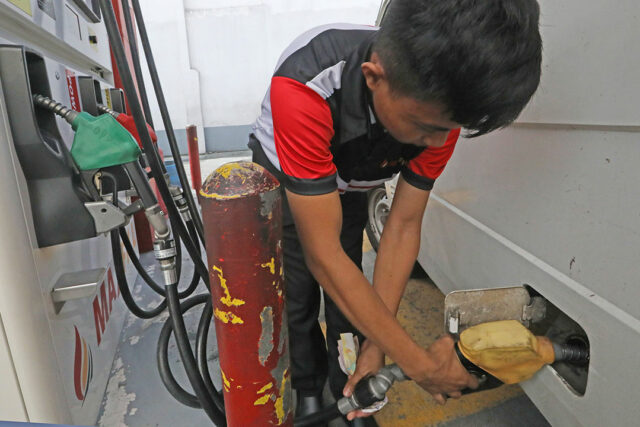
An attendant fills up a vehicle at a gasoline station in Manila, Sept. 18, 2023. — PHILIPPINE STAR/EDD GUMBAN

By Sheldeen Joy Talavera, Reporter

THE DEPARTMENT of Energy (DoE) directed oil companies to increase the coco biodiesel blend starting October, in a bid to help reduce pump prices and support the local industry.

In a circular, the DoE said all diesel fuel sold in the country should contain a biodiesel blend of 3% starting Oct. 1, from 2% now.

Oil firms should increase the coco biodiesel blend to 4% by Oct. 1, 2025, and to 5% by Oct. 1, 2026.

The Biofuels Act of 2006 mandates that all liquid fuels for motors and engines contain locally sourced biofuel components.

Since February 2009, oil companies have been required to implement a 2% biodiesel blend by volume in all diesel fuel sold and distributed in the country.

“Following the drastic increase in the cost of fuel over the past years as a consequence of the Ukraine-Russia conflict, production cuts by the Organization of the Petroleum Exporting Countries (OPEC) Plus and global inflation, the National Biofuels Board (NBB) has determined that an increase in the bioethanol blend will reduce pump price of diesel and gasoline fuel and help alleviate the burden of rising prices on consumers,” according to the circular.

The increase in the coco methyl ester (CME) blend from 2% to 5% was supposed to have been implemented in 2020 but was delayed due to the coronavirus pandemic. At that time, there was a lack of assurance on the sufficiency of biodiesel supply, as well as logistical limitations.

Under the circular, the DoE said oil companies can also offer gasoline fuel containing 20% bioethanol blend on a voluntary basis. At present, the DoE has mandated a 10% bioethanol blend by volume into all gasoline fuel sold locally.

In a statement, the DoE said increasing the bioethanol blend to 20% could result in a P3.21 per liter reduction in gasoline pump prices.

“Implementing the higher biofuel blend is a win-win solution as we promote economic growth, uphold environmental stewardship and strive for cleaner energy utilization. It is also about investing in a future where sustainability drives progress,” Energy Secretary Raphael P.M. Lotilla said.

The DoE said in the circular that the downstream oil industry should implement measures to ensure that all requirements for the transition to the higher biofuel blend are in place before the deadline.

Oil firms should ensure there is sufficient storage capacity, blending facilities and transport systems to accommodate an expected increase in biofuel supply.

Fuel retailers that implement the 20% bioethanol blend are also directed to provide a dedicated storage tank and dispensing pump. Vehicle owners should be informed before dispensing gasoline.

Meanwhile, biofuel producers should ensure there is ample feedstock and production to meet the demand for higher biofuel blend.

“The proposed increase in the ethanol blend in gasoline and the CME blend in diesel is part of the country’s efforts to reduce reliance on imported fossil fuels, lower greenhouse gas emissions, and support the local bioethanol and biodiesel industries,” Rodela I. Romero, assistant director of the DoE Oil Industry Management Bureau, said in a Viber message.

She said the new policy is part of government efforts to comply with environmental regulations, promote the use of “cleaner fuels” and support local industries.

However, Terry L. Ridon, a public investment analyst and convenor of think tank InfraWatch PH, said the new policy “should have included a suspension mechanism in the event of unreasonable surges in global biodiesel and bioethanol prices.”

He said allowing a price surge would defeat the government’s objective to mandate biofuels to ensure lower pump prices.

“[The] government should focus on using local biofuel supply instead of relying heavily on importation for our blending requirements,” he said in a Viber message.

Dean A. Lao, Jr., president of Chemrez Technologies, Inc., said the higher biodiesel blend is “long-time coming and much needed” by the agriculture industry.

“There is so much local value adding to coconut oil and even more CO2 (carbon dioxide) displacement for the country. I am glad the biodiesel industry can be credited with such inclusive benefits for the Philippines,” he said.

Chemrez, a subsidiary of publicly listed D&L Industries, Inc., operates the country’s first continuous-process biodiesel plant, according to its website.

The United States Department of Agriculture (USDA) expects biofuel consumption to recover in 2024 as fuel ethanol demand is seen to grow by 8% to 682 million liters, while biodiesel demand is expected to inch up by 0.8% to 240 million liters.

“The primary driver of this growth will be increases in the fuel pool, with potential for greater growth if higher blending standards are fully adopted,” the USDA said in its report.


DBCC set to review revenue targets

PHILIPPINE STAR/RUSSELL PALMA

THE GOVERNMENT is keeping its revenue targets for now, although a review by the Development Budget Coordination Committee (DBCC) is scheduled next month.

“We’re keeping the targets. [We] will make a review [by the] end of June,” Finance Secretary Ralph G. Recto told reporters in a Viber message on Monday.

This comes as the Department of Finance (DoF) reiterated that it would not push new tax measures to avoid fanning inflation.

Finance Undersecretary and Chief Economist Domini S. Velasquez over the weekend said the DoF would rely on nontax revenue to meet collection targets.

“Nontax revenue is actually a short-term solution… We were expecting that this year. I think the intent is not to impose new taxes,” she said during a forum organized by the Economic Journalists Association of the Philippines and San Miguel Corp. at the weekend. 

The DoF has been looking for ways to generate much-needed revenue as Mr. Recto earlier said he does not plan to introduce any new taxes this year.

Ms. Velasquez said the DoF is not planning to push “inflation-inducing” taxes.

“We do recognize that (the targets are) challenging. That’s why we have in place the nontax revenues,” she added.

Nontax revenues refer to collections from government services, including regular fees and service charges, the privatization of state assets and dividends from government-owned and -controlled corporations (GOCC).   

Latest data from the DoF showed that nontax revenues stood at P206.4 billion as of April.

The agency has been proposing initiatives to boost nontax revenues. Last week, Mr. Recto suggested selling the government’s stake in the Subic-Clark-Tarlac Expressway (SCTEx) to state pension funds.

The DoF also raised the mandatory dividend remittances of GOCCs to the National Government to 75% of their annual net income in 2023 from 50%.

Ms. Velasquez said the focus on nontax revenues would “buy time” for the department to ensure that its revenue-generating agencies can improve their collections.

The Bureau of Internal Revenue (BIR) is tasked to collect P3.055 trillion, while the Bureau of Customs’ (BoC) revenue target is at nearly P1 trillion.

In the first four months of the year, the government collected P1.4 trillion in revenues or nearly a third of the full-year target, data from the Finance department showed.

The BIR had collected P912.9 billion as of end-April, falling short of its P1.03-trillion goal for the period.

On the other hand, the BoC collected P229.67-billion, exceeding its P288.53-billion target by 3.86%.

Union Bank of the Philippines, Inc. Chief Economist Ruben Carlo O. Asuncion welcomed the DoF’s plan not to introduce new taxes.

“New taxes are unpopular. People wouldn’t want to have new taxes especially that inflation and interest rates are high and impact spending of almost everyone,” he said in a Viber message.

P&A Grant Thornton tax principal Eleanor L. Roque said the government’s ability to generate enough revenues without imposing new taxes would depend on its collection efficiency.

“If there are untaxed sectors or inefficiencies in the collection efforts, the government can concentrate on plugging the loopholes and increased collection,” she said in a Viber message.

“The government should also consider global tax developments such as BEPS (base erosion and profit shifting) to ensure that the taxes that should be paid in the Philippines is not paid to other jurisdictions just because we are late in adopting BEPS,” she added.

To improve tax collection, Ms. Roque said the BIR should ensure that it has enough personnel or infrastructure to help taxpayers and improve tax collection.

Meanwhile, the Finance department is also studying ways to improve tax collection in electronic commerce platforms, citing best practices in other Asian economies.

“There could be missed [revenues] in e-commerce, especially those who moved from brick-and-mortar shops and now sell online,” Ms. Velasquez said in mixed English and Filipino.

In a statement, the department said it is working to adopt best practices in digitalization from South Korea, Singapore and Japan to improve tax collection.

The DoF will also meet with the Securities and Exchange Commission  and Bureau of Local Government Finance to “establish a comprehensive data-sharing agreement.” — Beatriz Marie D. Cruz

Muted remittance growth seen to further dampen consumption

PHILIPPINE STAR/MIGUEL DE GUZMAN

MUTED REMITTANCE growth in the coming months will continue to dampen household spending in the Philippines, Pantheon Macroeconomics said.

“The support remittances are providing to private consumption in the Philippines remains sub-par,” it said in its weekly Emerging Asia economic monitor.

Pantheon Macroeconomics noted that the growth of remittance inflows  in peso terms slowed to 4.6% year on year in March from 5.3% in February.

However, average growth rose to 4.9% in the first quarter from 0.9% in the fourth quarter.

“But this was down solely due to currency effects rather than an actual improvement in US dollar transfers, a year-over-year lift that is more likely to wane than grow in the second half,” Pantheon Macroeconomics said.

It noted that remittance growth in peso terms is “now below the historical average for a 10th consecutive month.”

“This underperformance is likely only to worsen, looking at the lackluster momentum since the start of the year,” it added.

Data from the Bangko Sentral ng Pilipinas (BSP) showed cash remittances rose by 2.5% to $2.74 billion in March from $2.67 billion a year ago. It was the slowest growth since 2.1% in June 2023.

In the first quarter, cash remittances grew by 2.7% to $8.22 billion from $8 billion a year earlier.

The BSP expects cash remittances to grow by 3% this year.

Rizal Commercial Banking Corp. Chief Economist Michael L. Ricafort said it is still possible to meet the central bank’s remittance target this year.

“The higher US dollar-peso exchange rate by more than 4% since the start of 2024 and more than 13% over the past two years or since the Russia-Ukraine conflict started in February 2022 could help reduce the need to send more remittances, with more peso equivalent, that are also needed to cope with higher prices locally from the point of view of overseas Filipino worker (OFW) families,” he said. 

Cash remittances that fuel household spending, account for about three-fourths of the economy.

Private consumption grew by 4.6% in the first quarter, slower than 5.3% in the previous quarter and 6.4% a year ago. This was the slowest since the 4.8% drop in the first quarter of 2021. — L.M.J.C.Jocson

Philippines in talks for sustainable aviation fuel plant

STOCK PHOTO

THE Department of Transportation said it is in talks with some groups to put up a sustainable aviation fuel (SAF) plant in the country. “We are encouraging the private sector because it is not the government that will put up the plant, it is the private sector. In fact we have some groups, encouraging them to get involved in the production of SAF,” Transportation Secretary Jaime J. Bautista told reporters on the sidelines of a forum last week. 

Mr. Bautista did not identify the groups involved.

“There are many materials from the Philippines (used for SAF) and these are being exported to Singapore to use for SAF. Although we cannot identify these groups yet, we have discussions with them and they will look at it,” he said. 

In March, President Ferdinand R. Marcos, Jr. said that the Philippines secured a commitment from Airbus, an aerospace company, to collaborate with the Transportation department on sourcing energy from landfills for biofuels and its eventual use in the aviation sector.

The Department of Energy said it is still working on the draft regulations governing SAF to help accelerate the adoption of green fuel.

SAF can help reduce emissions from air transportation, being made from nonpetroleum feedstock like agricultural waste and used vegetable oil.

The International Air Transport Association has estimated that SAF will contribute around 65% of the reduction in carbon emissions needed by the aviation sector to reach net zero by 2050.

In the Philippines, only Cebu Pacific currently operates SAF-powered flights. The budget airline has expressed its aspiration to integrate SAF across its network by 2030.

Meanwhile, flag carrier Philippine Airlines said it is working to secure a green fuel supply deal as it aims to operate SAF-powered flights to Singapore by 2026. — Ashley Erika O. Jose

KFC targets to open over 50 stores in PHL this year

PIXABAY

RAMCAR Food Group’s KFC Philippines said it plans to open over 50 stores this year to bring the brand closer to more provincial markets.

“In 2023, we ended with 382 stores, and we are bound to open more than 50 stores this year because our thrust is to bring KFC closer to our market,” said Charmaine Pamintuan, chief marketing officer of KFC, on the sidelines of the KFC Kentucky Town Music and Arts Festival on Saturday.

“These will be located in the National Capital Region, and some will be opened in provincial areas too,” she added.

To date, the company has already opened about ten stores. Last Friday, it opened a new store at SM Caloocan.

“One of our biggest strengths is actually in malls, and we know that SM is one of our biggest mall partners,” she said.

Ms. Pamintuan also said the Ramcar group plans to expand its farm in Bulacan to support the expansion of the company’s store portfolio.

“We are vertically integrated so that we can assure that from farm to table, it is actually monitored at the highest quality,” she said.

“There are plans, especially as we open more businesses in the Visayas and Mindanao areas. It’s part of something that we are looking at because expansion is one of our thrusts,” she added.

Last year, she said that the company was able to hit its target growth rate, which it aims to replicate this year.

“Coming from the two-year pandemic, we can still see people being excited to go out. So we still see revenge eating and revenge get-together,” Ms. Pamintuan said.

“We know that every time Filipinos get together, it is always with a meal, and we are fortunate that they enjoy having a meal together because KFC has offerings like our bucket meals,” she added.

Other brands under the Ramcar group are Mister Donut, Malcolm’s Place, and Tokyo Tokyo, among others. — Justine Irish D. Tabile

Metro Retail profit falls 16% with decreased general merchandise sales

METRORETAIL.COM.PH

LISTED Metro Retail Stores Group, Inc. saw a 16% decline in its first-quarter net income to P50.3 million, attributed to narrower profit margins resulting from a reduced contribution from the general merchandise segment.

 Net sales rose by 4.8% to P8.7 billion, the highest recorded first-quarter sales since Metro Retail’s public listing in 2015, Metro Retail said in a statement to the stock exchange on Monday.

Comparable sales during the period were also up by 2.8%.

 Among sectors, food retail climbed by 7.9% on strong sales of basic groceries while general merchandise dropped by 2.9% amid spending constraint on discretionary items due to persistent high inflation.

 With the reduced share to business of general merchandise, Metro Retail’s first-quarter blended gross margin fell to 20.8% from 21.9% last year.

 Earnings before interest, taxes, depreciation, and amortization declined by 5.1% to P389.2 million from P410.2 million on lower margins.

 In January, Metro Retail opened a Metro Value Mart in Lapu-Lapu City, Cebu, bringing its current network to 64 stores. It also had the groundbreaking of five supermarkets in Cebu and Leyte to boost its presence in Visayas.

 Metro Retail recently launched its 10-hectare Metro Distribution Center in Sta. Rosa, Laguna that seeks to strengthen the company’s logistics system and lays the foundation for the expansion pipeline throughout Luzon in the next few years.

 “Looking ahead to 2024, we are poised for growth with cautious optimism,” Metro Retail President and Chief Operating Officer Manuel C. Alberto said.

 “Our strategic plans are geared towards calibrated expansion, enhancing our online presence, and continuing to modernize our stores,” he added.

 Metro Retail operates various store formats such as Metro Supermarket, Metro Department Store, Super Metro Hypermarket, and Metro Value Mart.

 On Monday, Metro Retail shares were unchanged at P1.30 apiece. — Revin Mikhael D. Ochave

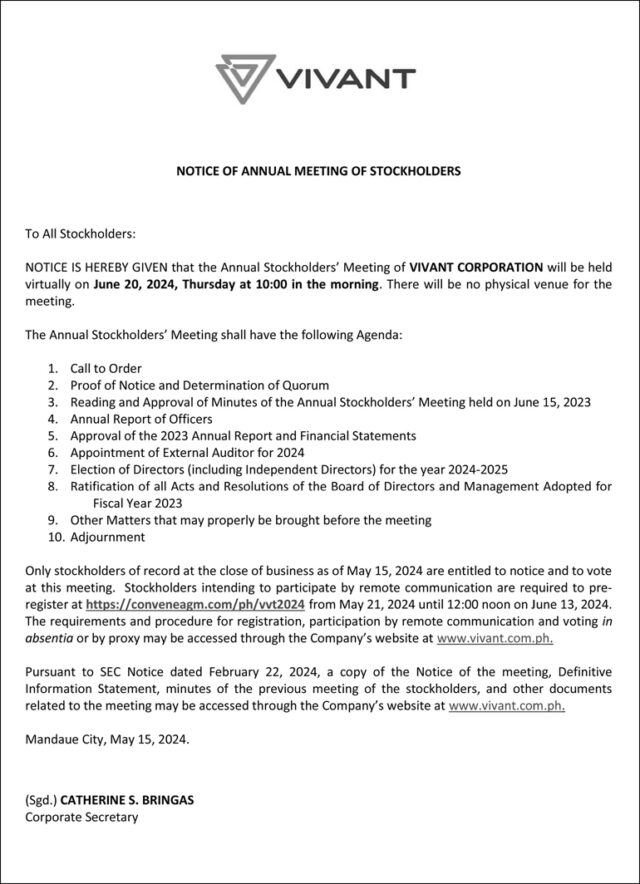
Vivant Corp. announces virtual Annual Stockholders’ Meeting on June 20


Spotlight is BusinessWorld’s sponsored section that allows advertisers to amplify their brand and connect with BusinessWorld’s audience by publishing their stories on the BusinessWorld Web site. For more information, send an email to online@bworldonline.com.

Join us on Viber at https://bit.ly/3hv6bLA to get more updates and subscribe to BusinessWorld’s titles and get exclusive content through www.bworld-x.com.

Roxas Holdings secures PSE nod for trading halt from May 20-31

ROXAS Holdings, Inc. (RHI) has secured approval from the Philippine Stock Exchange (PSE) for a voluntary trading suspension starting Monday morning until May 31 following the planned takeover of Solar Philippines Power Project Holdings, Inc. Founder Leandro Antonio L. Leviste.

The voluntary trading suspension aims to avoid “speculative trading” when the investment agreement and other definitive agreements are indicated to be executed and completed as per the term sheet, RHI said in a stock exchange disclosure on Monday.

 “Rest assured that the company will apprise the PSE of further developments on this matter as they arise,” RHI added.

 On May 16, RHI, First Pacific Natural Resources Holdings BV, First Agri Holdings Corp., and Leviste-led Countryside Investments Holdings Corp. signed a nonbinding term sheet.

 The signed term sheet covers a plan to invest P5 billion for an initial 71.6% stake in RHI.  

 First Pacific Natural Resources Holdings BV, First Agri Holdings Corp. are wholly owned subsidiaries of Pangilinan-led First Pacific Co. Ltd., and collectively own 62.89% of RHI.

 The term sheet sets indicative key terms and conditions for the proposed subscription by Countryside Investments to RHI primary shares in tranches.

 RHI said that the term sheet is indicative only and does not create any legally binding obligations for any of the parties.

 The term sheet is subject to the execution and delivery of definitive documentation and fulfillment or satisfaction of various closing conditions.

 “Once the binding definitive documentation is executed, RHI will make the proper disclosure of material information relating to the proposed investment of Countryside Investments in RHI,” the company said.

 RHI is a unit of Roxas and Co., Inc., which has business interests in real estate through Roxaco Land Corp. and sugar milling through a minority interest in RHI.

 Hong Kong-based First Pacific Co. Ltd. has three key Philippine units consisting of Metro Pacific Investments Corp., Philex Mining Corp., and PLDT Inc.

 Hastings Holdings, Inc., a unit of PLDT Beneficial Trust Fund subsidiary MediaQuest Holdings, Inc., has a majority share in BusinessWorld through the Philippine Star Group, which it controls. — Revin Mikhael D. Ochave

Maya Bank and WeFund forge a P2.75-B loan channeling partnership to boost access to credit

In the photo from left to right: Joseph Ruan, WeFund Lending Corp. and JuanHand COO; Francisco “Coco” Mauricio, WeFund Lending Corp. and JuanHand CEO/President; Shailesh Baidwan, Maya Group President and Maya Bank Co-Founder; and Angelo Madrid, Maya Bank President

Philippine digital banking leader Maya Bank and Wefund Lending Corporation, through Lightning Financing Company, have established a P2.75-billion loan channeling deal to significantly expand access to financial services for underserved communities.

This collaboration provides immediate access to capital to more creditworthy Filipinos and underscores the importance of responsible borrowing, thereby fostering financial empowerment. With this partnership, Maya and WeFund are making significant strides in bridging the economic divide, offering a lifeline of credit to underserved communities, and paving the way for their financial independence.

As a pioneer in digital financial services, Maya Bank is committed to transforming the economic landscape for Filipino consumers and micro, small, and medium-sized enterprises (MSMEs) through innovative offerings like savings and deposits. The loan channeling initiative with WeFund extends Maya Bank’s mission to increase credit accessibility for the unbanked populations in the Philippines.

Angelo Madrid, President of Maya Bank, emphasized the collaboration’s impact, stating, “We are proud to work with WeFund, and this initiative is a powerful step in getting more Filipinos banked through digital technology. This joint effort significantly expands the financial options available, helping to also promote better financial health, especially among the unbanked and underserved.”

WeFund operates the JuanHand online lending platform, which has already disbursed over P21 billion in loans, boasting a user base of over 7 million registered individuals. As it strives to cement its position as the country’s leading fintech cash lending app, JuanHand remains steadfast in its commitment to provide immediate assistance by approving and disbursing loans in less than 5 minutes. With its focus on fair interest rates, stringent regulatory compliance, polite customer service, and user-friendly interface, JuanHand emerges as the trusted and preferred option for those seeking tech-driven financial solutions.

“We are honored to partner with Maya Bank, a company known for innovation and a pioneer in our country’s digital banking industry. The collaboration enables us to positively impact the lives of millions of Pinoys who are underserved yet creditworthy.  Having access to much-needed financial services is the start of financial empowerment and long-term success. Responsible borrowing will always be a tool for good, and we’re proud to have Maya Bank support us in this noble endeavor,” said Francisco “Coco” Mauricio, WeFund Lending Corp. and JuanHand’s President and CEO.

This initiative between Maya Bank and WeFund sets the gold standard for a more inclusive and equitable financial landscape in the Philippines, advancing their goal of nurturing a financially empowered society.

*Download JuanHand app now via IoS Appstore and Google Playstore or visit www.juanhand.com.


Spotlight is BusinessWorld’s sponsored section that allows advertisers to amplify their brand and connect with BusinessWorld’s audience by publishing their stories on the BusinessWorld Web site. For more information, send an email to online@bworldonline.com.

Join us on Viber at https://bit.ly/3hv6bLA to get more updates and subscribe to BusinessWorld’s titles and get exclusive content through www.bworld-x.com.

Bullet Dumas prepares for comeback concert

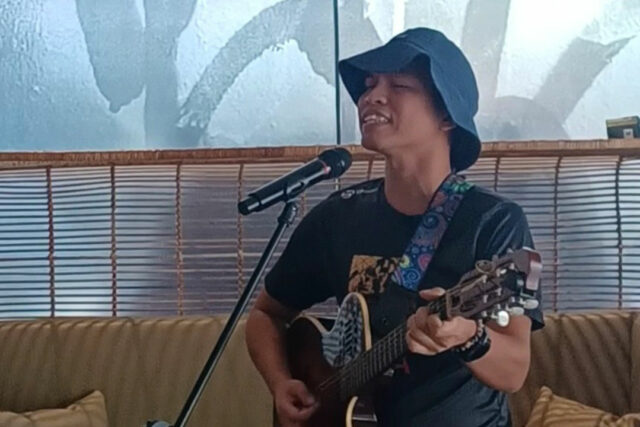
BULLET DUMAS gives a sneak peek of his upcoming performance. — BRONTË H. LACSAMANA

Expect new songs born from pandemic, theater work

THE PAST few years since the pandemic saw indie folk artist Bullet Dumas shift focus from his own music to theater acting. From Tanghalang Ateneo’s rock opera 2Bayani in 2022 to 9 Works Theatrical’s jukebox musical Ang Huling El Bimbo in 2023, his onstage work as an actor has flourished.

This year, Mr. Dumas goes back to his roots after a long period of exploration. Nananatili — set for June 8, 7 p.m. at the Music Museum at the Greenhills Shopping Center in San Juan — consolidates the lessons learned over the past five years into an intimate solo concert.

The singer-songwriter will be performing new songs for the first time since the pandemic, all centered on themes of love, grief, and acceptance.

“I didn’t want to return nang basta-basta (just for the sake of it). I wanted to do it with new material, this being my biggest chance to do it, so since the beginning of the year I have been writing,” said Mr. Dumas at a press conference at The Astbury in Makati City on May 17.

His first solo concert, Usisa in 2018, celebrated the release of his album of the same name. From it, his songs “Tugtog,” “Put to Waste,” and “Limguhit” made waves — but the music scene has changed drastically since.

Now, younger artists have been cropping up all over the place, armed with music they developed over the pandemic. Musicians were left to work on themselves, making today’s music scene more vibrant and inspiring than ever before, according to the singer-songwriter.

“I’ve been going to a lot of gigs. The likes of Unique [Salonga], Zild, Ena Mori — ang daming magagaling ngayon (there’s lots of talent now),” Mr. Dumas said. “That’s why I couldn’t just come back without new music of my own.”

REFLECTIONS ON IMPERMANENCE
His concert repertoire will include new songs inspired by personal experiences with death in a transitory world. The show is billed as “an elegy, a eulogy, and a funeral drama all rolled into one.”

With Mr. Dumas co-producing the concert with Gabi Na Naman Productions, its vision is far different from all his previous performances as a musician.

Ang working concept ko ay last day ng funeral kung saan lumalabas lahat ng kuwento ng patay. Mas nakikilala natin iyung patay sa tingi-tinging kuwento mula sa iba’t ibang tao (My working concept is that it’s the last day of a funeral/wake where stories about the dead come out. We learn more about the dead through the little details told by various people),” he explained.

While his music remains in the indie and folk genre, ranging from soothing to intense tunes, his time in theater has changed a few things.

Natutunan ko iyung paggamit ng counterpoint at motif (I learned to use tools like counterpoints and motifs),” said the musician.

The songs are also mostly born from revisiting draft recordings made throughout the pandemic. In 2024, the new tracks are finally ripe and ready to be heard on stage.

“The title is Nananatili because it speaks to how the dead remain with us as we remember them,” Mr. Dumas said.

Maangas din iyung term kasi sinasabi na nandito pa rin, kahit ano mangyari (It’s also a cool term since it conveys being here always, no matter what).”

Tickets to Nananatili ni Bullet Dumas are available via bit.ly/nananatili, and are priced from P1,800 to P4,600. — Brontë H. Lacsamana

ADVERTISEMENT
ADVERTISEMENT