Home Blog Page 3214

Prime Infra subsidiary obtains supplier license from ERC

PRIMEINFRA.PH

RAZON-LED Prime Infrastructure Capital, Inc. (Prime Infra) said on Tuesday that its wholly owned subsidiary has secured a retail electricity supplier license from the Energy Regulatory Commission (ERC).

With the license, PrimeRES Energy Corp. will be able to enter into retail electricity supply agreements with large electricity end-users, its parent company said in a statement.

Large electricity end-users include contestable customers with an average monthly peak demand of 500 kilowatt and is a participant in the Retail Competition and Open Access (RCOA) scheme.

PrimeRES received its license after complying with the technical, financial, and administrative requisites which “proves its competence to operate and sell electricity to end-users under the RCOA,” Prime Infra said.

The company said that PrimeRES will source the power it will sell from affiliate and non-affiliate firms, including a portion of Prime Solar, another subsidiary of Prime Infra, and other future development projects.

Prime Solar has a 128-megawatt capacity of renewable energy from its solar in Tanauan, Batangas and Maragondon, Cavite.

“Part of our commitment in delivering socially relevant infrastructure is providing dependable energy that is accessible and affordable to people,” Prime Infra President and Chief Executive Officer Guillaume Lucci said.

“Through PrimeRES, we will be able to bring added value to our customers as they choose and negotiate their preferred retail electricity suppliers,” he added.

Prime Infrastructure said that Prime-RES also aim to support the electricity needs of other companies within the Razon Group with businesses in the areas of utilities, ports, construction, hospitality, and consumer services.

Another Razon-led company Manila Water Co., Inc. said that its P271-million Kalayaan sewer projects are expected to serve more than 1,000 households in the east zone of Metro Manila.

The 1.95-kilometer Kalayaan Sewer Replacement Package 2 with an allocated budget of P113 million was completed in February and is said to serve over 600 households.

The 3.23-kilometer Kalayaan Sewer Replacement Package 3, which has an allocation of P158 million, is slated for completion in the second quarter of 2024 to serve more than 800 households.

“These projects on sewer line enhancements form part of Manila Water’s big push to protect community health and promote environmental sustainability. By expanding and upgrading our wastewater services, we lessen our environmental impact,” Manila Water Corporate Communications Affairs Director Jeric T. Sevilla said.

With the recent acquisition of Prime Infra’s subsidiary Trident Water Co. Holdings, Inc. of Ayala Corp.’s remaining stake in Manila Water, Prime Infra has committed to strengthen the growth and expansion trajectory of the water utility firm. — Sheldeen Joy Talavera

Portraits of British royals from last 100 years on show in new London exhibit

RCT.UK

LONDON — From Andy Warhol’s colorful depiction of Queen Elizabeth II to Cecil Beaton’s pictures of her sister Princess Margaret, a new exhibition looks at portrait photography of Britain’s royal family over the last 100 years.

“Royal Portraits: A Century of Photography,” which opened at The King’s Gallery in Buckingham Palace on Friday, features more than 150 photographic prints, proofs, and documents from the Royal Collection and the Royal Archives, some of them never released or seen before in public.

“This exhibition charts the evolution of royal portraits photography over the past century, so from… the high society glamour of the 1920s all the way to the coronation of King Charles III in 2023,” Allesandro Nasini, senior curator of photographs at the Royal Collection Trust and exhibition curator, told Reuters.

The exhibition begins with a 1923 engagement portrait of Prince Albert and Lady Elizabeth Bowes-Lyon, who later became King George VI and Queen Elizabeth, which hangs close to the 2023 official coronation portrait of King Charles.

“(They are) exactly 100 years apart. We have analogue technology one side, digital technology (on the other), monochrome, color, and a private commission and the official. I think gives the range… of the exhibition which goes from the very private to the very public, the official.”

Among highlights is a colorful 1985 screenprint of Elizabeth II, who died in 2022, by Mr. Warhol, based on a portrait of the monarch and features “diamond dust,” or fine particles of crushed glass.

There are wartime images of the royal family, including some by society photographer Mr. Beaton who took many portraits of the royal family over several decades.

A 40th-birthday portrait of Prince William’s wife Kate, the Princess of Wales, hangs near a painting that inspired it: that of a previous Princess of Wales, Alexandra of Denmark.

The exhibition also features pictures of the royals by famous photographers including Annie Leibovitz, David Bailey, and Rankin. — Reuters

Indigenous Peoples as stewards of Philippine biodiversity

MATIGSALUGS TRIBE of Kadayawan Village, Davao — RANIELJOSECASTANEDA-WIKIPEDIA

AS ONE of the 18 mega-biodiverse countries in the world, safeguarding its rich biodiversity is important for the Philippines. Nearly half the plants and animals found in the country exist nowhere else on Earth. The country is home to two-thirds of the earth’s biodiversity and between 70% and 80% of the world’s plant and animal species. These wonders thrive within 228 identified Key Biodiversity Areas.

Thus, the Philippines has committed to the ambitious Kunming-Montreal Global Biodiversity Framework (KMGBF) which aims to address biodiversity loss, restore ecosystems, and protect indigenous peoples’ rights. It includes protection and conservation of at least 30% of the world’s land, fresh water, and sea by 2030 (also known as the 30×30 targets).

The ambitious GBF targets will entail a whole of society approach that is inclusive and leaves no one behind. This means having the National Government agencies, local government units, indigenous peoples and local communities, civil society organizations, academic and research institutions and the private sector, all doing their share. Appropriate governance mechanisms, increased financing, local innovative solutions, capacity-building, gender mainstreaming and youth participation will definitely be crucial as we work towards the 30×30 targets.

One cannot deny the fact that indigenous peoples are significant on-site stewards of the rich biodiversity of the Philippines. In fact, there is an almost a 1:1 correspondence of Key Biodiversity Areas and ancestral domains in the Philippines. To emphasize, many of the remaining Key Biodiversity Areas that are not protected areas are ancestral domains. This data provides tangible evidence that the traditional knowledge, systems, and practices of Indigenous Peoples (IP) that are deeply rooted in their culture and belief are in fact sustainable. Thus, the Indigenous Peoples, being the holders of vast natural resources, are in the forefront of environmental management.

The theme of this year’s International Day for Biodiversity — “Be part of the plan” — is a reminder of the significance of indigenous peoples’ inclusion and participation in the work towards biodiversity protection.

The United Nations Development Programme (UNDP) in the Philippines, alongside our partners, has made it a commitment to safeguard the environmental and social rights of the IP communities in our biodiversity work. In key areas, we ensure that provisions of the United Nations Declaration on the Rights of Indigenous Peoples (UNDRIP) are integrated. We uphold the Philippine Constitution, the Indigenous Peoples Rights Act (IPRA), and country’s Free Prior and Informed Consent (FPIC) policy in all initiatives dealing with IP communities.

With support from the Global Environment Facility (GEF), the Department of Environment and Natural Resources (DENR) and the National Commission on Indigenous Peoples (NCIP), UNDP Philippines, since 2010, has worked with 17 IP communities on delineating boundaries and mapping precious ecosystems, conducting inventory of resources and documentation of indigenous knowledge, systems, and practices. Twenty-five IP organizations were also supported in their establishment of community-led livelihood initiatives. It is important to engage the indigenous communities as resource groups rather than as beneficiaries alone.

Another major milestone to date is the inclusion of a salient provision on Indigenous Communities Conserved Areas (ICCAs) in the enhanced National Integrated Protected Areas System (ENIPAS) law.

The GEF-supported UNDP-DENR Biodiversity Management Bureau Philippine ICCA Project (PICCAP) provided opportunities to ensure indigenous peoples were well represented in the drafting of the ICCA Bill, which recognizes the contributions and the effective conservation measures by the indigenous peoples. Select IP organizations were provided technical and financial assistance by PICCAP and the 5th Operational Phase of the GEF Small Grants Program for the establishment and operation of biodiversity-friendly enterprises.

The ongoing efforts led by the DENR-BMB to update the Philippine Biodiversity Strategy and Action Plan (PBSAP) ensures its alignment with the GBF, including the 30×30 target. One of the key developments is for the ICCAs to be considered as a stand-alone conservation measure alongside protected areas and Other Effective Area-Based Conservation Measures (OECMs). The UNDP, through our GEF supported projects, including the GBF Early Action Support, the BD Corridor, Access and Benefit Sharing, the Small Grants Program, and the Biodiversity Finance Initiative projects, supports this undertaking for it serves as an avenue for a participatory and inclusive process.

Moreover, the UNDP, together with other development partners, have supported the DENR in institutionalizing the recognition, management, and strengthening of Local Conservation Areas as OECMs, in strengthening the access and benefits of IP communities from the country’s wealth of genetic resources, and in collaborating with other stakeholders and utilizing a landscape approach on improving biodiversity corridor management.

With the climate crisis and biodiversity loss facing humanity, there is no better time than now to renew our commitment and to ensure the inclusion of all sectors to be #PartOfThePlan in bolstering efforts for the achievement of our 30×30 targets #ForNature. Our lives are intertwined with nature. Protecting biodiversity is essential for preserving the planet’s natural capital and safeguarding our future.


Selva Ramachandran is the UN Development Programme Philippines resident representative.

Visa Philippines aims to boost offshore transactions through digital platform

VISA Philippines wants to boost outbound transactions through a digital payment platform that lowers the cost and speeds up sending money offshore.

The company has been promoting its Visa Direct platform to various partners, including banks, remittance centers, e-wallets, pawnshops, and nonbank financial institutions, Visa Philippines Country Manager Jeffrey V. Navarro said at a briefing on Tuesday.

Visa Direct is active in 190 countries and territories, sends money to 8.5 billion endpoints, and supports 160 currencies.

Visa Philippines is looking to increase the volume of money coursed through the platform by partnering with more local banks and nonbank financial institutions, Mr. Navarro added.

“My own aspiration is, let’s get the ball rolling and create momentum because I feel sometimes it’s very difficult to put a number there, especially since it’s just starting. Year on year, we aspire to really grow and partner with as many financial and nonfinancial institutions in this space,” he said.

Visa Direct has already partnered with the two big e-wallets, banks that have a debit or prepaid card, as well as Western Union, Moneygram, Remit.ly, and Xoom, Mr. Navarro said.

He added that the platform can be tapped by micro, small, and medium enterprises looking to expand their businesses globally and those procuring goods and services abroad.

It could also benefit students abroad who need allowance and money for tuition, as well as expats living in the Philippines sending money to their countries of origin, he said.

Mr. Navarro said he hopes Visa Direct could make sending money abroad as easy and convenient as person-to-person payments done via e-wallets or mobile banking apps. — AMCS

Drone startup Neros raises funding from Sequoia, eyes supplies to Ukraine, US military

PEXELS -DARREL UND

NEROS, an autonomous drone startup founded about a year ago, has raised $10.9 million in a seed round from Sequoia Capital to build a new factory and manufacture more drones to sell to Ukraine, the company told Reuters.

Neros joined a series of American drone companies trying to capitalize on the huge demand for drones in the Russia-Ukraine conflict, where thousands of unmanned aerial vehicles have been deployed at unprecedented scale to track enemy forces, guide artillery and bomb targets.

Founded by former professional drone racers Soren Monroe-Anderson and Olaf Hichwa, Neros said it had designed, manufactured and shipped drones to the battlefield in Ukraine within months of the company’s launch.

It is currently producing hundreds of drones a month and plans to use the funding for hiring and scaling up production.

Neros competes with Chinese drone makers that currently dominate the Ukraine market at cheaper prices. With its systems priced in the low four figures, Neros said it aims to be cost effective while using non-Chinese supply chains.

The company said it is also in conversation with the US Department of Defense (DoD) about using its vehicles across the Army, Air Force and special forces.

“What we really want is a cost-effective, performing product that serves Ukraine and the DoD combined, and no one’s accomplished that yet,” Neros CEO Monroe-Anderson said in an interview.

This deal also marks Sequoia Capital’s continued bet on defense tech, a sector it first joined other Silicon Valley venture capital firms in investing in last year.

“I think Neros is already best designed in the world for their class,” said Shaun Maguire, the Sequoia partner who led the deal.

“The next step is having more skilled supply chain purchase, having as much as possible be from US suppliers and all of it from Western suppliers.” — Reuters

Petron targets sales volume increase following Q1 performance

LISTED oil company Petron Corp. said it will focus on increasing sales volume following its perfomancee in the first quarter (Q1) and the previous year.

“We are now focused on increasing our sales volume and improve our financial performance,” Petron General-Manager Lubin B. Nepomuceno said during the company’s annual stockholder’s meeting on Tuesday.

“We’re taking advantage of the ongoing economic recovery that is why you will notice the huge improvement in our sales volume last year,” he added.

For the first quarter, Petron posted a 16% increase in its net income to P3.93 billion driven by the growth in its local and Malaysian operations.

Consolidated revenues went up by 21% to P227.64 billion brought by the strong volume growth.

Petron Chief Executive Officer Ramon S. Ang cited excise tax, value-added tax (VAT), and the absence of subsidies as reasons for high gasoline and electricity prices in the country compared to neighboring nations.

“For example, the price of gasoline is P60 per liter in the Philippines. In Malaysia, it’s only P20 per liter… because the government of Malaysia do not impose excise tax and VAT of 12%,” he said in mixed English and Filipino. 

Republic Act. No. 10963 or the Tax Reform for Acceleration and Inclusion Law raised excise tax on fuel in three trances from 2018 to 2020.

The tax rates are currently at P10 per liter for gasoline, P6 per liter for diesel, P5 per liter for kerosene, and P3 per liter for LPG.

“The electricity rate in the Philippines is usually three times compared to our regional countries because our neighboring countries also put in subsidy,” Mr. Ang said.

He said that the Philippines is “market forced” unlike other neighboring countries which are “heavily subsidized.”

“But I think our neighboring countries will not be able to sustain that in the long term,” he said. — Sheldeen Joy Talavera

Mona Lisa’s mysterious background decrypted by art-loving geologist

EN.WIKIPEDIA.ORG.
EN.WIKIPEDIA.ORG.

LECCO, Italy — Over 500 years after Leonardo da Vinci painted the Mona Lisa, an academic believes she has unraveled the mystery about the backdrop to one of the world’s most famous works of art.

Art historians have long debated its landscape, speculating on the locations that could have inspired Leonardo but the geologist and Italian Renaissance specialist Ann Pizzorusso thinks she has pinpointed it to Lecco in northern Italy.

“When I came to Lecco, I realized he had painted the Mona Lisa here,” Ms. Pizzorusso said, speaking of the small town on the shores of Lake Como, hitherto best known as the setting of Alessandro Manzoni’s masterpiece novel The Betrothed.

According to the scholar, the arched bridge depicted in the painting would correspond to the 14th-century Ponte Azzone Visconti, even though previous theories had related it to similar structures in other Italian cities, such as Arezzo and Bobbio.

Ms. Pizzorusso is not the first person to have claimed to have solved the mystery but she cites her knowledge of geology to back her claims.

“The bridge to me was not the important aspect of painting,” Ms. Pizzorusso said. “In the other hypotheses the geology was just incorrect.”

The geologist found that rock formations in Lecco were limestone, which matched what is depicted behind the noblewoman.

“When you look at the Mona Lisa, you see this part of the Adda River, and you see another lake behind it, which are perfectly shown underneath these sawtooth mountains,” she said from the spot where the scene could have been painted.

Ms. Pizzorusso’s research on Leonardo “shows perfectly the extent to which the artist and the scientist came together,” said Michael Daley, executive director of ArtWatch UK, a nonprofit organization monitoring the conservation of artworks.

“No art historian is qualified to take Ann on in terms of her scientific understanding. The other studies are dead ducks now,” he said. — Reuters

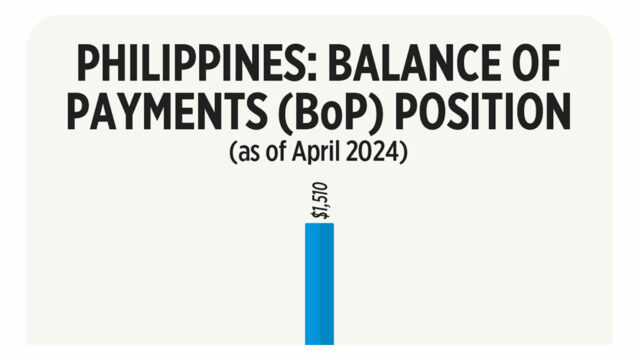
Philippines: Balance of Payments (BoP) Position

THE COUNTRY’S balance of payments (BoP) deficit widened in April as the government paid back foreign debt and the trade balance remained in a deficit, the Bangko Sentral ng Pilipinas (BSP) said. Read the full story.

Philippines: Balance of Payments (BoP) Position

Biden shouldn’t diss the ICC to back Netanyahu

UNITED NATIONS PHOTO

IT CAME AS A SHOCK, if not a surprise. The prosecutor of the International Criminal Court (ICC) in The Hague is seeking arrest warrants, on accusations of war crimes, for not only three commanders of Hamas but also two leaders of Israel, including Prime Minister Benjamin Netanyahu. “Outrageous,” said US President Joe Biden, speaking for almost everybody in Israel and many in Washington. But if the US now scorns the court it helped create in the 1990s, it will undermine the international regime of law and order that it claims to defend.

The request by Karim Khan, the prosecutor, next goes to a panel of independent judges. Even if they issue the warrants, there’s little risk of anybody on the list ever being arrested. For a start, neither the US nor Israel is a signatory to the Rome Statute that established the ICC, and neither feels bound by it. And in the theoretical event that any of the five were ever tried, they’d be presumed innocent and have their day in court.

All of this may get lost in what is indubitably the most emotionally fraught and controversial conflict the ICC has ever taken on. By contrast, the Russian war of aggression against Ukraine seems morally clear-cut, with hardly anybody in the West objecting to the arrest warrant the court issued last year against Vladimir Putin. But as Khan this week emphasized on behalf of the ICC, and by extension the world, “if we do not demonstrate our willingness to apply the law equally, if it is seen as being applied selectively, we will be creating the conditions for its collapse.”

No reasonable person will object to the charges against the three Hamas terrorists on Khan’s list. Yahya Sinwar, Mohammed Al-Masri, and Ismail Haniyeh were without doubt among the masterminds behind the gruesome attacks of Oct. 7. The ICC now wants them for the crimes, as defined in Articles 7 and 8 of the Rome Statute, of extermination, murder, rape, and torture, as well as taking and abusing hostages and more. If anybody in Israel disagrees, it would be only about how to mete out a just punishment.

The controversy is instead about the charges against Netanyahu and his defense minister, Yoav Gallant. They stand accused of deliberately causing starvation, suffering, persecution, collective punishment, and other inhumane acts — also as defined in Articles 7 and 8 — against the civilian population of the Gaza Strip, as distinct from Hamas. The details include restricting the delivery of food and medicine, shutting off water and electricity, killing civilians and even aid workers.

The body of international humanitarian law, both customary and codified, has plenty to say about such tactics. Collective punishment is taboo, and even collateral damage of civilian targets must be kept “proportionate” not in relation to the overall war aim (eliminating Hamas, in this case) but to the immediate objective of a given missile strike, say.

Aware of the acrimony bound to come his way, Prosecutor Khan showcased the meticulous evidence that his trial lawyers have collected, and the august legal minds that gave advice in the process. That may not keep the US, in a show of support for its ally Israel, from impugning the legitimacy of the entire court.

The Biden administration has made clear that it denies the ICC’s jurisdiction in the matter and won’t respect its findings. Some legislators are ready to go further; a dozen Republican senators had already sent a letter to the ICC: “Target Israel and we will target you,” they wrote to Khan, threatening “to end all American support for the ICC, sanction your employees and associates, and bar you and your families from the United States.”

It wouldn’t be the first American harassment of this court. One of the chief architects of the Rome Statute, the US subsequently turned against its own creation, lest the ICC should ever prosecute American soldiers or commanders. In 2002, Washington passed the “Hague Invasion Act,” a law that would in theory let a president dispatch troops to free Americans from detention. The administration of Donald Trump later slapped sanctions on an ICC judge and a lawyer who were investigating allegations against American soldiers in Afghanistan.

And yet, the US also cooperates with the ICC — in its investigations into Russian atrocities in Ukraine, for example. This cherry-picking is a terrible look for a power that still aspires, more or less, to be the leader of the free world. Across much of the planet, and especially in the so-called Global South, the US appears hypocritical, invoking its “rules-based order” against adversaries, from Russia to China, but ignoring it on behalf of friends, currently Israel.

The best argument against the ICC’s application for arrest warrants is that it implies, as a leading Republican senator put it, “a false moral equivalency” between the crimes of Hamas and the allegations against Israel. That, however, ought to be for the judges to decide. To cast aspersions preemptively on their professionalism and objectivity would be a disastrous signal for Washington to send.

The ICC and its neighbor in The Hague, the International Court of Justice, represent the concrete legacy of a centuries-old human aspiration, and passionate American leadership after the barbarism of World War II, to build a more humane world that rests on some modicum of law and order. The people who serve in The Hague tend to be idealists, and recognized authorities in their field.

The US cannot claim, at home or abroad, to stand for the rule of law only when it happens to like the particular rules or laws. Washington must end its on-again, off-again embrace of the treaties, conventions, and institutions that it helped to build, or risk bequeathing to future generations a regression to the arbitrary barbarity of bygone centuries. Instead of condemning the ICC, the US should instead argue its best case before the tribunal that Israel’s leaders are not guilty as charged, and then accept the verdict.

BLOOMBERG OPINION

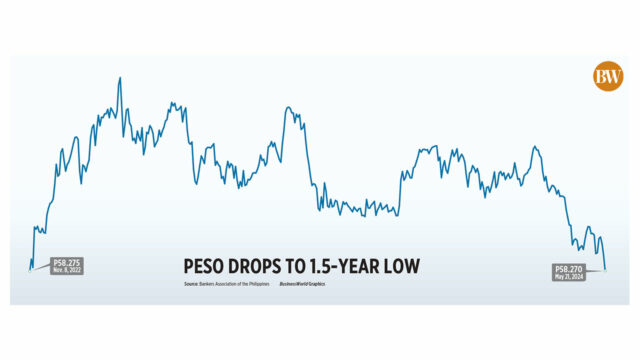
Peso drops to 1.5-year low

THE BANGKO SENTRAL ng Pilipinas (BSP) warned it will intervene in the foreign exchange market as the Philippine peso on Tuesday closed at the 58-per-dollar level for the first time in over 18 months. Read the full story.

Peso drops to 1.5-year low

PSEi member stocks performed — May 21, 2024

Here’s a quick glance at how PSEi stocks fared on Tuesday, May 21, 2024.


DoE signs two more deals with US to enable nuclear transition

PNRI.DOST.GOV.PH

THE Department of Energy (DoE) signed two memoranda of understanding with the US State Department on Tuesday enabling the Philippines to safely transition to nuclear power, with the two sides moving forward from the initial 123 Agreement, which had opened the door to US nuclear technology exports.

On the sidelines of the Indo-Pacific Business Forum, Assistant Secretary Daniel J. Kritenbrink of the State Department’s Bureau of East Asian and Pacific Affairs, said the memoranda are vital in supporting the Philippines as it builds a safe and secure civil nuclear industry.

“Signing the 123 Agreement is just the first step; building a safe and secure civil nuclear sector also requires skilled engineers and technicians, robust regulations, and strong commercial partnerships to bring the nuclear sector to life and to maintain it safely throughout its life cycle,” Mr. Kritenbrink said.

The two sides signed the 123 Agreement last year.

The agreement that the DoE signed with the Philippine-American Educational Foundation (PAEF) aims to establish a framework of cooperation for creating scholarship opportunities and academic exchanges centered around civil nuclear and renewable energy.

“This will help the Philippines develop the skilled workforce needed to build clean energy infrastructure, including the ability to operate state-of-the-art nuclear power plants,” Mr. Kritenbrink said.

“The collaboration with the PAEF will give the country an opportunity to have advanced training for the clean energy sector in developing the human resources that are needed, including the opportunities for civil nuclear cooperation,” Energy Secretary Raphael P.M. Lotilla said.

Meanwhile, the agreement between the US Agency for International Development (USAID) and the DoE aims to promote the US-Philippines Civil Nuclear Cooperation Agreement and develop a smart and green grid plan.

Under the agreement, USAID will commission a study on nuclear power viability that will assist the Philippine government in enhancing public acceptance of nuclear power in the country.

In November, the Philippine and US governments will organize the first Nuclear Suppliers Forum in the Philippines.

“This forum will bring together US experts, private sector leaders, and Philippine energy stakeholders to further solidify our civil nuclear cooperation,” Mr. Kritenbrink said.

In the Philippine Energy Plan for 2023–2050, the DoE is targeting a 35% share for renewable energy in the power generation mix by 2030, rising to 50% by 2040. — Justine Irish D. Tabile

ADVERTISEMENT
ADVERTISEMENT