Home Blog Page 3210

Australian researchers turn morning coffee waste into greener concrete

ALFRED KENNEALLY-UNSPLASH

MELBOURNE — Your morning coffee could help the planet.

That’s the promise of an Australian university turning used coffee grounds into a material that can be added to concrete to make it stronger and more sustainable, potentially lowering greenhouse gas emissions.

Concrete production, which involves mixing sand and gravel with cement and water, is a major producer of greenhouse gases, responsible for around 7% of the world’s emissions, according to the United Nations.

Researchers at Melbourne’s RMIT University heated coffee waste without oxygen, a process known as pyrolysis, to create a substance called biochar that can replace up to 15% of the sand used in concrete.

The inclusion of the biochar makes the concrete 30% stronger and reduces the amount of cement needed by up to 10%, said lead researcher Rajeev Roychand.

“This ticks all the boxes,” he said. “You preserve carbon and you are getting significantly higher strength.”

Roughly 50 billion metric tons of sand is dug up each year, mostly for use in concrete, a 2022 U.N. report said. Its extraction is often environmentally destructive and it is in increasingly short supply, the report said.

Cement production, which involves heating a mixture of limestone and clay to around 1,500  degrees Celsius (2,732°F), is responsible for most of concrete’s emissions.

The Macedon Ranges Shire Council near Melbourne used the coffee concrete earlier this month to construct a footpath.

RMIT is talking with several construction firms and concrete makers and with Starbucks to take its waste coffee grounds, and could form a company to make biochar, Roychand said. Starbucks did not respond to a request for comment.

Australian infrastructure company Bild Group said it planned to trial the concrete and hoped to use it on major road projects. Construction giant Arup supported the research.

Millions of tons of used coffee grounds are produced globally and most are sent to landfills where they emit methane as they break down.

Australia generates around 75,000 tons of waste coffee grounds a year and biochar made from this could replace up to 655,000 tons of sand in concrete because it is a denser material, Roychand said. Globally, coffee-waste biochar could replace up to 90 million tons of sand in concrete, he said.

Food waste accounts for around 3% of Australia’s emissions, according to the government, and most could eventually be made into biochar, Roychand said.

“We anticipate that about 60-70% (of organic waste) we can divert from landfill into concrete applications,” he said.

Other international universities are also researching the potential of biochar and other bio-engineering in concrete. RMIT was the first to use waste coffee grounds in this way, Roychand said. — Reuters

Struggling economy awaits winner of British election

People walk near the Elizabeth Tower, more commonly known as Big Ben, and the Houses of Parliament in London, Britain, Feb. 22, 2024. — REUTERS

LONDON — The winners of Britain’s election on July 4 will have to tackle an economy that looks stuck in a rut of slow growth with high levels of debt limiting the next government’s ability to spark a significant recovery.

After the blow dealt by the global financial crisis of 2007-09, the world’s sixth-biggest economy has been buffeted by the 2016 decision to leave the European Union, the COVID pandemic and a surge in energy and food prices in 2022.

Britain’s economic performance since the coronavirus crisis has been the weakest among the Group of Seven economies with the exception of Germany, which was also hit hard by the jump in energy prices following Russia’s invasion of Ukraine.

And the country’s inability to keep up with its peers in terms of productivity growth has contributed to a gap in living standards compared with other European countries.

Middle-income people in Britain are 20% poorer than their peers in Germany and 9% poorer than those in France, according to research by the Resolution Foundation, the Centre for Economic Performance and the Nuffield Foundation.

Prime Minister Rishi Sunak, who is struggling to turn around a huge opinion poll deficit, has sought to lift the mood of voters by saying the economy is turning a corner after a short, shallow recession in the second half of last year.

In his speech to announce the election, Sunak pointed to a fall in inflation to almost 2% in data published earlier on Wednesday – down from a peak above 11% in 2022 – as proof that his plans were working.

“Economic stability was only ever meant to be the beginning,” he said. “The question now is how and who do you trust to turn that foundation into a secure future for you, your family and our country.”

Gross domestic product grew strongly in the first quarter of 2024 and the fall in inflation has raised the prospect of the first Bank of England interest rate cuts since 2020.

But the recovery looks likely to be halting. The International Monetary Fund this week predicted growth of 0.7% in 2024 and 1.5% in 2025, well below its 2.75% average before the global financial crisis.

LOW INVESTMENT, HIGH DEBT
The main opposition Labour Party, riding high in the polls, blames Sunak’s Conservatives for what looks set to be the first fall in living standards between one national election and the next since at least the 1950s.

Labour leader Keir Starmer claims he will turn Britain into the fastest-growing Group of Seven economy by attracting private investment that he says has been held back by the political upheaval since the Brexit vote under the Conservatives.

In 2022, British business investment was below its level in 2016, a contrast with other G7 economies that experienced a 14% average increase during the period.

For all the upbeat talk of both party leaders, whoever occupies 10 Downing Street after the election will face major impediments to getting the economy on a stronger growth path.

Public debt levels are their highest since the 1960s when the public finances were still under strain from the costs of World War Two.

That limits the ability of the Conservatives to follow through on talk of further tax cuts by Sunak or Labour’s hopes of borrowing to fund big investments in the green economy.

Both parties have committed to a fiscal target of getting public debt falling as a share of gross domestic product at the end of a rolling five-year period, a goal that the government is barely on course to meet at the moment.

The IMF was blunt in its assessment of how Britain should meet the challenge of fixing the public finances and getting the economy growing again: higher taxes and politically sensitive reforms to relax restrictions that have thwarted the construction of homes and new infrastructure.

“Right now, too many businesses and households still face rising costs which delay investment decisions and dampen consumer spending,” Rain Newton Smith, head of the Confederation of British Industry, said.

Britain’s next government must also find a way to tackle deep problems in its labour market.

The country is the only one in the G7 where the share of working-age people outside the workforce remains higher than before the pandemic, which contributes to the slow pace of economic growth and puts pressure on inflation.

Rob Wood, chief UK economist at consultancy Pantheon Macroeconomics, said Labour’s plans would provide a modest boost to growth, raising Britain’s economic speed limit to 1.75% a year from 1.5%.

“The most sure-fire way of boosting UK productivity and potential growth would be a major improvement in the UK-EU trading relationship,” Wood said in a note to clients.

But Starmer has ruled out a major shift to rejoin the EU’s single market or a customs union, “which means only small improvements in trading relations with the EU are possible,” Wood said. — Reuters

Philippine central bank says intervened in forex market just to curb speculation

BANGKO SENTRAL ng Pilipinas Governor Eli M. Remolona, Jr. — COURTESY OF BANGKO SENTRAL NG PILIPINAS

MANILA – The Philippine central bank is only in the foreign exchange market to control speculation and its interventions have been “very modest,” its governor said on Wednesday.

Bangko Sentral ng Pilipinas Governor Eli Remolona also told reporters the central bank was looking to cut interest rates by 25 basis points in the third quarter and another 25 basis points in the fourth quarter. –– Reuters

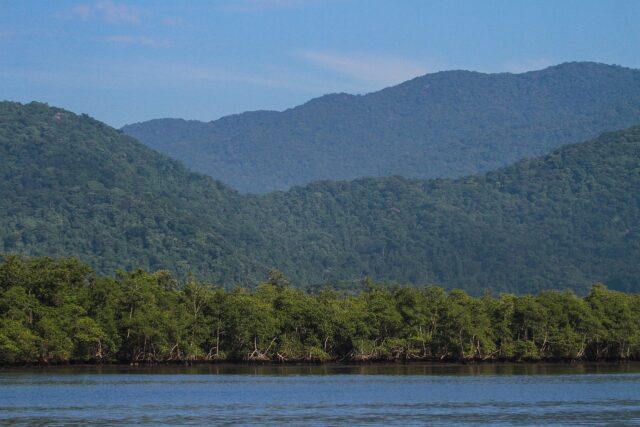
Half of world’s mangroves under threat, says conservation group

STOCK PHOTOS | Image by Jose Eduardo Camargo from Pixabay

 – Half of the world’s mangrove ecosystems are at risk of collapse as a result of human activity, rising sea levels and extreme weather, according to the latest survey by an international conservation group.

Unless action is taken, a quarter of the world’s total mangrove areas could be completely submerged within 50 years, with critically endangered ecosystems in India, Sri Lanka and the Maldives expected to bear the brunt, said the International Union for the Conservation of Nature (IUCN) in an assessment published on Wednesday.

“This global assessment has found that 50% of the mangroves worldwide are at risk of collapse, and that is much more than what we expected,” said Marcos Valderrabano, who runs the IUCN’s “Red List” assessing ecosystem threats.

Mangrove forests cover around 15% of the world’s coastlines and play a vital ecological and economic role, filtering water and providing breeding grounds for fish and other marine life.

As well as storing an estimated 11 billion tons of carbon, mangroves also serve as an important buffer that protects coastal communities against storm surges and floods.

Singapore, which lost almost all of its coastal mangrove habitats as a result of extensive land reclamation, is currently planning a restoration program that will help defend its low-lying coastline against rising sea levels.

Switzerland-based IUCN assembled more than 250 experts to conduct the survey, and found that climate change was already affecting the spatial distribution of mangrove forests. Damaging ecosystem changes were also being driven by the widespread diversion of freshwater for irrigation purposes, it said.

Mr. Valderrabano said mangroves need help to adapt to climate change and become more resilient.

“This will be vital if we want to prevent some mangrove ecosystems from disappearing altogether,” he said. – Reuters

Reeling from one heat wave, Mexico awaits ‘highest temperatures ever recorded’

STOCK PHOTO | Image by Mario Aranda from Pixabay

 – Mexico, reeling from a heat wave that has already broken records, caused power outages and killed people and animals, could see “unprecedented” temperatures over the next two weeks, the country’s largest university warned on Wednesday.

The extreme heat, fueled partly by the most recent El Nino weather phenomenon, will arrive with 70% of Mexico in drought and a third in severe drought, according to data from the national water commission.

“In the next 10 to 15 days, the country will experience the highest temperatures ever recorded,” researchers from the National Autonomous University of Mexico (UNAM) said in a statement.

Temperatures in the capital could reach a record 35 degrees Celsius (95 degrees Fahrenheit) in the next two weeks, said Jorge Zavala, director of UNAM’s Institute of Atmospheric Sciences and Climate Change.

Most of the metropolitan area’s 21 million residents – accustomed to more temperate weather – lack air conditioning. Earlier this month, the capital was one of at least ten cities in Mexico that registered their hottest day on record.

Mexican health ministry data shows at least 26 people have died from heat-related causes between the start of the hot season on March 17 and May 11.

The heat has also taken a toll on some threatened species, including howler monkeys, which have been dying from suspected dehydration in southern Mexico.

In the city of Leon in the central state of Guanajuato on Tuesday, a caretaker provided water for geese and ducks after a nearby dam reservoir dried up.

“We have to help them a little because they suffer,” said Carlos Cuevas, the caretaker.

Under a tent near the parched reservoir, Alfonso Cortes, a local Catholic archbishop, led a mass for rain as parishioners fanned themselves in the heat.

“We are going to pray that the Lord will send our state and all human beings the gift of water,” Mr. Cortes said.

“Everything revolves around our life and water.” – Reuters

Taiwan dispatches forces to areas around island after China starts ‘punishment’ drills

CHESS PIECES are seen in front of displayed China and Taiwan’s flags in this illustration taken Jan. 25, 2022. — REUTERS

 – Taiwan’s military mobilized its forces and said it was confident it could protect the island, after China started two days of “punishment” drills around Taiwan on Thursday in what it said was a response to “separatist acts”.

The exercises, in the Taiwan Strait and around groups of Taiwan-controlled islands that sit next to the Chinese coast, come just three days after Lai Ching-te took office as Taiwan’s new president, a man Beijing detests as a “separatist”.

China, which views democratically governed Taiwan as its own territory, has denounced Lai’s inauguration speech on Monday, in which he called on China to stop its threats and on Tuesday Chinese Foreign Minister Wang Yi called Lai “disgraceful“.

Lai has repeatedly offered talks with China but been rebuffed. He says only Taiwan’s people can decide their future, and rejects Beijing’s sovereignty claims.

The Eastern Theatre Command of the Chinese People’s Liberation Army (PLA) said it had started joint military drills, involving the army, navy, air force and rocket force, in areas around Taiwan at 7:45 a.m. (2345 GMT).

The drills are being conducted in the Taiwan Strait, the north, south and east of Taiwan, as well as areas around the Taiwan-controlled islands of Kinmen, Matsu, Wuqiu and Dongyin, the command said in a statement.

Taiwan’s defense ministry condemned the drills, saying that it had dispatched forces to areas around the island and was confident it could protect its territory.

“The launch of military exercises on this occasion not only does not contribute to the peace and stability of the Taiwan Strait, it also highlights (China’s) militaristic mentality,” the ministry said.

A senior Taiwan official, speaking anonymously given the sensitivity of the matter, told Reuters that the drills are part of a scenario Taiwan had anticipated and that the island’s government has a “comprehensive grasp” of Chinese military movements.

Taiwanese officials had said in the run-up to the inauguration they were keeping watch for Chinese military movements.

The drills focus on joint sea-air combat-readiness patrols, precision strikes on key targets, and integrated operations inside and outside the island chain to test the “joint real combat capabilities” of the forces, China’s military said.

“This is also a strong punishment for the separatist acts of Taiwan independence forces and a stern warning against the interference and provocation by external forces,” the command added.

Chinese state media published a map of the drills zones, in five areas all around Taiwan and the islands Taiwan controls near the Chinese coast.

Su Tzu-yun, a research fellow at Taiwan’s top military think tank, the Institute for National Defense and Security Research, said that although the drills would only last two days, the scope is large relative to previous exercises, as they included Taiwan’s outlying islands.

This is designed to demonstrate China’s ability to control the seas and prevent the involvement of foreign forces, he added.

“The political signals here are greater than the military ones,” he added.

There was no sign of alarm in Taiwan, where people are long used to Chinese military activity. The benchmark stock index .TWIIcurrently at a historic high, was up 0.2% on Thursday morning.

The drills will have a short-term psychological impact, but won’t reverse the long-term upward trend of Taiwan stocks,” said Mega International Investment Services vice president Alex Huang.

In August 2022, China launched live-fire military exercises around Taiwan immediately after a visit, much condemned by Beijing, by former U.S. House speaker Nancy Pelosi. That series of exercises, the scale of which was unprecedented, lasted for four days, followed by several days of additional drills. – Reuters

‘Boiling not warming’: Marine life suffers as Thai sea temperatures hit record

STOCK PHOTO | Image by kmarius from Pixabay

 – Aquatic life from coral reefs to fish in the Thailand’s eastern gulf coast is suffering as sea surface temperatures hit record highs this month amid a regional heatwave, worrying scientists and local communities.

The once vibrant and colorful corals, about five meters (16 feet) underwater, have turned white in a phenomenon known as coral bleaching, a sign that their health was deteriorating, due to higher water temperatures, scientists say.

Sea surface temperatures in the Eastern Gulf of Thailand reached 32.73°C (90.91°F) earlier this month while underwater readings are slightly warmer, with dive computers showing around 33°C, data shows.

“I couldn’t find a single healthy coral,” said marine biologist Lalita Putchim of the Department of Marine and Coastal Resources (DMCR) after completing a dive in the gulf coast.

“Almost all of the species have bleached, there’s very little that’s not affected.”

The Trat archipelago is home to over 66 islands, with over 28.4 square kilometers (2,841 hectares) of coral reef, where Lalita has found that up to 30% of coral life was bleaching and 5% had already died.

If water temperatures do not cool, more coral will die, Lalita said.

“It’s global boiling, not just global warming,” she said.

Rising temperatures were also impacting other marine life and the livelihoods of local fishermen including Sommay Singsura.

In recent years, his daily catch of seafood has been dwindling. Previously he had been able to make up to 10,000 baht ($275) a day, but now sometimes he comes back empty handed.

“There used to be jackfish, short mackerel, and many others … But now, the situation isn’t good. The weather isn’t like what it used to be,” Mr. Sommay laments.

Coral reefs are both a food resource and habitat for marine life, as well as being natural barriers preventing coastal erosion, scientists say.

If bleaching causes marine life to decrease, fishermen will need to spend more to get their catch, which could see selling prices rise, said Sarawut Siriwong, the dean of faculty of Marine Technology at Burapha University.

“While this (coral bleaching) would affect food security, at the same time, their (community) income stability is also at stake,” he said. – Reuters

Dollar hovers near highest in a week after hawkish Fed minutes

JOHN GUCCIONE-PEXELS

 – The dollar hovered near a one-week high on Thursday following its best day this month against its major peers after minutes of the last Federal Reserve meeting revealed a willingness to raise interest rates among some officials.

Sterling remained firm after jumping to a one-month peak following hotter-than-expected inflation, and also drew support from the announcement of a UK parliamentary election for July 4.

The yen languished just above a three-week low despite the continued threat of intervention by Japanese officials.

Ether continued to hover near Tuesday’s more than two-month peak amid speculation over the potential approval of U.S. spot exchange-traded funds that would track the world’s second-biggest cryptocurrency.

The dollar index =USD, which tracks the currency against six major rivals including the euro, sterling and yen, was little changed at 104.89 after gaining 0.28% overnight.

Fed officials at their April 30-May 1 session indicated they still had faith that price pressures would ease, if only slowly, but the meeting summary also reflected discussion of possible tightening.

“The minutes revealed concerns that inflation might not decline as quickly as hoped and that some members are open to further rate hikes if needed,” supporting the dollar, James Kniveton, senior corporate FX dealer at Convera, wrote in a note to clients.

“Consequently, expectations for the first rate reduction have shifted from September to November. With the Federal Reserve meeting occurring just after the U.S. elections, early November could see significant market volatility.”

The dollar was little changed at 156.77 yen JPY=EBS after rising to 156.85 overnight, the highest since May 1. Traders and analysts suspect Japan’s Ministry of Finance intervened several times to support the yen following its plunge to a 34-year low of 160.245 per dollar on April 29.

The euro EUR=EBS ticked 0.06% higher to $1.08275, but remained close to the overnight low of $1.08175.

Sterling GBP=D3 held its ground at $1.2723, following a surge to as high as $1.27610 on Wednesday for the first time since March 21 as sticky inflation crushed bets for a June cut by the Bank of England.

Meanwhile, Prime Minister Rishi Sunak called a national election, which his Conservatives are widely expected to lose to the opposition Labour Party after 14 years in power.

“A Labour win with prospects of a softer Brexit are GBP+, especially vs EUR,” TD Securities analysts wrote in a note.

“However, GBP is likely to trade on this only around the election date as inflation and rate divergence remain the primary FX drivers, especially into first cuts.”

Among cryptocurrencies, ether ETH= traded at about $3,763, up slightly from the close on Wednesday. It surged as high as $3,838.80 on Tuesday for the first time since March 15.

Bigger rival bitcoin BTC= was little changed at $69,491 after reaching $71,957 on Tuesday for the first time since April 9. – Reuters

The Vatican is cracking down on miracles. Here are the new rules for ‘supernatural’ occurrences

Disclaimer: This asset – including all text, audio and imagery – is provided by The Conversation. Reuters Connect has not verified or endorsed the material, which is being made available to professional media customers to facilitate the free flow of global news and information.

SOURCE: THE CONVERSATION


by Philip C. Almond, Emeritus Professor in the History of Religious Thought, The University of Queensland

New norms for differentiating supernatural phenomena from the natural within Roman Catholicism took effect on May 19.

The new norms arise from the need to evaluate as quickly as possible the supernatural origin or otherwise of an array of phenomena occurring increasingly within the Catholic world and spreading quickly via social media.

Possible supernatural phenomena include apparitions – especially of Jesus or the Virgin Mary – interior or exterior voices, writings or messages from the beyond, the weeping or bleeding of sacred images, the bleeding of consecrated eucharistic hosts, and so on. Visions of the Virgin Mary, in particular, continue to occur regularly within Catholic Christendom.

The new document neither endorses supernatural phenomena nor rejects them. Rather, it provides a set of criteria and processes by means of which the church can officially discriminate between them and separate the authentic from the fake. So what do we need to know about these norms?

The new norms replace an earlier document from 1978.

In this 1978 document, the decision whether to approve a phenomenon as supernatural or not was essentially left in the hands of a local authority – in most cases, a diocesan bishop.

According to criteria, the bishop decided on a choice of two options: supernatural, or not.

In the case of a judgment that a phenomenon was of supernatural origin, he could permit a public manifestation of devotion to the supernatural phenomenon equivalent to his saying, “for now, nothing stands in the way” (“pro nunc nihil obstat”).

Under this document, central control of the Vatican was minimal. Local authorities were in control.

The new document is intended to more effectively oversee the validation of such events.

It does so by centralizing authorization, management and control of the supernatural within the Dicastery for the Doctrine of the Faith, better known as “the Inquisition”. Any decision bishops or any other authority wish to make has to be submitted to the Dicastery for approval.

The new document declares the Holy Spirit may:

reach our hearts through certain supernatural occurrences such as apparitions or visions of Christ or the Blessed Virgin.

But the central authority of the church will now decide where, when and how God works, his wonders or miracles to perform.

Overall, God will be shown to be minimally directly intervening in the world.

Rather than a relatively simple judgment whether an event is supernatural or not, the church now provides six possible ways an event can be classified.

These range from “nihil obstat” (“nothing stands in the way”) to “declaratio de non supernaturalitate” (“declaration of non-supernaturality”).

But even where a nihil obstat is granted, as a rule, neither a diocesan bishop, nor any conference of bishops, nor the Dicastery itself “will declare that these phenomena are of supernatural origin”.

In short, a clear declaration of a supernatural event having taken place will virtually never happen (or, at least, unless the Pope intervenes).

A declaration of non-supernaturality will be made if it is discovered

the phenomenon was based on fabrication, on an erroneous intention, or on mythomania.

In short, if a fake or a hoax is discovered.

Between these two extremes lie four other possible judgments. Although there are positive signs of divine action in each of these, they each indicate increasing worries about credibility. The first two of these concern increasing doubts about the credibility of the phenomenon. The next two concern increasing doubts about the honesty of the people involved.

If a diocesan bishop, after consultation, believes a supernatural phenomenon requires investigation, he alerts the Dicastery.

He then convenes an Investigatory Commission to carry out a “trial”. This trial will see witness examinations, sworn depositions, expert analysis of written texts, along with technical-scientific, doctrinal and canonical assessments. It is pretty much the traditional method of the Inquisition in modern dress (or vestments).

The commission finally makes a judgment on the truth of the matter based on positive and negative criteria.

Positive criteria include the reputation of persons involved, doctrinal orthodoxy, exclusion of fakery and the fruits of Christian life that have resulted from it.

Negative criteria include the possibility of manifest error, potential doctrinal errors, breeding of division within the church, an overt pursuit of profit, power, fame or social recognition, and the personal and public ethical rectitude of those involved, along with their mental health.

In the light of the commission’s work, the bishop proposes to the Dicastery a judgment following one of the six ways of classification. The Dicastery then makes a final judgment to be delivered to the bishop, who is obliged to implement the decision and make it public

There is deep concern within the Vatican over misinformation and disinformation about the supernatural.

The document informs us:

Now more than ever, these phenomena involve many people […] and spread rapidly across different regions and many countries.

The digital world is a place of multiple meanings where the supernatural occupies a space somewhere between reality and unreality. It is a domain where belief is a matter of choice and disbelief is willingly and happily suspended.

Ironically, the outcome of the new norms will be to minimize the number of phenomena recognized as “supernatural” within the Catholic Church. In effect, it will put stricter limits on God’s action within the world.

The new norms within the church to manage the supernatural are intended more to “disenchant” the world than further to “enchant” it.


Acquisitions, synergy, and technology headline Aboitiz Group’s Great Transformation

From left: Aboitiz Equity Ventures’ Chief Synergy Officer Eduardo “Dudes” Aboitiz, Chief Strategy Officer Chris Beshouri, and Transformation Head Dea Franko-Csuba discussed Aboitiz’s transformation journey and the next steps to evolve the Group into the country’s first techglomerate. Onstage with them is Master of Ceremonies and UnionBank Co-Brand Product Manager Jerrica Pastor.

The Aboitiz Group reinforced its transformation goals for 2024 and beyond as it put its partnerships, acquisitions, and interbusiness opportunities front and center during its 8th annual Leaders Conference (LeadCon) held this month. Over 500 Aboitiz leaders gathered for the conference at Solaire Grand Ballroom, where the Group not only unveiled its growth strategies, but also presented its cutting-edge innovations including its first pair of AI-powered virtual team members.

With the LeadCon’s theme ‘Unlocking Techglomerate Potential’, the Group took stock of the steps that have been taken in recent years in order to transform itself into the Philippines’ first techglomerate. As the Group experienced massive growth in recent years, it is poised to form a sustainable business ecosystem among its many diverse companies that will become the core of its strategy in the coming years.

Aboitiz Group President and CEO Sabin M. Aboitiz called on Aboitiz Group leaders to be models and spread the values of transformation to their teams.

The Aboitiz Group is in the third year of its Great Transformation initiative, with everything from its culture, to processes, to technology evolving at a rapid pace. Aboitiz Group President and CEO Sabin M. Aboitiz emphasized the need for team leaders to imbibe the value of transformation and be the examples for their team members.

“Our people will never change unless our leaders do, and our leaders will never change unless they know why they’re doing it and why it’s important. It’s our responsibility as leaders to make sure everyone is supported. When we genuinely care about our teams, we create a leadership that inspires more than motivates,” Sabin Aboitiz said. 

Sabin Aboitiz added that the LeadCon is an avenue for the Group’s team leaders to learn the key factors to unlocking techglomerate potential for their teams — namely strategy, synergy, and transformation — directly from Aboitiz’s top brass. Each key speaker in the event offered a view of the Aboitiz Group’s transformation journey and the opportunities that lie ahead.

Chris Beshouri, Aboitiz Equity Ventures’ (AEV) Chief Strategy Officer, presented how the Aboitiz Group has rapidly transformed in the last decade after divesting its shipping and transport business. In such a short timespan, the Group has expanded to become a major conglomerate, diversifying its business interests with big-ticket acquisitions such as Citibank’s Philippine consumer banking business, the operation and management of the Mactan-Cebu International Airport, and a 40% stake in Coca-Cola Beverages Philippines, Inc., among others.

The Group has also entered into major partnerships. One is with Japan’s largest power generation company JERA, and a separate partnership with Meralco PowerGen and San Miguel Global Power Holdings for the country’s first and most expansive integrated LNG facility in a deal worth $3.3 billion. In just three and a half years, the Aboitiz Group had entered into P255 billion worth of deals. According to Beshouri, this is the clearest sign yet of the Group’s transformation.

“The goal of transformation is to have impact. And the potential for this Group to have economic impact is enormous. If you add up the market value of the (Aboitiz) Group, we represent an estimated 4%-5% of the total PH stock market capitalization as of 2023,” Beshouri said.  

Meanwhile, Eduardo Aboitiz, AEV Chief Synergy Officer, discussed the important role synergies will play in the pursuit of the Group’s goals. Eduardo contextualized synergies as activities wherein Aboitiz businesses work together, enhancing value creation and making the whole Group to be more than the sum of its parts.

He shared that the Group is not starting from scratch. The Aboitiz story began with abaca production. From abaca, the Group started producing rope and mainly selling this to the shipping industry — which eventually became the Group’s flagship business for over 80 years.

Today, the Aboitiz ecosystem is wider, resulting in more synergy opportunities. A straightforward example is AboitizPower (AP) reliably providing 100MW of competitively-priced power to its sister companies such as Republic Cement, Pilmico, UnionBank, Aboitiz Infracapital, and Coca-Cola. The Group also leverages on synergies to strengthen its Economic Estates. The Group combines its various assets such as power, water, construction, and banking to create a stronger offer to estate locators, enhancing value for all parties involved.

There are other initiatives being pursued. Still, despite these, Eduardo emphasized that massive opportunities remained untapped. He challenged everyone to maximize synergies and integrate the thinking in every team member of the Group.

“Synergies do not start and end with the people in this room. Everyone can contribute. As we embark on this journey, we will start to see more connections appear. When we maximize these connections, that’s when we can become a fully-integrated ecosystem and be fully transformed,” he said.

The Group’s businesses are not the only ones called to transform, but the individual team leaders as well. AEV Head of Transformation Dea Franko-Csuba called on the leaders to be adaptive and open to technologies, processes, and behaviors that can improve themselves, their teams, and the business. She cited the need to embrace emerging technologies that will assist teams in automating and optimizing work processes, such as artificial intelligence (AI).

“The Transformed Aboitiz Group is not an end destination. The future of our industries is unfolding in front of our eyes and we have to constantly reimagine ourselves on the fly. To build an adaptive, intelligent organization, we need to change the way from command and control leadership to an agile, empowering leadership style, where the leaders define where we are and where we are heading but the team figures out how to get there as a collaborative effort,” Franko-Csuba said.

Transformation Head Dea Franko-Csuba (rightmost) unveils Elsie and Albert, the Aboitiz Group’s first virtual team members.

As a highlight of her discussion, she introduced the Aboitiz Group’s first-ever virtual team members, Elsie and Albert. The AI avatars were presented onstage, and gave helpful summaries of the presentations throughout the conference. They were also available to answer queries outside the event entrance, showcasing the ability of AI to assist the leaders and their teams. 

The LeadCon also welcomed guest speaker Michael J.T. Steep, Founder of the Stanford University Disruptive Technology Program, who cited the need for innovation to facilitate transformation. He advocated for the use of AI in order to assist in the growth of businesses, and encouraged leaders to not only focus on being efficient workers, but also to foster people and networking skills to find the experts that their businesses need.

The Aboitiz Group’s Leaders Conference gathers team leaders from across the Group’s various business units in order to set direction and strategy as well as share best practices and achievements within the Group. This year’s conference makes a return to a grand in-person event after several years of being held virtually or on a hybrid basis.


Spotlight is BusinessWorld’s sponsored section that allows advertisers to amplify their brand and connect with BusinessWorld’s audience by publishing their stories on the BusinessWorld Web site. For more information, send an email to online@bworldonline.com.

Join us on Viber at https://bit.ly/3hv6bLA to get more updates and subscribe to BusinessWorld’s titles and get exclusive content through www.bworld-x.com.

Peso’s nonstop fall may stoke prices

BW FILE PHOTO

By Aaron Michael C. Sy, Reporter

A PROLONGED depreciation of the Philippine peso could stoke inflation, though it could also benefit the economy by boosting export earnings, analysts said.

“We see the peso’s weakness against the dollar persisting,” Ruben Carlo O. Asuncion, chief economist at Union Bank of the Philippines, Inc., said in a Viber message on Wednesday.

“The BSP has to be ready, as they have done in the past, to intervene and battle volatility and speculative play,” he added.

Diwa C. Guinigundo, country analyst at GlobalSource Partners, said the peso’s weakness could boost export competitiveness “as long as its pass-through to inflation does not exceed the benefits of external competitiveness.”

“That is growth positive,” he said in a Viber message. “As long as the peso avoids a sharp and prolonged depreciation, the impact on inflation could be manageable. Otherwise, imported inflation could be very problematic.”

The peso closed at P58.06 against the dollar, 21 centavos stronger than on Tuesday, when it closed at the weakest level in 18 months, according to Bankers Association of the Philippines data.

The currency has depreciated by P2.69 this year from its P55.37-a-dollar close on Dec. 29, 2023.

Mr. Guinigundo, a former central bank deputy governor, said the peso could strengthen if the Bangko Sentral ng Pilipinas (BSP) turns more hawkish again.

“Any hint of the BSP’s less hawkish stance could move the market,” he added.

BSP Governor Eli M. Remolona, Jr. last week said the central bank could cut rates as early as August and earlier than the Fed amid easing inflation. He also expects one or two 25-basis-point rate cuts in the second half.

The peso is likely to be dragged down by the widening balance of payment (BoP) deficit, Mr. Guinigundo said.

The payment position widened to a $639-million deficit in April from the $148-million gap a year earlier, according to BSP data. This was also a reversal of the $1.17-billion surplus in March.

The BSP expects the country’s BoP position to end at a $700-million deficit, equivalent to 0.1% of economic output.

Juan Paolo E. Colet, managing director at China Bank Capital Corp., said the peso’s weakness could affect companies with dollar loans.

“Our currency’s weakness will have an impact on companies that have borrowed in US dollars but whose revenues are mainly in peso, because it becomes more expensive to [pay] the debt,” he said in a Viber message.

The peso has been weaker than its regional peers, and it’s mainly depreciating due to the Philippine central bank’s dovish tone, Emilio S. Neri, Jr., lead economist at Bank of the Philippine Islands, said in a Viber message.

“The Philippine economy’s narrowing current account deficit combined with possible softening of forthcoming US inflation may cap what seems to be a near-term overshoot of the exchange rate versus its expected medium-term trend,” he added.

The BSP estimates a $6.1-billion current account deficit this year, or 1.3% of economic output.

Companies welcome an earlier rate cut by the BSP because it is a sign of slowing inflation, Jonathan L. Ravelas, senior adviser at Reyes Tacandong & Co., said in a Viber message.

Inflation quickened to 3.8% in April from 3.7% in March, still within the central bank’s 2-4% target for the year. It was slower than 6.6% a year earlier.

It averaged 3.4% in the first four months, below the BSP’s 3.8% full-year forecast.

Mr. Ravelas said the peso would probably remain at the P58 level as long as the BSP remains dovish.

Education, manufacturing and tourism are key growth drivers, says JG Summit CEO

JG Summit CEO Lance Y. Gokongwei delivered a keynote speech on the private sector’s role in fueling economic growth at BusinessWorld’s economic forum on Wednesday. — PHILIPPINE STAR/JESSE BUSTOS

By Revin Mikhael D. Ochave, Reporter

THE PHILIPPINE government and private sector should harness the potentials of education, manufacturing and tourism, which are critical to economic growth, JG Summit Holdings, Inc.’s top executive said on Wednesday.

The state should serve as a “key enabler” by facilitating the cost and ease of doing business, while private companies should continue to invest, create jobs and wealth to improve lives, JG Summit President and Chief Executive Officer  (CEO) Lance Y. Gokongwei said in a speech at BusinessWorld’s economic forum in Taguig City.

“Underlying these three critical areas is, of course, the importance of both physical and technological infrastructure that will support and further hasten the growth of our human capital, manufacturing sector and tourism industry,” he added.

Mr. Gokongwei said young Filipinos should have skills to let them keep up with an economy driven by technology, while teachers should be upskilled and reskilled in science, technology, engineering and mathematics.

He added that with an adequately equipped workforce, the government and business can “confidently woo global capital to pitch their tents in our country based on the undeniable resources we offer.”

Mr. Gokongwei said revitalizing the manufacturing sector would also boost the economy.

“Our industrialization hinges on the government and private sectors jointly identifying and agreeing on the manufacturing industries that we need to develop, supported by enabling policies and incentives,” he said.

The bid to become a manufacturing economy also depends on the country’s ability to equip its workforce so it can meet the demands of the emerging industrial and technological landscape.

Mr. Gokongwei added that both direct and indirect tourism receipts should form part of the Philippines’ economic growth plans.

“Our natural wonders, our kindhearted people, and our ideal location — these are the perfect ingredients to make us a tourism powerhouse with significant contributions to our gross domestic product,” he said.

Philippine economic prospects remained bright despite risks and challenges, National Economic and Development Authority Secretary Arsenio M. Balisacan told the forum in a separate speech.

“The Philippines’ prospects remain bright and amidst current projections, we are working hard to keep our fundamentals sound,” he said.

“Despite some of the greatest challenges we have ever faced, we remain committed to meeting our short-term goals. We aim for no less than socioeconomic transformation in the medium term,” he added.

Mr. Balisacan cited the need to make economic growth more inclusive amid improving poverty statistics in recent years.

“We must enhance access to high-quality employment and market opportunities and strengthen social protection, reduce poverty to single-digit levels and improve the overall quality of life,” he said.

The economy grew by 5.7% in the first quarter, slower than expected and below the state’s 6-7% target for the year.

‘SYNERGY’
George I. Royeca, chief executive officer of motorcycle ride-hailing mobile app Angkas, said informal workers have a lot to contribute to the economy.

“The challenge for us is how to create a platform for informal workers, how to provide financial services and raise financial literacy,” he told the forum. “I really hope that we can push the informal sector and make it really thrive.”

He added that the country should adopt innovative strategies in various industries.

Globe Telecom, Inc. Vice-President Emmanuel L. Estrada said there’s a need to bridge the digital divide.

“Digital connectivity has now become fundamental to economic progress,” he said at the forum. “We need not just connectivity, but universal and meaningful connectivity.”

Jesus C. Romero, chief operations officer and senior executive vice-president at Converge ICT Solutions, Inc., said the local broadband industry still has a lot of work to do in boosting capacity and cutting costs.

“There is no one-size-fits-all internet for all situations,” he told the forum. “There will be people who are better off with mobile and those who are better off with fiber broadband.”

Miguel G. Belmonte, president and CEO at BusinessWorld Publishing Corp., said public-private coordination is needed to attract investments and create more jobs.

“Among these growth drivers, what stands out to me is the inspiring synergy between the government and the private sector, which is a major driving force for the country in spurring investment, innovation and job creation,” he said.

“The private sector employs over 60% of the labor force and contributes a large chunk to Philippine GDP,” Mr. Belmonte said. “With critical industries like energy, telecommunications and infrastructure having given a huge potential to the private sector, the possibilities for the country are truly marvelous.”

ADVERTISEMENT
ADVERTISEMENT