Home Blog Page 318

Weak confidence seen delaying PHL recovery

JCOMP/FREEPIK.COM

THE ECONOMY could struggle to recover in the near term with weak confidence continuing to dampen consumption, investments and public spending, ANZ Research said.

“We are not certain at this stage whether growth in the Philippines will inflect for the better anytime soon,” Sanjay Mathur, ANZ Research chief economist for Southeast Asia and India, said in a report on Tuesday.

Mr. Mathur noted that the flood control corruption scandal has hit consumer and business confidence beyond just slowing government spending, particularly for infrastructure projects. 

“The governance issues surrounding public infrastructure projects have not only led to a significant deceleration in government capital spending, but have also taken a toll on business and household confidence,” he said. 

Last year, extensive flooding led to the discovery of defective or even non-existent flood control projects. Evidence has implicated Public Works officials, legislators, and private contractors in kickback schemes.

As a result, gross domestic product (GDP) growth slumped in the second half of 2025.

GDP growth settled at 3.9% in the third quarter before slowing further to 3% in the fourth quarter, which brought full-year growth to a post-pandemic low of 4.4%.

Economic managers have since acknowledged that governance concerns continue to weigh on investors and household sentiment.

“The share of corporates intending to raise investment has tapered off, whereas households are downbeat on their economic prospects over the next 12 months,” Mr. Mathur noted. “In fact, consumer confidence is lower now than during the pandemic.”

According to the Bangko Sentral ng Pilipinas’ (BSP) Business Expectations Survey, businesses were more optimistic in the fourth quarter, with their overall confidence index (CI) rising to 29.7% from 23.2% in the third quarter but falling from 44.5% a year earlier.

However, businesses turned sour for the first quarter with a 23.7% CI.

Meanwhile, consumer confidence worsened in the fourth quarter, with their CI at -22.2% from -9.8% in the third quarter and -11.1% a year prior.

This was the worst consumer outlook since the pandemic, when the consumer CI came in at -24% in the fourth quarter of 2021.

Whether the government can resume the pace of infrastructure spending also remains uncertain, Mr. Mathur added.

“We do not know how quickly infrastructure spending can be revived,” he said.

“The last restructuring of public finances in 2001 resulted in a prolonged period of low and static public spending. It is not clear whether this will be the case or a faster resolution of governance issues will occur,” he added.

Infrastructure spending declined for a fifth straight month in November, falling 45.2% year on year to P48 billion.

Mr. Mathur said the BSP could ease further to boost the economy, although “weak confidence may restrict its impact.”

“A more expansionary fiscal stance is critical in the present environment,” Mr. Mathur added.

The central bank has been on an easing cycle since August 2024, having delivered a total of 200 basis points (bps) worth of rate cuts.

Mr. Mathur expects the Monetary Board to reduce benchmark borrowing costs one last time by 25 bps, which would bring the key policy rate to 4.25% from the current 4.5%.

BSP Governor Eli M. Remolona, Jr. has said that the monetary authorities could ease once more this month to help spur domestic demand, though the Monetary Board has also noted that the end of the easing cycle is nearing.

The Monetary Board will hold its first policy meeting of the year on Feb. 19. — Katherine K. Chan
Resolution of tariff issues needed before US FTA talks — Ambassador Romualdez

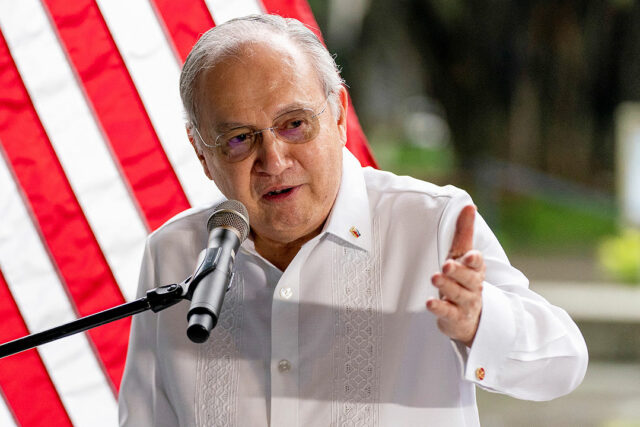
Philippine Ambassador to the US Jose Manuel Romualdez speaks at an event in Manila, Philippines, Aug. 6, 2022. — ANDREW HARNIK/POOL VIA REUTERS

By Justine Irish D. Tabile, Senior Reporter

THE US has signaled openness to pursue a free trade agreement (FTA) with the Philippines, but negotiations can only move forward once a deal on reciprocal tariffs is finalized, the Philippine  ambassador to Washington said.

Ambassador Jose Manuel G. Romualdez said that the US expressed openness to negotiate an FTA during reciprocal tariff talks.

“We mentioned it, and we just said that perhaps this is not the time. But they said that they are open (to an FTA),” he said at the US-Philippines Society briefing on Tuesday.

“ I do not think we are prepared to go into discussions on (an FTA) until we have more or less solidified our agreement on the tariffs. But the Trump Administration is open to having an FTA with the Philippines,” he added.

He said that during the first term of US President Donald J. Trump, his administration had pushed for the FTA.

“We were already on the verge of having some serious conversations on the FTA with the US,” he added.

He also said that the Philippines has been implementing reforms that were previously identified as hurdles to an FTA to happen, including reforming land ownership rules.

“We’ve had successful legislation (that will address US concerns) for an FTA,” he said, referring to the amendments to the Investors’ Lease Act, which allowed foreign investors to lease private land for up to 99 years, up from the previous 50-year limit.

“Right now… we are not really pushing it … because there are other more important things at this time,” he added.

He said on the issue of reciprocal tariffs, “We’ve had a number of conversations with the US Trade Representative, and we have been very happy with the exemptions that we have requested because almost all have been granted,” he said.

“That, I think, has already stabilized our basic request for our trade to be more or less balanced,” he added.

He said the US semiconductor industry has been taking that lead to make sure that chip tariff rates will not be “too upsetting,” as there are many US chip companies operate in the Philippines.

The US business process outsourcing industry has also sought to ensure that the industry will be exempt from tariffs.

“We are still continuing to talk about other issues here and there, but at the end of the day, we are quite happy,” he added.

The US started imposing a 19% reciprocal tariff on most of Philippine goods entering the US market in August.

In November, the US issued an executive order that exempted several agricultural products from the tariff.

This rendered about 46% of Philippine exports to the US in 2024 exempt from the 19% tariff.

Since then, the Philippines has been working on more exemptions, including for some industrial goods.

Mr. Romualdez said there have been continuous talks with regard to the potential Philippine acquisition of aircraft from Lockheed Martin Corp., after the purchase was put on hold in September.

“Lockheed has been talking to us, and we’re finding ways… to finance the purchase,” he said.

“I know our Air Force really wants this, and it’s best right now in terms of what the capabilities of our Air Force are,” he added.

However, he said that the purchase is not feasible given the government’s current budget.

“We’re not closing the door, but it’ll take quite some really imaginative and creative ways to be able to purchase,” he said.

“We need at least a minimum of about 24 F-16 (fighter aircraft). This is a $4.8 billion-$5 billion purchase. We just have to wait and see how we move forward on that particular item,” he added.

The Philippines is budgeting for at least $2.5 billion in defense items between 2026 and 2030 after the US Senate approved a bill that authorized new security assistance.

Mr. Romualdez said most US defense financing will be related to enhancing the capabilities of its ground and maritime forces as well as cyber security.

“It will take some time before we can actually make a firm decision on whether we’ll be able to get the F-16s within the timeframe of a special agreement,” he added.

NRA proposal not considered immediate fix — BIR

PHILIPPINE STAR/RUSSELL PALMA

THE Bureau of Internal Revenue (BIR) said renewed proposals to merge the government’s main revenue-generating agencies into a National Revenue Authority (NRA) should be considered as a last resort, saying that the immediate priority involves restoring credibility and public trust in the current institutions.

New calls to establish an NRA could remain part of the long-term conversation, though, Commissioner Charlito Martin R. Mendoza said.

“It should be approached as a governance reform of last resort, not a first response,” he told BusinessWorld via Viber on Feb. 9.

Former Finance Undersecretary Cielo D. Magno and Asian Consulting Group Chairman Raymond Abrea had called for a sweeping overhaul of the BIR and Bureau of Customs (BoC), including a proposal to establish an NRA, to be run professionally as a Government-Owned and -Controlled Corporation (GOCC).

Mr. Mendoza said this push “reflects long-standing concerns over fragmentation and coordination in revenue administration,” although the problem lies in “governance quality, not merely institutional form.

House Bill 695, filed in 2017 by former President Gloria Macapagal‑Arroyo, then a legislator, sought to replace the BIR and streamline tax collection.

“The more immediate and pragmatic reform path is to strengthen governance where it matters most — deepening coordination and data sharing between revenue agencies, tightening audit integrity and accountability mechanisms, and institutionalizing digital, risk-based processes,” he said.

These reforms directly address the governance deficits that reform advocates seek to correct, without the destabilizing effects of an abrupt merger, he said.

“Without these foundations (in governance reform), structural consolidation risks replicating existing problems at a larger scale,” Mr. Mendoza said.

For 2026, the government hopes to collect P4.82 trillion in revenue, with P3.431 trillion expected from the BIR and P1.003 trillion from the BoC. — Aubrey Rose A. Inosante

Critical minerals agreement expected to unlock investments in processing facilities, DTI says

FREEPIK

THE Department of Trade and Industry (DTI) said the US-Philippines critical minerals agreement has the potential to unlock investments in mineral processing plants and related industries.

“The agreement provides a framework for investment attraction by leveraging the Board of Investments (BoI) to support mineral processing, refining, and downstream manufacturing,” the DTI said on Tuesday.

“The memorandum of understanding (MoU) is also expected to attract diverse investments not only in mining but also in related industries such as power generation, logistics, and chemical handling,” it added.

The department was referring to the agreement signed by the US and the Philippines last week to develop the Philippine critical mineral industry.

“The MoU is a major enabler for the Philippines to shift from simply exporting raw mineral ores to becoming a significant player in value-added processing,” Trade Secretary Ma. Cristina A. Roque said.

“We are aiming (to become) more than just a supplier; we are positioning ourselves as a vital link in the global supply chains for semiconductors, defense, and clean energy,” she added.

According to the DTI, the deal will allow the Philippines to access US grants, feasibility studies, and joint geological mapping to modernize the mining industry.

“It will also reduce over-reliance on a single buyer by connecting Philippine minerals to a broader network of over 50 allied nations and create high-skilled jobs through technology transfer and advanced research initiatives,” it added.

The deal is also expected to reinforce commitments to environmental sustainability in mining.

“Through this agreement, we expect to attract substantial and diverse investments that will develop the workforce and strengthen our standing in the industries of the future,” said Ms. Roque.

Philippine Ambassador to the US Jose Manuel G. Romualdez said that he expects more details of the MoU soon.

“There is going to be a bilateral strategic dialogue with the US and the Philippines in the coming week. I think it is during that time that we will have more information regarding the critical minerals agreement that we have with the US,” he said at the US-Philippines Society briefing on Tuesday.

“We have been talking about being part of the critical minerals supply chain not only for the US but for other countries as well,” he added.

He said that the agreement will allow the Philippines to develop a mineral processing industry, as almost 90% of its nickel exports go to China because of the “processing that we do not have right now.”

“That is one area where I think we can have very good cooperation with the US in the processing of our nickel and many others that they are looking at, like copper,” he said. — Justine Irish D. Tabile

Debt-to-GDP ratio to stay ‘manageable’ as it exceeds 65% over next two years

THE Philippine debt load is less alarming than in past crises and is expected to remain manageable with the debt-to-gross domestic product (GDP) expected to 65% over the next few years, a government think tank said.

The debt ratio is projected to hit 66% in 2026 before easing to 65.7% in 2027, the Philippine Institute for Development Studies (PIDS) said in a Feb. 9 report.

The projection indicates that “the country’s debt position today is less worrisome than during previous debt crises, and that the debt-to-GDP ratio will remain manageable despite peaking above 65% over the next couple of years,” it said.

The Bureau of the Treasury reported that government debt amounted to P17.71 trillion at the end of 2025.

 This brought the outstanding debt as a share of GDP to 63.2%, the highest level since the 65.7% posted in 2005.

PIDS said a swift return to pre-pandemic debt levels is unlikely due to the need for continued government spending to curb long-term economic scarring and give the economy room to recover.

“This underscores the need for a sound medium- to long-term fiscal consolidation plan to anchor sentiment,” the think tank said.

PIDS added that returning to the pre-pandemic level of 40% would require the government’s annual primary balance to increase from 1.4% of GDP in 2020 to 3.4% of GDP in 2031.

The Development Budget Coordination Committee aims to bring the debt ceiling to 61.8% this year and 61.3% in 2027, according to its updated medium-term fiscal framework.

The rule of thumb for healthy levels of debt for developing countries is 60%, which the government has informally abandoned in favor of a new 70% benchmark of the International Monetary Fund (IMF).

Finance Secretary Frederick D. Go has clarified that the government tracks the IMF’s general government (GG) debt-to-GDP ratio rather than the narrower National Government measure.

The Philippine GG debt-to-GDP currently stands at 54% to 55%.

Mr. Go’s office has yet to release the latest GG debt-to-GDP data.

The conclusions were contained in a paper, “Fiscal Effects of the COVID-19 Pandemic: Assessing Public Debt Sustainability in the Philippines,” written by Margarita Debuque-Gonzales, Charlotte Justine Diokno-Sicat, John Paul P. Corpus, Robert Hector G. Palomar, Mark Gerald C. Ruiz, and Ramona Maria L. Miral. — Aubrey Rose A. Inosante

NFA to auction nearly 37,000 MT in old rice stock

PHILIPPINE STAR/MIGUEL DE GUZMAN

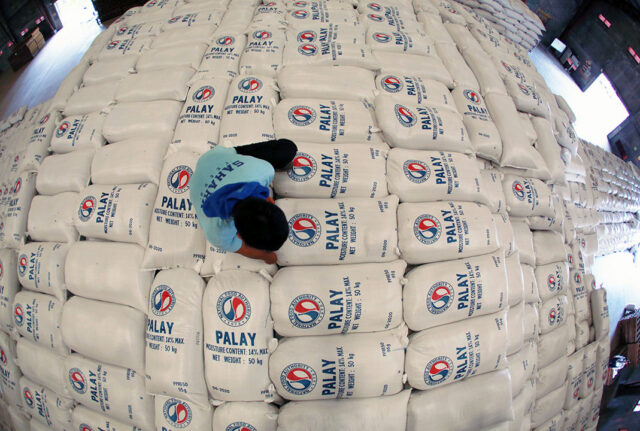
THE National Food Authority (NFA) said it will auction nearly 37,000 metric tons (MT) of ageing rice to free up warehouse space and improve inventory turnover ahead of the upcoming harvest.

According to the bid invitation, the NFA said the auction will cover about 737,339 50-kilogram bags of rice, or a total of 36,867 MT, valued at approximately P909.8 million.

A pre-auction conference is scheduled on Feb. 13, while the opening of auction tenders will be held on Feb. 20.

The stocks offered for sale are priced between P22.52 per kilogram and P25.16, depending on how long the grain has been stored.

The rice stocks have been in storage between three and 18 months, with 88.1% aged between three and nine months.

“Our milled rice inventory is at 2.74 million bags, and about 700,000 bags of that will be auctioned,” NFA Administrator Larry R. Lacson told reporters. “The remaining two million bags are intended for disposal during calamities, the P20 rice program, and other emergency requirements.”

The NFA reported that as of Jan. 31, its milled rice inventory was the equivalent of 8.52 million bags, or around 426,000 MT, including palay (unmilled rice) holdings yet to be milled. 

According to the NFA, the national rice reserve is equivalent to 11.03 days’ demand. — Vonn Andrei E. Villamiel

Rice import eligibility could be tied to volume of domestic purchases

BW FILE PHOTO

THE Department of Agriculture (DA) said it is considering a proposal to link eligibility to import rice to the volume of rice purchased from domestic farmers.

Agriculture Secretary Francisco P. Tiu Laurel, Jr. said the proposal would require traders to buy palay (unmilled rice) or rice to receive import allocations.

“You have to buy palay or rice to get an import allocation. That’s the general idea. It’s like they invest in local industries, so that they won’t kill the industry with imported products,” he told reporters on the sidelines of an Economic Journalists Association of the Philippines event late Monday.

Mr. Laurel said the scheme is meant to “self-police” stakeholders in the rice industry and ensure transparent and objective import allocation.

A similar mechanism is already in place for molasses imports, where traders are granted import allocations based on the volume of locally produced molasses they purchase, using a 3:1 local-to-imported ratio.

Mr. Laurel, however, said the specific ratio for rice imports and local purchases has yet to be determined.

The DA said it is consulting industry participants, including importers and rice producers, and has formed a technical working group composed of private sector and department representatives.

“The private sector and the government will discuss this. We’ll ask for the recommendation of the private sector and tweak it a little to come up with a win-win solution,” Mr. Laurel said.

Mr. Laurel said the DA is targeting initial implementation of the system in the second half of the year, possibly by July.

“Our target is, hopefully, by the end of this year, the system will be a bit more solid. Initially, there will be trials first because a certain percentage of the quantity to be imported will be subject to the new system, he said.

Mr. Laurel added that the proposed policy will be waiting on authorization from the Rice Industry and Consumer Empowerment (RICE) Act, which the DA hopes will be enacted by June or July.

The RICE Act, currently pending in Congress, seeks to restore and expand the regulatory powers of the National Food Authority (NFA), which were significantly reduced under the Rice Tariffication Law of 2019. The measure would also grant the government broader authority over the rice trade.

Raul Q. Montemayor, national manager of the Federation of Free Farmers, told BusinessWorld that the proposed local purchase requirement “will not be a problem” as some rice importers are also millers and traders.

“For importers who have no local buying operations, they could easily tie up with local millers or traders or put up their own shell companies,” he said via Viber.

Mr. Montemayor said the proposed scheme would also benefit from additional requirements, such as proof of rice purchase at the floor price or higher. — Vonn Andrei E. Villamiel

PHL, Netherlands exploring collaboration in water management, semiconductors

FACEBOOK.COM/ASML

THE PHILIPPINES and the Netherlands are exploring potential collaboration in water management, semiconductors, and agriculture, the Dutch embassy said.

“As we celebrate 75 years of diplomatic relations, the Netherlands looks forward to building an even stronger partnership with the Philippines,” Netherlands Minister of Trade and Development Aukje de Vries said in a statement on Tuesday.

“We share many interests, and I saw firsthand the many economic opportunities for Dutch and Filipino business, including water, agriculture, and semiconductors,” she added.

Ms. De Vries completed a two-day visit to the Philippines, according to the embassy.

“In a high-level meeting with Department of Trade and Industry Secretary Cristina Aldeguer-Roque, both officials underscored the strong economic relationship between the two countries as a testament to decades of friendship and collaboration,” it said.

The meeting “explored possibilities of deepening collaboration in water management and coastal protection, semiconductors, and healthcare, as well as the priorities of the ASEAN Chairship.”

Ms. De Vries also met with Dutch companies operating in the Philippines.

During her visit, Ambassador Marielle Geraedts hosted a roundtable discussion which five agreements were signed between Dutch and Filipino government agencies, businesses, and academic institutes.

Among these agreements was the partnership between Vitens Evides International, which will be donating 25 water bladders to the Department of Environment and Natural Resources (DENR).

“The bladders have already proved their critical value during Typhoon Tino and the magnitude 6.9 earthquake that struck Central Philippines in late 2025,” the embassy said.

“The additional donation of 25 Dutch-sourced water bladders to the DENR further demonstrates their long-term commitment to strengthening the emergency preparedness and resilience of partners in the Philippines,” it added.

Meanwhile, the Anti-Red Tape Authority has also partnered with the Dutch Chamber of Commerce in the Philippines to reduce red tape and promote an efficient, business-friendly government environment.

“Besides the maritime, banking, and water sectors, the semiconductor industry presents significant economic opportunities for collaboration between the Philippines and the Netherlands,” the embassy said.

“With 85% of globally manufactured chips using Dutch technology and the Philippines serving as a critical production hub for testing and packaging, the complementary nature of both nations’ semiconductor capabilities creates natural synergies,” it added. — Justine Irish D. Tabile

Marcos survives impeachment as House backs dismissal by committee

PRESIDENT FERDINAND R. MARCOS, JR. FACEBOOK PAGE

By Kenneth Christiane L. Basilio, Reporter

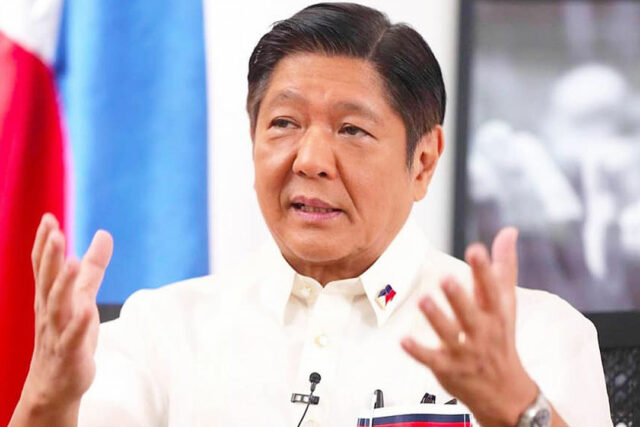
PHILIPPINE President Ferdinand R. Marcos, Jr. survived impeachment on Tuesday after the House of Representatives overwhelmingly supported a congressional body’s dismissal of complaints against him, delivering a political win amid allegations of corruption linked to multibillion-peso flood control projects.

A total of 284 lawmakers voted to uphold the Justice committee’s recommendation to dismiss the cases. Eight opposed the move, while four abstained.

The vote ended the short-lived effort to oust Mr. Marcos, whose administration has faced criticism for scandals that weighed on economic growth and investor confidence.

“Complaints that are fundamentally insufficient in substance must be dismissed, not indulged for the sake of political theater,” Batangas Rep. Gerville R. Luistro, who heads the committee, told the floor before the vote. “To do otherwise is to degrade impeachment from a constitutional safeguard into a weapon of harassment.”

The dismissed complaints alleged that Mr. Marcos had benefited from questionable government contracts linked to defective infrastructure projects, receiving kickbacks and institutionalized corruption through a budget allocation formula for congressional districts.

Additional accusations included his alleged involvement in authorizing the arrest of former President Rodrigo R. Duterte for proceedings at the International Criminal Court and claims of the President’s alleged drug use.

“These complaints failed to establish a factual nexus between the President and any impeachable offense,” Ms. Luistro said. She argued the filings had tried to recast policy disagreements and routine executive actions as betrayal of public trust without proving bad faith or malice.

Opposition lawmakers criticized the decision. “There was strong evidence that the President was aware of corruption in flood control projects, directly participated in it and received kickbacks,” House Deputy Minority Leader Antonio L. Tinio said, urging the House to consider the complaints on their merits.

Analysts said the outcome was widely expected given the composition of the House. “It’s obviously a numbers game,” Dennis C. Coronacion, chairman of the University of Santo Tomas Political Science Department, said in a Facebook Messenger chat.

“No matter what justifications were given by the members of the House Committee on Justice, at the end of the day, it’s still about who remains loyal to the administration.”

The committee dismissal followed earlier votes that stalled the complaints at the panel level. Critics argued the committee had ruled prematurely without allowing full debate on the allegations, effectively shielding the President from scrutiny.

Meanwhile, the House Secretary-General transmitted a third impeachment complaint against Vice-President Sara Duterte-Carpio to the Speaker’s office on Tuesday. The filing, lodged a day earlier, accuses Ms. Duterte of misusing P612.5 million in confidential and intelligence funds allocated to her office and the Department of Education.

The complaint, endorsed by Party-list Rep. Leila M. de Lima, alleges graft, corruption and plunder, claiming violations of the Constitution and public trust.

Referral to the House Justice Committee formally triggers the impeachment process, which bars further complaints against the Vice-President for one year.

Analysts said the case could deepen political fault lines between allies of Mr. Marcos and Ms. Duterte, a potential 2028 presidential contender.

The outcome underscores the consolidation of legislative power by Mr. Marcos’ allies while keeping the spotlight on high-profile corruption allegations that continue to attract public attention.

Critics warn that the handling of these cases may influence perceptions of accountability and governance as the administration approaches midterm policy priorities.

BIR banks on growth to revive tax take this year

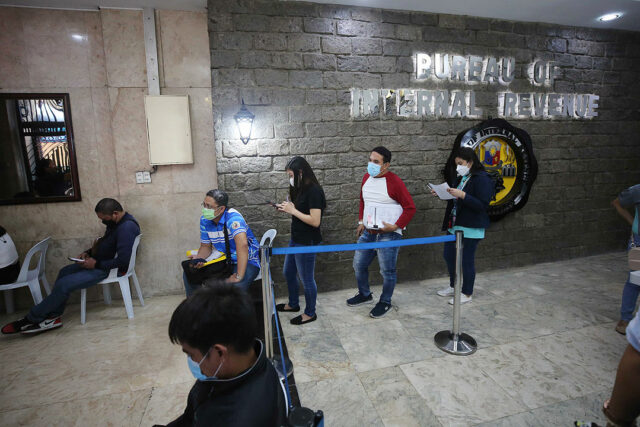
People line up to file their income tax returns at the Bureau of Internal Revenue office in Intramuros, Manila, April 18, 2022. — PHILIPPINE STAR/ RUSSELL A. PALMA

By Adrian H. Halili, Reporter

THE PHILIPPINES’ tax authority is betting that faster growth, a rebound in public works and changes to audit rules will help revive revenue after a disappointing year, even as confidence was shaken by allegations of corruption tied to infrastructure spending.

The revenue increase also hinges on infrastructure spending and administrative reforms aimed at improving tax compliance, Internal Revenue Commissioner Charlito Martin R. Mendoza told BusinessWorld on the sidelines of a Senate hearing on Tuesday.

The Bureau of Internal Revenue (BIR) is targeting P3.431 trillion in collections in 2026, a 10.5% increase from P3.105 trillion raised last year, after falling short of its 2025 goal. The agency is shifting its focus toward voluntary compliance as it tries to rebuild trust among taxpayers while supporting the government’s fiscal position.

Economic growth above 5% would increase income and excise tax collections, Mr. Mendoza said. He added that an acceleration in infrastructure projects would have a “big multiplier effect” on tax receipts.

The economy expanded just 4.4% in 2025, well below 5.7% growth a year earlier and short of the government’s 5.5% to 6.5% target. Growth slowed as public construction weakened amid a corruption scandal in which senior officials and engineers were accused of siphoning off billions of pesos meant for flood control projects.

That episode dented investor confidence and disrupted project rollouts, weighing on domestic demand and tax intake. Collections missed the target last year as uneven activity and enforcement bottlenecks persisted, prompting the BIR to recalibrate its approach.

Mr. Mendoza said the agency is relying less on aggressive audits and more on administrative reforms designed to encourage compliance.

Central to that effort is a revamp of audit authorizations under Revenue Memorandum Order No. 1-2026, which took effect after months of complaints from businesses.

The order introduced a single-instance audit framework, limiting audits to one taxpayer per year. It also clarified the scope of audit authority, adopted risk-based and system-assisted case selection and anonymized examiner assignments to reduce discretion.

These reforms “will boost taxpayer confidence,” Mr. Mendoza said. “Our focus is really on voluntary compliance.”

CLEAR STANDARDS
The changes follow a two-month suspension of audits late last year after lawmakers and business groups alleged that some tax officials abused letters of authority (LoAs) and mission orders. Audits resumed on Jan. 27 under the revised framework.

“With these reforms… standards are clear and accountability is enforced,” the BIR chief told senators during the hearing.

The Senate Blue Ribbon Committee is investigating corruption within the BIR, including claims that personnel pocketed a large share of collections.

Mr. Mendoza told the body at least 30 personnel are under investigation over their misuse of audit documents, as the Senate continues to probe the weaponization of the agency’s letters of authority.

He added that 25 of the workers under investigation are set to be charged either with administrative, civil, or criminal cases.

Foreign chambers and local firms have said unpredictable audits added to operating risks and discouraged investment.

Economists said revenue recovery is possible, but hinges on whether growth and spending rebound in a sustained way.

“Faster economic activity and a ramp-up in infrastructure projects will naturally lift tax take,” Jonathan L. Ravelas, senior adviser at Reyes Tacandong & Co., said in a Viber message. He added that changes to audit rules could improve predictability and trust.

“When people see fairness and clarity, compliance rises,” he said.

Still, risks remain. Infrastructure spending must accelerate meaningfully to offset last year’s drag, while restoring investor confidence is critical after the flood control scandal exposed governance weaknesses.

John Paolo R. Rivera, a senior research fellow at the Philippine Institute for Development Studies, said tax performance would depend on how quickly growth firms up and whether public spending regains momentum.

“Faster infrastructure rollout and improved business activity typically widen the tax base and lift value-added tax, income and corporate tax collections,” he said via Viber. Better compliance can raise efficiency without increasing rates, he added.

Revenue recovery also depends on stabilizing consumption, managing inflation pressures and continuing digitalization to reduce leakages, Mr. Rivera said.

For the government, stronger collections are key as it balances higher spending needs with deficit management. The Marcos administration has signaled that shoring up revenue is a priority after last year’s shortfall narrowed fiscal space.

Mr. Mendoza said the BIR would continue refining its reforms as implementation proceeds. “We will keep listening, monitor outcomes, and refine measures where necessary,” he said.

The agency earlier suspended the issuances of audit documents, but the ban was lifted two months later after reforms were implemented.

Mr. Mendoza said about 45,000 active LoAs would be consolidated into one electronic LoA per taxpayer per taxable year, unless a formal request is made to retain separate issuances.

Marcos supports abolition of travel tax to boost tourism

REUTERS

PHILIPPINE President Ferdinand R. Marcos, Jr. wants Congress to abolish the country’s travel tax system before its June adjournment, Malacañang said on Tuesday, as the administration moves to cut travel costs and support tourism while pushing a broader slate of governance reforms.

The repeal was among 21 priority bills approved during a meeting of the Legislative-Executive Development Advisory Council (LEDAC) at the Palace, according to Press Officer Clarissa A. Castro. The measures are part of the President’s legislative agenda aimed at easing household burdens and restoring confidence in public institutions.

“The President saw that this would make travel more affordable for tourists and for Filipinos who need to travel,” Ms. Castro said, adding that the measure is expected to have positive spillover effects on the economy.

The proposal has raised concerns from groups that benefit from the levy, which funds tourism infrastructure, education and cultural programs. Ms. Castro said the government is aware of these allocations and plans to address the funding gap.

Under existing rules, half of travel tax collections go to the Tourism Infrastructure and Enterprise Zone Authority (TIEZA), 40% support education assistance and scholarships through the Commission on Higher Education, and 10% fund cultural programs of the National Commission for Culture and the Arts.

Ms. Castro said these programs would instead be financed through the national budget if the tax is repealed.

The Palace has also asked TIEZA to submit a full accounting of how travel tax revenues are used as part of efforts to improve transparency and accountability.

Congress has begun moving on the proposal. In the House of Representatives, Majority Leader Ferdinand Alexander “Sandro” A. Marcos III filed House Bill No. 7443 or the Travel Tax Abolition Act of 2026, which seeks to scrap the levy entirely. In the Senate, Senator Rafael “Raffy” T. Tulfo filed a bill that would exempt economy-class passengers while retaining the tax on business and first-class travelers.

House Speaker Faustino “Bojie” G. Dy III has said the chamber would hold nationwide consultations to speed up deliberations on the administration’s priority measures before lawmakers adjourn in June.

The Department of Economy, Planning and Development (DEPDev) said placing the travel tax repeal on the LEDAC agenda reflects a wider push to rebuild public trust, following public backlash over governance and spending issues.

Beyond tourism, the priority list includes proposals such as the Anti-Political Dynasty Law, Expanded Anti-Online Sexual Abuse or Exploitation of Children Act, and CADENA Act, which seeks to strengthen disclosure and oversight of public spending.

In a statement, DEPDev Secretary Arsenio M. Balisacan said the measures are designed to improve public service delivery and ensure stronger scrutiny of government expenditures.

He said the administration sees 2026 as a critical point to regain momentum by focusing on governance reforms that produce visible results for Filipinos. — Erika Mae P. Sinaking

Jose de Venecia, five‑time Speaker, dies at 89

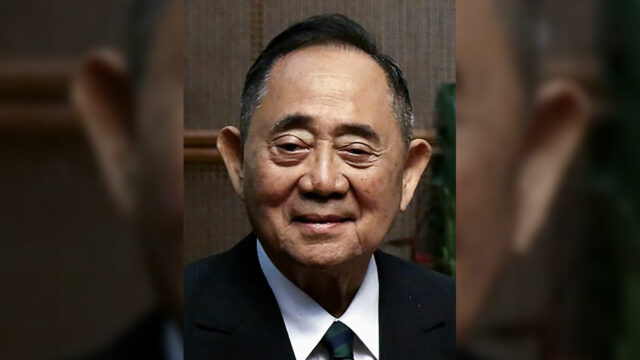
JOSE C. de Venecia, Jr. — PRESIDENTIAL COMMUNICATIONS OPERATIONS OFFICE FILE PHOTO

JOSE C. de Venecia, Jr., the Philippines’ longest‑serving Speaker and a defining figure of post‑Martial Law politics, died on Tuesday at age 89, his family said.

Known affectionately as JDV, Mr. De Venecia’s political career spanned more than three decades. He first entered the House of Representatives in 1987, representing Pangasinan’s fourth district during the restoration of democratic institutions after years of dictatorship.

He was the principal author of several landmark laws designed to revitalize a country emerging from political and economic disarray, including the Dollar Remittance Program, New Central Bank Act, Philippine Economic Zone Act, Bases Conversion and Development Act and the Build-Operate-Transfer Law, his family said in a statement.

He was elected Speaker five times in nonconsecutive terms from 1992 to 2008, a record in the country’s contemporary Congress. His leadership helped guide the Legislature through periods of political transition under multiple Presidents and played a key role in coalition-building in a politically diverse chamber.

Mr. De Venecia was widely regarded as a skilled vote‑counter and strategist who kept majority support in the House during volatile political eras. Supporters credited him with advancing key economic policy reforms and initiatives that aimed to strengthen governance and institutional stability.

He sought the presidency in 1998, finishing second in a crowded field of candidates. Though unsuccessful, the campaign reinforced his national prominence and cemented his status as a veteran lawmaker with deep experience in legislative affairs.

In his later years, Mr. De Venecia stepped back from frontline politics but remained involved as an elder statesman.

He participated in governance forums and institutional discussions and was honored by the House with the inauguration of a building and museum in his name at the Batasang Pambansa complex in 2025.

Mr. De Venecia was born in Dagupan City on Dec. 26, 1936. He studied journalism at the Ateneo de Manila University and was an entrepreneur before entering politics.

He is survived by his wife Maria Georgina Perez-de Venecia, who represents Pangasinan’s fourth district, and five children. — Kenneth Christiane L. Basilio and Norman P. Aquino

ADVERTISEMENT
ADVERTISEMENT