Home Blog Page 3142

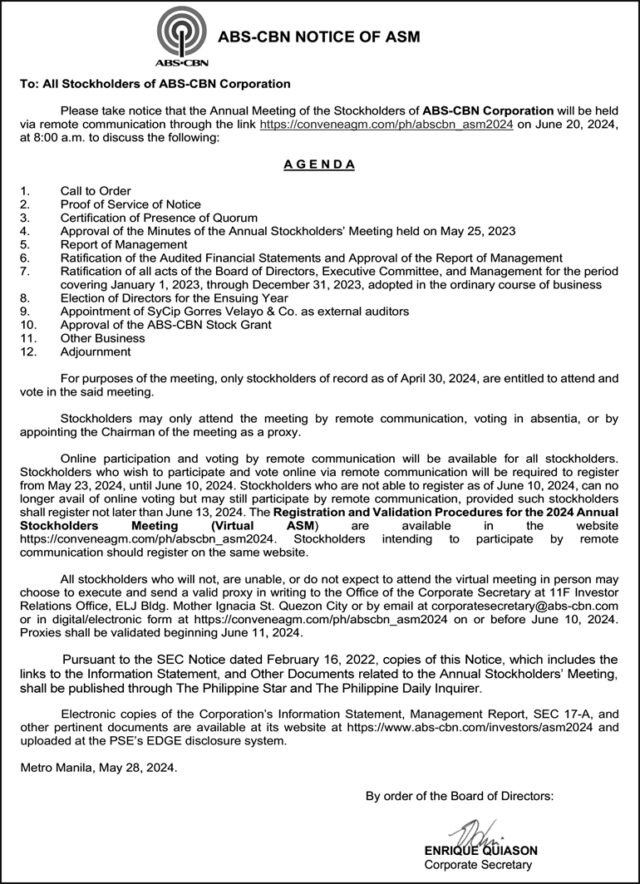
ABS-CBN Corp. to hold annual meeting of stockholders on June 20 via remote communication


Spotlight is BusinessWorld’s sponsored section that allows advertisers to amplify their brand and connect with BusinessWorld’s audience by publishing their stories on the BusinessWorld Web site. For more information, send an email to online@bworldonline.com.

Join us on Viber at https://bit.ly/3hv6bLA to get more updates and subscribe to BusinessWorld’s titles and get exclusive content through www.bworld-x.com.

SpaceX’s next Starship rocket test gets FAA go-ahead

REUTERS

 – The US Federal Aviation Administration (FAA) on Tuesday said it issued a license for SpaceX’s fourth flight of its Starship rocket system, another test mission along the company’s path to building a reusable satellite launcher and moon lander.

SpaceX, owned by Elon Musk, is aiming to launch its nearly 400-foot-tall (122-meter), two-stage Starship as early as Thursday at 7 a.m. CDT (1200 GMT) from its rocket facilities in south Texas, from which past flights in the company’s test-to-failure development campaign have launched.

Starship represents the future of SpaceX’s dominant satellite launch and astronaut business. It is designed to be fully reusable and cheaper – but more powerful – than the company’s workhorse Falcon 9. NASA plans to use Starship later this decade to land the first crew of astronauts on the moon since 1972.

Each Starship rocket has made it farther in its testing objectives than previous tests before blowing up. The first launch in April 2023 exploded minutes after liftoff, and the most recent flight in March broke apart in Earth’s atmosphere as it attempted to return from space halfway around the globe.

On Thursday, the rocket system’s first stage, called Super Heavy, will ignite its 33 Raptor engines to lift off, then separate from the Starship second stage, which will blast further into space.

Meanwhile, Super Heavy will reignite some engines and return toward the Gulf of Mexico for a “soft splash-down” to simulate a landing that would otherwise be on land.

In space, Starship will trek around the globe and head for the Indian Ocean, where it will make a second attempt to survive the intense heat of atmospheric reentry – the crucial point at which it failed during the March test.

“The main goal of this mission is to get much deeper into the atmosphere during reentry, ideally through max heating,” Mr. Musk, CEO of SpaceX, wrote on X on Saturday.

Starship is shielded with hundreds of small black tiles on its exterior that SpaceX hopes will protect it from the extreme heat the spacecraft endures while plunging through Earth’s atmosphere at hypersonic speeds.

Much is riding on SpaceX’s swift development of Starship, a key pillar of NASA’s moon program that rivals China’s moon ambitions.

Mr. Musk’s drive to rapidly build Starship has endangered SpaceX workers in Texas and California, a Reuters investigation earlier this year found.

E*Trade possibly ousting GameStop bull ‘Roaring Kitty’ spurs online backlash

A report on Monday that online broker E*Trade may consider banning Keith Gill, the meme-stock influencer who ignited frenzied trading in shares of GameStop in 2021, has triggered a backlash on social media sites.

The Wall Street Journal on Monday reported that E*Trade is considering banning Gill, who resumed posting online after a three-year hiatus in recent weeks.

E*Trade-parent Morgan Stanley, declined to comment on the report and the messages on social media calling for a boycott of the brokerage platform.

Brokerages have invited the ire of retail customers in the past, most notably in 2021 when Robinhood came under fire after it restricted purchases of certain heavily traded stocks, including GameStop, because of volatility.

“@etrade singled out their own customer @TheRoaringKitty taking marching orders from some smoke-filled back room somewhere and tried to say “nope, you don’t get to be rich, you don’t get to join the elites,” X user @welp007 posted on Monday evening.

Many of those commenting on the latest twist in the Roaring Kitty/Gamestop saga referred to their perception that the Roaring Kitty episode serves as an example of the way in which big Wall Street players, from hedge funds to trading firms, take advantage of small retail investors.

Several posters on both X, where Gill uses the moniker RoaringKitty, and on Reddit, where he posts under the username DeepF**kingValue, posted screenshots of their requests to close their E*Trade accounts. Reuters was unable to independently verify the authenticity of the screenshots and the posters did not respond to requests for comment.

“If they’re gonna ban the kitty, all of retail should leave their platform,” proclaimed Reddit user FalseDifficulty2340.

Posters also suggested the firm’s rivals likely would welcome Gill as a client if E*Trade removed Gill from its platform. – Reuters

Philippine inflation quickens for fourth straight month in May

A wide variety of fish at the Marikina Public Market. — PHILIPPINE STAR/ WALTER BOLLOZOS

MANILA – Philippine annual inflation quickened for a fourth straight month in May due largely to the faster pace of increases in housing, utility and transport costs, the statistics agency said on Wednesday.

The consumer price index rose 3.9% in May from 3.8% the previous month, marking the fastest rise since November 2023, bringing the five-month average inflation to 3.5%, well inside the central bank’s 2.0%-4.0% target for the year.

Economists in a Reuters poll had forecast annual inflation at 4.0%.

The Bangko Sentral ng Pilipinas (BSP) said last month’s data was consistent with its expectations that inflation could accelerate over the near term due to the impact of adverse weather conditions on farm output.

Core inflation, which strips out volatile food and energy prices, eased to 3.1% in May from 3.2% the prior month.

BSP Governor Eli M. Remolona reiterated on Tuesday the benchmark policy rate, currently at a 17-year high of 6.50%, could be cut before the U.S. Federal Reserve starts it easing cycle.

But Ruben Carlo O. Asuncion, chief economist at Manila-based Union Bank, believed the BSP would still prefer to wait for the Fed to move before it does to prevent the peso, down more than 5% against the dollar so far this year, from weakening too much.

“They may have to prioritize interest rate differentials over the speed of cuts,” Mr. Asuncion said in a phone message.

The Philippine central bank, which kept its benchmark rate steady at its last five meetings, has said it was looking to cut rates by 25 basis points as early as August and by another 25 basis points in the fourth quarter.

Its next meeting is on June 27. –Reuters

BSP may cut policy rate before Fed

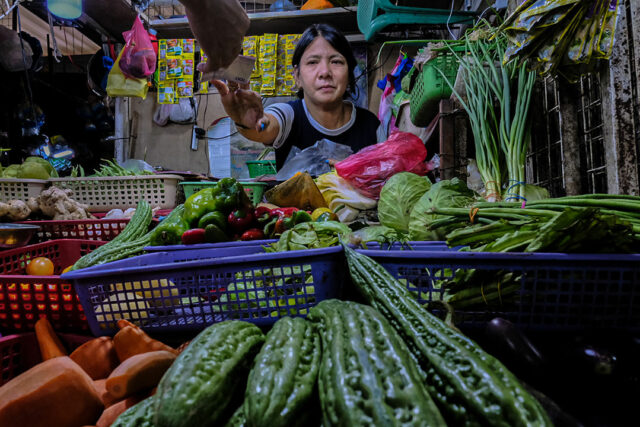
A FEMALE VENDOR accepts payment from a customer at Paco Market in Manila, April 6, 2024.— PHILIPPINE STAR/RYAN BALDEMOR

By Luisa Maria Jacinta C. Jocson, Reporter

THE Bangko Sentral ng Pilipinas (BSP) can cut its policy rate before the US central bank despite a volatile peso, Governor Eli M. Remolona, Jr. said on Tuesday.

“It’s possible that the Fed can cut in July,” he told reporters in mixed English and Filipino.  “There are analyses that say July… We may go first, but it depends on whether their inflation is stubborn. They may not cut.”

The BSP chief earlier said the earliest the central bank could cut the rate is by August.

The Monetary Board last month kept its key rate steady at a 17-year high of 6.5%. The central bank raised borrowing costs by 450 basis points (bps) from May 2022 to October 2023 to tame inflation.

Mr. Remolona said the peso is depreciating not because it is weak but more because the dollar is strong.

“The story is not about the weak peso,” he said. “The real story is about a strong dollar. Anytime there’s tension, anytime there’s uncertainty, money goes into the US dollar and the dollar gets stronger against other currencies.”

The peso closed three centavos weaker against the dollar at P58.71 on Tuesday, according to Bankers Association of the Philippines data posted on its website. On May 21, it sank to the P58-a-dollar level for the first time since November 2022.

The dollar is also strengthening due to hawkish signals from the US Federal Reserve, the BSP chief said.

“The Fed has been saying that policy rates in the US will be high for longer. But the longer part keeps shifting, so that creates some uncertainty,” he added.

The BSP does not target a specific level for the peso, Mr. Remolona said.

“We don’t worry too much about the level itself,” he said. “We worry more about how it gets to where it’s going. We try to guide the market by occasionally expressing our own view on where it should go.”

The Development Budget Coordination Committee (DBCC) expects the peso to range from P55-P57 a dollar this year.

The central bank has not been intervening in the foreign exchange market daily, but it does so from time to time to “express our own view about where the peso should be going.”

“We don’t intervene every day,” Mr. Remolona said. “We intervene when we have to. And when we say we have to, it’s when the currency is under stress. Under stress means we find some dysfunction in the market.”

“Sometimes, the peso goes sharply in the wrong direction, and then we might intervene,” he added.

Diwa C. Guinigundo, country analyst at GlobalSource Partners, said comments made by central bank officials are affecting the peso’s performance.

“Market observers and traders attribute the recent weakness of the Philippine peso precisely to this less hawkish statement on monetary policy outside the formal press statement of the Monetary Board, which was unequivocally hawkish,” he said in a note.

“Immediately, the peso reacted by dropping to P58.27. It was not to be some temporary weakness, but it is now ushering in a depreciating trend beyond P58 a dollar,” added Mr. Guinigundo, who is a former central bank deputy governor.

He said the peso’s persistent weakness could add to inflationary pressures.

‘TOO AGGRESSIVE’
“If the weakness of the peso extends a year with such magnitude, and with an exchange rate passthrough of 0.08 percentage point (ppt) for every peso depreciation, we are looking at an additional inflation of 0.24 ppt,” he said.

“This means the market may even be more adaptive to the central bank’s forward guidance rather than to the actual stance of monetary policy as defined by its policy rate,” he added.

Mr. Remolona said cutting rates by as much as 150 bps in the next two years might be too aggressive and would require a “hard landing” scenario.

“Given the present trajectory (of economic growth), it could be too aggressive,” he said.

He said the BSP might cut the key rate by 50 bps this year and by another 100 bps next year, but there must be “a risk of a hard landing” for this to happen.

“In taming inflation, we don’t want unnecessary loss of output,” he said. “Although you sometimes can’t avoid a bit of loss of output because our calculations are not always precise. But if the loss of output will be significant, we will have to react to that.”

Finance Secretary Ralph G. Recto earlier said the Monetary Board could reduce the policy rate by as much as 150 bps in the next two years.

The Philippine economy grew by 5.7% in the first quarter, below the government’s 6-7% goal this year.

Meanwhile, Mr. Remolona said the central bank is conducting a “post-mortem” exam after its probe of so-called ghost employees. “We’re doing a post-mortem on this. What else can we do to prevent this in the future?”

The central bank is conducting disciplinary proceedings on six employees under certain Monetary Board members. Four of these were “ghost” employees, while the other two were identified as supervisors.

The investigation was triggered in October after the Office of the General Counsel received reports about the workers.

“I was flabbergasted,” Mr. Remolona said. “I didn’t think this kind of thing would happen at BSP. We really need a good reputation and enough credibility just to make monetary policy work.”

The Monetary Board is the policy-making body of the central bank headed by the governor. Its members are Mr. Recto, Benjamin E. Diokno, V. Bruce J. Tolentino, Anita Linda R. Aquino, Romeo L. Bernardo and Rosalia V. de Leon.

NEDA board OKs low tariff regime amid rising prices

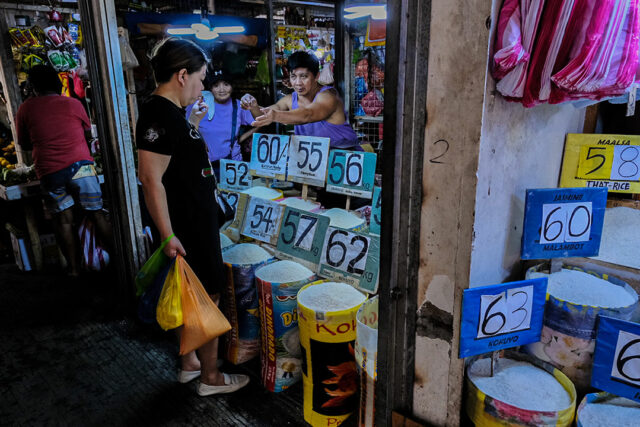
A customer buys rice at a stall in Paco Market, Manila, April 6, 2024. — PHILIPPINE STAR/RYAN BALDEMOR

By Kyle Aristophere T. Atienza, Reporter

THE BOARD of the National Economic and Development Authority (NEDA) has approved a medium-term plan to lower tariffs on agricultural and industrial products, as the Philippines struggles with rising prices and declining factory performance.

The NEDA board approved the Comprehensive Tariff Program for 2024 to 2028 amid concerns about inflation, which is widely expected to have quickened further in May. The expansion in local manufacturing output also slowed in May.

Under the plan, the government would keep the rates for “more than half of the tariff lines” for products that have relatively low tariffs,” NEDA Secretary Arsenio M. Balisacan told a news briefing at the presidential palace on Tuesday.

He said the program seeks to improve manufacturers’ access to inputs and boost their competitiveness.

“This measure will help our domestic industries by reducing the costs they incur for their inputs, enabling them to be more competitive, especially in the global market,” he added.

Mr. Balisacan said the board had approved a recommendation to reduce the tariff on certain chemicals and coal briquettes to “improve energy security and reduce input costs.”

Chemicals under reduced tariffs include inputs for antiseptics, detergents and medical research.

Reduced tariffs on coal are timely as the country faces “energy constraints,” he said.

Terry L. Ridon, a public investment analyst, said the decision to further lower coal tariffs goes against the government’s policy to phase out coal-fired power plants.

“While it is correct that there are pressures on the price of electricity, it is not solely because of the price of coal,” he said in a Facebook Messenger chat.

The Philippines in 2020 declared a moratorium on new coal power plants, a move that policy makers including Senate President Francis Joseph G. Escudero have linked to massive brownouts on the main Philippine island of Luzon.

Philippine electricity prices are among the highest in Southeast Asia, according to a study by the Ateneo de Manila University’s Department of Economics and Ateneo Center for Economic Research and Development.

The country’s residential rate was $0.16 per kilowatt-hour (kWh) as of December 2021, compared with Singapore’s $0.18/kWh, Thailand’s $0.10/kWh, Indonesia’s $0.10/kWh and Malaysia’s $0.05/kWh, it said.

Mr. Balisacan said the country needs a “balancing act” in its transition to clean energy.

“We cannot immediately and quickly transition to zero emission, otherwise that will also kill our industries,” he said. “But we are committed to be part of the global effort to reduce emissions.”

“Reducing the tariff of briquette will allow us to produce energy from coal, [which] will be more accessible to our population and particularly our industries.”

The government should continue to accelerate the transition to renewable energy while using coal to sustain its industries, George T. Barcelon, president of the Philippine Chamber of Commerce and Industry, said by telephone.

Mr. Barcelon hopes the NEDA board’s move would boost exports, which he said continue to be hounded by “weaknesses.”

Also approved by the NEDA board is a proposal to merge tariff lines on certain chemicals and chemical products, textiles, machinery and transport equipment to simplify the tariff structure and ease customs administration.

Philippine factory activity expansion slowed in May as employment fell for the first time in five months, S&P Global said on Monday.

Its Purchasing Managers’ Index (PMI) for the Philippines stood at 51.9, down from 52.2 in April, indicating “modest improvement” in factory activity. A PMI reading above 50 signifies improved operating conditions from the previous month, while a reading below 50 shows the opposite.

‘SAD DAY’
“The tariff reductions are only one phase of a medium-term plan,” Ateneo economics professor Leonardo A. Lanzona said in a Facebook Messenger chat, noting that the state should craft midterm employment and skill development plans to boost manufacturing.

“While the plan can increase the gross domestic product, we may end up with a lot of capital-intensive industries,” he said.

Aside from electricity costs, food prices continue to drive Philippine inflation, which Mr. Balisacan said threatens economic growth.

Under the tariff program, reduced tariff rates for corn, pork and mechanically deboned meat that started in 2019 would be kept until 2028. Rice tariffs will go down to 15% from 35% until 2028.

The policy is “a sad day for Philippine agriculture,” the Samahan ng Industriya ng Agrikultura said in a Viber message.

Rice prices accounted for more than half of Philippine inflation, which quickened to 3.8% in April.

Inflation likely quickened for a fourth straight month in May to 4%, mainly due to a spike in electricity costs, according to a median estimate of 16 analysts in a BusinessWorld poll.

Mr. Balisacan said the government aims to stay within the 2-4% inflation target “so that we can go back to the low interest rate regime.” “Once interest rates start falling, then economic activity will start and will be even more robust.”

The country’s largest farmers’ groups said in a joint statement reduced tariffs in the past four years on rice from non-ASEAN (Association of Southeast Asian Nations) have not lowered prices.

“Reduced rice tariffs paved the way for more rice imports and yet, rice prices have only gone up,” they said, noting that reduced rice tariffs have “not benefited consumers” and “have only penalized local producers.”

They have also deprived the government of much needed revenue, they added.

“As with all previous tariff reductions, a new round of tariff cuts will be useless as our foreign rice suppliers simply increase their prices,” said the groups including the Federation of Free Farmers, SINAG and Kilusang Magbubukid ng Pilipinas.

The Philippines has imported two million metric tons of rice as of end-May, equivalent to 53% of projected imports.


Finance secretary wants to keep original revenue goals

THE government is still looking at keeping its revenue goals for the year, Finance Secretary Ralph G. Recto said on Tuesday, after the Development Budget Coordination Committee (DBCC) cut the targets for the Tax and Customs bureaus.

“Those are DBCC numbers,” he told BusinessWorld in a Viber message. “We haven’t adjusted revenue targets for the year yet.”

In the DBCC’s latest quarterly fiscal program, the Bureau of Internal Revenue’s full-year revenue estimate was slashed to P2.85 trillion from P3.055 trillion, while its estimate for the Bureau of Customs was trimmed to P939.7 billion from P959 billion.

Mr. Recto said the revisions in the DBCC program were a “consequence of adjusting growth numbers.” “As I mentioned, [this is for the] DBCC. But [we] have not adjusted the Budget of Expenditures and Sources of Financing target.”

The cuts in the collection goals “reflect the current economic climate,” Robert Dan J. Roces, chief economist at Security Bank Corp., said in a Viber message, citing weaker-than-expected growth and global uncertainties.

The economy grew by 5.7% in the first quarter. At its April meeting, the DBCC narrowed this year’s growth target to 6-7% from 6.5-7.5%.

“It is hardly surprising that revenues are lower than expected,” Leonardo A. Lanzona, an economics professor at the Ateneo de Manila University, said in an e-mailed reply to questions. “Even if efforts are made to raise these funds more efficiently, the revenue receipts will not be able to meet the required amount needed for government purposes.”

Mr. Recto earlier said the government would not seek to impose new taxes and would instead boost tax administration and collection efficiency.

The Finance department is also working on privatizing government assets to boost state coffers.

“While this may necessitate adjustments to government spending and could lead to a wider fiscal deficit, the government’s focus on nontax revenue measures like privatization is a welcome alternative to introducing new taxes,” Mr. Roces said.

Mr. Lanzona said the no-tax policy would make it difficult for the government to support priority programs.

“This ties the hands of the government to meet the needs of the public,” he said.  “Additional taxes should not be seen simply as the means of raising revenues, but as a mechanism to enforce a socially efficient economy.”

“It should allow the government to respond to unexpected events that can disrupt and reduce social welfare.”

The National Government’s revenues jumped by 16.8% to P1.47 trillion at the end of April. Tax revenue went up by 13.21% to P1.28 trillion, while nontax revenue climbed by 48.8% to P188.8 billion.

Meanwhile, the Customs bureau in a separate statement said it collected P81.75 billion in May, exceeding its target by 2.68%. It was also 4.9% higher than a year earlier.

From January to May, it collected P381.35 billion, surpassing its target by 4.18% and up by 6.13% from a year earlier.

The agency attributed this to “continuous monitoring of the values and classifications of imported commodities to ensure accurate duty and tax collection.”

It also cited audits and public auctions, intensified border control and improved trade facilitation. — Luisa Maria Jacinta C. Jocson

WB keeps PHL growth projection for 2024, 2025

BW FILE PHOTO

By Beatriz Marie D. Cruz, Reporter

THE WORLD BANK (WB) kept Philippine growth forecasts for 2024 and 2025 amid improved global conditions and better trade, but said delayed policy easing and China’s property sector woes pose risks to the outlook.

In its Philippine Economic Update report, the lender said it expects growth at 5.8% this year and 5.9% next year.

“The Philippines has sustained its growth momentum into the first quarter of 2024, supported by an improvement in global economic activity,” World Bank Senior Economist Ralph van Doorn separately told a news briefing on Tuesday.

“Growth will increase to an average of 5.9% between 2024 and 2026, which will be anchored by a strong domestic demand and a pickup in global growth,” he added.

These are below the government’s 6-7% target for 2024 and 6.5-7.5% for 2025.

The World Bank expects Philippine economic growth at 5.9% for 2026, which is also below the state’s 6.5-8% estimate until 2028.

“The positive outlook hinges on successfully containing inflation and transitioning to a more accommodative monetary policy, which will support private domestic demand,” according to the report.

The World Bank forecasts inflation to remain within the Philippine central bank’s 2-4% target in the next few years.

Inflation quickened for a third straight month to 3.8% in April as food and transport costs picked up. The local statistics agency will release May inflation data on Wednesday.

Escalating geopolitical tensions could fan global energy prices and disrupt trade and investment activities, Mr. Van Doorn said. This could reduce household disposable incomes and weaken consumption.

Growing trade protectionist measures amid global shocks could also affect trade.

“There’s also a risk of a prolonged downturn in the property sector in China, which could lead to softer growth and reduced imports from the region, resulting in active spillovers to manufacturing and tourism in the region,” Mr. Van Doorn said.

Lasting impacts of the El Niño dry spell and “stronger-than-expected” La Niña could also affect growth prospects.

“These disruptions include impacts on educational services, reductions in farm yields and constraints on water and electricity supplies,” Ndiame Diop, World Bank country director for Brunei, Malaysia, the Philippines and Thailand, said in a statement.

Sticky inflation could also delay rate cuts and dampen the country’s growth outlook, he said.

Last month, the Philippine central bank kept its key policy rate at a 17-year high of 6.5%, even as it signaled a rate cut by August.

To meet growth targets, the Philippines should manage inflation through nonmonetary actions, including timely and adequate food imports and aid to poor households, the World Bank said.

The government should also boost tax revenues to meet fiscal targets. “An inability to generate additional revenues could lead to further reductions in public expenditure, or an increase in borrowing, which could lead to higher debt,” it added.

The passage of five key tax measures is expected to raise revenues by 0.2 percentage point, according to the report.

These include the value-added tax on digital service providers, excise tax on single-use plastics, the fourth package of the Comprehensive Tax Reform Program, changes to the mining fiscal regime and the motor vehicle users’ charge.

The government should also broaden the tax base for consumption and personal income taxes, rationalize tax incentives and strengthen tax administration, the World Bank said.

INCOME STATUS
Meanwhile, it might take as long as three years  before the Philippines reaches upper middle-income status.

“We do expect the Philippines, at its current growth rates, to cross the threshold in the next few years,” Mr. Van Doorn said.

The government of Philippine President Ferdinand R. Marcos, Jr. earlier said it is on track to attain upper middle-income status by 2025.

“When exactly that will happen is something that we don’t know, because the threshold itself is also determined every year based on global exchange rate conditions, so it’s adjusted every year,” Mr. Van Doorn said.

To be considered an upper middle-income economy, a country’s gross national income (GNI) per capita must be $4,466 to $13,845. The Philippines is classified as a lower middle-income country with a $3,950 GNI per capita.

But the country’s tax to GDP (gross domestic product) ratio remains well below upper middle-income levels, Mr. Van Doorn said.

The American Chamber of Commerce of the Philippines, Inc. (AmCham) said the country would attain upper middle-income status through key tax and investment measures.

“We continue to support and advocate for reforms that will grow investments and jobs,” AmCham Executive Director Ebb Hinchliffe said in a Viber message.

These include the CREATE to Maximize Opportunities for Reinvigorating the Economy bill, rationalization of the mining fiscal regime and measures that will expand internet connectivity and set up a Philippine Airports Authority.

“Development cannot simply be measured in terms of economic growth but necessitates the creation of institutions to sustain growth amid social and environmental disruptions,” Leonardo A. Lanzona, who teaches economics at the Ateneo de Manila University, said in a Facebook Messenger chat.

The true measure of a country’s development is the quality of its people’s lives, IBON Foundation Executive Director Jose Enrique A. Africa said in a Viber message.

A life born from comics

LONG before the advent of smartphones and television, people were entertained by comic books, known locally as komiks.

In the 1980s, artist Reynold Dela Cruz spent his childhood along the train tracks or riles in Muntinlupa, a crossing of many things, people, and places. Among them was his own mother who used to sell komiks to everyday Filipinos.

Ito ang hanapbuhay ng nanay ko noong maliit ako. Hindi ako mahilig magbasa pero gustong gusto ko ng mga action words at suntukan, kaya siguro gumagawa ako ngayon ng pop art (This was my mother’s livelihood when I was little. I wasn’t much of a reader, but I loved seeing action words and fight scenes, which is probably why I’m now drawn to the pop art style),” said Mr. Dela Cruz at the May 29 launch of his latest exhibition.

Titled “KO-MIX,” referring to komiks but with emphasis the Filipino word “ko” meaning the self, it is a reflection on the artist’s own identity parallel to that of the Filipino identity. Now on view at Museo ng Muntinlupa as an apt revisiting of his origins, the exhibit blends the past with the present, and local pop culture with global pop culture.

SLICED CANVAS
One example of this is his series of nine oil paintings, depicting different variations of the same woman’s face, is quintessential pop art. “It shows how everyday life varies from one day to the next. Nothing is the same,” Mr. Dela Cruz said.

His signature sets it apart from Andy Warhol, however. The faces in the paintings are sliced, the canvas ruined methodically so that the board underneath peeks through with the cloth held in place by a large safety pin.

Slightly visible beneath the slashed canvas are floral patterns and even secret messages placed by the artist. He clarified to the press that they aren’t necessarily meant for anyone else’s eyes, near-invisible proof of the hidden meanings behind everything.

On how his sliced canvas signature came to be, Mr. Dela Cruz said it dated back to 2014, when someone had commissioned a painting but then refused to pay for it. “I needed the money and I was broken-hearted,” he said.

When he told his wife that he was going to burn the painting, she replied that he should slash it instead, so that it could bear witness to his anger. The habit stuck, and his sliced canvas paintings became successful.

“The negative became a positive,” he added.

“KO-MIX” is a milestone as well, being his first exhibit in Muntinlupa in 30 years. The last time he showed his work there was in 1994, at a group show at city hall, making this a true homecoming.

Riding on the medium of the comic book, both a subject and a vessel of reflection, his sliced canvas paintings offer a peek into the past. The slices are better seen in person than in pictures.

‘POP!’, ‘POW!’, ‘KABOOM!’
As a child, Mr. Dela Cruz was enamored when a friend and he playing on the street were lucky enough to see actress Gretchen Barretto across the road.

Naging espesyal siya sa isip ko kaya nandiyan siya sa komiks na Espesyal ang title (She became special to me which is why she’s seen here along with the komiks titled ESPESYAL),” he said.

SPECIAL depicts Ms. Barretto beside a small Mickey Mouse, included because of its special place in kids’ minds being the first cartoon they watch. A basketball aligns perfectly in the “O” of the action word ‘POP!’, indicating Filipinos’ love for basketball. 

“When I start painting, I don’t have a clear idea of what to put there. It just happens,” said Mr. Dela Cruz. The slicing happens at the very end.

The most memorable piece in the exhibit shows how awe-inspiring this process is. “KO-MIX” is a culmination of everything, a vast spread of the history of komiks, the artist’s personal history, and the history of Filipino culture.

Faces of celebrities, imitations of Warhol, Basquiat, and Banksy visuals, and characters ranging from Captain Barbell to Godzilla to a fat Spiderman fill up the massive canvas. Contextualized by komiks titles like ALIWAN, WAKASAN, and HIWAGA and action words like ‘OOPS!’, ‘WHAM!’, and ‘OUCH!,’ the painting is an overwhelming testament to memory and identity.

Mr. Dela Cruz lingered on random details, each related to a story from his childhood. He dwelled on the Incredible Hulk, recalling how he would wear a tight-fitting polo shirt and climb onto hills of gravel to pretend to “hulk out.”

Kaya ito concept ko kasi malaki ang kinalaman sa story ng buhay ko. Kinukuwento ko lang ang narrative ko at ng Pilipinas. (This is the concept I arrived at because komiks has a lot to do with my life. I’m simply telling my narrative, and the narrative of the Philippines),” he said.

“KO-MIX” runs until July 29 at the 3rd floor of Museo ng Muntinlupa, Centennial Ave., Barangay Tunasan, Muntinlupa City. It is free and open to the public. — Brontë H. Lacsamana

PHINMA Corp. signs JV for P2-B cement plant in Davao del Norte

MEMBERS of the Philcement Mindanao Corporation Board — (seated L-R) Nguyen Truong Son, Vissai Group; Vicente R. Floirendo, ANFLOCOR Agri Group president & chief executive officer (CEO); Ricardo F. Lagdameo, Philcement Mindanao vice-chairman; Ricardo R. Floirendo, ANFLOCOR vice-chairman; Ramon R. del Rosario, Jr., PHINMA chairman and CEO; Victor J. del Rosario, Philcement Mindanao chairman; and Eduardo A. Sahagun, Philcement Mindanao president and CEO — with select PHINMA and Philcement executives

DEL ROSARIO-LED conglomerate PHINMA Corp. said its subsidiary has signed a joint venture (JV) deal with Anflo Management and Investment Corp. (ANFLOCOR) to build a P2-billion cement manufacturing plant in Davao del Norte.

PHINMA’s subsidiary Philcement Corp. and ANFLOCOR are building the facility to support Mindanao’s growth, the listed conglomerate said in a statement to the stock exchange on Tuesday.

The cement manufacturing plant,  with a production capacity of two million metric tons per year, is expected to be operational by 2026.

The project allows Philcement to ensure supply for the customers of its legacy brand Union Cement, PHINMA said.

ANFLOCOR is the management and investment company of the Mindanao-based ANFLO Group of Companies led by the Floirendos.

“Construction materials are among the many essentials needed to a dignified life through housing and infrastructure,” PHINMA Construction Materials Group President and Chief Executive Officer Eduardo A. Sahagun said.

“This partnership, which is one of many with the ANFLO Group, will enable us to improve the lives of many Mindanaoans,” he added.

The cement facility will be operated by Philcement Mindanao Corp., a 70%-owned subsidiary of Philcement. The remaining 30% of Philcement Mindanao is owned by ANFLOCOR.

The Davao International Container Terminal, Inc., operator of Mindanao’s most modern port terminal and part of the Anflo Group, is also involved in the JV.

“(We) anticipate continued growth in Mindanao which will require good quality cement. Partnering with a like-minded group that has a very extensive track record in this space and whose core value is improving the lives of the communities they operate in was something very important for us.” ANFLOCOR Real Estate and Construction Group President and Philcement Mindanao Vice-Chairman Ricardo F. Lagdameo said.

Philcement is a 60%-owned subsidiary of PHINMA Corp. The company has business interests in the production, importation, processing, distribution, and sale of cement products. It currently operates a cement processing facility in the Freeport Area of Bataan in Mariveles.

On Tuesday, PHINMA Corp. shares fell by 5.26% or P1.15 to P20.70 per share. — Revin Mikhael D. Ochave

Exploring modern dating and relationships onstage

FOR THOSE who want a taste of the different facets of love, there’s that and more to look forward to in Repertory Philippines’ (REP) upcoming production, I Love You, You’re Perfect, Now Change!.

With performances set at the Carlos P. Romulo Auditorium from June 14 to July 6, the musical comedy features four actors playing 40 characters, each serving fresh takes on modern dating and relationships. Its title, a witty yet achingly real reflection of how love often goes, holds a mirror to the complexities of romance in the world today.

Known as the longest-running off-Broadway show, I Love You, You’re Perfect, Now Change! was originally performed at New York City’s Westside Theatre in 1996, with book and lyrics by award-winning Joe DiPietro and music by renowned composer Jimmy Brooks.

The 2024 staging, directed by Menchu Lauchengco-Yulo, will update the story to the present day, where swiping left or right is the norm, and phenomena like the talking stage, “situationships,” and ghosting complicate matters.

Ms. Lauchengco-Yulo told the media at a May 31 preview that the audience can expect a colorful musical, and a “wild rollercoaster ride through love.”

“It’s basically a musical revue, which means it doesn’t have a real narrative. What it has are vignettes that talk about relationships and people trying to connect in different ways, from dating to marriage to old age and so forth,” she said.

“It’s a very big challenge for my four actors, since they keep shifting characters to take you on a journey.”

Gian Magdangal, Krystal Kane, Gabby Padilla, and Marvin Ong take on the daunting challenge of embodying 40 characters, along with Barbara Jance and Davy Narciso as understudies.

Ms. Lauchengco-Yulo likens the actors to “superheroes.”

“They have to do super quick costume changes and also manipulate the set. They pretty much do anything on that stage,” she said.

The cast is also supported by a strong production team: assistant director Cara Barredo, musical director Ejay Yatco, set and costume designer Joey Mendoza, projector graphics designer GA Fallarme, lighting designer Meliton Roxas, choreographer Stephen Viñas, and sound designer Aji Manalo.

“We all trust the process and work as an ensemble to tell the story,” said Gabby Padilla. Known for her roles in films like Gitling and Billie and Emma, this production is her return to theater.

“Especially for material like this, which are adaptations, we have to tell it in a different way and modernize it, so it doesn’t seem too dated. That’s why it’s so fulfilling,” she said.

The actors all agreed that it was easy for them to say yes to Rep despite the “surefire difficulties in production” — in fact, even more so because of the challenging yet intriguing material.

As for how they’re able to relate to the 40 characters they play (and what each teaches them about love), the answers are complex.

“There are younger characters in the dating scene and they’re so frustrated because men. I’ve been there. Before we find our partners, it’s really a trial-and-error dynamic,” said Ms. Padilla.

“But the characters that we haven’t been through what they’ve experienced? They still retain a sense of optimism about love. We all wish to have that.”

I Love You, You’re Perfect, Now Change! runs from June 14 to July 6 at the Carlos P. Romulo Auditorium, RCBC Plaza, Ayala Ave. Corner Gil Puyat Ave., Makati City. Tickets are available via TicketWorld and Ticket2Me. — Brontë H. Lacsamana

Morrison eyes more opportunities in PHL renewable energy sector

FREEPIK

GLOBAL infrastructure investment company Morrison said it is exploring more opportunities in the Philippines’ renewable energy sector.

“Our teams will bring their expertise and experience in renewable energy development to work closely with stakeholders, government authorities, and communities in the Philippines to navigate regulatory complexities, enhance infrastructure reliability and operate to the highest environmental, social and governance standards,” Morrison Chief Executive Officer Paul Newfield said in an e-mail on May 28.

Through the listed infrastructure firms it manages, he said the company is “committed to advancing renewable energy solutions that align with the Philippines’ targets.”

Morrison, which was founded in New Zealand in 1988, said it has invested in the 75-megawatt (MW) Palauig solar power plant in Zambales. The project is expected to be completed by the third quarter of 2024.

The company, which has managed listed infrastructure portfolios since 2006, is also investing in the Capas project, a solar farm with a peak capacity of 39 MW.

The two solar projects are being developed by Singapore-based Gurīn Energy, which is owned by Infratil, a listed infrastructure firm managed by Morrison since 1994.

“Through Infratil’s investment in Gurīn Energy, the aim is to contribute to the sustainable growth of the energy sector in the Philippines while ensuring alignment with national objectives and community priorities,” Mr. Newfield said.

Morrison-managed platforms currently have a renewable energy and storage portfolio of 4.4 gigawatts (GW) and a development pipeline of more than 50 GW across Europe, Asia, North America, and Australia, he noted.

“As the Philippines actively explores new renewable energy projects as part of its broader agenda to reduce the carbon intensity of its energy supply, it offers an attractive environment for energy sector investments, supported by progressive policies, increasing energy demand, and a strong commitment to renewable energy,” he added. — Sheldeen Joy Talavera

ADVERTISEMENT
ADVERTISEMENT