Home Blog Page 3

Stuff to Do (02/06/26)


Drop by the Art Fair

THE 13th edition Art Fair Philippines is now being held at the Circuit Corporate Center One at Circuit Makati, from Feb. 6 to 8. The fair will be spread throughout six floors of the office building. There will be hourly P2P buses from the One Ayala transport hub on EDSA corner Ayala Ave., to cater to fairgoers coming from the central business district. The bus will stop right in front of Circuit Corporate Center One. This year’s fair will have exhibitors from the Philippines, France, Hong Kong, Indonesia, Japan, Korea, Malaysia, Singapore, Taiwan, Vietnam, and Spain. The ArtFairPH/Projects section will focus on modern masters and contemporary visionaries namely Imelda Cajipe Endaya, Ambie Abaño, Max Balatbat, Ged Unson Merino, Jon and Tessy Pettyjohn, Filipino diaspora artists from Berlin-based Sa Tahanan Co. collective, Spanish artist Ampparito, and four late Filipino masters: Brenda Fajardo, Constancio Bernardo, Solomon Saprid, and Romeo Tabuena. This year’s ArtFairPH/Talks, handled by the Ateneo Art Gallery and the Museum Foundation of the Philippines, will present daily discussions that dive into the evolving art landscape, including project artists’ work at the fair and experts’ views on art collecting and the art market. Speakers and specific topics for the 2026 sessions will be announced on the fair’s website. The ArtFairPH/Digital section will feature painter and graphic artist TRNZ’s animated short film The Keeper, created in collaboration with Fleet Studios. There will also be an immersive installation by TLYR Collective. Complementing the fair is the 10 Days of Art initiative, a series of events, public installations, and museum openings held around Makati City from Jan. 30 to Feb. 8. A regular day pass to the fair is P750. Tickets for students, senior citizens, and PWDs with valid IDs are P500. Makati students and teachers with valid IDs can get tickets for a discounted price of P300. Tickets can be purchased in advance at www.artfairphilippines.com. They will also be available at the reception area for the duration of the event. For more information, visit the Art Fair Philippines website and follow Art Fair Philippines on Instagram (@artfairph) and Facebook (www.facebook.com/artfairph).


Hop on Pasinaya’s Paseo Museo tour

THOSE who want to immerse themselves in the artistic landscape of Manila and Pasay can join the Cultural Center of the Philippines’ (CCP) Pasinaya 2026 hop-on, hop-off tour Paseo Museo. Slated for Feb. 7 and 8, visitors who register for CCP Pasinaya can take the free shuttle provided by the Museum Foundation of the Philippines at the terminal along Vicente Sotto St. and explore 19 museums and galleries across the two cities. It follows a pay-what-you-can scheme. The participating venues are: Adamson University, the Asian Institute of Maritime History, Bahay Tsinoy, Baluarte de San Diego, Calle Wright, Casa Manila, Centro de Turismo, Museo de Intramuros, GSIS Museo ng Sining, the Manila Clock Tower Museum, Museo Pambata, Museum of Contemporary Art and Design, the National Museum’s Anthropology, Fine Arts, and Natural History complexes, the NCCA Gallery, PWU-SFAD’s Jose Conrado Benitez Gallery, and UP Manila’s Museum of a History of Ideas. Tours start at 9 a.m., with the last trip at 4 p.m. This is part of the CCP Pasinaya 2026: Open House Festival, the country’s largest annual multi-arts event. With over 150 shows, workshops, and activities in music, theater, dance, visual arts, film, and literature, there’s something for everyone across the CCP Complex and partner museums and galleries. The festival works on a pay-what-you-can system.


Visit the Luneta Art Fair

THE Luneta Art Fair, a large-scale showcase of traditional and non-traditional artworks from up-and-coming artists, collectives, creative spaces, art schools, and galleries from Metro Manila and beyond, is taking place on Feb. 7 and 8 at Rizal Park. The event is free to the public. For this year’s edition, there is a spotlight on seven artists: Gelo Andres, Ululay, Kulas Jalea, Patrick Kent Oaferina, Jirah Millano-Perea, Joveneil De Guzman, and Pipesman. Over at Papakape Luneta, there will also be an indie film showcase held in the afternoon of both days, featuring films from CIIT students and Awkward Penguin filmmakers James Robin Mayo and Thop Nazareno.


See PETA’s Kislap and Algo

AFTER their debut at PETA’s Control + Shift: Changing Narratives in 2024 and 2025, the bold experimental works Kislap at Fuego and Children of the Algo are now back on the stage until Feb. 7 at the PETA Theater Center in Quezon City. Moving from the experimental fringes to the spotlight, these two productions headline the Philippine Educational Theater Association’s (PETA) Main Theater Season as a twin bill performance. Dominique La Victoria’s Kislap at Fuego, directed by Maribel Legarda and J-mee Katanyag, with a Filipino translation by Gentle Mapagu, revolves around an unexpected fairytale between a kapre and a country girl, set amidst the Philippine Revolution against Spain. Mixkaela Villalon’s Children of the Algo, directed by Johnnie Moran, delves into the lives of Gen Z content creators, hiding their deeper realities while navigating the digital age with wit and vulnerability. For more information, including performance dates, ticketing, and educational engagements, visit PETA’s social media channels.


Join in some praise and music

ARANETA CITY’S Gateway Mall will be hosting a Praise & Worship Pop-up on Feb. 7 at the Activity Area, Upper Ground Floor, Gateway 1. Kate Torres will lead the pop-up worship session.


Cheer on elite jiu-jitsu fighters

ARANETA CITY will be hosting the ASEAN International Jiu Jitsu Open at the Quantum Skyview, Upper Ground B, Gateway Mall 2 on Feb. 7 and 8. The event will unite elite fighters from across the region for an action-packed showcase of technique and strength.


View a Lion Dance Competition

CELEBRATE culture, skill, and spectacle this Lunar New Year at GH Mall’s South Wing Atrium where, on Feb. 8, 10 a.m., the 2nd Lion Dance Invitational Competition returns, now recognized as a Gold Winner in the IBA Stevies 2025. Held in partnership with Pawchester and the Huang Lion & Dragon Dance Group, GH Mall transforms into the ultimate arena for the nation’s most elite lion dance troupes. The competition will feature two divisions, each competing for a P50,000 grand prize: the Junior Division, which is a showcase of young talents and rising stars, and the Pro Division, featuring high-intensity performances by seasoned masters. GH Mall is located at the Greenhills Shopping Center, San Juan.


Go for a run and dance with Ateneo alumni

THE 2025 Ateneo Grand Alumni Homecoming, the Ateneo de Manila University High School Batch 2000 will hold OBF: ONE BEAT FEST, a Sundown Fun Run and Music Festival, on Feb. 8, 3 p.m., at the Ateneo de Manila University Campus. Participants of the run are requested to sign up at https://myruntime.com/register/one-beat-fest-fun-run. The Ateneo High School Batch 2000 will co-host the event together with Ateneo Batch 2001, which will serve as hosts of the Grand Alumni Homecoming 2026. The fun run will support the Ateneo Alumni Association Order of the Blue Eagles Scholars, retired Ateneo teachers, and the Ateneo Track and Field Team.


Get nostalgic with Bagets the Musical

BAGETS THE MUSICAL, a stage adaptation of the 1984 coming-of-age film Bagets, follows a group of high school friends navigating adolescence, family, friendship, and young love. This production by Newport World Resorts, The Philippine Star, and VIVA Communications, is directed by Maribel Legarda, with a book by J-mee Katanyag and music by Vince Lim. The five leads are played by Sam Shoaf, Milo Cruz, Noel Comia, Jr., Ethan David, and Andres Muhlach. They alternate with Jeff Moses, Migo Valid, Tomas Rodriguez, KD Estrada, and Mico Hendrix Chua. Also in the cast are Neomi Gonzales, Natasha Cabrera, Mayen Cadd, Ring Antonio, and Carla Guevara Laforteza. Bagets the Musical runs until March at the Newport Performing Arts Theater, Pasay City. Tickets, ranging in price from P1,000 to P4,000, are now available at the Newport World Resorts Box Office and via TicketWorld.


Travel the world with the Brickman Wonders

GMG PRODUCTIONS has announced that the Manila leg of the global tour of the exhibition Brickman Wonders of the World will be extended until March 8 at The Space at Solaire. It features over 45 iconic landmarks from across the globe, all brought to life in LEGO brick form. Visitors can walk through recreations of famous sites such as the Taj Mahal, the Leaning Tower of Pisa, the Arc de Triomphe, and many more. Tickets are available exclusively on TicketWorld.


Do not sing along with Les Miz

THAT is the plea of GMG Productions which has brought Les Misérables: World Tour Spectacular, a reimagined staged concert production of the iconic musical, to the Philippines. “Let the cast tell the story,” it exhorts. That cast includes Filipinos: Lea Salonga and Red Concepcion as the Thénardiers, Rachelle Ann Go as Fantine, and Emily Bautista as Éponine. The expanded concert-like format features a new design and production enhanced with new set and lighting designs, bringing Cameron Mackintosh’s critically acclaimed production to life on a scale never seen before in Manila, with a company and crew of over 110, including an international all-star cast and a large ensemble of musicians. Les Misérables runs at the Theater at Solaire, Solaire Resort & Casino, Entertainment City, Aseana Ave., Parañaque until March 1, with no extensions possible. As of now, all 48 shows are sold out. But keep checking as you never know.

Asiabest Group invests P100M to launch modular construction unit

STOCK PHOTO | Image from Freepik

ASIABEST GROUP International, Inc. said its board of directors has approved a P100-million investment to establish its wholly owned subsidiary ABG Modular, which will focus on modular construction and sustainable building solutions for the property development sector.

“The Board approved the incorporation of a wholly owned subsidiary, ABG Modular, and the investment thereto,” Asiabest Group said in a regulatory filing on Thursday.

ABG Modular will target sectors such as housing, commercial projects, infrastructure, schools, and community facilities, the company said, adding that it will be a vertically integrated supply, logistics, and manufacturing company.

The subsidiary will have an authorized capital stock of P100 million and an initial subscribed capital of P10 million, fully owned by Asiabest Group as the parent company.

Asiabest Group said ABG Modular is set to form a joint venture with Concrete Stone Corp. (CSC), which is expected to provide precast components, scale up operations, and support projects.

At present, the company is deferring acquisition of CSC shares, citing that the timing conflicts with the incorporation of ABG Modular as it focuses on building operating momentum for the new subsidiary.

“In the meantime, further acquisition of CSC shares is deferred as to timing under a phased approach, as the Corporation prioritizes ABG Modular to pursue near-term opportunities and build operating momentum,” Asiabest Group said.

The company referred to its September 2025 announcement to acquire 10 million primary common shares of CSC at P15 each. — Ashley Erika O. Jose

Beyond access: Why digitization alone will not empower Filipino households

BW FILE PHOTO

For more than a decade, financial inclusion has been framed as a problem of access. Open an account. Digitize payments. Bring people into the system. By those standards, the Philippines appears to be a success story. Mobile wallets are widespread. Digital banks are growing. Government cash transfers and remittances increasingly move through electronic channels. Yet beneath this progress lies a stubborn and unsettling truth. Access has expanded, but empowerment has not.

This contradiction lies at the heart of the Atlantic Council’s recent report, “A Three-Billion-Person Challenge: Decision Time for Financial-Sector Leaders.” The report argues that roughly three billion economically active adults already have financial accounts but do not meaningfully use them for formal savings, credit, or insurance. The gap is no longer about connectivity alone. It is about trust, affordability, relevance, and governance. Viewed through a Philippine lens, the report reads less like a distant global diagnosis and more like a precise description of our own financial reality.

THE 3B-PERSON CHALLENGE, PHL EDITION
The Philippines mirrors the report’s central paradox almost perfectly. Access is no longer the problem. Usage is.

The country has high financial account penetration, driven largely by mobile wallets, digital banks, and the digitization of government cash-transfer programs. Filipinos are among the heaviest users of digital payments in Southeast Asia. Paying bills, transferring money, and receiving remittances through apps has become routine.

Yet beyond payments, participation thins out quickly. Formal savings remain shallow. Formal credit is limited. Insurance penetration is weak, especially outside salaried urban workers. In short, Filipinos can pay digitally, but they cannot easily build financial resilience.

This places the Philippines squarely inside the “three billion” group described in the report. These are not the excluded or the disconnected. They are economically active households who have entered the system but do not fully trust or benefit from it.

Who are the “three billion” in the Philippine context?

In Philippine terms, the three billion are not abstract. They are micro-entrepreneurs running sari-sari (sundry) stores, online reselling operations, transport services, and home-based businesses. They are gig and platform workers whose incomes fluctuate week to week. They are women household managers juggling care work, microbusinesses, and informal savings. They are families of overseas Filipino workers receiving remittances but lacking tools to convert inflows into long-term security.

They have a mobile phone. They have a wallet or bank account. They have some cash flow.

But they still rely on informal lending, paluwagan*-style savings, and emergency borrowing at punitive rates. Their financial behavior is not backward. It is cautious. It reflects lived experience with systems that feel fragile, opaque, and unforgiving.

WHY PINOYS DON’T FULLY USE FINANCIAL SERVICES
The Atlantic Council report identifies several structural barriers to usage. In the Philippine context, these barriers are not theoretical. They are encountered daily.

First, connectivity is uneven, not absent. Mobile penetration is high, but network reliability and data costs still disrupt usage, particularly in provincial and island communities. Dropped connections during transactions are not minor inconveniences. They undermine confidence. When money disappears mid-transaction, trust erodes faster than any awareness campaign can repair.

Second, affordability is the real deal breaker. Filipinos are extremely price-sensitive. Hidden fees, unclear charges, and transaction costs that feel negligible to banks loom large for daily wage earners and micro-entrepreneurs. Women are especially affected, consistent with the report’s finding that affordability is a gendered issue. In the Philippine context, fee opacity does not remain a technical concern. It quickly becomes reputational damage that spreads through word of mouth and social networks.

Third, trust is fragile and easily lost. This is where the Philippine lens becomes sharper than the global average. Filipinos already live with scam-heavy SMS environments, phishing through messaging apps, deepfake-enhanced fraud, and persistent anxiety over data privacy. Every scam story reinforces a simple belief: “Mas ligtas pa ang cash. (Cash is safer.)” Trust, as the report notes, is now infrastructure. In the Philippines, it is also reputation currency. Once spent, it is costly to rebuild.

Fourth, products do not match Filipino lives. Most financial products still assume predictable incomes, monthly repayment cycles, and formal employment. Filipino financial life is irregular, seasonal, family-centered, and shock-prone. When digital credit is available, it often delivers short-term relief at the cost of long-term stress, leading to over-borrowing and eventual disengagement. This cycle breeds not inclusion, but distrust of the system itself.

One reason this tension persists is that digital credit has become the most visible and, for many Filipino households, the most accessible entry point into formal finance. Mobile-first lenders have stepped into a space long underserved by traditional banks, extending small-ticket, short-term loans to borrowers without formal credit histories, collateral, or predictable incomes. By using alternative data and simplified onboarding, these lenders reach micro-entrepreneurs, gig workers, and women household managers who are often excluded by conventional underwriting models. In doing so, digital lenders offer a regulated alternative to informal lenders and emergency borrowing that typically comes with far harsher terms and no consumer protection at all.

Where digital lender’s potential becomes most relevant to the Atlantic Council’s argument is in its capacity to move borrowers beyond survival finance. Digital lending, when designed responsibly, can serve as a steppingstone toward financial agency rather than a revolving source of short-term relief. This means using credit not only to bridge cash-flow gaps but also to build data trails, improve creditworthiness over time, and introduce borrowers to more appropriate financial products as their needs evolve.  In a trust-fragile environment like the Philippines, lenders that invest in transparency, borrower understanding, and humane engagement do more than extend loans. They help normalize formal finance as something that works with, rather than against, the realities of Filipino household life.

WHY THIS MATTERS FOR PHL GROWTH
The report’s macroeconomic logic lands hard in the Philippines. Micro, small, and medium enterprises account for more than 99% of businesses, yet face chronic financing gaps. Women-led enterprises remain underfinanced despite evidence of strong repayment behavior. Remittances remain largely consumption-heavy instead of investment-oriented.

The Philippines is not underbanked. It is under-empowered.

Unlocking appropriate savings, credit, and insurance for this segment is not merely social policy. It is economic strategy. Financial inclusion that fails to build resilience weakens productivity, limits enterprise growth, and amplifies vulnerability during shocks.

WHAT PHL HAS AND WHAT IS MISSING
The report places strong emphasis on digital public infrastructure, particularly the combination of digital identification, instant interoperable payments, and consent-based data sharing. The Philippines has made progress. A national digital ID system is emerging. E-wallet penetration is high. Fintech innovation is active. The central bank has generally taken a progressive posture toward digital finance.

What remains missing is equally important. True interoperability across platforms is incomplete. Clear, enforceable consent-based data-sharing frameworks are still evolving. Governance across finance, data privacy, artificial intelligence, and digital identity remains fragmented.

The report is clear on this point. Digital public infrastructure only works when all three pillars move together. Partial digitization creates risk, not trust. When systems advance unevenly, consumers bear the cost of complexity and exposure.

BEYOND ACCESS, TOWARD FINANCIAL AGENCY
The Atlantic Council report is right to frame this as a decision moment. But the decision is not simply about deploying the right technologies. It is about redefining what inclusion means.

For Filipino households, inclusion should mean the ability to withstand shocks without falling into debt traps, to grow small enterprises with confidence, and to trust that institutions will act predictably and fairly. Digitization can support these goals, but it cannot substitute for trust, transparency, and sound governance.

Beyond access lies agency. And agency, not connectivity, is the true measure of financial inclusion.

*Paluwagan is an informal community-based savings group.


Dr. Ron F. Jabal, APR, is the CEO of PAGEONE Group (www.pageonegroup.ph) and founder of Advocacy Partners Asia (www.advocacy.ph).

ron.jabal@pageone.ph

rfjabal@gmail.com

Federal Reserve’s Cook says it’s time to ‘wait and see’ on rates

REUTERS/KEVIN LAMARQUE/FILE PHOTO

US FEDERAL RESERVE Governor Lisa Cook on Wednesday signaled that she will not support another interest rate cut until she sees more proof that price pressures are receding, saying she is more concerned about stalled progress on inflation than a weakening labor market.

“At this time, I see risks as tilted toward higher inflation,” Ms. Cook told the Economic Club of Miami, a week after she joined the majority of her fellow US central bankers in a 10-2 vote to leave the policy rate steady, after cutting interest rates at its prior three meetings.

“We put a lot of easing into the pipeline at the end of last year and I think that given where the labor market is, where inflation is, this is the right time to sit back and wait to see what happens,” she said. Monetary policy is currently “ever so mildly restrictive,” she said.

The Fed’s target for short-term borrowing costs is currently 3.5%-3.75%, and after last week’s decision, Fed Chair Jerome H. Powell said the central bank is “well-positioned” to assess when or whether another rate cut will be needed.

Financial markets are currently pricing two more interest rate cuts, both after Mr. Powell’s leadership term ends in May.

President Donald J. Trump, who has pressured the Fed to slash interest rates sooner and faster than it has, last week nominated former Fed Governor Kevin Warsh to succeed Mr. Powell in part because Mr. Warsh supports the rate cuts that Mr. Trump wants.

Mr. Trump last year tried to oust Ms. Cook over alleged misstatements on her mortgage applications, an effort that she has sued to stop in a case currently before the Supreme Court.

Ms. Cook said she had received an “outpouring” of support from friends, colleagues and former colleagues in recent weeks, and said she would not comment on the case, which is widely viewed as a referendum on the president’s power to exert control over the Fed.

“I can say that it is an honor to serve on the Board of Governors of the Federal Reserve System,” she said. “I will continue to carry out my sworn duties in that role on behalf of the American people.”

Ms. Cook has voted with Mr. Powell and the majority of Fed policymakers on every interest rate decision she has taken part in since she started the job in 2022, supporting rate hikes when the Fed was fighting rising inflation, and more recently rate cuts when the labor market appeared to be weakening.

The job market has now stabilized, she said, using the same term that Mr. Powell used last week. Unemployment, at 4.4% in December, is well below the 50-year average of 6.2% that preceded the 2020 COVID-19 pandemic, she noted.

But in remarks that sounded more hawkish than Mr. Powell, she said progress on inflation, which the Fed targets at 2%, has stalled. Estimates put inflation at about 3% at the end of last year, after stripping out volatile food and energy prices.

“Such a plateau is frustrating after seeing significant disinflation in the preceding few years,” she said.

And while she is optimistic that the effect of tariffs on goods prices will recede and allow inflation to come back down again this year, there is “much uncertainty” over that path, including future tariff policy and whether inflation expectations may become entrenched.

“After nearly five years of above-target inflation, it is essential that we maintain our credibility by returning to a disinflationary path and achieving our target in the relatively near future,” Cook said. “Until I see stronger evidence that inflation is moving sustainably back down to target, that is where my focus will be, in the absence of unexpected changes in the labor market.” — Reuters

PHL topped ASEAN in GenAI vulnerability — ILO

FREEPIK

THE PHILIPPINES faces the highest level of jobs at risk due to Generative Artificial Intelligence (GenAI) in the Association of Southeast Asian Nations (ASEAN), according to a research brief issued by the International Labour Organization (ILO).

The report, Generative AI and Jobs in the Philippines: Labour Market Exposure and Policy Implications, found that 27.2% of the Philippine workforce — equivalent to approximately 12.7 million workers — is potentially vulnerable to disruption by GenAI technology.

Corresponding rates for Indonesia, Thailand, and Vietnam were between 21% and 22%.

While the headline numbers suggest a massive shift in the labor landscape, the ILO said that exposure does not necessarily equate to a looming unemployment crisis. The authors of the brief clarified that “exposure does not equate necessarily to full job replacement but rather the automation of tasks within occupations.”

The study found that only 3.6% of jobs fell into the highest GenAI exposure category with an elevated risk of job displacement. Instead of outright job replacement, the brief argued that the most significant impact on the Philippine labor market is likely to be the “transformation of jobs, potential gains in productivity and enhanced employment quality.”

The study underscores how AI affects different demographics, noting that “GenAI vulnerability is not gender neutral.”

Women face double the rate of GenAI exposure compared to men, reaching 40.3%, which reflects their greater concentration in high-exposure occupations such as clerical support and services and sales.

The ILO said women with advanced educations face a “particularly high potential of GenAI disruption.”

While the exposure rate for those aged 15-24 is slightly lower than that of adults, the report warned that young people are more likely to fill occupations at greater risk of displacement, with the potential impact being “greater for young women than for young men.”

Geographically, the impact is concentrated in urban centers where the Information Technology–Business Process Management (IT-BPM) industry is concentrated. In the National Capital Region, around two in five jobs are exposed to GenAI, a trend mirrored in Central Luzon and Calabarzon, where exposure exceeds 30%.

To navigate the looming transformations, the ILO recommended that “tripartite efforts prioritize measures that ensure the benefits of GenAI are inclusive” and prepare the workforce for evolving occupational profiles. This includes supporting enterprises — especially MSMEs — in adopting AI, strengthening digital infrastructure, and fostering collaboration with industry.

The ILO also noted in its brief the need for education and training programs to include AI and digital skills, with complementary labor market measures and income support for those affected by workforce changes.

“Moreover, given the uneven distribution of GenAl risks across the economy, differentiated regional and sectoral strategies are needed to avoid deepening prevailing inequalities,” the ILO added. — Erika Mae P. Sinaking

Apple TV sets October launch for Mattel’s Matchbox car movie

Matchbox (2026)
Matchbox (2026)

LOS ANGELES — Apple TV will debut Matchbox The Movie in October, betting that Mattel’s classic car toys — tiny enough to slip into matchboxes — can spark a fresh franchise in a thriller about a framed soldier racing to clear his name.

Apple TV said at a press day event on Tuesday that it will begin streaming the film globally on Oct. 9, based on the famous miniature car brand launched in the early 1950s.

John Cena, Jessica Biel, Sam Richardson, Teyonah Parris, and Arturo Castro star in the film and discussed the legacy of the palm-sized cars and why it remains timely for the 2026 action-adventure flick.

Ms. Parris said they relished tapping into childhood memories of the palm‑sized die-cast collectors’ items while Mr. Richardson, an avid Matchbox collector, joked he wished he could have kept the life-size cars used on set.

The film follows Sean, played by Mr. Cena, a former soldier who is kidnapped and framed after completing a mission and reuniting with his friends. The group must clear their names and navigate the bonds of their friendship.

The movie, directed by stuntman Sam Hargrave, is a collaboration between Mattel and Skydance Media.

PUSH FOR MATTEL-BRAND ENTERTAINMENT
Mattel is pushing deeper into brand‑driven entertainment.

Its other upcoming toy-inspired films include the animated Bob the Builder movie and a live-action Masters of the Universe: Chronicles film, based on the He-Man action figure and arriving in theaters on June 5.

Apple TV’s 2026 release aims to build on its post-Barbie momentum as Hollywood hunts for familiar IP with global pull. Barbie dolls and accessories are Mattel’s biggest brand. The toy company’s portfolio also includes Hot Wheels, Fisher-Price, American Girl, Masters of the Universe, Polly Pocket, and UNO.

In 2025, Mattel combined its film and television units to form Mattel Studios in a move to produce entertainment driven by its brands and potentially repeat the commercial success of the 2023 Barbie movie.

Apple TV’s press day also included first-look previews of various shows, including the Emmy-nominated TV series Shrinking, and the upcoming shows Lucky, Imperfect Women, and The Dink. Reuters

SEC clears Century Properties’ P5-B bond offer

CENTURY-PROPERTIES.COM

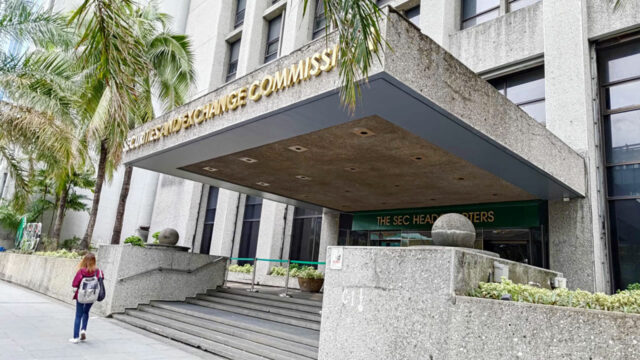
THE SECURITIES and Exchange Commission (SEC) has approved listed developer Century Properties Group, Inc.’s (CPG) planned P5-billion bond offer, which is expected to support its nationwide residential project pipeline.

In a stock exchange disclosure on Thursday, CPG said it received from the SEC an order of registration and a certificate of permit to offer securities for the bond sale.

The offering consists of a base principal amount of P3 billion, with an oversubscription option of up to P2 billion.

The coupons are set at 6.5080% per annum (p.a.) for four-year Series D Fixed Rate Retail Bonds due 2030, and 7.6280% p.a. for seven-year Series E Fixed Rate Retail Bonds due 2033. The bonds will be listed and traded through the Philippine Dealing & Exchange Corp.

China Bank Capital Corp. Managing Director Juan Paolo E. Colet said funds from the bond sale will support CPG’s expansion in both its affordable and premium residential segments.

“CPG has one of the best investment stories in its category and the bonds have attractive rates, so we are confident in market demand for this offering,” he said in a Viber message.

Last year, the Antonio family-led developer announced plans to launch two horizontal projects in Pampanga and Cavite targeting the premium residential segment.

Meanwhile, its affordable housing brand, PHirst Park Homes, Inc., has 31 active projects across Cavite, Laguna, Batangas, Quezon, Bulacan, Pampanga, Bataan, Nueva Ecija, and Bacolod City.

In June 2025, the CPG unit said it plans to launch 10 residential projects over the next two years, focusing on seven key regions in the Philippines.

For the first nine months of 2025, CPG posted a 17% increase in net income to P2.1 billion, driven by strong demand in its affordable housing business.

At the local bourse on Thursday, CPG shares rose 2.6% or two centavos to close at 79 centavos each. — Beatriz Marie D. Cruz

In defense of the Holy Fiscal Deficit: Accounting and economics

BW FILE PHOTO

Part II: The reality of how the government spends and taxes, and other misunderstandings

By Jesus Felipe and Mariel Monica Sauler

A fundamental problem in the discussion of what the government does is the misunderstanding of how it pays for infrastructure, civil servant salaries, etc., and what happens to taxes.

When the Philippine government pays a contractor to build a road, a school, etc. it uses (every time) new money created by the central bank (Bangko Sentral ng Pilipinas or BSP). This is done “out of nothing,” ex nihilo. Pesos are not scarce, and hence cannot be treated as a resource like oil. This money is called “reserves balances” and the BSP is not financially constrained.

This is stated in RA 7653 (Central Bank Republic Act). The other way around, the taxes that we pay do not sit in a government account and wait to be sent back to us when it pays for a new project. Your bank transfers reserve balances to the Treasury’s account at the BSP. Taxes disappear in the process. The system in place (the same as in any other country) treats spending as a legal instruction to the BSP, and taxes as Treasury receipts, not funding instruments. Sections 89, 110, 113, and 114 of RA 7653, imply the following: a.) All National Government receipts are credited to Treasury accounts at the BSP; b.) All Government payments are made through the BSP; c.) Every Peso of reserve used to settle government spending is created by the BSP, not collected via taxes; d.) Spending is operationally a reserve credit decision by the BSP, subject to authorization, not funding availability; and, e.) Reserve availability is a policy variable, not a Treasury constraint.

Operationally, when Congress authorizes spending, Treasury instructs the BSP to pay, the BSP credits bank reserve accounts, and banks credit private deposits. Taxes reduce bank reserves earlier (banks need reserve balances before they can settle tax payments), increase Treasury deposits, and they are accounting offsets, not payments. Summing up: spending and taxation are separate and delinked operational processes. Taxes are not parked in a special account to be used to pay for infrastructure projects. No theory. It is the law, an operational reality.

It is true that the Philippine legal framework (budget process rules like PD 1177 and the Constitution) requires that the government have appropriations and revenue sources before spending. However, the requirement to have balances prior to spending does not mean that the government is financially constrained like a household or a firm. Payments proceed as explained above. We likewise emphasize that it is a mistake to think that taxes go back into the system to finance government spending. Taxes play several important roles in the economy (so we need to maintain them), but they do not finance spending. Taxes free up real resources in the economy (for the government) that otherwise would have been used by the private sector for private ends. They thus allow the government to spend without coming up against the inflation constraint that would be created once all resources are fully utilized.

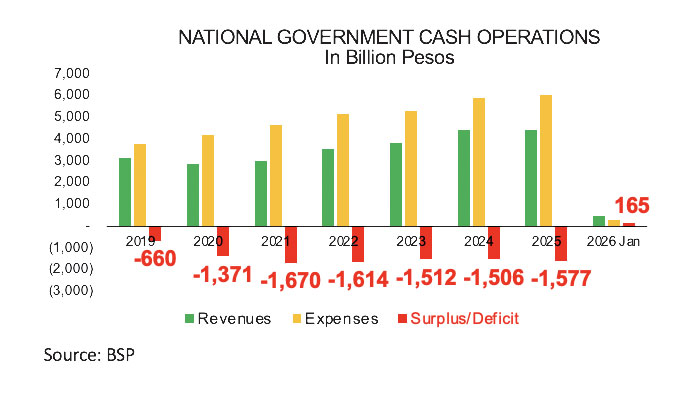
So, what is the role of bond issuance if payments occur as explained above, and taxes do not finance spending? This brings us to the connection with the Bangko Sentral ng Pilipinas. Our central bank sets an interest rate to try to achieve its inflation target (its main goal and role), the so-called overnight reverse repurchase rate. This has been the backbone of our modern monetary policy since the early 2000s, together with the corridor system in place since 2016. What happens to this interest rate, key to managing the economy, and anchor of the interest rates in the banking system, when the government runs a fiscal deficit?

A fiscal deficit implies that there are excess reserve balances in the banking system (government pays us through the banking system and we pay taxes also through the banking system). This, invariably, puts downward pressure on interest rates, including on the central bank’s policy rate (to zero), not upward pressure, as many believe. The central bank cannot allow this to happen.

The solution? The excess reserves have to be drained. How? By coordinating with the Treasury department. It issues Treasury bills and offers them to the so-called primary dealers (major financial institutions), who are very happy to buy them because T-bills offer a great alternative to keeping the funds idle. It is just a portfolio exchange. Whoever thinks that bond issuance is an act of submission of the government with respect to the private sector should witness an auction in action. The government is clearly not borrowing from the private sector, much less in the sense that we are asked to believe, that the government is at the mercy of the private sector.

Apart from the fact that a fiscal deficit pushes interest rates downward, notice also that the initial possible inflationary impact of government spending (private spending is also inflationary) on prices is neutralized by the bond issuance, as excess liquidity (reserve balances) is mopped up. Peso depreciation as a result of using our own currency to build schools? Certainly not. But if this were the case, the groups advocating that we need a significant depreciation of the currency should jump for joy.

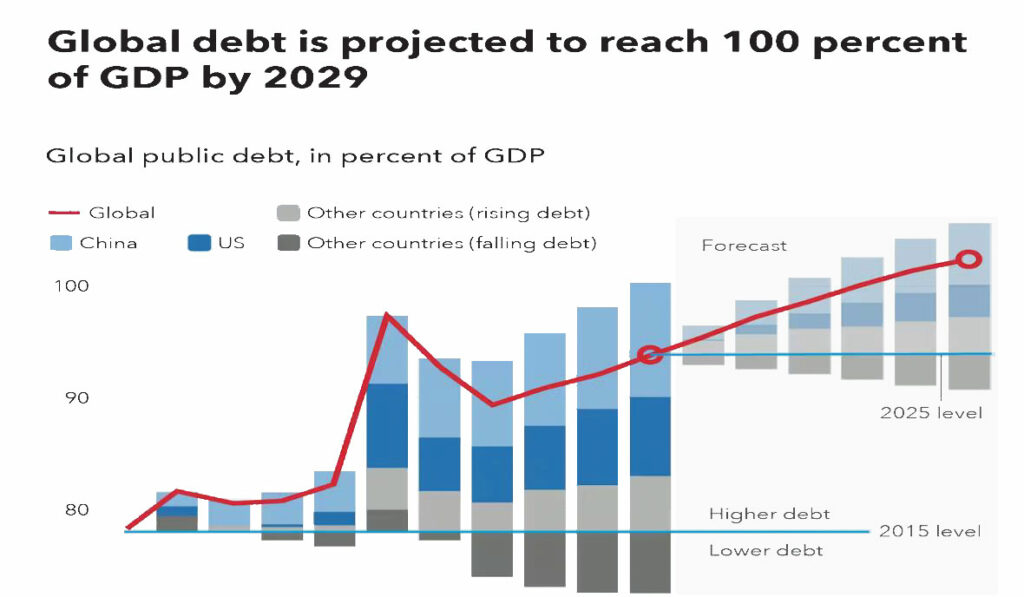
Primary dealers can later offer T-bills to households and firms in the secondary market. These also purchase them gladly. For us in the private sector, it is wealth. Yet, most people call this “national debt” and have a negative view of it simply because of the word, debt. In reality, it is just an accounting record of the Treasury bills in the hands of the private sector (its wealth), P17 trillion currently. Those obsessed with the national debt claim it represents over 60% of our GDP. This ratio is irrelevant. One can choose how to call it, debt or wealth, as long as what it is and who owns it is clear.

The average Filipino does not owe about P130,000. This statement is ludicrous. Yet newspapers and commentators repeat it over and over. If anything, the truth is that, on average, each Filipino owns this amount, though in reality the ownership of T-bills is highly concentrated in the financial system and households with high income.

Another important point to highlight is that T-bills are issued as an interest rate maintenance operation, not government borrowing, as is most often understood. It is intriguing to hear bankers complain about the fiscal deficit. Bond (debt) issuance brings stability to our financial system, and a large portion is in the asset side of our banks’ balance sheets.

It is important to differentiate between debt in pesos and debt in a foreign currency. The Philippine government will always pay peso-denominated debt simply because it will always have pesos to honor it. This represents about 70% of the total national debt. The other 30% is foreign-denominated. This is the potentially problematic one because the government has to make sure it has the foreign currency to pay it. This is not a large share, and, so far, the government has been able to honor it.

There might be good reasons why the Philippine government sometimes borrows dollars, for example to purchase defense equipment. What is less clear is when the government claims that foreign borrowings are for budgetary support, if this means for items in the national budget such as education, civil servants’ salaries, and the like, denominated in pesos.

For those obsessed with the debt-to-GDP ratio, they should follow just foreign-currency denominated debt. Moreover, while economists have spilled uncountable volumes of ink worrying about government debt, there is no particular “debt ratio” that even their most sophisticated theories say governments should target — while the most popular empirical studies were later debunked for having simple Excel errors.

No economy has entered into a crisis as a consequence of running fiscal deficits and issuing debt — such as Treasury bills — denominated in its own currency. The rating agencies and international institutions unnecessarily raise a red flag when the ratio of public debt-to-GDP increases. The debt that matters is that of the private sector and that in a foreign currency. If the world economy collapses, as some predict, it will be the result of private sector debt, not public.

Related to the above, a perennial complaint is that interest payments on debt represent a significant portion of the national budget. These pesos, some claim, could be used more productively. This complaint shows significant lack of understanding.

Follow this example: the government spends, say, P1,000 on infrastructure (a payment that goes to a company in the private sector) and collects only P500 in taxes. The difference is the fiscal deficit. Second, Treasury and the BSP offer the private sector (through the primary dealers) a great deal: the excess P500 — money that entered the economy through government spending — is swapped for a piece of paper called a Treasury bill, which is willingly purchased because the sovereign Treasury of the Philippines is expected to repay (zero default risk unless this is a political decision) the principal P500 with interest of, say, P25. How does Treasury pay interests on debt?

The same way as any other payment: through the BSP by creating new money. Apart from the fact that the government paid a company to build infrastructure (corruption has nothing to do with what we are explaining here), the operation provides the private sector with additional funds in the form of interest, additional disposable income. Businesspeople seem to complain about the fact that interest payments on debt are income that goes to their pockets. We rest our case.

(To be continued.)


Jesus Felipe is a distinguished professor and research fellow at the Carlos L. Tiu School of Economics, De La Salle University. Mariel MonicA Sauler is an associate professor and chair of the Carlos L. Tiu School of Economics, De La Salle University. The authors are grateful to Eunice Gerenia, economics student, De La Salle University, for her excellent research assistance.

Visa sees AI-powered shopping taking off

PIXABAY/PHILSTAR FILE PHOTO

GLOBAL PAYMENTS technology company Visa expects agentic commerce, or artificial intelligence (AI)-powered automated online shopping, to gain traction in the Philippines once worldwide adoption widens.

“This is one of the exciting innovations and trends that we’re seeing. Our role as Visa is we detect and see how things are progressing and ensure that we enable towards that and prepare for it. So, as and when it happens, definitely it will largely be driven [by adoption] in some parts of the world, and then it comes to us,” Visa Philippines Country Manager Jeffrey F. Navarro said at a media briefing on Thursday.

He added that pilots for agentic e-commerce are already happening in the Americas.

Last year, the company announced that it will be rolling out Visa Intelligent Commerce in Asia-Pacific, which will bring integrated application program interfaces and a commercial partner program to AI platforms. Visa said it was in talks with Ant International, Grab, and Tencent to grow AI commerce.

Mr. Navarro added that Visa will work with regulators to help set industry standards and regulations for the technology.

“So, in the evolution of agentic commerce, where payment is a key component of completing the commerce, Visa also participates in really agreeing on what the standards are so that it becomes very seamless,” he said.

“When it comes to Philippines, and given that this is relatively new, then most likely there will be discussions, and we’re going to talk about it with the central bank as and when we feel that there’s traction already.”

For now, Mr. Navarro said Visa is working to ensure that the country’s payments infrastructure is ready to handle these kinds of new technologies via its clients.

“But I think what’s very important is being ready, and being ready means let’s not wait for it to happen or not. There are things that are very foundational that clients need to do like passkeys or tokenization. Whether that happens or it doesn’t, that needs to happen because that’s the foundation for security and preventing fraud.”

APPLE PAY
Meanwhile, Mr. Navarro said there is strong demand from Philippine banks for the integration of Apple Pay as players await its domestic availability following the launch of Google Pay here last year.

He said Visa is in talks with its clients and is prepared to help them with the possible rollout as demand for contactless payments continues to grow in the country. — A.M.C. Sy

How to cure demotivation

I’m the operations manager of a multinational. After working for five years, I am no longer as motivated as I was. At times I’d like to quit and do something else, including starting a business or applying for another job. Please advise. — Night Heron. 

​Wait a bit longer. Don’t be trigger-happy. But first, find out why you’re “no longer as motivated as before.” Otherwise, you could be jumping from the frying pan into the fire. In other words, you may be moving into a worse situation than before. 

​First things first. Being demotivated and being burned out are related but are two different things. The World Health Organization defines burnout as a recognized occupational phenomenon. It happens when there’s chronic workplace stress.

​You’ll need relief from what’s bugging you at work. As an unapologetic Kaizen advocate, I suggest you do a systematic self-reflection by using a practical tool like the Fishbone Diagram with the help of your spouse, objective work colleague, or best friend.

​While commonly used to detect process issues, the Fishbone or Ishikawa Diagram can help give you a clear picture of your situation. This weekend, draw a simple fishbone that contains six categories like Manpower, Method, Machine, Material, Measurement, and Milieu. Come up with as many reasons as you can, then decide on the number one reason.

​For Manpower, this may include your relationship with your boss, work colleagues, or customers. For Method, define all processes that make your job difficult. Machine may include a defective computer or other office equipment. Examples of Material factors include policies that guide your work or things that adversely affect your health and safety.

​Measurement refers to poorly designed or misaligned performance management systems. It may also include an unreasonable, high production quota. Milieu can cover things as seemingly minor as poor air conditioning and ventilation.

SEVEN APPROACHES
Having a feeling that you’re demotivated or having a burnout is not automatically a motivation problem. Rather, it boils down to a system or situational issue. That’s why I recommended using the Fishbone Diagram. Solving burnout starts by looking hard at your work design and not resort to blaming management or other people.

​When you can review your purpose, seek autonomy, and pursue other interventions, you may recover your energy in due time. Address workloads and clarify priorities. A positive workplace doesn’t mean squeezing your energy. Here are some important points to help you bring your best every day:

One, fix your workload before fixing your attitude. Most of the time, it’s a system and situational. You can’t be motivated if you’re already drowning in non-value-added things. Identify your top priorities. Balance them. Don’t attend or create low-value meetings and formal reports. Do all these with the consent of your boss.

​Two, ask management for a bit of autonomy. Independence is oxygen. Request your boss to empower you in certain things. Ideally, an operations manager is given a great amount of authority and responsibility. More importantly, this lightens the load of your boss. It also doesn’t cost money but gives you energy.

​Three, accept things that you can’t change. But don’t sugarcoat. Acknowledge reality.

Nothing demotivates faster than being forced to think there’s nothing wrong. Surely, there’s something wrong and it’s beyond your control. Just the same, listen without jumping to an instant solution. Sometimes, acceptance could be the motivation that you’re looking for.

​Four, make progress visible to you and others. Burnout happens right away if there’s no improvement. Try breaking down your work into short, winnable milestones. Celebrate completed work, not heroic effort. Show how your work connects to real progress. There’s nothing like momentum to prod motivation.

​Five, identify what work means to your life. As soon as you can discover this, it will help you find a reason to stick around. Most people don’t mind hard work. What they hate is meaningless work. Ask yourself: “If I stopped working, what would happen to me?” Nothing energizes like rediscovering your purpose.

​Six, try recovering or redefining your purpose. Sit back and relax. If necessary, ask for an extended vacation someplace. If you can afford it, go to a foreign country where you can learn the perspective of other cultures. Spend more time with your family. They could help you rediscover why you’re working.

​Seven, review your current pay and perks. If you’re underpaid and overworked, you’ll surely burn out quickly and become disengaged. But be professional in handling this issue with your boss. Identify what you can and cannot fix. Transparency builds trust while silence burns it down.

BOTTOM LINE
​Being demotivated or feeling burned out isn’t a personal failure. It’s a signal that you may be doing it wrong. Pause before looking at drastic options. Again, reset priorities, ask for support, delegate without guilt, and treat your health as a Key Performance Indicator.

​When a manager models recovery, clarity returns, decisions improve, and the team learns that sustainable performance beats heroic exhaustion every time. You can’t motivate yourself by wallowing in your current situation. You can only improve by identifying and removing what’s draining your energy at work.

​If you do that, you’ll bring energy back to life naturally.


Consult your workplace issues for free with Rey Elbo. E-mail elbonomics@gmail.com or DM him on Facebook, LinkedIn, X or via https://reyelbo.com. Anonymity is guaranteed.

‘Angel Meloni’ scrubbed off Rome church painting on priest’s orders

ROME — An angel restored with the face of Italian Prime Minister Giorgia Meloni has been scrubbed off a wall painting in a central Rome church on the orders of the parish priest, following a political and clerical uproar.

One of two angels in a chapel of the Basilica of St. Lawrence in Lucina, close to government headquarters, was altered to look virtually identical to the 49-year-old right-wing leader, Italy’s first woman premier.

The image was spotted on Saturday by center-left newspaper la Repubblica and stirred outrage among opposition figures and irritation from Cardinal Baldo Reina, Vicar General for the diocese of Rome.

When the church opened on Wednesday, the Meloni-like face had been painted over, leaving the angel headless.

“I always said that if (the Meloni image) proved divisive we would remove it,” the church priest Daniele Micheletti told Italian news agency ANSA. “There was a procession of people that came to see it instead of listening to Mass or praying. It wasn’t acceptable.”

The amateur artist who restored the painting, Bruno Valentinetti, was quoted by Repubblica on Wednesday as saying he had been asked to erase it by the Vatican.

A spokesperson for the Holy See declined to comment. The Rome diocese said it would release a statement later.

On Saturday, Cardinal Reina expressed “bitterness” over the incident, ordered an investigation and warned that “images of sacred art and Christian tradition cannot be misused or exploited.”

The Italian Culture Ministry also announced an inquiry, while Ms. Meloni laughed off the incident. She posted a picture of the disputed painting on Instagram, with the caption “No, I definitely don’t look like an angel,” and a laughing emoji.

The altered wall painting was done in 2000, and is not under any heritage protection. Mr. Valentinetti is its original author and was asked to restore it to fix water damage, priest Micheletti said on Saturday. — Reuters

NEO Office PH partners with Holcim to co-process office waste

NEOOFFICE.PH

SUSTAINABLE OFFICE developer NEO Office PH has partnered with Holcim Philippines, Inc. to adopt cement kiln co-processing for waste collected in its office buildings, aiming to reduce landfill waste.

The partnership leverages Holcim’s global waste management brand Geocycle to ensure responsible co-processing of post-consumer waste from NEO’s office towers, the company said in a statement.

Qualified residual waste will be converted into alternative fuels and raw materials for cement production. Waste collected from NEO buildings will be processed at Holcim’s Norzagaray Cement Plant in Bulacan.

“Together, we are turning everyday building waste into valuable resources, proving that responsible development can drive both environmental impact and business value,” NEO Group Chief Executive Officer Raymond D. Rufino said.

The move supports NEO’s push for a low-carbon office portfolio by integrating circular economy practices.

“By bringing Geocycle’s co-processing technology into our waste management approach, we’re reinforcing our commitment to circular economy principles, turning waste into value and helping deliver real, measurable ESG (environmental, social, and governance) outcomes,” NEO Co-Managing Director and Chief Sustainability Officer Gie L. Garcia said.

NEO’s portfolio spans 289,000 square meters across seven office buildings in Bonifacio Global City — One/NEO, Two/NEO, Three/NEO, Four/NEO, Five/NEO, Six/NEO, and Seven/NEO.

Its towers have been recognized by local and international green building certifications, including the 5-Star Building for Ecologically Responsive Design Excellence (BERDE), Advancing Net Zero Philippines (ANZ/PH), International Finance Corporation’s EDGE Zero Carbon, and the WELL Health-Safety Rating under the International WELL Building Institute. — Beatriz Marie D. Cruz