Home Blog Page 2955

BSP conducts annual Corporate Financial Trends Survey

THE BANGKO SENTRAL ng Pilipinas (BSP) will be conducting the fourth Corporate Financial Trends Survey (CFTS) this quarter, it said on Tuesday.

“The CFTS is a BSP initiative designed to provide a better understanding of the financial conditions of nonfinancial corporations,” the central bank said in a statement.”

The BSP conducts the CFTS yearly to assess the health of the corporate sector as part of its mandate to maintain financial stability.

It will gather granular data on firm-level borrowing activity, profitability, liquidity and solvency conditions, and funding structure and usage.

Other data to be collected are those related to companies’ total assets, liabilities, and equities, sources and uses of funds, currency mismatch, debt-to-equity ratio and its distribution across different sectors, debt by type of financing, debt by type of interest rate and maturity to total debt, distribution of debt by sector and currency, total debt by type of interest rate and currency, hedged exposures, total revenue and net income, and liquidity and profitability ratios.

Data will be collected from 310 enterprises, or 176 micro, small, and medium enterprises (MSMEs) and 134 large enterprises from the 2019 BusinessWorld Top 1000 Corporations, list of Department of Trade and Industry-assisted firms, and the Bureau van Dijk Database.

Questionnaires will be distributed and collected this month until August, and the survey results are expected to be released to respondents in October.

The central bank said it will only use the data collected from each respondent for research and policy formulation, and these will not be made available publicly except under a court order or if approved by the Monetary Board. — AMCS

DoE seeks partners for geothermal risk reduction initiative

PHILSTAR FILE PHOTO

THE Department of Energy (DoE) on Tuesday said it is in talks with possible implementing partners to launch its project that seeks to reduce the risks of geothermal power projects in the country.

“We are talking to possible implementing partners,” Energy Assistant Secretary Mylene C. Capongcol told reporters in a Viber message.

Ms. Capongcol said in a recent interview that the DoE is working to de-risk the “most expensive and riskiest” part of geothermal development, which is the exploration phase.

“So part of that is the de-risking tool that we will be using,” she said.

The DoE official said that they will immediately launch the de-risking project once they have found an “ideal” implementing partner.

“Since this is private financing, the general framework involves addressing risks with de-risking tools, [which act] as a sort of guarantee for the project,” Ms. Capongcol said.

The Asian Development Bank (ADB) has initiated a de-risking project to support the DoE’s “continued thrust on the further development of indigenous geothermal energy sources in the country,” according to a briefer.

In August 2022, the ADB and DoE tapped Amala Clean Energy Advisors and its partners, GeothermEx and Parhelion Underwriting (Amala), as the consultants for the implementation of the project.

According to the briefer, Amala was able to finalize reports under the geothermal de-risking project after a series of consultations, meetings, and workshops.

“As observed, geothermal fields that are ready to proceed with drilling will require mobilization of risk (equity) capital, which most developers have struggled with thus far,” the briefer read.

“From the several commonly applied options for addressing this main issue, a cost-shared approach between the public sector and private developers for exploration drilling fits well with the present conditions in the Philippines,” it added.

The entities are proposing a geothermal resource de-risking facility that will “cost-share exploration drilling with qualifying private developers to de-risk geothermal resources at the pre-development stage.”

The DoE is expected to arrange for funding to capitalize the facility with the support of ADB as its anchor partner. — Sheldeen Joy Talavera

Alphabet in talks to buy Wiz in $23-billion cyber deal

WIZ.IO

GOOGLE parent Alphabet, Inc. is in talks to acquire cybersecurity startup Wiz, Inc., according to a person familiar with the matter.

A deal may be worth as much as $23 billion, said the person, who asked not to be identified discussing nonpublic information. That would make it the tech giant’s largest acquisition to date. An agreement hasn’t been reached and talks could still end without one, the person said.

A representative for Alphabet didn’t respond to requests for comment. A spokesperson for Wiz declined to comment.

Alphabet already owns the cybersecurity firm Mandiant, which it bought for $5.4 billion two years ago in its second-largest acquisition, topped only by its deal for Motorola Mobility Holdings LLC completed in 2012. An acquisition target as large as Wiz would be unusual for a big tech company like Alphabet and may draw even more scrutiny from antitrust regulators.

Google already faces several antitrust challenges, including a lawsuit by the US Justice department accusing it of abusing its dominant position in online search and another one regarding its digital advertising tools.

The Wiz talks, which were previously reported by the Wall Street Journal, come on the heels of Alphabet shelving efforts to acquire customer relationship management company HubSpot, Inc., which Bloomberg News reported last week.

Google shares, which have gained more than 33% this year, rose about 1% to $186.54 at 1 p.m. in New York.

New York-based Wiz connects to cloud storage providers such as Amazon Web Services and Microsoft Azure and scans data stored there for security risks. The company, founded in 2020, was valued at $12 billion during a May funding round that drew investors such as Andreessen Horowitz, Lightspeed Venture Partners and Thrive Capital.

The acquisition of Wiz could help Google catch up to Microsoft Corp. and Amazon.com, Inc. in an increasingly competitive cloud market.

Alphabet has been ramping up investment in its cloud customer business, including offering more generative artificial intelligence tools for clients. Though Google still lags behind Microsoft and Amazon in the market for cloud computing, the company reported that its cloud unit has been profitable in consecutive quarters, after years of the unit being a money-losing operation.

Opportunities are growing in the space as more startups move their apps and data to the cloud, particularly for generative AI purposes. Artificial intelligence tools are trained off of enormous data sets and often require vast amounts of compute power to generate content such as images, marketing campaigns or software code.

An Alphabet takeover of Wiz also stands to intensify Google’s competition against Microsoft, the world’s largest seller of cybersecurity products. Microsoft has been hit with a series of embarrassing hacks that have exposed corporate and government customers in recent years. A US government report blasted the company earlier this year for its failure to stop hackers tied to the Chinese government from pilfering the e-mail boxes of US officials.

Google has been betting Microsoft’s very public cybersecurity failures — along with deep discounts — will persuade corporate and government customers to use the search giant’s productivity software rather than Office. In May, it released a white paper highlighting its rival’s security lapses, and was considering launching similarly themed social media and advertising campaigns.

Google was also offering one free year to government agencies that switch 500 or more users to Google Workspace Enterprise Plus for three years and said they would be eligible for a “significant discount” for the rest of the contract. — Bloomberg News

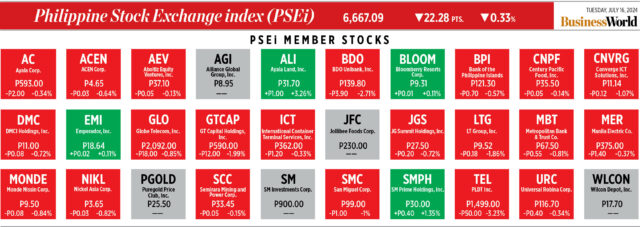
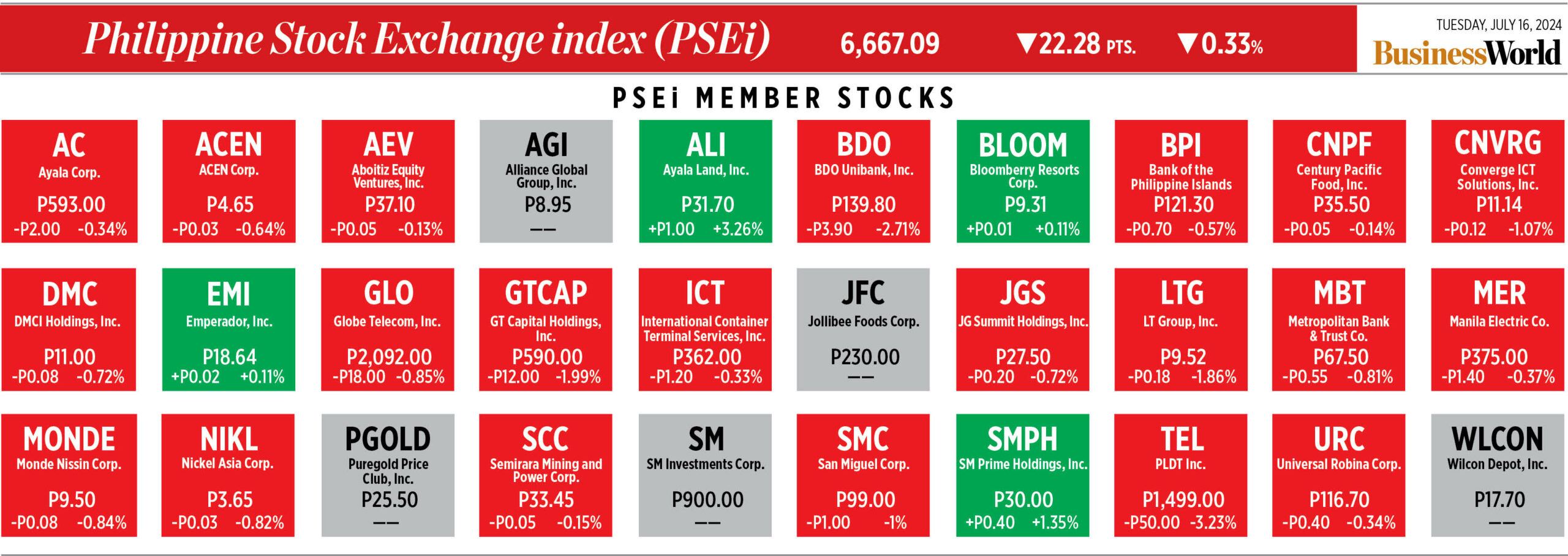
How PSEi member stocks performed — July 16, 2024

Here’s a quick glance at how PSEi stocks fared on Tuesday, July 16, 2024.


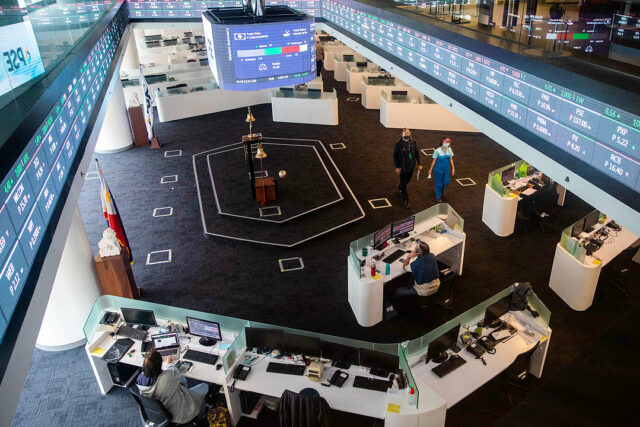
Profit taking halts PHL shares’ three-day climb

REUTERS

PHILIPPINE SHARES closed lower on Tuesday as investors pocketed their gains following the market’s three-day rally.

The Philippine Stock Exchange index (PSEi) fell by 0.33% or 22.28 points to close at 6,667.09 on Tuesday, while the broader all shares index dropped by 0.23% or 8.29 points to end at 3,585.93.

“The local market dropped due to last-minute profit taking after a three-day consecutive climb,” Philstocks Financial, Inc. Research and Engagement Officer Mikhail Philippe Q. Plopenio said in a Viber message. “Many chose to remain on the sidelines as net market value turnover was tepid.”

“This Tuesday’s correction may imply that investors are not yet prepared to see the bourse above the 6,700 resistance level,” Mr. Plopenio added.

“Local shares succumbed to profit taking following a successive run-up of the index as investors bet that the unsuccessful assassination attempt boosted Donald J. Trump’s chances of reclaiming the White House,” Regina Capital Development Corp. Head of Sales Luis A. Limlingan said in a Viber message.

The shooting attempt on Republican candidate and former US President Donald J. Trump’s life immediately altered the dynamics of the presidential campaign, which had been focused on whether President Joseph R. Biden should drop out due to concerns about his age and acuity following a halting June 27 debate performance, Reuters reported.

Mr. Limlingan added that dovish comments from US Federal Reserve Chair Jerome H. Powell overnight also affected the local market’s movement on Tuesday.

Mr. Powell said on Monday the three US inflation readings over the second quarter of this year do “add somewhat to confidence” that the pace of price increases is returning to the Fed’s target in a sustainable fashion, remarks that suggest a turn to interest rate cuts may not be far off, Reuters reported.

Traders continue to expect a September rate cut followed by additional cuts in November and December, bringing the policy rate down to 4.5%-4.75% by yearend.

Almost all sectoral indices closed lower on Tuesday, with property being the sole gainer, rising by 1.73% or 45.86 points to 2,697.04.

Financials dropped by 1.32% or 26.89 points to 2,000.53; services went down by 0.84% or 17.35 points to 2,029.27; mining and oil declined by 0.56% or 48.98 points to 8,597.27; holding firms retreated by 0.33% or 19.45 points to 5,765.91; and industrials lost 0.27% or 24.75 points to end at 9,131.75.

“Among the index members, Ayala Land, Inc. was at the top, climbing 3.26% to P31.70. PLDT, Inc. lost the most, dropping 3.23% to P1,499,” Mr. Plopenio said.

Decliners beat advancers, 98 versus 79, while 55 issues were unchanged.

Net foreign buying stood at P304.96 million on Tuesday, a turnaround from the P46.18 million worth in net selling recorded on Monday. — R.M.D. Ochave with Reuters

Peso rebounds vs dollar as dovish Powell comments bolster easing view

PHILSTAR FILE PHOTO

THE PESO rebounded against the dollar on Tuesday as dovish comments from the US Federal Reserve chief bolstered bets of a rate cut from the central bank soon.

The local unit closed at P58.385 per dollar on Tuesday, strengthening by 9.5 centavos from its P58.48 finish on Monday, Bankers Association of the Philippines data showed.

The peso opened Tuesday’s session slightly stronger at P58.455 against the dollar. Its intraday best was its closing level of P58.385, while its weakest showing was at P58.52 versus the greenback.

Dollars exchanged rose to $1.42 billion on Tuesday from $1.095 billion on Monday.

The peso rose as the dollar remained relatively weak on Tuesday due to dovish comments from Fed Chair Jerome H. Powell overnight, a trader said by phone.

The dollar inched away from five-week lows on Tuesday, as investors weighed the case for a September rate cut after comments by Mr. Powell and pondered rising odds for the reelection of former US President Donald J. Trump, Reuters reported.

On Monday, Mr. Powell said the second quarter’s three US inflation readings “add somewhat to confidence” that the pace of price increases is returning to the Fed’s target in a sustainable way.

Markets now anticipate 68 basis points of easing this year, with a rate cut in September fully priced in, the CME FedWatch tool showed.

The dollar index, which measures the US unit against six peers, was 0.12% higher at 104.36, not far from the one-month low of 104 it touched on Monday.

The peso was also supported by lower global crude oil prices and improved global market risk appetite, Rizal Commercial Banking Corp. Chief Economist Michael L. Ricafort said in a Viber message.

On Tuesday, Brent futures fell 0.3% to $84.63 a barrel, while US West Texas Intermediate crude slipped 0.3% to $81.64, Reuters reported.

For Wednesday, the trader expects the peso to move between P58.20 and P58.60 per dollar, while Mr. Ricafort sees it ranging from P58.30 to P58.50. — AMCS with Reuters

Business chambers identify 21 pending bills as priorities

PHILIPPINE STAR/MICHAEL VARCAS

BUSINESS CHAMBERS said they view the lifting of foreign equity restrictions and the increased ceiling for farmland owned by foreigners, among other pending bills, as the highest priorities for Congress.

In a statement on Wednesday, Philippine Business Groups and the Joint Foreign Chambers (PBG-JFC) said they are requesting President Ferdinand R. Marcos, Jr.’s support to pass 21 measures they deem critical.

“These proposed reforms aim to drive economic growth, enhance global competitiveness, and promote inclusive development,” the chambers said.

They said that some of the measures are part of the 24-item priority list they compiled for Congress in July 2022.

“We greatly appreciate that of the 24 measures, three have been signed into law and three more have been identified in the LEDAC (Legislative Executive Development Advisory Council) Common Legislative Agenda for passage,” they added.

Resolution of Both Houses (RBH) No. 7, which is currently with a Senate committee, seeks to amend economic provisions in the constitution to change foreign participation restrictions on public utilities, educational institutions, and advertising.

The groups also sought to increase the ownership ceiling for foreigners on agricultural land from five hectares to 24 hectares and to remove the 15% domestic preference in awarding contracts for construction or repair of public works contained in Commonwealth Act 138.

The groups also sought changes to the Corporate Recovery and Tax Incentives for Enterprises (CREATE) and Philippine Economic Zone Authority laws, particularly regarding flexible work schedules, as well as reforms to apprenticeship programs.

“Amendments are sought to allow locators greater flexibility in setting work-from-home arrangements,” PBG-JFC said. “Further reforms in the current apprenticeship program will make it more attractive to both enterprises and prospective apprentices.”

The groups also said that the government should prioritize amendments to the E-Commerce Act and the Intellectual Property Code to align with treaty obligations and adopt international best practices.

They said that the Capital Income and Financial Taxes Reform should be passed to simplify the taxation of passive income and financial transactions, harmonize tax rates on interest, dividends, and capital gains, and rationalize the documentary stamp tax to reduce costs.

The groups also sought amendments to the Secrecy of Bank Deposits Law to allow the central bank to exercise its supervisory powers to examine deposits related to unlawful activities.

The groups also sought priority treatment for the Konektadong Pinoy Bill, the Freedom of Information Act, and the Satellite-based Technologies Promotion Act. They also urged the promotion of digital payments.

They said that these measures will help lower internet costs, bridge the digital divide, make digital payments efficient, and provide citizens with access to information in all government offices.

They also pushed for the creation of the Philippine Airports Authority, which will handle the regulation and operation of all airports, and the transfer of Philippine Ports Authority-operated ports to a separate public sector body.

In relation to this, the PBG-JFC said that the International Maritime Trade Competitiveness Act should strengthen the oversight functions of government agencies over the imposition of shipping charges by international shipping lines.

Other measures being pushed by the groups are the National Unemployment Insurance Program, the Department of Disaster Resilience bill, the Pandemic Protection Act, the Holiday Rationalization Act, and the strengthening of the Philippine pension system.

“With one year left in the current Congress, we believe that the 21 measures are achievable reforms that will generate substantial impact in achieving our shared vision of inclusive growth through job generation, poverty reduction, and global competitiveness,” PBG-JFC said.

“We will continue to work with Congress and the administration in support of these remaining reforms as we look forward to the State of the Nation Address,” it added.

Signatories to the statement were the Management Association of the Philippines, Makati Business Club, Semiconductor and Electronics Industries in the Philippines Foundation, Inc., Association of International Shipping Lines, Inc., Chambers of Customs Brokers, Inc., Confederation of Wearable Exporters of the Philippines, and the Philippine Association of Multinational Companies Regional Headquarters, Inc.

The other signatories are the American Chamber of Commerce of the Philippines, Inc., the Canadian Chamber of Commerce of the Philippines, Inc., the European Chamber of Commerce of the Philippines, the Japanese Chamber of Commerce and Industry of the Philippines, Inc., and the Korean Chamber of Commerce Philippines. — Justine Irish D. Tabile


Social spending put forward as growth driver instead of infra

DSWD.GOV.PH

THE GOVERNMENT needs to spend more on social spending and agriculture instead of infrastructure projects to stimulate economic development amid signs of slowing growth, an economist said on Tuesday.

The government should fund social projects, agricultural infrastructure, and provide support for industry to stoke economic growth as trade and investment slump, Jose Enrique A. Africa, executive director at think tank IBON Foundation, said.

“The only thing the government can do to support growth is to spend more… on high-impact, high-multiplier activities,” he said in a briefing.

“We strongly disagree that infrastructure spending is a high-multiplier activity, especially for big-ticket projects, as they are very import-dependent,” he added.

The Philippines won’t meet its target gross domestic product growth of 6-7%, Mr. Africa added, noting that slowing household spending, slumping foreign investment, and weak domestic capital formation are hampering growth.

The Bangko Sentral ng Pilipinas reported that foreign direct investment (FDI) inflows fell 36.9% to $556 million in April. This was the lowest monthly reading for FDI inflows in 10 months, or since the $541 million posted in June last year.

Month on month, net inflows dropped 19% from March.

On the other hand, household spending rose 4.6% in the first quarter, against 5.3% in the fourth quarter and 6.4% a year earlier, according to the Philippine Statistics Authority (PSA). 

“Unless there’s going to be a major shift in terms of government spending, it’s unlikely (to meet growth targets),” he said.

Funding big-ticket infrastructure projects does not offer “bang for the buck” as most of it is spent on materials, equipment, and overseas contractors, he said, and won’t help in developing domestic industry, which could stimulate growth.

The government has 185 infrastructure flagship projects valued at P9.54 trillion under the Marcos administration’s “Build Better More” program.

While increasing government spending on social projects won’t “generate financial returns,” it would help increase consumer spending, benefiting domestic industry, he added.

“It’s going to be money spent on Filipinos, and that’s money Filipinos will spend domestically,” said Mr. Africa. “It won’t generate financial returns, but (it will) …  increase purchasing power and spending.”

The government should also focus on irrigation projects to enable the agriculture industry to increase food production, eventually making food cheaper, he said.

He advocated the development of a domestic electronics industry to establish a stronger foundation for the economy, instead of relying on foreign investments, he said.

Electronic products were the top export in May, accounting for 56.2% of total Philippine exports during the period, bringing in $3.56 billion, the PSA said last week.

“Much of our exports are electronic components. Why not find that segment of electronic components where the Philippines already has supply and consumer capacity, then go all out to support that?,” he said. — Kenneth Christiane L. Basilio

NEDA Board approves changes to Laguna lakeshore road project

PPP.GOV.PH

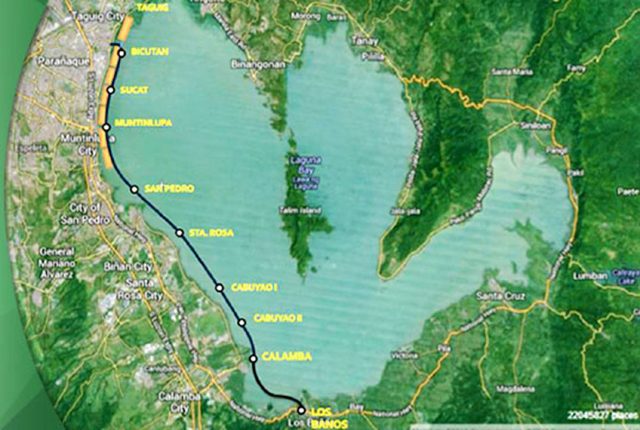
THE National Economic and Development Authority (NEDA) Board approved changes to the Laguna Lakeshore Road Network (LLRN) project, to include connecting roads to nearby areas.

“The NEDA Board, chaired by President Ferdinand R. Marcos, Jr., has approved modifications to the Phase 1 scope of the LLRN Project, which now includes the development of connecting roads and interchanges in various locations,” NEDA said in a statement following its July 15 meeting.

The roads and interchanges will be in Barangay Tunasan, Muntinlupa City, as well as San Pedro, Biñan, and Cabuyao, Laguna, it said.

The LLRN is a 37.5-kilometer primary road and a 12.0-kilometer viaduct from Lower Bicutan, Taguig, to Tunasan, Muntinlupa. It also includes a 25.5-kilometer shoreline viaduct and embankment from Tunasan, Muntinlupa to Calamba, Laguna.

Due for completion in 2027, the project is expected to boost economic activity in southern Metro Manila and provinces to the south of the capital region.

“The NEDA Board recognizes the significant potential of this project in reducing transportation constraints on existing road networks, promoting economic development in the region, and providing safer, more convenient, and faster travel for road users coming from the north and south to various tourist and business destinations in Laguna and nearby provinces,” NEDA Secretary Arsenio M. Balisacan was quoted as saying in the statement.

Feasibility studies for the second phase of the LLRN project will be completed by December, NEDA said.

This will cover the eastern shore of Laguna de Bay from Binangonan, Rizal to Calamba, Laguna, bringing the total length of the LLRN main road to around 71.5 kilometers.

Meanwhile, the NEDA Board also approved the negotiated parameters, terms, and conditions for the Bohol-Panglao International Airport project and the Laguindingan International Airport project in Misamis Oriental.

The approved parameters ensure the Bohol-Panglao International Airport complies with Republic Act No. 11966 or the Public-Private Partnership (PPP) Code.

The project costs P4.5 billion and seeks to increase the maximum number of passengers handled by the airport to 3.9 million a year.

Approved changes in the parameters for the upgrade and expansion of the Laguindingan International Airport include guidelines for adjusting the passenger service charge.

Changes in the passenger service charge “will be contingent upon achieving the set key performance indicators and minimum performance standards and specifications for operation and maintenance during the concession period.”

The project costs P12.75 billion, and will result in the upgrade of standing facilities, NEDA said.

“We expect these projects to significantly boost tourism, and as a result, generate more high-quality jobs,” Mr. Balisacan said.

The NEDA Board also signed off on an additional $30-million loan for the Project Development and Monitoring Facility (PDMF).

The PDMF is a project preparation facility that’s supporting agencies in the preparation, development, approval, procurement, coordination, and monitoring of various PPP projects.

“As we strive to expand private sector participation in our infrastructure projects, this additional support for the PDMF will ensure that our PPP undertakings are meticulously planned and executed to the highest standards,” Mr. Balisacan said.

“It will also guarantee continued access to international sources of innovation, expertise, advice, and best practices in the development and implementation of PPP projects,” Mr. Balisacan added. — Beatriz Marie D. Cruz

Meat imports up 10% led by pork, chicken

REUTERS

MEAT imports rose 10% in the five months to May with pork, chicken, and beef seen leading, according to the Bureau of Animal Industry (BAI).

The BAI said imports amounted to 524.68 million kilograms during the five-month period.

In May, meat imports rose 4.9% to 128.29 million kilos.

Shipments of pork increased 10.6% to 253.55 million kilos during the five months, accounting for 48.32% of the total.

Spain supplied around 64.7 million kilos of pork, followed by Brazil (58.4 million), and Canada (36.5 million) during the period.

Imports of chicken meat totaled 181.23 million kilos in the five months. Shipments rose 4.98% and accounted for 34.5% of meat imports.

Brazil remained the top supplier of chicken with shipments of 98.3 million kilos, followed by the US (58.9 million kilos), and Australia (7.2 million kilos).

Shipments of beef accounted for 13.1% of total imports. Imports increased 28.8% to 68.53 million kilos during the five months.

Beef from Brazil amounted to 23.9 million kilos, followed by Australia (20.4 million kilos), and Ireland (6.3 million kilos).

Imports of turkey increased to 647,529 kilos from 89,889 kilos a year prior.

Meanwhile, imports of buffalo, duck, and lamb fell during the five-month period.

Buffalo imports, which accounted for 3.89% of the total, fell 9.87% during the five months to May to 20.4 million kilos.

Shipments of duck declined 39.7% to 84,254 kilos, while lamb imports fell 48.2% to 199,000 kilos. — Adrian H. Halili

Railway masterplan seen delayed to 2026, JICA says

THE Philippines’ 30-year railway master plan will not be released by yearend, with the Japan International Cooperation Agency (JICA) saying it needs more time to complete the study.

(By the end of 2024) is too early. We still need a few years, it will not be ready within the year, we need more time,” JICA Chief Representative in the Philippines Takema Sakamoto told BusinessWorld on the sidelines of a forum on Tuesday. 

Last month, Transportation Secretary Jaime J. Bautista said the DoTr (Department of Transportation) is expecting the completion of the rail masterplan by the end of the year. 

“I think we are targeting the completion of the master plan in two years. So, maybe by 2026,” Mr. Sakamoto said.

Signed in 2023, the project to draft a master plan will aim to raise the share of passenger trips accounted for by railways.

Last year, the Transportation department said JICA committed 300 million yen to draft the 30-year railway master plan.

The master plan calls for Philippine rail lines to be brought up to international standards using Japanese technology, the Transportation department said.

It is also expected to outline how to enhance the sustainability of the Metro Manila Subway, North-South Commuter Railway; Metro Rail Transit Line 3 and other ongoing and upcoming rail projects. — Ashley Erika O. Jose

Crop insurance GOCC urged to modernize

THE Department of Agriculture (DA) said that it is seeking to modernize the operations of the Philippine Crop Insurance Corp. (PCIC) to better support local producers.

“PCIC should digitalize its processes, upgrade its technologies, and develop insurance products that will provide better protection for its clientele,” Agriculture Secretary Francisco P. Tiu Laurel, Jr. said in a statement on Tuesday.

In May, President Ferdinand R. Marcos, Jr. signed Executive Order No. 60, which transferred the control and supervision of the PCIC back to the DA from the Department of Finance.

Mr. Laurel added that modernizing will allow the PCIC to offer more affordable insurance products, and pointed to the crop insurance systems of Japan, Taiwan, Thailand, and Vietnam as possible models.

He said that the PCIC should also enhance its reinsurance practices to better manage its risk profile.

He urged the use of crop insurance to facilitate farmer access to financial services, by reassuring lending institutions that the collateral they hold will have the benefit of insurance cover.

The PCIC has an annual budget of P4.5 billion. It indemnifies farmers, fisherfolks, and livestock raisers who sustain losses from natural calamities, diseases, pest infestation, and other risks.

For 2024, the PCIC aims to increase its coverage to 1.2 million farmers, 21,000 livestock raisers, and fisheries stakeholders. It processed 744,000 claims in 2023. — Adrian H. Halili