Home Blog Page 2905

The Boys prequel Vought Rising announced at Comic-Con

JENSEN ACKLES, seen here in a scene from The Boys, will star in The Boys’ prequel, Vought Rising. — IMDB

SAN DIEGO — A prequel of the Prime Video series The Boys, called Vought Rising, was announced at San Diego Comic-Con on Friday and will star Jensen Ackles and Aya Cash.

The Boys series executive producer Paul Grellong will be both executive producer and showrunner for Vought Rising.

Mr. Ackles also said he will return as his character Soldier Boy for Season 5 of The Boys.

Superhero show The Boys follows a team of misfit vigilantes who fight corrupt super-powered people called Supes.

The show’s panel had a lively start with a comedic live musical performance of songs from the show, actor Jeffrey Dean Morgan throwing up his middle finger on stage, and a teaser trailer for Season 2 of the spin-off Gen V at the annual pop culture convention.

Jessie T. Usher, who plays the speedster named A-Train, joined performers briefly on stage to perform a rap.

Clips were projected on screen while performers sang, including the Season 4 song “Let’s Put the Christ Back in Christmas” from The Boys’ parody of Disney on Ice.

“In case you didn’t know these guys, (they are) world-class Broadway performers,” said Mr. Morgan, who moderated the panel and stars as CIA analyst Joe Kessler in Season 4.

He playfully honored the musical composer with a middle-finger gesture, echoing the show’s crude humor.

The Season 4 main cast took the stage, including Antony Starr, who plays Homelander, the petty leader of the Supes, Jack Quaid, Erin Moriarty, Chace Crawford, Laz Alonso, Tomer Capone, Usher, and Karen Fukuhara.

The show’s creator Eric Kripke was also on the panel.

Season 5, which premieres in 2026, will be the series’ last season as part of show director Kripke’s vision for the comic-book adaptation.

The popular series also spawned the animated series The Boys Presents: Diabolical.

Stars have returned to the San Diego Comic-Con after the 2023 writers and actors strikes led to a subdued event last year, with no A-list celebrities or Hall H panels, which are known for delivering some of the biggest industry news. — Reuters

A people-centered transformation

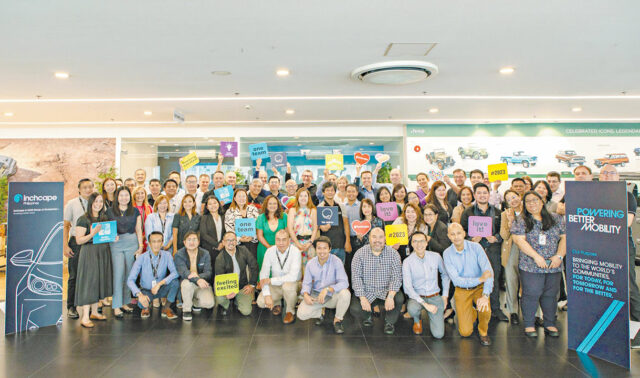
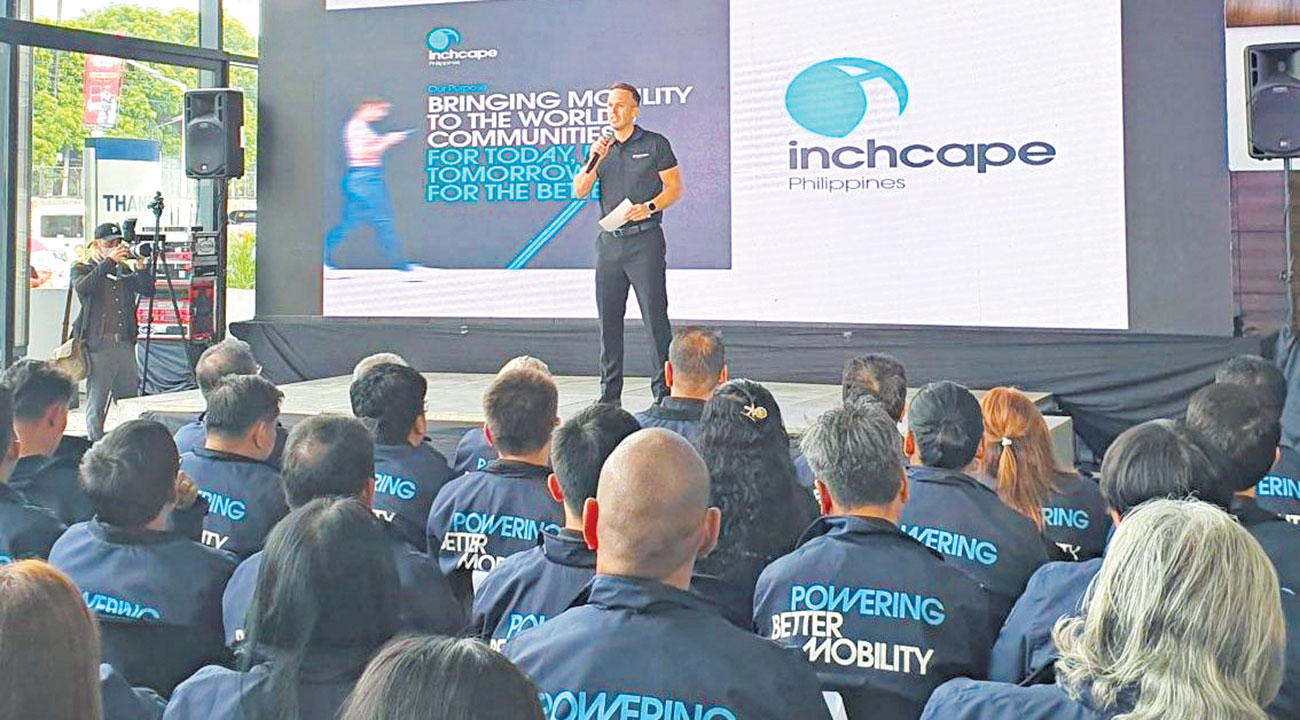
The company, a joint venture by Inchcape and CATS Group of Companies, now has a number of mobility brands under its wing. — PHOTO FROM INCHCAPE PHILIPPINES

Inchcape Philippines flexes a Great Place to Work certification as it nears its first anniversary

By Joyce Reyes-Aguila

ASIDE FROM marking its first anniversary in the country next month, automotive distributor Inchcape Philippines is highlighting another achievement: a Great Place to Work (GPTW) certification. The recognition is given to “employers who create an outstanding employee experience,” according to Great Place to Work, the firm that hands out the recognition to deserving companies.

“We’re talking so much about the cars, but we’re not talking enough about the people behind the vehicles that we showcase,” says Inchcape Philippines Head of People Lyn Cyril Palle, in an exclusive interview with “Velocity.” “We want to make sure that our team is really together in these initiatives to strengthen the brand, and we always rally them for support. This is the core family that we have when we bring our brands forward.”

The company, a joint venture by Inchcape and CATS Group of Companies, started on its GPTW application six months after the integration in August last year, according to the executive. Ms. Palle reveals that the culture of the two entities aligns with the “One Inchcape” culture — which the company says is a “big part of (the firm’s) ongoing success.”

“Then, CATS as a legacy brand already has 34 years in the industry as a family business,” she explains. “The immediate conversations were really to understand the people behind the existing organization. There was a big exercise to map out and understand the culture, values, and behaviors that we want to carry forward to the Inchcape dynamics. Inchcape has an established global reputation. Having to understand who gets the superiority was really an interesting journey. We tried to map out the existing CATS culture and core values against the One Inchcape values and behavior. Apparently, everything matched but it was just verbalized in a different way in CATS and in Inchcape. But all in all, it’s really focusing on our desire to be customer-centric, to be able to deliver to the people we serve, and we just used different words.”

Ms. Palle shares that an initial survey was fielded in the company to gain insights from its over 500 employees. “In the beginning, there will be a lot of questions. The beauty of how we did this transformation is that we really had a lot of individual conversations to make our people comfortable. The intention from the beginning is to make sure that everybody jumps over to the joint venture. We did not want to clean it up before doing it. The story that we told everyone is that we are all being invited.”

The executive, who led the CATS Group of Companies’ People Team prior to the merger, reveals that the conversations revolved around how people can benefit from the move, including opportunities from globalization and access to international resources. “Having that reassurance that we’re all in this together in this journey, I think, allowed most of our employees to be really convinced to jump over. I’m happy to say that everyone jumped over.”

Ms. Palle continues that the organization’s confidence comes from the solutions it already made available to its people. The reforms include new technology for its after-sales and backend processes, and a “very professional” body and paint facility in their location in C5. “They could not imagine (these) could happen, but they were delivered.” She adds, “In the area of health and safety, we’ve been aggressively making sure that our teams are well-protected. We have revamped a lot of our lifts and replaced them with new ones to make sure that our people see action in what we say. We are making sure that our teams go back to their families healthy and well.”

Inchcape Philippines is also taking care of its talent through upskilling, and eventually plans to offer international career opportunities within the company. “Most of our cars really churn different models every so often. Your skillset needs to be up to speed. Now, our technicians will be trained in electronic diagnosis, special tools, and equipment. They all need to learn that very fast because the things that they use in servicing always change, and there are different brands that we cater to.

“Because we are a house of brands, we also want our team to move around the environment, not just to grow old vertically with a certain brand.” She adds, “I think that Inchcape brought in (initiatives) to make sure that our teams will be ready for that scale-up to digitalization. It’s really to support the entire journey of their career and the aspirations of our employees. Most of the time, our technicians fly out of the business to join international companies. The aspiration is to really make sure that we move our talent to the businesses that we also own abroad.”

The executive shares that the management wants to understand employee aspirations and then strengthen their skillset, and move them to “accommodate new talents to develop,” talents who display passion in vehicles and services.

“In the future, we want our local talent to be part of that pool who can go around the region,” Ms. Palle explains.

Inchcape Philippines is strengthening its inclusion and diversity thrust to support the brand’s international presence. “It is very, very important for us because, from a family business, we started to open our doors to all markets. We break those silos of grouping, and not knowing who are in the other brands. We started staging activities and learning sessions that have representation from all our brands. The Philippines is being seen as a spot where we can really grow certain areas in terms of shared services. The more we create a diverse thinking pot, the smarter we get, the better we get, and the faster we can move the business to achieve its goal.”

Ms. Palle says changes, such as implementing a uniform software in all brands to centralize data, aligned all their brands (Mercedes-Benz, Chrysler, Dodge, Jeep, Ram, Jaguar Land Rover, and Changan Auto, as well as dealerships for Mazda, Harley-Davidson Motorcycles, and Fuso) to the requirements of Inchcape’s unified transformation approach. The GPTW certification the firm received last April had high marks for making people feel welcome and having competent leaders to take the company into the future. On the other hand, the HR head reports that respondents identified well-being as an area of focus, and a wellness program is available to support the company’s goal of having people that are “sound, healthy, and well.”

“We want to make sure that people really like waking up and coming to work,” Ms. Palle insists. “We want to make sure that we continue to excite our teams because we know we ask so much from them. All these changes that we have accelerated and pilot for the Philippines helped our people really feel that this organization is really vested to grow and bring us together on that growth.

“While we want to still be identified for the brands we represent, at the backend, there’s a bigger Inchcape family supporting all. I think that’s the strength in the scale of resources that we have at Inchcape. That’s something that we want to promise to our employees — that these (changes) are not just for this phase because it’s for integration.”

She concludes, “We always aim for our true north to be consistently recognized. There are things that you feel you only need to think about as the people or human resources team. But these are things that can also be thrown back to the team so that they define what they really like in order to be engaged. You just need to give them a platform.”

DigiPlus shares decline amid POGO ban news

DIGIPLUS Interactive Corp. emerged as one of the most actively traded stocks last week following the government’s announcement of a ban on online gaming operators, which caused investors to sell shares.

Data from the Philippine Stock Exchange showed that a total of 32.44 million shares worth P482.95 million were traded from July 22 to 26, positioning DigiPlus as the 10th most active stock in the local market during that period.

The listed digital gambling company’s shares decreased by 1.8% week on week, closing at P15.52 per share, down from P15.80 per share on July 19.

Year to date, DigiPlus’ share price has increased almost 100% from P8 per share.

Trading was suspended on July 24 due to heavy rains brought by Typhoon Carina.

The recent ban on Philippine offshore gaming operators (POGOs) and internet gaming licensees (IGLs) has caused a decline in the company’s stock this week, as investors believed DigiPlus would be affected by the ban, said Philstocks Financial, Inc. Research Analyst Claire T. Alviar in an e-mail.

“On a positive note, it was immediately clarified that the license of Digi-Plus is different from those of POGOs and IGLs. This means that DigiPlus is not negatively affected by this ban in any way,” Ms. Alviar said.

“Since it was not cleared up at first, many thought it would be affected and sold shares, causing a nearly 7% drop during intraday trading last Tuesday from Monday’s closing price. As it was clarified that it would not be affected, investors returned to buy shares. It slowly regained momentum, however, it still failed to post gain last week, losing 1.77% week on week,” Ms. Alviar said.

During President Ferdinand R. Marcos, Jr.’s third State of the Nation Address last week, he announced the ban on all POGOs, saying that they have been linked to money laundering and financial scams.

DigiPlus issued a statement saying that the company is not a POGO or an IGL as defined by Philippine laws and assured local gaming enthusiasts that they need not worry.

“Fans of DigiPlus’ products will be glad to know that their top-of-the-line platforms will continue running without interruption, unaffected by the recent presidential announcement,” DigiPlus President Andy Tsui said in a statement.

DigiPlus said that it is a localized digital gaming company, serving customers based in the Philippines and operating physical branches across the country.

DigiPlus saw its first-quarter attributable net income rise by more than four times to P2 billion from P436.77 million posted in the same period last year, driven by better revenues and higher user traffic.

Meanwhile, its revenues soared by more than two times to P13.63 billion from P4.18 billion in the first quarter of 2023, led by growing user traffic in its flagship platforms BingoPlus and ArenaPlus digital sportsbook, as well as fresh contributions from new game offerings.

“Given the strong first-quarter performance of DigiPlus, we expect it to continue its momentum this year particularly with the launch of new game offerings. The possibility that it may sustain revenue growth of around 200% year on year is high,” added Ms. Alviar.

 Ms. Alviar saw the stock immediate support at P14.80 per share, while the second support was pegged at P13.80 per share. The resistance was pegged at its 52-week high, P15.90 per share. — Lourdes O. Pilar

Greenhouses for high-value crops to be built via tie-up with SKorea

REUTERS

THE Bureau of Plant Industry (BPI) said that it is planning to expand its greenhouse network for high-value crops through a tie-up with the Korea Partnership for Innovation of Agriculture (KOPIA).

“We are trying to expand it further in terms of numbers and in areas covered, hopefully in areas where there are BPI centers,” BPI Director Gerald Glenn F. Panganiban said on the sidelines of a KOPIA event last week.

He added that the BPI was evaluating potential sites in Baguio, Davao, Guimaras, Los Baños, Laguna and La Granja, Negros Occidental, with building to start next year or in 2026.

KOPIA Philippine Center has two pilot greenhouse projects in Laguna, Quezon province, and Nueva Ecija.

Lee Kyu-seong, director of KOPIA Philippine Center, said that it is planning to scale up its pilot projects starting in 2026.

“(We) are also trying to find other projects (like) transferring our technology to communities here in the Philippines.

KOPIA and the BPI have agreed to expand the pilot project to about 10 sites near BPI centers.

“The vision is to have shared facilities that could be used by farmers, similar to what we did with KOPIA,” Mr. Panganiban added.

He said that the BPI will also partnering with private parties to take up the products produced in the greenhouses.

Separately, Agriculture Undersecretary Jerome V. Oliveros said that KOPIA’s pilot farms have reported superior yields compared with open farming methods.

“The yields are very high, more than about 30% compared to normal methods,” Mr. Oliveros added.

KOPIA is an official development assistance program of the Rural Development Administration, which is South Korea’s largest agricultural research and development organization. — Adrian H. Halili

Profit taking causes debt yields to move sideways

YIELDS on government securities (GS) ended mixed last week due to profit taking after the Philippine capital was hit by Typhoon Carina.

GS yields, which move opposite to prices, inched up by 0.71 basis point (bp) on average week on week on Friday, according to PHP Bloomberg Valuation Service Reference Rates data published on the Philippine Dealing System’s website.

Yield movements were largely mixed. At the short end, the rate of the 91-day Treasury bills (T-bills) decreased by 0.61 bp to 5.7294% on week on week, while those on the 182- and 364-day T-bills edged up by 1.67 bps, and 5.3 bps to 6.0390% and 6.1583%, respectively.

At the belly, yields on the two-, three-, four-, five-year Treasury bond (T-bonds) dropped by 2.87 bps (to 6.0370%), 2.46 bps (6.0893%), 1.19 bps (6.1469%), and 0.08 bp (6.1948%), respectively. Meanwhile, the rate of the seven-year T-bond went up by 1.62 bps (6.2488%).

Lastly, the long end of the curve rose week on week, with the rates of the 10-, 20-, and 25-year debt papers increasing by 2.56 bps (to 6.2759%), 1.91 bps (to 6.4019%), and 1.91 bps (to 6.4013%), respectively.

GS volume traded stood at P34.19 billion on Friday, higher than the P8.06 billion recorded on July 19.

Analysts attributed last week’s yield movements to the typhoon, which intensified monsoon rains and floods in the capital and nearby areas. Trading at the fixed-income market was suspended on Thursday (July 25) due to the typhoon’s impact.

“The bond market consolidated last week as players took profits given the onslaught of Typhoon Carina, which closed trading for one day,” Security Bank Corp. Chief Investment Officer for Trust and Asset Management Group Noel S. Reyes said in a Viber message.

Market activity thinned in the later part of the week due to the typhoon, causing yields to move mostly sideways, a bond trader said.

“The recent rally since a couple of weeks back lost steam as the market fully priced in expectations of a rate cut by the BSP (Bangko Sentral ng Pilipinas) this August,” Mr. Reyes added.

BSP Governor Eli M. Remolona, Jr. last month said the Monetary Board may deliver its first rate cut in over three years at their Aug. 15 review — the only policy meeting scheduled this quarter — as they expect inflation to continue easing until yearend, barring any shocks.

The Monetary Board could reduce benchmark borrowing costs by 25 bps this quarter and by another 25 bps in the fourth quarter, Mr. Remolona said.

The BSP last month kept its policy rate at a 17-year high of 6.5% for a sixth straight meeting following cumulative hikes worth 450 bps from May 2022 to October 2023 to help tame elevated inflation.

Last week, Finance Secretary and Monetary Board member Ralph G. Recto said the BSP remains “on track” to cut rates within the year to support economic growth.

“Additionally, stronger GDP (gross domestic product) numbers than expected for the US also influenced such a move as the market awaits further proof that inflation does not see a similar blip. Yields inched up by 2-4 bps week on week as a result and also was felt by the reissuance of the 20-year bond last week,” Mr. Reyes said.

The US economy grew faster than expected in the second quarter amid solid gains in consumer spending and business investment, but inflation pressures subsided, leaving intact expectations of a September interest rate cut from the Federal Reserve, Reuters reported.

Gross domestic product increased at a 2.8% annualized rate last quarter, the Commerce department’s Bureau of Economic Analysis said in its advance estimate of second-quarter GDP. That was double the 1.4% growth pace in the first quarter.

Economists polled by Reuters had forecast GDP rising at a 2% rate. Estimates ranged from a 1.1% rate to a 3.4% pace.

The growth rate in the first half of the year averaged 2.1%, half the 4.2% pace logged in the last six months of 2023. That is just above the 1.8% pace viewed by US central bank officials as the non-inflationary growth rate.

The Fed has maintained its benchmark overnight interest rate in the current 5.25%-5.5% range for the past year. It has hiked its policy rate by 525 bps since 2022. Financial markets expect three rate cuts this year, starting in September.

For this week, yields may continue to move sideways as the market awaits more economic data out of the US that could affect the Fed’s policy path moving forward, Mr. Reyes said.

Investors are also likely to wait for the actual start of the BSP’s monetary easing cycle before pushing yields lower, he added.

The market will take cues from the monetary policy meetings of the Fed and the Bank of Japan this week, the trader added.

The June US personal consumption expenditures (PCE) price index data released on Friday could also affect GS yield movements this week, the trader said.

US prices increased moderately in June as the declining cost of goods tempered a rise in the cost of services, underscoring an improving inflation environment that could position the Fed to begin cutting interest rates in September, Reuters reported.

The report from the Commerce department on Friday also showed consumer spending slowed a bit last month. Signs of easing price pressures and a cooling labor market could boost the confidence of Fed officials that inflation is moving toward the US central bank’s 2% target. The Fed will hold its next policy meeting on July 30-31.

The PCE price index nudged up 0.1% last month after being unchanged in May, the Commerce department’s Bureau of Economic Analysis reported. The increase in PCE inflation was in line with economists’ expectations.

In the 12 months through June, the PCE price index climbed 2.5%. That was the smallest year-on-year gain in four months and followed a 2.6% advance in May.

The Fed tracks the PCE price measures for monetary policy. — CWEL with Reuters

Immunotherapy is revolutionizing cancer treatment

FREEPIK

In the past 50 years, understanding of cancer has advanced considerably, and treatments are far more effective. Thanks to new and innovative therapies, being diagnosed with cancer today is no longer a death sentence.

Some cancers that were once terminal in every case are now generally treatable. For example, childhood leukemia, testicular cancer, and Hodgkin’s disease — previously fatal — are now generally curable through chemotherapy. In 1968, a child with acute lymphoblastic leukemia (ALL) had a diagnosis that was almost uniformly fatal. Today’s best treatments provide cure rates approaching 90% for ALL.

The development of successful treatments has followed our understanding of the biology of the disease, attained through incremental advances and occasional moments of great insight. These advances paved the way for innovative cancer treatments including chemotherapy, radiation therapy, and targeted therapy, among others.

Today, a new era in medicine is revolutionizing how we diagnose, treat and hopefully one day cure the many diseases that make up cancer. The pipeline has never been more promising with 79% of medicines in development for cancer having the potential to be first-in-class treatments. More than 70% of cancer medicines in the pipeline also have the potential to be personalized medicines.

The latest and most exciting development in our search for a cure for cancer is in the growing field of cancer immunotherapy. Also known as immuno-oncology, cancer immunotherapy is a form of cancer treatment that uses the power of the body’s own immune system to prevent, control, and eliminate cancer.

According to the American Cancer Society (ACS), immunotherapy involves: 1.) stimulating, or boosting, the natural defenses of your immune system so it works harder or smarter to find and attack cancer cells; or, 2.) making substances in a laboratory that are just like immune system components, and using them to help restore or improve how your immune system works to find and attack cancer cells.

A class of immunotherapies have already achieved US Food and Drug Administration (FDA) approval in a range of cancers, including certain types of melanoma, non-small cell lung cancer, renal cell carcinoma, bladder cancer, head and neck cancer, liver cancer, and classic Hodgkin’s lymphoma. The first generation of immuno-oncology drugs are poised to become the standard of care across multiple tumor types in advanced disease, and are already being followed with other immune-activating agents.

Another immunotherapy approach is called adoptive cell transfer (ACT) which collects and uses a patients’ own immune cells to treat their cancer. One of the more advanced forms of ACT is CAR T-cell therapy. CAR stands for chimeric antigen receptor. CAR T-cell therapy employs the use of T-cells, which play a critical role in orchestrating the immune response and killing cells infected by pathogens.

In CAR T-cell therapy, some T-cells are taken from a patient’s blood and mixed with a special virus that makes the T-cells learn how to attach to tumor cells. The cells are then given back to the patient so they can find, attach to, and kill the cancer, the ACS explains. With the potential for this treatment to be effective against a wide variety of aggressive cancers, expectations and hopes are running high.

CAR T-cell therapy is just one of several main types of cancer immunotherapy, according to the ACS. Checkpoint inhibitors are drugs that basically take the “brakes” off the immune system, which helps it recognize and attack cancer cells. Cytokines (small proteins that carry messages between cells) stimulate the immune cells to attack cancer.

Immunomodulators are a group of drugs that generally boosts parts of the immune system to treat certain types of cancer. Cancer vaccines trigger an immune response to help prevent or treat cancer. Monoclonal antibodies (mAbs) are man-made versions of immune system proteins that can be very useful in treating cancer because they can be designed to attack a very specific part of a cancer cell.

Oncolytic viruses are lab-modified viruses designed to infect and kill certain tumor cells. Oncolytic viral therapies zero in on cancer cells, replicate, and cause them to rupture. They have been recognized as a promising new treatment, with the potential to be a standard therapeutic option for all cancer patients.

Some immunotherapy treatments use genetic engineering to enhance immune cells’ cancer-fighting capabilities and may be referred to as gene therapies. The gene editing technology CRISPR/Cas9 allows researchers to manipulate cancer cell function.

The first clinical trial involving CRISPR, a family of DNA sequences in bacteria and archaea, started in 2016. Today there are over 20 human trials underway. One of these trials will feature the first-ever attempt to edit cells inside the body, with the aim of targeting and destroying the genes of HPV that cause tumor growth.

The global prevalence of cancer is increasing rapidly, presenting an especially heavy burden for people in low and middle-income countries (LMICs). Collaborative and innovative thinking is now needed to expand access to cutting-edge cancer therapies, including immunotherapy. To this end, the research-based pharmaceutical industry is committed to facilitating public and private sector partnerships for better access to quality cancer care.


Teodoro B. Padilla is the executive director of Pharmaceutical and Healthcare Association of the Philippines (PHAP).PHAP represents the biopharmaceutical medicines and vaccines industry in the country. Its members are in the forefront of research and development efforts for COVID-19 and other diseases that affect Filipinos.

Philippines remains restricted in Global Expression Report

The Philippines placed 98th out of 161 countries in the 2024 edition of the annual Global Expression Report (GxR) by international human rights organization ARTICLE 19. With a score of 40 out of a possible 100, the Philippines was categorized under “restricted.” The index ranks countries based on the right to free expression and information using 25 indicators.

Philippines remains restricted in Global Expression Report

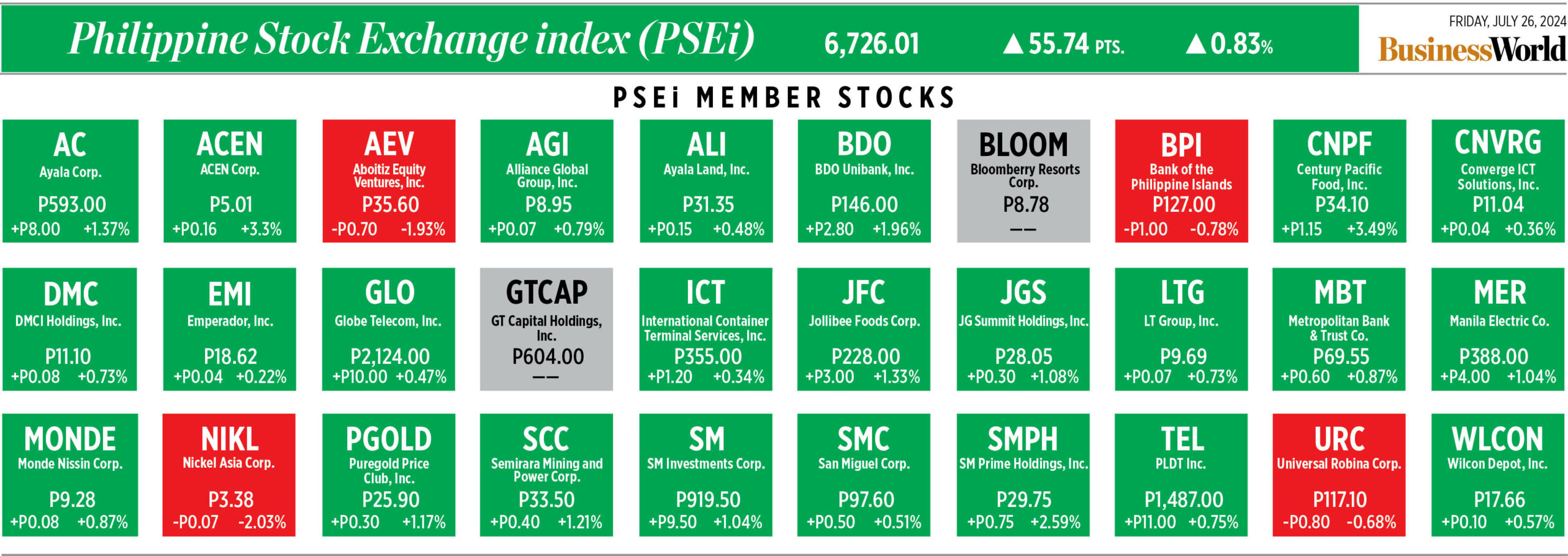
How PSEi member stocks performed — July 26, 2024

Here’s a quick glance at how PSEi stocks fared on Friday, July 26, 2024.


Peso may rise as US data bolster Fed cut hopes

BW FILE PHOTO

THE PESO is expected to trade sideways with an upward bias against the dollar this week as recent US economic data strengthened expectations of a September rate cut by the US Federal Reserve.

The local unit closed at P58.35 per dollar on Friday, appreciating by 8.5 centavos from its P58.435 finish on Tuesday, Bankers Association of the Philippines data showed.

The market was closed on Wednesday and Thursday (July 24-25) following the suspension of work in government offices in Metro Manila after Typhoon Carina hit the capital.

Week on week, however, the peso inched down by 1.5 centavos from its P58.335 finish on July 19.

“The market seems to be in a holding pattern, searching for new drivers to dictate its next move. After the two-day closure, the pair resumed trading with pent-up buying pressure,” Security Bank Corp. Chief Economist Robert Dan J. Roces said in a Viber message on Friday.

The peso was also supported by a generally weaker dollar overnight as US economic data continued to boost expectations of a Fed rate cut this year, Rizal Commercial Banking Corp. Chief Economist Michael L. Ricafort said in a Viber message.

On Thursday, the dollar index, which measures the greenback against a basket of currencies including the yen and the euro, fell 0.05% to 104.33 after the release of US gross domestic product data, Reuters reported.

The US economy grew faster than expected in the second quarter amid solid gains in consumer spending and business investment, but inflation pressures subsided, leaving intact expectations of a September interest rate cut from the Federal Reserve.

Gross domestic product (GDP) increased at a 2.8% annualized rate last quarter, the Commerce department’s Bureau of Economic Analysis said in its advance estimate of second-quarter GDP. That was double the 1.4% growth pace in the first quarter.

The growth rate in the first half of the year averaged 2.1%, half the 4.2% pace logged in the last six months of 2023. That is just above the 1.8% pace viewed by US central bank officials as the non-inflationary growth rate.

The Fed has maintained its benchmark overnight interest rate in the current 5.25%-5.5% range for the past year. It has hiked its policy rate by 525 basis points since 2022. Financial markets expect three rate cuts this year, starting in September.

For this week, the peso will continue to be supported by stronger bets of monetary easing by the Fed following the personal consumption expenditures (PCE) index data released on Friday, Mr. Roces said.

US prices increased moderately in June as the declining cost of goods tempered a rise in the cost of services, underscoring an improving inflation environment that could position the Fed to begin cutting interest rates in September, Reuters reported.

The report from the Commerce department on Friday also showed consumer spending slowed a bit last month. Signs of easing price pressures and a cooling labor market could boost the confidence of Fed officials that inflation is moving toward the US central bank’s 2% target. The Fed will hold its next policy meeting on July 30-31.

The PCE price index nudged up 0.1% last month after being unchanged in May, the Commerce department’s Bureau of Economic Analysis reported. The increase in PCE inflation was in line with economists’ expectations.

In the 12 months through June, the PCE price index climbed 2.5%. That was the smallest year-on-year gain in four months and followed a 2.6% advance in May.

Excluding the volatile food and energy components, the PCE price index rose 0.2% last month. The so-called core PCE inflation gain was 0.182% before rounding. May’s unrounded figure was revised up to 0.127% from the previously reported 0.083%. April’s core PCE inflation was upgraded to 0.261% from the previously estimated 0.259% rise.

In the 12 months through June, core PCE inflation advanced 2.6%, matching May’s rise. Core inflation increased at a 2.3% annualized rate in the three months through June, sharply slowing from the 2.7% pace in May.

The Fed tracks the PCE price measures for monetary policy.

The market will also monitor other US data to be released this week, specifically the latest employment report, Mr. Ricafort added.

On Monday, the peso could range from P58.25 to P58.45 against the dollar, Mr. Ricafort said. Meanwhile, he expects the local unit to move between P58.05 and P58.55 against the greenback this week. — A.M.C. Sy with Reuters

Stocks to move sideways with Fed meet in focus

PHILIPPINE STAR/KRIZ JOHN ROSALES

PHILIPPINE SHARES may move sideways this week ahead of the US Federal Reserve’s policy meeting as investors await clarity on the path of monetary easing in the world’s largest economy.

On Friday, the Philippine Stock Exchange index (PSEi) rose by 0.83% or 55.74 points to end at 6,726.01, while the broader all shares index gained by 0.64% or 23.29 points to close at 3,630.10.

Week on week, however, the PSEi dropped by 0.97% or 65.68 points from its 6,791.69 finish on July 19.

Trading at the stock market was disrupted last week as Super Typhoon Carina (international name: Gaemi) enhanced a southwest monsoon, causing torrential rains in Metro Manila.

“Amid the onslaught of Super Typhoon Carina, local equities broke their multi-week winning streak, although losses were trimmed before weekend,” online brokerage firm 2TradeAsia.com said in a market note.

“The local market has already exhibited a golden cross as its 50-day exponential moving average crossed above its 200-day counterpart. This signals a possible rally in the medium- to long-term for the bourse. Trading remains tepid, however, as many are still on the sidelines amid lingering uncertainties,” Philstocks Financial, Inc. Senior Research Analyst Japhet Louis O. Tantiangco said in a Viber message.

For this week, the Fed’s July 30-31 policy review will take center stage, Mr. Tantiangco said.

“In particular, investors are expected to watch out for clues regarding the Fed’s policy outlook. If the Fed gives a dovish outlook, this may spur optimism in the local market,” he said.

The Fed is widely expected to keep its target rate at the current 5.25%-5.5% range for the eighth straight meeting this week. However, markets are awaiting more hints from Fed Chair Jerome H. Powell on the central bank’s easing cycle, which investors expect to begin by September.

Mr. Tantiangco added that the market will monitor the July S&P Global Philippines Manufacturing Purchasing Managers’ Index data scheduled to be released on Aug. 1.

He put the PSEi’s support at 6,400 and resistance at 6,700-6,800.

Meanwhile, Rizal Commercial Banking Corp. Chief Economist Michael L. Ricafort placed the market’s immediate major support at 6,360 and resistance at 6,800-7,000.

For its part, 2TradeAsia.com put immediate support at 6,600 to 6,650 and resistance at 6,850.

“Momentum generated by an improving macro backdrop of inflation and growth are likely to persist until data confirms otherwise, and positive earnings growth should help the PSEi brute force its strong resistance near the 7,000 mark,” it said. “On that note, the upcoming ghost month may increase friction in the short term.”

The ghost month is a period in the Lunar calendar when some Asian investors refrain from making big investments or decisions, resulting in lower trading volumes. For this year, the period is scheduled to start on Aug. 4 and end on Sept. 2. — R.M.D. Ochave

MRT-4 project cost to change after monorail plan abandoned

DOTR PHOTO

THE DEPARTMENT of Transportation (DoTr) is seeking approval to adjust the project cost of Metro Rail Transit Line 4 (MRT-4) ahead of a possible loan signing this year.

The cost adjustment proposal will go before the National Economic and Development Authority (NEDA) following a shift from the originally proposed monorail format to a metro rail configuration.

“We are still targeting to have this approved by the ADB (Asian Development Bank) board as well as AIIB (Asian Infrastructure Investment Bank) board within the year… we need to get NEDA board re-approval right now,” Transportation Undersecretary Timothy John R. Batan said on the sidelines of a forum last week.

NEDA approval is required before major government projects can change scope or costing, Mr. Batan said.

He said the monorail configuration will have limited capacity.

“We saw that we need to change from monorail technology to conventional heavy metro rail technology,” he added.

Mr. Batan have no details about the magnitude of the cost change, which the DoTr has yet to finalize.

The move towards a greater-capacity solution followed a review of the passenger projections for the MRT-4 service area. 

“We saw that demand was higher than expected for Eastern Metro Manila,” he added.

The MRT-4 will run 12.7 kilometers from the Epifanio de los Santos Avenue (EDSA)-Ortigas Ave. junction to Taytay, Rizal. It will have 10 stations.

Once operational, the MRT-4 is expected to serve more than 400,000 passengers daily, the DoTr has said.

In May, ADB said it is working on approving the proposed $1-billion loan to fund the construction of MRT-4, while AIIB said last year that the Philippines is seeking a loan of about $537.4 million from the Beijing-based bank. — Ashley Erika O. Jose

Flood-control focus urged for infrastructure projects

PHILIPPINE STAR/EDD GUMBAN

By Beatriz Marie D. Cruz, Reporter

THE GOVERNMENT must realign its infrastructure spending priorities to give more weight to flood control projects, analysts said. 

“There is a need to revisit the number, breadth and extent of flood control facilities that are currently operational and make plans to build more,” Terry L. Ridon, and public investment analyst and convenor of think tank InfraWatch PH, said in a Viber message.

The Department of Budget and Management (DBM) reported that infrastructure spending in May rose 31.4% year on year to P136.4 billion.

Month on month, spending rose 14.7%.

Rene S. Santiago, former president of the Transportation Science Society of the Philippines, cited the need to update flood-related infrastructure due to the need to respond to climate change.

“An infrastructure built for a 20-year rainfall is expected to be overwhelmed once in 20 years. To the consternation or befuddlement of our engineers, it appears that the 20-year cycle has shortened to 10; most likely due to climate change,” he said via Viber.

“The recent flooding produces the perennial blame-game. Even if our flood control programs had been completed — and they are not — flooding will occur. Only a question of when, not if.”

Nigel Paul C. Villarete, senior adviser on PPP at the technical advisory group Libra Konsult, Inc., said the high infrastructure spending recorded in May was likely due to the advanced preparation of some projects included in the budget.

“While most projects were identified during the budget preparation in the last quarter of the preceding year, the time of execution depends on how ready they are for implementation,” he said via Viber.

“If there are many projects ready for actual implementation for the budget year, they will have a head start in spending.”

The DBM noted that “sizeable disbursements” made by the Department of Public Works and Highways (DPWH) for the construction of roads, bridges, flood control structures, hospital buildings, and multi-purpose building projects were behind the infrastructure spending performance in May.

Solid spending was also reported as a result of the armed forces modernization program, and direct payments made by development partners for the South Commuter Railway Project, the DBM added.

In the first five months of the year, infrastructure spending rose 21.7% year on year to P472.1 billion. This was linked to completed DPWH projects and the speedy processing of payment claims.

Ruben Carlo O. Asuncion, chief economist at Union Bank of the Philippines, Inc., said the government is expected to continue rolling out infrastructure spending in the coming months to “help cushion any soft growth patches due to high borrowing costs and elevated inflation.”

The government targets spending on infrastructure equivalent to 5-6% of gross domestic product.

ADVERTISEMENT
ADVERTISEMENT