Home Blog Page 2852

Maya Bank’s loan disbursements hit P47B at end-June

MAYA BANK, Inc. has disbursed P47 billion in loans to over a million borrowers as of June, it said on Wednesday.

“Every day, we’re driven to make banking simple, intuitive, and useful for everyone. In just over two years, we’ve shown that digital banking with Maya is the fastest and easiest way to boost the financial health of Filipinos. These new recognitions from our peers truly validate our efforts,” Maya Group President Maya Bank Co-Founder Shailesh Baidwan said in a statement.

“As of end-June 2024, Maya has provided loans to over a million borrowers, with total loan disbursements life-to-date reaching P47 billion,” the digital lender said.

The continued increase in loans was partly driven by its artificial intelligence (AI)-based credit scoring model, it said.

“Maya revolutionized unsecured lending by creating an AI-driven credit scoring model that uses payments and other alternative data, allowing it to lend profitably with speed and at scale,” the online lender said.

Of its total borrowers, 59% were first timers, it added.

Meanwhile, the digital bank’s deposit balance grew by 32% year on year to P32.8 billion as of end-June.

It said it has the biggest market share in terms of deposit balances among digital banks, with 38% as of March.

It also has the highest number of monthly active users and the highest user ratings on major app stores, Maya Bank said.

The digital lender previously said it expects to breakeven by this year and be profitable by 2025.

Maya Bank is owned by Voyager Innovations, Inc. PLDT Inc. is Voyager’s main shareholder. Hastings Holdings, Inc., a unit of PLDT Beneficial Trust Fund subsidiary MediaQuest Holdings, Inc., has a majority stake in BusinessWorld through the Philippine Star Group, which it controls. — AMCS

Inside a social bubble

LOOKSTUDIO-FREEPIK

WHEN VIPs attend events like product launches or wedding anniversaries, they are seldom unaccompanied. They want to be inside their own social bubble. It’s not just their security team but a coterie of subordinates or friends that they bring along. Otherwise, who can they talk to? Seating assignments are ignored and it’s up to the event planner to adjust — this way please.

Like a dieter who feels he will not find the right food at a party and so carries his own tamarind bag, the VIP brings along his own seatmates. His greatest fear is being stuck in a table of uninteresting people who cannot discuss The Count of Monte Cristo and the theme of sudden wealth and cold-blooded revenge.

Worse, the likelihood of favor seekers asking him to pass the salt and in the same breath seeking employment “in one of your affiliates” is ever present. Can the request for a photo opportunity be far behind? A waiter is summoned, and the VIP must stand up and smile for the snapshot.

The VIP’s table should be filled with acquaintances, if not subordinates who know their place. Anyway, with his many commitments, the VIP can’t stay long enough for the closing speech. He may be coming from a previous event (maybe a planning session) and on his way to a fireworks display. His coterie may have come from either the previous or subsequent event and were not invited to the current one.

What are the requirements for playing the role of hanger-on in a tag team?

Attire is essential. It should conform to the required look, like “smart casual.” Good grooming is mandatory along with the appearance of someone who moves in the same circle, even in a slightly farther orbit. Certain conversation skills are necessary. One of them is listening, and the ability to lean towards the VIP as if trying to catch his witticisms, amidst the ambient noise.

Long verbal exchanges are unlikely. The soliciting of opinions in a give and take that normal conversation entails is remote. Seldom are interruptions and snoopy questions posed — Have you thought of a successor?

The size of the coterie is ideally at least three. Most tables at a big reception go from 10 to 12. Bringing too many for a table of 10 can be offensive as too many other guests are displaced, and maybe additional tables are required, especially if there are many VIPs with their own coteries.

But what if the VIP is assigned to the presidential table? What happens to his dangling earrings? The place of honor is elevated and laid out in a straight line which means that uncertain seat partners only number two, one on each side. Presumably seat mates are other VIPs too, possibly with even a higher status. There are also name cards attached with mechanical stays that are not capable of being removed by hand.

So, if the VIP is assigned a seat with a name card, what happens to his coterie? No problem — the group disperses, and everyone finds his way to free holes in different tables. Hangers-on are not picky about being thrown with strangers. Anyway, they cannot dispense favors even when asked to intercede by some importunate pest. (Do you think he may be interested in a beach property in Pundaquit?)

There is a way to eliminate uninvited guests attached to an invited VIP. Among the invitees are already peers and colleagues that the honored one may feel comfortable with. These may be former classmates who are past the favor-seeking stage, or distant relatives that are equally wealthy, even if not with the same number of zeros in their net worth. The event planner only needs to make sure they’re assigned to the right table.

But this pairing of guests needs to be abreast of the current situation. Bosom buddies of a month ago (like the unity ticket) and even couples together for a long time may have become estranged prior to the event.

In a culture that finds name-dropping socially acceptable, the hazard of table-crashing is ever present. A glowering look just bounces off the intruder posing for another photo op with the VIP. (And now, wacky please.)


Tony Samson is chairman and CEO of TOUCH xda

ar.samson@yahoo.com

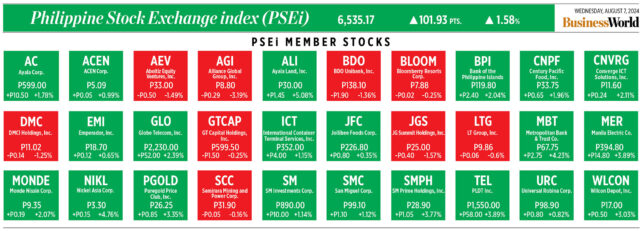
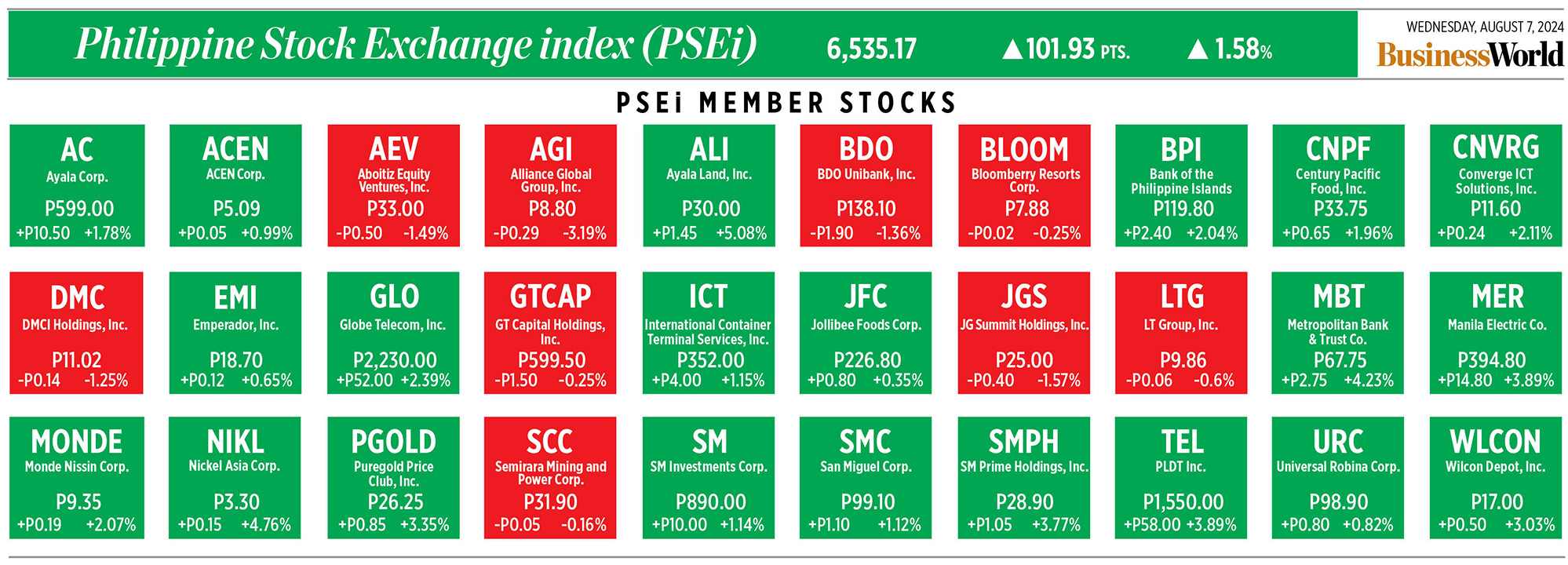
How PSEi member stocks performed — August 7, 2024

Here’s a quick glance at how PSEi stocks fared on Wednesday, August 7, 2024.


Dumaguete airport loan deal signed with Korea Eximbank

DUMAGUETE SIBULA AIRPORT FACEBOOK

THE Department of Finance (DoF) said it signed a P13.15-billion loan agreement with the South Korean government to finance the new Dumaguete airport.

The loan was provided by the Export-Import Bank of Korea (Korea Eximbank), Finance Secretary Ralph G. Recto said at a forum on Wednesday.

In a separate statement, the DoF said the project is expected to boost tourism and trade, as well as enhance the standard of living in Negros Oriental and the surrounding area.

“With the new Dumaguete airport, we anticipate accommodating up to 2.5 million passengers per year, up from just 800,000. From serving limited domestic flights, we can now open the door to international routes,” Mr. Recto was quoted as saying during the loan agreement signing.

The project’s total cost is P17.06 billion, with P3.91 billion to be funded by the government.

It will be built on 197.55 hectares in Bacong, Negros Oriental, the DoF said.

The loan will charge interest of 0.05% for non-consulting services and 0.0% for consulting services, payable over 40 years with a grace period of 10 years.

The government is also looking to upgrade more regional airports to enhance connectivity, Mr. Recto added.

Meanwhile, the government and the Korean Eximbank also signed a $3-billion Economic Development Promotion Facility to support the Philippine infrastructure flagship program.

“This agreement serves as an additional financial bridge that will fill the gaps in realizing our ambitious Build Better More Program,” Mr. Recto said in his speech.

There are currently 185 infrastructure flagship projects in the pipeline valued at P9.14 trillion.

The $3-billion loan has an interest rate of 1.2%, payable over 25 years, with a 7-year grace period.

Projects to receive support from the new facility include the Panay-Guimaras-Negros Island bridges; the Consolacion-Liloan Bypass Road project; the Lapu-Lapu Coastal Road project; and the Pampanga Integrated Disaster Risk Reduction and Climate Change Adaptation Project Phase II.

The financing agreements were signed by Mr. Recto and Korean Eximbank Chairman and President Yoon Hee-sung on Wednesday. — Beatriz Marie D. Cruz

Initial study results of offshore wind ports due by September

UNSPLASH

THE Department of Energy (DoE) said the initial findings of the pre-feasibility study on ports that will be repurposed to service the offshore wind energy industry are expected by the end of next month.

Energy Undersecretary Giovanni Carlo J. Bacordo said recently that findings on five of the 10 ports being considered will be available by that time, while the rest of the findings will be out by November.

The pre-feasibility study is being carried out with technical assistance from the Asian Development Bank (ADB) to determine which ports can service the offshore wind industry’s needs.

The ports for which the early findings are expected are Bulalacao, Oriental Mindoro; Culasi, Capiz; Tabaco, Albay; and Pulupandan and San Carlos, both in Negros Occidental.

Mr. Bacordo said NIRAS, ADB’s consultant, has conducted site visits to these ports, collecting data from local government units and port authorities.

The other ports being studied are the Energy Supply Base port of the Philippine National Oil Co. in Batangas; Bauan International Port, Inc. Batangas; Subic; the Iloilo Commercial Port Complex; and Port Irene, Cagayan.

“These ports will cater to the offshore wind front-runners in the northwest Luzon, west of Manila, north and south Mindoro areas,” Mr. Bacordo said.

He said that “the road to first kilowatt-hour in 2028 is, without a doubt, very challenging” but he added that the DoE aims to support their development by ensuring that the ports are adequately prepared and equipped to handle the specific requirements of the industry.

Mr. Bacordo has said that the funding to make ports ready for the offshore wind industry needs to be budgeted for in the 2025 General Appropriations Act (GAA).

“While the GAA 2025 is being considered as a potential funding mechanism, further evaluation of financial requirements and budgetary allocations will be necessary to solidify project timelines and expenditures,” Mr. Bacordo said.

Offshore wind farms need to be serviced from specialized ports hosting maintenance facilities and equipment.

Mr. Bacordo has said that the DoE is hoping to conduct a Green Energy Auction specific to offshore wind in the first half of 2025.

To date, the DoE has awarded 92 offshore wind energy service contracts to 38 renewable energy developers with a total potential capacity of 66.101 gigawatts (GW).

According to the Philippine Offshore Wind Roadmap, the Philippines has a potential capacity of about 63 GW from tapping offshore wind resources. — Sheldeen Joy Talavera

PhilHealth ‘idle funds’ to support infra — DoF

PNA/JOAN BONDOC

THE Department of Finance (DoF) said P89.9 billion in “idle funds” returned to the Treasury by the Philippine Health Insurance Corp. (PhilHealth) will be used for infrastructure and other social programs.

“That is the farthest from the truth,” Finance Secretary Ralph G. Recto told a forum on Wednesday, referring to allegations that the PhilHealth funds are a form of “pork barrel.”

“Unprogrammed funds are not pork barrel, most of them will be used for foreign assisted projects, international commitments,” he said.

Pork barrel refers to the traditional Congressional practice, since declared illegal by the Supreme Court, of allocating government projects and funding in such a way as to win favor from voters.

The administration has instructed government-owned and -controlled corporations (GOCCs) to remit funds deemed idle to the Treasury, raising fears that the President will have his own war chest to distribute to supporters.

Mr. Recto noted that the unprogrammed funds will help support several foreign-assisted projects including the Bataan-Cavite Interlink Bridge, the Metro Manila Subway, the Panay-Guimaras-Negros Island bridges, the Davao City Bypass, and the Salary Standardization VI for government employees.

The funds will also support the North-South Commuter Railway System, the Philippine National Railways South Long Haul line, and other big-ticket infrastructure works.

It will also help fund the Support to Parcelization of Lands for Individual Titling program and the Philippine Fisheries and Coastal Resiliency project.

Other programs to be funded are the Philippine Multi-Sectoral Nutrition project, Supporting Innovation in the Philippine Technical and Vocational Education and Training System, the Mindanao Inclusive Agriculture Development project, the Philippine Rural Development project, and other development initiatives.

In Circular 003-2024, the DoF asked PhilHealth and the Philippine Deposit Insurance Corp. to remit unutilized funds worth P89.9 billion and P110 billion to the Treasury.

Mr. Recto has said that the fund transfers were legal and conducted after consulting the Governance Commission for GOCCs, Office of the Government Corporate Counsel, and the Commission on Audit.

He also noted that the remitted funds include a portion of the government subsidy to GOCCs and not from PhilHealth members’ contributions.

In a Senate hearing last week, Mr. Recto said projects funded by unprogrammed appropriations will increase gross domestic product growth by 0.7%, provide up to P24.4 billion in additional revenue, and create jobs.

Meanwhile, Mr. Recto said he would prefer better health benefit packages and to reduce PhilHealth members’ out-of-pocket expenses, but said he would leave it to its board to cut premium contributions if deemed necessary.

Republic Act No. 11223 or the Universal Health Care Act authorizes a yearly increase of PhilHealth members’ contributions until 2025. — Beatriz Marie D. Cruz

June manufacturing output growth slows to 2.5% from previous month

PHILIPPINE STAR/KRIZ JOHN ROSALES

FACTORY output growth slowed in June, with the 2.5% increase led by food and fabricated metal products, the Philippine Statistics Authority (PSA) said. 

Output growth weakened from 3.2% growth in May but accelerated from 2.1% a year earlier, according to preliminary results of the PSA’s Monthly Integrated Survey of Selected Industries.

Factory output is measured by the volume of production index (VoPI).

Month on month, the manufacturing sector’s VoPI contracted 3.9% in June after posting 0.8% growth in May. Stripping out seasonal factors, factory output that month declined 1.3%.

In the year to date, factory output growth averaged 1.3%, slowing from 5.61% a year earlier.

The S&P Global Philippines Manufacturing Purchasing Managers’ Index (PMI) eased to 51.3 in June from 51.9 in May, pointing to further slowdowns going forward.

PMIs are a leading indicator for factory activity, reflecting the volume of materials purchased in advance of manufacturing operations weeks or months down the line. A reading above 50 marks increased purchasing activity for materials that will later be transformed into goods, while a reading below 50 means reduced purchasing.

Growth in the VoPI was led by food products (8.8% in June from -0.9% in May) and fabricated metal products, except machinery and equipment (19.6% from -8.8%).

However, slower growth in three categories impacted overall output: basic metals (-17.7% from -2.8% in May), transport equipment (-8.8% in June from -1.2% in May), and coke and refined petroleum products (46% in June from 52.7% in May).

Average capacity utilization stood at 75.3% in June, against the 73.3% posted a year earlier and 75.6% in May.

All industry categories reported average capacity utilization rates exceeding 60% for the month, with paper and paper products recording the weakest capacity utilization of 61.9%.

Leonardo A. Lanzona, who teaches economics at the Ateneo De Manila, said the lack of investment to support the manufacturing sector may have been behind the slowdown.

“During the time when the economy was still on an upward trajectory, there was no strategy to rescue the sector which had not received substantial investment. The government should have (undertaken) the necessary steps to lower cost of production, especially in energy. Instead, they had been pushing for more infrastructure that apparently had no effect on manufacturing,” he said via Messenger. — Beatriz Marie D. Cruz

Batangas municipalities to get ASF vaccine faster if emergency declared

REUTERS

THE Department of Agriculture (DA) said on Wednesday that Batangas municipalities may need to declare an emergency to facilitate the release of funds to obtain African Swine Fever (ASF) vaccines.

“Local government units may need to declare a state of emergency to enable the DA to respond swiftly to the situation and release funds for the urgent purchase of vaccines,” Agriculture Secretary Francisco P. Tiu Laurel, Jr. said in a statement.

The DA noted that active ASF cases have been recorded in Lobo, Lian, Rosario, Calatagan, and Lipa City, Batangas.

Constance J. Palabrica, assistant secretary for Poultry and Swine, said that the DA estimates the need for vaccines at about 10,000 doses.

The DA’s Bids and Awards Committee and Bureau of Animal Industry will draft the resolution which will set in motion the emergency procurement process, shortening the regular procurement period to around two weeks.

The DA is currently collaborating with local officials in enforcing movement restrictions to prevent the spread of infected animals.

The DA has said that it is planning a limited rollout of the AVAC ASF Live Vaccine from Vietnam by the third quarter.

It has allocated P350 million for the trial, funding about 600,000 vials. — Adrian H. Halili

Gen Z now seen as heavily favoring online shopping

PHILIPPINE STAR/ WALTER BOLLOZOS

ONLINE RETAILERS will need to rethink how they advertise to Gen Z consumers, who are emerging as their most enthusiastic users, according to the results of a study.

In a joint study, The Fourth Wall and Uniquecorn Strategies concluded that Gen Zs (born between 1997 and 2012) are now solidly in favor of online shopping.

“Almost all the respondents (92%) use their own mobile phones for purchases and prefer cashless methods (53%),” they said.

The study, which surveyed 400 people, found that three out of four Filipino Gen Z consumers in urban areas shop online because they believe they deserve it, which the study referred to as the “Deserve ko ’to” mentality.

“The young generation is rapidly becoming a significant portion of the consumer market and is already shaping market trends, especially in the e-commerce space,” according to John Brylle L. Bae, research director at The Fourth Wall.

“This self-rewarding behavior among Filipino Gen Zs stems from their growing self-awareness, driving them to seek rewards that affirm that sense of self-worth,” he added. 

The Philippine Statistics Authority (PSA) estimates that Gen Zs account for 38% of the population, or 41 million.

Uniquecorn Strategies founder and CEO Dean Bernales said that it is important for retailers to “pay close attention to the shopping desires and needs of Filipino Gen Zs.” 

“Brands need to reassess their supply chain strategies and enhance their social commerce platforms to build trust, create personal connections, and develop a relatable image to capture the young market,” he added.

According to the study, brands face challenges in establishing trust due to the prevalence of scams and paid endorsements, in establishing personal affinity, and in creating an immersive customer experience.

The study concluded that brands must develop tailor-fit marketing strategies.

The study said partnering with podcast creators may help boost brand awareness and conversion, describing podcasting as an emerging medium for sharing more “personal yet credible brand reviews.”

It added that brands could also encourage thorough and well-crafted reviews left by customers to build trust and drive conversion.

The study said that brands need to focus on the Gen Zs’ entrepreneurial mindset, “Deserve ko ’to” mentality, and emotions.

“Emphasize how your products can support Gen Zs in their side hustles or hobbies, which some also turn into their side businesses,” according to the study.

“For local brands, highlight the process or journey of how the products were sourced, crafted, and transported to reach consumers,” it added. — Justine Irish D. Tabile

House think tank says 2024 revenue target within reach

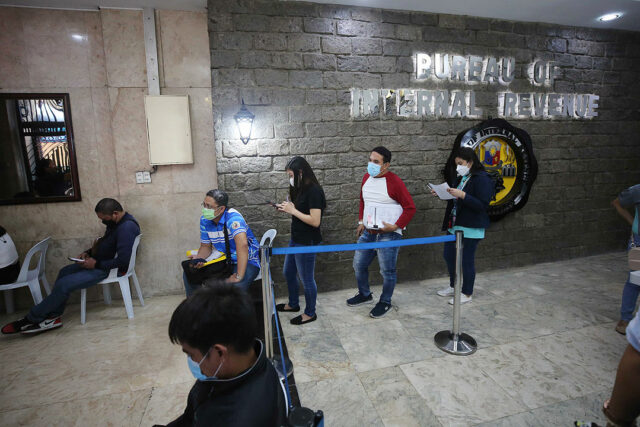
People line up to file their income tax returns at the Bureau of Internal Revenue office in Intramuros, Manila, April 18, 2022. — PHILIPPINE STAR/ RUSSELL A. PALMA

THE National Government is on track to achieve its revenue target of P4.27 trillion, judging from the pace set by first-half collections, a Congressional think tank said.

The Congressional Policy and Budget Research Department (CPBRD) noted, however, that first-half revenue was driven by non-tax collections, casting doubt on the sustainability of recurring tax collections.

“The revenue performance for January-June 2024 suggests that the government is on track to meet its full-year revenue target,” the CPBRD said in a report.

“The first half performance, however, shows a notable divergence between tax and non-tax collections when compared to programmed targets,” it added.

Total government revenue for the first half of 2024 amounted to P2.15 trillion, according to Finance Secretary Ralph G. Recto’s Monday presentation to the House of Representatives appropriations panel.

Of the first-half collections, P1.83 trillion came from tax revenue, up 10.8% from a year earlier. The total missed by 2.8% the first-half revenue target.

“Tax revenue underperformed, with the actual collection of P1.83 trillion falling short of the P1.86 trillion goal. This shortfall was primarily due to (the performance of) BIR collections (P1.36 trillion as against P1.40-trillion target),” the CPBRD said.

The Bureau of Customs, whose collections are also classified as tax revenue, exceeded its first-half target with P455.5 billion collected in the first half, beating its target by 3%.

Non-tax revenue generated P314.2 billion during the same period, 46% higher than target. The surge in non-tax collections is due to higher collections by the Bureau of the Treasury (BTr) and other revenue streams, the CPBRD said.

The BTr said income rose 76% to P163.9 billion in the first half of 2023.

“Bureau of the Treasury income…  is P71 billion higher compared to the same period in 2023; and other non-tax revenues… doubled from P62.1 billion to P121.1 billion in the same period,” the CPBRD said.

The CPBRD noted that the BTr took in more dividends from government-owned and -controlled corporations (GOCCs), after the Department of Finance ordered an increase in GOCC dividend payouts to the government to 75% from 50%.

The remittance of unutilized funds from GOCCs also boosted the BTr’s holdings, it added.

In May, the Philippine Health Insurance Corp. and Philippine Deposit Insurance Corp. remitted P20 billion and P30 billion respectively to the BTr.

“The government’s fiscal strategy to optimize existing financial resources through the mobilization of non-tax revenue represents a pragmatic approach to fiscal management and aligns with its commitment to increase funding for priority programs without enacting new taxes or resorting to additional borrowing,” it said.

While unutilized funds from GOCCs could be a potential source of funding for the government, it should address potential tax collection issues, the CPBRD said. “Sustained revenue growth is largely contingent on brisk growth in tax revenue.”

The CPBRD report was prepared by Novel V. Bangsal, David Joseph Emmanuel Barua Yap, Jr., Jhoanne E. Aquino, Rutcher M. Lacaza, Edrei Y. Udaundo, Pamela Diaz-Manalo, Julius I. Dumangas, Ricardo P. Mira, Arlene L. Tuazon, Lawrence B. Dacuycuy, Byron M. Bicenio, Christine Marie A. Mendoza-Walog, Noel Belarmino H. Sempio, Ray Leonard D. Denolo, Alexiz S. Taaca, and Romulo E.M. Miral, Jr. — Kenneth Christiane L. Basilio

Sugar industry wants other sweeteners to be regulated

REUTERS

SUGAR PRODUCERS said on Wednesday that the Department of Agriculture (DA) needs to regulate imports of other sweeteners that compete with cane sugar.

In a statement, the United Sugar Producers Federation of the Philippines (UNIFED) said the entry of glucose, sucrose, maltose, dextrose, maltodextrin and lactose is currently unregulated.

UNIFED added that the volume of other sweeteners being shipped amounts to 100,000 to 200,000 metric tons per year.

“This volume of sugar premixes (is equivalent to) about 4 million bags of sugar (valued at) roughly P10 billion, and the continued lack of regulation for these sugar-based products is highly detrimental to the sugar industry,” UNIFED President Manuel R. Lamata said.

Mr. Lamata added that the increased shipments of these products may have caused the stagnation in sugar prices.

“This is probably why demand for sugar has remained constant in the last 10 years or so despite the growth of the population,” he said.

Agriculture Secretary Francisco P. Tiu Laurel, Jr. has ordered an investigation after meeting with the sugar industry.

He ordered the Sugar Regulatory Administration to look into the actual volumes of other sweeteners and, if warranted, require them to acquire clearances as well.

“If this is not addressed, then the sugar industry will be paying a hefty price along with the five million Filipinos dependent on the industry,” Mr. Lamata said.

Code 17.02 of the Asean Harmonized Tariff Nomenclature sets tariffs only for high fructose corn syrup. — Adrian H. Halili

Navigating VAT recovery under the EoPT Act

In an effort to make doing business easier, the government introduced significant changes to the Value-Added Tax (VAT) provisions through Republic Act (RA) No. 11976, known as the Ease of Paying Taxes (EoPT) Act. In today’s article, I would like to focus on the revisions to the VAT refund process and the VAT credit for uncollected receivables, examining their implications for businesses.

RISK-BASED VAT REFUND PROCESS
The EoPT Act introduces a risk-based approach to the verification and processing of VAT refund claims. These changes are poised to have a substantial impact on the way businesses manage their VAT refund claims, and promote a more streamlined and taxpayer-friendly approach.

Under the EoPT Act, VAT refund claims are categorized into low, medium, and high risk. This new framework aims to streamline the verification process, with medium- and high-risk claims subjected to more rigorous audits. Furthermore, the Commissioner now has the authority to issue refunds without requiring a countersignature from the Commission on Audit (CoA). However, these refunds will be subject to post-audit by CoA. Any amounts disallowed by the CoA will be the taxpayer’s responsibility, and BIR employees may face administrative liability for gross negligence in the refund process.

Revenue Regulations (RR) No. 5-2024 elaborates on the risk-based framework introduced by the EoPT Act. Complementing this, the BIR issued Revenue Memorandum Order (RMO) No. 23-2024, which provides comprehensive guidelines, policies, and procedures for verifying VAT refund claims.

RR No. 5-2024 defines the three risk levels. Low-risk claims are where all required documentation is complete, and will be processed without the need for further verification of sales or purchases, minimizing the administrative burden for these claims. Medium-risk claims require verification of at least 50% of both sales transactions and purchases, including supporting documents such as invoices and proof of VAT zero-rating. High-risk claims are subject to a comprehensive verification of 100% of sales and purchases, reflecting the higher risk associated with these claims and ensuring thorough examination.

The risk classification process considers factors such as the size of the claim, frequency of filing, and tax compliance history. Specific conditions are imposed to maintain the integrity of the verification process. Claims from first-time applicants are automatically deemed high risk and continue to be classified as such for their subsequent three claims. If a claim is fully denied, the following claim will also be categorized as high risk. Medium-risk claims can be escalated to high-risk status if a Revenue Officer has a 30% disallowance rate on the VAT refund claim. Claims that have been classified as low risk for three consecutive filings will undergo full verification on the fourth filing, regardless of the current risk classification. Claims related to VAT credits or refunds from canceled registrations or status changes are also classified as high risk. Risk classifications are reviewed for each filing, and the Commissioner of Internal Revenue may impose additional limitations through further issuances.

The verification and processing of VAT refund claims are distinct from regular audits of internal revenue taxes. Findings that do not affect the refund amount may be forwarded for further review or incorporated into existing audits based on whether the processing and auditing offices are the same. All required documentation must be submitted by taxpayers, regardless of the risk level, and will be subject to post-audit by CoA. The BIR may also utilize data from the Electronic Invoicing/Receipting and Sales Transmission System (EIS) to aid in the verification process.

Verification procedures for low- and medium-risk claims focus on the completeness and authenticity of documentation, while high-risk claims undergo thorough verification. This structured approach allows for necessary adjustments based on findings, to help ensure well-documented and justified risk assessments.

Ultimately, however, the success of a VAT refund claim hinges on the documentation of the input VAT credits. Since the same documents are required for all VAT refunds, regardless of the risk level classification, it seems prudent for taxpayers to prepare their refund claims assuming a high-risk review, ensuring complete compliance, to increase the likelihood of a favorable outcome in their VAT refund claims.

VAT CREDITS FOR UNCOLLECTED RECEIVABLES
The EoPT Act also introduced the use of output VAT credits for uncollected receivables in the subsequent quarter after they become overdue. This measure benefits taxpayers who have reported receivables for VAT purposes in a prior quarter but have yet to collect them. For example, if output VAT is paid on a sale made in Q2 2024, but the receivable on the sale remains uncollected by Q3 2024, the seller may deduct the VAT previously paid from the Q3 2024 output VAT due.

Under Revenue Memorandum Circular (RMC) No. 65-2024, the following conditions must be met to qualify for the VAT credit:

1. The sale or exchange occurred after April 27, 2024.

2. The sale was on credit or account.

3. There must be a written agreement specifying the payment period, such as a credit term indicated in the invoice or another document. Loan Agreements are considered sufficient if they state the credit terms.

4. The VAT should be separately itemized on the invoice.

5. The sale must be specifically reported by the seller in the Summary List of Sales for the period when the sale occurred, and not included under “various” sales.

6. The seller must have declared the corresponding output VAT in the quarterly VAT return (BIR Form No. 2550Q) within the prescribed period.

7. The agreed payment period between the seller and the buyer, whether extended or not, must have lapsed.

8. The VAT component of the uncollected receivable must not have been claimed as a deduction from gross income (i.e., bad debt) under Section 34(E) of the Tax Code.

If the uncollected receivables are later recovered, the related output VAT must be included in the taxpayer’s output VAT for the recovery period. Failure to declare this will result in penalties.

Therefore, it is crucial to track uncollected receivables to determine if VAT can be carried over or if VAT should be paid for amounts previously used as credit upon recovery. Under RMC No. 65-2024, claiming output VAT credit is optional; sellers may choose not to claim it if the receivables are likely to be collected.

These amendments are a significant shift in the VAT recovery process. While these changes aim to streamline compliance and enhance efficiency, taxpayers are likely to face difficulties navigating the new requirements, especially the application of output VAT credits on uncollected receivables. The handling of receivables that are eventually collected but were previously deducted could also pose issues, as the VAT deducted would eventually need to be remitted again upon collection. The subsequent monitoring of VAT credits creates a particularly onerous challenge to taxpayers.

The authorities could consider addressing the administrative burden associated with the uncollected receivables. Perhaps establishing clear guidelines and thresholds for when receivables are considered “uncollectible” can also reduce ambiguity. Simplifying this aspect would align with the EoPT Act’s objective of easing compliance and reducing administrative burdens for businesses.

In summary, the changes brought by the EoPT Act constitute a significant advancement in regulatory reform. However, their implementation is not without difficulties. Certain provisions may require additional refinement to effectively achieve its objectives. Addressing these birth pains is essential for the Act’s successful execution.

The views or opinions expressed in this article are solely those of the author and do not necessarily represent those of Isla Lipana & Co. The content is for general information purposes only, and should not be used as a substitute for specific advice.


Aubrey Gayle T. Diaz is an assistant manager at the Tax department of Isla Lipana & Co., a Philippine member firm of the PwC network.

aubrey.gayle.diaz@pwc.com