Home Blog Page 2838

Concern over Senate’s CREATE MORE

PEXELS-PATRICK VOGT

CREATE MORE, for being more, should turn out better than CREATE. But in a BusinessWorld column published in November 2023, we expressed fear that “CREATE MORE will mean creating more troubles.”

CREATE MORE stands for “CREATE to Maximize Opportunities for Reinvigorating the Economy.” It is essentially about overhauling the governance of fiscal incentives and providing more incentives or enhanced incentives.

CREATE MORE amends the CREATE (Corporate Recovery and Tax Incentives for Enterprises) Act which was passed in 2021. In truth, as we shall discuss, CREATE MORE is not building on CREATE but is undermining it.

CREATE is a landmark piece of legislation; its defining feature, apart from the reduction of corporate income tax, is the rationalization of fiscal incentives. CREATE has made fiscal incentives transparent, performance-based, and time-bound. Moreover, it has established sound economic governance in two ways. First, it subjects the application for fiscal incentives to rigorous economic analysis. Second, it narrows the scope of incentives to firms that qualify for inclusion in the Strategic Investment Priority Plan (SIPP).

This was a reform long overdue. Several administrations had difficulty passing such a transformative reform because of the stiff resistance from mighty vested interests. Now that it has passed, CREATE is expected to deliver strategic gains for investments, jobs, and growth. But still in an early stage of implementation, CREATE is already being threatened.

CREATE MORE would have been welcome if it only sought to amend what Senator Win Gatchalian termed “murky provisions” and clarify conflicting interpretations of its Implementing Rules and Regulations (IRR). To illustrate, an acceptable amendment would have been to do away with the complications of the VAT refund system resulting in long delays. But the amendments found in CREATE MORE strike at the very heart of sound fiscal and economic governance.

The column on CREATE creating more troubles was published on Nov. 13, 2023, at the time that the House of Representatives was deliberating on the bill titled CREATE MORE. The House subsequently passed a harmful bill in March 2024. The Senate is now deliberating on Senate Bill 2762, which has its share of questionable features.

Here, we reiterate and sharpen our arguments why we strongly oppose the most pernicious amendments to CREATE.

We put fiscal incentives in their proper place in the broader setting of economic strategy and policy. The evidence —global and national, theoretical and empirical, shows that fiscal incentives are not the main determinant of job-creating investments. Due to space constraints, we cite three of the most relevant sources.

First is a paper written as far back as 2001 by tax experts from the International Monetary Fund. We quote Vito Tanzi and Howell Zee, from their paper “Tax Policy for Developing Countries.”

“While granting tax incentives to promote investment is common in countries around the world, evidence suggests that their effectiveness in attracting incremental investments — above and beyond the level that would have been reached had no incentives been granted — is often questionable. As tax incentives can be abused by existing enterprises disguised as new ones through nominal reorganization, their revenue costs can be high. Moreover, foreign investors, the primary target of most tax incentives, base their decision to enter a country on a whole host of factors (such as natural resources, political stability, transparent regulatory systems, infrastructure, a skilled workforce), of which tax incentives are frequently far from being the most important one.”

The second paper is a recent publication from the Asian Development Bank, authored by Janet Stotsky titled “Tax Incentives and Investment” (2024). Stotsky laid out the “key policy implications” on the basis of evidence on the effectiveness of fiscal incentives:

“These key implications are that tax incentives should be used sparingly and should focus on encouraging activities that have clear social benefits, including research and development.”

The third document is a chapter from the book Taxation, International Cooperation and the 2030 Sustainable Development Agenda, edited by Irma Johanna Mosquera Valderrama, Dries Lesage, and Wouter Lips. Chapter 7 is titled “Tax Incentives in Developing Countries: A Case Study— Singapore and the Philippines.” The co-authors, Irma Mosquera Valderrama and Mirka Balharová, show that Singapore’s fiscal incentives “complemented its already attractive investment environment instead.” That’s what matters — having a favorable overall investment climate — for example: policy predictability, sound macroeconomic management, rule of law, infrastructure, and a skilled and educated labor force.

CREATE is responsive to the framework and approach cited in the literature above. But CREATE MORE undermines the fundamental principles governing fiscal incentives.

CREATE MORE dilutes the powers of the Fiscal Incentives Review Board (FIRB), the central governing body for fiscal incentives. In turn, CREATE MORE expands the powers of the investment promotion agencies (IPAs) and even expands their number.

In CREATE, the FIRB coordinated with the Board of Investments to formulate the Strategic Investment Priority Plan (SIPP), held the power to cancel, suspend, and withdraw fiscal incentives, and audited the compliance of IPAs. In CREATE MORE, the FIRB can no longer formulate and approve place-specific SIPPs but can only formulate additional time-bound or place-specific projects for inclusion in the SIPP; can only monitor the cancellation, suspension, or withdrawal of fiscal incentives (the power to do so has been transferred to the IPAs); and has been stripped of its audit functions.

Further, CREATE MORE expands the discretionary power of the President to give fiscal and nonfiscal incentives to enterprises, even without an FIRB recommendation. It delegates the process of accepting, processing and granting business permits to firms to IPAs, which may present a conflict of interest, given that IPAs are primarily for-profit bodies. CREATE MORE thus fragments the governance of fiscal incentives and gives IPAs undue authority and jurisdiction over investments in the country.

Further, CREATE MORE expands the Strategic Investment Priority Plan (SIPP) established in CREATE by allowing individuals IPAs to create a local SIPP. The SIPP in CREATE (which will now be called the national SIPP), formulated by the Board of Investments, identifies the industries critical to the country’s economic development and is published every three years.

Senator Pia Cayetano, former chair of the Ways and Means Committee and sponsor of CREATE in the Senate, noted in her interpellation on Aug. 5 that the intention of the SIPP was to streamline processes for locators and that the creation of a local SIPP could possibly complicate the incentive availment process for locators.

CREATE MORE’s Senate sponsor, Senator Sherwin Gatchalian, said that the local SIPP was created to consider IPAs with unique geographical locations and unique offerings, noting those in the Eastern Seaboard like the Aurora Pacific Economic Zone and Freeport (APECO), which offer agriculture, cold storage, and fisheries businesses.

But priorities, by definition, should be narrow, targeted, and disciplined. The creation of a local SIPP through CREATE MORE makes the SIPP sweeping, rambling, inconsistent, and incoherent.

CREATE MORE unnecessarily expands fiscal incentives. It expands the allowable deductions under the enhanced deductions regime (EDR) and lengthens the sunset period for the EDR or Special Corporate Income Tax (SCIT) regimes, extending up to 27 years, fueling concerns raised by our economic managers during the deliberations on the House version of CREATE MORE that it be a revenue-eroding measure.

All of the above paves the way for abuse, corruption, and favoritism.

The push for CREATE MORE also comes at a time that the Philippine fiscal situation is fragile. Finance Secretary Ralph Recto argued in a Senate Health Committee hearing on July 30 that the Department of Finance (DoF) has a “herculean task of funding our gargantuan budget” worth P5.77 trillion. In the process of scouting for resources, the DoF has even targeted P89.9 billion worth of premium contributions of indirect contributors from the Philippine Health Insurance Corp. or PhilHealth and ordered that these funds be returned to the National Treasury, for both health and non-health projects.

This begs the question: if fiscal space is so tight, why are our legislators eroding revenues further by handing out more incentives? Loosening the discipline in governing fiscal incentives and allowing expanded incentives through CREATE MORE will only worsen the binding fiscal constraint.

The huge forgone revenues will impair the expenditure plan for human development, transition to green energy, infrastructure, etc.

Finally, CREATE MORE is not responsive to the new challenges that new industrial policy wants to address. Like it or not, the jobs being generated in the Philippines are in the small- and medium-scale enterprises (SMEs). The jobs are mainly in the service sector, particularly in the informal service sector. This sector should be the focus of policy. The goal is to create good jobs, productive jobs, quality jobs in the service sector and in SMEs.

CREATE MORE, however, caters to the already entrenched and entitled big businesses.

We urge our Senators to protect the essential reforms within CREATE and reject the CREATE MORE amendments which can enable arbitrariness, redundancy, and abuse within our fiscal incentive regime. Further, PREVENTING the erosion of government revenues is the best option to put us on track to hit our fiscal targets without taking funds from crucial social programs.


Pia Rodrigo is strategic communications officer while Filomeno S. Sta. Ana III coordinates the Action for Economic Reforms.

www.aer.ph

Vaccine alone not seen sufficient to contain Batangas ASF outbreak

REUTERS

HOG FARMERS said animal movement restrictions will be key to containing the African Swine Fever (ASF) outbreak in Batangas.

“Stopping the spread of the virus to other parts of Batangas may not (solved by) vaccine alone; we must have the resolve to strictly monitor the movement of animals,” National Federation of Hog Farmers, Inc. Vice-Chairman Alfred Ng told BusinessWorld.

Last week, the Department of Agriculture (DA) said that it was preparing to conduct emergency procurement of 10,000 doses of the ASF vaccine to curb the spread of the disease.

The DA added that the new ASF outbreak has led several towns in Batangas to declare a state of calamity to facilitate access to emergency funds.

Mr. Ng added that the current outbreak in the area may have been caused by non-compliance with biosecurity protocols.

He added that rains could have infected water sources and eased the spread of the disease.

The DA has said that it is planning a limited rollout of the AVAC ASF Live Vaccine from Vietnam by the third quarter.

As of Aug. 8, 62 municipalities across 22 provinces had active ASF cases, according to the Bureau of Animal Industry (BAI).

The first cases of ASF in the Philippines was detected in 2019.

The DA said that it will set up livestock checkpoints across Luzon in response to the rapid spread of ASF cases in Batangas.

It suspected the practice of selling diseased pigs to have worsened the spread of ASF.

“We have set up additional livestock quarantines and will keep it there at least until Dec. 31… Policemen along with BAI and other DA personnel will man the checkpoints,” Constance J. Palabrica, assistant secretary for Poultry and Swine, said in a statement over the weekend.

“We have the funds to procure the vaccines and the emergency funds to indemnify hog raisers adversely affected by the resurgence of the ASF virus,” Agriculture Secretary Francisco P. Tiu Laurel, Jr. said.

The DA has allocated P350 million for the trial, sufficient to fund about 600,000 vials. Vaccination will initially be concentrated in red zones or those areas with active ASF cases and pink zones, or areas adjacent to zones with infections.

Hog production slipped 0.2% to 422,060 metric tons during the second quarter, according to the Philippine Statistics Authority. — Adrian H. Halili

Metrobank bullish on earnings after record first half

BW FILE PHOTO

METROPOLITAN Bank & Trust Co. (Metrobank) is bullish on its earnings for this year after it booked a record net income in the first half and amid a robust economy, an official said.

“We just did our results and it’s a record result for our first half… We’re very optimistic for the rest of the year,” Metrobank Senior Vice-President and Chief Marketing Officer Hierbert “Digs” A. Dimagiba told reporters on the sidelines of an event on Friday.

“Look at our first half and look at how the economy is going… If the economy continues to thrive, businesses continue to thrive. It’s going to be great, not just for Metrobank, but I think for the whole country,” Mr. Dimagiba said.

Metrobank saw its net income rise by 11.44% in the second quarter as it booked higher net interest earnings amid an expanded loan book and elevated rates, it reported earlier this month.

The lender’s attributable net income stood at P11.61 billion in the April-to-June period, up from P10.42 billion in the same period last year, according to its financial statement disclosed to the stock exchange on Thursday.

This brought Metrobank’s net profit for the first semester to a record P23.61 billion, rising by 12.95% year on year from P20.898 billion, driven by “robust asset expansion, stable margins, well-managed cost growth and healthy asset quality,” it said.

Mr. Dimagiba said Metrobank has a strong balance sheet, which will allow it to withstand potential market volatility in the coming months. Its consolidated assets expanded by 14.5% year on year to P3.3 trillion at end-June.

“I think as with all of the financial institutions, there are plans in place whether rates go up or down. We’re resilient. Our plans are ready,” he added.

The Bangko Sentral ng Pilipinas (BSP) is widely expected to cut rates by a total of 50 basis points (bps) this year, with the first 25-bp reduction potentially happening as early as this week.

The BSP has kept its policy rate at an over 17-year high of 6.5% since October 2023 following cumulative hikes worth 450 bps.

Meanwhile, the US Federal Reserve is likewise expected to begin its monetary easing cycle by September, with markets seeing more than 50 bps in cuts following recent data pointing at a potential slowdown in the world’s largest economy.

The Fed has kept its benchmark overnight interest rate at the current 5.25%-5.5% range since July 2023 after increases worth 525 bps.

CONSUMER LOANS
Meanwhile, Metrobank Senior Vice-President and Consumer Lending Group Head Anna Therese Rita “Peaches” D. Cuenco said the bank wants to increase the share of consumer credit in its loan portfolio and is working towards doubling the current level within the next few years.

“This whole sector is actually a priority of the bank… We are really investing in a lot of promotions, campaigns, resources into growing this business. We are confident that in a couple of years, we will see a significant increase in our growth rates,” Ms. Cuenco said on the sidelines of the same event.

The bank’s consumer loan portfolio grew by 13.7% year on year in the first half.

“Of course our commercial loans will always be strong because the core DNA of Metrobank is still commercial banking. That’s why we want to be also known for consumer loans… We are confident that as a whole, on an institutional level, things will be looking good for all of us,” she added.

Metrobank said in a separate statement that it expects to sustain the growth in its auto and home loan portfolios, driven by consumer demand and new offers.

“We see an overall positive growth trajectory for our auto and home loan businesses as we expect more bookings towards the end of the year given expectations of lower rates in the second half as well as through our offers like the Happy Holideals loan promo,” Ms. Cuenco said. “We’ve started to see a shift in the profile of both our auto and home loan customers. They are a bit younger now, still mostly married, but the single demographic has been increasing as well.”

“Consumer is a priority growth area of the bank and car and home loans play a very big part in that. Our plan is to cater to more customers, open new channels, and constantly upgrade our levels of service,” she added.

As part of its Happy Holideals offers, from Aug. 1 to Oct. 31, Metrobank is waiving fees for car loans for up to P100,000, covering chattel mortgage registration fee, documentary stamp tax (DST), and notarial fee and with an interest rate of 8.7% per annum for a 36-month term.

Once the loan is approved, borrowers will be pre-qualified for a Metrobank Toyota Mastercard.

The bank is also waiving fees for home loans up to P100,000 covering mortgage registration fees, DST, and notarial fees with an interest rate of as low as 6.75% per annum for a five-year fixed term and a pre-qualification for a Metrobank credit card.

“Qualified car and home loan applications must also be approved and subsequently booked on or before Dec. 27, 2024 to enjoy the Happy Holideals offers,” the bank said. — A.M.C. Sy

Manila Water president targets to broaden company’s service reach

JOSE VICTOR EMMANUEL A. DE DIOS

By Sheldeen Joy Talavera Reporter

JOSE Victor Emmanuel “Jocot” A. de Dios, president and chief executive officer of water utility Manila Water Co., Inc., said he hopes to expand and replicate the company’s service model beyond its east zone concession.

“I think it’s our collective mission in the company to bring it out to areas where [there are] less privileged or really just victims of the very complex regulatory environment that we have, [who] do not enjoy the same level of service,” Mr. De Dios said in an interview with BusinessWorld.

“That means you have to expand, you have to grow your business outside the East Zone with the intent of replicating what you do in the East Zone in the Non-East Zone,” he added.

Manila Water provides water supply, wastewater, and sanitation services to over 7.3 million customers in 23 cities and municipalities of the east zone of Metro Manila and Rizal province.

The company has holding companies for its domestic operating subsidiaries and international ventures that cater to the consumers outside the concession.

In 1997, Manila Water and the Metropolitan Waterworks and Sewerage System entered into a concession agreement to hold the right to provide water and wastewater services to the eastern side of Metro Manila for 25 years. Set to expire in 2022, this was extended until 2037.

Republic Act No. 11601 granted Manila Water a 25-year legislative franchise to establish, operate, and maintain a waterworks system and sewerage and sanitation services in the east zone and the province of Rizal and confirms its status as a public utility.

PROFESSIONAL JOURNEY
Prior to becoming the president of Manila Water in 2021, Mr. De Dios was the chief executive officer of Prime Metro BMD Corp. (Prime BMD), a subsidiary of Razon-led Prime Infrastructure Holdings, Inc.

Mr. De Dios was also the country manager and chief executive officer of multinational company General Electric Philippines from 2012 to 2020. He also worked for publicly listed Australian firm Nido Petroleum Ltd. and the government as undersecretary of the Department of Energy and chairman of the Philippines National Oil Co. – Exploration Corp.

He started his professional career in 1990 as a lawyer.

Having expertise in energy, infrastructure, and legal, he might seem new to the water sector but his experiences molded him for the new environment.

“It’s a new sector, but I take the view that even if it’s a new sector, as long as you build muscle memory in other sectors, it’s just a difference in currency… The principles should remain the same,” he said.

Mr. De Dios said that the water sector may seem simple, but it is really “a complex sector.”

Unlike in the power sector where energy facilities can be built along the coastline and as long as there is a transmission backbone, building water infrastructure depends on the water source.

“You can’t find water just anywhere, so it entails a lot of cost, which is a challenge,” he said.

Despite the challenges, the company executive is optimistic about the development of the water sector in the Philippines.

“Whether it’s half full or half empty, you can always put water in the glass. It’s quite positive. I think we’re in the right direction,” Mr. De Dios said.

“Obviously, there are still things to be done and we stand ready. We stand very willing to give our thoughts to our stakeholders, to our regulators,” he said.

PLANS FOR MANILA WATER
With Manila Water seeking the extension of its revised concession agreement with Metropolitan Waterworks and Sewerage System until 2037, the company has targeted to invest P1.15 trillion over the extension period to ensure the continuous provision of water and wastewater services to its customers.

“You look around the world, whether you’re talking about developing countries or first-world countries, you will always have issues. Water is not free. Sewage is not free,” Mr. De Dios said.

“[You] just don’t dump your waste into the rivers, into the bays that will pollute your environment and kill your marine life. It is not free and you have to make sure that you’re responsible in doing this. It’s easier said than done, but that’s the mission,” he said.

As of the first half of the year, the company’s capital expenditure reached P10.1 billion, with the east zone concession accounting for 92% of the total with its P9.3-billion accomplishment.

Among Manila Water’s major projects is the P7.84-billion East Bay Phase 2 water treatment plant at Laguna Lake, which is designed to provide 200,000 cubic meters of water per day.

The project is expected to deliver potable water to an estimated population of two million by the first few months of 2025. It is in partnership with Spanish infrastructure firm Acciona, PrimeBMD, and Santa Clara International.

“We are a public utility, pretty much in the private sector, so [we] make sure we continue to do what we do best. That’s a given and that you cannot compromise,” Mr. De Dios said.

“There has to be a very brutal determination to provide the best service possible, best water supply possible to [our] customers in the East Zone and outside,” he said.

Style (08/12/24)


Shangri-La Plaza Mall has Olympics fever

SHANGRI-LA Plaza celebrates every Filipino athlete at the Olympics with a special showcase of Team Philippines’ Sinag Barong by designer Francis Libiran at the mall’s East Wing. Worn by Filipino Olympians at the Opening Ceremony, the barong features details celebrating the Philippines’ cultural heritage. Constructed using piña-jusi fabric, each outfit has a detachable silk organdy sling adorned with embroidered sun rays and patterns inspired by the Pintados, the pre-colonial tattooed warriors. The sling is also purposely placed near the wearer’s heart. The Sinag Barong is on view in an exhibit by event stylist Dave Sandoval. This display showcases the details and craftsmanship of Mr. Libiran’s design alongside an immersive visual experience celebrating the Philippine heritage. Meanwhile, the opening ceremony outfit is now available for pre-order at Shangri-La Plaza’s Francis Libiran branch. Apart from Mr. Libiran, Adidas Philippines also teamed up with the Philippine Olympic Committee to deck out Filipino athletes with sporty casual Village and Podium looks for 16 officially sponsored teams. The apparel, modeled by the likes of Mr. Yulo and Ms. Petecio, features bold fonts with striking line patterns and vibrant colors to capture the spirit and strength of Filipino sportsmanship. Shang has the exact Adidas Ultraboost 5 sneakers Mr. Yulo wore as he stood on the podium with his gold medals while singing the National Anthem. Pop over to Adidas at Shang to grab a pair (and a piece of Philippine sports history). Follow Shangri-La Plaza on Facebook at www.facebook.com/shangrilaplazaofficial and on Instagram @shangrilaplazaofficial.


Ever Bilena rewards Olympics winners

Winning Filipino Olympians will receive support from the direct selling arm of local cosmetics company, Ever Bilena Cosmetics, Inc. Double Olympic Gold Medalist Carlos Yulo will be receiving P1 million worth of Ever Bilena Direct Sales business packages for his triumph in men’s gymnastics at the Paris 2024 Olympics. Fellow athletes, boxers Nesthy Petecio and Aira Villegas, will receive P250,000 worth of business packages each for winning bronze in their respective weight categories, according to a Facebook post of Ever Bilena Direct Sales. Ever Bilena has a history of supporting Philippine sports, with a roster of athletes including pole-vaulter Ernest “EJ” Obiena, professional boxer Carl Jammes Martin, swimmer Jasmine Alkhaldi, wakeboarder Raphael Trinidad, chess prodigy Bince Rafael, and the SEA Games Gilas Pilipinas women’s basketball team. The company also remains a supporter of the National University Lady Bull Dogs, the UAAP’s record-holder for 100 consecutive victories. Ever Bilena Cosmetics, Inc. awarded Olympic Gold medalist weighlifter Hidilyn Diaz with P1 million worth of business packages back in 2021.


Marian Rivera is Bench Active’s new face

BENCH Active announced that Marian Rivera is its newest endorser. This campaign marks the actress’ return to the Bench family. She previously endorsed Bench’s apparel line and even had her own Eau de Toilette fragrance. Now, she’s back with Bench Active, bringing her passion for fitness and wellness to the forefront. “Nakakatuwa na bumalik ako pagkatapos ng 10 taon, at sa puntong ito, masasabi kong napaka-grateful ko na mabigyan ng pagkakataon na maging parte muli ng Bench family — at this time, Activewear naman. (I’m thrilled to be back after 10 years, and at this point, I can say that I’m very grateful to have the opportunity to be part of the Bench family again — this time, with Activewear),” said Ms. Rivera during her shoot for the Bench Active ad campaign.


Local airline releases luggage

LOCAL boutique airline Sunlight Air launched an exclusive Sunlight Air-themed luggage line in collaboration with The 815 Co. Named the Special Edition Collection, the luggage line features a navy exterior and comes in three sizes. The bags are made with high-quality Polycarbonate PC material, and have built-in TSA locks. Each bag includes a dust bag, luggage belt, and a sticker sheet to personalize the bags. The luggage also includes a convenient top-opening zipper. Each luggage size corresponds to one to two kilo additional check-in or carry-on baggage allowance for Sunlight Air flights and lifetime rights to priority lane access at the airline’s check-in counters and boarding gates. “We wanted to commemorate our 5th year by introducing something new that will further elevate the travel experience of our passengers,” said Ryna Brito-Garcia, CEO of Sunlight Air in a statement. “With The 815 Co., we produced the Special Edition Collection with our passengers’ needs in mind, as well as both aesthetics and functionality that will allow for relaxed and stylish travels with Sunlight Air ahead.” Sunlight Air passengers using the Special Edition Collection will also be entitled to exclusive perks. The Special Edition Collection is available via The 815 Co.’s online store, Sunlight Air’s exclusive merchandise store called Sunlight Air SkyMerch, as well as Zalora, Shopee, and Lazada. Visit The 815 Co. store at SM North EDSA, Monarc, and SM Megamall.

Jetour Auto Mandaue now open

Jetour Auto Mandaue is located along AC Cortes Avenue. — PHOTO FROM JETOUR AUTO PHILIPPINES

JETOUR AUTO PHILIPPINES, INC. (JAPI)officials recently oversaw the opening of a dealership in Cebu. Jetour Auto Mandaue, strategically located along AC Cortes Avenue in Mandaue City, is owned and managed by the Gateway Group, the country’s largest multi-brand car dealership chain.

The 3S (sales, service, and spare parts) facility features a showroom area that can display up to four vehicles. In a release, JAPI said that after-sales service is provided by “highly skilled and competent technicians and advisors.” During the inauguration, JAPI Managing Director Miguelito Jose said, “Today, we at Jetour, offer hardworking, highly creative, and immensely enterprising Cebuanos and Visayans the opportunity to realize their life’s passions through the vehicles they drive. We are proud to offer you Jetour vehicles — the product of hard work, creativity, and outstanding global automotive research, engineering, design, and development.”

With the opening of Jetour Auto Mandaue, there are now 22 Jetour dealers across the country. The company said it will “soon open seven more dealerships.”

Established in 2004, Gateway has taken in 21 car brands, employed over 3,000 highly skilled and professional staff, and has established more than 100 dealerships across Luzon, Visayas, and Mindanao. Gateway is led by its Chairman and CEO Markane Earle Goho, President Raymond Basubas, Executive Vice-President Michael Goho, and Chief Finance Officer Eraile Digi Bruan.

For more information about Jetour, vist https://jetourauto.ph/.

Bleak Monday

KJPARGETER-FREEPIK

On Monday, Aug. 5, 2024, the Dow Jones Industrial Average dropped 1,033.99 points, or 2.6%, to end at 38,703.27. The Nasdaq Composite lost 3.43% and closed at 16,200.08, while the S&P 500 slid 3% to end at 5,186.33. The blue-chip Dow and S&P 500 registered their biggest daily losses since September 2022. Japan’s stock market posted its worst drop since Wall Street’s Black Monday in 1987, contributing to fears of global turmoil in the markets (according to cnbc.com on Aug. 6).

What caused the stock market crash, and are we facing a new financial crisis? Some analysts blame it on the unexpected jump in the unemployment rate announced on Friday before the crash. The news caused panic that the US economy is in much worse shape than previously believed, and that a recession was looming (CNN, Aug. 5). CNN’s Fear & Greed Index, which measures seven barometers of market sentiment, was at an “extreme fear” reading on Tuesday morning after the crash.

“One trigger for the selloff was the unraveling of the Japanese yen carry trade. That’s when investors borrow yen to invest money in other assets like stocks and bonds with higher-yielding returns. That has been a popular trade in recent years, since Japan’s low interest rates kept the yen cheap against the US dollar. But all that changed when the Bank of Japan last Wednesday raised interest rates for the second time this year, strengthening the yen” (CNN, Aug. 9).

Analyst Ben Norton interviewed economist Michael Hudson to discuss the extreme volatility that gripped the financial markets that horrifying stock market crash day (geopoliticaleconomy.com, Aug. 7). “Is this another Black Monday?,” he asked.

“It was the biggest market plunge since the beginning of the pandemic in 2020, when many investors were selling off their holdings, fearing that there was going to be a big recession. The volatility index, the VIX — which is a measurement of how rapidly stock prices move in the S&P 500 biggest companies on US stock exchanges — is at the highest level since the beginning of the COVID-19 pandemic,” Norton stressed.

Michael Hudson responded with acidic chastisement of the way governments and financial institutions handled economic and financial crises:

“It’s not so much that we’re in a recession; the whole economy has been shrinking really, since 2008. The idea of a recession is a fantasy created by the National Bureau of Economic Research. And the whole principle underlying all of its models is that the economy works in a sine curve; it goes up and down, and there are automatic correction factors. Once it goes up, there are internal correction factors that move it down, but it’s always rescued, because when an economy moves down, labor becomes cheaper, there’s unemployment, it is hired again, and employers can make more profits, and there’s a recovery.

“This is not how economies have worked for the last 5,000 years. What does the National Bureau leave out of account? That every recovery from a recession has started from a higher and higher debt level.  Now the economy has reached the very peak of its debt-carrying capacity, and there is no way that it can recover. Every recovery has been weaker, and weaker, and weaker, because the debt that it has come has been sort of like driving a car and stepping on the brake.” (Ibid.)

The increasing debt that has been supporting the “recovery” is paid for by the 90% of the economy that is indebted — wage earners, corporations, local governments, and the federal government. The ones benefiting and enriching themselves are the creditor class, basically the 10%, or even the 1%, and especially the 0.1% high-worth individuals, Hudson explained. He called it a grand “Ponzi” scheme/scam, where new debt pays for old debt, and the principal just rolls over.

And government claims credit for continued GDP growth — much of which so-called growth in national income has been financial returns. Interest payments are counted as part of the GDP. Penalty fees are part of GDP. Rising housing prices are counted as part of the GDP. And yet it’s harder and harder for people to buy housing, and they have to pay more and more mortgage debt in order to buy the higher priced housing.  All of this is called the boom, and it’s not a boom at all. It’s impoverishing the real economy of production and consumption. But it has been making money for the financial economy, which is really extractive,” Hudson warned.

But Hudson, the “prophet of gloom,” might have been rebuffed by the sprightly rebound of the markets. Stocks ticked up Friday as the stock market built on its incredible comeback from Monday’s violent rout. The broad market index ended the week just shy of completely reversing its weekly losses (cnbc.com, Aug. 10).

The S&P 500 advanced 0.47% to finish at 5,344.16. The Nasdaq Composite added 0.51% to close at 16,745.30. The Dow Jones Industrial Average inched up 51 points, or 0.13%, to end at 39,497.54.  Week to date, the broad market index was just 0.04% lower. During Friday’s session, it had managed to briefly turn positive for the week before losing some of its gains. Meanwhile, the blue-chip Dow and tech-heavy Nasdaq were down on the week by 0.6% and 0.18%, respectively.

And how were the Philippine equities and financial markets affected by “Bleak Monday” (not “Black Monday,” after all — based on the easy rebound of US stocks)?

The PSEi index seemed not to have been moved by the “thrilla” of the Aug. 5 “Bleak Monday.”  The index closed at 6,434.73 on Aug. 5; 6,433.24 on Aug. 6; 6,535.17 on Aug. 7; 6,549.27 on Aug. 8, and 6,647.80 on Friday, Aug. 9. Not much of a change from the month before, July.  Perhaps the 12-hour time difference from New York gave time to the local bourse to observe the easing of the US stock market fall, and to keep its confidence in mighty America to lead the world economy.

Count on America to borrow more and more, to keep the economy and the markets working, we hear the economist Hudson rant in fretful warning. And we, in the small developing economy of the Philippines, must feel alluded to, with our burgeoning debt that justifies our obsession to grow our gross domestic product (GDP) and be recognized as a partner-player in the global economy.

“Our gross domestic product (GDP) growth has accelerated to 6.3% in the second quarter, faster than the adjusted 5.8% growth rate recorded in the first quarter of 2024. This significant development brings our real GDP growth to 6% for the first half of the year, keeping us on track to achieve our target growth rate of 6% to 7% for 2024. This performance keeps our position as one of Asia’s best-performing major emerging economies,” National Economic and Development Authority (NEDA) Secretary Arsenio M. Balisacan announced on the Philippine Economic Performance for the Second Quarter of 2024 (Philippine Statistics Authority, Aug. 8).

The day before the glorious GDP announcement (and a day after “The Crash” in the US stock markets), House Assistant Minority Leader and Gabriela Women’s Party-list Rep. Arlene Brosas lambasted the increase in the debt servicing allocation in next year’s proposed P6.352-trillion budget at the expense of programs that are actually beneficial to Filipinos.  She pointed out that “interest payments on debt would rise by P178 billion to P848 billion in the 2025 budget, from P670.4 billion in last year’s General Appropriations Act.”  It is a “debt trap,” a “debt-driven disaster waiting to happen.” (Philippine Daily Inquirer, Aug. 7)

Brosas criticized the Marcos administration’s borrowings, saying “each Filipino family now owes P558,114,” and questioned how the loans were spent. The government has borrowed an average of P204.7 billion monthly over 23 months, more than double the rate of the previous Duterte administration, she said (Ibid.).

Philippine debt:  a Ponzi scheme to fund development, and for bragging points for hallowed GDP growth?

Bleak Monday could have taught some important lessons to our country and our leaders.


Amelia H. C. Ylagan is a doctor of Business Administration from the University of the Philippines.

ahcylagan@yahoo.com

China shuts cattle farm after anthrax outbreak

REUTERS

BEIJING — China’s eastern province of Shandong reported that five people were infected with anthrax and a beef cattle farm was shut after an outbreak in the province.

All of the livestock on the farm were culled, the disease control and prevention center of Yanggu county in Shandong said in a statement on WeChat.

Five farm workers with direct contact with the infected animals were diagnosed with cutaneous anthrax and are undergoing treatment in isolation, it said.

“Cutaneous anthrax is a zoonotic infectious disease that is preventable, controllable and treatable, and transmission between humans is rare,” the center wrote.

Anthrax is a bacteria found naturally in soil and commonly affects animals that come in contact with spores in contaminated soil, plants, or water.

It mostly infects susceptible herbivores, such as cattle, mules, sheep, horses, and donkeys.

Anthrax is not contagious, and humans can only get infected by ingesting the bacteria. — Reuters

ALI inches up after first-half earnings, AirSWIFT sale plans

AYALA Land, Inc. (ALI) was one of the most actively traded stocks last week, following the release of its first-half earnings and the plans to sell its boutique airline AirSWIFT.

Data from the Philippine Stock Exchange showed that ALI ranked sixth in value turnover, with P1.12 billion worth of 38.31 million shares exchanging hands from Aug. 5 to 9.

The property developer’s shares closed at P30 each on Friday, 3.8% higher than their Aug. 2 close of P28.90. However, the stock has dropped by 12.9% since its P34.35 finish on Dec. 29, 2023.

Toby Allan C. Arce, head of Sales Trading at Globalinks Securities and Stocks, Inc., said that Ayala Land became one of the most active stocks traded last week due to the increase in its earnings for the first half of 2024 and strategic moves to optimize its portfolio with the sale of its boutique airline AirSWIFT.

“By divesting from Air-SWIFT, Ayala Land can reallocate capital towards higher-growth areas within its real estate portfolio,” Mr. Arce said.

He added that the decision has been positively received by investors who view it as a “prudent move” to enhance ALI’s operational efficiency and financial health.

Last week, ALI said it hopes to complete the sale of Air-SWIFT this year, as it is considering offers from several buyers, aside from the Gokongwei-led Cebu Pacific.

According to Ayala Land Head of Leasing and Hospitality Mariana Zobel de Ayala, the company is also in talks with other airlines for its planned sale of AirSWIFT.

Meanwhile, Regina Capital Development Corp. Equity Research Analyst Jemimah Ryla R. Alfonso said that ALI’s residential sales have held up strong on the back of high demand for its premium brand.

“Investors seem pleased with the company’s direction, hence making ALI one of the most active stocks [last] week,” she said in a Viber message.

In a disclosure to the local bourse, ALI’s net income grew by 15% year on year to P13.1 billion in the first semester, following an increase in consolidated revenues to P84.3 billion.

Its residential revenues rose by 40% to P43.7 billion, and commercial and industrial lot sales increased by 19% to P6.3 billion.

“This performance is attributed to a recovering economy and increased consumer spending, which have driven demand for real estate products and services,” Mr. Arce said.

Its second-quarter financial statements were not yet available.

For the third quarter, Mr. Arce expects ALI’s bottom line to hit P6.9 billion and its full-year net income to reach P28.1 billion.

Ms. Alfonso, for her part, sees ALI’s attributable net income growing by 27% to “north of P30 billion” this year.

“Given the current technical setup, Ayala Land’s stock is expected to show stability around the pivot point of P29.85, with potential upside towards the resistance levels of P31 and above if bullish momentum increases,” Mr. Arce added.

Ms. Alfonso pegged ALI’s support and resistance levels at P29.25 and P30.25, respectively. — C.W.E. Laureta

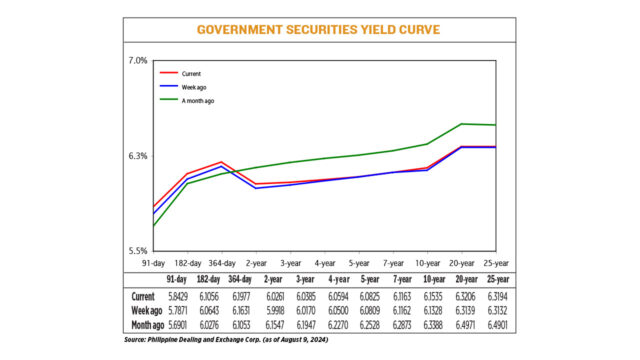
Gov’t debt yields climb

By Abigail Marie P. Yraola, Deputy Research Head

YIELDS on government securities (GS) traded in the secondary market climbed across the board last week following the release of data showing better-than-expected Philippine economic growth in the second quarter and quicker inflation in July.

GS yields, which move opposite to prices, went up by 2.11 basis points (bps) on average week on week, based on PHP Bloomberg Valuation Service Reference Rates data as of Aug. 8, published on the Philippine Dealing System’s website.

Rates of the 91-, 182-, and 364-day Treasury bills (T-bills) rose by 5.58 bps, 4.13 bps, and 3.46 bps week on week to 5.8429%, 6.1056%, and 6.1977%, respectively.

At the belly, yields on the two- three-, four-, five- and seven-year Treasury bonds (T-bonds) went up by 3.43 bps (to 6.0261%), 2.15 bps (6.0385%), 0.94 bp (6.0594%), 0.16 bp (6.0825%), and 0.01 bp (6.1163%), respectively.

Likewise, at the long end, the 10-, 20-, and 25-year debt papers saw their rates increase by 2.07 bps (to 6.1535%), 0.67 bp (6.3206%), and 0.62 bp (6.3194%).

GS volume traded was at P23.13 billion on Friday, lower than the P31.8 billion recorded a week earlier.

“Local yields broadly moved higher as market participants anticipated a stronger Philippine inflation reading for July, which surpassed market consensus… Market participants focused more on local economic releases during the week despite weak US economic data. The higher inflation reading and the stronger second-quarter Philippine economic growth both supported the upward move in domestic yields,” a bond trader said in an e-mail.

The recent rise in domestic rates boosted demand for government securities with longer tenors, as seen in last week’s auctions, the trader said, adding that “less dovish” remarks from Bangko Sentral ng Pilipinas (BSP) Governor Eli M. Remolona, Jr. following the July inflation uptick also supported yields.

Headline inflation accelerated to a nine-month high of 4.4% in July from 3.7% in June, the Philippine Statistics Authority (PSA) reported last week.

This was slower than the 4.7% print in the same month a year ago and was within the BSP’s 4%-4.8% forecast for the month. However, this was higher than the 4% median estimate in a BusinessWorld poll of 15 analysts and was the fastest in nine months or since the 4.9% clip in October 2023.

The July print marked the first time since November that inflation exceeded the BSP’s 2-4% annual target.

The Monetary Board is now “a little bit less likely” to cut rates at its Aug. 15 policy meeting following the worse-than-expected July inflation print, Mr. Remolona said following the data release.

The Monetary Board in June kept its policy rate at an over 17-year high of 6.5% for a sixth straight meeting following cumulative hikes worth 450 bps from May 2022 to October 2023.

Meanwhile, Philippine gross domestic product (GDP) expanded by an annual 6.3% in the second quarter, the PSA reported separately last week. It was stronger than the revised 5.8% growth in the first quarter and 4.3% in the second quarter of 2023.

For the first semester, GDP growth averaged 6%, hitting the low end of the government’s 6%-7% target.

“The market initially reacted adversely to the poor jobs data from the US and the potential implication of a recession and some geopolitical news out of the Middle East,” a second bond trader said in a Viber message.

“This was coupled with higher-than-expected inflation for July coupled with statements from Mr. Remolona that a rate cut was less likely to happen [this] week. As such, there was a bit of a sell-off, but it quickly dissipated as markets eventually stabilized prior to the release of the GDP data,” the second trader said.

For this week, GS yields may continue to climb as the market awaits the Monetary Board’s rate-setting meeting on Thursday, both traders said.

“Local yields are expected to move higher amid less dovish expectations ahead of the BSP policy meeting and potentially strong US consumer and producer inflation reports,” the first trader said.

July US producer and consumer inflation data will be released on Aug. 13 (Tuesday) and 14 (Wednesday), respectively.

“The market will likely be focused on the timing of the rate cut — if it will begin [this] week or at some off-cycle date,” the second trader said.

Mr. Remolona last week said they are open to an off-cycle policy move.

After Aug. 15, the Monetary Board’s remaining policy-setting meetings this year are on Oct. 17 and Dec. 19.

ISIS-inspired suspect in Taylor Swift show plot planned suicide attack

Taylor Swift in Taylor Swift: The Eras Tour (2023)

VIENNA — An Austrian teenager arrested over an alleged plot to strike a Taylor Swift concert in Vienna planned to carry out a suicide attack that would have caused a “bloodbath” and had vowed loyalty to Islamic State (IS), authorities said on Thursday.

The 19-year-old man, who has North Macedonian roots, made a full confession in custody, Austria’s general director for public security Franz Ruf told a news conference.

He swore allegiance to the IS group’s leader on the internet and had chemicals, machetes, and technical devices at his home in the town of Ternitz in preparation for an attack, Mr. Ruf added.

The suspect was planning a lethal assault among the estimated 20,000 “Swiftie” fans set to gather outside Vienna’s Ernst Happel Stadium, said national intelligence head Omar Haijawi-Pirchner. Two other Austrian youths aged 17 and 15 were detained on Wednesday over the reported plot.

“The main perpetrator has confessed that he was supposed to carry out a suicide attack with two accomplices,” said Austrian Chancellor Karl Nehammer.

“The suspects actually had very specific and detailed plans … to leave a bloodbath in their wake.” Authorities painted a picture of the main suspect having self-radicalized, transforming his appearance and sharing Islamist propaganda online. He quit his job on July 25, telling people he had “big plans,” Mr. Ruf said.

One neighbor told Austrian broadcaster Puls24 that the suspect had kept himself to himself and had grown a “Taliban beard.”

The 17-year-old suspect had been given a job with a company a few days ago that was providing services at the stadium, according to security officials.

Event organizer Barracuda Music said it had canceled Ms. Swift’s three concerts in Vienna, due to start on Thursday for a sold-out 65,000 audience each, in coordination with the singer’s management team.

Fans, many of whom had travelled a long way to Vienna, expressed both dismay and understanding.

“It’s just heartbreaking, just frustrating. But at the end of the day I guess it’s for everyone’s safety,” said Mark del Rosario, who had flown from the Philippines to see the wildly popular US singer.

MUSIC WORLD ROCKED
US broadcaster ABC cited law enforcement and intelligence sources as saying Austrian authorities had received information about the Swift concert threat from US intelligence.

It quoted the sources as saying that at least one of the suspects had pledged allegiance to ISIS-K, a resurgent wing of IS, on Telegram in June, though the plot was IS-inspired rather than directed by the group’s operatives.

Austrian Interior Minister Gerhard Karner said foreign intelligence agencies had helped with the investigation, as Austrian law does not allow monitoring of messenger apps.

Event organizer Live Nation urged fans of Coldplay, which is due to play at the same stadium on Aug. 21, to stay calm and said it was in contact with authorities.

It did not comment on whether the show would take place.

British police said on Thursday there was nothing to indicate that the planned attack in Vienna would have an impact on Swift’s shows at Wembley Stadium in London next week.

“Concerts are often a preferred target of Islamist attackers, large concerts,” said Karner, listing the 2015 attack on the Bataclan venue in Paris and the 2017 bombing at England’s Manchester Arena where US pop star Ariana Grande had played.

The plot in Austria also brought to mind a foiled plan by three IS-linked suspects to attack Vienna’s gay pride parade last year.

Islamic State was largely crushed by a US-led coalition several years ago after establishing a “caliphate” in large areas of Iraq and Syria, but has still managed some major attacks while seeking to rebuild and reinvent itself.

Last week’s shows were to be part of the record-breaking Eras Tour by American singer-songwriter Ms. Swift which started on March 17, 2023, in Glendale, Arizona, and is set to conclude on Dec. 8, 2024, in Vancouver, Canada.

Ms. Swift, 34, has not yet commented on the cancellations on her official Instagram account, which has 283 million followers.

Her fans were horrified at the threat, with some begging organizers to postpone the concert instead of canceling it outright. Promoters have said they will pay back tickets. — Reuters

Bosch Car Service Philippines breaks ground on pioneer outlet

PHOTO FROM BOSCH CAR SERVICE PHILIPPINES

Officials of Bosch Car Service Philippines, under ACMobility, recently held groundbreaking ceremonies for the company’s first outlet. Bosch Car Service Bacoor is located along Molino Boulevard, and is set to open in early September. In photo are (from left) Bosch MA Project Manager Yukselen Cenk, BCS-MF General Manager Geronimo Campilan, BCS-MF CFO Vanessa Joy Tan, Bosch MA Product Manager Jose Ligot, and BCS-MF Service and Training Manager Christopher Paul Ofilada. Once completed, the Bosch flagship outlet will showcase state-of-the-art servicing facilities, with seven work bays within a 1,464-sq.m. lot.