Home Blog Page 2835

Gov’t to consider new taxes if revenue collection falls short — Recto

FINANCE SECRETARY RALPH G. RECTO — DEPARTMENT OF FINANCE FACEBOOK PAGE

THE GOVERNMENT will only consider introducing new taxes if revenue collection falls short of target, the Department of Finance (DoF) said.

“It’s easy to pass a tax law. It’s easy to do a tabletop revenue estimate. What’s always harder is implementing the law and collecting the tax,” Finance Secretary Ralph G. Recto told reporters on the sidelines of a House Committee on Appropriations hearing late on Monday.

He said new taxes may be considered if revenue collections are not enough.

The National Government (NG) aims to collect P4.64 trillion in revenues next year, up 8.77% from this year’s projected P4.27-trillion collection. Of this, the government looks to collect P4.33 trillion in tax revenues, 13.41% lower than this year’s target.

“It’s a high target. Assuming there’s a shortfall in that, then we just manage the expenditures,” he added.

While Mr. Recto has repeatedly said there are no plans to introduce new taxes, the DoF has urged Congress to approve tax reforms that will generate as much as P28.38 billion in revenues next year.

Priority bills include the value-added tax on digital service providers, excise taxes on single-use plastics and pickup trucks, the rationalization of the mining fiscal regime, the motor vehicle road user’s charge, and the Corporate Recovery and Tax Incentives for Enterprises to Maximize Opportunities for Reinvigorating the Economy.

Filomeno S. Sta. Ana III, cofounder and coordinator at the Action for Economic Reforms, said that better tax administration is not enough to fund the government’s deficit.

“The challenge that the government faces is to unwind the deficit resulting from the heavy borrowing during the pandemic, and at the same time, it has to sustain high investments in social development, infrastructure, and green energy,” he said in a Viber message.

“In this context, careless and wasteful spending is a no-no, and the government is pressured to generate new revenues. Tax administration, with recent economic episodes as a guide, is insufficient,” he said in a Viber message.

For 2025, the NG set a deficit ceiling of P1.54 trillion or equivalent to 5.3% of gross domestic product.

BORROWINGS
Meanwhile, Mr. Recto said the borrowing mix for 2025 was raised in favor of domestic sources to minimize foreign exchange risk.

Next year’s borrowing program is set at P2.55 trillion, 0.97% lower than P2.57 trillion this year. Broken down, 80% will come from domestic sources with the remaining 20% from external sources. The government previously adopted a 75-25 borrowing mix.

Mr. Recto said the department is also aiming to secure its borrowings at the “lowest possible cost” and will opt for longer-term tenors, depending on the rates.

“Domestic borrowing can also be a sign of confidence in the local economy and may stimulate growth if the funds are used for productive investments that improve infrastructure and public services,” Jonathan L. Ravelas, senior adviser at Reyes Tacandong & Co., said in a Viber chat.

Mr. Recto said this won’t likely weaken output and consumption, with interest rates expected to go down. — Beatriz Marie D. Cruz

The importance of grants to small museums, galleries

THE BUILDING of the National Commission for Culture and the Arts in Intramuros. — COMMONS.WIKIMEDIA.ORG

THE NATIONAL Commission for Culture and the Arts (NCCA) has a budget of P133 million for its competitive grants program this year.

In a press conference in July, NCCA’s Cultural Heritage Subcommission Head Ivan Anthony S. Henares said that the grants will be spread out equally among the six national committees: archives, art galleries, historical research, library and information sciences, museums, and monuments and sites.

He explained that they are hoping for more applications than last year, with civil society organizations and local government units disseminating information on the grants. The deadline for submission of grant proposals is on Aug. 31.

“This program reaffirms our commitment to the advancement of Philippine arts and culture,” Mr. Henares said.

Under the law, it is Republic Act 7356, or the NCCA Charter, that mandates that grants be given to artists and cultural groups that contribute significantly to the country’s cultural legacy.

NCCA Executive Director Eric B. Zerrudo said at the press conference that cultural heritage in particular has been a hot topic lately, with the commission conducting training, capacity building, increasing awareness and education to promote the protection and preservation of cultural heritage.

He called on all Filipinos to play a part: “Hindi lang ito dapat dahil sa sentimental value o sa pera (This shouldn’t just be for sentimental or economic value). It has to be more than that. We hope you can help us put together a more scientific, logical system to communicate it to more people.”

The NCCA Competitive Grants Program accepts project proposals and studies them in a rigorous and confidential evaluation process based on merit, quality, and relevance.

The projects are categorized under 19 committees divided into four sub commissions: the Sub commission on the Arts; Sub commission on Cultural Communities and Traditional Arts; Sub commission on Cultural Dissemination; and Sub commission on Cultural Heritage.

SUPPORT FOR SMALL PLAYERS
One of the 19 committees is that on Museums, whose head, Jose Eleazar R. Bersales, told BusinessWorld that small museums, especially in the regions, often find it hard to compete for grants.

“If properly researched, curated, and presented to the public, every museum object has worth in terms of the story it tells and how it helps develop our understanding of life,” he said via Messenger.

With a grant, a museum can develop and enhance its exhibition capabilities, whether it tells the history of a small barrio or the legacy of an old church.

“The value of museums should never be measured in monetary terms but rather on how much each contributes to educating and inspiring visitors.”

Meanwhile, National Committee on Art Galleries head Maria Teresa Rayos del Sol noted that people managing museums and galleries have to be “well-versed in history and the value of artworks and artefacts.”

“They need proper education and workshops on how to protect their collections from disasters and theft,” she told BusinessWorld in a phone call. “If they write to us or apply for grants, NCCA is prepared to give technical assistance.” — Brontë H. Lacsamana

9 Works Theatrical introduces the magic of Once on This Island

THE ALLURE of the Broadway musical Once on This Island emerges from a community marked by a class divide — not too dissimilar from the world today — making it a fine choice for a 1980s play to bring to modern audiences.

Once on This Island, written for the stage by Lynn Ahrens and based on a Caribbean-set retelling of The Little Mermaid, is set on a French Antilles tropical island in the 1920s. It follows peasant girl Ti Moune who falls in love with the wealthy boy Daniel, despite the two being from two different social classes: the dark-skinned descendants of African slaves and the light-skinned descendants of French colonizers.

For director Robbie Guevara, the musical’s striking narrative of family, humanity, and community deserves a larger Filipino audience.

“Only few theater companies active today can bring back classic musicals. We will revive this one in a way that will not just educate the younger generation, but also help them see how theater has evolved. We’ll present it with a contemporary feel, even if it was written in 1985,” said Mr. Guevara at a July 30 press preview of the musical.

While 9 Works Theatrical was wary of the “deluge of theater shows this year that might exhaust the market,” they decided to push through with a staging of Once on This Island.

A LARGE CAST
The musical was last staged in the 1990s when the material was still new. This time, a mix of old and new faces will be taking on an expanded cast of 15 to highlight the tremendous, village-set dance pieces.

Thea Astley and Angela Ken will alternate as Ti Moune while Sam Concepcion and Jef Flores take turns playing Daniel. Lorenz Martinez stars as Papa Ge; Shiela Valderrama-Martinez and Jasmine Fitzgerald alternate as Erzulie; Garrett Bolden as Agwe, Radha as Asaka; Lani Ligot as Mama Euralie; Noel Rayos and Raul Montesa as Tonton Julian; Shanaia Gomez and Krystal Kane as Andrea; PJ Rebullida as Armand. Jonjon Martin, Sam Libao, Jordan Andrews, and Fay Castro play the Storytellers, and Bianca Estacio and Reese Iso alternate as Little Ti Moune.

“We cast these people based on the story that calls a lot of singing and dancing, a lot of diversity in looks. You have a village representing a nation, so we really want to showcase as much as we can,” Mr. Guevara said.

For Ms. Astley, who just came from 9 Works Theatrical’s staging of Rent, being part of Once on This Island has been her dream ever since she was fortunate enough to see the 2017 revival on Broadway. She will be taking on the lead character, Ti Moune.

“In my first year at Ateneo blueREP, I auditioned with the [Once on this Island] song ‘Waiting for Life.’ This is really a dream role of mine,” she explained. “I can never fully claim to know the experience of Ti Moune, of the peasants, of black people, but I know what it’s like to be looked down upon because you’re darker.”

Ms. Ken, who alternates as Ti Moune, said that she only learned of the musical when the role came up. “The hunger to get the role was there because the story of Ti Moune is very relevant to our generation,” she said.

A UNIQUE SETTING
Although Once on This Island is set in the island of Martinique in the French Antilles part of the Caribbean, it is easy to draw a lot of parallels with Philippine culture, according to scenographer Mio Infante.

“They followed the European dress and adapted it to the tropical weather, which is also what we did. We’ll just underline several things that will set it apart so that the market here wouldn’t see that it’s too Filipino,” he said.

With themes of family and community sure to resonate with theater audiences, the cast agreed it was important to convey the central message of the musical — love.

Mr. Concepcion and Mr. Flores, who alternate as Daniel, said that they are determined to play their shared role well, even while they balance it with a different production they also star in (PETA’s One More Chance the Musical).

Once on This Island shows us that love is stronger than death. It goes on even when we’re gone,” said Mr. Concepcion.

For the direction of the musical, Mr. Guevara noted that “issues of race and class being prevalent even today” motivated them to make the production a continuous education for audiences.

“The message is universal. Music is very communicative of emotion and this show has an endearing way of using that to show the value of humanity, community, and family,” he said.

“It’s probably my second favorite musical after Les Miserables.

Once on This Island will have performances from Sept. 6 to 29 at the Carlos P. Romulo Auditorium, RCBC Plaza in Makati. Tickets are now available via ticket2me.net. — Brontë H. Lacsamana

Wider internet access may boost esports industry

MPL PHILIPPINES

THE GOVERNMENT should boost internet access in the countryside to make the esports landscape more inclusive, according to the top executive of a Philippine esports company.

“It is very important to reach everyone,” Ronald Robins, founder of Manila-based Mineski Global, said in an interview. “How can we get better at esports games if we don’t have internet?”

Mr. Robins recalled his struggles in Cebu province in central Philippines when he was younger, as he faced difficulties in joining big esports tournaments in the absence of support for aspiring esports players.

Several local groups have sought more government support for the Philippine esports industry, including seeing it as a legitimate creative sector and sport.

That playing video games competitively could be a salaried profession was nonsense a few years ago. Now, professional gamers make a decent living and turn into millionaires on some occasions.

Salaried pro gamers in the United States earn as much as $60,000 yearly, while tournament prize money can go as high as $50,000, according to Esports Grizzly. Video game streamers earn as much as $2,000 a month.

Internet access in regions outside Metro Manila, particularly in the Visayas and Mindanao, ranged from 28.5% to 51.3% last year, according to the Philippine Statistics Authority. In contrast, seven of 10 households in Metro Manila had internet access.

Mr. Robins’ company has introduced the GG Truck (Good Game Truck), which seeks to “gamify” the country’s 42,000 barangays or villages by providing a literal truck with a gaming setup including an LED display, generator set, stage lights, wi-fi internet and an operating crew.

Using the truck, a gamer can enjoy the services of an operating crew and the ability to stream his game on Facebook.

The initiative aims to provide internet access and discover talent in rural communities.

“We have a very specific approach to inclusivity,” Mr. Robins told BusinessWorld. “We believe everybody should have a chance and GG Truck allows us to execute tournaments anywhere.”

The GG Truck is equipped with a sizable high-gain antenna where cell towers in remote areas can gain fast internet access for casual gaming events and esports tournaments.

“Instead of asking everybody to come to Metro Manila or Metro Cebu, we reached out to all of these communities, and it allows us to open it up as an internet café and still have all of these tournaments for mobile gamers,” Mr. Robins said.

Aside from the GG Truck, Mineski brings reliable internet access closer to remote areas by setting up more than 100 internet cafés at P30 per hour. 

Mr. Robins thinks the local esports industry is unstoppable as it continues to gain traction each year, backed by 43 million active Filipino gamers.

Mr. Robins said timing is crucial to an entrepreneur’s success.

“Where you there at the right time or were you there too early or too late?” he said. “You learn from all your failures, allowing you to sense when is the right time is to do something,” he added.

“The most important thing in your entrepreneurial journey is learning how to bounce back when you fall,” Mr. Robins said. “That’s sounds like cliché, but it’s true.”

An entrepreneur should be around people who will make them uncomfortable because they will push you out of your comfort zone and open new learning opportunities, he added. — Edg Adrian A. Eva

Gov’t fully awards T-bonds amid robust demand

BW FILE PHOTO

THE GOVERNMENT made a full award of the reissued seven-year Treasury bonds (T-bonds) it offered on Tuesday amid strong demand and even as rates fetched were higher than market expectations as headline inflation picked up in July, which may cause the central bank to hold off on its planned policy easing.

The Bureau of the Treasury (BTr) raised P30 billion as planned via the reissued seven-year T-bonds it auctioned off on Tuesday as total bids reached P73.079 billion, or more than double the amount on the auction block.

This brought the total outstanding volume for the series to P189.7 billion, the Treasury said in a statement.

The bonds, which have a remaining life of four years and nine months, were awarded at an average rate of 6.107%. Accepted yields ranged from 6.05% to 6.128%.

The average rate of the reissued papers dropped by 29.9 basis points (bps) from the 6.406% fetched for the series’ last award on July 2, and was also 39.3 bps lower than the 6.5% coupon for the issue.

This was also 0.8 bp lower than the 6.115% seen for the same bond series but 5.4 bps above the 6.053% quoted for the five-year bond, the tenor closest to the remaining life of the papers on offer, at the secondary market before Tuesday’s auction, based on PHP Bloomberg Valuation Service Reference Rates data provided by the BTr.

The Treasury fully awarded its bond offer on Tuesday amid robust demand, a trader said in a text message, but noted that the average yield was at the higher end of the expected range amid the faster-than-expected July headline inflation figure.

“The fact that this offer was still 2.44 times oversubscribed shows that market is already comfortable with the current levels, confident about the BSP’s (Bangko Sentral ng Pilipinas) inflation forecast, and most probably looking forward to potential number of cuts ahead,” the trader added.

“The higher-than-expected inflation data could reduce the possibility of a local policy rate cut on Aug. 15, as signaled by local monetary authorities lately,” Rizal Commercial Banking Corp. Chief Economist Michael L. Ricafort said in a Viber message.

Headline inflation accelerated to a nine-month high of 4.4% in July from 3.7% in June, the Philippine Statistics Authority reported on Tuesday.

This was slower than the 4.7% print in the same month a year ago and was within the BSP’s 4%-4.8% forecast for the month. However, this was higher than the 4% median estimate in a BusinessWorld poll of 15 analysts conducted last week and was the fastest in nine months or since the 4.9% clip in October 2023.

The July consumer price index (CPI) marked the first time since November that headline inflation exceeded the central bank’s 2-4% annual target.

For the first seven months, the CPI averaged 3.7%, above the BSP’s 3.3% forecast for the year.

The central bank is now “less likely” to cut rates at its policy meeting next week following the worse-than-expected July inflation print, BSP Governor Eli M. Remolona, Jr. said on Tuesday.

Mr. Remolona said a rate cut at its Aug. 15 review is “a little bit less likely” due to the elevated July CPI.

“That 4.4%, there is a base effect there of 0.3 percentage point. Without the base effect, it’s really 4.1%, which is still worse than expected but not that bad because it only slightly breached the ceiling,” he said.

Asked if the BSP will likely hold rates steady, Mr. Remolona said: “We are not sure because there is still a lot of data we are looking at… If growth is unexpectedly weak, then it looks like our projections of inflation and inflation expectations suggest lower inflation going forward. Then we can cut.”

Second-quarter gross domestic product data will be released on Aug. 8 (Thursday).

The BSP chief earlier signaled that they were on track to cut rates for the first time in over three years this month, possibly by 25 bps, adding that another 25-bp cut is likely next quarter.

The Monetary Board in July kept its policy rate at a 17-year high of 6.5% for a sixth straight meeting. It raised borrowing costs by a cumulative 450 bps from May 2022 to October 2023 to help tame elevated inflation.

The BTr is looking to raise P220 billion from the domestic market in August, or P80 billion from Treasury bills and P140 billion via T-bonds.

The government borrows from local and foreign sources to help fund its budget deficit, which is capped at P1.48 trillion or 5.6% of gross domestic product for this year. — AMCS

Arts & Culture (08/07/24)


Wifi Bodies performances

THE NEXT part of the Cultural Center of the Philippines (CCP) Choreographers’ Series, WifiBody PH: Platform will focus on solo and duet performances. The set of intimate and concise choreographic expressions is curated by Myra Beltran and Denisa Reyes with the aim to uncover and promote emerging talent in Filipino choreography. The competition is divided into two sets, which will be performed on Aug. 10 at 2 p.m. and 4:30 p.m. The winners will be announced after the performances. WifiBody PH: Platform will take place at the Tanghalang Ignacio Gimenez (CCP Black Box Theater) at the CCP Complex in Pasay City, with tickets costing P500.


Print exhibit at Fundacion Sansó

AN EXHIBITION of prints by students and artists is on view at Fundacion Sansó in San Juan. The exhibit, “To See the World in a Grain of Sand,” features 60 artworks made using various printmaking methods: rubbercut, monotype, drypoint, cyanotype, and collagraph. The initiative was organized by the Fine Arts in Culture-Based Arts Program of the De La Salle College of Saint Benilde (DLS-CSB), co-presented by Fundacion Sansó. It features students from the program as well as design foundation enrollees under a course in basic printmaking. “To See the World in a Grain of Sand” is free and open to the public, and is on view until Aug. 17 at the Fundacion Sansó, 32 V. Cruz, San Juan.


Imahica Art opens group exhibition

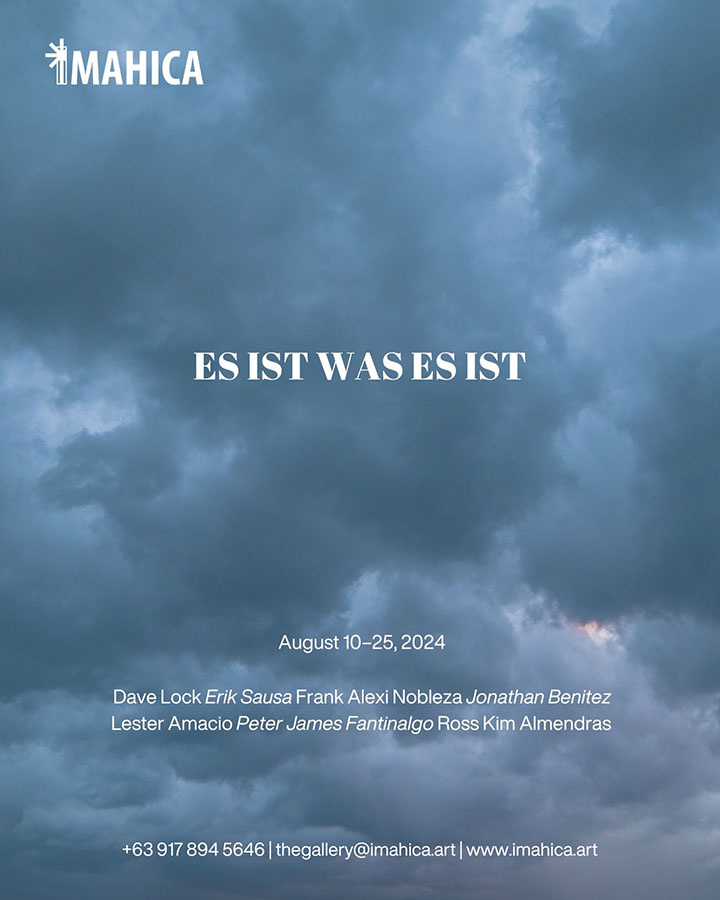
THE IMAHICA Art Gallery is opening the group exhibition “Es Is Was Es Ist” (German for the phrase “It is what it is”).  The participating artists are Dave Lock, Erik Sausa, Frank Nobleza, Jonathan Benitez, Peter James Fantinalgo, Ross Kim Almendras, and Lester Amacio who brought the group together. The title of the exhibit references humans’ profoundly earnest inquiry into the nature of reality and perception. “Es Is Was Es Ist”  runs from Aug. 10 to 25 at Imahica Art Gallery, 2A Lee Gardens, Shaw Blvd. Mandaluyong City.


Free public lecture on healing trauma through art

A PRACTICING psychiatrist and psychotherapist from the Makati Medical Center, Dr. Rene Samaniego, will have a free public lecture where he will talk about the transformative power of art in healing human traumas. Inspired by the works of Heidi Bucher, a groundbreaking Swiss artist of the international neo avant-garde, the discussion will expound on the relationships between surface, identity, memory, and trauma. Organized by the Museum of Contemporary Art and Design (MCAD) of the De La Salle-College of Saint Benilde (DLS-CSB), the talk is free and open to the public. It will be conducted at the MCAD Multimedia Room, Benilde Design + Arts Campus, Dominga St., Malate, Manila on Aug. 15, 3 p.m. Interested participants may register through bit.ly/MCADIdentity.


Ateneo Art Gallery presents two new exhibitions

LAUNCHING on Aug. 10 at the Ateneo Art Gallery are two different exhibitions. “Project Belonging: From There to Here, curated by Spain-based Filipino curator Kristine Guzmán, features works by Spanish visual artist Enrique Marty, with Isabel and Alfredo Aquilizan as guest artists. There will be an artist talk on Aug. 10, 2 p.m., at the 2nd floor of the Ateneo Art Gallery, with the exhibition launch following at 4 p.m. The opening will coincide with that of “Transitions and Continuity: Selections from the Ateneo Art Gallery Video Art Collection at the 3rd floor galleries. This exhibition will feature four works by Martha Atienza, Kaloy Olavides, Mark Salvatus, and Gerry Tan, each touching on themes of urbanization, privacy, representation, and socio-ecological concerns. Both shows run until Oct. 26 at the Ateneo Art Gallery, Areté, Ateneo de Manila University, Katipunan Ave., Quezon City.


Pow Martinez, Mariano Ching exhibits at MO_Space

TWO exhibitions are opening at MO_Space on Aug. 10. “Look, but don’t touch. Touch, but don’t taste. Taste, but don’t swallowby Pow Martinez will take up the Main Gallery. He tackles a new form of “dark ages” within the technocratic digital realm which reflects on the tastes of barbarians who were once swayed by Christendom, and now by virtue signaling and moralist gaffes.Flicker and Fadeby Mariano Ching will be on view at Gallery 2, where his strange inventory of objects and oddities characterize a new kind of surrealism. The two shows will run from Aug. 10 to Sept. 8, 3rd Floor of the MOS Design Bldg. along 9th Avenue, Bonifacio High Street, Taguig City.


M Art Studio holds cardboard craft workshop

THE WORKSHOP “Material Transformations: Sculpting Cardboard Into Art” will be teaching participants the fundamentals of character design and construction using cardboard. Organized by the M Art Studio of the Metropolitan Museum, its goal is to enhance artists’ creativity and hands-on crafting skills. The workshop will be facilitated by Baste Cacho, a University of the Philippines Industrial Design student. Early bird tickets, available until Aug. 10, cost P2,000 while regular tickets cost P2,500. Both are inclusive of materials and access to The M’s ongoing exhibits. The workshop is scheduled for Aug. 17, 2 to 5 p.m., at The M in Bonifacio Global City, Taguig.


Pianist Ong to receive Asian Pillars Award

FOR his work in the worlds of arts and technology, concert pianist Jordan Shangkuan Ong will be receiving an Asian Pillars Award that recognizes Asians with exceptional talents. Mr. Ong graduated with a Bachelor’s degree in Music and Piano Performance and a Master’s degree in Digital Media. He founded the Piano Whiz Kids Studio, becoming a beacon for young aspiring pianists. He also has directorial and production skills that were spotlighted at the Cannes Film Festival with the documentary Magic History of Cinema, which he also scored. Currently, Mr. Ong is directing a film that delves into the lives of renowned pianists. He will receive his Asian Pillars Award at the Okada Manila on Sept. 6, 7 p.m.


Manila International Book Fair at SMX MOA in Sept.

THE SMX Convention Center Manila in Pasay City’s Mall of Asia (MOA) will once again open its doors to Filipino book lovers. From Sept. 11 to 15, the Manila International Book Fair (MIBF) will bring brand new books to the Philippine market. These range from coming-of-age fiction like Ines Bautista-Yao’s My Lola’s Love Letters, to romantic comedy-drama novels like Crazy Rich Asians author Kevin Kwan’s latest, Lies and Weddings. Children’s literature will be spearheaded by the likes of Feeding the Hungry Ghost, published by Adarna House, Inc., a picture book that dives into Chinese culture. For non-fiction, there is RuPaul Charles’ memoir, The House of Hidden Meanings, and Miriam Coronel-Ferrer’s new book We Chose Peace: An Insider’s Story of the Bangsamoro Peace Talks. These books, and many more, are some of the finds to expect at the MIBF in September.


Tanghalang Pilipino unveils 38th season lineup

FOR its 38th theater season, Tanghalang Pilipino will be presenting three productions under the theme “Revolt.” The first is Balete, based on National Artist for Literature F. Sionil Jose’s novel Tree, adapted by Rody Vera and directed by Chris Millado. It stars Nonie Buencamino, Jonathan Tadioan, and Marco Viaña, and will run from Sept. 13 to Oct. 6. Tickets are available at https://bit.ly/TP38BALETE. Next is Sandosenang Sapatos, the story of a child born without feet based on the Palanca Award-winning short story of the same name by Dr. Luis Gatmaitan. It will be adapted by Layeta Bucoy, directed by Jonathan Tadioan, and star Felicity Kyle Napuli, Wincess Jem Yana, and Tex Ordoñez-De Leon. It will run from Nov. 18 to Dec. 8. Finally, Kisapmata will close the season on March 7 to 30, 2025. It is a theatrical adaptation of Mike de Leon’s acclaimed film of the same name that was based on Nick Joaquin’s crime report “The House on Zapote Street.” Directed by Guelan Varela-Luarca and the TP Actors Company, it features Jonathan Tadioan, Marco Viaña, Lhorvie Nuevo-Tadioan, and Toni Go-Yadao. For more information on Tanghalang Pilipino’s 38th season, visit its website and social media pages.

Private initiatives fostering marriage inviolability: Your Happy Marriage

JEONGIM KWON-UNSPLASH

(Part 5)

A very laudable initiative to help them deal with the conflicts that normally arise in the relationships between husband and wife from the mere fact that they are human and, therefore, fallible, is that by a married couple, Boni and Alice Belen.  They have written a three-part series of books (to be expanded to five parts in the future) entitled Your Happy Marriage.

Bonifacio D. Belen and Alice A. Belen have been happily married for 27 years. They have been very active in delivering courses and workshops under the Educhild banner, using the very effective “case method” teaching methodology that has been perfected in leading business schools like the Harvard Business School in the US, the IESE Business School in Europe and the Asian Institute of Management in the Philippines.

Rooted in deep philosophical and theological principles, the main thesis of this series of books, published by Central Book Supply, Inc., is that in a validly contracted marriage, there is no conflict that is “irreconcilable” as long as  the marriage partners concerned have the good will to employ readily available means to resolve their differences.

There are two ways of defining “human weaknesses” in the context of the present debate concerning the efforts of some lawmakers to introduce “absolute divorce” into the Philippines.  The first is that because of human weaknesses, one or both members of the couple in a valid marriage could commit offensive acts against the partner so that cohabitation is made very difficult or impossible. This problem, however, can be resolved by legal separation and does not justify absolute divorce.

Those who object to absolute divorce use the “human weakness” argument in the following sense: the very possibility of getting an absolute divorce would, through the human weaknesses of one or both of the partners, encourage lack of discernment, undue haste, precipitation, and carelessness in the decision to get married and in the choice of the right partner, thus opening the way to more incompatibilities and so-called irreconcilable conflicts.  This has been the empirically tested experience in the countries that allow absolute divorce.

By eliminating the possibility of dissolving a validly contracted marriage, those contemplating marriage will be a great deal more circumspect before actually deciding to get married and to whom. They would take more seriously all the means described in the preceding articles that are made available by countless private initiatives providing pre-nuptial or pre-Cana courses.

To be sure, it is also human weaknesses that lead to conditions that are grounds for annulment or declaration that no marriage bond actually existed. Among these are psychological incapacity, the non-existence of a marriage license, bigamous or polygamous marriage, the presence of sexually transmitted infection, fraud, lack of consent, unsound mind or the inability of one or both spouses to make a decision to marry due to a mental deficiency, impotence, mistaken identity, and the absence of essential requisites for a valid marriage. In these cases, however, there is no need to talk about irreconcilable conflicts because the spouses concerned are free to marry another person since there was no marriage in the first place. A law permitting absolute divorce in these cases would be irrelevant and unnecessary since there was no marriage at all. What is needed is the declaration of nullity which is already permitted under the laws of the Philippines.

We should heed the advice of some law makers to make the process of annulment cheaper or even costless for poor couples. If we apply the principle of progressive taxation, the rich can be charged an eye and a tooth to have their marriage annulled.

For couples going through very normal problems of conflicting ideas and behaviors, Boni and Alice’s book series is highly recommended.

They start the series with the most inspiring message of Pope Francis to married couples or those contemplating marriage, found in his Letter entitled “Amoris Laetitia” (the Joy of Love): “The love they pledge is more significant than any emotion, feeling or state of mind, although it may include all of these. It is a deeper love, a lifelong decision of the heart. Even amid unresolved conflicts and confused emotional situations, they daily reaffirm their decision to love, to belong to one another, to share their lives and to continue loving and forgiving. Each progresses along the path of personal growth and development.  On this journey, love rejoices at every step and in every new stage.” The five books planned in the series are: Book 1 (Beginning of the Journey); Book 2 (Failures of Expectations); Book 3 (Struggle for Dominance); Book 4 (Adjusted and Settled); and Book 5 (Enduring Commitment).

Book 3 is the most relevant to the issue of absolute divorce which we are discussing because it is the one that maintains that there are no irreconcilable conflicts if both of the spouses are willing to put in the necessary effort to resolve them. Book 3 is meant for those who have been married for about 12 to 30 years.   

The authors start by asserting that a psychologist told them that a troubled marriage is essentially the psychological or spiritual trouble of a person impacting on another, or the two individuals in the marriage colliding. A family therapist gives a more nuanced explanation: the problem in a troubled marriage does not exist in a person but in the chemistry between the spouses.  To address the marriage crisis, it is suggested that the husband and wife fix their intrapersonal troubles together.

There is no other way to fix a troubled marriage but to face squarely the intrapersonal differences. It takes two to quarrel and to make amends and reach an acceptable resolution. The efforts towards reconciliation will have to start from the more humble of the spouses, or the one more willing to give love a chance.  Earthly life is never simple. Our earthly journey is always messy. Marriage is even more. Even the seemingly most compatible unions — from the standpoints of family, religious, cultural, and educational backgrounds —will encounter difficulties at some point on the journey.

The ability to forgive is the key to a lasting union. Precisely because of human weaknesses, there will always be some fault, offence, imperfection, negligence, etc. of one of the partners to forgive. As Boni and Alice insist, from their personal experiences: “Marriage without forgiveness cannot last.  Suppose a couple do not learn to overlook little moments of friction resulting from moodiness and tiredness or disagreements over inconsequential and not-so-trifling matters. Suppose a couple get tired of forgiving the same repeated offenses, give in to bitterness and decide not to keep love in their hearts:  then the beginning of the end is near if not already there.”

Even pagans will concede that the root of moral evil can be found in three fundamental human weaknesses or evil tendencies: greed, lust, and pride. The most difficult to overcome is the last, pride, a super-ego which is the primary obstacle to the ability to forgive. That is why Book 3 of Your Happy Marriage has a sub-title, “Struggle for Dominance.” The original consent given at the time of marriage must be followed by a lifetime of commitment. As Boni and Alice end their Introduction to Book 3: “Commitment is consent renewed day-to-day, perseveringly day-by-day. In this Commitment, total and free, the wrestling for power gives way more quickly to the effort to let love, true love, take over instead of being overshadowed by conflicts in the struggle for dominance.”

Those interested in purchasing copies of the three books of Your Happy Marriage may send an e-mail to info@central.com.ph.


Bernardo M. Villegas has a Ph.D. in Economics from Harvard, is professor emeritus at the University of Asia and the Pacific, and a visiting professor at the IESE Business School in Barcelona, Spain. He was a member of the 1986 Constitutional Commission.

bernardo.villegas@uap.asia

BSP launches cyber resilience framework

BW FILE PHOTO

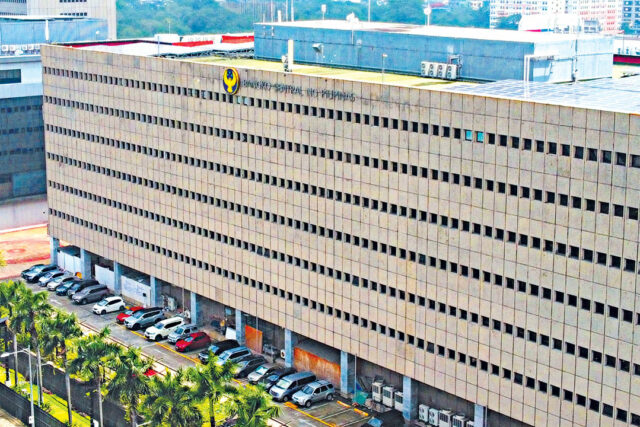
THE BANGKO SENTRAL ng Pilipinas (BSP) has launched a framework to enhance cyber resilience in the financial services sector.

The 2024-2029 Financial Services Cyber Resilience Plan (FSCRP) will serve as “the primary framework covering the high-level goals and strategies that aim to deepen the industry’s overall cyber resilience and maturity,” the central bank said.

“Our plan is not just a response to the threats we face, but a proactive strategy to anticipate and mitigate future risks,” BSP Governor Eli M. Remolona, Jr. said at the launch of the FSCRP on Tuesday.

“It’s our commitment to creating a robust, secure, and resilient financial system that can withstand cyber incidents and recover quickly from them,” he added.

The plan aims to create and promote defined and coordinated incident response protocols and mechanisms, active sharing and collaboration, strong cybersecurity culture and awareness, as well as holistic cybersecurity best practices and standards.

Some initiatives under the framework include establishing baseline industry incident response plans, developing scenario-based incident response playbooks and conducting industry-wide cyber testing exercises, according to the central bank.

It also seeks to expand and improve the Bankers Association of the Philippines’ Cybersecurity Incident Database, create cyber education programs, and push for policy reforms on digital security controls, among others.

“Cyber threats are evolving at an alarming rate, becoming ever more diabolical. As financial institutions embrace digital innovation, we also become prime targets for cyberattacks,” Mr. Remolona said.

Central bank data showed that nearly 60% of cyber fraud losses reported by BSP-supervised financial institutions (BSFIs) in 2023 was due to account takeovers, identity theft and phishing. This was also more than double the percentage reported in 2022.

The finance and insurance industry was the top most attacked sector in 2018 and 2020, and ranked second from 2021 to 2022, the BSP said, citing the IBM X-Force Threat Intelligence Index report.

“These attacks not only threaten the disability of individual institutions but also pose systemic risks to the entire financial system and undermine the trust in the system,” Mr. Remolona added.

The plan will be reviewed on a quarterly basis, the BSP said.

A council will also be established to oversee the implementation of the plan, which will include board and senior level officials from industry associations, BSFIs and senior management of the central bank. — Luisa Maria Jacinta C. Jocson

Inflation rates in the Philippines

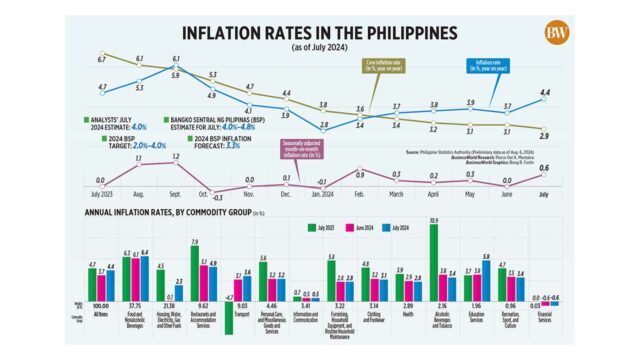
HEADLINE INFLATION accelerated to a nine-month high in July, mainly driven by a spike in electricity rates and food costs, data from the Philippine Statistics Authority (PSA) showed. Read the full story.

Inflation rates in the Philippines

Smart partners with DTI to help 1M mom-and-pop stores

A man waits for customers at a sari-sari store in Quezon City, July 21, 2021. — PHILIPPINE STAR/MICHAEL VARCAS

THE Department of Trade and Industry (DTI) and Smart Communications, Inc. have signed a deal that seeks to bridge the digital divide by teaching more than a million mom-and-pop store owners in the Philippines to better manage their business.

In a statement on Tuesday, Smart said it would help the DTI in its Tindahan Mo, e-Level Up Mo Sari-Sari Store Advancement program, which holds free webinars for store owners.

“The sari-sari stores have been our key partner since day one, particularly in Smart electronic load distribution,” Jac N. Bocalan, vice-president and head of channel management at Smart, said in the statement.

She added that the PLDT Inc. wireless unit wants to support initiatives that could boost its electronic channel.

“Together with industry partners and the DTI, we share the mission of empowering our sari-sari store owners and customers by assisting them in their digital transformation journey.”

“The [program] adopts a multifaceted approach to uplift our micro retailers, focusing on digital transformation, financial literacy, sustainable business practices and consumer protection,” Trade Undersecretary Jose Edgardo G. Sunico said in the statement.

“Our goal is clear: to make our sari-sari stores more resilient, innovative and competitive in the digital economy,” he added.

Under the agreement, Smart and Maya representatives will take part in the program by teaching store owners how to expand capital through digital products and services, particularly Smart e-load.

Smart said its e-load platform is one of the fastest-selling products among mom-and-pop stores since it was launched in 2003.

Ms. Bocalan said they want to teach store owners how to level up and use digital devices with a smartphone to boost their income. “We are also looking forward to working with the DTI and industry partners to push forward these progressive programs that uplift the lives of Filipinos.”

Hastings Holdings, Inc., a unit of PLDT Beneficial Trust Fund subsidiary MediaQuest Holdings, Inc., has a majority stake in BusinessWorld through the Philippine Star Group, which it controls. — Justine Irish D. Tabile

Deadpool & Wolverine leads a pop culture cascade of F-bombs

IMDB

LOS ANGELES — What the f—? The F-word, once seen as the most shocking expletive in the English language, has become commonplace in pop culture.

Deadpool & Wolverine, the R-rated Marvel film from family friendly Walt Disney, features the word “fuck” more than 100 times. Taylor Swift sings it 18 times in just one song on her hit album The Tortured Poets Department, and many other pop stars utter it freely.

As its public usage has increased, the word has undergone what language experts call a “semantic shift,” or a change in meaning over time, said Roy Peter Clark, a writing teacher and author of several books on writing.

He points to a scene in My Lady Jane, a drama series on Amazon’s Prime Video streaming service. A girl who appears to be roughly 10 years old uses the word as her older sister is about to be beheaded under orders from Queen Mary.

“Fuck Mary,” the girl says.

Putting the F-word in the mouth of a child actor, Mr. Clark said, shows it has become less taboo over time.

“It’s used in so many different ways, some that are clearly very negative, and other ways that are humorous, and other ways that are mischievous and other ways that are emphatic,” said Mr. Clark, a senior scholar at the Poynter Institute, a nonprofit focused on media. “It has become less negative.”

A British study published in 2021 found that “fuck” was the most-used swear word and was particularly popular with teenagers and young adults. A 2023 study published in the Journal of Pragmatics sought to understand how its usage had evolved.

Comparing conversations among British teenagers in the 1990s and 2010s, researchers Robbie Love and Anna-Brita Stenstrom found less slinging of the F-word as an insult, or as a term for sexual intercourse.

The word was more likely to appear in phrases such as “what the fuck?” and “for fuck’s sake,” they found. Teens tossed the word around in friendly conversations.

Karen North, a psychologist and professor of digital social media at the University of Southern California’s Annenberg School, said habituation likely has made the word less jarring.

“Anything that you experience over and over and over again, you’re desensitized to,” Ms. North said. “If you’re in a room that smells very bad, then after a few minutes you don’t smell it.”

With language, “if you keep hearing the F-word, or any particular inflammatory or emotional thing over and over and over again, you’ll start desensitizing because your senses get used to it,” Ms. North said.

Many people still find the F-word highly offensive. Its use is often cited by politicians to ban books such as J.D. Salinger’s 1951 novel The Catcher in the Rye in schools and libraries, Mr. Clark noted.

At Disney, executives offered “nothing but support” after seeing the foul language in the new Deadpool movie, said Kevin Feige, president of Marvel Studios. They understood that the raunchy humor was a key to the success of two earlier Deadpool movies made by Fox.

When Disney bought the Deadpool character as part of a deal with Fox, Marvel filmmakers decided “we were going to stay true to the spirit of what Deadpool is,” Mr. Feige said.

Deadpool & Wolverine was rated R in the US and 15 in the United Kingdom, a signal to parents that it was not intended for young children. In the Philippines, it received a rating of R-16 from the Movie and Television Review and Classification Board. R-16 restricts viewership to those aged 16 and above, with the reviewers citing the film’s mature content as the reason.

Audiences embraced the movie, which racked up the biggest opening weekend of the year with $211 million at US and Canadian box offices. Total global sales reached an estimated $824 million through Sunday.

For the Deadpool character, the F-word “makes sense, and if it wasn’t there, it wouldn’t feel right,” said 22-year-old Marvel fan Gaige Johnson from Michigan.

Another Marvel fan, Diana Alvort from Mexico, laughed when asked if there was too much swearing in the film.

“Fuck that,” she said. “Come on, it’s a fun movie. Let’s not get so serious. You know, there’s moments for everything and so I don’t have a problem with that. Just enjoy it.” — Reuters

Transformative mindset of the new procurement law for good governance

FREEPIK

We’ve heard too many horror stories about procurement in government. Opaque processes, favored bidders, and rigged specifications — resulting in delayed, poor quality, and badly implemented projects — have often accompanied the way our agencies and local government units selected their suppliers or contractors in delivering government services.

As a result, people don’t get the quality of projects and services they deserve. Public funds are wasted and get into the hands of unscrupulous groups or individuals, and our aspirations toward good governance remain just that, aspirations.

A new law, enacted just on July 20 and which will take effect on Aug. 13, seeks to change this.

Republic Act 12009 or the New Government Procurement Act (NGPA), championed by Department of Budget and Management Secretary Amenah Pangandaman as the “biggest anti-graft and corruption law in modern history,” aims to promote transparency, competitiveness, efficiency, proportionality, accountability, public monitoring, procurement professionalization, and sustainability in government procurement.

According to President Ferdinand Marcos, Jr., it is “a testament to our unwavering commitment to build a government that truly serves the people by ensuring that every peso spent is accounted for and is used for the benefit of the Filipino people.”

This law was deemed a piece of priority legislation by the Legislative Executive Development Advisory Council because it includes key reforms aimed at putting an end to side deals, under-the-table agreements, uncompetitive behavior, corruption, and other criminal activities.

Before RA 12009, there was an existing procurement law enacted in 2003. But Republic Act 9184, or the Government Procurement Reform Act, needed to be reviewed and updated to become responsive to the many changes that have taken place since then and to address numerous gaps that still allowed irregularities in the procurement process.

There are several salient points and key features of the NGPA that make it more attuned to the demand of the present. For example, it includes an emphasis on value for money instead of mere low prices, introducing the “Most Economically Advantageous Responsive Bid” or MEARB as a new award criterion in addition to the existing Lowest Calculated Responsive Bid.  This new award criterion frees agencies from the obligation of selecting the lowest-priced bid, which sometimes ends up with the government getting the cheapest items but with the lowest quality, allowing them to choose the best deals that would result in the most optimized benefit for the item or service being procured.

It strengthens the procurement planning process that needs to use market scoping and strategies for best results, the use of emerging technologies and innovative solutions. All procurement shall be conducted with sufficient planning and preparation to ensure sound procurement decisions. The process will also be streamlined from three months to just 60 days.

Newer factors like environmental, social, and economic factors, life cycle, gender parity, poverty alleviation, and marginalized/vulnerable sectors must also be considered as procurement principles and practices. In the old law, there was no mention whatsoever of sustainability.

The principles of open government and participatory procurement, as well as beneficial ownership information, must be included in procurement decisions to enhance transparency and accountability.

It tries to prevent conflict of interest in the procurement process through the disclosure of relations between the bidder and procuring heads of agencies. There will be improved public monitoring through civil society observer participation and use of video recording for all procurement-related conferences.

Finally, procurement practitioners should be professionalized and developed into a skilled and competent workforce driven only by excellence and integrity.

The enactment of the NGPA is expected to significantly improve the execution of government projects. Its enactment is anticipated to foster trust among stakeholders, including local and international investors, by demonstrating the government’s commitment to ethical governance practices and to build a more transparent, accountable, and sustainable procurement system, ultimately benefiting the Filipino people.

However, the test of the new law — as is the tests of all laws — is its conscientious implementation. We at Stratbase hold the view that attempts at attracting and keeping investments and inducing technology-driven economic growth will not happen unless transparency in government transactions is normalized. The people have seen far too many instances of public officials promising to serve them and putting their interests above all, and yet, behind closed doors, rigging the bidding process so that it favors them and their conspirators.

This may not completely eliminate irregularities in the procurement process as there will always be devious minds who will continue to look for loopholes that they can exploit despite the safeguards established by the law.

This is where the watchful eyes of the other sectors must come to enforce transparency. It is good that the new law already provides additional means by which the public can observe and monitor the bidding process. Irregularities, after all, happen in the dark, under the veil of secrecy.

The law will take effect soon and we look forward to the consultative process that will ensue for the crafting of the Implementing Rules and Regulations. Here, the actual situations for the operationalization of the law will be discussed by those who actually know the technical and operational dynamics of government procurement. We are confident that under the leadership of Budget Secretary Pangandaman, the full implementation of this law will finally help curb corruption and institute good governance practices at all levels of national and local government, and according to its spirit and intent.


Victor Andres “Dindo” C. Manhit is the president of the Stratbase ADR Institute.