Home Blog Page 2753

ACEN shares up after Indonesia wind deal

INVESTORS snapped up ACEN Corp. last week after the Ayala-led renewable company partnered with an Indonesian firm to develop over 300 megawatts (MW) of wind energy projects in that country.

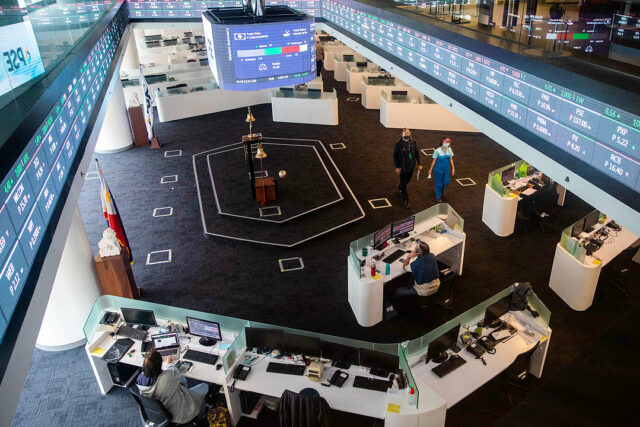
Data from the Philippine Stock Exchange showed ACEN was one of the most actively traded stocks in terms of value turnover, with P556.73 million worth of 102.02 million shares exchanging hands from Aug. 27 to 30.

Local financial markets were closed on Aug. 26 due to National Heroes Day.

The Ayala-led firm’s shares closed at P5.44 apiece on Friday, 4.6% higher than its Aug. 22 close of P5.20. Year to date, the stock has increased by 24.2%.

Arielle Anne D. Santos, equity analyst at Regina Capital Development Corp., said that the public viewed the partnership of ACEN with PT Barito positively.

“Such move would enhance ACEN’s regional expansion, leading to upward pressure on the stock,” Ms. Santos said in a Viber message.

Last week, ACEN entered into a partnership with renewable energy company PT Barito Renewables Energy Tbk to advance the development of wind projects with a capacity of 320 MW in Indonesia. 

ACEN said in a statement that the collaboration, which will be executed by its subsidiary ACEN Indonesia Investment Holding Pte. Ltd. and Barito Renewables’ subsidiary PT Barito Wind Energy, brings together the two firms to drive the nation’s shift towards a sustainable energy future.

The partnership builds on the acquisition of three “strategically located” late-stage wind development assets in South Sulawesi, Lombok, and Sukabumi that was announced in January.

The said assets offer a potential capacity of 320 MW of wind energy, supplemented by battery energy storage solutions, which are poised to enhance grid efficiency and stability in the region.

The firm holds about 4.8 gigawatts (GW) of attributable renewable capacity in operation and under construction, and has signed agreements and won competitive tenders worth over one GW.

“ACEN has also been in the spotlight due to its ongoing aggressive expansion in the renewable sector, including new project announcements and updates on existing projects. Market sentiment has been buoyed by the company’s commitment to scaling its renewable portfolio, which is seen as aligning well with global energy transition trends,” Ms. Santos said.

ACEN is looking to expand its renewables capacity to 20 GW by 2030.

Revenue from electricity sales of ACEN went down 6.6% in the first semester to P18.95 billion from P20.29 billion in the six months to June last year.

Its attributable net income, meanwhile, rose by 48.7% to P6.29 billion in the first half.

Ms. Santos said that ACEN is expected to post moderate earnings growth driven by new project completions and favorable market conditions.

“However, full-year earnings will likely be impacted by ongoing capital expenditures and the scaling of new projects. The company’s focus on long-term growth may dampen short-term profitability, but it sets the stage for substantial gains in the coming years,” she said.

“Support is at P5.10 while resistance is at P5.65. In near term, ACEN would likely just be confined within the range,” Ms. Santos said. — C.W.E. Laureta

Government debt yields slip before key US data

YIELDS on government securities (GS) mostly declined last week on profit taking amid a lack of catalysts and as investors took positions before the release of key US economic data that could affect the US Federal Reserve’s policy decision this month.

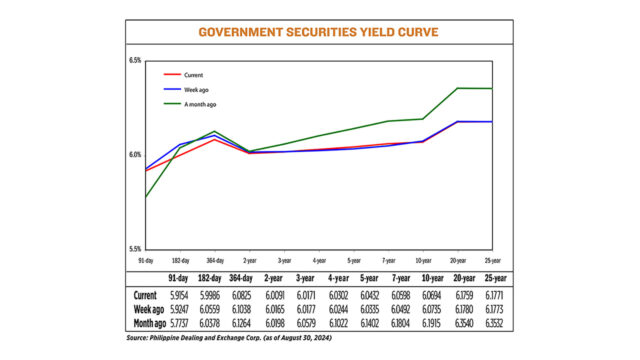
GS yields, which move opposite to prices, went down by an average of 0.69 basis point (bp) week on week at the secondary market, according to the PHP Bloomberg Valuation Service Reference Rates as of Aug. 30 published on the Philippine Dealing System’s website.

Rates at the short end of the curve decreased, with the 91-, 182-, and 364-day Treasury bills (T-bills) falling by 0.93 bp, 5.73 bps and 2.13 bps to fetch 5.9154%, 5.9986% and 6.0825%, respectively.

At the belly, yield movements were mixed, as the two- and three-year Treasury bonds (T-bonds) saw their rates decline by 0.74 bp (to 6.0091%) and 0.06 bp (6.0171%), respectively, while the four-, five-, and seven-year papers climbed by 0.58 bp (6.0302%), 0.97 bp (6.0432%) and 1.06 bps (6.0598%), respectively.

Lastly, tenors at the long end saw their rates fall across the board. The 10-, 20-, and 25-year T-bonds slipped by 0.41 bp, 0.21 bp and 0.02 bp to fetch 6.0694%, 6.1759%, and 6.1771%.

Total GS volume traded reached P16.01 billion on Friday, lower than the P43.32 billion recorded on Aug. 30.

“Local yields slightly declined over the week as local participants have firmed their expectations of a September US Federal Reserve rate cut following dovish guidance from Fed Chair Jerome H. Powell during the Jackson Hole Symposium,” the first bond trader said in an e-mail.

“While market participants welcomed this clear dovish signal from the Fed, local participants remained on the sidelines ahead of further key US economic data on the second reading of US gross domestic product growth and the Fed’s preferred inflation gauge,” the first trader added.

The second bond trader said GS yields mostly moved sideways last week amid a lack of trading drivers.

“We saw good two-way interest — players building up their positions while others were taking profit,” the second bond trader said in a Viber message.

US consumer spending increased solidly in July, suggesting the economy remained on firmer ground early in the third quarter and arguing against a half-percentage-point interest rate cut from the Fed this month, Reuters reported. The report from the Commerce Department on Friday also showed prices rising moderately last month, curbing inflation.

Consumer spending, which accounts for more than two-thirds of US economic activity, rose 0.5% last month after advancing by an unrevised 0.3% in June, the Commerce department’s Bureau of Economic Analysis reported.

On the other hand, the personal consumption expenditures (PCE) price index rose 0.2% in July after an unrevised 0.1% gain in June, the report also showed. In the 12 months through July, the PCE price index increased 2.5%, matching June’s gain.

For this week, GS yield movements will be driven by August Philippine headline inflation data to be released on Sept. 5 (Thursday), both traders said.

“Yields are likely to move lower amid a potential reversion of domestic inflation towards the BSP (Bangko Sentral ng Pilipinas) target and expectations of subdued readings on the US labor market in August,” the first trader said.

The second trader said the August consumer price index (CPI) report “would provide additional information on how many cuts the BSP can deliver until end of year.”

A BusinessWorld poll of 15 analysts yielded a median estimate of 3.7% for the August CPI, within the BSP’s 3.2-4% forecast for the month. If realized, this would be slower than the nine-month high of 4.4% in July, which also marked the first time since November 2023 that headline inflation exceeded the BSP’s 2-4% goal. This would also be below the 5.3% print recorded in August 2023.

The BSP last month cut benchmark interest rates for the first time in almost four years amid an improving inflation and economic outlook, with its governor signaling at least one more reduction before the end of the year.

The Monetary Board on Aug. 15 reduced its policy rate by 25 bps to 6.25%.

BSP Governor Eli M. Remolona, Jr. said they could cut rates by another 25 bps within the year. The Monetary Board’s remaining policy-setting meetings this year are on Oct. 17 and Dec. 19. — Lourdes O. Pilar with Reuters

Mindful consumption: A closer look at SM’s green retail initiative

The retail industry, once equated with consumption and unabated waste, is experiencing significant transformation. Today, there is a growing consciousness among vigilant consumers about the industry’s environmental impact and social responsibility. As observed in recent years, this shift is not merely a trend but is fast becoming necessity, driven by evolving consumer preferences, regulatory pressures, and the urgent need to protect the environment and the planet. The need for a more sustainable future is real and a felt need among consumers.

Central to a more sustainable retail is the idea of a circular economy — a system focused on eliminating waste and keeping products and materials continue to be in use and useful. This approach contrasts sharply with the traditional “take, make, dispose” model of past retail regime. By embracing circular principles, retailers can significantly reduce their environmental impact, conserve resources, and unlock new economic opportunities.

And fortunately, the retail industry is taking heed of this global call to change its old business practices. Sustainability is no longer just a buzzword; it’s becoming an integral part of global retail practices. As we can observe, businesses are beginning to adopt these sustainable methods not only to reduce their environmental footprint but also to meet the increasing demand for eco-friendly products.

In the Philippines, an exemplary example of an initiative that promotes circularity is the collaboration between SM Store’s green retail initiative “Green Finds,” and Zarah Juan, a well-known artisanal designer and social entrepreneur. Together, they repurposed used tarpaulins from SM Store into tote bags and pouches, promoting a circular economy while empowering local communities and setting a strong example for sustainable retail practices.

The partnership between SM Green Finds and designer Zarah Juan is a highly commendable project that transforms discarded tarpaulins — once seen as garbage or waste — into stylish and functional tote bags and pouches. This green initiative is giving new life to waste materials even as it showcases the potential of retail to drive positive social impact by providing employment opportunities for marginalized communities.

THE CIRCULAR ECONOMY: TURNING WASTE INTO VALUE
The concept of circular economy is not very difficult to understand: it is an economic system that is aimed to reduce waste and make the most out of existing resources. Unlike the traditional linear economy, which follows a “take, make, dispose” model, the circular economy emphasizes reuse, repair, refurbishment, and recycling. The SM Green Finds x Zarah Juan tarp project is a very good example of illustration of this concept: the initiative made use of 34,000 square feet of used tarpaulins to produce reusable shopping bags. This effort not only diverts waste from landfills but also conserves resources by reducing the need for new materials, thus lowering the environmental impact.

The success of this project lies in its ability to combine sustainability with aesthetic appeal — which to some may be difficult but this project is proving this to be otherwise. With dedication and full intent to protect the environment through circularity, wastes can be made into something not just beautiful but also functional for reuse of all. As the product of this initiative shows, the bags are not just functional; they are also fashionable, demonstrating that eco-friendly products can be both desirable and commercially viable. One thing is for sure: by making sustainable choices attractive to consumers, businesses can encourage a broader shift toward conscious consumption.

EMPOWERING COMMUNITIES THROUGH SUSTAINABLE PRACTICES
Sustainability in retail goes beyond environmental concerns — it also encompasses the adoption and promotion of social value — a good indicator of positive social performance and a clear example of transformative social investment. The partnership between SM Green Finds and Zarah Juan is a clear example of the retail giant’s social investment because it provides additional livelihood and income to nearly 100 women, including independent artisans and people deprived of liberty (PDL) in Quezon City. This initiative is especially meaningful for the PDLs because they do not just gain valuable artistic and economic skills but can also ensure a more positive future when they are fully reintegrated to society. According to Quezon City officials, the project is giving more than 30 female PDLs a renewed sense of purpose and dignity.

Clearly, the SM Green Finds x Zarah Juan project demonstrates how retail can contribute to social upliftment by creating job opportunities for marginalized communities. This collaboration underscores the power of partnerships in driving systemic change within the industry.

DESIGN WITH PURPOSE AND LONGEVITY
As current practice shows, sustainable product design involves more than just using eco-friendly materials. More than anything else, it also requires creating items that are functional, attractive, and durable. And this is embodied in the tote bags designed by the SM Green Finds x Zarah Juan tarp project. Armed with a vision, a passion and a lot of creativity, Juan did not just focus on longevity and enduring appeal, she also ensured that these bags serve a practical purpose with the goal of encouraging consumers to adopt a more sustainable lifestyle. This philosophy challenges the culture of fast fashion and disposable goods, encouraging consumers to invest in items with a longer life cycle.

Retailers also have the opportunity to create significant social impact: the SM Green Finds x Zarah Juan tarp project is an excellent example of this as proceeds from the bag sales supports the SM Foundation’s youth and education initiatives. This not only furthers education but also reinforces the idea that sustainability is about a broader commitment to social responsibility.

THE ROLE OF CONSUMER SUPPORT
Consumer patronage is vital for the success of any sustainable initiative. Retail businesses can generate and promote this support through transparent sustainability practices. The SM Green Finds x Zarah Juan tarp project did this effectively, communicating the environmental and social advantages of their products. By purchasing these bags, consumers contribute to waste reduction, support local artisans, and help fund education initiatives. This empowers consumers to make informed choices that align with their values.

The shift towards sustainability in retail is not only necessary but also beneficial for businesses, consumers, and the environment. Projects like SM Green Finds x Zarah Juan show how businesses can embrace sustainable practices that promote a circular economy, empower communities, and drive social impact. By repurposing materials, supporting local artisans, and raising consumer awareness, retailers can play a crucial role in creating a more sustainable future. As more businesses adopt these practices, the collective impact could lead to significant positive changes for the economy and society.

While the SM Green Finds x Zarah Juan project is a highly commendable initiative, it is also important to recognize that sustainability is a complex challenge that requires multifaceted and multi-sectoral approach. For one, retailers must address various aspects of their operations, including sourcing materials, packaging, and waste management. This involves reducing carbon emissions, minimizing water usage, and promoting ethical labor practices.

As in all sustainability initiative, transparency and accountability are also crucial, as consumers increasingly demand information about the sustainability of their purchases. Retailers need to be more proactively open about their supply and value chains, environmental impact, and social performance. By providing clear and credible information, businesses can build trust with consumers and enhance their reputation. But it is also accepted truism that transitioning to a more sustainable retail is fraught with some challenges. Implementing new practices often requires substantial investments in research, supply chain management, and employee training, and sometimes social acceptability. While some consumers may be willing to pay more for sustainable products, others are not; thus, it has become imperative for retail businesses to constantly communicate the value of sustainable lifestyle, products and practices. Moreover, businesses also need to ensure that these sustainable products remain accessible to a wider audience.

Overcoming these challenges requires collaboration among governments, businesses, and consumers. Policy makers can support the transition by providing incentives for sustainable practices, investing in research, and establishing clear regulations. Businesses can lead by example, demonstrating the business case for sustainability. Consumers, armed with information, can make conscious choices and support retailers committed to sustainability.

But at the end of the day, the long-term benefits of adopting sustainable practices outweigh the costs. By embracing sustainability, retailers can mitigate risks, improve brand image, and attract environmentally conscious consumers.

Today, the retail industry stands at a crossroads: the choices and decision points for retail businesses, consumers and other pertinent stakeholders are very clear: either continue with the unsustainable practices of the past or embrace a future defined by circularity, social responsibility, and environmental stewardship.

Indeed, the SM Green Finds x Zarah Juan tarp project is a clear example of how retail business can help manage environmental degradation and social inequality. The project is a proof point that sustainability can be a powerful driver and promoter of innovation, job creation, and community development. And as consumers become increasingly aware of the environmental and social impact of the goods and services they buy, retailers that embrace and promote sustainable business will surely gain a competitive advantage.

Clearly and understandably, the future of retail lies in circularity, transparency, and social responsibility. By adopting sustainable practices, retailers can not only contribute to a healthier planet but also build stronger, more resilient businesses. The SM Green Finds x Zarah Juan tarp project is a compelling case study that inspires us to imagine a future where consumption is aligned with conservation.


Dr. Ron F. Jabal, APR, is the CEO of PAGEONE Group (www.pageonegroup.ph) and founder of Advocacy Partners Asia (www.advocacy.ph).

ron.jabal@pageone.ph

rfjabal@gmail.com

Loan growth expansion propelled bank stocks in Q2

By Charles Worren E. Laureta

LISTED BANKS grew in the second quarter as bank lending continued to grow despite high interest rates.

Loans might even grow more thanks to lower borrowing costs, but banks’ net interest margins could potentially take a hit in the medium term, analysts said.

The Philippine Stock Exchange index (PSEi) dropped by 7.1% quarter-on-quarter basis at the end of the second quarter of 2024, a turnaround from the 7% growth in the first quarter. Year on year, PSEi slipped by 0.9%. 
 

This was reflected by the financials subindex, which included the banks, as it inched down by 5.4% last April-to-June period. This was a reversal from the 17% growth in the previous quarter.

Year on year, the subindex increased by 4.2%.

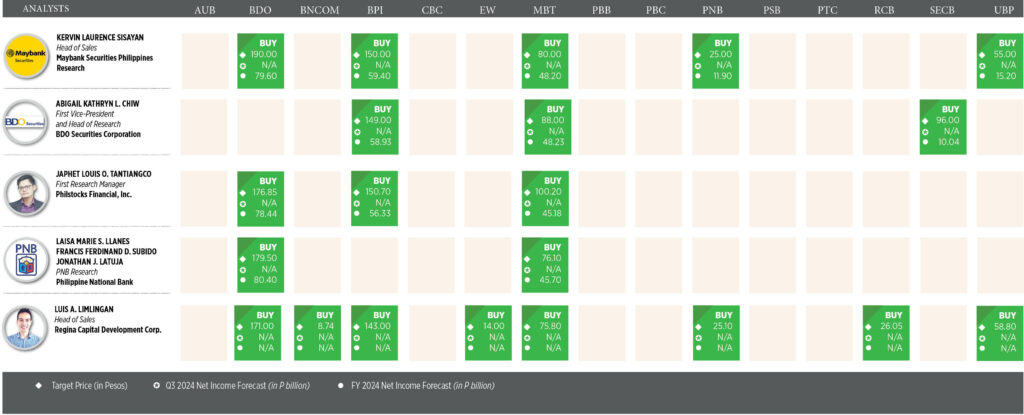
Despite this, the second quarter saw nine out of 15 listed banks’ stock prices grow on a quarter-on-quarter basis. The Philippine Trust Co. led with a 39.8% increase in its share price from P85.00 in the first quarter, followed by Philippine National Bank (PNB, 11.4%), Asia United Bank (10.2%), and China Banking Corp. (9.6%)

On the other hand, five listed banks saw their share prices decrease in the second quarter.

Union Bank of the Philippines led the losers with a 23.7% decline in its share price quarter on quarter, followed by BDO Unibank, Inc. (-17%), Philippine Bank of Communication (-16.8%), Security Bank Corp. (SECB, -8.3%), and Rizal Commercial Banking Corp. (-1.1%).

Moreover, the share price of the Philippine Business Bank steadied at P8.90 apiece in the second quarter.

“The performance of listed banks in second quarter was shaped by a high-interest rate environment that supported net interest margins (NIMs), modest loan growth, stable asset quality, ongoing digital transformation efforts, and external factors like currency fluctuations,” Luis A. Limlingan, head of sales at Regina Capital Development Corp., said in an e-mail.

Last August, the Bangko Sentral ng Pilipinas (BSP) cut the interest rates by 25 basis point (bps) to 6.25% for the first time in nearly four years, marking the start of what BSP Governor Eli M. Remolona, Jr. referred to as “calibrated” easing cycle amid an improving inflation and economic outlook.

Prior to the cut, the central bank kept its policy rate at an over 17-year high of 6.5% for six straight meetings following cumulative hikes worth 450 bps between May 2022 and October 2023 to combat inflation.

PNB Research traced the listed bank’s performance during the second quarter to loan growth.

“Compared to the single-digit expansion that they saw last year, the big 3 banks all posted loan growth in the low to mid-teens. This allowed them to keep net interest income growth at double digits despite stable NIM,” PNB said in an e-mail.

Outstanding loans by universal and commercial banks, net of reverse repurchase (RRP) placement with the central bank, climbed by 10.1% year on year to P12.09 trillion in June, latest data from the BSP showed.

This was the fastest loan growth expansion since the 10.2% growth in March 2023.

Likewise, the gross total loan portfolio of these big lenders increased by 11.9% to P13.25 trillion as of end-June from P11.84 trillion a year ago.

As of end-June, interest income of the big banks grew by a fifth to P645.47 billion from P538.34 billion last year.

The aggregate net income of universal and commercial banks, meanwhile, increased by 5.3% to P178.91 billion as of end-June from P169.92 billion last year.

Provision for credit losses by these big banks reached P42.84 billion in the first half, up by 26.7% from P33.81 billion a year ago.

The big banks’ NIM — a ratio that measure banks’ efficiency in investing their fund by dividing annualized net interest income to average earning asset — increased to 4.04% in the second quarter from 3.74% recorded in the same period a year ago.

BANK STOCK PICKS
Analysts said that market players should track the developments in banks loans’ growth of the listed banks in the near term amid the policy rate cut of the BSP.

“Investors should continue to monitor banks’ loan growth amid the policy rate decisions of the BSP. Although the central bank recently cut the RRP (reverse repurchase) rate by 25 bps, the banks are confident that they can maintain stable NIM. Moreover, the relative lower cost of borrowing can spur additional loan growth,” PNB Research said.

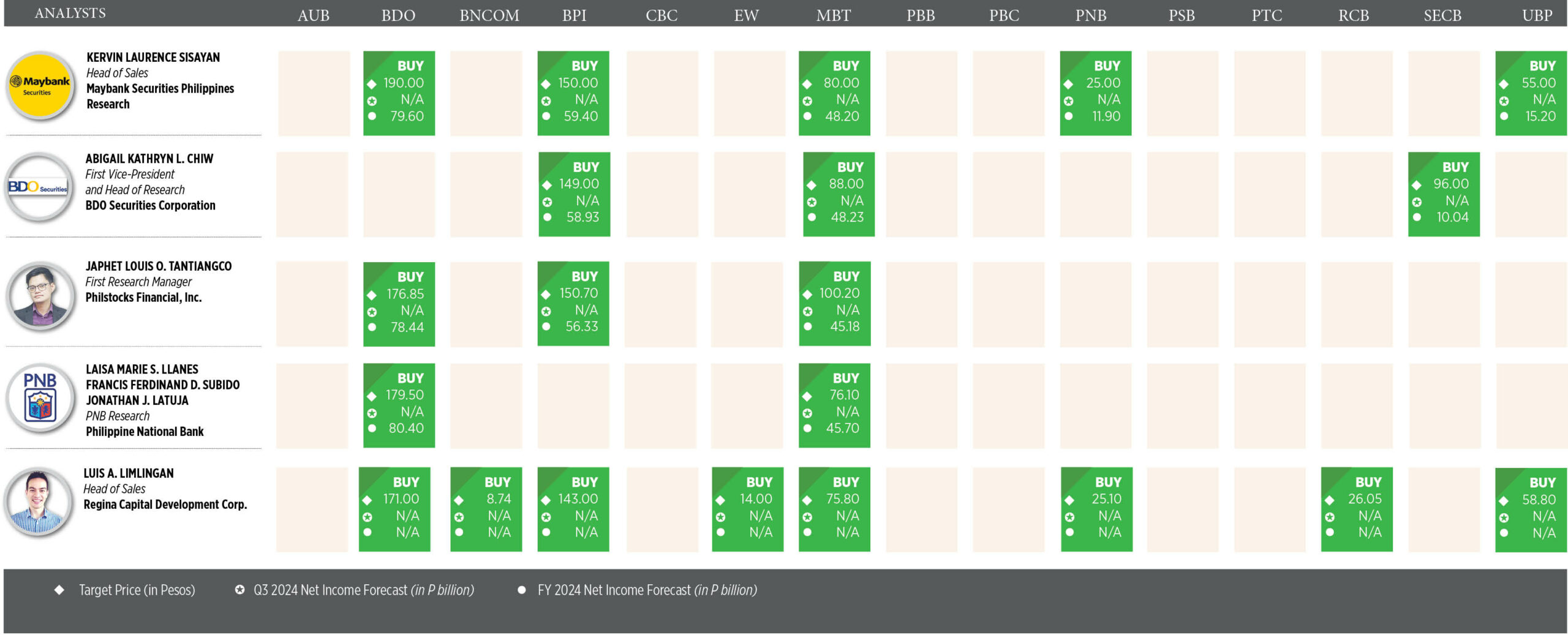
Meanwhile, Japhet Louis O. Tantiangco, research manager at Philstocks Financial, Inc., said that market players should look into how the banks would capitalize on the lowered borrowing cost.

“While the policy easing will bring interest rates down, it would also make borrowing more enticing which would mean more transaction volumes for the banks, all other things being equal. The lower interest rates will also mean easier debt servicing which in turn could lower our banks’ nonperforming loans,” Mr. Tantiangco said in an e-mail.

“BPI and SECB stood out amongst other banks after reporting very high loans growth of 18-19% which is faster than industry loan growth and their peers,” Kervin Laurence Sisayan, head of research at Maybank Securities Research-Philippines, said in an e-mail.

For Mr. Limlingan, BDO excelled with robust growth in interest and non-interest income, which is supported by its broad branch network and digital strengths, while BPI benefited from small medium enterprises loans and strong corporate banking.

RATE CUT
With the recent reduction of the interest rate, analysts said it may lower the lending margins and interest income.

Mr. Remolona already signaled that they could cut the policy rates by 25 bps again within the year. The Monetary Board’s remaining policy-setting meetings this year are scheduled on Oct. 17 and Dec. 19.

BDO Securities Corp. First Vice-President and Head of Research Abigail Kathryn L. Chiw said that rate cuts are seen to potentially limit net interest income growth and trim lending margins, which may incite some profit taking in banking stocks.

“The impact of rate cuts to margins may also be compensated for by stronger loan growth and lower provisioning costs, as borrowing costs and nonperforming loans risks go down,” she said in an e-mail.

On the other hand, Mr. Limlingan said that while lower rates might reduce interest income, banks diversified revenue, solid digital platforms, and strong retail focus could mitigate its impact.

“Expected BSP rate cuts could compress NIMs but may boost loan demand, particularly in interest-sensitive sectors,” he said.

On the other hand, PNB Research said that if the central bank decides to implement further rate cuts in the future, it may start affecting the banks’ NIMs.

“For the rest of the year, we expect that those banks that are able to continually grow their business while controlling expenses would be the ones more favored by investors,” PNB Research said.


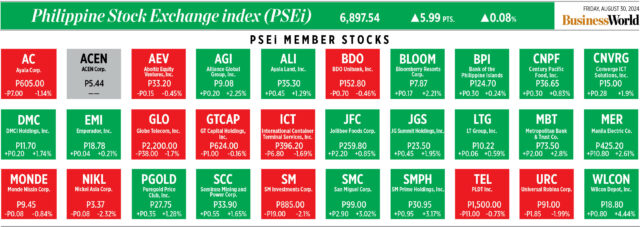
How PSEi member stocks performed — August 30, 2024

Here’s a quick glance at how PSEi stocks fared on Friday, August 30, 2024.


PHL shares may rise before August inflation data

REUTERS

PHILIPPINE SHARES may climb this week as headline inflation likely slowed last month and returned within the Bangko Sentral ng Pilipinas’ (BSP) annual target.

On Friday, the bellwether Philippine Stock Exchange index (PSEi) rose by 0.08% or 5.99 points to end at 6,897.54, while the broader all shares index went up by 0.25% or 9.52 points to close at 3,742.81.

Week on week, the PSEi fell by 0.93% or 64.42 points from its 6,961.96 close on Aug. 22.

“Local equities took a breather after almost a month-long upward move ahead of the August inflation data release [this] week,” online brokerage firm 2TradeAsia.com said in a market note.

“Last week’s trading shows that the local market is having a difficult time getting past its 7,000 resistance level,” Philstocks Financial, Inc. Senior Research Analyst Japhet Louis O. Tantiangco said in a Viber message. “On a positive note, the market has been maintaining its position above its 10-day exponential moving average.”

For this week, Philippine stocks may climb before the release of the August inflation report on Sept. 5 (Thursday), he said.

“The market could move with an upward bias on the back of expectations that the Philippines’ August inflation print would be lower than July’s 4.4%. Confirmation of the said expectations may also somehow give the market a boost on the latter part of the week,” he added.

A BusinessWorld poll of 15 analysts yielded a median estimate of 3.7% for the August consumer price index, within the BSP’s 3.2%-4% forecast for the month.

If realized, this would be slower than the nine-month high of 4.4% in July, which also marked the first time since November 2023 that headline inflation exceeded the BSP’s 2-4% goal. This would also be below the 5.3% print recorded in August 2023.

“Investors are also expected to take cues from other economic data, including the peso’s movement against the dollar, the S&P Global Philippines’ Manufacturing Purchasing Managers’ Index for August, and the Philippines’ labor force figures for July,” Mr. Tantiangco added.

He put the PSEi’s major support at 6,700-6,800.

Rizal Commercial Banking Corp. Chief Economist Michael L. Ricafort said in an e-mail that the market’s resistance is at the 7,000 level, particularly the high of 7,070.72 posted on April 2.

“The underlying upward trend for more than three weeks already remains intact for as long as it remains above the immediate support at 6,635 to 6,705 levels,” he said.

2TradeAsia.com placed the PSEi’s immediate support at 6,800 and resistance at 7,000.

“Two-thirds into the year and at the tail end of the ghost month, the PSEi remained just beneath 7,000. Evolving geopolitical downside risks should provide additional short-term friction on top of supply pressure,” it said. “However, in the long run, lower interest rates mean cash returns are coming back to earth, and ultimately, the excess cash should find their way back home to equities.” — Revin Mikhael D. Ochave

Peso may move sideways as markets eye Fed meet

BW FILE PHOTO

THE PESO may trade sideways against the dollar this week, with markets looking ahead to the US Federal Reserve’s policy meeting after key data released on Friday supported expectations of a rate cut this month.

The local unit closed at P56.111 per dollar on Friday, strengthening by 17.2 centavos from its P56.283 finish on Thursday, Bankers Association of the Philippines data showed.

This was the peso’s best finish in more than five months or since its P56.03-a-dollar close on March 21.

Week on week, the peso appreciated by 22.2 centavos from its P57.333-per-dollar close on Aug. 22.

The peso strengthened against the dollar on Friday after the Bangko Sentral ng Pilipinas (BSP) said inflation likely slowed in August, Rizal Commercial Banking Corp. Chief Economist Michael L. Ricafort said in a Viber message.

Market players also repositioned before the release of the US personal consumption expenditures (PCE) price index data, Security Bank Corp. Chief Economist Robert Dan J. Roces said in a Viber message.

Headline inflation likely settled within 3.2% to 4% last month, the BSP said on Friday.

Philippine headline inflation likely eased in August to return within the central bank’s 2-4% annual target, analysts said.

A BusinessWorld poll of 15 analysts yielded a median estimate of 3.7% for the August consumer price index (CPI), within the BSP’s forecast for the month.

If realized, this would be slower than the nine-month high of 4.4% in July, which also marked the first time since November 2023 that the CPI exceeded the BSP’s 2-4% goal. This would also be below the 5.3% print recorded in August 2023.

Meanwhile, the US PCE price index rose 0.2% in July after an unrevised 0.1% gain in June, the Commerce department said on Friday, matching economists’ forecasts, Reuters reported.

The data looks unlikely to divert the Fed, which tracks the PCE price measures as an inflation gauge for monetary policy, from lowering interest rates by at least 25 basis points (bps) this month.

In the 12 months through July, the PCE price index increased 2.5%, matching June’s gain and beating the 2.6% gain expected by economists polled by Reuters.

The Fed has maintained its policy rate in the current 5.25%-5.5% range for more than a year, having raised it by 525 bps in 2022 and 2023.

Money markets suggest traders mostly expect the Fed to cut rates by 25 bps at its Sept. 17-18 meeting, with odds of a 50-bp cut dimming further after Friday’s data, according to CME Group’s FedWatch Tool.

For this week, Mr. Roces said the peso could be range-bound against the dollar as the market awaits more leads before the Fed’s review.

For his part, Mr. Ricafort expects the peso to retest the P55 level this week and range from P55.80 to P56.30 per dollar. — AMCS with Reuters

US condemns China’s ‘dangerous and escalatory actions’ in ramming event

PHILIPPINE STAR/RYAN BALDEMOR

THE US State Department on Sunday condemned what it called “dangerous and escalatory actions” by the Chinese Coast Guard after its vessel collided with a Philippine Coast Guard vessel three times near Sabina Shoal on Saturday.

“The People’s Republic of China’s (PRC) unlawful claims of “territorial sovereignty” over ocean areas where no land territory exists, and its increasingly aggressive actions to enforce them, threaten the freedoms of navigation and overflight of all nations,” spokesman Matthew Miller said in a statement on Sunday.

“The United States reiterates its call for the PRC to comport its claims and actions with international law and to desist from dangerous and destabilizing conduct,” it added.

The Chinese Embassy in Manila did not immediately reply to a Viber message seeking comment.

The US said the incident, which was the second confrontation between the Philippines and China at the shoal in days, damaged Manila’s vessel and jeopardized the safety of Filipinos aboard the ship.

Washington also reaffirmed its Mutual Defense Treaty with the Manila, which requires it to defend the Philippines in case of an armed attack on its forces, public vessels or aircraft in the South China Sea.

The Australian Embassy in Manila said Canberra shares Philippine concerns about China’s “destabilizing behavior at Sabina Shoal in the South China Sea.” “Repeatedly ramming vessels is unacceptable and dangerous. All countries must comply with international law. The 2016 arbitral award is binding on its parties,” it said in an X post.

The New Zealand Embassy in a statement said China’s “ramming” act was “profoundly troubling and fits a recent pattern of dangerous and destabilizing actions in the region.”

In a statement at the weekend, Chinese Coast Guard spokesperson Liu Dejun said China was exercising “indisputable sovereignty” at the shoal, adding Manila had acted in an “unprofessional and dangerous” manner.

Philippine Coast Guard spokesman Jay Tristan Tarriela on Saturday said Beijing’s vessel “directly and intentionally” rammed the BRP Teresa Magbanua. The Chinese vessel hit its port bow, starboard quarter and port beam.

The Philippine ship’s bridge wing and freeboard were also damaged, he said in an X post.

Speaker Ferdinand Martin G. Romualdez said it is high time for the Philippines to “consider stronger measures.” “We should enhance our presence in the West Philippine Sea, reinforce our alliances and ensure that our capabilities are sufficient to protect our sovereign rights,” he said in a statement, referring to parts of the South China Sea within the Philippines’ exclusive economic zone.

In a separate statement, Senator Jose “Jinggoy” P. Estrada, Jr. urged the government to raise these incidents to international courts and hold China accountable for its aggression.

“Our government has sufficient basis to take immediate and decisive legal action to hold China accountable for its increasingly aggressive actions,” he said.

“They have repeatedly endangered the lives of our brave men and women Coast Guard personnel and violated international maritime laws and sovereign rights,” he added.

Meanwhile, the National Maritime Council (NMC) on Saturday evening vowed to deter any aggressive acts at sea while using diplomatic channels.

“As directed by the President, the Philippines will fully utilize and continue to pursue diplomatic channels and mechanisms under the rules-based international order and pursue the peaceful resolution of disputes,” it said in a statement.

UNCALLED FOR
The agency said the Philippines would “not succumb to acts of harassment and aggressive behavior.”

The Philippine ship has near Sabina Shoal since mid-April, amid China’s alleged dumping of dead corals at the atoll to alter its elevation.

Sabina, which is 140 kilometers off the Philippine island of Palawan, has been a staging ground for resupply missions for Filipino troops at Second Thomas Shoal.

“China’s latest actions are uncalled for as the Philippine vessel was engaged in a peaceful and lawful patrol within its own maritime jurisdiction,” the Philippine maritime council said.

Samuel Paparo, commander of the United States Indo-Pacific Command, told a forum last week it was an “entirely reasonable option” for United States vessels to accompany Philippine resupply missions, though that would require consultation between the treaty allies.

Senate President Francis “Chiz” G. Escudero earlier said an escort arrangement would likely deter Chinese aggression.

Last week, Manila’s South China Sea task force accused Chinese vessels near Sabina Shoal of ramming and using water cannons against a Philippine fishery vessel transporting food, fuel and medicine for Filipino fishermen.

Beijing has pressed its claim to the disputed conduit for more than $3 trillion of annual ship-borne commerce, while Manila has kept up supply missions, particularly those to a beached naval ship at the hotly contested Second Thomas Shoal.

In 2016, an international arbitration court ruled that China’s claim was illegal, in a landmark victory for the Philippines, which filed the lawsuit, Beijing has rejected the decision.

Last month, the Philippines and China agreed on a “provisional arrangement” for resupply missions to Filipino troops at Second Thomas Shoal, after trading blame on raising tensions in the waterway.

Both countries also agreed to set up new lines of communication to improve their handling of sea disputes after resuming talks on easing growing tensions, the Department of Foreign Affairs said last month. — J.V.D. Ordoñez and K.A.T. Atienza

Senate’s CREATE MORE bill could open doors to fuel smuggling — IBON

BW FILE PHOTO

By John Victor D. Ordoñez, Reporter

THE SENATE version of the Corporate Recovery and Tax Incentives for Enterprises to Maximize Opportunities for Reinvigorating the Economy (CREATE MORE) bill, which allows value-added tax (VAT)-free importation of fuel for international carriers, could worsen oil smuggling, an economist said.

“Apart from creating even more liberal opportunities for smuggling, it is a revenue loss in itself, just when the government should be earning more to finance so many needed interventions, as well as a bias against domestic carriers,” IBON Foundation Executive Director Jose Enrique “Sonny” A. Africa said in a Viber message at the weekend.

“Creating a more productive work force and favorable domestic industrial ecosystem is a much more development-oriented approach for competitiveness than mere fiscal incentives,” he added

Albay Rep. Jose Maria Clemente “Joey” S. Salceda, who heads the House of Representatives ways and means committee, last week cited the clause as one of the priority measure’s flaws that needed to be corrected at a bicameral conference committee.

Senator Sherwin T. Gatchalian, who sponsored Senate Bill No. 2762 or the CREATE MORE bill, did not immediately reply to a Viber message seeking comment.

The measure, which is in the period of amendments at the Senate, exempts international carriers from paying VAT on imported fuel, goods and supplies used for international shipping or air transport operations.

“We vehemently object to this,” Mr. Salceda said in a statement on Thursday. “Such products will not be fuel-marked when imported, so the Senate proposal will confuse law enforcement as to the provenance of unmarked fuel.”

He added that the smuggled products from Customs-bonded warehouses had cost the government about P357 billion in foregone revenues from 2010 to 2019.

“We cannot agree to something we have already found in our own investigations to be a policy that creates and allows smuggling,” the congressman said.

The Senate is likely to approve the measure on second and third reading this week, Senate President Francis “Chiz” G. Escudero told a news briefing last week. The House passed its version of the bill on final reading in March.

“When crafting the CREATE MORE bill, senators should consider factors such as the potential impact on government revenue, the competitiveness of the tax rates compared with neighboring countries, and the specific needs of different industries,” Jonathan L. Ravelas, senior adviser at professional service firm Reyes Tacandong & Co., said in a Viber message.

The bill lowers income taxes on domestic and foreign companies to 20% from 25% and removes VAT on goods and services in essential areas such as janitorial, security, financial consultancy, marketing and human resources.

Registered business enterprises will also be subject to a 2% local business tax based on their gross sales, while giving these companies 100% additional deduction on power expenses incurred in a taxable year to address high power costs.

The measure also allows local companies to implement a work-from-home setup for up to 50% of their workforce to cut costs.

It also transfers the responsibility of processing VAT refund claims to the Department of Finance from the Bureau of Internal Revenue (BIR) to reduce delays.

“Fairness can be maintained by ensuring that the benefits of tax reductions are equitably distributed across various sectors and business sizes,” Mr. Ravelas said.

“Ensuring fiscal sustainability involves balancing tax cuts with measures to prevent revenue loss, such as broadening the tax base or improving tax compliance,” he added.

Philippine agents arrest 162 foreigners at Cebu POGO

PHILSTAR FILE PHOTO

PHILIPPINE authorities arrested more than 160 foreign nationals at an illegal offshore gaming hub in the central city of Lapu-Lapu at the weekend, according to a presidential task force.

The Presidential Anti-Organized Crime Commission (PAOCC) said its raid of a property of Tourist Garden Hotel in Lapu-Lapu City, Cebu province stemmed from the request of the Indonesian Embassy to rescue eight of their nationals who were being held against their will by the POGO operator.

Authorities arrested 162 foreign nationals working at the alleged scam farm, including 83 Chinese, 70 Indonesian, two Taiwanese, six Burmese and a Malaysian, during the raid on Saturday, the PAOCC said in a statement.

It said five Filipino workers engaged in scamming activities were also found.

“Six of the said [Indonesian] human trafficking victims were rescued, while 162 foreign nationals were caught in the act of engaging in scamming activities,” PAOCC said.

It said the POGO hub had three different scam work areas upon inspection.

“The different operating units are currently conducting an inventory of the place in preparation for the application of a warrant to search and examine computer data,” it said.

The arrested foreigners were brought to Manila “to face inquest proceedings for violation of immigration laws,” it added.

POGOs, which mainly cater to Chinese markets, have been a major headache for the government, so much so that President Ferdinand R. Marcos, Jr. ordered their ban in July.

Congress under his predecessor Rodrigo R. Duterte passed a law taxing POGOs to legalize them, despite concerns about their social costs. Chinese President Xi Jinping had asked him to ban them.

Mr. Marcos said in his third address to Congress POGOs have been “disguising” as “legitimate entities,” but their operations have ventured into illicit areas, linking them to financial scams, money laundering, prostitution, human trafficking, kidnapping, brutal torture and “even murder.” — Kyle Aristophere T. Atienza

VP’s secret fund use not sufficient for impeachment

PNA PHOTO BY ALFRED FRIAS

By Kenneth Christiane L. Basilio and Chloe Mari A. Hufana, Reporters

THE UNACCOUNTED P73-million spending of the Office of the Vice-President’s (OVP) 2022 confidential and intelligence funds (CIF), flagged by the Commission on Audit (CoA), is not yet sufficient as grounds for impeachment, a constitutional law expert said.

It, however, potentially opens Vice-President (VP) Sara Duterte-Carpio to litigation, according to Michael Henry Ll. Yusingco, a senior research fellow at the Ateneo Policy Center, noting that vice presidents are not immune from legal action.

“[It is] not yet a ground for impeachment,” he told BusinessWorld in a Facebook Messenger chat at the weekend.

In a CoA report made public last week, state auditors said they cannot account for the P73.3 million expenditure of the OVP’s P125-million secret fund in 2022, citing lack of documentation supporting the spending. The OVP reportedly spent the P125 million within 11 days, generating controversy among the public.

Party-list Rep. France L. Castro said last week that the OVP’s utilization of CIF could be grounds for impeachment. Talks of the Vice-President’s impeachment also started to surface after Ms. Duterte-Carpio revealed in her opening statement that there were ongoing efforts to plot her ouster.

Edmund Tayao, president of Political Economic Elemental Researchers and Strategists, said in a separate Viber message that the Constitution provides for many possible grounds for impeachment, and that “the CoA findings, especially when not addressed, is a considerable ground.”

The OVP’s proposed 2025 budget snag at the House of Representatives shows a “complete breakdown of relations between the vice president and the administration,” he added.

The OVP has proposed a P2-billion budget for next year, according to the 2025 National Expenditure Program, 7% lower than the OVP budget in the previous year.

“The increases in the budget of OVP since 2022 is largely due to various programs that duplicate existing programs and projects of other departments,” Zy-za Nadine M. Suzara, a public budget analyst and former executive director of policy think tank Institute for Leadership, Empowerment, and Democracy, said in a Viber message. 

The OVP did not immediately reply to an e-mail seeking comment.

LACKS RESPECT
Ms. Duterte-Carpio made headlines last week for not answering intelligently in the same budget hearing, repeating a script that avoided answering the inquiries of congressmen on her over P2-billion 2025 budget.

Federation of Free Workers (FFW) President Jose Sonny G. Matula sounded the alarm over the Vice President’s refusal to defend her office’s 2025 spending plan, which could reflect her lack of respect to the public.

He said failure to prepare for a budget hearing sends a message that may be interpreted as a lack of respect for taxpayers and their hard-earned contributions to the nation’s coffers.

“As a lawyer, the Vice-President should be well aware of the importance of preparation, much like preparing for a court case,” he told BusinessWorld in a Viber message at the weekend.

“A congressional budget hearing is no different… These hearings are not just routine bureaucratic procedures but critical platforms for ensuring that the people’s money is appropriated wisely and transparently,” he added.

Mr. Matula said every peso should be accounted for in public funds, citing that public money should be allocated to projects or activities that serve Filipinos.

He likened Ms. Duterte-Carpio to a “bird parroting lines than a prepared and thoughtful leader, raising concerns about her readiness and dedication to the role.”

In a separate interview, Leonardo A. Lanzona, Jr., an economics professor at the Ateneo de Manila University, said the OVP must answer two questions to the public.

“What are these public goods and how are they going to help society in general? It is up to Congress and the Department of Finance (DoF) to explain to the public how these [will be] financed,” he told BusinessWorld in a Facebook Messenger chat.

“Hence, the OVP has to help Congress in identifying what these public goods [are] and why these are worth funding.”

He added that if public goods do not produce what is expected of them, the DoF will scrap and replace them with more effective programs.

“The issue here is the sustainability of public goods which the government produces.  These are not going to be funded by the private sector, and the financing of these goods [has] to come from taxes paid by the public.”

Tropical depression forms in Samar

PAGASA.DOST.GOV.PH

THE LOW-PRESSURE AREA (LPA) near Eastern Visayas has intensified into a tropical depression (TD), the state weather bureau reported on Sunday.

In a bulletin, the Philippine Atmospheric, Geophysical and Astronomical Services Administration (PAGASA) said that TD Enteng was packing maximum sustained winds of 45 kilometers per hour (kph) near the center and gustiness of up to 55 kph.

The weather bureau said that Enteng may reach tropical storm category by Monday, Sept. 2.

“On the forecast track, a landfall and passage over the localities in Bicol Region and Eastern Visayas area is not ruled out within the next 48 hours,” PAGASA said.

As of 11 am the TD was last seen 120 kilometers (km) north northeast of Borongan City, Eastern Samar or 150 km east of Catarman, Northern Samar.

PAGASA had hoisted Tropical Wind Signal no. 1 over the eastern portion of Camarines Sur, Catanduanes, Albay, Sorsogon, Burias Island, and Ticao Island.

Signal no. 1 was also issued in Northern Samar, Samar, Eastern Samar, Biliran, and the northeastern portion of Leyte. — Adrian H. Halili

ADVERTISEMENT
ADVERTISEMENT